Champagne Escapes, Machinery Doesn’t: The US Targets 14 Economies With Tariffs of Up to 35% | Market Outlook | 26 Nov 2026
Market Outlook | Thursday 26 November 2026
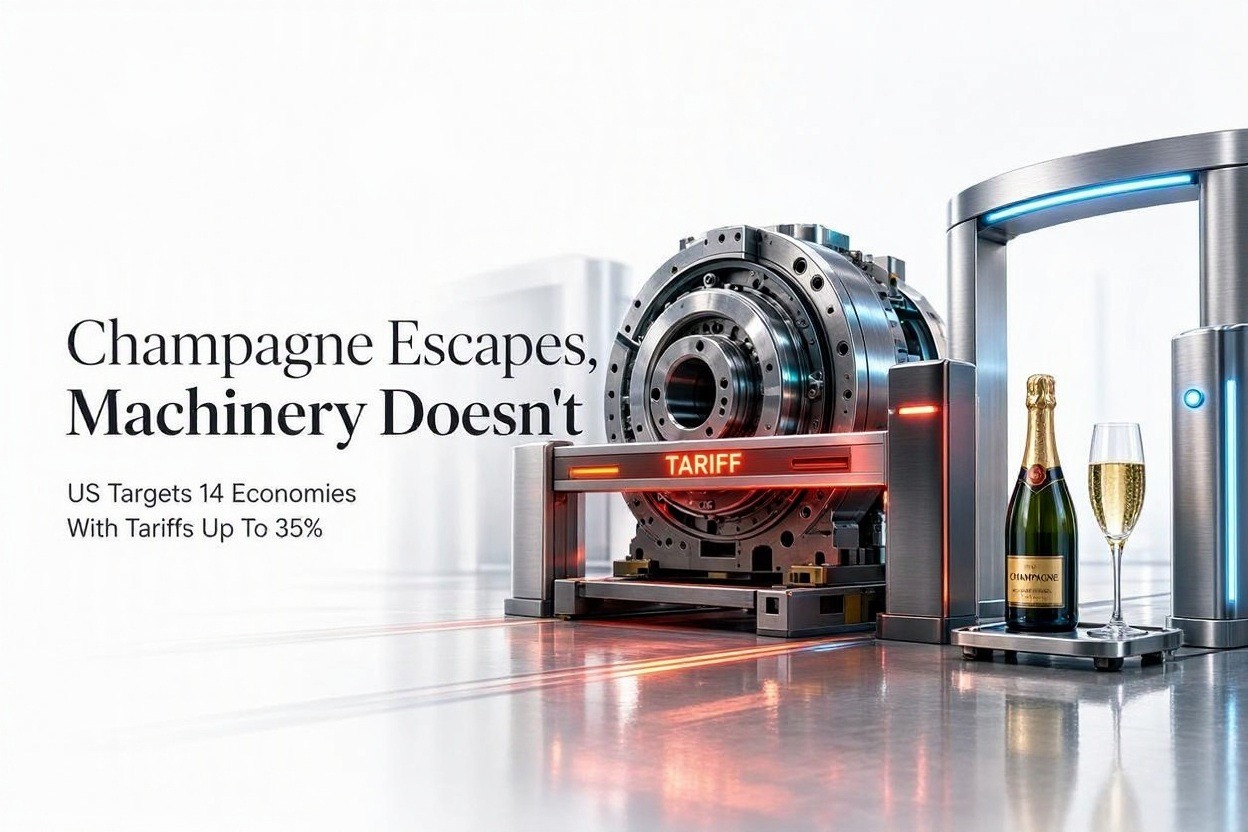
Champagne Escapes, Machinery Doesn’t: The US Targets 14 Economies With Tariffs of Up to 35%
14 economies, 15%-35% proposed Comments due 5 Jan 2027 US-China truce ends 10 Jan Public hearing 25 Jan
Market sentiment, next five sessions Cautious Relief rally, but China talks hold the key
- EU and Japan
- 15%
- Up to 20% if talks fail
- China
- Up to 20%
- Up to 40% if talks fail
- Euro Stoxx 50 today
- +2.17%
- After -1.82% on Wednesday
- Highest proposed rate
- 35%
- Vietnam, or 20% with a trade deal
Overview
Washington delivered an early holiday surprise on 25 November. The Office of the US Trade Representative proposed new tariffs on 14 economies it accuses of building “structural excess capacity” in manufacturing, after a review of more than 1,000 public comments and nearly 140 witnesses. The menu runs from 15% for the European Union, Japan, Korea, Switzerland and Taiwan to up to 20% for China, 25% for India and 35% for Vietnam, with a higher price for anyone whose talks disappoint. The small print is kinder than the headline: rates include duties already paid, cars, chips and steel are excluded for most, and Champagne, Scotch whisky and Christmas lights all made the exemption lists. Markets read it the same way. Asian and European shares fell sharply on Wednesday, then Europe bounced 2.17% today. The real test arrives on 10 January, when the US-China truce expires.
Key highlights
- Status: proposed, final rates expected early 2027
- Most exposed: Vietnam, China, Korea, Taiwan
- Deadline: China truce ends 10 January
The Plan in Brief: Fourteen Economies, One Very Long Shopping List
Section 301 excess capacity tariffs
Risk-off leanHigh impactFinal decision early 2027
- Economies covered
- 14 of 16
- Mexico and Norway still under review
- Base rates
- 15%-35%
- 12 of 14 at 20% or lower
- Comments due
- 5 Jan 2027
- Hearing on 25 January
- US-China truce
- Ends 10 Jan
- China’s alternative rate is 40%
- Excluded goods
- Section 232 items
- Steel, cars, chips, medicines, copper
This is the third tariff chapter of 2026: the Supreme Court struck down the emergency tariffs in February, and 10%-12.5% forced labour tariffs on 60 economies replaced them on 24 July.
Why it matters: the list reads like a map of global manufacturing, from batteries, machinery and chemicals to solar modules, ships and textiles, and it lands in the same month as the China deadline.
Risk-off trigger: a breakdown in US-China talks before 10 January, a Chinese retaliation list, or a move to the alternative rates of up to 40% for China and 25% for Korea and Taiwan.
Risk-on trigger: trade agreements that cut the bill, which the notices already price in: India at 17%, Vietnam at 20% and Singapore at 10%.
Country by Country: Who Pays What, and for Which Products
Each economy received its own notice, its own list of sectors and, in several cases, a list of goods that escape the tariff. Here is the guide, from the most exposed to the least.
China: up to 20%, or 40% if talks fail
Sectors cited: 22 sectors, including aluminium, cars, batteries, semiconductors, steel, textiles, tyres and wind turbines. The twist: China gets no exemption for goods already under Section 232 tariffs, but some listed goods (Annex A) face only 10%, and about $30 billion of consumer goods (Annex B) are exempt: fireworks, toys, Christmas lights, small appliances, plastic tableware and home textiles. Santa’s supply chain, it seems, has friends in Washington.
Market to watch: the yuan at 6.659 per dollar and the Shanghai Composite near 3,477.
Vietnam: up to 35%, or 20% with a deal
Sectors cited: textiles, apparel, footwear, shipbuilding, cement and electronics. The twist: Vietnam faces the highest rate on the list, partly because the notice accuses it of failing to stop goods from other countries being routed through its ports. Trainers and T-shirts are first in line.
Market to watch: US-listed apparel and footwear brands that manufacture in Vietnam.
India: up to 25%, or 17% with a deal
Sectors cited: pharmaceuticals and medical devices, steel, solar and information technology hardware. The twist: India has no alternative rate and no exemption list, only an open invitation to finish a trade agreement. The 8-point discount is the clearest carrot in the entire package.
Market to watch: USD/INR near 92.46 and Indian generic drug makers.
Korea: up to 15%, or 25% if talks fail
Sectors cited: cars, semiconductors and petrochemicals. The twist: cars and chips are already under Section 232 tariffs and therefore excluded, so the new rate lands mostly on petrochemicals and other industrial goods. The threat is the 25% alternative.
Market to watch: the Kospi near 4,711 and the won at 1,343.5 per dollar.
Taiwan: up to 15%, or 25% if talks fail
Sectors cited: electronics, semiconductors and telecommunications equipment. The twist: chips are excluded, but servers, networking gear and electronic assemblies are not. Orchids, seaweed and silk, meanwhile, are on the exemption list.
Market to watch: the Taiex near 39,152.
European Union: 15%, or up to 20% if talks fail
Sectors cited: cars, chemicals and pharmaceuticals. The twist: the 15% matches the cap in the existing EU-US arrangement, cars and patented medicines are excluded, and the exemption list includes Champagne, Irish whiskey, Scotch whisky, cork, silk, pearls and diamonds. Celebrations can continue; machinery and chemicals exporters will be less cheerful.
Market to watch: the DAX near 25,242 and EUR/USD near 1.0960.
Japan: up to 15%, or 20% if talks fail
Sectors cited: cars, steel, semiconductors and optical fibre. The twist: most of the named sectors are already under Section 232 tariffs, so the practical impact falls on machinery, robotics and precision equipment. No exemption list was attached.
Market to watch: the Nikkei near 57,499 and USD/JPY near 159.20.
Switzerland: up to 15%, or 20% if talks fail
Sectors cited: pharmaceuticals, steel and chemicals. The twist: patented medicines are excluded, which spares much of the country’s largest export. Flower bulbs, chicory roots and cork are on the exempt list too.
Market to watch: the Swiss franc, Wednesday’s strongest G10 currency.
Singapore: up to 20%, or 10% with a deal
Sectors cited: electronics and semiconductors, health products and petrochemicals. The twist: a rare case where a deal would halve the rate, giving Singapore one of the strongest incentives to settle quickly.
Market to watch: regional electronics and chemical exporters.
Indonesia, Malaysia, Thailand and Cambodia: up to 18%, or 25%
Sectors cited: Indonesia for textiles, metals and renewable energy; Malaysia for electronics and cars; Thailand for electronics, cars and machinery; Cambodia for apparel, solar and tyres. The twist: the exemption lists are the most colourful in the package, covering palm oil, seaweed, orchids, rattan and, in Cambodia’s case, frog legs and edible insects.
Market to watch: the ringgit, baht and rupiah.
Bangladesh: up to 18%, or 20% if talks fail
Sectors cited: ready-made garments and apparel. The twist: USTR is asking whether a fixed volume of clothing imports could enter at a lower rate, a quota-style option also floated for Cambodia, India and Malaysia. Like China, Bangladesh did not accept consultations.
Market to watch: global apparel retailers’ sourcing costs.
Products Hit and Spared: From Washing Machines to Whisky
The tariff is economy-wide in principle, but the product lists decide who actually feels it. The pattern is clear: industrial and electronic goods are in the line of fire, while goods already taxed under Section 232, and a selection of food, drink and natural products, are spared.
| Product group | Main suppliers named | Status | Market angle |
|---|---|---|---|
| Machinery, robotics, precision equipment | EU, Japan, Thailand | Targeted | European and Japanese industrial shares |
| Electronics, servers, telecom equipment | Taiwan, Vietnam, Malaysia, Singapore | Targeted | Taiex, Asian assembly exporters |
| Chemicals and petrochemicals | EU, Korea, Switzerland, Singapore | Targeted | European chemical makers |
| Textiles, apparel, footwear | Vietnam, Bangladesh, Cambodia, Indonesia | Targeted | US retail and brand margins |
| Batteries, solar modules, wind equipment | China, India, Cambodia | Targeted | Clean energy costs in the US |
| Cars, steel, aluminium, copper, chips, patented medicines | All except China | Excluded | Already under Section 232 tariffs |
| Toys, fireworks, Christmas lights, small appliances | China | Exempt | About $30 billion of goods spared |
| Champagne, Scotch and Irish whisky | European Union | Exempt | European spirits makers |
| Palm oil, seaweed, orchids, cut flowers | Indonesia, Malaysia, Taiwan | Exempt | Goods the US cannot produce at home |
The Real Extra Cost: Why the Headline Rates Look Scarier Than They Are
Most rates are stated “net of” existing duties, so importers pay the gap between the new rate and what they already pay, not the full rate on top. Since 24 July, most of these economies have faced 10%-12.5% under the forced labour tariffs.
- EU and Japan
- +2.5 to +5 pts
- 15% against 10%-12.5% today
- India
- +15 pts
- 25% against 10%, or 17% with a deal
- Vietnam
- Up to 35%
- 20% with a trade agreement
- China if talks fail
- 40%
- Against up to 20% proposed
- Developed economies get off lightly: the EU, Japan, Korea, Switzerland and Taiwan face the smallest increases, and their biggest exports to the US, cars and chips, already sit under Section 232.
- Emerging Asia takes the larger bill: Vietnam, India, Cambodia, Indonesia, Malaysia, Thailand and Bangladesh face the biggest jumps, concentrated in clothing, footwear and electronics assembly.
- China’s maths is still unclear: its rate is net of the July rate, but the notice does not say how it sits alongside the 2018 Section 301 tariffs. China ran a $287.9 billion goods surplus with the US in 2024, so the answer matters.
What Happened Last Time: Tariff Moves in 2026
Markets have learned the routine this year: sell first, read the small print, then buy back part of the loss. Each step produced a sharp first-day fall in Asian technology markets and European shares, followed by a partial recovery within one or two sessions.
| What happened | Date | Impact | Market reaction |
|---|---|---|---|
| 10%-12.5% forced labour tariffs on 60 economies announced | US and Europe | High | Nasdaq 100 -1.87%, Euro Stoxx 50 -1.69%, S&P 500 -1.21% |
| Asia reacts as the tariffs take effect | Asia | High | Kospi -5.72%, Nikkei -2.73%, Taiex -2.67%, Shanghai -1.61% |
| Europe recovers once details are clear | Europe | Medium | Euro Stoxx 50 +1.14%, DAX +1.36% |
| Excess capacity tariffs proposed for 14 economies | Global | High | Taiex -4.80%, Nikkei -2.78%, Shanghai -2.03%, Euro Stoxx 50 -1.82% |
| Relief as the small print sinks in | Global | Medium | Taiex +2.50%, Euro Stoxx 50 +2.17%, DAX +2.18%, Hang Seng +1.19% |
Tariff Shocks in History: The Proposal Is Rarely the Big Day
Since 2018, the first headline has produced a sharp move, but the largest swings came later, when talks either collapsed or a pause was announced.
| What happened | Date | Impact | Market reaction |
|---|---|---|---|
| First Section 301 action against China | Announcement | High | S&P 500 -2.5%, Dow -2.9% |
| Talks break down, yuan falls through 7 per dollar | Escalation | High | S&P 500 -3.0%, Nasdaq -3.5% |
| Broad reciprocal tariffs announced | Escalation | High | S&P 500 -4.8%, Nasdaq -6.0%, dollar index about -1.7% |
| 90-day pause on most of those tariffs | Pause | High | S&P 500 +9.5%, Nasdaq +12.2% |
Lesson for today: the proposal stage has historically delivered the smaller moves. The sessions that mattered in 2019 and 2025 came when talks failed or a pause arrived. This time, the dates to circle are 10 January, when the China truce ends, and the final decision after the 25 January hearing.
Where Markets Stand: Asia Took the Hit, Europe Read the Small Print
| Market | Latest | What it means |
|---|---|---|
| Euro Stoxx 50 | 6,023 | +2.17% today after two days of losses |
| DAX | 25,242 | +2.18%, back above 25,000 |
| Nikkei 225 | 57,499 | +0.86% after -2.78% on Wednesday |
| Taiex | 39,152 | +2.50%, chips rebound after -4.80% |
| Kospi | 4,711 | +0.29%, steady after a 6.16% fall |
| Shanghai Composite | 3,477 | Flat; China’s 40% risk weighs |
| Hang Seng | 22,227 | +1.19% after -1.14% |
| USD/CNY | 6.659 | Yuan steady, near its strongest this year |
| EUR/USD | 1.0960 | Below 1.10 on tariffs and the US rate gap |
| Gold | 3,600 | Back from a 3,427 low on Wednesday |
Asian technology took the first punch
Taiwan, Korea and Japan fell hardest on Wednesday, with the Taiex down 4.80% and the Kospi 6.16%, as the proposal landed on top of the AI sell-off. Chips themselves are excluded for 13 economies, which helped Taiwan bounce 2.50% today.
Watch: Korea and Taiwan’s 25% alternative rate.
Europe did the maths
Once investors worked out that the 15% EU rate already includes existing duties, the extra cost shrank to a few percentage points. The Euro Stoxx 50 recovered 2.17% today, led by industrial shares.
Watch: the European Commission’s response and any talk of counter-measures.
China is still waiting for its bill
China has no Section 232 exemption, an alternative rate of 40% and a truce that ends on 10 January. Shanghai fell 2.03% on Wednesday and is flat today, the weakest recovery in the region.
Watch: Beijing’s response and any extension of the truce.
Key Dates: The Tariff Calendar Into January
Today: US markets are closed for Thanksgiving and Friday is a shortened session, so Europe and Asia get the first word.
Thu 26 Nov
Tokyo CPI, November Medium
Bank of Japan hike pricing as Japan faces 15%
Sun 29 Nov
OPEC+ ministerial meeting Medium
Energy goods are on the sector list
Wed 9 Dec
Federal Reserve decision High
Tariffs add to inflation already at 3.8%
Tue 5 Jan 2027
Written comments due Medium
Industry lobbying shapes product lists
Sun 10 Jan 2027
US-China trade truce ends High
Decides between 20% and 40% for China
Mon 25 Jan 2027
Public hearing in Washington High
Final rates expected afterwards
Exposure Scorecard: Who Has the Most to Lose
| Economy | Proposed, alternative | Exposure |
|---|---|---|
| China | Up to 20%, up to 40% | High |
| Vietnam | Up to 35%, 20% with a deal | High |
| Korea and Taiwan | Up to 15%, up to 25% | High |
| India | Up to 25%, 17% with a deal | Medium |
| EU and Switzerland | 15%, up to 20% | Medium |
| Japan | Up to 15%, up to 20% | Medium |
| Singapore | Up to 20%, 10% with a deal | Low |
Net score: three high, three medium and one low exposure; the risk sits with China and the Asian supply chain.
Reading the Fine Print: Five Terms That Decide the Bill
Trade notices are not written for entertainment, but these five phrases matter more to markets than the headline rates.
| Term | Applies to | What it means | Likely market response |
|---|---|---|---|
| “Net of” existing tariffs | Most economies | Headline rate includes current duties | Smaller real increase; supports relief rallies |
| Alternative rate | China, EU, Japan, Korea, Taiwan and others | Higher rate if talks are judged unsatisfactory | Main escalation risk for Asian stocks |
| Responsive agreement rate | India, Vietnam, Singapore | Lower rate if a trade deal is signed | Supports the rupee and Vietnamese exporters |
| Section 232 exclusion | 13 economies, not China | Steel, cars, chips and medicines spared | Limits damage to carmakers and chipmakers |
| Annex and Part II lists | China, EU, ASEAN and others | Lower rate or exemption for listed goods | Spares consumer goods, spirits and farm products |
Tariff Scenarios: Three Ways January Could Go
Escalation: the China truce lapses
If 10 January passes without an extension and China moves towards 40%, a repeat of July’s Asian sell-off is likely: the Kospi and Taiex could fall 4%-6% in a session, USD/CNY could rise towards 6.75, and gold could test 3,700.
Negotiation into January (base case)
The proposal stands while governments bargain. Markets trade headlines, Asian indices stay volatile but hold Wednesday’s lows, EUR/USD ranges between 1.09 and 1.10, and the yuan stays near 6.66.
Deals cut the bill
Agreements with India, Vietnam or Singapore, or an extension of the China truce, would lift Asian and European exporters. The Euro Stoxx 50 could add 2%-3%, and emerging Asian currencies would firm.
Tariff Reaction Map: Why Each Market Moves and by How Much
Tariffs reach markets through three doors: exporters’ profits, the currencies of exposed economies, and US inflation, which feeds Fed expectations. The estimates below are scaled from the measured moves of 23-24 July and 25-26 November 2026.
| Market | Now | Why it moves | Last comparable move | If escalation | If deals |
|---|---|---|---|---|---|
| Kospi | 4,711 | Exporter heavy; alternative rate 25% | -5.72%, 24 Jul | -4% to -6%, towards 4,450 | +2% to +4%, towards 4,900 |
| Taiex | 39,152 | Electronics supply chain exposure | -4.80%, 25 Nov | -3% to -5%, towards 37,500 | +2% to +3%, towards 40,100 |
| Nikkei 225 | 57,499 | Machinery and electronics exports | -2.78%, 25 Nov | -2% to -3%, towards 56,000 | +1% to +2%, towards 58,600 |
| Shanghai Composite | 3,477 | Highest alternative rate at 40% | -2.03%, 25 Nov | -2% to -3%, towards 3,380 | +1% to +2%, towards 3,540 |
| Euro Stoxx 50 | 6,023 | Industrial and chemical exporters | -1.82%, 25 Nov | -1.5% to -2%, towards 5,900 | +2% to +3%, towards 6,170 |
| USD/CNY | 6.659 | Yuan absorbs China trade risk | Yuan broke 7 in August 2019 | +0.8% to +1.4%, towards 6.75 | -0.3%, towards 6.64 |
| EUR/USD | 1.0960 | EU growth hit against US inflation | Euro below 1.10 on 25 Nov | -0.3% to -0.6%, towards 1.0900 | +0.4% to +0.8%, towards 1.1030 |
| Gold | 3,600 | Haven demand on trade conflict | +1.87%, 26 Nov | +1.5% to +3%, towards 3,700 | -1% to -2%, towards 3,530 |
- Asia moves most: on 24 July the Kospi fell 5.72% while the S&P 500 was flat, and on 25 November the Taiex fell 4.80% against a 0.25% decline in the S&P 500.
- Europe bounces fastest: the Euro Stoxx 50 regained its July and November losses within one session both times, because the EU rate adds only a few points.
- The yuan has room to give: at 6.659 it sits near its strongest level of the year, so Beijing could let it weaken if talks fail, as it did in August 2019.
- Tariffs meet the Fed: higher import costs would add to US inflation already at 3.8%, strengthening the case for more Fed hikes after 9 December and keeping the dollar firm.
Key Triggers: What Each Tariff Headline Means for Prices
If China announces retaliation
Then Asian stocks fall, USD/CNY towards 6.75
If the China truce is extended
Then Taiex and Kospi recover Wednesday’s losses
If the EU threatens counter-measures
Then Euro Stoxx 50 back towards 5,900
If India or Vietnam sign trade deals
Then rupee and Asian exporters firm
Conclusion: A Loud Headline With a Quieter Bill, Until January
Bottom line A negotiation risk, decided by 10 January
The plan sounds louder than it costs. Most rates include existing duties, cars, chips and steel are excluded for most economies, and the exemption lists spare everything from Champagne to Christmas lights. That is why Europe has already recovered 2.17% today. The real risk sits with China, where the truce ends on 10 January and the alternative rate is 40%, and with Korea and Taiwan, which could face 25%. Until then, Asian technology markets remain the most exposed, and gold near 3,600 stands to gain from every sign of escalation.
Trade global indices, currencies and gold with Capital Street FX.
Frequently Asked Questions
Which countries are on the new US tariff list?
The 14 economies are China, the European Union, Japan, Korea, Switzerland, Taiwan, Singapore, Vietnam, India, Indonesia, Malaysia, Thailand, Cambodia and Bangladesh. Mexico and Norway are still under review.
When will the new US tariffs take effect?
They are only proposed. Comments are due on 5 January 2027, a public hearing is set for 25 January, and final action is expected afterwards, so the tariffs are unlikely to apply before February or March.
Which products are hit by the new tariffs?
Machinery, electronics, chemicals, batteries, solar modules, textiles, apparel and footwear are the main targets. Goods already under Section 232 tariffs, such as cars, steel, chips and patented medicines, are excluded for all economies except China.
Are Champagne and Scotch whisky affected?
No. The EU notice exempts Champagne, Scotch whisky and Irish whiskey, along with cork, silk, pearls and diamonds. The EU’s general rate is 15%, or up to 20% if talks fail.
What happens to China’s tariff when the truce ends?
China faces up to 20% under the proposal, but up to 40% if talks are judged unsatisfactory. About $30 billion of consumer goods, including toys and Christmas lights, are exempt. The truce expires on 10 January 2027.
How did stock markets react to the tariff plan?
On 25 November the Taiex fell 4.80%, the Nikkei 2.78%, Shanghai 2.03% and the Euro Stoxx 50 1.82%. On 26 November European shares recovered 2.17% and the Taiex 2.50%.