America Taxed Itself $133 Billion and Called It a Trade War | Capital Street FX
America Taxed Itself $133 Billion, Called It a Trade War, and Now Nobody Can Find the Receipt
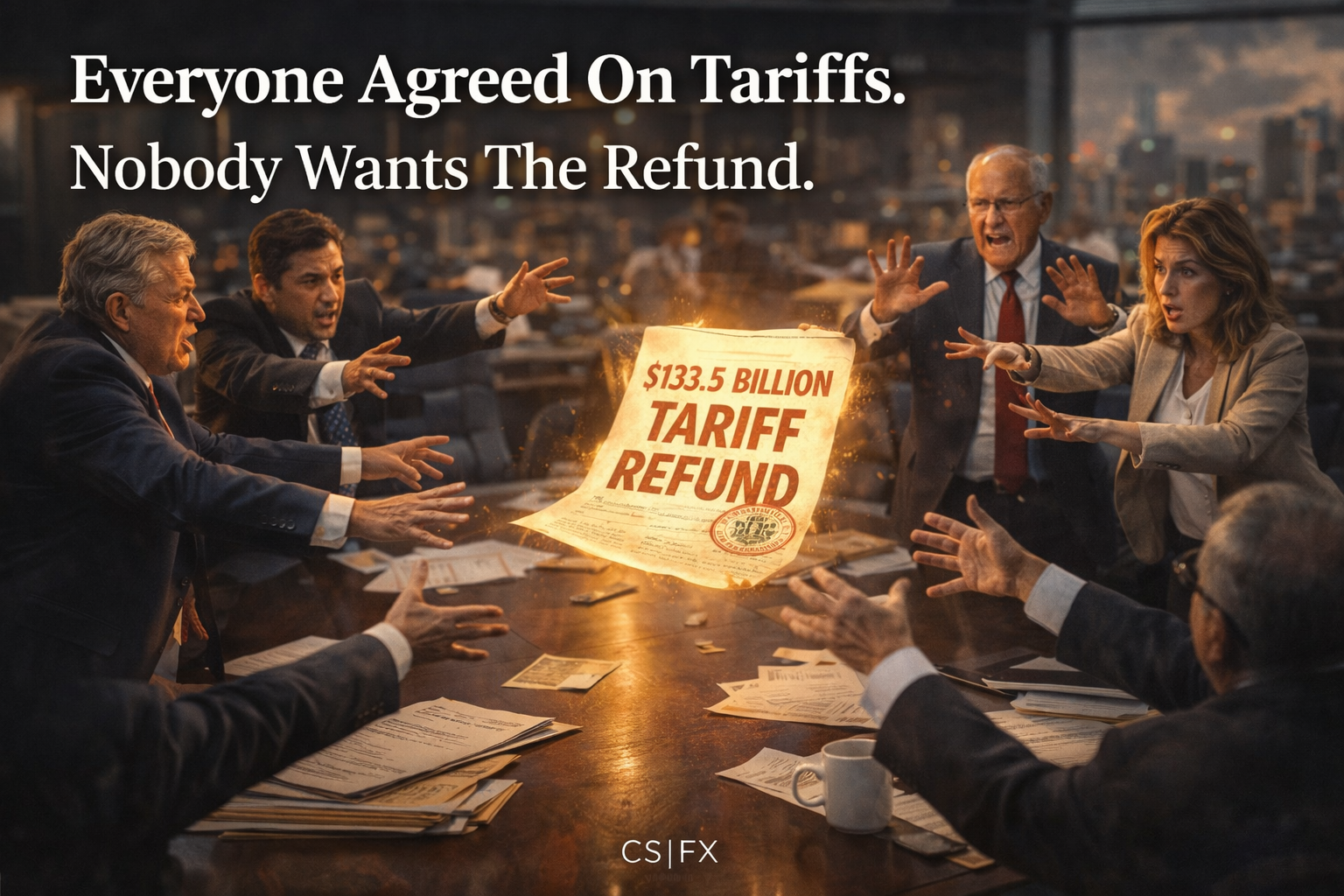
The Supreme Court just ruled Trump’s tariffs illegal. Now $133.5 billion needs paying back — except nobody knows to whom, through which process, or by when. Businesses are filing claims, governors are sending “Past Due” invoices, foreign governments are shredding trade deals, and the White House has already reached for a fresh tariff from the bottom drawer. Welcome to the most expensive game of hot potato in economic history.
On February 24, 2026, the U.S. Supreme Court delivered a 6-3 ruling that shook the foundations of American trade policy: the tariffs Trump imposed on virtually every country on earth — justified under the International Emergency Economic Powers Act (IEEPA) — were unconstitutional. The President, the Court ruled, had exceeded his authority. What followed was not a victory lap for free trade. It was chaos, paperwork, and a truly impressive number of lawyers suddenly billing at $900 an hour.
Within hours of the ruling, the White House announced a replacement: a 15% blanket tariff on all global imports under Section 122 of the Trade Act of 1974 — a law originally designed for short-term balance-of-payments crises, not permanent restructuring of world trade. Think of it as reaching for the fire extinguisher after you’ve been told the flamethrower was illegal — technically legal, deeply unsettling, and still very much on fire.
But the court’s decision left behind a question that no one — not the justices, not the administration, not the Treasury — has fully answered yet: what happens to the $133.5 billion already collected?
The Invoice That Went Viral
Illinois Governor JB Pritzker made the first aggressive move. Within 48 hours of the ruling, he sent a formal letter to the White House — stamped “Past Due – Delinquent” — demanding a refund of $8.68 billion, or roughly $1,700 per Illinois family. The letter was part political theatre, part legitimate legal demand, and it went viral immediately. Somewhere in a parallel universe, an intern at CBP read it, quietly closed their laptop, and went home early.
Pritzker’s invoice is the most polite way anyone has ever told a sitting president “you owe me $8.68 billion.” No late fees mentioned, which frankly seems generous.
“Cut the check. These tariffs were ruled illegal. The money belongs to American families and businesses, not a slush fund for a trade war that the Supreme Court just declared unconstitutional.”
— Illinois Governor JB Pritzker, letter to the White House, Feb. 2026Pritzker’s move opened the floodgates. Trade associations representing importers — from consumer electronics to furniture to apparel — began filing preliminary refund claims with U.S. Customs and Border Protection (CBP). The problem: there is no established mechanism for a refund at this scale. CBP processes customs refund claims routinely, but nothing in its procedural history covers a $133 billion repayment triggered by a Supreme Court ruling. It’s a bit like asking your local post office to handle a nuclear submarine delivery — technically within the realm of “mail,” but nobody’s filled in the form for it.
Who Actually Paid the Tariffs?
The tariffs were not paid by China, Vietnam, or the European Union. They were paid by American businesses — importers who buy goods at the border and absorb or pass on the cost. Foreign governments did not write cheques to Washington. U.S. companies did. So the “we’re making other countries pay” narrative was, to use a technical economic term, completely backwards. Beijing watched the whole thing unfold with the serene expression of someone who knows they didn’t get the bill.
| Sector | Est. Tariff Burden | Primary Exposure | Refund Eligible? |
|---|---|---|---|
| Consumer Electronics | ~$28B | China, Vietnam | Likely Yes |
| Apparel & Footwear | ~$19B | Bangladesh, Cambodia | Likely Yes |
| Steel & Aluminium | ~$14B | Canada, EU, South Korea | Disputed |
| Automotive Parts | ~$22B | Mexico, Germany | Disputed |
| Agriculture & Food | ~$11B | Brazil, Australia | Likely Yes |
| Other Goods | ~$39.5B | Multiple | Under Review |
Foreign Governments Are Tearing Up Their Deals
Perhaps the most geopolitically explosive consequence of the Supreme Court ruling is this: every trade deal signed under the pressure of IEEPA tariffs is now legally and diplomatically in question. Countries that made significant concessions did so under coercion that a U.S. court has now declared illegal. India and South Korea’s trade negotiators are currently re-reading those deals with the focused energy of someone who just found an exit clause.
India Trade Deal
Agreed to 18% tariff floor + $500bn in U.S. goods over 5 years. Indian delegation now “waiting for final outcome” before proceeding.
South Korea Deal
Lowered tariffs from 25% to 15% in exchange for $350bn in investments. Seoul is reviewing whether the coercive basis voids their commitments.
New Negotiations
Analysts see the reset as an opportunity: countries may now engage in good-faith talks without the tariff gun to their heads.
The Road Ahead: A Timeline
CBP Refund Process Announcement
U.S. Customs and Border Protection must publish a formal mechanism for processing IEEPA tariff refund claims. Watch for guidance from Treasury.
Congressional Vote on Section 122 Extension
A vote on extending the 15% blanket tariff will be a bellwether for the political appetite to sustain the trade war.
India & South Korea Deal Renegotiations
Both governments are likely to seek revised terms. Failure to reach new agreements could push them closer to China’s trade architecture.
The Art of the Unravel
What we are witnessing is not just a tariff dispute. It is the slow-motion unwinding of the most audacious trade experiment in modern history — and the bill is now coming due in every currency simultaneously.
For markets, the lesson is brutal and clear: policy uncertainty is now a permanent input cost. It belongs in your models, your hedging strategy, and your supply chain risk register alongside inflation and interest rates.
The $133.5 billion refund saga will drag through courts, congressional committees, and diplomatic back-channels for years. Keep an eye on the dollar. Keep an eye on the midterms. And definitely keep an eye on your receipts.
Frequently Asked Questions
Disclosure: This article is produced for informational and educational purposes only. It does not constitute financial advice. All figures referenced are based on projections as of February 26, 2026.