Cornered: The Dream That Never Died | Capital Street FX
CORNERED
From a Greek philosopher’s olive presses in 600 BC to the Reddit rebellion of 2021 — the complete history of the most dangerous, most brilliant, and most consequential trade in financial markets. Every corner. Every mechanism. Every man who thought he could become the market itself.
The Dream That Never Died
Every speculator who has ever stood on a trading floor, sat at a terminal, or studied a market has felt it — the fantasy of becoming not just a participant but the market itself. The fantasy of owning enough of something that you no longer have a counterparty. You are the counterparty.
That dream is as old as commerce itself. It predates stock markets by two thousand years. It predates money in its modern sense. It is the dream of the merchant who corners the grain supply before a famine, the banker who quietly accumulates the bonds that governments will need to roll over, the trader who buys every olive press before the harvest arrives. The instrument changes with every generation. The dream does not.
A market corner — in its precise technical definition — occurs when a single entity or coordinated group acquires sufficient control over the supply of a tradable asset that they can dictate the price to anyone who must buy or deliver it. The cornerer does not manipulate through false information. They manipulate through genuine ownership of a real thing. They do not lie about value. They simply own enough of it that their price is the only price available.
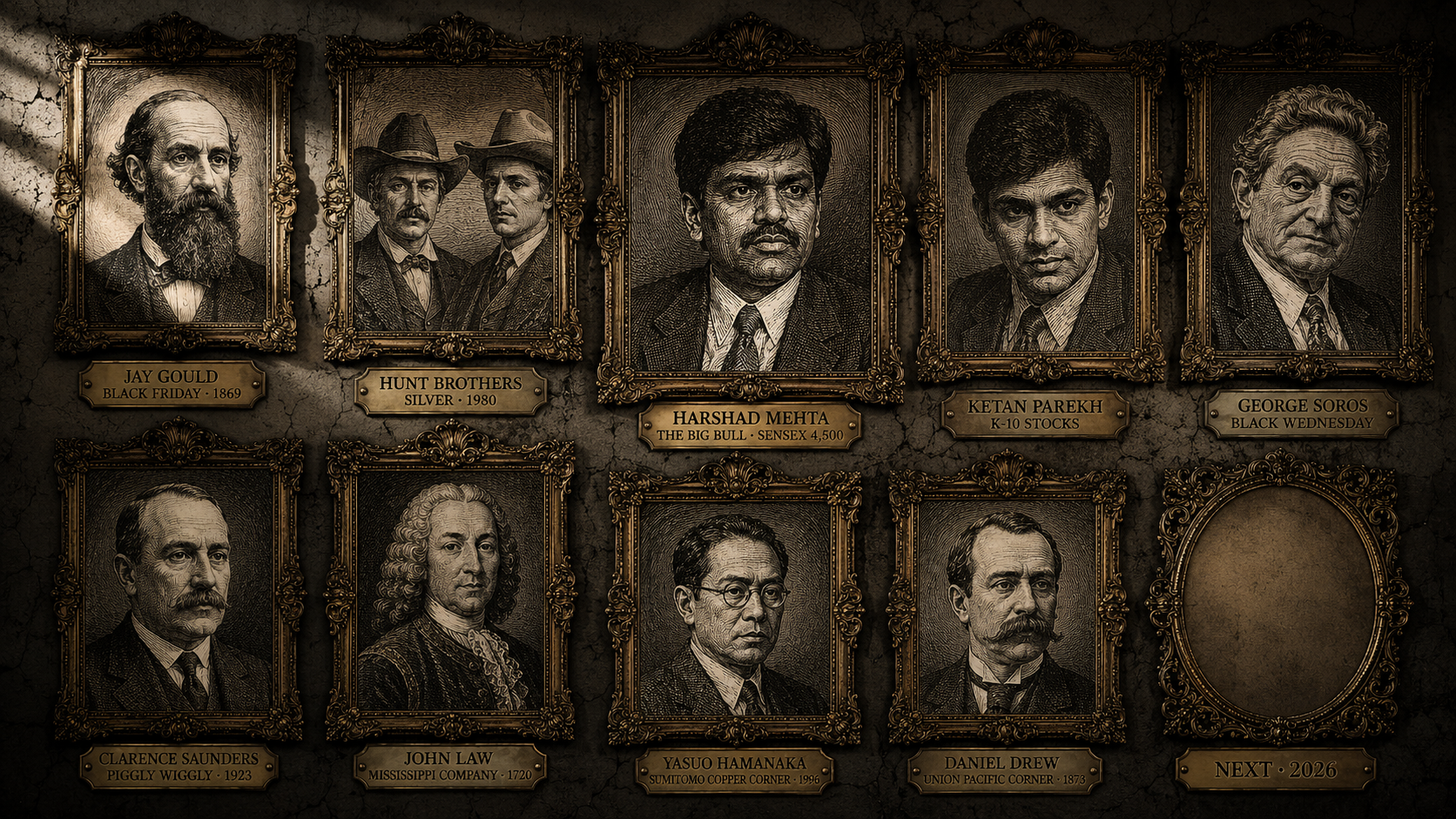
In 600 BC, Thales of Miletus cornered the olive presses of the Aegean coast. In 1609, Isaac Le Maire cornered the short side of the Dutch East India Company — inventing bear raids in the process. In 1869, Jay Gould tried to corner the gold supply of the United States and needed to neutralise the President of the United States to do it. In 1979, the Hunt Brothers accumulated one-third of the world’s silver. In 1992, Harshad Mehta cornered not a commodity but the trust infrastructure of India’s entire banking system. In 2021, five million Reddit users cornered the short sellers of GameStop using smartphones. The instruments are different. The arithmetic is the same.
The bear corner — the inverse trade — deserves equal standing. Le Maire invented it. George Soros perfected it. When a government commits to defending a currency peg, it creates a mandatory buyer with finite resources. Accumulate enough of a short position and sell against that mandatory buyer until their reserves are exhausted. The corner is not on a commodity. It is on an obligation. The mechanism is identical. The direction is reversed.
“A wise old broker told me that all the big operators had one ambition — and that was to work a corner. It was more than the prospective money profit. It was the vanity complex asserting itself among cold-blooded operators.”Edwin Lefèvre — Reminiscences of a Stock Operator, 1923
Every corner in the 2,600-year record of this trade has ended the same way: the rules were changed, the government intervened, the cornerer’s own leverage failed, or new supply arrived. Usually more than one of these at once. The Hunt Brothers met all four simultaneously. Clarence Saunders met the first. George Soros was the government, and he met the fourth — exhausted reserves are new supply in the currency sense.
And every time a corner has been broken, a new one has been attempted. Because the dream does not die when the trade fails. It only waits for a different instrument, a thinner market, a slower regulator, or a man with more patience and more capital than the one who came before.
This article is the complete record of that dream — who had it, how they executed it, what broke them, and where the conditions for the next one are building right now.
The exchange controls the rules and can always change them mid-game. COMEX Silver Rule 7 (1980). NYSE extra time for Piggly Wiggly shorts (1923). Robinhood turns off buying (2021). The most common mechanism — and the most infuriating for the cornerer.
Governments treat corners as systemic threats regardless of political ideology. Grant released Treasury gold (1869). The Fed pressured banks to stop lending to the Hunts (1980). SEBI and RBI dismantled Mehta’s banking mechanism within weeks of exposure (1992).
Every major corner in history was financed with borrowed money. When the price finally turns, margin calls arrive faster than the cornerer can meet them. The Hunts, Porsche, Piggly Wiggly, Ketan Parekh — all undone by leverage, not by a shortage of the cornered asset.
High prices create new supply. Leiter’s wheat corner broke when Philip Armour chartered ships to bring Canadian wheat through the Great Lakes. The Hunt Brothers’ silver corner broke partly because silver jewellery and scrap flooded the market at $49/oz. The cornerer is always racing against supply response.
The Ancient World — The First Corners
The market corner did not begin with Wall Street. It did not begin with joint-stock companies or commodity exchanges. It began wherever two things coexisted: a scarce resource that other people needed, and a man patient enough to accumulate it before they understood what was happening.
Thales of Miletus — The First Recorded Corner, 600 BC
The philosopher Thales of Miletus is remembered today for his contributions to mathematics and early scientific thought. What is less commonly taught is that he also executed the first documented market corner in recorded history. Aristotle records the episode in his Politics, presented as proof that philosophy could make money if it chose to — but had more important things to think about.
Thales observed through astronomical study that the coming season would produce an unusually large olive harvest across the Aegean coast. Before the harvest season began — before any farmer had a crop worth pressing — he quietly negotiated the hire of every olive press in Miletus and in Chios, the two principal cities of the region. He paid deposits at low rates, acquiring the right of exclusive use when the pressing season arrived. The farmers, seeing no unusual demand, were happy to accept his deposits.
When the harvest came in and proved as abundant as Thales had predicted, every farmer needed a press simultaneously. There was only one man from whom they could hire one: Thales. He rented them back at whatever price he chose. The mechanism was identical to every commodity corner that would follow across the next 2,600 years: control the processing infrastructure, wait for the moment of mandatory demand, name your price.
The asset was not a futures contract or a listed stock. It was iron machinery in a Greek city-state. But the arithmetic was indistinguishable from COMEX silver in 1980 or GameStop shares in 2021. Find what someone must have. Own it before they know they need it. Collect when they come to you.
Aristotle’s account of Thales is the oldest documented description of a market corner in any language. It establishes the philosophical precedent that cornering a market is, at its core, a problem of information — the cornerer knows something the market does not, and acts on that knowledge before the market can respond. The edge is not manipulation. The edge is foresight translated into physical control before the foresight becomes common knowledge.
Rome and the Grain Corner — The Annona Under Threat
The Roman grain supply — the annona — was the political centre of the Empire. Every emperor understood that the man who controlled Rome’s food supply controlled Rome itself. The annona system distributed free or subsidised grain to the urban population of Rome, and its failure meant riots, political instability, and the potential for revolution. Cicero’s correspondence and Livy’s histories document multiple episodes across the Republic and Empire periods of merchants cornering the wheat supply during shortage years.
The mechanism was straightforward: identify a crop failure or supply disruption in the grain-producing provinces, buy forward contracts or physical grain in quantity before the shortage was publicly known, then wait as the price rose and the urban population began to go hungry. The Roman solution was predictable and consistent — price controls, state intervention, and in the most egregious cases, criminal prosecution for hoarding under the charge of frumentarii misconduct. The pattern — speculator corners food supply, government intervenes, speculator faces legal consequences — was established in Republican Rome and has not changed since.
Venice and the Spice Route — The 500-Year Corner
The Venetian Republic’s control of the overland spice route from Asia to Europe between the 10th and 15th centuries was the longest-running and geographically most ambitious corner in pre-modern history. Venice did not corner the spot market for pepper and cloves — it cornered the physical route through which they travelled. Every European buyer of Asian spices paid the Venetian toll. The Republic used its naval power, its diplomatic network, and its unmatched commercial intelligence to maintain this monopoly for five centuries.
The corner was broken not by a regulator or an exchange rule but by geography: Vasco da Gama’s 1497 voyage around the Cape of Good Hope created an alternative route that Venice could not control. New supply — in the most literal possible sense — arrived from an unexpected direction and broke the corner permanently. Venice never recovered its commercial dominance. The lesson — corners built on physical route control eventually fall to technological disruption — recurs across history with remarkable regularity.
Le Maire Invents the Bear Corner
Isaac Le Maire did not invent the market corner. That honour belongs to Thales and the olive presses of Miletus, two thousand years earlier. What Le Maire invented was something more specific and, in many ways, more sophisticated: the bear corner — the corner built not on accumulating supply but on accumulating the obligation to short it.
Le Maire had been one of the founding shareholders of the Vereenigde Oost-Indische Compagnie — the Dutch East India Company, the VOC — the world’s first publicly traded joint-stock company and, by any measure, the most powerful commercial enterprise that had ever existed. He had invested 85,000 guilders. He had helped design its corporate structure. Then in 1605 he was expelled from its board, accused of conducting private trade on company routes — a violation of the VOC’s monopoly that he may or may not have committed. His assets were seized. His reputation was destroyed. He was a founding shareholder of the world’s most profitable company, and he was owed dividends he could not collect.
By 1609, Le Maire had a plan. He assembled a syndicate of eight investors — the Groote Compagnie, the Large Company — with a single purpose: to destroy the VOC’s share price. His method was twofold. First, he and his associates sold forward contracts on VOC shares they did not own — forward sales, committing to deliver shares at a future date at a price they expected to be lower than the prevailing market price. This was the invention of short selling as a formal financial instrument. Second, they spread rumours through Amsterdam’s trading community — on the bridge and in the chapel where shares were exchanged — of shipping disasters, management failures, and impending dividend cuts.
The VOC’s share price began to fall. But the operation contained the seed of its own destruction. The opposing syndicate — VOC shareholders defending the price — began buying aggressively. Le Maire’s associates had shorted more shares than they could cover at the prices they needed. The bear corner became a squeeze. Several of Le Maire’s partners were ruined. Le Maire himself eventually negotiated a settlement with the VOC, recovering a portion of his original investment. He died in 1624 having never fully rebuilt his fortune.
The Dutch government’s response was immediate and historically significant: in 1610, they issued the first securities regulation in the history of financial markets — a ban on short selling. The ban was largely ignored from the beginning, routinely circumvented by the same traders it was designed to constrain. But its existence established the principle, still operative today, that a market corner — whether long or short — would eventually produce a regulatory response. Every regulatory framework governing modern financial markets begins with this moment on the Amsterdam exchange in 1609.
first securities law
Le Maire’s operation established three principles that govern every bear corner in history: (1) the short seller needs to accumulate a position larger than the mandatory long counterparty can defend; (2) the information advantage — here, Le Maire’s insider knowledge of VOC’s vulnerabilities — must be translated into position size before it becomes market knowledge; (3) the regulator always arrives one cycle late. The ban on short selling came after the trade, not before it. That has not changed in 415 years.
John Law and the Corner That Cornered an Entire Nation
Every corner in this article cornered a commodity, a stock, or a currency. John Law cornered something larger — the entire capital market of France and with it, the financial psychology of a nation. It is the most ambitious corner in history, and its collapse was the most consequential.
John Law was born in Edinburgh in 1671, the son of a goldsmith. He was an accomplished mathematician with a rare talent for understanding systems of money and credit at a time when most educated Europeans still thought of banking as a form of usury. He was also a duelist who killed a man in a 1694 duel, was sentenced to death, escaped from prison, and fled to the Continent. He spent the following decade travelling through Europe’s financial capitals — Amsterdam, Genoa, Venice — studying their credit systems, their bank structures, and their approaches to government finance.
His opportunity came from France’s catastrophic fiscal position in 1715. Louis XIV had died leaving the French state effectively bankrupt — debt at approximately 3 billion livres, annual revenues of 145 million, annual expenditure of 142 million, leaving virtually nothing for debt service. The Regent, the Duke of Orléans, was desperate for a financial solution. Law proposed one: a bank that could issue paper money backed by confidence rather than gold, which would circulate as a medium of exchange and allow the government to refinance its crushing debt at lower rates.
In 1716, Law received permission to establish the Banque Générale. In 1717, he founded the Compagnie d’Occident — the Mississippi Company — to exploit France’s Louisiana territory. In 1718, the Banque became the Banque Royale, issuing paper currency with state backing. By 1720, the Mississippi Company had absorbed the East India Company, the China Company, and the African Company, becoming the Compagnie des Indes — a single corporation holding France’s entire overseas trade monopoly. Law had also assumed control of the Mint, the collection of taxes, and effectively the management of the national debt. He was appointed Contrôleur Général des Finances — the equivalent of Finance Minister and Chancellor combined.
The share price of the Mississippi Company rose from its initial price to 10,000 livres by January 1720. The city of Paris had entered a speculative mania without historical precedent. People lined the streets outside Law’s offices attempting to buy shares. The word millionnaire was coined in French to describe the fortunes being made. Servants became rich. Noblemen who had sold shares early wept at having sold too soon. Law rode through Paris in a carriage of such magnificence that crowds gathered simply to watch him pass.
The corner was not on Mississippi Company shares. The corner was on the entire French credit system. Law had made the paper currency and the share price mutually dependent — the bank printed money to lend to investors to buy shares; the rising share price made the money appear credible; the credibility of the money allowed more lending; the lending produced more share buying. The loop was self-reinforcing in both directions. It produced the greatest financial bubble in European history. It also ensured that when confidence broke, both the share price and the currency collapsed simultaneously.
In May 1720, the Prince of Conti presented 14 million livres in paper notes at the Banque Royale and demanded gold coin in exchange. The bank could not pay in full. News spread. In June, the share price began falling. Law attempted emergency measures: he issued new notes, imposed a prohibition on holding gold, decreed forced acceptance of paper money. None worked. The share price collapsed from 10,000 to below 500 livres. The paper currency became worthless. Law fled France in December 1720. He died in Venice in 1729, a pensioner of the Orléans family, having lost everything.
The Mississippi Bubble destroyed France’s confidence in paper money and central banking for over a century. When the rest of Europe was developing sophisticated credit systems and issuing government bonds, France remained wedded to gold, physical assets, and a deep institutional suspicion of banks. Napoleon’s Banque de France was a timid echo of what Law had tried to build. The 18th-century French preference for gold hoarding — the cultural habit that persists in French savings behaviour to this day — was born directly from Law’s catastrophic experiment. A corner that destroyed a currency reshaped the financial character of a nation.
initial to peak
Law’s system is unique in corner history because it cornered not a physical commodity or a single financial instrument but the trust infrastructure of an entire economy — precisely the mechanism that Harshad Mehta would replicate in India 272 years later. Both men understood that in a system built on paper and confidence, the man who controls the confidence controls everything. Both men were brilliant. Both were undone by the same structural flaw: a self-reinforcing loop in which the mechanism that creates the bubble contains the seed of its inevitable collapse.
No exchange rule could break the Mississippi corner because Law controlled the exchange, the currency, and the government simultaneously. It was broken by the oldest mechanism in financial history: physical reality. The gold was not there. The paper was not worth what it claimed. When one powerful creditor tested that claim, the entire structure failed within weeks. The lesson: a corner that requires the suspension of physical reality cannot be sustained indefinitely, regardless of how much political and financial power the cornerer commands.
The Robber Baron Era — When Corners Were Legal
The American financial landscape between the Civil War and the turn of the 20th century was a wilderness without rules. No SEC. No CFTC. No position limits. No disclosure requirements. The New York Stock Exchange was a gentlemen’s agreement. The Chicago Board of Trade was a private club. Into this vacuum walked the greatest cornerers in history.
Vanderbilt — Harlem Railroad, 1863 (The Prototype)
Cornelius Vanderbilt’s 1863 corner of the Harlem Railroad is the prototype of every equity corner that follows. The mechanism was textbook: Vanderbilt had acquired control of the Harlem Railroad and secured a key operating franchise from the New York City Council. The Council members — the very people who had just voted for the franchise — then shorted the stock, planning to revoke the franchise they had just granted and profit from the resulting collapse.
Vanderbilt saw the short interest building and responded with the patience and arithmetic precision that defined his career. He accumulated Harlem Railroad shares quietly until he owned more than the total outstanding float — more shares than existed in the market. The short sellers, who had sold shares they did not own expecting to buy them back at lower prices, discovered that there was nowhere to buy them. The only seller was Vanderbilt, and he named his price.
His counterparties included New York City aldermen, state legislators, and his most dangerous rival, Daniel Drew. Vanderbilt magnanimously allowed them to settle at modest losses rather than extracting the full ransom — keeping the railroad, establishing his control of Manhattan’s rail connections, and demonstrating that the most powerful men in New York could be systematically trapped by a man who understood the arithmetic of ownership better than they did. It was a measured demonstration of power, not a financial execution. He wanted their cooperation in future dealings more than he wanted their ruin.
Jay Gould and Jim Fisk — Gold, Black Friday, September 24, 1869
The most audacious corner in American history required corrupting the President of the United States. Jay Gould understood one fatal vulnerability of the gold market: the US Treasury held the largest gold supply in the country, and any speculator who cornered gold could be instantly broken by the President ordering the Treasury to sell. His plan was therefore not just to corner gold — it was to neutralise the government first.
Through Abel Corbin — President Ulysses Grant’s brother-in-law — Gould worked to convince Grant that a high gold price served American farmers and exporters by making US agricultural exports cheaper for foreign buyers. He simultaneously bribed Daniel Butterfield, the assistant US Treasurer in New York, with a $1.5 million stake in the scheme in exchange for advance warning of any government gold sales. Through disguised brokers operating under fictitious names across multiple accounts on the New York Gold Exchange, Gould and Fisk accumulated over $50 million in gold contracts through the summer of 1869, driving the price from $132 to $162.
The Gold Room on Broad Street was in pandemonium. Traders were physically fighting on the floor. Fortunes were being made and lost in minutes. The price moved faster than messenger boys could carry quotes to brokers uptown. On the morning of September 24, 1869, Gould was still buying, the price was still rising, and the trap appeared perfectly set.
Then President Grant, vacationing in western Pennsylvania, finally understood the depth of the conspiracy when shown a letter Gould had drafted to Corbin describing the scheme. He ordered Treasury Secretary Boutwell to release $4 million in government gold. The announcement came at approximately noon on September 24. The price of gold collapsed within minutes, falling from $162 to $133 before the day was out. The Gold Room descended into chaos. Dozens of brokers failed. The knock-on effect crashed the stock market — causing a broader panic that became known permanently as Black Friday.
Gould had secretly sold his own positions before the Treasury announcement, having received advance word from his contacts. He emerged from Black Friday a substantial winner. Fisk repudiated his contracts through favoured Tammany Hall judges, using the legal system as a personal weapon. Neither faced meaningful legal consequences. The lesson Black Friday teaches is the one every subsequent cornerer has had to confront: a corner that requires neutralising a government has a single fatal point of failure — the government.
“If I win, I’ll be a great man. If I lose, I’ll be nobody.”Jay Gould — attributed, before the 1869 gold operation
The Three Big Chicago Corners — Hutchinson, Leiter, Patten (1888–1909)
The Chicago Board of Trade between 1863 and 1915 was the most reliably cornered market in the world. Wheat, corn, oats, and rye were cornered so frequently that exchange historians documented a dozen major operations in those five decades. Three stand above the rest.
Benjamin “Old Hutch” Hutchinson, 1888: Hutchinson was Chicago’s first great speculative operator, a veteran of the trading floor who combined genuine market insight with the patience to accumulate positions over months. His 1888 wheat corner was built on a real foundation — a genuine crop failure in the US South had reduced supply — but Hutchinson amplified the scarcity rather than creating it. He accumulated the entire deliverable wheat supply of Chicago and briefly controlled the market absolutely, naming his price to every short seller and miller who needed grain. He was celebrated rather than prosecuted. The exchange saw nothing wrong with what he had done.
Joseph Leiter, 1897–1898: Joseph Leiter began purchasing wheat in April 1897 after allegedly flipping a coin to determine whether to buy stocks or attempt a corner of the nation’s wheat supply. By early 1898 his storehouses and elevators were crammed. He had briefly succeeded in holding the entire American supply of wheat, sending prices up all over Europe and America. His operation inspired Frank Norris’s 1903 novel The Pit — the first great work of fiction about financial market manipulation, still in print today.
But before he could harvest his profits, Philip Armour — the meat-packing magnate — moved against him with the precision and resources of a man who had made his fortune in commodity markets. Armour chartered icebreaker ships to smash through the frozen Great Lakes and bring Canadian wheat to Chicago, creating new supply at the moment it was most needed. By May 1898 the corner had broken. Leiter lost an estimated $10 million. The lesson: no wheat corner can survive a determined competitor with access to alternative supply and the capital to deliver it.
The Northern Pacific Railway — May 9, 1901 (The Most Famous Corner in History)
The Northern Pacific corner of 1901 is the most celebrated market corner in American financial history — not because it was planned but because it was entirely accidental. Two of the most powerful men in American finance each tried independently to acquire control of the Northern Pacific Railway, neither knowing the other was buying, and together they cornered a market that neither intended to corner.
E.H. Harriman, backed by Kuhn, Loeb & Co. and Standard Oil money, wanted the Northern Pacific to complete his transcontinental railroad empire. J.P. Morgan, the supreme power of American finance, had just reconstructed the Northern Pacific after its 1893 bankruptcy and backed James J. Hill in the belief that they already controlled it securely. Harriman began buying quietly in April 1901. Morgan and Hill, confident in their existing shareholdings, were not alarmed at first. By the time they realised Harriman was accumulating a controlling interest, a race had begun.
Both camps bought simultaneously through May 9, 1901 — a single day of buying so intense that together they acquired more shares than existed. Short sellers who had sold Northern Pacific stock in what they believed to be an overvalued railroad found they could not deliver shares that neither camp would lend. The float had ceased to exist. Northern Pacific hit $1,000 per share in a single session — from $114 at the start of May. In the chaos, short sellers sold every other stock they owned to raise cash to cover Northern Pacific: US Steel, Union Pacific, Atchison Topeka. The New York Stock Exchange experienced its worst crash in years, triggered entirely by the accidental corner of a single railroad.
Morgan and Harriman settled through the Northern Securities Company, which was promptly dissolved by the Supreme Court in 1904 under the Sherman Antitrust Act — the most significant antitrust action in American history to that point. The accidental corner that nearly destroyed the stock market produced the legal framework for modern antitrust enforcement.
Corners Meet Regulation — and Win Anyway
The Securities Exchange Act of 1934 created the SEC and declared market manipulation illegal. It did not end corners. It merely raised the cost — and created a generation of operators clever enough to work around the new rules.
Clarence Saunders — Piggly Wiggly, 1923 (The GameStop That Happened First)
Clarence Saunders invented the modern self-service grocery store. He was a self-made Southern businessman from Memphis who had built a retail empire through operational genius and an extraordinary instinct for consumer behaviour. He had no Wall Street connections, no powerful friends in New York, and no experience in financial markets. When the bears came for him, he fought back with the only weapon he had: arithmetic.
In 1922, a group of New York short sellers — including some of the most powerful trading firms on Wall Street — targeted Piggly Wiggly Stores stock. The mechanics of their attack were standard: borrow shares, sell them short, spread negative commentary about the company’s finances, wait for the price to fall, buy them back at lower prices. For Saunders, who had built Piggly Wiggly from nothing, this was not an abstract market operation. It was a personal attack on his life’s work by men who wanted to profit from its destruction.
Saunders borrowed everything he could — from banks, from personal friends, from anyone who would lend — and began accumulating Piggly Wiggly shares. By the end of February 1923, he controlled 198,872 of the 200,000 outstanding shares — 99.4% of the entire company. The firm’s share price went from a low of $39 in late 1922 to $124 by March 20, 1923. The bears were trapped. They could not cover their short positions because Saunders owned virtually every share in existence.
Then the NYSE Governing Committee acted. Packed with representatives of the very Wall Street trading firms that Saunders was squeezing, the Committee declared a “corner” existed and gave the short sellers five days — rather than the standard 24 hours — to find and deliver shares. The extra time allowed them to locate the small quantities of Piggly Wiggly stock held by investors in Iowa, Nebraska, and other distant states who had not yet heard the news of the corner and were willing to sell. The artificially extended settlement window broke the corner. Saunders was unable to maintain his positions through the financing he needed. He lost $9 million, went bankrupt, lost his company, and lost his 40-room mansion — the Pink Palace, still standing in Memphis today as a museum. He called the New York Stock Exchange “the worst menace in America” until his death in 1953.
In 2021, Robinhood turned off the buy button for GameStop. The mechanism was identical. The technology was different. The playbook was the same. Saunders had written it 98 years earlier.
Arthur Cutten — The Grain King of Chicago, 1924–1925
Arthur Cutten was a Canadian immigrant who arrived in Chicago in 1890 with $50 in his pocket and no connections to the grain trade. By the 1920s he was the most powerful individual speculator on the Chicago Board of Trade, feared by farmers, millers, merchants, and regulators alike. His 1924–25 operations in wheat were so large and so systematically disruptive that they produced what historians of the exchange describe as three key institutional innovations through federal government coercion of the grain futures industry.
Cutten’s method combined genuine market insight with aggressive position-building that repeatedly pushed against the limits of what the Grain Futures Act permitted. Most of the wide and erratic price fluctuations in wheat futures at Chicago during the early part of 1925 were largely artificial and were caused primarily by heavy trading by a limited number of professional speculators — of whom Cutten was the most prominent. His operations were felt in every grain market in the world. Cutten concealed his positions across multiple accounts and grain firms to circumvent position reporting requirements — a technique that Ketan Parekh would use in India 75 years later at the Calcutta Stock Exchange to exactly the same end. He was eventually barred from trading and his case went to the Supreme Court. He is largely forgotten outside specialist financial history. In his era, he was the most famous trader in America.
Vincent Kosuga — The Onion Corner, 1955 (The Most Absurd Corner in History)
Vincent Kosuga was a New York onion farmer. Through futures contracts on the Chicago Mercantile Exchange, he accumulated 30 million pounds of onions — equivalent to the entire US onion supply at the time — and created a glut so extreme that the price of a 50-pound bag fell to 10 cents. The bag itself cost more than the onions inside it. Farmers were paying to have their crops taken away rather than face the cost of storage.
Congress was sufficiently alarmed to pass the Onion Futures Act of 1958, banning all futures trading in onions permanently. The ban remains in effect today — the only specific commodity in the United States prohibited from futures trading. The onion market now has no price discovery mechanism, no ability to hedge future production, and experiences wilder price swings than it did under the futures system. The cure was worse than the disease. But the Onion Futures Act has never been repealed. Congress banned onion futures and moved on.
The Modern Era — When Corners Went Global
The Hunt Brothers — Silver, 1979–1980 (The Largest Commodity Corner of the 20th Century)
Nelson Bunker Hunt, William Herbert Hunt, and Lamar Hunt were the sons of H.L. Hunt — a Texas oil billionaire so wealthy that he employed a staff of accountants solely to calculate what he was worth. After Nixon closed the gold window in August 1971, severing the last link between the dollar and precious metals, the Hunts became convinced that paper currencies were undergoing a slow and irreversible debasement. Silver — the monetary metal with the deepest industrial demand base — was their hedge against the collapse of paper money itself.
They began accumulating in 1973, buying both physical silver and futures contracts simultaneously. By the late 1970s, they had been joined by a syndicate of wealthy Saudi investors including members of the Mahfuz and al-Amoudi families. By 1979, the Hunts and their partners had accumulated approximately 200 million ounces of silver — representing about one-third of the world’s total supply of tradable silver. The price began its historic run: from approximately $6.80 per ounce in early 1979 to an intraday high of $50 per ounce on January 18, 1980. At that peak, their position was worth an estimated $10 billion on paper.
The scale of the operation attracted attention that even the Hunts could not manage. Tiffany & Co. — the jewellery company — took out a full-page advertisement in the New York Times condemning the brothers for deliberately driving up the price of silver used in jewellery and flatware, and costing ordinary consumers money. More importantly, it attracted the attention of COMEX and the Federal Reserve.
On January 7, 1980, COMEX introduced Silver Rule 7 — restricting new leveraged silver purchases and requiring existing large positions to be reduced. The Federal Reserve simultaneously pressured major banks to stop extending credit to speculators in commodity markets. With their ability to finance their positions cut off, the Hunts began facing margin calls they could not meet as the price fell from its peak. The decisive moment was Silver Thursday — March 27, 1980 — when the Hunts defaulted on a $100 million margin call from their brokers. The price plunged from approximately $15.80 to $10.80 in a single session. The cascade of defaults and failures that followed threatened several major brokerage firms and required a $1.1 billion emergency credit line organised by a consortium of banks under Fed supervision to prevent systemic damage.
Both Nelson Bunker Hunt and William Herbert Hunt eventually declared bankruptcy. In 1988, after a seven-year legal proceeding, they were found liable for attempting to corner the silver market and ordered to pay $134 million in damages to a Peruvian mining company that had suffered losses. The corner that had threatened to remake the global silver market ended with its architects bankrupt, convicted, and permanently barred from commodity trading.
Note: Soros bear corners not shown — they measured government reserve depletion rather than price appreciation. Bear corner profits are collected from the mandatory buyer’s exit, not from a price rise in a long position.
Yasuo Hamanaka — Copper, 1986–1996: Ten Years of Deception
Yasuo Hamanaka, Sumitomo Corporation’s chief copper trader, was known to the London Metal Exchange as “Mr Five Percent” — a reference to his believed share of global copper supply. For a decade between 1986 and 1996, he maintained that position through a combination of genuine trading skill, forged documents, unauthorised trading, and a willingness to use Sumitomo’s corporate balance sheet as collateral for positions his superiors did not know existed.
His operation was unique in corner history: it was run not by a tycoon or a hedge fund but by a single rogue trader inside one of Japan’s largest trading houses, operating for a decade without detection. Hamanaka forged trading records, created false confirmations, and concealed his true position from Sumitomo’s management through an elaborate system of shadow accounts. The London Metal Exchange and Western regulators suspected that large positions were being used to manipulate the copper market but could not prove it until Sumitomo itself discovered the fraud in 1996. The corporation’s losses totalled $2.6 billion. Hamanaka was sentenced to eight years in prison in 1998. His case demonstrated that a sustained corner in a global industrial commodity was possible through a single operator — but required institutional cover, forged documentation, and a decade of meticulous concealment.
Salomon Brothers — US Treasuries, 1991
Paul Mozer, a managing director at Salomon Brothers, submitted false bids in US Treasury note auctions between 1990 and 1991, effectively capturing up to 94% of a single 2-year note auction and creating a squeeze on short sellers in the when-issued Treasury market. Salomon submitted bids in the names of clients who had not authorised them, cornering the issuance of the most important debt securities in the world. The scheme was discovered in April 1991 when one of the falsely named customers contacted the Treasury. Salomon Brothers paid $290 million in fines — the largest fine in financial market history to that point — and the firm came within hours of collapse before Warren Buffett arrived as emergency chairman and personally guaranteed Salomon’s counterparty obligations. The Treasury promptly reformed auction rules to prevent single-bidder dominance.
The Bear Corner — Soros, Black Wednesday, and the Sovereign Trap
The bear corner is the same trade running in reverse. Instead of controlling the supply of something others must buy, the bear cornerer controls the volume of selling that a mandatory buyer cannot absorb. The target is not a short seller who must deliver. The target is a government that has promised to maintain a price it can no longer afford.
When a government commits to defending a currency peg, it creates the most vulnerable position in all of finance: a mandatory buyer with publicly disclosed, finite resources. The peg defender must buy its own currency whenever it falls to the floor. It can only do so as long as its foreign exchange reserves last. A speculator who accumulates enough of a short position and sells against the government’s mandatory buying can exhaust those reserves — and when the reserves run out, the peg breaks and the currency falls however far the fundamentals dictate. The corner is complete. The mandatory buyer has been trapped and exhausted.
George Soros and Black Wednesday — September 16, 1992
By the spring of 1992, George Soros and his chief portfolio manager Stanley Druckenmiller had identified what they believed to be the clearest monetary mispricing in global currency markets: the British pound’s membership in the European Exchange Rate Mechanism. The ERM required member countries to keep their currencies within tight bands against the German mark. Britain had entered in October 1990 at a rate of DM 2.95 — a rate that required UK interest rates significantly higher than its domestic economy could comfortably sustain, while Germany’s post-reunification interest rates were driven by entirely different domestic considerations.
The mathematics were unavoidable. Britain was in recession, unemployment was rising, and the housing market — where millions of ordinary families had taken out variable-rate mortgages — was under severe stress. The interest rate required to defend the ERM peg was precisely the interest rate that would cause the most damage to British households and businesses. The government knew this. The market knew this. The only remaining question was how long political will could substitute for economic reality.
Druckenmiller wanted to short 100% of the Quantum Fund in sterling. Soros told him that when the fundamentals are this clear, the position should be 200%. They borrowed and sold pounds through every counterparty that would deal with them, building a position that ultimately reached $10 billion. Other hedge funds, watching the Quantum Fund’s positioning, built their own short positions behind it. The combined selling pressure against sterling eventually exceeded the Bank of England’s ability to buy.
On the morning of September 16, 1992, the British government raised interest rates from 10% to 12%, then to 15% — an extraordinary double hike in a single day, designed to attract capital and defend the peg. Neither worked. The Bank of England spent an estimated £3.3 billion in foreign exchange reserves attempting to buy sterling before noon alone. At 4pm, Chancellor Norman Lamont announced that Britain was suspending its ERM membership and allowing the pound to float. By the close of business, sterling had fallen 15% against the deutschmark. Soros’s Quantum Fund made approximately $1 billion in profit between the morning and the evening of a single trading day. Britain’s exit from the ERM — Black Wednesday — permanently ended the Conservative Party’s reputation for economic competence and is widely credited as a significant factor in the Labour landslide of 1997.
The Bank of England’s foreign exchange reserves in September 1992 were approximately £44 billion. The total speculative short position against sterling was estimated at £10–15 billion from Soros alone, with other funds adding multiples of that. The arithmetic was simple: the reserves were large but finite and publicly disclosed. The speculative capacity was in theory unlimited. A government defending a peg against the market is in the position of every cornered short seller in history — they have an obligation to buy at a specified price, their resources are finite, and their counterparty has more capital than they do. The resolution is always the same.
The SNB Floor Removal — January 15, 2015 (The Bear Corner the Central Bank Created for Itself)
The Swiss National Bank’s removal of the EUR/CHF 1.20 floor on January 15, 2015 is the most dramatic single event in modern foreign exchange market history — and it illustrates the inverse of the Soros trade. The SNB had accumulated approximately 480 billion francs in foreign currency reserves (primarily euros) while defending the floor for three years. When it stepped away from the peg without warning on January 15, it essentially released the accumulated short position the market had been building against the floor for three years simultaneously. The CHF rose 30% against the euro within minutes. Several retail FX brokers went insolvent. FXCM, one of the largest retail FX brokers in the world, required an emergency $300 million credit facility to avoid collapse. The lesson: a central bank that creates a one-sided peg — a known floor in EUR/CHF — is building the conditions for the most violent possible reversal the moment it decides to step away. The SNB in 2015 was both the cornerer and the corner being broken simultaneously.
The Two Men Who Cornered an Economy
A mentor and his student. Two men from the same world — Dalal Street, Mumbai, the frenzied early years of India’s economic liberalisation. Together, in 2026 stock market equivalent terms, their operations cost Indian investors approximately $170 billion. One was brought down by a journalist. The other was brought down by a competing corner.
Harshad Mehta — The Big Bull, 1991–1992
India in 1991 was a country in the middle of the most transformative economic moment in its post-independence history. Finance Minister Manmohan Singh and Prime Minister Narasimha Rao were dismantling the licence raj — the system of permits and controls that had strangled growth for four decades. Foreign investment was being invited for the first time. Indian companies were discovering capital markets. The Bombay Stock Exchange’s Sensex, long dormant at around 1,100, was beginning to stir.
Into this moment walked Harshad Shantilal Mehta — a stockbroker from a modest Gujarati family in Rajkot, who had arrived in Mumbai with almost nothing and spent the 1980s learning the operational mechanics of the Indian financial system in granular detail. He understood the interbank securities market — the system by which banks traded government bonds among themselves to manage their statutory liquidity requirements — better than most of the bankers operating within it. He had identified a gap in that system so exploitable that its existence seems, in retrospect, almost impossible to believe.
Indian banks were required by the Reserve Bank of India to hold a specified percentage of their deposits in government securities. They traded these securities constantly among themselves through the Ready Forward deal mechanism — short-term secured loans, collateralised by government bonds, typically for 15 days. Because physically transferring bonds for a 15-day loan was logistically inconvenient, banks issued Bank Receipts (BRs) instead — essentially IOUs promising that the securities existed and would be delivered. The BR was paper. It depended entirely on trust.
Mehta identified that two smaller banks — the Bank of Karad and the Metropolitan Co-operative Bank — had officials willing to issue BRs without any underlying securities actually existing. Through these banks, Mehta obtained fake BRs, presented them to large banks as legitimate collateral, received cash, and diverted that cash to Dalal Street. He used it to buy stocks — concentrating his buying in specific companies, driving their prices up, creating the appearance of a bull market driven by genuine investor enthusiasm, attracting retail investors who saw rising prices and followed the Big Bull into the market, and using the rising prices as further collateral for more loans.
The scale of what Mehta built in 18 months was extraordinary. He bought ACC Cement from ₹200 to ₹9,000 — a move of 4,400%. He pumped Apollo Tyres, Sterlite Industries, and dozens of other stocks. The Sensex moved from approximately 1,100 in April 1991 to 4,500 in April 1992 — a 309% gain in 13 months. An entire generation of Indian middle-class families put their savings into the market for the first time, following the Big Bull whose investments seemed infallible. Mehta drove to his office in a Lexus LS400 — the first privately imported Lexus in India. He paid ₹24 crore in personal income tax in FY1992, the highest individual tax payment in India that year — more than Dhirubhai Ambani. At the 1992 exchange rate of ₹26/$1, his declared peak personal holdings were approximately $1.54–$1.92 billion.
Ketan Parekh — The Pied Piper of Dalal Street, 1999–2001
Ketan Parekh had worked in Harshad Mehta’s firm, GrowMore Research & Asset Management, in the early 1990s. He had watched the master operate at close range. He had seen what worked and, more importantly, he had seen what broke the operation: one financing mechanism, one journalist, and one exposure. Parekh drew his lessons accordingly. He would be more subtle. He would spread across more instruments. He would use a different kind of leverage. And he would wait for precisely the right moment — a moment when the entire world was prepared to believe that any stock with the words “technology,” “media,” or “telecom” in its description was worth ten times its revenues.
By 1999, the Nasdaq was approaching 5,000 and every global investor was searching for India’s technology sector. Parekh gave them what they wanted. He selected ten companies — the K-10 — all in the technology, media, and telecom sectors, all benefiting from genuine global excitement about India’s IT future, all with floats small enough that concentrated buying could move prices dramatically. His method combined two techniques simultaneously.
The first was circular trading: buying and selling the same stocks between his own entities and affiliated accounts, creating the illusion of massive trading volume and investor interest. Prices were ramped upward by luring other investors through high-volume trading at rising prices, which signalled demand that did not genuinely exist. The second was unique in corner history: Parekh persuaded the very companies whose stocks he was inflating to give him money to inflate them. SEBI’s investigation documented that Zee Telefilms gave approximately ₹515 crore, the Himachal Futuristic group gave approximately ₹700 crore, and Adani Exports gave ₹100 crore to Parekh between January 2000 and March 2001. Company promoters gave him capital from their corporate treasuries, which he used to buy their own shares, making the promoters paper-wealthy and providing him with more collateral for further purchases. The loop was more closed and more self-referential than anything Mehta had built.
Parekh made one operational choice that showed either genius or extraordinary audacity: he routed most of his circular trades through the Calcutta Stock Exchange, which operated under significantly lighter regulatory oversight than the BSE or NSE. SEBI’s investigation documented that Parekh sent more than ₹2,700 crore to brokers in Calcutta between January 2000 and March 2001 alone. The Calcutta exchange’s badla system — India’s version of the carry trade, allowing positions to be rolled forward without physical settlement — provided leverage that SEBI-regulated exchanges would not have permitted.
The K-10 stocks produced price movements that defy comprehension in hindsight. Zee Telefilms rose from ₹127 to ₹10,000 — a gain of 7,774%. Visualsoft rose from ₹625 to ₹8,448. PentaMedia Graphics rose from ₹175 to ₹2,700. Global Telesystems rose from ₹185 to ₹3,100. At the peak, Parekh was described as the most powerful individual in Indian financial markets. Foreign institutional investors had bought K-10 stocks as India’s technology plays. Mutual funds owned them. Retail investors — millions of ordinary families who had seen the returns — had bought them.
The fall was orchestrated not by a regulator but by a counter-operation — a bear cartel of traders who had identified the same structural weakness in Parekh’s positions that Soros had identified in the Bank of England’s reserves in 1992. Parekh’s K-10 stocks were artificially elevated, his leverage was at its limits, and the entire edifice depended on the inflated valuations remaining intact. In February 2001, the bear cartel began aggressively short-selling the K-10 stocks. The prices broke. The collateral evaporated. The banks called the loans. Parekh defaulted on ₹137 crore owed to the Bank of India — and the cascade began.
By the time it was over, ₹30,000–40,000 crore ($9.3 billion at the 2001 exchange rate of ₹43/$1) in investor wealth had been destroyed. SEBI banned Parekh from securities markets for 14 years — one of the longest bans in the regulator’s history. He was convicted in 2008. In early 2025, SEBI uncovered a new front-running operation led by Parekh, netting approximately ₹65.7 crore through insider information about institutional trades, communicated via burner phones and WhatsApp, with contacts saved as “Jack,” “Boss,” and “Bhai.” The man had not changed. Only the technology had.
| Metric | Harshad Mehta · 1992 | Ketan Parekh · 2001 |
|---|---|---|
| Mechanism | Fake Bank Receipts — cornered the trust infrastructure of India’s entire interbank securities system | Circular trading + company-funded self-inflation — cornered the market’s belief in a single operator’s infallibility |
| Total fraud (INR) | ₹4,025 crore | ₹40,000 crore |
| Total fraud (USD at time) | $1.55 billion | $9.3 billion |
| Sensex multiplier → 2026 | 16.7× (Sensex 4,500 → 75,000) | 15× (Sensex 5,000 → 75,000) |
| 2026 market equivalent | ~$26 billion | ~$140 billion |
| Peak personal wealth (USD) | ~$1.54–1.92 billion | ~$200–400 million est. |
| Biggest single stock move | ACC: ₹200 → ₹9,000 (+4,400%) | Zee: ₹127 → ₹10,000 (+7,774%) |
| Income tax paid at peak | ₹24 crore — highest in India, more than Dhirubhai Ambani | Not publicly reported |
| Market index impact | Sensex +309% in 13 months | K-10 stocks avg +500–2,000%+ |
| How it broke | Journalist Sucheta Dalal, Times of India, April 23, 1992 | Rival bear cartel + leverage collapse, February 2001 |
| Regulatory legacy | SEBI fully empowered · NSE created · Electronic trading · Demat shares mandatory · Bank Receipt system abolished | Badla system abolished · T+2 settlement · Cross-market surveillance · Bank lending against shares restricted |
| Relationship | The Teacher — Parekh worked at Mehta’s firm GrowMore Research | The Student — learned the trade directly from watching Mehta operate |
Porsche, Cocoa, and the Reddit Rebellion
Anthony Ward, “Choc Finger” — Cocoa, 2002 and 2010
Anthony Ward of Armajaro Holdings ran one of the most physically audacious commodity corners of the 21st century — twice. In 2002, following genuine harvest failures and political instability in West Africa’s cocoa-producing regions, Ward accumulated 204,000 tonnes of physical cocoa beans, profiting by more than £40 million when the supply shortage drove prices higher. He sold and moved on. In 2010 he did it again at larger scale.
In July 2010, with global cocoa supply constrained by poor harvests in Ivory Coast and Ghana — together producing approximately 60% of the world’s crop — Ward took physical delivery of 240,100 tonnes of cocoa beans through the London Cocoa terminal market. The position was valued at approximately £658 million and represented about 7% of the world’s total annual cocoa supply and approximately 15% of global stockpiles. Prices hit their highest level in 33 years. The press named him “Choc Finger.” The trade was legal, logistically extraordinary, and financially a near-miss. Storage and financing costs on 240,000 tonnes of perishable soft commodity in climate-controlled warehouses ran to an estimated $7–10 million per month. When new supply arrived from the 2010–11 harvest, Ward was forced to sell into a recovering market. The 2010 corner produced a small loss after costs — the physical corner worked in 2002; at larger scale in 2010 it barely broke even. Markets adapt faster than cornerers expect.
Porsche and Volkswagen — October 2008
The most sophisticated equity corner of the 21st century was executed not by a hedge fund or a speculative operator but by one of Europe’s oldest and most respected automobile manufacturers — and it nearly destroyed the company that executed it. Porsche’s intention was to acquire Volkswagen and create a unified German automotive group. Its method was to accumulate exposure quietly, avoid triggering the mandatory takeover disclosure thresholds by using cash-settled options rather than share purchases where possible, and then reveal the full position at a moment of its choosing.
Porsche had been disclosing approximately 31% ownership of VW shares. It actually controlled approximately 74% through a combination of physical shares and cash-settled call options that gave it the economic exposure without the legal ownership disclosure requirement. Hedge funds had been heavily shorting VW shares — the stock appeared overvalued against any automotive fundamental metric, particularly against the backdrop of the 2008 global financial crisis destroying demand for cars worldwide. Short interest in VW shares had reached extraordinary levels, with approximately 12% of outstanding shares sold short.
On Sunday evening, October 26, 2008, Porsche announced its true position. The available float — VW shares not held by Porsche or by the German state of Lower Saxony — collapsed to approximately 1% of outstanding shares. The short sellers held 12%. The mathematics were impossible: there was not enough VW stock in the world to cover all existing short positions. On Monday morning, VW shares opened at €519, having closed at €210 on Friday. Through the day they rose further, reaching €1,005 intraday — briefly making Volkswagen the most valuable company on earth, surpassing ExxonMobil. Hedge funds scrambled to borrow VW shares from any available source and pay whatever price was demanded. Estimates suggest the short squeeze cost hedge funds between €10–30 billion collectively.
The corner collapsed not because of regulatory intervention but because of Porsche’s own balance sheet. Financing the options accumulation had required enormous debt. The 2008 credit crisis had made that debt impossible to refinance at acceptable cost. Porsche’s chief executive Wendelin Wiedeking and chief financial officer Holger Härter — the architects of the corner — resigned within months. Rather than Porsche absorbing Volkswagen as planned, Volkswagen absorbed Porsche. The hunter became the prey.
GameStop — January 2021 (Piggly Wiggly at Internet Scale)
In January 2021, five million participants on Reddit’s WallStreetBets forum executed the most precise replication of the Piggly Wiggly corner of 1923 that has ever occurred in financial markets. The template was 98 years old. The technology was new. Every other element was identical.
GameStop, a brick-and-mortar video game retailer whose business model was in structural decline, had been targeted for short selling by multiple hedge funds including Melvin Capital. By January 2021, short interest in GameStop had reached approximately 140% of its float — more shares had been sold short than existed. This apparent impossibility arises from the mechanics of securities lending: the same share can be borrowed and re-lent, creating multiple short positions against a single underlying share. It also creates a mathematical trap: if the price rises sharply, every short seller needs to cover simultaneously, and the shares required to cover exceed the shares available.
The WallStreetBets community identified this structural condition and began buying. The stock, which had traded at approximately $20 at the start of January, rose to $147 by January 27 and to $483 on January 28. Melvin Capital required a $2.75 billion emergency investment from Citadel and Point72 to survive. The mathematics of the corner were working precisely as Saunders had demonstrated in 1923.
Then, on the morning of January 28, Robinhood — the retail brokerage through which millions of the buyers were executing their purchases — suspended buying of GameStop shares. Users could sell but not buy. The buying pressure that had been sustaining the price disappeared. The price began to fall. Within days it was at $120. Within months it was below $40. Within a year it was below $10.
Congressional hearings followed. The SEC investigated. The House Financial Services Committee questioned Robinhood’s CEO. Vlad Tenev offered explanations about clearing house deposit requirements. Nobody went to jail. Melvin Capital eventually liquidated. GameStop’s fundamentals remained unchanged: a declining retail business with a small but loyal customer base. The corner — as every corner does — resolved to fundamentals when the mechanics could no longer sustain the disconnection.
The lasting consequence of GameStop was not legal but cultural: it permanently elevated retail investor awareness of short interest data, cost-to-borrow metrics, days-to-cover ratios, and the mechanics of securities lending. A generation of retail traders now understand the arithmetic of corner formation — not because they studied financial history, but because they lived it.
Why Every Corner Breaks — and the Rules Each One Made
Every corner in 2,600 years of financial history has been broken by one of four mechanisms. And every corner has produced a regulation designed to prevent its recurrence. The regulation always arrives one cycle late. The next corner exploits the gap in the most recent rule.
Five Markets Showing Corner Conditions Right Now
These are not theoretical scenarios. The data is live, the positions are measurable, and the conditions for each corner are verifiable today. The question is not whether these conditions exist — it is which catalyst triggers the mechanism first.
| Market | Concentrated Supply |
High Delivery Obligation |
Thin vs Capital Available |
No Physical Substitute |
Regulatory Blind Spot |
Overall |
|---|---|---|---|---|---|---|
| Silver (COMEX) | ● | ● | ● | ● | ◐ | CRITICAL |
| Gold (Sovereign) | ● | ◐ | ○ | ● | ● | HIGH |
| Bitcoin / MSTR | ◐ | ● | ● | ● | ● | HIGH |
| Small-Cap Biotech | ○ | ● | ● | ● | ◐ | MODERATE |
| US Treasuries | ○ | ◐ | ○ | ◐ | ○ | SYSTEMIC |
below 15% stress threshold
The arithmetic of a COMEX silver squeeze has never looked more compelling than it does in May 2026. COMEX registered silver inventory — the only metal actually available for delivery against futures contracts — stands at approximately 76 million ounces. Against that, total open interest in silver futures represents approximately 576 million ounces of paper claims. The coverage ratio: 13.4%. For context, exchange analysts historically flag coverage below 15% as entering stress territory. The current reading is below that threshold. Five paper claims for every one physical bar.
The silver market has run a structural supply deficit for five consecutive years. The Silver Institute’s 2025 data puts the annual deficit at 148.9 million ounces — the fifth consecutive year of industrial demand exceeding mine supply plus recycling. The four-year cumulative shortfall has reached 678 million ounces. Unlike the Hunt Brothers’ 1979–1980 operation, which relied primarily on investment demand to drive prices, the current structural supply gap is driven by photovoltaic solar panel manufacturing, electric vehicle charging infrastructure, 5G network buildout, and AI data centre cooling systems — industrial demand that does not disappear when price rises. It intensifies with it.
A sufficiently capitalised actor — a large commodity fund, a sovereign wealth fund, or a coordinated group of institutional longs — who systematically stands for physical delivery on COMEX contracts while accumulating eligible silver (metal in COMEX vaults not yet warranted for delivery) would compress the coverage ratio toward crisis levels. At that point, the exchange either declares force majeure and cash-settles — the same mechanism that broke the Hunt corner in 1980 — or the price resets to whatever level brings enough new physical supply to market to satisfy delivery demands. Either outcome produces violent price movement.
PBOC: 16 consecutive months buying
Gold’s potential corner is structurally different from silver’s. It is not being built by hedge funds or speculative operators. It is being built by central banks — and the mechanism it exploits is not a commodity futures market but the fundamental disconnect between two parallel gold pricing systems: the Western paper market (COMEX and LBMA) and the Eastern physical market (the Shanghai Gold Exchange). On the COMEX and LBMA, fewer than 1% of contracts ever result in physical delivery. On the Shanghai Gold Exchange, over 90% of spot contracts result in actual delivery of actual metal. The PBOC has been buying gold for 16 consecutive months as of May 2026. The RBI holds 880 tonnes at a record high. By systematically demanding physical delivery rather than cash settlement, Eastern central banks are withdrawing physical gold from the Western paper system at a rate that the paper market’s delivery guarantee cannot indefinitely sustain.
The India dimension adds a specific wrinkle: India’s private households hold an estimated 25,000 tonnes of gold — the largest private gold hoard in any nation — much of it in jewellery and investment metal held through intermediaries connected to the global paper system. When the July 2024 import duty cut to 6% was followed by record net inflows of ₹430 billion into Indian gold ETFs in 2025, India’s enormous private demand moved from the physical jewellery market into paper instruments directly connected to COMEX and LBMA pricing. This integrates Indian demand into the system being drained by Eastern central banks — increasing the total claim on the same physical pool.
~3.9% of total supply
Strategy Inc (formerly MicroStrategy) raised $25.3 billion in equity capital in 2025 — the largest equity issuance of any US public company for two consecutive years — and used virtually all of it to buy Bitcoin. As of May 2026, Strategy holds 818,334 BTC, representing approximately 3.9% of Bitcoin’s entire 21 million coin supply cap. The meaningful figure is not total supply but free float — the Bitcoin that is actively traded rather than permanently lost, long-term held, or held in institutional cold storage. Subtract permanently lost coins (estimated 3–4 million), coins in long-term cold storage by holders who have not moved them in five or more years (estimated 4–6 million), and coins held in ETF products and other institutional vehicles. The freely tradable float may be as low as 3–5 million BTC. Strategy alone holds approximately 16–27% of that estimated active float.
This creates a dual-squeeze structure unique in the history of corners. At the Bitcoin level, Strategy’s continuous accumulation tightens the free float with each purchase. At the MSTR equity level, institutional short sellers have built substantial positions betting that Strategy’s premium to Bitcoin NAV is unsustainable and will compress. If Bitcoin rises sharply — driven in part by the supply tightening that Strategy’s own accumulation contributes to — both squeezes trigger simultaneously. Short sellers covering MSTR push the equity higher. The equity premium recovery allows Strategy to issue more equity at premium terms. Strategy uses that equity capital to buy more Bitcoin. The Bitcoin buying tightens supply further. The loop is self-reinforcing — until it is not.
The mechanism that breaks it: if Bitcoin falls sharply, Strategy’s NAV premium collapses, equity issuance at premium terms becomes impossible, debt service becomes strained, and Strategy potentially faces pressure to sell Bitcoin — becoming the largest single forced seller in a thin market. The cornerer and the corner-breaker are the same entity. This is the most structurally interesting corner forming in current markets.
for structural squeeze
The small-cap biotech structural squeeze is the most reliably repeatable corner structure in modern equity markets — and it requires no coordinated accumulation, no single dominant player, and no deliberate manipulation. It emerges organically from the intersection of three features that the biotech sector reliably produces: binary outcomes (the drug works or it does not), tiny floats (10–30 million shares outstanding for a pre-revenue company), and high short interest from institutional investors betting on trial failure.
When an FDA approval arrives or a Phase 3 trial reports positive results, every short seller in a stock with 40–80% short interest and a 10–30 million share float must cover simultaneously in a market where there are physically not enough shares to satisfy all the covering demand. The stock doubles, triples, or increases by a factor of ten in a single session. This is the same arithmetic as every corner in this article. The cornerer is not a person — it is the structural combination of binary catalyst, tiny float, and accumulated short interest. But the trader who identifies the setup in advance and owns the stock before the catalyst arrives is trading the same mathematical position as Vanderbilt accumulating Harlem Railroad before the short sellers discovered their trap.
capture — 1991 — the template
Paul Mozer at Salomon Brothers captured 94% of a single 2-year Treasury note auction in 1991 through false bids and squeezed the when-issued market. The rules changed. Single-bidder limits were imposed. Disclosure requirements were tightened. But the structural vulnerability — that concentrated ownership of a specific Treasury maturity can create delivery obligations that primary dealers cannot meet — has not been eliminated. It has been obscured.
The modern version operates through the repo market. A large institution that accumulates a specific on-the-run Treasury maturity and simultaneously restricts its availability in the repo market can force dealers who have shorted that specific security into delivery failures. The resulting “special” repo rate can go deeply negative — effectively charging the short seller for the privilege of borrowing the bond. This happens in smaller versions multiple times per year in off-the-run Treasuries. A large enough concentrated position in an on-the-run maturity could produce the systemic version. Not accessible to retail traders. The corner that the Federal Reserve’s repo desk exists to prevent. The one that keeps the BIS and the FSB awake.
How to Trade a Corner — Signals, Entry, Exit
Every corner in history has produced the same trading opportunity at two points: the long entry during accumulation, and the short entry after the regulatory announcement that signals the break. The second trade is more reliable. The first is more profitable.
Recognising a Corner in Formation — Five Signals
When all five of the following conditions coexist in a single market, the structural arithmetic of a corner is in place. The timing of the catalyst remains unknown — but the preconditions are measurable in advance:
Trading the Long Side — Following the Cornerer
Taking the long side of a forming corner requires identifying the preconditions before the trap is fully sprung. The highest-reward entry is in Phase 1 — the accumulation phase — before the narrative is widely known. The lowest-risk entry is at the moment the trap is confirmed. The distinction is the difference between 10× and 2× returns on the same correct thesis.
Never chase the vertical move. By the time the squeeze is obviously underway and the move is parabolic — the GameStop rally from $100 to $483, the VW move from €400 to €1,005 — the exit is already close. Entering the parabola is entering just before the rule change or the leverage failure that marks the peak of every corner in history.
Trading the Break — The Counter-Corner
Every corner in 2,600 years of history has broken. None has been permanent, with the arguable exceptions of OPEC and China’s rare earth dominance — both of which are protected by sovereign immunity that no exchange rule can override. For every other corner, the break produces the most reliable and often the most violent trade available: the counter-corner short.
FAQ — The Corner Explained
The Dream That Never Dies
Thales of Miletus cornered the olive presses of the Aegean coast in 600 BC. He made his money, proved his point to the philosophers who had doubted him, and moved on. 2,626 years later, five million Reddit users cornered the short sellers of a dying video game retailer from their smartphones and made the same point: the market is not a neutral mechanism. It is an arena, and the person who controls the supply of what others must buy is not a participant. They are the market itself.
Every corner in the historical record has broken. Every operator who tried to become the market permanently was eventually broken by a rule change, a government, their own leverage, or new supply that arrived from a direction they had not anticipated. Jay Gould had the President of the United States in his pocket and still lost when the Treasury released gold at noon. The Hunt Brothers owned one-third of the world’s silver and still went bankrupt when COMEX changed its rules on a Tuesday morning. Porsche controlled 74% of Volkswagen and still ended up absorbed by its target company. The cornerer’s advantage is always temporary. The market’s memory of the event is permanent.
And yet five markets show corner conditions today that are as structurally compelling as anything in this article’s 2,600-year history. COMEX silver coverage stands at 13.4% — below the stress threshold the exchange analysts flag. Strategy Inc holds approximately 818,000 Bitcoin against an estimated free float that may be as small as 3–5 million coins. The PBOC has been buying gold for 16 consecutive months. The biotech pipeline is the most active in history for binary FDA decisions against elevated short interest. The next corner is not coming. It is already here. The question is which one breaks first.
The regulator will arrive one cycle late. The rule will be written after the damage is done. The cornerer’s only job is to be right before either happens.