
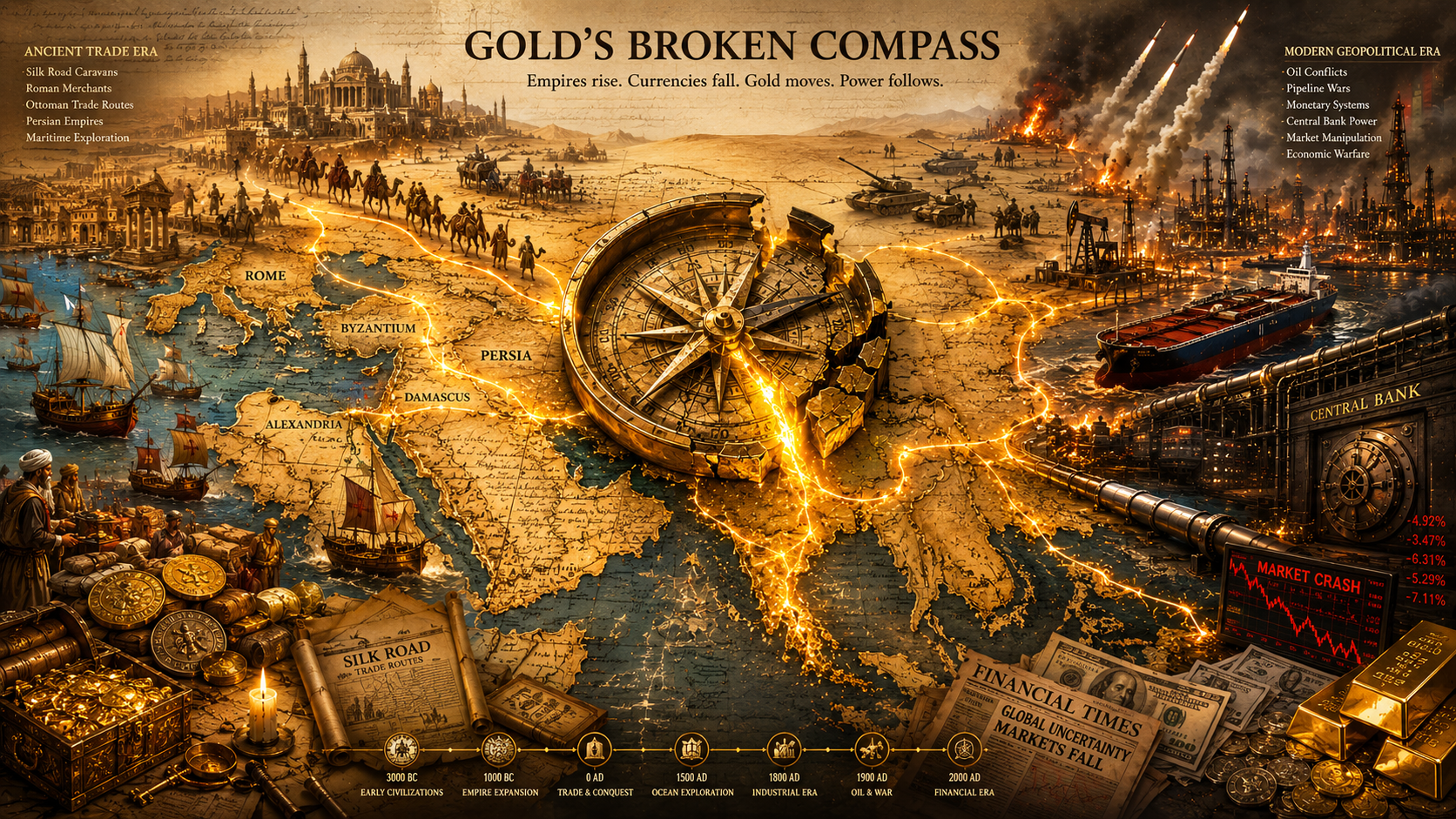
Gold’s War Paradox: History, India’s Limits & 2026 Forecast
Gold’s Broken
Compass
Five Paradoxes That Are Forcing a Rewrite of How This Asset Actually Works — and a Framework for What Comes Next
Gold fell 25% during the biggest war in 20 years. India’s government buys gold officially while ordering citizens to stop. Russia bans its own gold exports. The safe-haven thesis isn’t broken — but it was always incomplete. Here is what 110 years of evidence actually shows, and what traders need to do with it now.
Has Gold’s Operating Logic Changed — or Were We Always Wrong About What It Does?
Gold rose 65% in 2025, hit $5,595, then crashed 25% the moment the biggest war in twenty years began. This is not an anomaly. It is a signal — and the question it forces is not “what went wrong with gold?” but “what did we get wrong about gold in the first place?”
The safe-haven thesis is one of the most deeply held convictions in financial markets. Gold rises when there is war. Gold falls when there is peace. It is, in its simple form, dangerously incomplete. The Iran war of 2026 is not the first time gold has failed this test. It is the most dramatic failure in fifty years of data.
Behind the crash lies something more interesting: a gold market that is simultaneously being upgraded by states and misunderstood by retail investors, financialised in ways that amplify moves in both directions, and weaponised by governments with no historical precedent. Understanding which of these forces is driving price at any given moment is the entire analytical game for XAU/USD traders in 2026.
This article begins with five live paradoxes, extends the historical record back to World War I, builds a four-state practical framework, and ends with 12-month trade setups — with specific entry, stop, and take-profit levels for gold.
- The Five Paradoxes: Contradictions the Old Thesis Cannot Explain
- 110 Years of Evidence: From the Gold Standard to the Iran War
- The Mechanism: Why the Same War Produces Opposite Outcomes
- Is Gold’s Operating Logic Actually Changing? Three Answers.
- The India Chapter: State-Level Schizophrenia About Gold
- The Gold State Model: A Practical Framework for Traders
- 12-Month Trade Projections: Three Scenarios, Precise Levels
- FAQ: Five Questions Every Gold Trader Is Asking
The Five Paradoxes of Gold in 2026
The safe-haven framework makes one simple prediction: armed conflict pushes gold higher. In 2026, that prediction failed spectacularly. But it is not one failure — it is five separate, simultaneous contradictions. Each tells a different part of the story. Click each card to expand the evidence and its analytical implication.
On February 28, 2026, US and Israeli forces struck Iran. Gold spiked 5.2% on Day 1 — exactly as the textbook predicts. Then it crashed nearly 25% over the next ten weeks. The 1-month post-war decline of 13.6% is the single worst wartime performance in all ten major conflicts tracked since 1971.
The deeper paradox: gold had already risen 23.9% in the 30 days before the war began — the largest pre-war rally in history. The market priced in the safe-haven premium before the first missile was fired. When the war’s actual monetary impact became clear, the premium collapsed violently.
Analytical implication: War creates a short-term reflexive safe-haven spike. Whether it holds depends entirely on what the war does to monetary policy — not on the war itself.
The 1973 Yom Kippur War triggered an oil embargo and 400% oil surge. Gold rose 75% over 18 months. The 2026 Iran war triggered a Hormuz disruption and 55% oil surge (Brent to $126/bbl). Gold fell 25%. Superficially identical trigger. Structurally opposite outcome.
The difference is the monetary regime. In 1973 the Fed had no credible anti-inflation policy. In 2026 it has a legal 2% mandate. The oil shock was read as a rate-hike trigger, not a monetary breakdown trigger.
Analytical implication: An oil shock that forces monetary tightening is gold-bearish. An oil shock in a regime of monetary disorder is gold-bullish. The regime is the variable. The war is only the trigger.
In May 2026, PM Modi asked 1.4 billion citizens to stop buying gold jewellery. The import duty was raised from 6% to 15%. Yet simultaneously, the Reserve Bank of India was officially accumulating gold as a strategic reserve, bringing India’s holdings to 876 tonnes.
The same government, in the same week, was restricting gold at the consumer level and accumulating it at the institutional level. This perfectly illustrates gold’s bifurcating role: a consumer import that drains dollar reserves (unwanted) and an unseizable geopolitical strategic asset (essential).
Analytical implication: Gold’s demand base is splitting into two permanently different streams — state-level strategic accumulation (price-insensitive, persistent) and consumer discretionary demand (price-sensitive, suppressible). The structural bid is now sovereign, not retail.
Gold entered the Iran war having risen 65% in 2025. When other assets generated losses from oil-driven inflation, institutions sold gold not because of a changed view — but because it was the most liquid asset with the largest unrealised gains.
This mechanism did not exist in 1973. The paper gold ecosystem — ETFs (first launched 2004), derivatives, structured products — had not been built. A 25% decline in 10 weeks would have been structurally impossible in the pre-ETF era. Physical demand is sticky. Paper demand is not.
Analytical implication: Monitor weekly ETF holdings data as closely as geopolitical headlines. Sustained institutional outflows are a more reliable near-term price indicator than any war bulletin.
From May 1, 2026: Russia banned gold exports over 100g, removing an estimated 300+ tonnes annually from international markets. China accelerated reserve accumulation. BRICS proposed a settlement unit 40% backed by physical gold. India’s RBI bought gold officially while banning citizens from importing it. All while Western ETF holders were selling.
The 2022 freezing of Russia’s $300bn in dollar reserves sent an irreversible signal: dollar assets can be weaponised; physical gold held domestically cannot. This permanently altered central bank reserve policy — creating a structural demand floor independent of short-term price moves.
Analytical implication: Watch World Gold Council monthly central bank data as closely as ETF flows. The structural floor in gold is now sovereign demand. This is a more stable but less reflexive foundation than any previous bull market cycle.
Common thread across all five paradoxes: Gold’s operating logic has not broken — it has layered. The monetary-policy mechanism remains the dominant driver. The financialisation layer amplifies moves in both directions. The state-weaponisation layer creates a structural demand floor. Navigating which layer is active at any given moment is now the essential analytical skill for gold traders.
From the Gold Standard to the Iran War
This is not a timeline of wars. It is a record of every time gold’s behaviour contradicted investor expectations — organised by the monetary regime that determined the outcome. The regime is always the explanation. The war is only sometimes the trigger.
The Iran war 2026 (−13.6% in 30 days) is the single worst wartime gold performance in the entire dataset. All positive performers share one characteristic: the Fed was unable or unwilling to raise rates at the time. The Ukraine 2022 crash is the most instructive precedent — identical mechanism.
Era 1: The Gold Standard (1914–1971) — When the Price Could Not Speak
The Gold Standard’s Defining Stress Test: Every Government Chose War Over Gold
When WWI began in August 1914, every major European belligerent — Britain, France, Germany, Russia, Austria-Hungary — suspended gold convertibility within weeks. The classical gold standard, which had delivered price stability since the 1870s, was abandoned the moment war finance required money printing. The gold price ($20.67/oz) did not move in the official market — but Swiss black market premiums told the real story. The lesson: even under the gold standard, states facing existential threats choose monetary expansion over monetary discipline. The price fix was a lie.
Gold Fixed at $35 — Suppressed, Not Absent
Under Bretton Woods the gold price is pegged at $35/oz and says nothing about the war. The Fed caps Treasury yields at 2.5% and monetises wartime debt. The seeds of the inflationary 1970s are planted here. When Bretton Woods collapses in 1971 and gold is finally released to markets, it quickly reveals how much suppressed monetary value had accumulated: from $35 in 1971 to $200 by 1974. Not because of any single war — but because 30 years of suppressed monetary reality was suddenly priced in at once.
Gold Is Released to Markets — Everything That Follows Starts Here
Nixon closes the gold window. Gold begins responding to real interest rates, dollar value, and monetary policy expectations. This is the founding moment of modern gold trading. Every “war trade” since must be understood in this context: gold rising in wars is not inevitable — it is conditional on the monetary regime. The proof arrived almost immediately when Paul Volcker raised rates to 20% in 1980 and gold crashed from $850 to $252 over 20 years, despite ongoing conflicts worldwide.
Era 2: The Wars That Created the Myth (1973–1980)
+75%: The War That Created the Safe-Haven Myth — and Why It Was a Special Case
Egypt and Syria attack Israel. OPEC imposes an oil embargo. Gold rises 75% over 18 months. But 1973 had a unique monetary context: the Fed had no credible anti-inflation policy; the dollar had only been freed from gold two years earlier; real yields were deeply negative; and dollar credibility was genuinely uncertain. The war was the catalyst. The monetary breakdown was the engine. Future investors would conflate the two — and pay for it in 2022 and 2026.
+126% in 12 Months: Three Crises, One Broken Dollar — and the Proof
Gold hits $850. Then Volcker raises rates to 20% in 1980 and gold crashes — and keeps falling for 20 years despite ongoing conflicts. This is the definitive proof: the entire 1970s gold bull was fundamentally a monetary story, not a geopolitical one. The moment the monetary environment was corrected, gold collapsed regardless of geopolitics. This lesson has been available since 1982. Most investors still haven’t learned it.
Era 3: The Wars That Did NOT Move Gold (1990–2003)
+15.8% Then Full Reversal: The 100-Hour Template
Gold spikes 15.8% then reverses completely as the war ends in 100 hours, the dollar holds firm, and the Fed remains credible. Short wars with clear outcomes and a credible central bank do not sustain gold rallies. The war premium in gold is about monetary uncertainty — not military action. With the dollar functioning well, there is nothing for gold to hedge.
Muted or Negative: Telegraphed Wars Have No Surprise Premium
Afghanistan 2001: Gold barely moves — the war was telegraphed by 9/11, and the Fed was cutting rates aggressively. Iraq 2003: gold actually fell on invasion day — six months of UN debates had already priced in the conflict. Markets react to changes in expectations, not to events themselves. When a war is fully priced in, the actual event has zero additional impact on gold. This principle explains the 23.9% pre-war rally in 2026 and the subsequent crash.
Era 4: The Modern Cycle — The Template Was Written Before Iran (2022–2026)
The Blueprint Nobody Used: Spike to $2,070, Crash to $1,620 as Fed Hiked 11 Times
Russia invades Ukraine. Gold spikes to $2,070. Then the Fed raises rates 525bps over 11 hikes. Gold falls to $1,620 by September 2022 — a 22% decline from peak. The mechanism: war → energy → inflation → Fed tightening → real yields rise → dollar strengthens → gold falls. This is exactly the 2026 Iran playbook. It was written clearly and widely published. The 2026 crash was not a surprise — it was the 2022 template repeated at greater scale.
Gold Rose and Kept Rising — Because This War Did NOT Threaten Oil Supply
Hamas attacks Israel. Gold surges and keeps surging, beginning the rally that would carry it to $5,595 by January 2026. The critical difference from Iran 2026: this war did not threaten major oil supply chains, did not trigger an inflationary oil shock, and did not kill rate cut expectations. Safe-haven demand and falling real yields could coexist. The war was the catalyst; the monetary tailwind was the engine.
−25%: The Oil-Shock Paradox in Its Clearest and Most Costly Form
US and Israel strike Iran. Gold spikes 5.2%. Brent crude surges toward $126. CPI hits 3.8%, PPI +1.4% MoM. All rate cut expectations evaporate. Rate hike probability rises to 39%. Gold crashes 25% — the worst wartime performance in 50 years. The 2022 template played out at greater magnitude, amplified by paper gold liquidation from a larger 65% pre-war gain.
From $35 in 1971 to $5,595 in January 2026. Every major peak coincides with a period of monetary disorder — not just geopolitical conflict. Every major trough coincides with rising real interest rates. The pattern has been consistent for 55 years.
Why the Same War Produces Opposite Outcomes
The oil-shock paradox is the clearest illustration. In 1973 and 2026, a Middle East war triggered a major oil shock — yet gold rose 75% in 1973 and crashed 25% in 2026. The explanation is structural, not incidental.
GOLD SURGES — monetary disorder confirmed ✓
GOLD CRASHES — monetary tightening confirmed ✗
Three Mechanisms of the 2026 Crash
1 — The Rate Hike Paradox
Goldman Sachs quantifies the gold-rate relationship precisely: each 25bps of expected Fed rate cut generates approximately 60 tonnes of new gold ETF demand within six months. The Iran war did not just remove cut expectations — it added hike probability. Every basis point of additional hike expectation reversed the mechanism and generated institutional selling. At 39% hike probability priced, the selling pressure was substantial.
2 — Paper Gold Liquidation at Scale
Gold had risen 65% in 2025. When other assets generated losses from oil-driven inflation, institutional holders sold gold not because of a changed view — but because it was liquid and held the largest unrealised gains of any major asset class. ETF outflows reached multi-year highs in March 2026. Physical gold demand held steady. Paper gold demand collapsed — and the paper market now dwarfs the physical market.
3 — Central Bank Partial Reversal
Central banks in energy-importing emerging markets began selling gold to raise dollar liquidity for buying oil and defending currencies. Turkey turned net seller. Russia sold to fund wartime spending. The structural floor that had supported gold through four consecutive years of record buying partially gave way precisely when speculative demand also collapsed. The combination was devastating to price.
Is Gold’s Operating Logic Changing — or Did We Always Have the Wrong Theory?
The evidence from 110 years of conflict resolves into three answers — all simultaneously true. Together they explain why gold behaves differently now, without requiring the conclusion that gold’s fundamental function has changed.
Answer 1: Nothing Has Changed — We Had the Wrong Theory From the Start
Gold has always been a monetary disorder hedge, not a war hedge. The 1973 and 1979 episodes created the myth because they happened to coincide with genuine monetary disorder. Every conflict since — Gulf War 1990, Afghanistan 2001, Iraq 2003, Ukraine 2022, Iran 2026 — produced flat or negative gold performance, and all share one factor: a Fed that was able to respond to inflationary pressure. The framework was correct. The application to war as a trigger rather than monetary disorder as the condition was always wrong. This is the most important single insight in this article for anyone who has ever bought gold on a war headline.
Answer 2: Something Has Changed — Financialisation Has Transformed Short-Term Behaviour
The explosive growth of paper gold since 2004 has permanently altered gold’s short-term market dynamics. The 25% decline in 10 weeks seen in 2026 would have been structurally impossible in 1973 — physical gold buyers do not panic-sell. Institutional risk management decisions — margin calls, position limits, portfolio rebalancing — now drive short-term price action in ways with no historical precedent. The “war = buy gold” reflex now more often traps retail traders on the wrong side of institutional liquidation events than it makes them money.
Answer 3: Gold Is Being Upgraded — From Consumer Safe Haven to State Strategic Weapon
Central banks have purchased over 800 tonnes annually for four consecutive years. Russia banned gold exports — treating it as a strategic military resource. The BRICS proposed settlement unit ties 40% of its value to physical gold. The 2022 freezing of Russia’s $300bn in dollar reserves sent an irreversible signal: dollar assets can be weaponised; physical gold held domestically cannot. This has permanently altered central bank reserve allocation. Gold is becoming a better long-term store of value and a worse short-term crisis trade. Its demand base is becoming more institutionally anchored and less retail-driven.
The verdict: Gold’s framework hasn’t broken — it has layered. The monetary-policy mechanism is unchanged and remains dominant. The financialisation layer is new and amplifies both rallies and crashes. The state-weaponisation layer is new and creates a structural demand floor that did not exist in previous cycles. The safe-haven thesis was not wrong. It was always incomplete.
The Government That Accumulates What It Forbids Citizens to Buy
India’s May 2026 gold policy is the single most vivid illustration of the India Paradox — and of the broader bifurcation of gold’s demand base between state-level strategic accumulation and consumer-level discretionary demand.
What Happened: Three Policy Actions in 48 Hours
On May 10–11, 2026, PM Modi publicly asked 1.4 billion citizens to voluntarily stop buying gold jewellery for at least one year — framing it as a form of national economic participation. Within 48 hours: the import duty was raised from 6% to 15% (10% BCD + 5% AIDC); the DGFT reclassified gold jewellery imports from “Free” to “Restricted” (requiring prior government licences); bank gold import programmes were disrupted by the regulatory change. Within hours of the announcement, domestic gold prices jumped nearly 6% — paradoxically benefiting existing holders.
Why: The Foreign Exchange Arithmetic
India’s forex reserves fell from a record $728.49bn on February 27 to $690bn by May 1 — a $38.5bn decline in 10 weeks driven by soaring oil import costs from the Iran war. India imports 89% of its crude oil. With the oil basket price rising from $69 to $109 per barrel, energy imports were non-negotiable. Gold imports — $72bn in 2025-26, up 58% YoY — became the only discretionary lever. Every dollar oil rises costs India approximately $1.7bn per year in foreign exchange; gold imports were the only lever government could pull.
India uses the gold import duty lever every time forex reserves come under significant pressure. The 2026 hike from 6% to 15% is the sharpest single-year increase on record. Precedents from 2013 and 2022: both times smuggling increased, long-term demand eventually rebounded, and the structural trend was determined by US monetary policy — not Indian import duties.
The Split-Brain Policy: RBI Buys While Modi Forbids
While Modi asked citizens to stop buying gold, the Reserve Bank of India was officially accumulating it. India’s official holdings stand at 876 tonnes. The same government is treating gold as two completely different things: a consumer import that drains dollar reserves (restrict it) and a geopolitical strategic reserve that cannot be frozen by adversaries (accumulate it). This is not contradiction — it is the clearest possible statement of gold’s bifurcating role in modern finance.
History says this policy works only temporarily. India did the same in 2013 and 2022. Both times: official imports fell, smuggling surged, and structural demand eventually returned. India’s gold appetite — driven by centuries of cultural, religious, and investment tradition — is among the most price-inelastic demand curves in any commodity market. For global gold prices, India’s restriction is a mildly negative short-term factor. The Federal Reserve’s interest rate path remains the variable that matters most.
The Gold State Model: Four States, Clear Signs, Specific Outcomes
At any point in time, gold is operating in one of four identifiable states. Each has a different dominant driver, produces different typical price behaviour, and has specific observable signs. Select a state below to see the full diagnostic.
Signs You’re in Tailwind
Historical examples: Most of 2024–2025, Q4 2023 when Fed pivoted. Gold rose 65% in 2025 in a classic Tailwind state.
What Gold Does in Tailwind
What to Watch For
Current Gold State (May 14, 2026): Headwind — TIPS real yield +1.8% (above +1.5% threshold), rate cut probability below 30%, ETF outflows ongoing. Partial Floor — CB buying continues to provide a structural bid at $4,500–4,600. State transition trigger: WTI oil falling below $90 sustained. That alone allows the Fed to reconsider cuts, beginning the shift from Headwind to Tailwind.
XAU/USD: Three Scenarios, Precise Levels, One Year
The Gold State Model identifies the transition trigger precisely: gold shifts from Headwind to Tailwind when oil falls enough to allow the Fed to signal rate cuts. That is the single event that matters more than any other. Three scenarios — with specific entry, stop, and take-profit levels for XAU/USD.
State: Headwind → Tailwind. Hormuz reopens in 30–60 days. WTI falls to $75–80. Fed signals 2–3 cuts H2 2026. Goldman: 3 cuts × 60t ETF demand = 180t new institutional buying. Western ETF demand returns. India partially relaxes duty. Target: $5,400–6,300.
State: Headwind / Floor hybrid. War continues; Hormuz partial. Oil $85–105. Fed holds all year. CB buying provides floor at $4,500–4,600. ETF demand muted. Russia export ban tightens supply. Target: $4,800–5,200 range.
State: Deep Headwind. Iran strikes Gulf infrastructure. WTI above $130. Fed forced to hike. Brief fear spike then crash — repeat March 2026. India doubles down with emergency import ban. Target: $3,800–4,200 before structural recovery.
🟢 Ceasefire / Tailwind Recovery — Probability: 40%
Trigger: Hormuz reopens; WTI falls below $90; CPI drops to 3% range by Q3 2026; Fed signals 2–3 rate cuts; TIPS real yield falls below +1.2%; ETF inflows positive for 3+ consecutive weeks.
Key acceleration: first Fed 25bps cut = 60t of new ETF demand entering within 6 months. Three cuts = 180t. Combined with 800t+ annual CB buying: well above the threshold for sustained price appreciation toward JPMorgan’s $6,300 target.
⚖️ Managed Stalemate — Probability: 45%
Trigger: War continues; Hormuz partial; oil $85–105; Fed holds all year; India duty maintained; CB buying provides floor; ETF flows mildly negative but stable. Gold grinds sideways within a defined range.
Russia export ban (300t+ removed annually) and continued CB buying provide structural support at the floor. No Fed catalyst means no directional breakout. Trade the range with discipline — 2–3 complete cycles expected.
🔴 Escalation / Deep Headwind — Probability: 15%
Trigger: Iran strikes Saudi/UAE energy infrastructure; WTI above $130; CPI above 5%; Fed forced to hike; TIPS real yield rises above +2.5%; ETF outflows accelerate sharply.
Initial war spike to $5,200 (brief Override), then deep crash as Fed hikes into oil-driven inflation (Headwind deepens). Structural CB buying reasserts below $4,000. Keep trailing stops tight on shorts after $4,200.
🏛️ CB Floor — The Patient 12-Month Accumulation Trade
Regardless of which scenario plays out, central banks are buying gold as a structural geopolitical reserve. This creates a floor independent of short-term price moves. The accumulation trade is not about timing — it is about buying at the level where sovereign demand persistently enters.
All major institutional forecasters remain bullish despite the Iran war crash. The range reflects genuine uncertainty about the Fed rate path — not about gold’s structural drivers. Goldman’s mechanism: 3 cuts in H2 2026 = approximately 180 additional tonnes of ETF demand.
Five Questions Every Gold Trader Is Asking
The Compass Is Not Broken — the Map Was Incomplete
Gold has maintained its value across six thousand years of human history, outliving every empire, every currency, and every government that tried to suppress or fix its price. In 2026, we have added a new chapter: a prime minister asking 1.4 billion citizens to stop buying the very asset his central bank is simultaneously accumulating. A producing nation banning its own gold exports as a strategic military resource. A geopolitical alliance proposing to settle trade in a unit 40% backed by physical gold. And a free market that sold gold aggressively during the biggest war in twenty years.
None of this represents a breakdown of gold’s function. It represents its layering. The monetary-policy mechanism — real yields, dollar value, rate expectations — remains the primary driver of price direction, exactly as it has since August 1971. The financialisation layer amplifies every move in both directions. The state-weaponisation layer creates a structural demand floor more stable and persistent than any retail safe-haven bid ever was.
The safe-haven thesis was not wrong. It was always incomplete. Gold does not hedge wars. It hedges the monetary consequences of wars. The Iran war of 2026 created the wrong monetary consequences — oil-driven inflation that forced real yields higher and eliminated rate cut hopes. The day that changes — the day Hormuz reopens, oil falls, and the Federal Reserve regains room to cut — gold’s structural bull market will reassert itself with the same force that drove it from $2,000 to $5,595. The compass is not broken. The map we were using to read it was missing three layers that now matter as much as the one we always knew about.
Trade Gold XAU/USD → Claim Your Bonus →