Petrodollar Explained: The 50-Year System Behind Global Oil & Dollar Dominance
The 50-Year Racket. The Biggest Rig in History — How America Captured the World’s Oil Revenue — The Complete History of the Petrodollar Arrangement, Its Architecture of Control, and Why the Gulf Is Walking Away
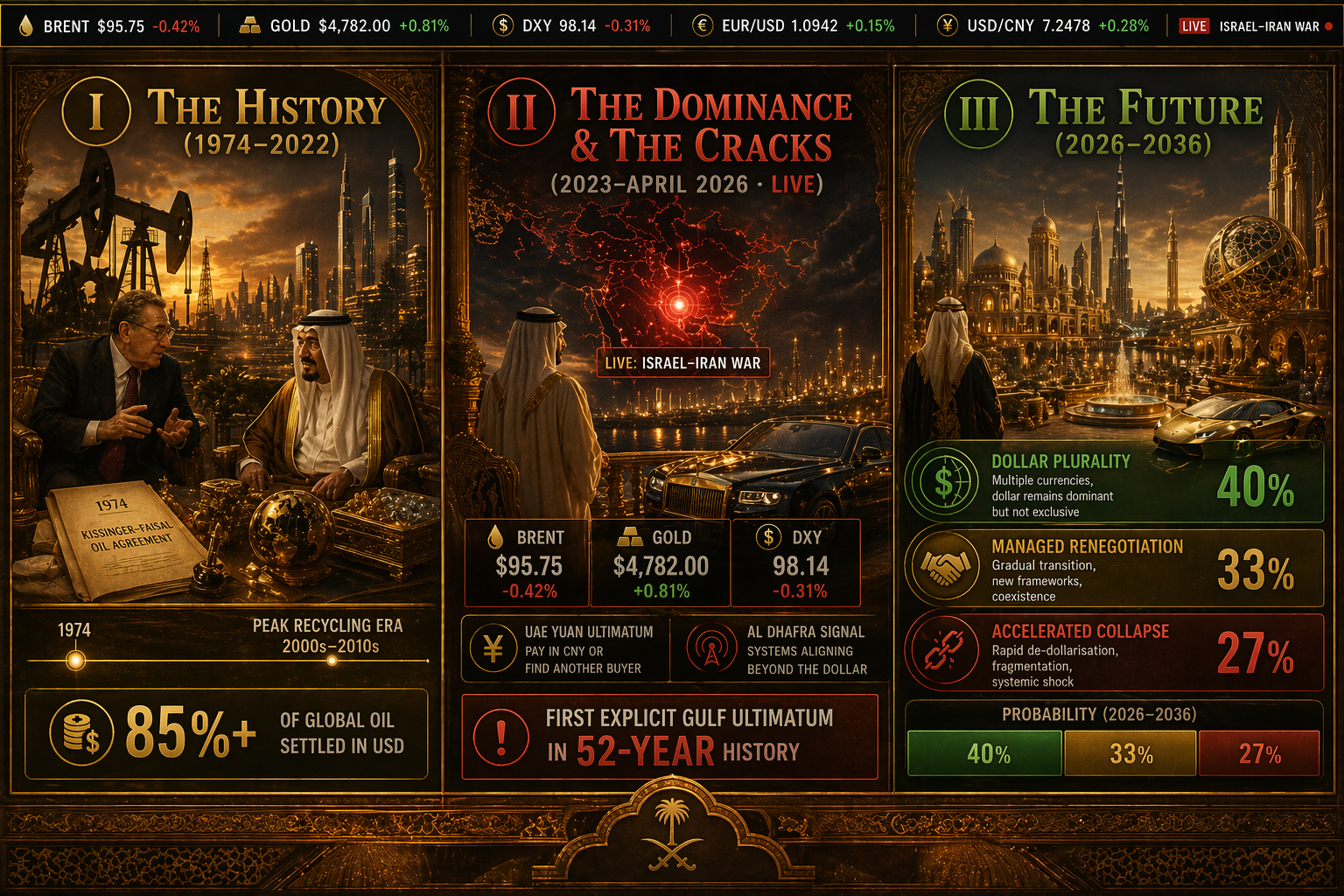
In the summer of 1974, Henry Kissinger flew to Riyadh and made the most consequential financial deal in modern history. It was not a treaty. It was not a trade agreement. It was an arrangement — a word chosen deliberately, because what was agreed could never be written down in full. For fifty years, that arrangement shaped every oil transaction on earth, financed American power, and held the Gulf states in a gilded cage of their own choosing. Now, quietly and with gathering purpose, they are testing the lock.
The World Before the Deal: Oil, Empires, and the Weapon That Changed Everything
Oil was already the most politically explosive commodity on earth long before Henry Kissinger ever set foot in Riyadh. The Arabian Peninsula’s oil reserves had been discovered and developed almost entirely by Western corporations — Standard Oil of California struck crude in Saudi Arabia in 1938, operating under a concession arrangement in which the Kingdom received a modest royalty in exchange for the right to extract, price, and sell its own national resource as the Americans saw fit. The arrangement was the commercial expression of a political reality that most Gulf leaders accepted as the permanent condition of the post-colonial world: Western technology, Western capital, and Western military power were the preconditions for extracting the underground wealth that geology had placed beneath their sands. The price for those preconditions was sovereignty over the pricing and disposition of that wealth.
For the first three post-war decades, this arrangement held. The major Western oil companies — the “Seven Sisters” of Exxon, Shell, BP, Gulf Oil, Texaco, Chevron, and Mobil — operated as a cartel that set oil production levels, prices, and distribution with minimal input from the host governments. Posted oil prices were fixed in US dollars, set by the companies, and changed unilaterally. When Exxon cut the posted price of oil without consulting the producing governments in 1959, the resulting outrage led directly to the founding of OPEC — the Organisation of Petroleum Exporting Countries — in Baghdad in September 1960, an event whose full consequences would take another thirteen years to become visible. The geopolitical history of oil pricing remains one of the most important analytical frameworks for understanding commodity market dynamics today.
The 1973 Earthquake: OPEC Discovers Its Weapon
October 6, 1973. Egypt and Syria launch a surprise attack across the Suez Canal and the Golan Heights against Israel on the Jewish holy day of Yom Kippur. The United States, under Richard Nixon and Kissinger as National Security Advisor, organises a massive emergency airlift of military equipment to resupply the Israeli Defence Forces. The Arab members of OPEC respond with a weapon they have been constructing in theory for years and had never fully tested in practice: they impose an oil embargo on the United States and any nation supporting Israel, and simultaneously announce production cuts designed to drive the oil price higher.
The results were convulsive. In the United States, petrol queues stretched for blocks. Speed limits were slashed to 55 mph to conserve fuel. Daylight saving time was extended. President Nixon appeared on television urging Americans to keep their homes cooler and their Christmas lights switched off. The economy, already strained by the fiscal expansion of the Vietnam War era, slipped toward stagflation. For the first time in post-war history, Americans experienced viscerally what dependence on foreign energy meant — not as an economic abstraction but as a daily humiliation at the petrol pump. The oil price, which had sat at approximately $3 per barrel at the embargo’s start, had quadrupled to $12 by early 1974. The economic consequences spread far beyond the United States: every industrialised nation dependent on imported oil — Japan, West Germany, France, the UK — was simultaneously struck by the same inflationary shock. The world’s first oil crisis had demonstrated, with shocking speed and clarity, that the producing nations of the Gulf collectively held a lever capable of stopping the entire machinery of Western industrial civilisation.
The 1973 embargo was not merely an economic crisis. It was a civilisational warning: the industrial world ran on a fuel controlled by states that had, until that week, been assumed to be permanently subordinate.
Capital Street FX Research Desk — April 2026
For Kissinger, the 1973 crisis was not primarily an energy problem. It was a strategic problem demanding a strategic solution. The question was not how to reduce American oil dependence in the short term — that was a technical and political matter that would take decades. The question was how to ensure that the enormous financial power that the oil price quadrupling had placed in Gulf hands was deployed in ways that served American interests rather than threatening them. The answer Kissinger devised was as elegant as it was audacious: instead of trying to reduce Gulf financial power, the United States would capture it. Understanding the strategic logic of the petrodollar arrangement is essential context for any trader analysing long-term USD dynamics.
The Arrangement: What Kissinger and King Faisal Actually Agreed in the Summer of 1974
In June 1974, Henry Kissinger and Treasury Secretary William Simon flew to Riyadh for a series of meetings with King Faisal bin Abdulaziz Al Saud and Saudi Finance Minister Mohammed Abalkhail that would, over the following weeks and months, produce the framework now known as the petrodollar arrangement. The meetings were not widely publicised at the time. The agreements reached were never codified in a publicly released treaty. What emerged was something more durable than a formal agreement: a mutual understanding between two governments, grounded in convergent self-interest so powerful that it did not require legal enforcement. Each party was getting something it desperately needed. Each party understood what would happen if the other party stopped delivering.
What Saudi Arabia Got
The United States offered King Faisal three things of extraordinary value. First, a military security guarantee — not merely arms sales, but the implicit commitment of American military power to the defence of the Saudi state against external threat and internal destabilisation. In a region where the Shah of Iran was ascendant and Israeli military capability had just been demonstrated in the Yom Kippur War, the American security umbrella was the most valuable single asset a Gulf monarch could possess. Second, access to American technology, expertise, and infrastructure development — the United States Joint Commission on Economic Cooperation, established in 1974, channelled American civilian and military technical assistance into Saudi Arabia at a scale that no other patron could match, building everything from military installations to desalination plants to telecommunications networks. Third, privileged access to US financial markets for the recycling of Saudi oil revenues — crucially, with a degree of opacity not offered to other foreign investors, with Saudi Treasury holdings excluded from the public reporting that revealed other nations’ positions. The structural consequences of this arrangement for the USD continue to define every major dollar currency pair in the forex market.
What America Got
In exchange, Saudi Arabia agreed to three things of equal strategic value to Washington. First, and most fundamentally: all Saudi oil sales would be denominated and settled exclusively in US dollars. Saudi Arabia would use its position as OPEC’s dominant producer and political voice to ensure that every other OPEC member adopted the same convention. The dollar would become the sole currency of the global oil trade — meaning that every nation on earth that needed to import oil was compelled to hold dollar reserves, creating structural global demand for the US currency independent of American trade flows or economic performance. Second, the accumulated dollar revenues from Saudi oil sales — the petrodollars — would be recycled back into US Treasury securities, US military equipment purchases, and US financial markets, rather than deployed into competing financial systems or used to purchase American industrial assets in ways that might raise political concerns. Third, Saudi Arabia would use its OPEC leadership to ensure that oil production levels, while managed to maintain price stability and producer revenues, would not be weaponised against the United States again as they had been in 1973.
The petrodollar arrangement was not a transaction. It was a structural relationship — a set of interlocking dependencies so deeply embedded in both parties’ economic and security interests that deviation by either side imposed immediate, visible, catastrophic costs. That mutual dependency was the genius of the design.
- Military security guarantee for Gulf monarchies
- Arms sales, military training, base infrastructure
- Technology transfer & civilian expertise
- Access to US financial markets at privileged opacity
- Political cover at the UN and in Western capitals
- Intelligence support against internal threats
- Dollar-only pricing for all oil exports
- Recycling of surpluses into US Treasuries & equities
- OPEC alignment with US production preferences
- No weaponisation of oil against the US or allies
- Strategic basing rights for US military forces
- Political stability serving Western regional interests
By 1975, all OPEC members had adopted dollar-only pricing for their oil exports. The petrodollar arrangement had been extended from a bilateral US-Saudi understanding into a universal convention of the global oil trade. This extension was not achieved solely by American diplomatic pressure. It reflected the rational self-interest of every oil-producing state: with their revenues now flowing in dollars and their financial reserves denominated in dollars, any individual producer who priced its oil in an alternative currency would be introducing exchange rate risk into its revenue stream with no compensating benefit. The system had become self-reinforcing. The dollar lock on oil pricing did not need to be enforced. It was simply the most rational choice for every participant in the market it had created. WTI crude oil and Brent futures remain dollar-denominated benchmarks directly tradeable at Capital Street FX, as they have been since this arrangement was institutionalised.
The Architecture of Control: How Dollar Oil Pricing Worked as a Global Revenue Capture Mechanism
The petrodollar arrangement was, in its most stripped-down description, a mechanism by which the United States extracted a structural tax from every oil-importing nation on earth without those nations ever consciously paying it. The mechanism was elegant precisely because it was invisible: it operated not through any explicit levy or treaty obligation, but through the logical consequence of a single convention — oil is priced in dollars — that appeared to be nothing more than a neutral commercial standard.
The Invisible Tax: How the System Extracted Value
The logic ran as follows. Japan needs to import 100 million barrels of crude oil per year. To pay for that oil, Japan must first acquire US dollars. Japan therefore sells yen and buys dollars — creating demand for USD and supply of JPY. Japan holds dollar reserves as a working balance to ensure it can always pay for its next oil shipment without exchange rate disruption. Japan invests those dollar reserves in US Treasury bonds, because Treasuries are the most liquid and safest dollar-denominated asset available. The United States, receiving this investment, borrows at lower interest rates than its fiscal position would otherwise justify, and uses the proceeds to finance its government expenditure — its military, its social programmes, its infrastructure. Japan, in effect, lends to the United States at subsidised rates in exchange for the privilege of accessing the oil that keeps its economy running. And Japan has no choice in this arrangement, because the oil is only available in dollars. The tax is levied not by legislation but by the architecture of the oil market.
Now multiply that single transaction across every oil-importing nation — Japan, South Korea, India, Germany, France, Brazil, China, every developing economy growing its industrial base — and across every year from 1974 to the present. The cumulative value of the subsidy that oil-importing nations have provided to the United States through forced dollar demand and Treasury recycling is a figure no government has officially calculated, but estimates from academic economists range from $5 trillion to $15 trillion in present-value terms over the arrangement’s fifty-year history. The structural premium that dollar reserve status confers on US asset valuations is directly relevant to traders positioning in US equity indices and Treasury markets.
The Currency Peg as a Compliance Mechanism
The Gulf states’ decision to peg their own currencies to the US dollar was not merely a technical monetary choice. It was the visible expression of the arrangement’s logic, and it created a feedback loop that deepened the structural dependency on both sides. By pegging the Saudi riyal, the UAE dirham, the Kuwaiti dinar, and the Qatari riyal to the US dollar at fixed rates — the Saudi riyal at 3.75 to the dollar since 1986, the UAE dirham at 3.6725 since 1997 — the Gulf states effectively merged their monetary systems with America’s. Their central banks were required to hold dollar reserves sufficient to defend the peg. Their interest rates were effectively set by the Federal Reserve, not by their own monetary committees. Their inflation imported the consequences of American monetary policy regardless of their own domestic conditions. The peg was simultaneously a statement of geopolitical alignment and a structural constraint on economic sovereignty — a gilded cage, its gold supplied by American security guarantees and its bars formed by the mechanics of dollar dependency. The structural dollar demand created by Gulf currency pegs is among the most important and least-discussed supports for USD strength in major forex pairs.
The Machine in Motion: How Petrodollar Recycling Financed American Power for Fifty Years
The term “petrodollar recycling” describes the circular flow of money that the arrangement created and that became one of the most important structural forces in global finance. Oil-producing nations receive dollars for their crude. They have more dollars than they can spend domestically. They invest those surplus dollars back into US financial markets — Treasury bonds, equities, real estate, private equity funds. The dollars flow out of the United States in payment for oil; they flow back as investment capital. The United States simultaneously pays for its energy imports and receives financing for its fiscal deficits. The arrangement is, from Washington’s perspective, close to a perpetual motion machine: it prints money, buys oil, and gets the money back as a loan.
Note: Flow volumes reflect peak petrodollar recycling years (2010–2014) when oil above $100/barrel generated GCC surpluses of $500–700B annually. At current prices (~$86 WTI / ~$96 Brent, April 21 2026), gross flows are approximately $380–430B annually, elevated by the Hormuz crisis risk premium but volatile against ceasefire developments.
The financial scale of what was flowing through this loop at the arrangement’s peak is almost impossible to overstate. In 2012 and 2013, when Brent crude averaged above $110 per barrel, the six GCC states — Saudi Arabia, UAE, Kuwait, Qatar, Bahrain, and Oman — were collectively generating current account surpluses of approximately $480–550 billion per year. The Saudi Public Investment Fund, the Abu Dhabi Investment Authority, the Kuwait Investment Authority, and the Qatar Investment Authority were absorbing petrodollar surpluses faster than their investment committees could deploy them. American banks — Citigroup, JPMorgan, Goldman Sachs, Merrill Lynch — had entire Gulf investment banking divisions whose primary function was managing the recycling of petrodollars into US and European assets. London’s property market was partly underwritten by Gulf sovereign wealth. American defence contractors were among the primary beneficiaries of petrodollar purchasing power. The arrangement was not merely sustaining the dollar. It was financing the entire Western financial establishment. Understanding petrodollar recycling dynamics is essential for traders in both oil and major currency pairs, as the flows directly affect USD liquidity conditions globally.
Sources: IMF, GCC central banks, Sovereign Wealth Fund Institute, US Treasury TIC data. SWF figures approximate as of Q1 2026. Recycling allocation estimates based on academic literature and available disclosed holdings. *2026E surplus elevated by Hormuz crisis risk premium at current WTI ~$86 / Brent ~$96 (April 21, 2026); highly volatile against ceasefire/escalation developments.
The Larger-Than-Life Characters Who Built, Ran, and Are Now Dismantling the Petrodollar
Henry Kissinger: The Architect
No individual is more responsible for the petrodollar arrangement’s creation than Henry Alfred Kissinger — the German-born Harvard professor who served simultaneously as National Security Advisor and Secretary of State, and who approached international relations with the unsentimental strategic clarity of a man who had spent his career studying the mechanics of power. Kissinger understood, with a precision that eluded most of his contemporaries, that the 1973 oil shock had created not merely an economic crisis but a strategic opportunity: the Gulf states had demonstrated their financial power, and that power needed to be embedded in the American system before it could be deployed against it. His mission to Riyadh in June 1974 was not a diplomatic visit. It was an acquisition — the purchase of the world’s most important commodity market using the currency of American military power. Kissinger’s strategic framework for converting financial vulnerability into structural advantage remains one of the most studied cases in geopolitical economy.
King Faisal: The Reluctant Partner
King Faisal bin Abdulaziz Al Saud was, in 1974, simultaneously the most powerful and the most conflicted figure in the petrodollar story. He had orchestrated the 1973 oil embargo with genuine ideological conviction — the Arab cause, the Palestinian question, the humiliation of American support for Israel were not rhetorical positions for Faisal but personal and religious commitments of the deepest sincerity. And yet he was also a pragmatist who understood that Saudi Arabia’s long-term security depended on the United States in ways that no other power could replicate. The Soviet Union, which was courting Arab nationalist governments across the region, represented an ideological and political threat to Gulf monarchies far more acute than American cultural imperialism. Faisal’s agreement to the petrodollar arrangement was a decision to choose the security guarantee over the ideological gesture — and to pay for it, in the currency of political independence, for the rest of the Kingdom’s modern history. He was assassinated in March 1975, eight months after the arrangement was concluded, by his own nephew.
Sheikh Ahmed Zaki Yamani: The Voice of Oil
Saudi Arabia’s Oil Minister from 1962 to 1986, Ahmed Zaki Yamani was the most famous oil minister in OPEC’s history and the public face of the petrodollar era’s first decade. Elegant, intellectually formidable, and deeply aware of the historical forces his decisions were shaping, Yamani was simultaneously the architect of the 1973 embargo and a persistent voice for moderation in oil pricing — a man who understood, with unusual clarity, that oil priced too high would accelerate the search for alternatives, and that the Kingdom’s long-term interest lay not in maximising short-term revenue but in maintaining oil’s indispensability to the global economy at a price that did not make alternatives economically viable. His warning in the 1970s — “The Stone Age didn’t end because we ran out of stones” — is perhaps the most prescient single observation in the entire history of the petrodollar arrangement. It was a warning about the threat of energy transition fifty years before that threat became concrete.
Mohammed bin Salman: The Disruptor
Crown Prince Mohammed bin Salman, who has been the effective ruler of Saudi Arabia since 2017, represents the most significant departure from the petrodollar arrangement’s original terms since 1974. Where his predecessors navigated the American relationship with the deference of states that knew their security depended on it, MBS has pursued a strategic repositioning of Saudi Arabia as an autonomous geopolitical actor — one that uses its oil wealth not merely to recycle dollars back to Washington but to build domestic industry (Vision 2030), attract Chinese investment, normalise relations with Iran, and, most consequentially, execute the first yuan-denominated oil trades in the arrangement’s fifty-year history. Whether MBS represents the arrangement’s end or merely its renegotiation remains the central open question in petrodollar analysis. Capital Street FX’s daily analysis covers MBS’s strategic moves and their implications for oil and USD pricing in real time.
Sheikh Zayed bin Sultan Al Nahyan: The UAE’s Founding Patriarch
No figure shaped the UAE’s relationship with the petrodollar arrangement more profoundly than Sheikh Zayed bin Sultan Al Nahyan, the founding father and first President of the United Arab Emirates, who ruled until his death in November 2004. Zayed took Abu Dhabi from a largely undeveloped emirate into one of the world’s most consequential oil states with a speed that astonished contemporaries. His decision to use oil revenues not merely for personal or dynastic enrichment but for infrastructure, education, and the construction of a modern state — while simultaneously channelling petrodollar surpluses into the Abu Dhabi Investment Authority (ADIA), established in 1976 — created the sovereign wealth architecture that makes the UAE one of the arrangement’s most financially sophisticated participants. Zayed’s genius was to understand that the petrodollar arrangement offered the UAE not just revenue but strategic relevance: a small state with enormous capital and the institutional capacity to deploy it globally commanded a geopolitical weight entirely disproportionate to its population of fewer than one million citizens. That insight has defined Emirati statecraft ever since.
Sheikh Mohammed bin Zayed (MBZ): The Strategist Who Pivots East
Sheikh Mohammed bin Zayed Al Nahyan, who became President of the UAE in 2022 following the death of his brother Sheikh Khalifa, is the figure most responsible for the UAE’s gradual but deliberate repositioning from a purely US-aligned client state to a genuinely multi-aligned strategic actor. MBZ was the architect of the Abraham Accords normalisation with Israel in 2020, demonstrating an ability to make historically unprecedented diplomatic moves independent of either American pressure or Arab consensus. He was equally the architect of the UAE’s deepening economic relationship with China — the UAE is now China’s largest trading partner in the Arab world, with bilateral trade exceeding $100 billion annually. MBZ’s willingness to host Huawei infrastructure, pursue the mBridge payment system with Chinese central bank partners, and abstain on UN votes condemning Russia’s Ukraine invasion reflect a coherent strategic doctrine: the UAE will maintain its American security relationship while building Chinese economic relationships and BRICS-adjacent financial infrastructure, keeping its options open in a world where American reliability can no longer be assumed. The UAE’s multi-alignment strategy is the single most important geopolitical factor shaping EUR/USD, USD/JPY, and commodity dollar dynamics in the years ahead.
Sheikh Hamad bin Khalifa Al Thani: Qatar’s Independent Voice
Qatar’s former Emir Sheikh Hamad bin Khalifa Al Thani, who ruled from 1995 until his voluntary abdication in favour of his son Tamim in 2013, pursued a strategy of petrodollar management more audaciously independent than any other Gulf ruler of his era. Hamad recognised that Qatar’s extraordinary LNG wealth — it became the world’s largest LNG exporter under his rule — gave the tiny emirate an outsized global voice if that wealth were deployed with strategic intelligence rather than merely recycled passively into US Treasuries. His establishment of Al Jazeera in 1996, which became the Arab world’s most watched and most controversial news network, and his willingness to host Hamas’s political bureau in Doha, the Taliban in peace negotiations, and any number of parties that American foreign policy found uncomfortable, demonstrated that Qatar was prepared to use petrodollar wealth to purchase diplomatic independence rather than US political cover. The Qatar Investment Authority (QIA), with assets exceeding $500 billion, has among the most geographically diversified sovereign wealth portfolio of any Gulf fund — deliberately so, as a hedge against the kind of unilateral US asset freezing that Russia’s 2022 experience made suddenly concrete.
Sheikh Jaber Al-Ahmad Al-Sabah: Kuwait’s Quiet Architect
Kuwait’s long-serving Emir Sheikh Jaber Al-Ahmad Al-Sabah, who ruled from 1977 until his death in 2006, presided over the petrodollar arrangement’s most important innovation from the Gulf side: the Kuwait Investment Authority, which under his stewardship became the world’s oldest and one of its most sophisticated sovereign wealth funds, managing assets that by 2026 exceed $800 billion. Jaber’s approach to petrodollar recycling was notably more diversified than Saudi Arabia’s — the KIA invested in European equities, Asian markets, and global real estate alongside US Treasuries, creating a portfolio that was less vulnerable to any single political jurisdiction’s decision to freeze or restrict assets. His legacy was tested most acutely by the Iraqi invasion of Kuwait in 1990: the Kuwaiti government-in-exile funded its liberation partly from KIA reserves, demonstrating that the sovereign wealth accumulated through petrodollar recycling could serve as a genuine strategic instrument in an existential crisis. The KIA’s current diversification away from pure dollar assets reflects a lesson Jaber’s successors absorbed from watching Russia’s $300 billion frozen in Western accounts overnight in 2022.
Sultan Qaboos bin Said: Oman’s Balancing Act
Sultan Qaboos bin Said, who ruled Oman from 1970 until his death in January 2020, pursued perhaps the most genuinely independent foreign policy of any Gulf leader within the constraints of the petrodollar arrangement. Where Saudi Arabia, the UAE, and Kuwait aligned closely with American preferences, Qaboos maintained Oman as a neutral intermediary — simultaneously a member of the GCC, a host for American military facilities, and the only Gulf state that maintained unbroken diplomatic relations with Iran throughout the period of maximum Western-Iranian hostility. It was through Oman that the back-channel negotiations for the 2015 Iran nuclear deal (JCPOA) were conducted. Qaboos understood that Oman’s geography — sharing a maritime border with Iran and a land border with Yemen — made purely Western alignment strategically untenable. His statecraft demonstrated that within the petrodollar arrangement, meaningful strategic autonomy was possible for states willing to accept the diplomatic complexity it required. Oman’s unique position as a Gulf state that bridges the Western and Iranian-aligned worlds makes it one of the most geopolitically significant small states in the arrangement’s future.
The Numbers: What the Petrodollar Arrangement Was Actually Worth to Its Participants
When the Machine Nearly Stopped: Every Crisis From the Iranian Revolution to the 2025 Tariff Shock
The Houthi campaign, which began in November 2023 with missile and drone attacks on commercial vessels in the Red Sea and evolved through 2024 into active interdiction of shipping in the Bab-el-Mandeb strait, directly threatened the Strait of Hormuz corridor through which approximately 21 million barrels of Gulf oil transits daily — roughly 20% of global oil supply. The United States launched Operation Prosperity Guardian to protect Red Sea shipping, but the operation was unable to fully suppress Houthi attacks: by mid-2024, over 100 merchant vessels had been attacked and major shipping lines had diverted to the Cape of Good Hope, adding 10–14 days and $1–2 million per voyage to shipping costs. What was conspicuously absent from the American response was any meaningful military pressure on Iran itself, whose Revolutionary Guard continued to arm, train, and direct the Houthi campaign from Iranian territory without facing any direct military consequence from Washington. The arrangement had always promised that American military power would keep the Gulf’s sea lanes open and Iran at bay. The Houthi campaign demonstrated that it could do neither simultaneously while also managing the Gaza war, supporting Ukraine, and managing its own domestic political constraints. The Hormuz risk premium has become a permanent feature of Brent crude pricing and directly affects every oil commodity trade at Capital Street FX.
The fiscal dimension of this crisis is as consequential as the military one, and has received far less analytical attention. With oil prices surging to the $86–95 per barrel range in April 2026 — driven by the Strait of Hormuz crisis, supply shock fears, and Iran-US military escalation — Gulf states face elevated but volatile revenue conditions against fiscal breakeven prices of $80–96 per barrel. Saudi Arabia’s fiscal breakeven oil price is estimated at approximately $90–96 per barrel in 2025–2026, meaning the Kingdom is running structural fiscal deficits at current prices. The UAE requires approximately $65–70 per barrel. Kuwait, Bahrain, and Oman are all running deficits at sub-$70 oil. These are not theoretical concerns: they are live balance-sheet pressures on states that simultaneously face escalating defence costs, cannot reduce welfare spending without social stability risk, and are carrying the enormous capital expenditure of Vision 2030, NEOM, and equivalent diversification projects. The Gulf states are simultaneously spending more on security they are not receiving, earning less from oil than their budgets require, and receiving zero financial backstop from the United States, which is itself running $2 trillion annual deficits and has neither the fiscal capacity nor the political will to provide the kind of Marshall Plan-style support that would make the arrangement’s financial terms more equitable. When Gulf finance ministers look at the arrangement’s ledger in April 2026, the balance sheet is stark: they are delivering dollars, recycling, pegs, and dollar pricing; they are receiving neither credible security nor financial solidarity in return.
War as Dollar Defence, Energy as a Weapon of War, and the Gulf’s Fiscal Emergency in April 2026
The petrodollar arrangement was never merely a financial agreement. It was a security architecture, and security architectures have body counts. From the Gulf War to the Iraq invasion to the sustained military presence across the Arabian Peninsula, the United States has expended enormous military resources — and the lives of its military personnel and the civilians caught in its wars — in defence of an arrangement whose primary beneficiary was the American financial system. This is not a comfortable fact. It is, however, a central one.
Iraq 2003: The Dollar Link
In November 2000, Saddam Hussein announced that Iraq’s UN Oil-for-Food programme would switch from dollar to euro pricing. The move was partly symbolic, partly practical — the euro had been strengthening, and euro-denominated oil revenues would purchase more imports. Iraq maintained euro pricing through 2001 and 2002. The United States invaded in March 2003. By June 2003, the Coalition Provisional Authority had re-denominated Iraqi oil exports back into US dollars. The sequence is widely known. The causal connection between the currency switch and the invasion has never been officially acknowledged by Washington and is disputed by many mainstream analysts. It is, however, regarded as established fact by governments in Beijing, Moscow, and Riyadh that drew their own conclusions about what dollar pricing apostasy might invite. The geopolitical risk premium embedded in oil prices reflects, in part, the market’s assessment of how far Washington will go to defend its financial architecture.
Libya 2011: The Gold Dinar Proposal
Muammar Gaddafi’s proposal for a pan-African gold dinar — a commodity-backed currency that would price African oil and gas exports in something other than dollars or euros — was live in 2010 and 2011, backed by Libya’s 143 tonnes of gold reserves and Gaddafi’s genuinely influential voice among African Union leaders. State Department cables released by WikiLeaks explicitly referenced French anxiety about the proposal’s threat to the CFA franc zone, France’s own petrodollar-adjacent monetary arrangement across Francophone Africa. NATO’s intervention began in March 2011. Gaddafi was killed in October. Libya’s gold reserves became unaccountable in the subsequent chaos. The gold dinar was never mentioned again. The pattern held.
Russia-Ukraine 2022: Energy as a Weapon of War — and the Dollar’s Collateral Damage
Russia’s use of natural gas as a weapon against Europe — the deliberate reduction and eventual suspension of Nord Stream pipeline flows in 2022, which drove European natural gas prices to ten times their historical average and triggered an energy crisis of a severity not seen since the 1970s — demonstrated that the weaponisation of energy was not uniquely an American or petrodollar phenomenon. Russia, which had built an enormous energy relationship with Europe as a deliberate strategic asset over four decades, used that relationship as a coercive tool with a directness that shocked European governments who had convinced themselves that economic interdependence made such weaponisation irrational. The episode had two consequences directly relevant to the petrodollar arrangement. First, it demonstrated to every energy-dependent economy that energy supply security and energy pricing currency were both potential instruments of geopolitical coercion — a lesson that reinforced demand for diversification away from any single supplier, any single pipeline, and any single pricing currency. Second, and more immediately, the European energy crisis generated an enormous acceleration in European LNG imports from the United States, Qatar, and Norway — all dollar or dollar-adjacent transactions — that temporarily strengthened the petrodollar arrangement’s reach into energy transactions that had previously been conducted in euros. European gas price dynamics and their relationship to global LNG markets remain among the most important macro inputs for commodity traders.
The Western response to Russia’s invasion — the most comprehensive financial sanctions regime ever applied to a major economy — also introduced a profound complication into the petrodollar’s supply side. Russia, producing approximately 10–11 million barrels of oil per day and exporting approximately 7–8 million, was partially expelled from the dollar oil system. Its crude, subject to a G7 price cap of $60 per barrel and excluded from Western insurance, shipping, and financial services, was diverted to China and India at discounts of $10–25 per barrel below Brent. Those transactions were settled in yuan and rupees. The sanctions did not eliminate Russian oil exports — it was far too large a producer for that — but they created a substantial and growing flow of non-dollar oil trade, providing both China and India with the infrastructure, operational experience, and commercial incentive to conduct a growing share of their energy imports outside the dollar system. The unintended consequence of the most aggressive application of dollar financial coercion in history was to accelerate the construction of the infrastructure for dollar alternatives.
The Iran-Israel-US War (2023–2026): The Arrangement Tested at Its Logical Limit
The sequence of events that unfolded from October 2023 through April 2026 — the Gaza war, the Houthi Red Sea campaign, Iran’s April 2024 direct ballistic missile strikes on Israel, escalating US-Iran naval confrontations in the Gulf, and Israeli strikes on Iranian territory — represents the most comprehensive simultaneous stress test of every element of the petrodollar arrangement that the system has ever faced. Not a single one of the arrangement’s three core promises — Gulf security, open sea lanes, and American financial reliability — was delivered without qualification, and in several cases was demonstrably absent.
The Houthi campaign against Red Sea shipping is the arrangement’s most operationally significant ongoing crisis. Beginning in November 2023 with missile attacks on vessels linked to Israel, the campaign evolved by early 2024 into general commercial shipping interdiction across the Bab-el-Mandeb strait, through which approximately 15% of global trade normally transits. Over 100 commercial vessels were attacked in the first year. By late 2024, the strait had become effectively non-commercial for vessels without significant naval escort, and the majority of major container shipping lines had permanently rerouted via the Cape of Good Hope — adding $1–2 million per round voyage and 10–14 days per sailing to global trade costs. The insurance premium for Gulf transit vessels reached multiples of their pre-crisis levels. The United States launched Operation Prosperity Guardian and later Operation Poseidon Archer, striking Houthi targets in Yemen repeatedly. None of it stopped the attacks. The Houthis, armed, funded, and directed from Iran, continued to operate from Yemeni territory despite the most sustained American airstrike campaign against any single adversary since Afghanistan. The sea lane that the arrangement had always promised would remain open — the one through which Gulf oil reaches Asia and Europe — was not reliably open. It was defended inadequately and never fully secured. The Brent crude Hormuz risk premium and its relationship to Red Sea shipping disruption costs is directly tradeable through oil futures at Capital Street FX.
The Strait of Hormuz itself — the 21-mile-wide chokepoint through which Saudi Arabia, UAE, Kuwait, Iraq, and Qatar export approximately 21 million barrels per day — was subjected to direct Iranian threats of closure on multiple occasions through 2024 and 2025. Iran’s Islamic Revolutionary Guard Corps seized, harassed, and impounded commercial vessels in the strait on multiple occasions. Iranian naval exercises involving simulated strait closure were conducted with a frequency and visibility that were clearly intended as a signal to both the Gulf states and Washington. The American Fifth Fleet, based in Bahrain, maintained its presence. But presence and deterrence are not the same thing: the Iranians demonstrated repeatedly that they were willing to impose costs on Gulf oil exports without triggering the military response that the arrangement had always implied would follow such action. The arrangement’s central deterrence promise — that Iranian aggression against Gulf oil infrastructure would be met with overwhelming American military force — had effectively been abandoned in favour of a managed escalation doctrine that prioritised preventing a wider war over enforcing the security guarantee.
The Gulf’s Fiscal Emergency: Low Oil, High Costs, and No American Backstop
The security crisis coincided with, and was compounded by, a fiscal crisis of significant severity across Gulf states. Oil prices spiking to the $86–95 per barrel range in April 2026 — driven by the Hormuz crisis risk premium and fears of a complete Strait closure blocking 21 million barrels per day of Gulf exports — have elevated revenues but simultaneously created acute inflationary pressure and demand-destruction risk that complicates fiscal planning across all GCC governments. Saudi Arabia’s fiscal breakeven is estimated at $90–96 per barrel; the Kingdom’s 2025 budget assumed $80 oil and has been materially disappointed. Vision 2030’s capital expenditure programme — NEOM, the Red Sea Project, Qiddiya, the sports and entertainment investments — represents non-discretionary political commitments that cannot be cancelled without shattering MBS’s domestic legitimacy. Defence spending, which accelerated after the Abqaiq drone attack and the Houthi campaign’s demonstration that the Kingdom’s oil infrastructure was genuinely vulnerable, is not reducible without creating the security vacuum that would immediately attract predatory pressure. Welfare and public sector spending, maintained to sustain the social contract between the Al Saud and the Saudi population, is the definition of inelastic expenditure for a government that cannot derive its legitimacy from democratic elections. The relationship between oil price levels, Gulf fiscal positions, and petrodollar recycling flows is among the most important structural factors driving EUR/USD, USD/JPY, and GBP/USD over multi-year horizons.
Kuwait, Bahrain, and Oman face the same structural arithmetic in more acute form: their oil revenues are smaller, their fiscal reserves less deep, and their economic diversification less advanced than Saudi Arabia’s. Bahrain, which has been effectively running on Saudi financial support since a fiscal crisis in 2018, has seen its fiscal position oscillate violently through April 2026: the Hormuz spike briefly lifted oil above its breakeven before the ceasefire-driven crash sent it below again — a whipsaw dynamic that makes budget planning effectively impossible and deepens dependence on Saudi Arabia. Oman, which requires approximately $80–85 per barrel to balance its budget, has been drawing down its sovereign fund and increasing domestic borrowing at a pace that is not sustainably indefinite. The arithmetic of Gulf fiscal sustainability at current oil prices is straightforward: several GCC states are consuming their sovereign wealth funds rather than building them, at exactly the moment when those funds are needed as strategic instruments of geopolitical independence.
What is conspicuously absent from this picture is any American financial backstop. The United States, running annual fiscal deficits of approximately $1.8–2.0 trillion and carrying national debt above $36 trillion, has neither the fiscal capacity nor the domestic political appetite to provide the kind of financial solidarity that would make the arrangement’s terms more equitable for Gulf partners under fiscal stress. There is no Gulf Marshall Plan being discussed in Washington. There is no dollar liquidity facility specifically designed to support GCC currency pegs under stress. There are no American proposals to share the fiscal burden of Gulf defence more equitably. The arrangement, in April 2026, operates entirely on the Gulf’s continued willingness to absorb its costs without reciprocal American financial support — a position that is becoming harder to sustain politically across the GCC as populations and technocratic elites alike observe the asymmetry with increasing clarity. The Gulf fiscal sustainability crisis and its implications for sovereign wealth allocation and dollar recycling flows are covered in Capital Street FX’s macro research.
Poll results are illustrative — tap to reveal simulated distribution
The War That Is Happening Right Now: Iran, the United States, and the Petrodollar’s Final Examination
Every chapter of this article until this point has been history. This chapter is current events. As of April 21, 2026, the United States and Iran are engaged in direct military conflict — not proxy skirmishing, not shadow warfare conducted through intermediaries, but the direct exchange of military force between the two states whose enmity has defined Gulf geopolitics for nearly half a century. That conflict is not a sidebar to the petrodollar story. It is its culmination: the moment when fifty years of deferred contradictions, accumulated grievances, and eroding deterrence all arrived simultaneously, and the arrangement’s foundational architecture was tested not in theory but in the most practical terms possible. The results of that test are catastrophically unflattering to the arrangement and to the American security guarantee that underpins it.
The Escalation Sequence: From Gaza to Direct War
The chain of causation that produced direct US-Iran military conflict has its proximate origin in October 7, 2023, but its deeper roots in every episode catalogued in the preceding chapters of this article. The Gaza war that followed Hamas’s attack on Israel drew Iran and its entire “Axis of Resistance” — Hezbollah in Lebanon, the Houthis in Yemen, militias in Iraq and Syria, and ultimately the Iranian state itself — into active conflict with Israel and, by extension, with the United States. Each escalatory step was individually containable and individually contained — until it was not. Hezbollah opened a northern front against Israel in late 2023 that drew Israeli airstrikes into Lebanese territory and Iranian weapons resupply missions that Israeli intelligence tracked and disrupted. The Houthi Red Sea campaign, which Iran equipped, advised, and directed through Revolutionary Guard officers embedded with Houthi units, drew American airstrikes into Yemen that killed Iranian-linked personnel. Iranian-backed militias in Iraq attacked American military bases with sufficient frequency and lethality to draw American retaliatory strikes on Iranian-linked targets in Iraq and Syria. With each exchange, the buffer of deniability and proxy distance that had kept US-Iranian conflict technically below the threshold of direct war was progressively eroded. The escalation sequence has created a persistent Brent crude geopolitical risk premium that is now a structural feature of oil pricing rather than an episodic spike.
The US Strikes on Iranian Nuclear Facilities
The crossing of the threshold from proxy conflict to direct war came in the context of the Iranian nuclear programme. As Iran’s uranium enrichment accelerated toward weapons-grade levels through 2024 and 2025, and as diplomatic efforts under the collapsed JCPOA framework failed to produce any negotiated restraint, the United States and Israel reached the conclusion that military action against Iranian nuclear infrastructure was necessary to prevent Iranian nuclearisation. The strikes — which involved American B-2 stealth bombers, submarine-launched cruise missiles, and Israeli aircraft operating in coordination — targeted Iran’s key enrichment facilities at Natanz, Fordow, and Isfahan. They represented the most significant direct American military action against Iranian territory since the two countries have been adversaries. They were the security guarantee’s most dramatic assertion: the United States was willing to go to war to prevent a nuclear-armed Iran from threatening the Gulf.
Iran’s retaliation was immediate and multidimensional. Ballistic missiles were launched at American bases in Qatar, Bahrain, and the UAE — directly striking infrastructure on the soil of America’s closest Gulf partners, the states whose security was the entire stated purpose of the petrodollar arrangement. The Al Udeid Air Base in Qatar, which hosts approximately 10,000 American personnel and is the forward headquarters of US Central Command, was struck. The strikes caused casualties and structural damage. For the governments of Qatar, Bahrain, and the UAE, whose entire security doctrine rested on American deterrence preventing exactly this kind of direct Iranian military action on their territory, the moment was extraordinarily clarifying: the arrangement had not prevented Iranian strikes on Gulf soil. It had invited them. By hosting American military bases as the physical expression of the security guarantee, the Gulf states had made themselves targets for the adversary the guarantee was supposed to deter. The direct Iranian strikes on GCC-hosted US military facilities represent a watershed in the arrangement’s history whose full implications for Gulf security doctrine are still being absorbed.
The Hormuz Closure: When the Arrangement’s Worst Nightmare Became Real
In the immediate aftermath of the US nuclear strikes, Iran announced the closure of the Strait of Hormuz to all commercial shipping and deployed naval forces, naval mines, and shore-based anti-ship missile batteries to enforce it. The closure, even partial and even temporary, was the single event that the petrodollar arrangement had been designed, for fifty years, to prevent. The Strait of Hormuz is not a shipping lane. It is the petrodollar’s physical throat: the 21-mile chokepoint through which every barrel of Saudi, UAE, Kuwaiti, Iraqi, and Qatari crude oil must pass on its way to the markets that generate the dollars that finance the arrangement. Close the strait, and you do not merely disrupt oil supply. You sever the physical mechanism through which the petrodollar’s financial flows are generated. No oil through Hormuz means no petrodollars. No petrodollars means no recycling. No recycling means the arrangement is not merely under political stress but has physically ceased to function.
The practical impact was ferocious. Brent crude spiked above $120 per barrel within 48 hours of the closure announcement. Global tanker insurance became effectively unavailable at any price. Asian refineries — in Japan, South Korea, China, and India, which collectively import approximately 15 million barrels per day through the strait — began emergency drawdowns of strategic reserves. The US Strategic Petroleum Reserve was activated. Saudi Arabia and the UAE, whose oil export infrastructure terminates at ports inside the strait, found their primary revenue stream physically severed. The Gulf states were not merely under financial pressure from low oil prices and high defence costs. They were facing the temporary but complete elimination of their oil export revenue — the one resource on which every element of their fiscal, social, and political stability depends. And the American military response, while mobilising the Fifth Fleet and accelerating air operations, could not reopen the strait immediately: clearing naval mines, suppressing shore-based missile batteries, and establishing safe transit corridors for commercial vessels under Iranian interdiction is not a matter of hours or even days. It is a matter of weeks, and potentially of significant military casualties. Brent crude’s response to the Hormuz closure represents the most acute petrodollar stress event in oil markets since the 1973 embargo, and every commodity trader needs a Hormuz scenario framework.
What the Live War Reveals About the Arrangement’s Structural Failure
The ongoing Iran-US conflict has, in a period of months, demonstrated every structural weakness of the petrodollar arrangement that fifty years of academic analysis had merely theorised. The security guarantee was supposed to deter Iranian aggression against Gulf oil infrastructure. Iran struck Gulf-hosted US bases directly. The arrangement was supposed to keep the Strait of Hormuz open unconditionally. Iran closed it. The arrangement was supposed to give Gulf states access to American military protection as a reliable deterrent. The Gulf states instead found themselves as collateral damage in an American-Iranian war that their own security hosting had attracted to their territory. American military power is engaged, but it is engaged on American strategic objectives — Israeli security, non-proliferation, regional hegemony — not on the petrodollar arrangement’s foundational promise of Gulf oil export security as a priority in its own right.
The Gulf states’ diplomatic responses to the conflict have been as revealing as the conflict itself. Saudi Arabia and the UAE declined to publicly endorse the American nuclear strikes on Iran. Both governments privately communicated alarm about Iranian retaliation against their territory and requested American reassurance about the scope of the military campaign. Qatar, whose territory hosts the largest American military base in the Middle East and which was directly struck by Iranian missiles, publicly called for de-escalation rather than endorsing the American strike campaign — a statement of Qatari political independence and of the fundamental contradiction between hosting American power and being protected by it. Kuwait activated its emergency oil sector protocols. Bahrain, most immediately vulnerable given the Fifth Fleet’s presence on its small island, found its government simultaneously hosting the force conducting the war and being targeted by the adversary of that force.
The Gulf states built the petrodollar arrangement on the premise that America’s enemies would be deterred by American power. What the live war has demonstrated is that America’s enemies are not deterred — they are provoked — and that the Gulf states are closer to the explosion than to the protection.
Capital Street FX Research Desk — April 2026
The Arrangement’s Emergency Response: What the Gulf Is Doing Right Now
With the conflict active and the Hormuz transit partially disrupted as of the writing of this article in April 2026, the Gulf states are operating simultaneously on three emergency tracks that each have profound implications for the petrodollar arrangement’s future. The first is diplomatic: back-channel contacts between Saudi Arabia, the UAE, and Iran — facilitated by China, which has emerged as the only major power with credible relationships on both sides of the conflict — aimed at securing Iranian commitments to limit strikes on Gulf civilian and economic infrastructure in exchange for Gulf states maintaining a publicly neutral posture toward the American campaign. The Chinese role as mediator in this conversation is the single most significant geopolitical development in the Gulf since the 1974 Riyadh bargain itself: it establishes Beijing as the essential diplomatic intermediary for Gulf security in a way that was previously Washington’s exclusive domain. The yuan’s role as the currency of the power mediating Gulf security is directly relevant to EUR/USD and GBP/USD dynamics in current markets.
The second emergency track is financial. With oil export revenues partially disrupted and defence costs spiking, Gulf sovereign wealth funds are being drawn on for operational budget support rather than long-term investment returns. The SAMA (Saudi Arabian Monetary Authority) has activated emergency dollar liquidity facilities to defend the riyal peg under conditions of extreme market stress. The UAE Central Bank has signalled similar peg defence commitments. But both institutions are drawing on reserves accumulated over decades of petrodollar surpluses, and those reserves are finite. The financial backstop that the arrangement never provided is being provided, in the crisis, by the Gulf states themselves — using the sovereign wealth they accumulated precisely because Washington would never offer the kind of financial solidarity that equitable partners in a genuine alliance would extend. The third emergency track is the most consequential for the arrangement’s long-term future: rapid acceleration of the non-dollar financial infrastructure that the Gulf states had been building cautiously for years. The crisis has made the abstract strategic case for mBridge, yuan settlement, and basket pegs into an immediate operational necessity. If American military operations have made the Gulf states targets, and if American financial infrastructure can be weaponised against them, then non-dollar alternatives are not a hedge against a possible future — they are an emergency exit from a burning building.
The Market Reality: What Traders Face Right Now
For traders operating in the instruments most directly affected by the Iran-US conflict, the petrodollar story has entered its most acutely volatile phase. Brent crude’s Hormuz premium is not a theoretical concept but a live market dynamic, with prices moving $5–15 per barrel on individual operational developments. Gold at $4,782 — down from a January 2026 all-time high of $5,595 but still up more than 40% year-on-year — reflects a market caught between two competing forces: de-dollarisation anxiety and active safe-haven demand on one hand, and Hormuz-driven inflation fears that have raised the prospect of central bank rate hikes on the other. The result has been extraordinary whipsaw volatility, with gold swinging $200–400 per ounce within individual sessions as the ceasefire-escalation cycle drives rapid repricing. The USD index (DXY) is navigating competing pressures: the traditional safe-haven dollar bid in a crisis, offset by the structural erosion of the petrodollar recycling flows that underpin dollar demand. USD/JPY has been swinging with the oil price in real time — spiking when Hormuz escalation sent Brent toward $117 as Japan’s dollar-buying imperative surged, then retreating sharply on every ceasefire headline that collapsed crude. The conflict is live. The instruments are moving. The history is being written in real time. Open a Capital Street FX account to trade the instruments through which the petrodollar arrangement’s live crisis is expressing itself in real time.
The Client States Turn Restless — and the World Joins Them: Who Is Walking Away from the Arrangement and Why
The petrodollar arrangement was always a relationship of unequal partners, and unequal relationships accumulate grievances. For fifty years, the Gulf states accepted the arrangement’s terms because the value of the American security guarantee — and the absence of any alternative that offered comparable protection — outweighed the costs of dependency. What has changed in the 2020s is not the Gulf’s desire for security, which is as acute as ever. What has changed is the Gulf’s assessment of whether the arrangement is still delivering what it promised. The answer, increasingly, is no.
The Security Guarantee Has Become Unreliable
The American withdrawal from Afghanistan in August 2021 — chaotic, abrupt, abandoning an allied government that the US had spent twenty years and $2 trillion building — was watched in every Gulf capital with the attention it deserved. If Washington would abandon the government it had created in Kabul, what did its guarantees to Riyadh actually mean? The Yemen war, in which a US-backed Saudi-led coalition had been fighting Houthi rebels (backed by Iran) for seven years without decisive outcome, while American support oscillated with each administration change, compounded the anxiety. The Biden administration’s 2021 decision to briefly pause arms sales to Saudi Arabia over human rights concerns — in the middle of an active conflict — was read in Riyadh as confirmation that the security guarantee was now conditional on political compliance, not merely on strategic alignment. Saudi Arabia’s evolving relationship with Washington is a primary driver of oil price volatility and structural USD weakness across major pairs.
The Tariff Shock: America Imposing Externalities on Its Own Partners
The Trump administration’s 2025 tariff programme was a turning point for Gulf perceptions of the arrangement in ways that went beyond its direct economic impact. The tariffs were not imposed on adversaries only — they were imposed broadly, on allies and neutral states alongside rivals, demonstrating that American economic coercion was no longer reserved for enemies. For Gulf states that had structured their entire monetary and financial architecture around dollar alignment — running dollar pegs that required them to import American monetary policy, holding dollar reserves that were subject to American jurisdiction, recycling surpluses into markets subject to American regulatory discretion — the realisation that Washington was prepared to use those structural dependencies as coercive tools against partners was deeply alarming. The arrangement had always required the client states to accept certain constraints on their economic sovereignty. What was new was the perception that Washington was actively exploiting those constraints rather than merely maintaining them.
The Yuan Trades: MBS Sends a Message
Saudi Arabia’s first yuan-denominated oil transaction, completed through the Shanghai Petroleum and Natural Gas Exchange in March 2023, was not commercially significant on its own terms. One million barrels of crude settled in yuan is a rounding error in Saudi Aramco’s daily production of 9–10 million barrels. But it was chosen to be visible. It was chosen to be public. MBS wanted Washington to know that the option existed, that Saudi Arabia was willing to exercise it, and that the automatic alignment of dollar pricing with American geopolitical preferences was no longer unconditional. It was the subtlest possible threat — not an abandonment of the arrangement but a demonstration that abandonment was available. Oil traders and forex analysts immediately repriced long-term USD structural risk following the March 2023 yuan oil transaction announcement.
The mBridge Project: Building the Plumbing for an Alternative
The UAE’s participation in mBridge — a multi-currency cross-border payment system developed jointly with the central banks of China, Hong Kong, Thailand, and Saudi Arabia that enables oil and goods settlement without routing through dollar-clearing infrastructure — is the most consequential technical development in the petrodollar story since 1974. mBridge does not need to replace SWIFT to matter. It only needs to exist as credible infrastructure so that the Gulf states can demonstrate, at any moment they choose, that they have the plumbing to trade without the dollar if they decide to. The mere existence of that option changes the negotiating dynamic of the arrangement fundamentally. Washington can no longer assume that the Gulf has no alternative; the Gulf has built one, carefully, over the past five years, in plain sight.
The UAE Ultimatum: Yuan Access, Dollar Liquidity, and the Al Dhafra Warning
The most direct and consequential challenge to the petrodollar arrangement’s immediate survival has come not from Riyadh but from Abu Dhabi. In a communication that sent shockwaves through the US Treasury and Federal Reserve in early 2026, UAE officials delivered what amounts to the arrangement’s first explicit ultimatum: unless the United States provides the UAE with a formal backstop granting direct access to Federal Reserve dollar liquidity facilities — equivalent to the swap line arrangements extended to major allied central banks including the European Central Bank, Bank of Japan, and Bank of England — the UAE will accelerate its transition to a yuan-based settlement framework for a material share of its oil and commodity trade. The demand is a direct consequence of the Hormuz crisis and the associated dollar liquidity squeeze: as Iranian military action disrupted Gulf financial flows and global risk appetite retreated from Gulf assets, the UAE Central Bank found itself unable to access the dollar liquidity it needed to defend the dirham peg and fund sovereign operations at acceptable cost, while the Fed’s swap network — the emergency dollar pipeline that kept allied financial systems liquid during the 2008 and 2020 crises — offered nothing to the Gulf. The message from Abu Dhabi was precise: the UAE has been a dollar partner for fifty years, has recycled hundreds of billions into US Treasuries and American assets, has hosted American military forces, and has never weaponised its financial position. In return, it is asking for the same dollar access that Washington extends to far less strategically important partners. If the answer is no, the UAE has the infrastructure — mBridge, CIPS connectivity, yuan swap lines with the People’s Bank of China, and operational experience from Russia’s post-sanctions playbook — to begin the transition immediately. The UAE dollar liquidity demand is the most concrete proof yet that petrodollar erosion has moved from strategic optionality to operational urgency — directly pricing into EUR/USD, GBP/USD, and gold.
The financial ultimatum has been compounded by a security ultimatum of equal or greater strategic weight. UAE officials have signalled, in back-channel communications with Washington, that the continued presence of US forces at Al Dhafra Air Base — the UAE’s most significant American military installation, which hosts F-35s, aerial refuelling tankers, and reconnaissance assets critical to American power projection across the Gulf and into Iran — is no longer unconditional. The specific grievance is the same as the financial one: the UAE hosted American forces as the physical expression of the security guarantee, and the guarantee failed. Iranian ballistic missiles struck UAE-proximate targets during the escalation, while the Al Dhafra presence made the UAE a primary Iranian target rather than a protected partner. Abu Dhabi’s position, communicated with studied diplomatic care but unmistakable clarity, is that hosting American military infrastructure that attracts Iranian retaliation without providing genuine deterrence against it is a net security liability rather than a net security asset. The request for the base to be removed, or its mission fundamentally redesigned, is a direct inversion of the petrodollar arrangement’s original security architecture: instead of seeking more American military presence, a Gulf state is asking for less. The Al Dhafra base signal is monitored by Capital Street FX’s macro research as a leading indicator of the arrangement’s structural trajectory — if the UAE proceeds, every other GCC host nation faces the same reassessment.
The implications of both signals — taken together — represent the arrangement’s most acute near-term threat since 1974. If the Federal Reserve declines to extend dollar liquidity access and the UAE begins routing a meaningful share of ADNOC’s oil exports through yuan settlement, the demonstration effect across the Gulf is immediate: every other GCC central bank will re-evaluate its own dollar dependency with the knowledge that the UAE has shown the exit is navigable. If the Al Dhafra base is removed or its mandate curtailed, the US military footprint in the Gulf contracts in ways that accelerate every other Gulf state’s own reassessment of the security guarantee’s value. Saudi Arabia, Kuwait, Qatar, and Bahrain — all hosting American military infrastructure on the same implicit terms — would face identical questions about whether the presence that the arrangement demands is an asset or a liability in a Gulf where Iran has demonstrated its ability and willingness to strike. The domino sequence, once begun from Abu Dhabi, could reduce American military and financial influence across the entire oil-producing Gulf within a timeframe measured in months rather than decades.
The Currency Peg Under Pressure: When Dollar Alignment Hurts
The Gulf states’ dollar pegs — maintained as a component of the petrodollar arrangement for four decades — have become a source of genuine economic pain in conditions the arrangement’s architects did not foresee. When the Federal Reserve ran an aggressive tightening cycle in 2022–2023, raising rates from 0.25% to 5.25%, Gulf central banks were compelled to follow — importing interest rate policy calibrated for the US economy into economies at completely different points in their own business cycles. The UAE and Saudi Arabia, both with inflation dynamics and growth conditions diverging significantly from American conditions, found their monetary policy effectively set in Washington. For states that had agreed to surrender monetary sovereignty in 1974 in exchange for military security, the discovery that the security was less reliable than advertised while the sovereignty surrender was as complete as ever represented a fundamental recalibration of the arrangement’s cost-benefit analysis. The GCC dollar pegs are among the most closely watched fixed exchange rate arrangements in forex markets, and their stability is directly tied to petrodollar arrangement dynamics.
The Demand Side: Who Is Desperately Seeking Dollar Alternatives and Why
The demand-side actors seeking alternatives to dollar oil settlement represent a strikingly diverse coalition, united not by ideology or geopolitical alignment but by a shared experience of the arrangement’s externalities. China is the most powerful and most systematic, importing approximately 11 million barrels per day and acutely aware that dollar dependency in its energy supply chain creates a vulnerability that American financial sanctions could exploit in a Taiwan crisis or any other confrontation with Washington. China’s motivation is not anti-American sentiment but cold strategic calculation: it cannot allow the world’s most important commodity input for its industrial economy to be denominated in the currency of its primary geopolitical rival. Every yuan oil transaction China conducts reduces that vulnerability incrementally.
India is the arrangement’s most sophisticated and politically careful challenger. As the world’s third-largest oil importer, India pays approximately $120–150 billion per year for crude oil — almost entirely in dollars. Every dollar it must acquire to pay for that oil represents a transfer of value from the Indian economy through currency conversion costs, exchange rate risk, and the structural premium that dollar demand imposes on the rupee. India’s post-2022 strategy of purchasing discounted Russian crude in rupees and roubles, its bilateral local-currency trade frameworks with Malaysia, Indonesia, and the UAE, and its participation in discussions about rupee-settled oil with Saudi Arabia, are not acts of anti-American hostility. They are acts of economic self-defence by a country acutely aware that the arrangement imposes annual costs on its economy that no Indian government can justify to its domestic constituency. USD/INR is directly affected by India’s growing share of non-dollar energy imports and is one of the most strategically important EM currency pairs to monitor.
The Global South — the constellation of developing economies across Africa, Southeast Asia, Latin America, and South Asia — represents the arrangement’s most numerous and most aggrieved constituency. For a developing economy that imports oil priced in dollars, earns export revenues in commodities priced in dollars, and services debt denominated in dollars, the petrodollar arrangement is not an abstraction. It is the mechanism by which every dollar-denominated oil price spike translates into domestic inflation, currency depreciation, and balance-of-payments crises that force painful austerity programmes. The 2022 energy price shock, driven partly by the Russia sanctions disrupting global energy markets, triggered sovereign debt crises in Sri Lanka, Pakistan, Ghana, and Zambia — economies that had no involvement in the Russia-Ukraine conflict but bore the full economic consequences of energy market disruption transmitted through the dollar pricing system. The accumulation of these grievances across dozens of developing economies is creating a political constituency for dollar oil alternatives that is unprecedented in the arrangement’s history. Emerging market currency dynamics and their relationship to dollar-denominated energy costs are covered in Capital Street FX’s macro research.
The Supply Side: Who Is Building the Infrastructure for Alternatives
On the supply side, the actors building the infrastructure for non-dollar oil settlement are distinct from those demanding it. Russia, following the 2022 sanctions, had no choice but to become the world’s most operationally experienced practitioner of non-dollar oil trade: by 2023, approximately 80% of its oil exports were settled outside the dollar system, in yuan, roubles, rupees, and UAE dirhams. Russia’s experience — managing the logistics, pricing, insurance, and settlement of enormous commodity flows without Western financial infrastructure — has provided a live operational template for any other producer that subsequently needs or chooses to follow the same path.
China has invested the most systematically in building the financial plumbing for alternatives. The Cross-Border Interbank Payment System (CIPS), China’s yuan-denominated equivalent of SWIFT, had connected over 1,400 financial institutions across more than 100 countries by early 2026. The Shanghai International Energy Exchange (INE) yuan crude futures contract handles hundreds of millions of barrels of equivalent volume annually, establishing price discovery infrastructure for yuan-settled crude. The Digital Yuan (e-CNY), while still primarily a domestic retail payment tool, has been tested in cross-border trade settlement with the UAE and several Southeast Asian partners, pointing toward a potential future in which digital currency technology eliminates the friction of yuan settlement that currently limits its adoption as a global oil currency. EUR/USD and USD/JPY remain the most liquid pairs for tracking the structural shift in oil settlement currency dynamics.
Iran, paradoxically, has become the arrangement’s most important proof of concept. Having been entirely expelled from the dollar oil system through sanctions, Iran has been conducting its entire oil trade — approximately 1.5–2 million barrels per day to China alone by 2024 — outside dollar clearing for over a decade. The operational infrastructure it has developed: yuan settlement channels, barter arrangements for Chinese goods against Iranian oil, commodity-backed payment frameworks, and shipping and insurance networks that bypass Western providers — represents a fully developed non-dollar oil trade ecosystem that has survived maximum American coercive pressure and continued to function. Every barrel of Iranian crude delivered to Chinese refineries is evidence that the arrangement is not physically unavoidable, only institutionally embedded.
Poll results are illustrative — tap to reveal simulated distribution
The Green Threat: How Electric Vehicles and Renewable Energy Are Undermining the Petrodollar’s Foundation
The petrodollar arrangement rests on a single foundational premise: oil is indispensable to the functioning of the global economy, and therefore the currency in which oil is denominated commands indispensable global demand. Every structural challenge to oil’s indispensability — every electric vehicle sold, every solar panel installed, every percentage point of oil’s share in global energy consumption lost to renewables — is simultaneously a structural challenge to the arrangement’s foundational logic. Sheikh Yamani understood this in the 1970s. The transition he warned about is now underway.
The EV Revolution: Oil’s Single Largest Demand Threat
Road transport accounts for approximately 45% of global oil demand. Electric vehicles, which eliminate that demand entirely, had reached a global sales share of approximately 18% of new vehicle sales in 2024 — rising from under 3% in 2019. China, the world’s largest oil importer and the largest potential petrodollar system contributor, is simultaneously the world’s largest EV market, with EVs representing approximately 35% of new car sales in 2024. The International Energy Agency projects that global oil demand from road transport peaks somewhere between 2025 and 2030, depending on EV adoption scenarios. This is not a distant threat. It is a present reality, visible in every quarterly oil demand forecast. EV adoption curves and their oil demand implications are among the most important long-term analytical inputs for commodity traders at Capital Street FX.
Gulf States Know This Better Than Anyone
The Gulf states’ own strategic response to the energy transition reveals how seriously they take the threat. Saudi Arabia’s Vision 2030, launched by MBS in 2016, is explicitly framed as a programme to diversify the Saudi economy away from oil revenues before the transition makes those revenues structurally unreliable. The UAE has invested more than $50 billion in renewable energy through Masdar, its state clean energy company, and has targets to generate 44% of its electricity from renewables by 2050. NEOM, the $500 billion Saudi smart city project, is designed to run on 100% renewable energy. These are not gestures. They are the preparations of states that have run the numbers on what the energy transition does to their petrodollar revenues and concluded that they need alternatives before the transition arrives in full force.
The irony is acute: the Gulf states are simultaneously defending the petrodollar arrangement (through their oil pricing conventions and dollar pegs) and preparing for its obsolescence (through sovereign wealth diversification and domestic energy transition investments). They are, in the language of strategic planning, running parallel scenarios — maintaining the existing arrangement for as long as it remains valuable while building the alternatives needed for when it is not. This is not treachery. It is prudence. And it is the most honest signal possible about where the Gulf states believe the arrangement is ultimately headed.
Sources: IEA Global EV Outlook 2025, BP Energy Outlook, BloombergNEF EV Sales Tracker. Projections based on IEA Stated Policies Scenario. Actual transition may accelerate or decelerate based on grid infrastructure, battery cost curves, and policy development.
The Two Forces That Are Ending the Petrodollar Age — and Why Their Convergence Is Unstoppable
The petrodollar arrangement is being dismantled by two forces operating on entirely different timescales and through entirely different mechanisms, but whose convergence creates a composite pressure that is, in the considered view of this analysis, structurally decisive. The first force is geopolitical: the erosion of trust in American reliability, the weaponisation of dollar infrastructure, and the active construction of alternatives by states that have decided the arrangement’s costs exceed its benefits. The second force is technological: the electrification of transport and the proliferation of renewable energy, which are gradually reducing oil’s indispensability to the global economy and therefore the structural dollar demand that oil pricing creates. Neither force alone would be sufficient to end the arrangement. Together, they are irresistible.
The Geopolitical Fracture: When the Arrangement’s Architecture Turns Against Itself
The petrodollar arrangement was designed to be self-reinforcing: once established, every participant’s rational self-interest was to maintain it, because the costs of exit exceeded the costs of compliance. What has changed since 2014 — and with accelerating speed since 2022 — is that the costs of compliance have risen sharply while the costs of exit have fallen. The costs of compliance now include: the risk of having dollar reserves confiscated (demonstrated concretely with Russia); the obligation to import Federal Reserve monetary policy regardless of domestic conditions (demonstrated painfully during the 2022–2023 tightening); the exposure to tariffs, sanctions, and economic coercion from the arrangement’s own architect (demonstrated by the 2025 tariff programme); and the acceptance of a security guarantee whose conditionality has been demonstrated by Afghanistan, Yemen, and the 2024 Iran strike. The changing cost-benefit calculus of the petrodollar arrangement is the defining macro theme for Gulf currency and energy markets through 2030.
Meanwhile, the costs of exit have been dramatically reduced by the infrastructure that China, Russia, and India have built since 2014. CIPS exists. The INE yuan crude futures exchange exists. mBridge exists. The operational experience of conducting large-scale non-dollar oil trade exists — Russia has been doing it at scale for three years. The diplomatic frameworks for bilateral local-currency settlement exist across a growing web of producer-consumer pairs. Exiting the arrangement no longer requires inventing an alternative from scratch. It requires switching to infrastructure that is already built, already tested, and already operational. The barrier to exit has never been lower. The motivation to exit has never been higher. That combination is the arrangement’s existential challenge.
The Energy Transition: Reducing the Prize Even as the Contest Intensifies
The energy transition operates on a longer and more uncertain timeline than the geopolitical fracture, but its direction is equally clear and its endpoint equally consequential. The petrodollar arrangement is structurally dependent on oil remaining central to global energy consumption. If oil’s share of global primary energy — currently approximately 31% — declines to 20% or below over the next two to three decades, the structural dollar demand that oil pricing creates declines proportionally. The arrangement does not need oil consumption to fall to zero to lose its structural importance. It needs oil to become one energy source among several equivalent alternatives, rather than the indispensable primary fuel it has been for a century.
The Gulf states are responding to this challenge with a sophistication that is frequently underappreciated. Saudi Arabia, the UAE, and Qatar are simultaneously the world’s most consequential oil exporters and among the world’s most aggressive investors in renewable energy, nuclear power, and green hydrogen. The UAE’s COP28 hosting in 2023, at which ADNOC CEO Sultan Al Jaber served as conference president, was a statement of strategic intent: the Gulf’s hydrocarbon producers intend to lead the energy transition, not be victims of it. Saudi Arabia’s NEOM project, its 2060 net-zero target, and its investments in solar, wind, and green hydrogen through ACWA Power are preparations for a world in which oil exports are no longer the primary revenue source. The question is not whether the Gulf will adapt to the energy transition. It is whether that adaptation will preserve or sever the petrodollar arrangement’s financial architecture. The answer depends critically on whether the energy transition’s new commodities — green hydrogen, lithium, cobalt, uranium for nuclear — are priced in dollars or in something else. That contest has not yet been decided, and it is being watched with intense attention in Washington, Beijing, and every Gulf capital. The energy transition’s new commodity markets and their pricing currency dynamics are emerging as the next frontier of petrodollar-equivalent geopolitical competition.
The Composite Picture: Three Convergent Scenarios
When the geopolitical fracture and the energy transition are considered together, three distinct composite scenarios emerge for the petrodollar arrangement’s medium-term trajectory. In the first, the geopolitical fracture accelerates faster than the energy transition: dollar oil pricing fragments significantly within a decade, but oil itself remains dominant in global energy consumption, so the arrangement’s collapse means the emergence of a genuinely multi-currency oil market rather than oil’s marginalisation. In this scenario, the yuan, rupee, and regional currency blocs become meaningful oil pricing currencies while oil itself remains the world’s primary energy source. The petrodollar’s monopoly ends, but oil’s centrality does not. In the second scenario, the energy transition outpaces the geopolitical fracture: the dollar retains oil pricing dominance as geopolitical alternatives fail to achieve scale, but oil’s share of global energy consumption declines so dramatically that the structural dollar demand oil pricing creates becomes economically marginal. The arrangement survives formally while becoming irrelevant substantively. In the third and most disruptive scenario — and, in this analysis, the most historically significant — both forces operate simultaneously and reinforce each other: geopolitical fracture drives Gulf states to build alternative financial infrastructure precisely as oil demand begins its structural decline, creating a world in which neither dollar oil pricing nor oil itself retains the dominance required to sustain the arrangement’s fifty-year architecture. This is the scenario that MBS, MBZ, and their counterparts are preparing for. It is also the scenario that every serious student of the petrodollar’s history must reckon with.
The Present Moment and the Road Ahead: What April 2026 Actually Looks Like, and Where It Goes From Here
The Present Reality: April 21, 2026
As of today, the petrodollar arrangement is in the most structurally compromised state of its fifty-two-year history. WTI crude trades at approximately $86.27 per barrel and Brent at $95.75 — but these numbers represent only the latest data point in forty days of extraordinary volatility that has already seen crude reach cycle highs and then shed more than a tenth of its value in a single session. The US-Iran conflict that began in mid-March 2026 produced the most violent oil price whipsaw since the COVID crash of 2020: Brent spiked toward $117 per barrel at the peak of the initial Hormuz closure panic — its highest level since the 2022 Ukraine shock — before collapsing 11.5% on a single Friday when Iran briefly declared the Strait “fully open” during ceasefire negotiations, only to spike again by more than 5% the following Monday when the US Navy seized an Iranian cargo vessel and Tehran reasserted control. Each Trump statement, each ceasefire announcement, each seized vessel, each round of Pakistan peace talks has sent crude, Brent, gold, and the dollar lurching in opposite directions within hours. Gold itself, despite its safe-haven status, has fallen more than 8% from its January 2026 all-time high of $5,595 per ounce as Hormuz-driven inflation fears triggered expectations of central bank rate hikes — a reminder that even gold’s directional logic inverts when inflation becomes the primary threat rather than deflation. EUR/USD has swung from below $1.16 to above $1.18 and back within weeks as the dollar simultaneously attracted safe-haven bids and repelled them on peace-deal optimism. EUR/USD printed at 1.1751 on April 21, 2026, while the dollar index (DXY) at 98.14 navigates competing pressures from Hormuz-driven safe-haven bids and structural petrodollar erosion. The Strait of Hormuz risk premium is now structurally embedded in Brent pricing. Iran has demonstrated it can strike Gulf infrastructure, seize vessels, and close the world’s most important oil chokepoint without triggering a decisive American military response. Saudi Arabia’s dollar peg holds nominally, but the fiscal arithmetic required to defend it is consuming reserves faster than oil revenue replenishes them — a dynamic that feeds structurally into USD weakness across EUR/USD and USD/JPY. Gulf sovereign wealth funds, which at their peak were the world’s most reliable buyers of US Treasuries, are diversifying into gold, yuan assets, European equities, and Asian infrastructure at a pace that would have been unimaginable a decade ago. The arrangement’s three pillars — dollar oil pricing, petrodollar recycling into US assets, and American military security — are each under simultaneous stress for the first time. Capital Street FX’s daily research tracks all three pillars in real time as part of its macro energy and currency coverage.
Base Case (55% probability): Oil settles in the $75–95 range once the current Hormuz crisis resolves or de-escalates, having already demonstrated in April 2026 that a full strait closure can spike Brent toward $117 and that a single ceasefire announcement can erase 11% of that in one session. Gulf state revenues recover partially from the pre-war lows, but the extreme volatility of the conflict period has permanently embedded a geopolitical risk premium that no peace deal fully removes. Gulf dollar peg pressures remain a live macro concern, feeding into USD/JPY and EUR/USD as the structural dollar demand underpinning those pegs is tested. Saudi yuan oil trades expand to 8–12% of exports. mBridge reaches operational scale for intra-Gulf and Gulf-China settlement. The Houthi campaign continues at reduced but not eliminated intensity. US-Gulf security consultations produce declarations but no new binding commitments. The arrangement operates on momentum rather than genuine mutual interest.
Upside Risk: A Hormuz closure event or Iranian military escalation that spikes Brent above $100 briefly restores Gulf fiscal breathing room and temporarily stabilises the arrangement’s terms.
Downside Risk: A Bahrain or Oman debt crisis triggers a GCC financial solidarity test. If Saudi Arabia provides the backstop and the US does not, the political optics accelerate de-dollarisation timeline materially.
ARRANGEMENT HOLDS — INCREASINGLY ON FUMESBase Case (50% probability): By 2031, approximately 20–25% of global oil trade is settled outside the dollar — primarily yuan (Gulf-China bilateral), rupee (Gulf-India), and a basket for intra-GCC settlement. At least one GCC state introduces a managed basket peg with a yuan component. Gulf SWF allocation to US Treasuries as a share of total assets falls below 40%. The Hormuz risk premium remains structurally embedded in Brent pricing, increasing global oil costs permanently. US military presence in the Gulf is renegotiated onto more explicitly transactional terms — specific services for specific financial considerations — replacing the implicit ideological alignment of the original arrangement. EV adoption reaches 40–45% of new vehicle sales, creating the first measurable structural decline in OPEC+ revenue projections and accelerating Vision 2030-type diversification urgency across all GCC states. The dollar remains the largest single oil pricing currency but its monopoly is definitively over.
Key Catalyst to Watch: Whether the UAE formally introduces a basket peg element is the single most watched signal. If MBZ does it, every other GCC state will follow within 24 months.
MANAGED TRANSITION — MULTI-CURRENCY OIL PRICING ESTABLISHEDBase Case (45% probability): By 2036, the petrodollar arrangement as Kissinger and King Faisal conceived it in 1974 no longer exists. Dollar oil pricing retains approximately 50–55% of global oil trade, down from 85%+. All GCC currencies have basket pegs. Gulf SWFs allocate 35–40% to US assets versus 65%+ at peak. EV penetration of new vehicle sales globally exceeds 60%, creating a structural oil demand peak in the rear-view mirror and permanently altering the fiscal trajectory of every Gulf oil producer. The security architecture has been replaced by a more explicitly transactional framework, with Gulf states paying directly for specific US military services rather than receiving them as part of the petrodollar bargain. China has surpassed the US as the primary economic relationship for Saudi Arabia, the UAE, and Kuwait. The arrangement’s legacy is visible in the institutional infrastructure — dollar-pegged central banks, US-trained military officers, American-educated technocrats — but its operational reality has been fundamentally rewritten.
Shock Scenario (25% probability): A Hormuz closure of more than 30 days — triggered by either an Iranian miscalculation or a deliberate Iranian decision that the US will not respond with force — causes a global oil supply shock of unprecedented severity, spikes Brent above $150, triggers a global recession, and forces an emergency geopolitical restructuring of Gulf security arrangements that could either restore the arrangement’s terms (if the US responds decisively) or end them permanently (if it does not).
ORIGINAL BARGAIN ENDED — NEW ARCHITECTURE BEING BUILT IN REAL TIMEThe Five Instruments Every Trader Must Watch as the Petrodollar Arrangement Unravels
The petrodollar’s transition from monopoly to contested plurality is not an abstract macro theme. It generates concrete, recurring, high-conviction trading opportunities across five specific instruments that directly express the arrangement’s structural dynamics. What follows is the Capital Street FX Research Desk’s assessment of those instruments, their petrodollar-specific drivers, and the directional biases those drivers create across the 1-year, 5-year, and 10-year outlooks.
Directional biases are structural analytical assessments of the petrodollar transition’s directional effect on each instrument, not trading recommendations. Always apply risk management discipline, stop-losses, and position sizing appropriate to your capital.
Instrument 1: XAU/USD (Gold) — The Highest-Conviction Petrodollar Transition Trade
Gold is the clearest and most consistent beneficiary of the petrodollar arrangement’s erosion across every scenario. In the 1-year outlook, gold is supported by Gulf central banks and EM sovereign buyers who are systematically increasing gold’s share of their reserves as they reduce dollar exposure — a structural bid that has driven gold from below $1,800 in early 2023 to a January 2026 all-time high of $5,595 — a 211% gain in three years — before the Hormuz inflation shock pulled it back to $4,782 on April 21, 2026, as markets priced in the possibility of central bank rate hikes to combat energy-driven price surges. In the 5-year outlook, the structural bid intensifies as Gulf SWFs diversify, BRICS central banks continue their documented gold accumulation programmes, and the dollar’s reserve share continues its measured decline. In the 10-year outlook, gold is the only widely accepted neutral reserve asset in a world where both dollar and yuan are instruments of geopolitical coercion — making it structurally undervalued at any price that doesn’t account for its role as the universal non-sovereign store of value. XAU/USD is available at Capital Street FX with spreads from 0.0 pips and leverage up to 1:10,000 — directly expressing the petrodollar transition’s most durable structural trade.
Instrument 2: Brent Crude — The Hormuz Risk Premium and the Long-Run Transition Short
Brent crude is the most complex of the five instruments because the petrodollar’s dynamics create contradictory short and long-term pressures. In the near term, the Hormuz risk premium — the permanent geopolitical anxiety premium embedded in Brent pricing since 2023 — and OPEC+ production discipline provide a structural floor. The US-Iran war of March–April 2026 delivered the most extreme proof yet of this dynamic: Brent hit a cycle high approaching $117 per barrel at the peak of the Hormuz closure panic, then crashed 11.5% in a single session when ceasefire hopes emerged, then rebounded 5%+ the next morning when the US Navy seized an Iranian vessel — all within a ten-day window. Gulf fiscal desperation at sub-$80 oil gives every GCC member a powerful incentive to maintain OPEC+ quotas, which is itself a structural price floor mechanism. But the 10-year directional is unambiguously bearish as EV adoption reduces road transport oil demand structurally. The trade is long Brent on geopolitical spikes (Hormuz threats, Iranian escalation, OPEC+ discipline surprises) and short on energy transition milestones (EV adoption inflections, major renewable capacity announcements). WTI and Brent crude oil are directly tradeable at Capital Street FX alongside XAU/USD and USD pairs, allowing traders to express simultaneous commodity and currency petrodollar views.
Instrument 3: USD/JPY — The Petrodollar Oil-Import Trade
USD/JPY at 158.58 is the major currency pair most directly shaped by the petrodollar arrangement’s mechanics. Japan imports virtually all of its crude oil and must first acquire US dollars to pay for every barrel — a structural dollar-buying imperative that has kept the yen perpetually vulnerable to oil price spikes. The Hormuz crisis of April 2026 demonstrated this in real time: each escalation that sent Brent toward $117 simultaneously drove USD/JPY higher as Japanese institutional dollar demand surged, while each ceasefire headline that collapsed oil also knocked USD/JPY lower as the dollar-buying urgency receded. As the petrodollar arrangement evolves and more oil is settled in yuan and other currencies, Japan’s structural dollar demand for energy imports diminishes proportionally — a structural yen-positive force that plays out over a 5–10 year horizon. In the near term, USD/JPY remains a high-sensitivity barometer for oil price shocks: long USD/JPY on Hormuz escalation, short USD/JPY on de-escalation, with the long-run structural bias favouring yen strength as the dollar loses its energy-demand monopoly. The BOJ’s own policy normalisation trajectory adds a second layer of yen-positive pressure over the same multi-year horizon. USD/JPY is available at Capital Street FX, directly expressing both the immediate Hormuz oil shock dynamics and the long-run petrodollar transition’s structural dollar-demand erosion.
Instrument 4: GBP/USD — Energy Vulnerability, Dollar Erosion and BOE Divergence
GBP/USD at 1.3502 sits at the intersection of two live petrodollar dynamics: the UK’s significant energy import exposure and the dollar’s structural erosion as petrodollar recycling fades. The UK imports a substantial share of its energy needs, making sterling acutely sensitive to the Hormuz risk premium — each Brent spike triggered by Middle East escalation compresses UK purchasing power and raises BOE inflation concerns, while ceasefire-driven oil collapses relieve that pressure and support cable. The April 2026 Hormuz crisis illustrated this directly: GBP/USD whipped with each oil headline, as sterling’s energy import sensitivity collided with the dollar’s competing safe-haven and structural-weakness dynamics. Over a 1–5 year horizon, GBP/USD carries a structural upside bias as the dollar loses the petrodollar recycling tailwind that has suppressed its exchange rate since 1974. The BOE’s policy trajectory relative to the Fed — with the Fed holding at 3.50–3.75% while the BOE navigates its own inflation-growth trade-off — creates additional near-term volatility but does not alter the structural dollar-weakness thesis. Near-term trade: long GBP/USD on oil-driven dollar weakness and ceasefire progress; cautious on Hormuz re-escalation spikes that temporarily favour the safe-haven dollar. GBP/USD is available at Capital Street FX, directly expressing both the immediate Hormuz oil shock dynamics and the long-run petrodollar transition’s structural dollar erosion.
Instrument 5: EUR/USD — The Dollar Weakness Trade as Petrodollar Recycling Fades
EUR/USD at 1.1751 reflects the dollar’s current structural vulnerability as petrodollar recycling flows into US Treasuries gradually reduce. For fifty years, Gulf SWF demand for dollar assets has been one of the suppressive forces on US Treasury yields and one of the structural supports for the dollar’s exchange rate across all pairs. As that recycling diminishes — in quantum as oil revenues fall with lower prices, and in dollar-asset allocation as SWFs diversify — the dollar loses a structural demand tailwind that is not visible in conventional macro models but has been consistently present since 1974. EUR/USD is the cleanest expression of this structural dollar headwind, as the euro is the world’s second-largest reserve currency and the natural alternative allocation for any SWF reducing dollar exposure. The 1-year and 5-year structural bias is for EUR/USD to grind higher toward 1.20–1.25 as petrodollar recycling fades, interrupted by risk-off episodes where dollar safe-haven demand temporarily reverses the trend. EUR/USD is Capital Street FX’s tightest-spread major pair, directly expressing the structural dollar dynamics of the petrodollar transition at the lowest possible transaction cost.
Poll results are illustrative — tap to reveal simulated distribution
Frequently Asked Questions: The Petrodollar for Forex and Commodity Traders
The Bargain Held for Fifty Years. The Next Fifty Will Be Different.
In the summer of 1974, Henry Kissinger and King Faisal made a bargain that neither of them could have predicted would last fifty years. They were solving immediate problems — Washington needed to anchor the dollar after the Nixon Shock; Riyadh needed military protection against an uncertain neighbourhood — with tools that happened to produce the most durable and consequential financial architecture of the modern era. The petrodollar arrangement was not designed to last a generation. It was designed to solve a crisis. That it endured, evolved, and quietly became the invisible scaffolding of the entire post-war financial order is a testimony to the convergence of interests that sustained it and to the absence, for fifty years, of any alternative that was both technically viable and politically achievable.
What has changed is not the quality of the arrangement’s original architecture. What has changed is the world around it. The American security guarantee that backed the arrangement has been visibly eroded — by Afghanistan, by Yemen, by Khashoggi, by the transactional unpredictability of successive administrations. The Gulf states’ genuine dependence on dollar recycling has been reduced by the diversification of their sovereign wealth and the construction of alternative financial infrastructure. China has built the economic relationship with the Gulf that makes yuan oil settlement commercially rational in ways it was not in 2004. Electric vehicles and renewable energy are beginning to eat into the oil demand that is the arrangement’s entire foundation. And the United States, through tariff programmes and sanctions overreach, has demonstrated that it is willing to impose externalities on partners as readily as on adversaries.
The petrodollar arrangement is not over. It will not end in a single dramatic rupture. What is ending is its unconditional, universal, unreflective acceptance as the natural order of things — the assumption that oil must be priced in dollars, that Gulf currencies must be pegged to the dollar, and that petrodollar surpluses must flow back to finance American power. Each of those assumptions is now being tested, quietly, by states that have spent fifty years inside the arrangement and know exactly how it works, what it costs them, and what it would take to exit it gradually enough to avoid the security consequences that abrupt exit would invite.
The devil’s bargain is being renegotiated. Not cancelled — renegotiated. The Gulf states are not turning their backs on America. They are telling America that the terms it set in 1974 are no longer acceptable in 2026, and that if Washington wants the arrangement to continue, it needs to offer something closer to what it originally promised: reliable security, genuine partnership, and a dollar relationship that serves Gulf interests as well as American ones.
That renegotiation will define the geopolitics of energy, money, and power for the next generation. The traders who understand its history and its mechanics will be better positioned than any others to navigate what comes next.
Explore More — Markets, Analysis & Research at Capital Street FX
Trade the Petrodollar Story — Oil, Gold, USD Pairs, and All Gulf Crosses at Capital Street FX
The petrodollar arrangement moves oil, gold, EUR/USD, USD/JPY, GBP/USD, WTI crude, and every major dollar cross. Trade the geopolitics of energy directly: WTI and Brent crude with spreads from 0.0 pips, XAU/USD gold, DXY-correlated pairs, and all major forex pairs on a single platform. Everything the petrodollar story generates, we trade it.