
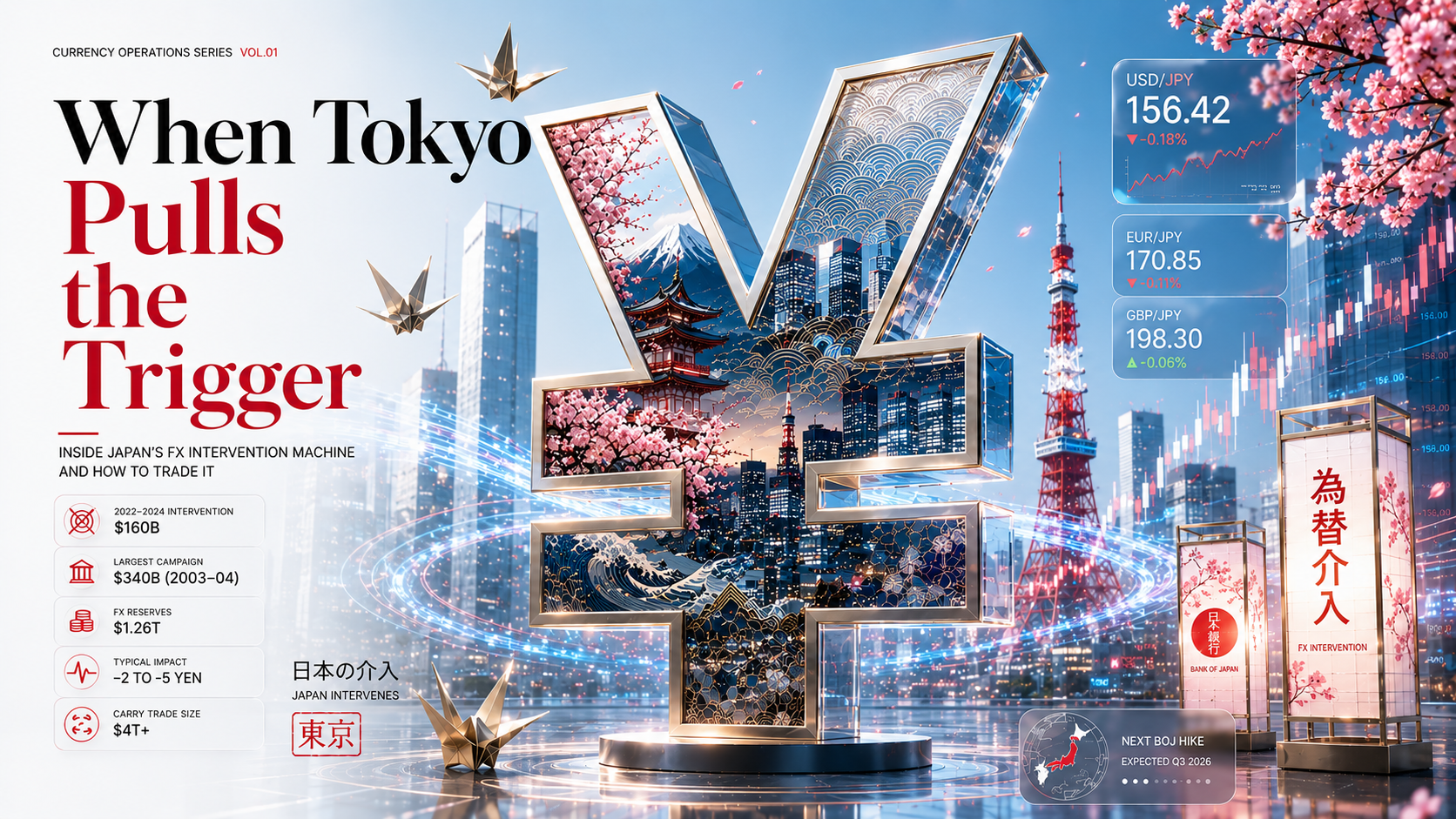
Trading Japan’s Intervention Machine — Capital Street FX Research Desk
Pulls the Trigger
to Let Its Currency Float Freely
Most countries want a stable currency. Japan needs one. The distinction sounds semantic until you look at the numbers. Japan imports nearly all of its oil, the majority of its natural gas, and a substantial share of its food. When the yen weakens by 10%, the cost of keeping the lights on and the supermarkets stocked rises in lockstep. At the same time, Japan’s largest companies — Toyota, Sony, Nintendo, Panasonic — earn a significant share of their revenue in dollars and euros, then convert it back to yen. When the yen strengthens by 10%, those conversions shrink. Every exporter’s profit-and-loss statement is, in one dimension, a foreign exchange trade.
This creates a bind that no other major economy faces quite so acutely. The yen cannot be too strong without crushing export earnings and triggering the kind of deflationary pressure that kept Japan economically paralysed for much of the 1990s and 2000s. It cannot be too weak without making the country’s import bill — denominated in dollars — an inflation emergency. Between these two extremes sits a narrow corridor where the yen is “acceptable.” And for forty years, whenever the market has pushed the yen toward one edge of that corridor, Tokyo has reached for the intervention toolkit.
What makes Japan’s situation unusual is not that it manages its currency — every major economy does that to some degree — but how openly, how consistently, and how expensively it does so. The United States influences the dollar through Federal Reserve rhetoric and policy signals. China manages the yuan through explicit administrative controls. Japan writes cheques. Large ones. Repeatedly. In full view of a global market that has learned, over forty years, that the cheques buy time but rarely buy resolution.
The deeper structural reason is the carry trade — but that comes in Chapter 4. First, you need to understand the machinery that deploys those cheques. Because the machinery is precise, institutional, and patterned in ways that create tradeable signals every time it activates.
One Decision. One Trigger.
On the morning of September 22, 2022, a Thursday, the yen was trading at 145.90 against the dollar. Finance Minister Shunichi Suzuki had spent the preceding weeks escalating his public language — “watching with urgency,” “all necessary measures,” “disorderly moves.” Currency traders, most of whom had watched similar language come and go without action for years, largely discounted it. Then, at approximately 10:30am Tokyo time, the market moved 2.5 yen in minutes. No announcement. No press conference. Just a wall of yen-buying orders hitting the market simultaneously. Japan had intervened for the first time in 24 years, and most of the market didn’t know it until hours later.
Understanding who authorised that operation — and how — is the foundation of reading future intervention signals correctly. The structure is deliberately split between two institutions with different mandates and different public postures.
The Ministry of Finance holds absolute authority. Under Japan’s Foreign Exchange and Foreign Trade Act, it is the MoF — not the Bank of Japan — that decides if, when, and at what scale to intervene in currency markets. The relevant official is the Vice Minister of Finance for International Affairs, a position sometimes called Japan’s “FX tsar.” In 2022, that was Masato Kanda — whose public statements, tracked carefully, telegraphed the September operation more clearly than most market participants appreciated at the time. When this official starts appearing at unscheduled press briefings with escalating language, the probability of imminent action rises sharply.
The Bank of Japan executes. It acts as the MoF’s agent — physically placing yen-buying orders through commercial banking channels using the Foreign Exchange Fund Special Account, a government account holding Japan’s vast FX reserves. The BoJ has no independent authority to intervene. It receives the instruction and executes. This separation is legally important: it keeps intervention classified as government fiscal policy rather than monetary policy, sidestepping the mandate constraints that would apply to central bank operations and maintaining Japan’s technical compliance with G7 commitments on exchange rate management.
Between those two institutions runs a private communication channel that traders have learned to watch for: the rate check. Before any significant operation, the MoF informally contacts major dealing banks to request current bid/offer quotes on USD/JPY. Officially, this is intelligence-gathering — understanding where liquidity sits before deploying capital. In practice, the market treats a confirmed rate check as a near-certain 24–72 hour precursor to actual intervention. The logic is simple: why would the Ministry of Finance need to know the exact state of the yen market unless it was about to operate in it? Every major operation since 2003 has been preceded by confirmed rate checks. When multiple banks confirm receiving them simultaneously, it is the closest thing to a confirmed fire alarm the intervention system produces.
Then the Money Follows.
Japan never surprises the market. Not really. The escalation from concern to action follows a script so consistent across forty years and nine campaigns that it reads less like improvised policy and more like institutional choreography. The words change before the money moves. The only traders who are surprised are the ones who weren’t listening to the words.
The ladder has three rungs. It almost always starts at the bottom and climbs in sequence. Understanding where Tokyo is on that ladder at any given moment is the most reliable intervention timing signal available.
“Japan never announces what level it is defending. It only says it is defending orderly markets. This language is not evasive — it is the legal architecture that makes every operation internationally defensible under the G7 framework.”
One final element of the ladder that traders consistently underestimate: the G7 framing. Japan is a signatory to G7 commitments that prohibit targeting specific exchange rate levels or using FX policy for competitive advantage. Every intervention is therefore publicly justified as a response to “excessive and disorderly movements” — never as a defense of a particular number. This is not mere diplomatic cover. It defines the operational mandate. Japan cannot (openly) say “we will hold 150.” It can say “we will not tolerate a 3-yen move in two days.” The distinction matters for understanding when intervention will fire: not when the level is wrong, but when the velocity becomes politically indefensible.
The Machine Japan Is Actually Fighting
Every intervention operation Japan has ever executed has been, at its core, a battle against the carry trade. Not against any particular speculator, not against any particular hedge fund or central bank, but against the fundamental arithmetic of interest rate differentials. And arithmetic, in the long run, always wins.
The logic of the carry trade is so simple it feels almost embarrassingly straightforward when you first encounter it. You borrow money where it is cheap. You invest it where it is expensive. You collect the difference. For most of the past twenty years, the cheapest place in the world to borrow was Japan — where the Bank of Japan held rates at zero, then negative, in a decades-long attempt to stimulate an economy still scarred by the bubble collapse of 1990. The most lucrative place to invest, for much of that same period, was the United States, where yields on government bonds and money market instruments offered returns that dwarfed anything available domestically. The trade wrote itself.
Multiply that arithmetic across hedge funds, pension managers, insurance companies, leveraged trading desks, and corporate treasury departments across the globe, and you arrive at the estimated outstanding carry position: somewhere north of $4 trillion. Japan’s total FX reserves — the war chest built over decades to fund intervention — stand at approximately $1.26 trillion. The math is unambiguous. The market is three times larger than the intervention fund. Tokyo can win a skirmish on any given afternoon; it cannot win a war against a structural flow that reconstitutes itself as fast as the central bank can disrupt it.
This is why every intervention in the 2022–2024 period eventually retraced. The carry trade re-entered. The differential was still wide. The arithmetic was still compelling. The yen sold off again. And the Ministry of Finance reached for the phone.
The only force that can structurally end the carry trade’s yen-selling pressure is rate convergence — the Fed cutting and the BoJ hiking until the spread narrows below the point where the trade is economically viable on a risk-adjusted basis. That process is currently underway. The Fed has cut from 5.25% to 3.625%. The BoJ has hiked from negative rates to 0.75%. The differential has narrowed from 525bp to roughly 300bp. At approximately 125–150bp, the trade’s risk-reward deteriorates sufficiently that positions begin to reduce organically. That threshold is perhaps 18–24 months away on current trajectories — which is exactly the timeline around which the long-term trade ideas in Part IV are built.
to the Holiday Strike
Nine major intervention campaigns in forty years. Each one was triggered by a specific convergence of market conditions, each one followed the same escalation pattern, and each one produced the same ultimate outcome: a temporary repricing, a subsequent drift back toward the fundamental trend, and a lesson that was never quite learned. The history is worth knowing in detail — not as a record of the past, but as a template for the future.
1985 — The Plaza Accord: When the G5 Broke the Dollar
The story of modern yen intervention begins not with Tokyo acting defensively, but with Washington acting offensively. By 1985, the dollar had appreciated roughly 50% against major currencies over five years, driven by the Reagan administration’s combination of large fiscal deficits and the Volcker Fed’s aggressively high interest rates. American manufacturers were being hollowed out. The trade deficit was ballooning. Congress was drafting protectionist legislation that threatened a global trade war.
On September 22, 1985, the finance ministers and central bank governors of the United States, Japan, West Germany, France, and the United Kingdom gathered in the Plaza Hotel in New York and agreed to something historically unusual: they would jointly intervene to weaken the dollar. For Japan, the consequences were entirely unintended. USD/JPY stood at 240 before the meeting. The agreement called for an orderly, modest adjustment. What the market delivered was a dollar that fell in half. By 1987, the pair was at 120. The intended target had been around 180–200. The yen had doubled in value in less than three years, making Japanese exports radically more expensive overnight and forcing the Bank of Japan into a desperate cheap-money policy to stimulate domestic demand to compensate. That cheap money inflated the bubble. The bubble collapsed in 1990. The Lost Decade followed. A single weekend meeting in a New York hotel set in motion a causal chain that shaped Japanese monetary policy for the next thirty-five years.
1995 — The Counter-Intervention: Selling Yen at the All-Time High
The Plaza Accord’s overcorrection created a new problem by the mid-1990s: the yen had become so strong that Japanese exporters were in genuine crisis. On April 19, 1995, USD/JPY touched 79.75 — the all-time low for the dollar against the yen, the all-time high for the yen’s purchasing power. At that level, a Toyota Camry built in Japan cost roughly twice what it had a decade earlier in dollar terms. Export orders were collapsing. The government could no longer sit and watch.
Japan and the United States intervened jointly — this time selling yen, buying dollars, to arrest the appreciation. The operation worked. USD/JPY rebounded sharply and never returned to that extreme. But the 79.75 level is not merely history. It is the psychological reference point that the Ministry of Finance uses, implicitly, as the definition of “unacceptably strong yen.” Forty years later, no MoF official has forgotten that number. It is the floor beneath every calculation they make about when appreciation has gone too far.
2003–2004 — The Great Blitz: Building the War Chest
The dollar was weakening again in the early 2000s — this time against the backdrop of the Iraq War, a widening US current account deficit, and a Federal Reserve that had cut rates aggressively after the dot-com crash. For Japan, still barely recovering from the Lost Decade, a strengthening yen threatened to strangle the export recovery that was the only source of meaningful growth. The Ministry of Finance decided it would not let that happen. Not through occasional, targeted operations. Through a sustained, industrial-scale campaign.
Between January 2003 and March 2004, Japan’s MoF authorised ¥35.3 trillion in dollar purchases — the equivalent of roughly $340 billion, or approximately 7% of Japan’s entire GDP. The scale was unprecedented. The pace was relentless: some months saw ¥5–7 trillion deployed in a single four-week period. USD/JPY, which had been threatening to break through 105, was held above 108 for much of the campaign. More importantly, Japan’s foreign exchange reserves grew from roughly $400 billion to $840 billion — a war chest that funded every subsequent intervention campaign for the next twenty years. When Tokyo spent $100 billion in 2024, it was spending money accumulated in those fifteen months two decades earlier.
2010–2011 — The G7’s Last Stand: After the Earthquake
At 2:46pm on March 11, 2011, a 9.0-magnitude earthquake struck off Japan’s northeastern coast. The Tohoku tsunami killed nearly 20,000 people. Three reactors at Fukushima Daiichi began melting down. Japan was facing its worst national crisis since World War II.
The currency market’s reaction was, to most observers, perverse. The yen surged. Within a week, USD/JPY had fallen to 76.25, approaching its 1995 all-time extreme. The logic — cold, mechanical, uninterested in human suffering — was repatriation. Japanese insurance companies and institutional investors, it was reasoned, would be forced to liquidate vast foreign asset holdings and convert the proceeds back into yen to fund reconstruction payouts. The anticipated selling of dollars and euros to buy yen drove the currency higher even as the country lay in ruins.
On March 18, exactly one week after the earthquake, the G7 acted together for the last time. Finance ministers and central bank governors from the United States, Europe, Canada, and Japan jointly intervened — selling yen, buying everything else — to arrest what they unanimously described as disorderly conditions. USD/JPY reversed sharply. The operation worked. And it has never been repeated, because the conditions that made it possible — universal agreement that a strong yen served no one’s interests — have not recurred. By 2022, the United States had its own inflation problem and a strong dollar was actively serving American policy objectives. Japan was, once again, alone.
$160 Billion, One Losing War
No intervention campaign in modern history has been as well-documented, as expensive, or as instructive for traders as the one Japan waged between September 2022 and July 2024. Six confirmed operations across twenty-two months. Approximately $160 billion in total capital deployed. And at the end of it, with the yen having touched its weakest level since 1986, the definitive proof that intervention and rate convergence are fundamentally different tools solving fundamentally different problems.
To understand why it happened, you have to understand the setup. In January 2021, USD/JPY traded at 103. The Federal Reserve’s policy rate was near zero. The Bank of Japan was at negative rates. The interest rate differential between the two economies was essentially nothing — and a nothing differential means no carry trade incentive. The yen, in that environment, was stable. Then the Fed began hiking.
Between March 2022 and July 2023, the Federal Reserve raised rates by 525 basis points — the fastest and most aggressive hiking cycle in forty years. The Bank of Japan, convinced that Japan’s inflation was transitory and terrified of aborting its fragile recovery, held at negative rates throughout. The differential blew out to 525bp: the widest in four decades. Every basis point of that widening was yen-selling pressure. The carry trade re-engaged at industrial scale. From 103 to 115 to 125 to 135 to 145 — and by October 2022, the pair had crossed 150 for the first time since 1990. By July 2024, it reached 161.95.
Operation One: September 22, 2022 — The Return After 24 Years
Japan had not bought yen since 1998. The market had spent years assuming the MoF had quietly retired the intervention playbook — that the BoJ’s accommodative stance made yen-buying politically incoherent while domestic rates were negative. It was a reasonable assumption. It was wrong.
In the weeks before September 22, Vice Minister Masato Kanda had escalated his language with unusual precision: “excessive and disorderly moves,” “watching with a high sense of urgency,” “will take decisive action if necessary.” The words were there for anyone who knew how to read them. On the morning of the 22nd, rate checks went out to major dealing banks. Word began circulating in the FX community. And then, at approximately 10:30am Tokyo time, with USD/JPY sitting at 145.90 — just below the psychologically critical 146 level — the order hit the market. ¥2.838 trillion in a single operation. USD/JPY fell from 145.90 to 140.35 in the space of hours. It was the first confirmed yen-buying intervention since September 1998, and it sent a message that markets had convinced themselves would never be sent again: Tokyo was back.
The immediate market reaction was sharp and genuine. But within five weeks, USD/JPY had recovered most of the move. The carry trade re-engaged. The differential was still 400bp. The arithmetic still worked. The yen drifted back to 148, then higher.
Operation Two: October 2022 — The Follow-Up
With the yen having retraced much of the September move, the MoF returned to the market in October — not with a single dramatic operation but with a series of interventions totaling ¥6.35 trillion across the month. The combined September-October campaign reached ¥9.2 trillion, the largest two-month intervention effort since the 2003–04 blitz. USD/JPY, which had been testing 150 again, was pushed back to 145. The operations were larger than anything the market had seen since before the financial crisis, and they were delivered with a ferocity that surprised traders who had assumed Japan’s intervention capacity was more limited.
Yet the fundamental story remained unchanged. The Fed was still hiking. The BoJ was still on hold. The differential was still 500bp. By January 2023, USD/JPY was back at 130. The respite had lasted two months.
The Gap: 2023 — A Year of Watching
Through most of 2023, the MoF watched and warned but did not act. USD/JPY spent the year oscillating between 127 and 152 — held in a range partly by intervention risk and partly by a market that had learned to treat 150 as an informal ceiling, pricing in the probability of another operation. The BoJ, under new Governor Kazuo Ueda who took over in April 2023, began sending cautious signals that policy normalization was coming — but “coming” in BoJ language meant months, perhaps years, rather than weeks. The verbal intervention was doing more work than the financial kind.
Operation Three: April 29, 2024 — The Holiday Strike
By spring 2024, the yen was in serious trouble. The Fed had held rates at 5.25–5.50% for months with no sign of imminent cuts. The BoJ had made its first tentative move — ending negative interest rates in March, raising to 0.0–0.1% — but the market treated this as the beginning of a very long and very cautious normalization process, not a structural shift. USD/JPY pushed through 155, then 158, then 160. By April 29 — Showa Day, a Japanese public holiday — the pair was testing 160.17.
What happened next has entered FX market lore. The MoF waited. The market, emboldened by the holiday-thin liquidity and reading the silence as a green light, pushed further. And then, at a moment chosen with surgical precision — maximum thin liquidity, minimum market depth, maximum psychological vulnerability — ¥5.5 trillion was deployed in approximately eleven minutes. USD/JPY crashed from 160.17 to 156.60. The scale and speed of the move were extraordinary. By the time most European traders arrived at their desks that morning, the operation was over and the aftermath was already beginning to fade. Tokyo did not confirm the operation for weeks.
This was the purest expression of Japan’s tactical intervention doctrine: exploit the calendar, exploit the clock, exploit thin liquidity. Make every yen count by ensuring there are as few other market participants as possible to absorb it.
Operation Four: May 2024 — The Stealth Insertion
A second operation in May 2024 — estimated at approximately ¥3.5 trillion — was never officially confirmed during the operation itself. It was identified only retroactively through discrepancies in the MoF’s monthly FX reserve data, which showed a decline inconsistent with market moves and interest accruals. This is the stealth variant of intervention: the MoF denies nothing, confirms nothing, and lets the market live with the uncertainty. Uncertainty itself is a policy instrument. If traders cannot know whether Tokyo has reserves left or appetite remaining, they will think twice before running yen shorts aggressively.
Operations Five and Six: July 11–12, 2024 — The Last Campaign
By early July, USD/JPY had pushed to 161.95 — its weakest level since December 1986, thirty-eight years. The MoF had been silent since the suspected May operation. The market was beginning to test the limits of Japan’s willingness to act at levels above 160.
On July 11, a softer-than-expected US CPI print created exactly the thin-liquidity moment Tokyo needed: the data moved markets rapidly, creating volatility that amplified the intervention impact. ¥3.57 trillion was deployed, sending USD/JPY from 161.95 to 157.40 within the session. The following day, a ¥2.37 trillion follow-up consolidated the gains. Two-day total: ¥5.94 trillion — approximately $38 billion. It was the largest two-day operation of the 2024 campaign.
But the pivotal event came three weeks later, on July 31, when the Bank of Japan raised interest rates to 0.25% — a move that, combined with simultaneously weakening US employment data on August 2nd, triggered a global carry trade unwind that no intervention operation had managed to produce. USD/JPY fell from 160 to 141 in three weeks. The Nikkei 225 dropped 12.4% in a single session on August 5 — its worst day since 1987. The carry trade, which had been built on the premise of perpetual cheap yen funding, panicked. It was margin calls, not Ministry of Finance orders, that moved the market in those three weeks. And it confirmed, definitively, the lesson that every campaign since 2003 had been quietly teaching: intervention manages velocity; rates determine direction.
| Date | Type | Scale | Trigger Level | Immediate Drop | Retrace Timeline | What Changed |
|---|---|---|---|---|---|---|
| Sep 22, 2022 | Buy yen · Confirmed | ¥2.84T | 145.90 | −5.5¥ in hours | ~80% within 5 weeks | First operation in 24 years — psychological reset |
| Oct 2022 | Buy yen · Confirmed | ¥6.35T | 149–151 | −5¥ over 2 days | ~75% within 6 weeks | Largest two-month campaign since 2004 |
| Apr 29, 2024 | Buy yen · Holiday strike | ¥5.50T | 160.17 | −3.6¥ in 11 min | ~65% within 5 weeks | Thin liquidity exploitation; most precise timing |
| May 2024 | Buy yen · Stealth | ~¥3.5T | ~157–158 | Unconfirmed during op | Confirmed via reserve data only | Demonstrates stealth capability; creates maximum uncertainty |
| Jul 11, 2024 | Buy yen · CPI timing | ¥3.57T | 161.95 (38-yr low) | −4.6¥ intraday | Did not fully retrace — BoJ hike followed | Timed to coincide with US CPI release |
| Jul 12, 2024 | Buy yen · Follow-up | ¥2.37T | ~159–160 | Follow-up consolidation | BoJ Jul 31 hike changed trend entirely | Two-day total ¥5.94T (~$38B) |
There Before the Money
Every intervention operation described in the previous chapter was preceded by readable signals. None came without warning for those who knew the vocabulary. The signals are not subtle once you understand the system — they are a methodical escalation from rhetoric to action, playing out in public in real time. What follows is the complete checklist, ranked by reliability.
Six Weeks After Tokyo Acts
The intervention fires. USD/JPY drops 3–5 yen in a session. The news carries the story. Analysts debate whether this time it will hold. And then, in most cases, the market does something entirely predictable: it takes the pair right back toward where it was.
The post-intervention pattern, derived from six confirmed operations between 2022 and 2024 and five operations in the 2003–2011 period, is consistent enough to be the basis of a systematic trade. Here is what the data shows.
The mechanism of the retrace is not mysterious. Intervention creates an artificial repricing of the carry trade’s entry point — the pair is now 3–5 yen lower than it was. But the carry differential is unchanged. The trade is now cheaper to enter than it was an hour ago. Leveraged traders who exited on the intervention spike begin re-entering. Unhedged Japanese corporate exporters who were waiting for a better level to convert dollar receivables start converting. The structural yen-selling pressure, paused briefly by the shock of the operation, re-engages. Over the following weeks, the pair drifts back toward the pre-intervention level.
The one consistent exception is an operation that coincides with — or is closely followed by — a BoJ rate move. The July 2024 operations did not retrace because the BoJ hiked on July 31, three weeks later. The rate differential changed. The carry trade’s economics deteriorated. The intervention amplified a fundamental shift rather than creating a temporary one. This pattern — intervention that reinforces a rate decision rather than substitutes for one — is the shape that future operations are most likely to take as the BoJ continues normalizing. For traders, this distinction matters enormously: the post-intervention retrace trade works best when the fundamental driver is unchanged; it fails when a BoJ decision validates the move.
“The intervention move is rarely the trade. The retrace is the trade — or, if the BoJ is hiking simultaneously, the continuation. Knowing which situation you’re in is the entire game.”
Is Finally Shifting
For the first time since 2021, the fundamental forces are no longer uniformly aligned against the yen. The Federal Reserve has cut from 5.25% to 3.625% and is still easing. The Bank of Japan has moved from negative rates to 0.75% and is still hiking. The rate differential, which reached 525bp at its peak, has narrowed to approximately 300bp and is trending toward 125–150bp on a 12–18 month view. The structural carry trade headwind — the force that defeated every intervention campaign between 2022 and 2024 — is, for the first time in years, softening.
This changes the intervention calculus in important ways. MoF operations in a narrowing-differential environment have more durability than operations in a widening-differential environment — because the carry trade is less motivated to re-enter at lower prices. The retrace trade (Trade 2) becomes less reliable. The structural short-yen trade (Trades 1, 3, 5) becomes more compelling. The intervention machine is still there; it will still fire if USD/JPY runs toward 160. But its role is shifting from fighting a structural trend to managing the pace of a structural reversal.
| Institution | Target | Core Assumption | Bias |
|---|---|---|---|
| JP Morgan | 164 | BoJ too cautious; US yields stay elevated | Short yen |
| ING | 153 | BoJ hiking continues; Fed cuts extend | Long yen |
| Scotiabank | 150 | Differential compression + repatriation flows start | Long yen |
| Westpac | 148 | Most aggressive BoJ normalization scenario | Strong long yen |
| Oxford Economics | ~150 | BoJ resumes July 2026; 1.50% terminal by 2027 | Long yen, gradual |
And What Intervention Looks Like in Each One
Each of the five scenarios below defines not just a USD/JPY outcome but an intervention regime — how frequently the MoF acts, in which direction, and how effective it is. Select a scenario to see the full architecture.
The BoJ hikes methodically: 1.00% by Q4 2026, 1.50% by end-2027. The Fed cuts to 2.75%. Differential reaches ~125bp — below the threshold that sustains aggressive carry positioning. Carry trades reduce gradually, then more rapidly as the 150bp level approaches. Japanese institutional investors begin repatriating foreign assets as domestic returns become competitive. USD/JPY drifts toward 135–140 on a 24-month view without dramatic volatility. The MoF has little reason to buy yen — the market is doing its work naturally. Its intervention risk in this scenario is actually to the downside: if the unwind overshoots below 130, the MoF may sell yen to protect exporters, reversing its forty-year role.
US growth re-accelerates through an AI investment supercycle, large fiscal expansion, or trade-war-driven domestic production incentives. The Fed pauses cuts at 3.50% or reverses. The BoJ, watching Japan’s growth numbers deteriorate, freezes the hiking cycle at 1.00% and signals an indefinite pause. Differential stays above 250bp. The carry trade re-intensifies. USD/JPY tests 165, and the MoF resumes heavy operations — but without rate support, each operation is a speed bump, not a structural floor. This is the scenario where Trade 2 (post-intervention retrace long) is most profitable and most repeatable.
A surprise catalyst — a BoJ hike larger than expected, a US recession print, a geopolitical shock, or a combination — triggers simultaneous forced liquidation of $4T+ in carry positions. The dynamic mirrors August 2024 but potentially far larger: USD/JPY collapses 20–30% in weeks. The Nikkei crashes as leveraged equity positions unwind. Emerging market bonds are sold. Crypto is liquidated. The speed of the move overwhelms all normal hedging. In this scenario, Tokyo does the unimaginable: it intervenes to slow yen appreciation — selling yen, buying dollars — to prevent the export sector from being crushed by a yen that has risen too far too fast. The intervention machine reverses its forty-year polarity.
Global stagflation traps both central banks. The Fed cannot cut because inflation remains sticky; cannot hike because growth is contracting. The BoJ cannot hike because Japan’s GDP is negative; cannot hold because import inflation — driven by yen weakness — is politically intolerable. Both institutions are paralysed. USD/JPY becomes a volatility instrument rather than a directional one, whipsawing across a 20-yen band driven by each data release, each central bank statement, each geopolitical headline. MoF intervenes in both directions — buying yen when the pair spikes above 162, selling yen when it crashes below 140 — with limited effectiveness in either direction because there is no fundamental anchor.
A US administration decides the strong dollar is incompatible with its domestic manufacturing and employment objectives. G7 agrees to coordinate a managed dollar weakening — a Plaza Accord for the 2020s. Japan benefits from an engineered yen appreciation without spending its own reserves. The difference from 1985: China is now the world’s largest exporter and a major currency force. Any effective Plaza 2.0 requires Chinese participation — and China’s incentives do not align with a weaker dollar. Without China, the agreement is arbitraged from day one. This is why the probability is low. The impact, if it happens, is immediate and very large — a 10–15 yen move on the announcement alone.
Built Around the Machine.
Each idea below is constructed specifically around Japan’s intervention machinery — either trading the moment an operation creates, or positioning for the structural shifts that change the machine’s direction. All levels are approximate reference points, not instructions. Adjust for your own risk framework and position sizing methodology. These are not investment recommendations.
Trade USD/JPY with Capital Street FX
Access USD/JPY, EUR/JPY, GBP/JPY and 200+ instruments with up to 1:10,000 leverage and professional-grade execution infrastructure.
Open Account