
Oil’s Silent Reckoning: IEA’s Vanishing Inventories, The $103 Illusion, and What the Market Has Not Priced Yet | Capital Street FX
Oil’s Silent Reckoning:
IEA’s Vanishing Inventories,
The $103 Illusion,
and What the Market Has Not Priced Yet
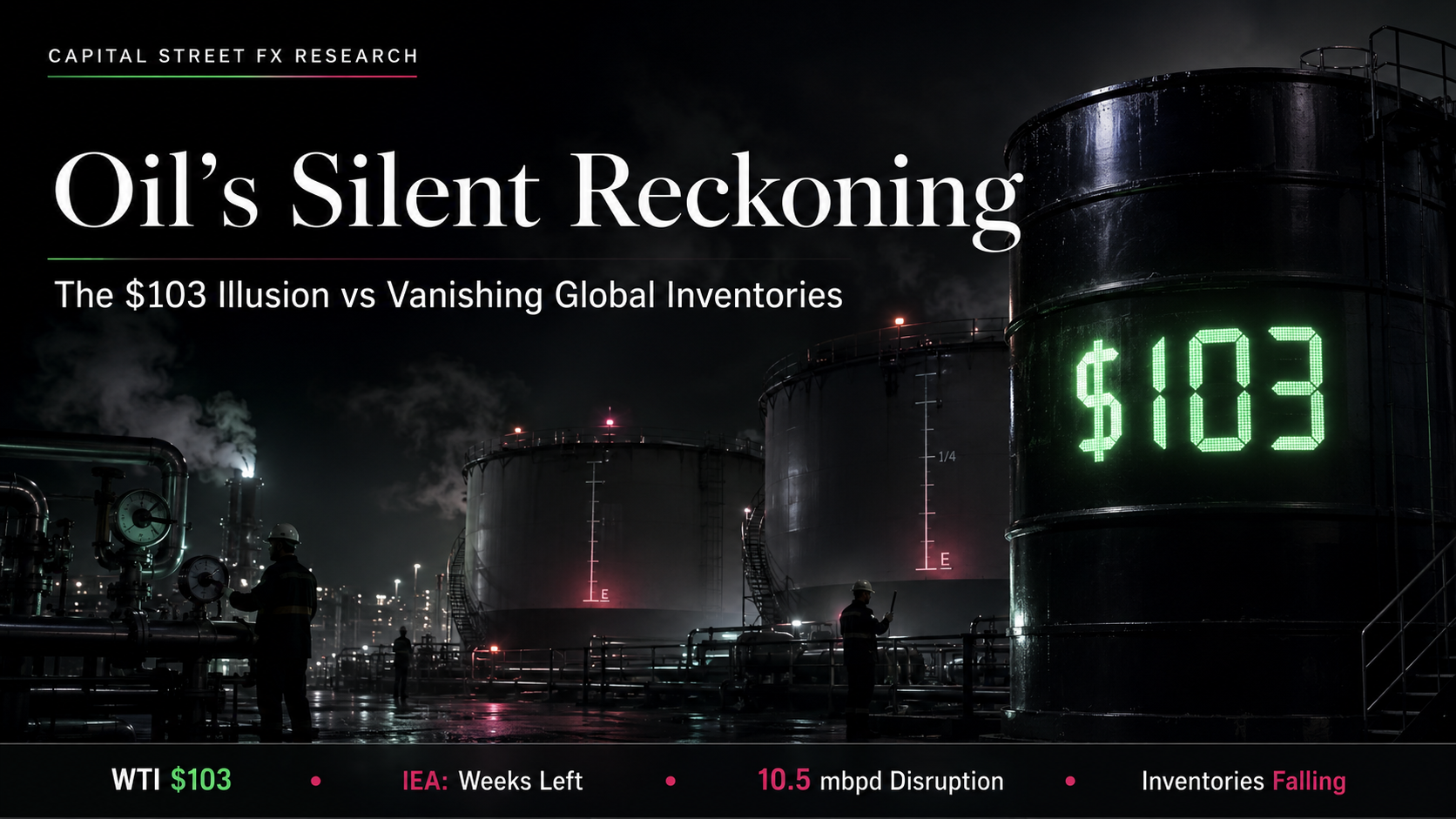
The IEA chief told the G7 in Paris that commercial oil inventories have only weeks left. Futures markets price WTI at $103. Both cannot be right for much longer. Here is the full sourced case for both sides — the forces holding oil back, and the silent reckoning markets have not yet priced.
When the Strait of Hormuz closed in March 2026, serious institutions called $150. $180. $200. Most of those deadlines have passed. WTI is $103. But on May 18 the head of the IEA stood before G7 finance ministers in Paris and said commercial inventories are depleting rapidly — only weeks left — and that there is a perception gap between what futures show and what the physical market is experiencing. This analysis presents both sides of that gap: every forecast sourced and dated, every suppression force measured against its limits, and the trade setups inside the divergence.
Two Markets, One Commodity: The Case For $103 and the Case For $180
On May 18, 2026, IEA Executive Director Fatih Birol told G7 finance ministers in Paris that commercial oil inventories are “declining rapidly” with only weeks left — and that there is a “perception gap” between what futures markets show and what the physical market is experiencing. WTI futures show $103. The IEA’s physical data tells a different story. Both sides of this argument are serious, sourced, and live. This analysis presents them both without a verdict.
The bear case on higher prices is real: five adaptive forces — pre-existing oversupply, emergency reserve releases, demand destruction, alternative supply routes, and ceasefire probability — have held WTI at $103 through the largest supply disruption in history. Each one is documented, sourced, and explained in full below. The bull case is equally real: the IEA revised its 2026 supply loss to 3.9 million bpd (up from 1.5 mbpd), strategic reserves have weeks left at current draw rates, summer demand is about to accelerate the drawdown, and the IEA chief himself has described the current futures price as a perception gap rather than a true clearing price.
Every forecast of $150, $180, and $200 in this article is attributed to a named source with a date and a condition. Some conditions have been met. Some deadlines have passed. Some remain open. The record matters because it tells traders which predictions are still live — and the trade setups at the end of this analysis are built around the answer.
Who Said What and When: The On-Record Predictions
These are the on-record $150–$200 predictions made by named institutions since the Hormuz closure. Each carries a condition. Some have expired. Some remain open. The full sourced register, including every forecast with date, condition, and current status, is in the dedicated section at the end of this analysis.
Note: the IRGC prediction was a political statement as well as a price forecast. All other sources above are independent analysts, research institutions, or named economists. WTI at time of original writing: $106. Updated May 19, 2026: WTI $103.40. The full prediction record with sources, dates, and conditions is in Part VIII of this analysis.
- ★ IEA Chief at G7, May 18: “Only Weeks of Inventories Left” — The Perception Gap Explained
- A Century of Oil Wars: What the Models Missed — And When They Were Right
- The Five Forces Holding Oil Back — And Where Each One Runs Out
- Demand Destruction: Powerful But Not Permanent
- Producer Opportunism: Who Is Pumping More and For How Long
- The Shadow Supply: Routes, Waivers, and the Grey Market
- The Four Oil States: Where We Are and What Breaks the Range Either Way
- Multi-Timeframe Trade Setups
- The Full Prediction Record: Every Named Forecast of $150–$200, Sourced and Tested
- Five Questions Every Oil Trader Is Asking
“Commercial Inventories Are Declining Rapidly — Only Weeks Left”
On May 18, 2026 — one day before this update — Fatih Birol, Executive Director of the International Energy Agency, spoke to reporters on the sidelines of the G7 finance leaders meeting in Paris. His remarks were reported by Reuters, the Globe and Mail, the Manila Times, Free Malaysia Today, Asia Times, Common Dreams, FXStreet, and The Edge Malaysia among others. What he said is the most authoritative and most recent statement in the current oil market. WTI futures did not move significantly in response. That is the perception gap he was describing.
What Birol Said — Direct Quotes, Named Sources
“Commercial oil inventories were depleting rapidly with only a few weeks’ worth left due to the Iran war and the closure of the Strait of Hormuz to shipping. These reserves are not endless.”Fatih Birol, IEA Executive Director — G7 Finance Leaders Meeting, Paris, May 18, 2026 · Source: Reuters, confirmed by Globe and Mail, Manila Times, Free Malaysia Today, The Edge Malaysia
“I described a perception gap in the markets between the physical markets and the financial markets.”Fatih Birol — on his remarks inside the G7 meeting, May 18, 2026 · Source: Reuters, confirmed by FXStreet, yourNEWS, investingLive
Four Things This Statement Changes
1. The IEA has revised its 2026 supply loss to 3.9 million bpd for the full year, up from its earlier projection of 1.5 million bpd. This is a near-tripling of the expected annual supply shortfall from the world’s most authoritative energy data institution. It was announced alongside Birol’s G7 remarks and has not been widely reflected in futures pricing.
2. Strategic reserves are approaching their limit. The IEA coordinated a release of 400 million barrels in March — the largest in its history. As of May 8, approximately 164 million barrels had been released. At the current draw rate of 8.5 million bpd, the remaining 236 million barrels covers approximately 28 days. Birol explicitly described this constraint to the G7 finance ministers.
3. Summer demand will accelerate the drawdown from here. Birol specifically warned that the onset of spring planting and summer travel seasons in the northern hemisphere will drain inventories faster — increasing demand for diesel, fertiliser, jet fuel, and gasoline at exactly the moment the buffer is thinnest. This is not a forecast. It is a seasonal pattern that arrives every year.
4. The perception gap is the central analytical question. When the head of the IEA tells G7 finance ministers that futures markets are not accurately reflecting physical supply conditions, that is material information for every trader in oil. The gap between $103 on screen and “weeks of inventory left” in the physical market cannot persist indefinitely. Either the physical market resolves through a diplomatic breakthrough — pulling futures down sharply — or futures close the gap upward. The analysis and trade setups in this article are built around both outcomes.
Why this statement matters above all others in this article: Multiple analysts have predicted $150–$200. Most were speaking in March and April. Birol spoke on May 18 — with twelve weeks of actual data behind him, at a G7 meeting, in his official capacity as head of the world’s pre-eminent energy agency. He did not predict a price. He described a physical measurement and a market mispricing. That carries a different weight than any investment bank forecast.
Every Major Oil-War Price Prediction In History — What The Models Missed, And When They Were Right
Since the moment crude oil became the primary fuel of industrial and military power, wars have threatened its supply — and analysts have systematically overestimated the price impact in most crises. But not all. The exception — 1973 — is as instructive as the rule. And 2026’s disruption is larger than anything that came before it.
World War I (1914–1918): Oil’s First Strategic Disruption
The first war fought with oil as a primary strategic resource did not produce a price spike — it produced a supply crisis managed almost entirely by state intervention. Britain’s Royal Navy had converted to oil fuel in 1912 at Churchill’s insistence. When war broke out, the Mesopotamian oilfields (modern Iraq) and Persian production (modern Iran, via APOC — the Anglo-Persian Oil Company) became strategic assets of the first order.
The disruption to normal trade routes and commercial supply chains was severe. Yet prices were administratively controlled by Allied governments throughout the war. The lesson the market learned in 1918 — and has relearned in every subsequent crisis — is that governments will intervene in oil markets when the stakes are high enough. The free-market price signal is always the second mechanism. State power is always the first.
WWI Template (1914–1918): First oil-strategic war. Price controlled administratively. Market mechanism suppressed. The lesson: in a genuine supply emergency, governments price-fix before they let the market clear. This pattern has repeated in every major crisis since.
World War II (1939–1945): The Supply Miracle Nobody Predicted
Before Pearl Harbor, analysts looking at the Axis powers’ oil constraints predicted the war would end quickly — Germany and Japan simply did not have enough oil to sustain a prolonged campaign. What actually happened was the opposite: the United States became the largest oil producer in history, supplying over 60% of all Allied oil consumption. US production went from roughly 4 million bpd in 1940 to over 5.5 million bpd by 1945.
The disruption to European and Pacific trade routes was total. Yet Allied oil supply was never critically constrained, because US production — which was not disrupted — vastly exceeded what any pre-war model had incorporated. The lesson: the producing nation outside the conflict zone always matters more than the model assumes. In 1945, that was the US. In 2026, it is the US shale industry, Russia, and the UAE.
Oil’s First Strategic Conflict
Allied governments administratively controlled oil prices. Market mechanism suppressed. Persian and Mesopotamian fields become strategic assets. Price did not spike — it was managed.
Lesson: State intervention caps prices before the market canThe Supply Miracle: US Production Doubles
Despite total disruption to Pacific and Atlantic trade routes, Allied oil supply held because US production expanded massively. Pre-war models missed the out-of-conflict producer. Commercial oil prices administratively controlled. Post-war price: barely higher than pre-war.
Lesson: The producer outside the war zone always matters more than forecastFirst “Oil Will Hit the Moon” Prediction — 11% of Suez Traffic Disrupted
The closure of the Suez Canal disrupted roughly 1.5 million bpd of oil flow to Europe. Analysts predicted severe European energy crisis and major price escalation. The US increased production and Venezuela rerouted supply. Oil prices rose modestly and stabilised within months. The Canal reopened within 6 months.
Prediction: Severe European energy crisis · Reality: Modest, brief disruptionArab Oil Embargo Attempt — Complete Failure
Arab oil producers attempted an embargo against the US and UK in response to their support of Israel. The embargo collapsed within weeks because member states cheated, US domestic production was at near-peak, and the global oil market was oversupplied. Prices were unchanged. The lesson of 1967: embargoes require compliance and market tightness to work.
Prediction: Major disruption · Reality: Embargo collapsed, no price impactThe One That Worked — But Even This Was Overestimated
The 1973 Arab oil embargo removed approximately 4.5 million bpd (7% of world supply) and drove oil prices up roughly 300% over 12 months — from $3/bbl to $12/bbl. This is the crisis every $200 analyst in 2026 pointed to. But even 1973 came with important caveats: the pre-existing market was extremely tight with almost no spare capacity; the IEA did not yet exist; and emergency reserves were minimal. Even so, the price stabilised within 18 months, and demand destruction plus non-Arab supply expansion accelerated faster than expected.
Prediction: Permanent price restructuring · Reality: Prices stabilised within 18 months; triggered demand destruction that took decades to reverseThe Exception That Proves the Rule — Multi-Year Disruption
The only historical template that produced a sustained multi-year price spike. Iran’s revolution removed ~2 million bpd; the Iran-Iraq War removed another 4 million bpd. Oil went from $13/bbl to $35/bbl (equivalent to roughly $130+ in 2026 dollars). But even then: demand destruction was enormous (global oil demand fell by 11% between 1979 and 1983); Saudi Arabia raised production to partially offset; US deregulation accelerated domestic supply. The 1979 episode lasted so long because it involved two consecutive crises with no diplomatic resolution for nearly a decade.
Lesson: The only template for $130+ is a multi-year, multi-front conflict with no diplomatic offramp. This is the bull case — not the base case.The 100-Hour War — And The $50 Prediction That Died in Three Months
Iraq’s invasion of Kuwait removed approximately 4.3 million bpd. Analysts predicted $50+ oil sustained for 12–24 months. Desert Storm ended in 100 hours. Oil prices peaked at ~$41/bbl in October 1990, then collapsed to $17/bbl by January 1991 — before the shooting even stopped. Saudi Arabia immediately raised production to offset Kuwait and Iraqi output. The speed of military resolution and the Saudi response combined to produce one of the most dramatic failed oil-price predictions in history.
Prediction: $50+ for 12–24 months · Reality: $41 peak, then collapse in 100 hoursThe Dog That Didn’t Bark — Iraq’s Oil Fields Stayed Intact
Pre-invasion predictions included $80+ oil and a severe supply crisis as Iraq’s fields were sabotaged or destroyed. Iraqi production was disrupted, but the global market was sufficiently supplied by non-Iraqi producers, Saudi spare capacity was brought online, and the predicted sabotage of southern fields did not materialise at scale. Oil rose from $28 to $40 over the invasion period — significant, but nowhere near predictions.
Prediction: $80+ · Reality: $28 to $40 — then a gradual rise driven by China’s demand growth, not the warThe Largest Disruption in History — A Prediction Delayed, Not Disproven
10.5–17.7 million bpd effectively removed from trade. Analysts called $150, $175, $200. WTI trades at $106 twelve weeks in. The disruption is genuinely unprecedented in scale — larger than anything in the historical record. The suppressed price response reflects powerful countervailing forces, but those forces are finite. Whether they hold long enough for diplomatic resolution, or exhaust before a deal is reached, is the defining question of 2026 oil markets.
Prediction: $150–$200 · Current: $90–$110 range-bound · Open question: how long do the buffers last?In most major oil-war crises, analyst predictions have overshot the eventual price peak. The 2026 Hormuz closure has produced the largest supply disruption in history — and so far, the largest suppression of that disruption by countervailing forces. Whether “so far” becomes “permanently” depends on the durability of those forces.
What Has Held Oil at $103 — and Why None of It Is Permanent
Five forces have absorbed the largest supply disruption in history and kept WTI at $103. Each one is real. Each one is also finite. The IEA chief told the G7 on May 18 that at least two of them — commercial inventories and strategic reserves — now have only weeks left. This section documents what each force is, what it has done, and where it runs out.
When the Hormuz crisis began in early March 2026, the global oil market was carrying a structural oversupply of approximately 3.7 million barrels per day — the consequence of OPEC+ production discipline collapsing in late 2025 and US shale production continuing to hit records.
This pre-existing buffer is not a small detail. It means that the supply shock had to first eliminate 3.7 mbpd of oversupply before it even began to create genuine scarcity. Think of it as filling a swimming pool — the war removed the hose, but the pool was already half-full before the hose was switched on.
In 1973, the global market had essentially zero spare capacity and minimal inventories. In 2026, the market entered the crisis with both. That structural difference alone explains why 1973 (7% supply removed, prices +300%) and 2026 (14–20% supply removed, prices +40%) produce such different outcomes so far. However, this buffer is being drawn down daily. If the crisis extends into Q3, the oversupply cushion will have been fully absorbed — and the market will be pricing raw scarcity, not buffered disruption.
The IEA coordinated the release of 400 million barrels of strategic reserves — the largest in the agency’s history, dwarfing even the 60 million barrel release during the 2011 Libya crisis. Member nations activated their strategic petroleum reserves simultaneously: the US SPR, Japan’s national reserves, South Korea’s government stockpile, China’s strategic reserve, the EU’s emergency stocks, and Australia’s Liquid Fuel Emergency Act provisions.
The IEA was created specifically in response to the 1973 crisis — the one disruption that actually worked. The global reserve system is, in effect, a permanent insurance policy against exactly this scenario. It functions as a direct ceiling on price: if prices rise above a threshold, governments release reserves, increasing supply and capping the price spike.
The limitation: the reserve system is finite. At 8.5 million bpd inventory draw, the 400 million barrel release covers only approximately 47 days. The race between diplomatic resolution and reserve exhaustion is the central variable driving the current price range.
When oil prices spike, demand falls — not eventually, not gradually, but immediately and across multiple vectors simultaneously. This is demand destruction, and it was systematically underestimated in every $200 model. Current IEA estimates put spontaneous demand reduction at approximately 2.1 million barrels per day globally since the crisis onset — before any government mandate.
This works through three simultaneous channels: (1) Consumer behaviour — individuals reduce discretionary driving, flying, and fuel consumption when prices are visibly high; (2) Industrial response — energy-intensive industries curtail production or switch fuels where possible; (3) Government mandates — Thailand, Vietnam, Malaysia, India and Pakistan have all implemented fuel demand suppression policies, speed limit reductions, and mandatory energy efficiency programmes since March 2026.
Add together 2.1 mbpd of demand destruction with the 3.7 mbpd pre-existing surplus and the IEA reserve release — and you have over 6 mbpd of effective supply cushion absorbing a 10.5 mbpd gross shock. The net disruption is far smaller than the headline number.
Not all Gulf oil moved through Hormuz before the crisis, and not all of it is blocked now. Approximately 4.2 million barrels per day of effective supply has been redirected through alternative channels since March: the IPSA (Iraq-Saudi Arabia) pipeline has been reactivated; Saudi Arabia and the UAE are routing some volume through the EAD pipeline to Fujairah for Cape of Good Hope shipment; and Russia’s emergency crude waivers to India — agreed outside the formal sanctions framework — have redirected Russian crude to replace Gulf volumes in Indian refineries.
The grey market deserves particular attention. Iran itself — the principal party in the conflict — has continued exporting oil through intermediaries, masked shipments, and transponder-dark tankers. Iranian crude at a steep discount has continued to reach Chinese and other Asian refiners throughout the crisis. The paradox: the country causing the disruption is simultaneously one of the suppliers benefiting from the disruption’s price impact to sell more oil.
Oil markets do not price today’s reality — they price the probability-weighted future. With ceasefire probability oscillating between 40% and 55% for six weeks, the market is pricing a significant chance that the disruption resolves. A confirmed ceasefire would send WTI to $80–85 in 30 days. At 40–55% probability, that expectation alone depresses the current price by approximately $10–15/bbl from where it would otherwise trade.
This is the most underappreciated element of the current pricing. Every day that Pakistan-mediated talks continue, every Trump statement implying a deal is close, every Iranian statement that is ambiguous rather than outright hostile — all of it is being continuously priced into the curve. The ceasefire premium is as real as the war premium, and it is actively fighting it.
The five forces that held oil at $103 were real, powerful, and measurably finite. On May 18, 2026, the head of the IEA told the G7 finance ministers in Paris that two of the most important ones — commercial inventories and strategic reserves — now have only weeks left. He called the gap between the futures price and the physical reality a perception gap. That is not a forecast. It is a measurement from the world’s most authoritative energy data institution.Capital Street FX Research Desk · May 19, 2026
Demand Destruction: How Consumers and Governments Are Killing the $200 Trade
Demand destruction is not a single event — it is a cascade of behavioural, industrial, and policy responses that begin almost immediately when prices spike and accelerate the longer the spike persists. In the $200 models, demand was assumed fixed or barely responsive. In reality, demand destruction has been the single most important price-suppressing force in 2026.
The Three Channels of Demand Destruction
Channel 1 — Consumer behaviour: High prices change individual decisions immediately. International flights from Southeast Asia — one of the fastest-growing aviation markets globally — are down approximately 18% in seat-miles from pre-crisis baselines as carriers have cut routes and passengers have reduced discretionary travel. Private vehicle fuel consumption in India, Thailand, Malaysia, and the Philippines has fallen measurably as motorists respond to price signals at the pump.
Channel 2 — Industrial curtailment: Energy-intensive industries have the fastest demand-destruction response. Petrochemical producers in South Korea and Japan — who are large buyers of naphtha derived from Middle East crude — have curtailed production to the extent their margins allow. Several Southeast Asian power utilities have switched from oil-fired to coal or gas generation where the infrastructure permits.
Channel 3 — Government mandates: Thailand’s Energy Regulatory Commission implemented emergency fuel-efficiency mandates in April 2026. Malaysia’s government introduced fuel subsidies paired with usage caps. India, the world’s third-largest oil consumer and most directly threatened by the crisis (nine days of reserve cover), enacted emergency fuel distribution controls that effectively rationed consumption for non-essential uses.
The Cumulative Effect: Approximately 2.1 million bpd of demand has been removed from the market since the crisis onset. Combined with the pre-existing 3.7 mbpd surplus and the IEA reserve release, this means the net supply disruption experienced by the physical market is approximately 4–5 mbpd — not the headline 10.5–17.7 mbpd. That is a significant part of why WTI is at $103 rather than $150+.
Why This Force Is Now Reversing: IEA Executive Director Fatih Birol warned at the G7 in Paris on May 18 that the onset of spring planting and summer travel seasons will work in the opposite direction — accelerating inventory drawdowns as demand for diesel, fertiliser, jet fuel, and gasoline rises sharply. The demand destruction that suppressed the price came from high prices forcing consumers to cut back. The summer demand surge that is now arriving is structural and seasonal — it does not respond to prices in the short term. Both forces are hitting simultaneously as the strategic reserve buffer approaches exhaustion. (Source: Reuters / Manila Times / Common Dreams, May 18, 2026)
The Historical Pattern of Demand Destruction
After the 1973 embargo, global oil demand fell by approximately 11% between 1974 and 1983 — a decade-long response to a single price shock that permanently restructured energy consumption patterns, accelerated nuclear power adoption, drove fuel-efficiency standards in the automotive industry, and triggered massive investment in North Sea and Alaskan production. The $200 models did not include any of this. They modelled the shock. They did not model the response.
After the 1979 crisis, the same pattern repeated: demand destruction was so severe that OPEC could not sustain prices at $35/bbl for more than a few years before the market broke to the downside. In 1986, oil collapsed to $10/bbl as the demand destruction that began in 1979 finally overwhelmed OPEC’s ability to manage production cuts. The $200 analysts in 2026 are, in essence, making the same error that OPEC made in 1981 — assuming demand is inelastic in a way it simply is not.
Producer Opportunism: Every Shortage Is Someone Else’s Opportunity
In every oil disruption in history, producers outside the conflict zone have attempted to fill the gap — some for commercial reasons, some for geopolitical advantage, and some in defiance of formal alliances. 2026 is no different. Several major producers are quietly pumping at or near record levels while the Hormuz crisis suppresses their competition.
US shale production hit an all-time record in April 2026 as operators responded to elevated prices. The Permian Basin alone is producing 6.8 mbpd. US LNG exports have also surged to replace Gulf gas volumes in European and Asian markets. The US is simultaneously the world’s largest producer and the military guarantor of the Gulf — a combination that creates complex incentives.
The UAE’s effective departure from OPEC quota compliance — preceded by months of tension with Saudi Arabia over production targets — is the most significant structural development of the 2026 crisis. Abu Dhabi National Oil Company (ADNOC) has signed emergency supply agreements with India (1.2 mbpd guaranteed for 24 months), Japan (0.4 mbpd), South Korea (0.3 mbpd), and the EU. UAE crude exported via the EAD pipeline to Fujairah — bypassing Hormuz — represents a genuinely new supply route that the pre-crisis models did not fully incorporate.
Russia — formally subject to Western sanctions — has negotiated emergency crude waivers with India, China, and Turkey that allow above-cap purchases in exchange for non-escalation commitments on the broader geopolitical situation. Russian Urals crude is flowing to Indian refineries at $15–18/bbl discounts to Brent, partially replacing Gulf volumes. The grey area of these waivers is deliberately maintained by all parties.
Saudi Arabia is in an extraordinarily complex position: the country benefits from high prices but is threatened by a broader regional conflict that could destabilise the Gulf. Riyadh has quietly raised production by 0.6 mbpd while maintaining public commitment to OPEC+ quotas. Saudi crude to Asia — routed via Cape of Good Hope — has increased. Saudi Aramco’s Q1 2026 results show record production capacity utilisation.
Canadian oilsands production — typically constrained by pipeline capacity and price differentials — has accelerated since March as the Trans Mountain Expansion’s additional capacity is being fully utilised. WCS heavy crude to Asian and Gulf Coast markets has increased, and Canadian producers are enjoying the best margins in a decade.
Both Libya and Nigeria — historically unreliable producers due to internal instability — have temporarily stabilised production and are exporting above recent averages. Libya is producing at the highest level since 2011. Nigeria has temporarily resolved some of the artisanal refinery and pipeline sabotage that has historically suppressed output. Both countries are exploiting a pricing window that may not last.
The UAE’s Strategic Pivot: What It Means for OPEC and the Long-Term Market
The UAE’s de facto departure from OPEC production discipline deserves extended analysis, because it is not merely a tactical response to the 2026 crisis — it represents a structural shift in Middle Eastern energy geopolitics that will outlast the current conflict.
For years, the UAE quietly chafed under OPEC+ quota constraints that it viewed as giving market share to competitors — particularly Russia. When the Hormuz crisis created an opportunity to establish long-term supply agreements with major consuming nations at prices that will look extremely attractive in a post-conflict market, ADNOC moved decisively. The 24-month supply agreement with India — at a fixed price of $92/bbl Brent-equivalent — locks in above-historical-average revenues even if the crisis resolves. The agreements with Japan and South Korea similarly guarantee UAE market share in the world’s most oil-hungry economies.
These deals are not simply about 2026 revenue. They are about the post-crisis market structure. When Hormuz eventually reopens and Gulf supply normalises, the UAE will have pre-committed customers in Asia who will draw from UAE volumes rather than returning to Saudi, Iraqi, or Iranian supply. The crisis is being used to reshape the competitive landscape of Gulf oil exports in a way that will persist for years.
The Producer Opportunism Total: Adding together US record production, UAE strategic re-routing, Russian emergency waivers, Saudi quiet increases, Canadian oilsands surge, and African swing supply — approximately 3.3 million barrels per day of additional supply has entered the market since the crisis began. This is the “secret supply” the $200 models did not adequately incorporate. It is not secret in the sense of being hidden — it is secret in the sense that it emerged faster than the static models could capture.
The Shadow Supply: Routes, Waivers, and Sanctioned Crude
Beyond the headline supply adjustments, a substantial volume of oil is flowing through channels that do not appear cleanly in official statistics, agency models, or analyst forecasts. This is the “shadow supply” — and it is one of the most important explanations for why the $200 prediction failed.
The Paradox of the Aggressor’s Oil
Iran — the party whose actions triggered the Hormuz closure — has not stopped exporting oil. Iranian crude continues to flow to Chinese refineries via transponder-dark tankers, intermediary ports in Oman and Malaysia, and direct ship-to-ship transfers at sea. Current estimates from tanker-tracking firms put Iranian crude reaching end-buyers at approximately 1.4 million bpd despite all official restrictions.
This is not unique to 2026. Iranian exports continued throughout the 2018–2024 sanctions period via similar mechanisms. China — which neither recognises the Hormuz closure as legitimate nor wishes to see oil prices spike further — has provided the primary market. The price: steep discounts to market, which partially explains why Iranian production incentives remain despite the conflict. Iran is simultaneously causing the shortage and profiting from the shortage.
The Cape of Good Hope Renaissance
The routing of tankers around the Cape of Good Hope adds approximately 12–15 days to journey times between the Gulf and European/Asian markets. This adds cost and delays — but it does not prevent delivery. Major oil companies including TotalEnergies, BP, Shell, and Equinor have all confirmed that their Gulf crude supply is now primarily routed via Cape. The shipping industry has responded with a surge in VLCC (Very Large Crude Carrier) charter rates and a significant redeployment of global tanker capacity.
The Cape route is a genuine capacity constraint — it slows supply, adds cost, and introduces scheduling uncertainty. But it does not eliminate supply. Oil that takes 15 extra days to arrive is still oil that arrives. The longer Hormuz remains closed, the more the market adapts to the Cape route as the new normal, reducing even the time-delay disruption.
The models that predicted $200 assumed Hormuz was the only pipe through which Gulf oil could flow. It was always the biggest pipe. It was never the only one.Capital Street FX Research Desk · May 2026
The Four Oil States: Where We Are and What Breaks the Range
Given the analysis above, the current market can be modelled as sitting between four possible states. Transitions between states are the highest-impact trade catalysts available. Click each state to see the signals, price implications, and trade approach.
Signs You’re in Siege
Siege condition: All supply through Hormuz blocked; 21 mbpd effectively stopped. Emergency reserves providing only partial offset. Physical market genuinely without adequate supply.
What Oil Does in Siege
Historical template: 1973–74 Arab embargo — but with far larger volumes. The reserve buffer buys 30–45 days before genuine rationing begins.
Trade Approach in Siege
Risk: Any diplomatic signal causes violent reversal. Always hold stop losses. The whipsaw from Siege to Watch state can be −$15/bbl in hours.
Current Assessment (May 19, 2026): Ceasefire Watch — with a critical new variable. WTI at $103.40, down on Trump’s cancelled Iran strike announcement. Talks active via Pakistan channel; Iran has not confirmed progress. Most important new development: IEA Executive Director Fatih Birol told the G7 in Paris on May 18 that commercial oil inventories are depleting rapidly with only weeks left, and that there is a perception gap between futures pricing and physical market reality. JPMorgan independently puts the OECD inventory stress threshold at early June. Watch for: Iran’s formal response to the US proposal; EIA weekly inventory data (Wednesday); any confirmed tanker movement through Hormuz. The transition from Watch to either Resolution or Structural Crisis is the highest-impact trade in global markets right now.
WTI Crude Oil: 1 Week · 1 Month · 1 Quarter · 1 Year
The broken $200 prediction tells us where the ceiling is not. The four-state model tells us what transitions to watch. The trade setups below give you the entry, stop, and target for each scenario and timeframe.
Ceasefire + Hormuz reopening from late May/June. EIA base case. WTI to $80–85 on confirmed deal. Pre-existing surplus returns with force — plus all the opportunist supply that ramped up during crisis. The irony: resolution is the most bearish event possible for oil.
No deal through Q3, partial Hormuz access only. Oil stays $90–115 range. Emergency buffers approach exhaustion. Summer demand peak adds pressure. Range-trade $90–$115 — both directions viable.
No deal, conflict escalates to Gulf infrastructure. WTI breaks above $130. Reserve exhaustion. Global recession risk. 1979 template. Even here: $200 unlikely. $140–155 Brent is the realistic ceiling.
1-Week Setup — May 18–25, 2026 · Triangle Breakout Confirmation
Context: WTI just broke above the symmetrical triangle resistance (~$101) and closed near $106. Triangle measured move target on upside = $110–$118. This is a breakout confirmation trade. Iran’s response to the US proposal this week is the primary catalyst.
1-Month Setup — June 2026 · Ceasefire vs. Summer Demand Peak
Context: EIA assumes Hormuz gradually reopens late May/June. IEA warns market materially undersupplied through October even with a deal. Summer demand peak approaching. The 1-month outcome hinges almost entirely on whether a ceasefire is credibly confirmed by end of May.
1-Quarter Setup — August 2026 · Peak Demand + Reserve Exhaustion
Context: IEA: market in deficit through Q3 even with a deal signed today. Summer demand peak (June–August). The 400 million barrel IEA release covers ~47 days at current draw rate. By August, reserve buffer is effectively exhausted. This is when structural crisis risk peaks.
1-Year Setup — May 2027 · The Fundamental Rebalancing
Context: EIA official forecast: Brent averages $89/bbl Q4 2026 and $79/bbl in 2027, assuming Hormuz gradually reopens. The opportunist producers who ramped up during the crisis — US shale, UAE, Canada, Russia — will not immediately cut back. Post-resolution surplus will be severe. The market that couldn’t reach $200 up may overshoot to $65–75 down.
Three-path annual projection. Resolution (35%): WTI falls to $72–80 by early 2027 as surplus reasserts — amplified by opportunist supply that won’t immediately cut. Stalemate (45%): $85–105 range, gradual downward bias. Structural Crisis (20%): $130–150 before demand destruction ceiling, then collapse.
Full Trade Summary — All Timeframes
| Timeframe | Scenario | Direction | Entry | Stop | TP | R:R | Key Trigger |
|---|---|---|---|---|---|---|---|
| 1 Week | Triangle Bull | ▲ Long | $104 | $99.50 | $113 | 1:2.0 | Breakout holds above $101 |
| 1 Week | Breakout Fail | ▼ Short | $101.50 | $105 | $92.50 | 1:2.5 | Close below $100 on volume |
| 1 Month | Resolution | ▼ Short | $104 | $112 | $88 | 1:2.0 | Confirmed ceasefire + Hormuz traffic |
| 1 Month | No deal + summer | ▲ Long | $104 | $96 | $118 | 1:1.75 | Talks collapse + summer demand peak |
| 1 Month | Range | ↔ Both | Buy $93 / Sell $110 | $89 / $115 | $108 / $95 | Range | Watch state continues |
| 1 Quarter | Reserve exhaustion | ▲ Long | $92 | $87 | $118 | 1:5.2 | OECD stocks below 2.4bn bbl |
| 1 Quarter | Resolution | ▼ Short | $104 | $112 | $78 | 1:3.2 | Hormuz open, rapid surplus return |
| 1 Year | EIA base case | ▼ Short | $104 | $122 | $72 | 1:1.7 | Pre-existing surplus + opportunist supply |
| 1 Year | Structural crisis | ▲ Long | $104 | $88 | $145 | 1:2.6 | No deal by Q3, reserve exhaustion |
Access all these setups: WTI crude oil CFDs, Brent CFDs, USD/CAD, USD/JPY and energy sector instruments all available through Capital Street FX with tight spreads, leverage up to 1:10,000 and bonus programmes for qualifying accounts.
Every Named Forecast of $150–$200 Oil: Source · Date · Condition · Status
Every significant forecast of $150, $180, or $200 oil made during the 2026 Hormuz crisis is recorded below — attributed to a named source, with the exact date, the condition attached, and an honest assessment of where that condition stands as of May 19, 2026. Predictions without a named analyst or institution are not included. This is the record that lets a trader distinguish which forecasts are still live from which have expired.
| Date | Who | What Was Said | Condition Attached | Status — May 19, 2026 |
|---|---|---|---|---|
| Mar 2, 2026 | Michael Hsueh, Deutsche Bank (client note · CNBC) | Brent “surge toward $200” | Full Hormuz closure enforced with mines, anti-ship missiles and weapons by Iran | Partial closure achieved, not full mine/weapons enforcement. Brent peaked ~$138 (Apr 7). $200 not reached. |
| ~Mar 3, 2026 | Natasha Kaneva, JPMorgan commodity research head (Bloomberg · CNBC) | Brent $120 if war >3 weeks; $150+ if extended | War lasting 3+ weeks would exhaust Gulf storage and force production shutdowns | War lasted well beyond 3 weeks. Brent averaged $117 in April. $150 not yet reached. JPMorgan revised timeline to June (see May 13 entry). |
| Mar 6, 2026 | Kalshi prediction markets (Seeking Alpha) | $180 priced as plausible 2026 peak | Crowd-sourced market odds — not a named analyst forecast | WTI has not exceeded ~$117 to date. |
| Mar 16, 2026 | Greg Newman, CEO Onyx Capital Group (CNBC) | “Not ridiculous at all to be $200” | If Iran war drags on and Hormuz stays closed | Both conditions met. $200 not reached. No updated statement found. |
| Mar 16, 2026 | Goldman Sachs (CNBC) | Brent $100+ in March; “major price spikes” possible | Hormuz disruption persisting | Revised down in April to Brent $90 Q2, $82 Q3 assuming mid-May reopening — which has not occurred. |
| Mar 19–20, 2026 | Saudi oil officials — unnamed · Wall Street Journal · confirmed by Times of Israel, Benzinga, MarketScreener, Political Wire | Brent past $180 | Hormuz disruptions persisting until late April 2026 | Condition was met — disruptions persisted past late April. $180 not reached. This is the only confirmed instance of the $180 figure from Saudi officials. No renewed Saudi $180 statement has been confirmed in May 2026. |
| Mar 20, 2026 | Rebecca Babin, senior energy trader, CIBC Private Wealth Management (TradingKey) | “$150 within a month… if timeline extends to June, could break $180” | “If the timeline extends to June” | First target (~$150 by mid-April) not reached. The June condition remains open. |
| Mar 20, 2026 | Wood Mackenzie (TradingKey) | “Not impossible for oil to reach $200 in 2026” | General 2026 scenario — no specific month | Year not over. $200 not reached. Scenario acknowledgment, not a base-case forecast. |
| Mar 20, 2026 | Bob McNally, former White House energy advisor (TradingKey) | Prices will keep rising without ceasefire or US ability to open Hormuz — neither likely near-term | No ceasefire; no US breakthrough on the strait | Both conditions remain accurate as of May 19. No specific price target given. |
| ~Mar 28, 2026 | Macquarie Group analysts (Bloomberg · FT · oilprice.com) | $200 if war drags through all of Q2 — stated probability: 40% | War through June 2026 | Q2 ends June 30. This condition is still open. $200 not yet reached. |
| Apr 1, 2026 | Fereidun Fesharaki, Chairman Emeritus, FGE NexantECA (Bloomberg Television) | “$150 first, then $200 and beyond $200” | Hormuz not improving within 6–8 weeks of April 1 (deadline: approx. May 13–27) | The 6–8 week window has elapsed. Hormuz has not reopened. $150 not reached. Condition met; price level not. |
| Apr 1, 2026 | Eurasia Group (Axios) | Oil above $150 if Iran damages Gulf oil infrastructure; 55% odds on war through May | Infrastructure damage required; war through May | War lasted through May. Infrastructure attacks occurred (Yanbu terminal, UAE nuclear facility). $150 not reached on WTI/Brent despite those attacks. |
| Apr 2, 2026 | Bank of America (CNN) | Brent above $150 in Q2 under extended supply loss; $200 possible if Hormuz stays closed even if war ends | Energy flows not restored within 2–4 weeks of early April | Flows not restored. Brent has not exceeded ~$138. BofA revised its Q2 Brent average down to $98 in a subsequent note. |
| Apr 3, 2026 | Natasha Kaneva, JPMorgan (Bloomberg · Investing.com) | OECD inventories hit operational minimum (~842M bbl) by late April or early May | Continued drawdown at current rate | JPMorgan’s own May 13 follow-up pushed this deadline to early June — demand destruction was larger than modelled. Deadline extended, not cancelled. |
| Apr 14–15, 2026 | Vandana Hari, Vanda Insight (Al Jazeera) | “$200 already within sight” — Middle Eastern benchmark crudes already crossed $150 | “How far crude climbs almost entirely hinges on how much longer Hormuz stays closed” | Oman/Dubai crudes did briefly exceed $150 in April. WTI and Brent have not. Hormuz still closed May 19. |
| Apr 24, 2026 | Paul Sankey, President of Sankey Research (Fortune) | Oil market “ongoing, absolute disaster” even if Hormuz opens tomorrow; non-linear price spike imminent | Pre-war tanker cargoes now consumed; physical vacuum unavoidable | No specific $ target given. IEA’s May 18 remarks on inventory depletion are directionally consistent with Sankey’s April 24 warning. |
| May 13, 2026 | JPMorgan (Rigzone · TheStreet) | Brent $120–$130 near term; $150+ if disruption persists; OECD operational stress by early June | Hormuz closed; inventories drawing toward operational minimum. Base case: “Strait reopens June 1.” | Most recent JPMorgan published forecast. $120–$150 is the scenario if the June 1 assumption proves wrong. Brent at $108 as of May 19. |
| May 13–16, 2026 | UBS analysts (Yahoo Finance · Fortune) | “Buffers have now largely been exhausted”; risk of “panic buying if physical dislocation intensifies” | Continued Hormuz closure and drawdown | No specific price target. Consistent with IEA’s May 18 warning. |
| May 13–16, 2026 | Capital Economics, Hamad Hussain (Yahoo Finance) | Stocks could reach “critically low levels by end of June”; risk of “non-linear adjustment in demand and prices” | Strait remaining effectively closed through June | No specific $ figure. June deadline consistent with JPMorgan and IEA. |
| May 18, 2026 | Fatih Birol, IEA Executive Director — G7 Finance Leaders Meeting, Paris Reuters · Globe and Mail · Manila Times · Free Malaysia Today · Asia Times · Common Dreams · FXStreet · The Edge Malaysia |
“Commercial inventories declining rapidly — only weeks left. Strategic reserves are not endless. There is a perception gap between the physical markets and the financial markets.” | Physical measurement — not a conditional forecast | This is not a prediction with a condition. It is the most senior energy official in the world describing current physical inventory data at a G7 meeting, one day before this article was updated. The futures price of $103 is the perception gap he is describing. |
What the record shows: The Saudi $180 prediction (WSJ, March 19–20) had its condition met without the price following. The Macquarie 40%-probability $200 scenario tied to Q2 is still technically open — Q2 ends June 30. JPMorgan’s June inventory stress timeline is still active. And the most recent and most authoritative statement in this entire record is not a forecast at all — it is the IEA chief at the G7 on May 18, describing a measurement: inventories have weeks left, and the futures price has not priced that yet.
Five Questions Every Oil Trader Is Asking Right Now
The $200 Prediction Was Wrong for the Same Reason It Has Always Been Wrong
From the British Navy’s first strategic oil crisis in 1914 to the Arab embargo of 1973 to Desert Storm to Hormuz in 2026, the pattern is identical. An analyst looks at the disruption, models supply removal, assumes fixed demand and no supply response, and produces a catastrophic price target. The catastrophic price target does not happen. The market adapts — through emergency reserves, demand destruction, opportunist supply, alternative routes, and the ever-present probability of diplomatic resolution.
This does not mean the 2026 crisis is not serious. It is the largest supply disruption in the history of the global oil market by volume. India has nine days of reserves. A US destroyer was attacked eleven days ago. Australia’s Liquid Fuel Emergency Act is on standby. These are not normal conditions. The difference between serious and catastrophic is the response — and the response has been extraordinary in scale.
The IEA’s 400 million barrel release. US shale at record 13.2 million bpd. The UAE’s strategic pivot, signing 24-month supply agreements that will reshape Middle Eastern export markets for years. Russian emergency waivers. Two million barrels per day of spontaneous demand destruction before a single government mandate was issued. The Cape of Good Hope route handling 180+ redirected tankers. Iranian crude still flowing via transponder-dark vessels to Chinese refineries. Every mechanism that history said would operate has operated, and collectively they have capped a 14–20% supply removal at a 40% price increase rather than the predicted 90–100%.
The trade is not the $200 oil that didn’t happen. The trade is understanding where oil goes from here — and being positioned for the transition that ends the frozen clock. A confirmed ceasefire sends WTI to $80–85 faster than any model currently prices. A confirmed breakdown without a diplomatic offramp sends WTI to $130–145. A prolonged stalemate keeps the range alive through summer, with the reserve exhaustion breakout the primary risk. The four-state model above gives you the signals. The trade table gives you the entries. History gives you the confidence that the frozen clock will tick again — and that when it does, the move will be fast and large in whichever direction the deadlock breaks.
Trade WTI Crude Oil → Claim Your Bonus →