EUR/USD 2026 Outlook: Growth Overtakes Central Bank Policy.
EUR/USD Annual Price Outlook: In 2026, accelerating economic growth is set to overtake central bank policy as the dominant force shaping the pair’s trajectory.
What a year it has been. Donald Trump’s return to the US presidency undeniably set the tone for global financial markets throughout 2025. His policy choices—often abrupt, occasionally predictable, but rarely conventional—played a decisive role in shaping investor sentiment, fostering an environment best described as one of exceptional uncertainty.
Tariffs: Then and Now
Tariffs may seem like a distant concern, yet the issue resurfaced only months ago. Shortly after assuming office as the 46th President, Trump announced in April an ambitious plan to rebalance the US trade deficit by imposing sweeping tariffs on all major trading partners. The measures were presented as a response to what he described as unfair trade practices, with the stated objective of revitalizing domestic manufacturing and strengthening the American industrial base.
Naturally, China stood at the center of Trump’s so-called trade war, but close neighbors Canada and Mexico were also prominently targeted.
Trump introduced tariffs across a wide spectrum of goods and services entering the US. The campaign began with a headline-grabbing 50% duty on steel and aluminum, before being significantly broadened in August to cover more than 400 additional products.
Beyond traditional trade measures, Trump also invoked federal emergency powers to escalate pressure on select countries. By declaring a national emergency under the International Emergency Economic Powers Act (IEEPA), the White House imposed extra tariffs on China, Canada, and Mexico, citing concerns linked to fentanyl trafficking. Similar measures were later applied to India, due to its continued purchases of Russian oil, and to Brazil, where tariffs were used as a lever against the country’s left-leaning government.
By year-end, a baseline 10% tariff is in effect across all US trading partners, while close to 60 countries face additional, differentiated levies.
In China’s case, average US tariffs on Chinese exports have climbed to 47.5%, now covering 100% of goods. Conversely, China’s average tariffs on US exports stand at 31.9%, also applied across the full range of products. Since the start of Trump’s second term on January 20, 2025, US tariffs have risen by 26.8 percentage points, while Chinese tariffs have increased by 10.7 percentage points, according to the Peterson Institute for International Economics.
Tariffs and the Federal Reserve
Tariff dynamics heavily influenced policy at the Federal Reserve throughout the year. In its December 2024 Summary of Economic Projections (SEP), the Fed had penciled in two rate cuts for 2025, ultimately delivering three—though not without internal friction.
In March, policymakers adopted a cautious tone, with the Federal Open Market Committee holding rates steady at 4.5% for a second consecutive meeting, citing concerns that tariffs could reignite inflation. Chair Jerome Powell warned that trade measures risked slowing progress on disinflation.
As the year progressed and tariff-driven inflation fears eased, the Fed revised its outlook. A 25-basis-point cut arrived in September, followed by another in October. However, markets were unsettled when officials signaled uncertainty around December action. Ultimately, the Fed cut rates again in December, lowering the federal funds range to 3.5%–3.75%, the lowest level since 2022.
Despite this outcome, divisions within the committee remained stark, with some members favoring faster easing and others urging restraint.
Powell’s cautious stance also drew sharp criticism from Trump, who spent much of the year publicly pressuring the Fed for deeper and faster cuts—at times even threatening to remove Powell, despite lacking the authority to do so. Trump also targeted dissenting policymakers, most notably by appointing Stephen Miran, chair of the Council of Economic Advisers, to the Fed’s Board of Governors in place of Adriana Kugler. Miran has openly supported more aggressive easing, including 50 bps cuts at year-end meetings.
Outlook for the Fed in 2026
The latest SEP projects one rate cut in 2026 and another in 2027. Markets, however, are pricing in at least two cuts next year, largely due to the political calendar. Powell’s term as Fed Chair expires in May 2026, and while Trump cannot dismiss him outright, he does have the power to appoint a successor.
Investors expect any new chair to adopt a more dovish approach, reinforcing expectations for lower borrowing costs and stronger corporate earnings. These hopes helped propel Wall Street to record highs in 2025, despite persistent uncertainty surrounding trade policy and the Fed’s evolving rate path.
European Central Bank: Policy Stability Amid Eurozone Fragility
The European Central Bank stayed firmly on the easing trajectory laid out in 2024, cutting interest rates eight times between June 2024 and June 2025. As a result, the rate on main refinancing operations was lowered to 2.15%, the marginal lending facility to 2.4%, and the deposit facility to 2.0%.
Since then, policymakers have opted to keep rates unchanged. While reiterating their willingness to adjust monetary policy if conditions warrant, officials have signaled that no further moves are likely in the near term. ECB President Christine Lagarde has repeatedly stated that the central bank is in a “good place,” consistently emphasizing its data-dependent, meeting-by-meeting framework.
At the same time, the ECB has highlighted the Eurozone’s economic resilience, even as real Gross Domestic Product (GDP) expanded by a modest 0.3% in the third quarter of 2025. Reflecting this cautious optimism, the central bank revised its growth outlook higher, forecasting 1.2% growth in 2026, 1.4% in 2027, and a steady 1.4% pace in 2028.
What to Expect from the ECB in 2026
“We are quite close to potential, but there is still significant work to be done to improve productivity across the euro area,” Christine Lagarde said at a Financial Times Global Boardroom event toward the end of the year.
As 2025 draws to a close, speculation has grown that the European Central Bank could once again shift direction and consider interest rate hikes in 2026. However, such expectations appear premature. Confidence in the Eurozone’s economic resilience should not be mistaken for genuine strength; at this stage, it reflects endurance rather than robust expansion. While the ECB’s messaging remains cautiously optimistic, persistently weak growth suggests that the likelihood of rate increases in 2026 remains limited.
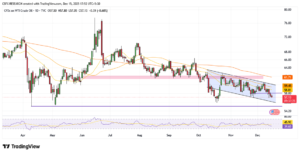
EUR/USD Technical Outlook: A challenging and volatile path is likely to define the pair’s movement through the first half of 2026.

The EUR/USD pair carved out a low at 1.0177 in January before rallying to a September peak at 1.1918, ultimately closing the year with solid gains near the 1.1800 area. From a long-term perspective, the broader bias still points to further upside. However, steady US growth contrasted with sluggish European momentum suggests that any advance is likely to be uneven and challenging until greater macro clarity emerges.
On the weekly chart, the pair continues to hold above a flat 20-period Simple Moving Average (SMA), while the 100 SMA—clearly bullish—is positioned roughly 700 pips lower, an encouraging signal for buyers. Momentum hovers near its midline, while the Relative Strength Index (RSI) has moved deeper into positive territory, supporting the bullish narrative but stopping short of outright confirmation.
The monthly chart paints a more constructive picture. EUR/USD trades close to its yearly highs, with a mildly bearish 200 SMA acting as nearby resistance. Below spot, a rising 20 SMA sits under a largely neutral 100 SMA, both well beneath current levels. Technical indicators remain firmly positive, aligning with a dominant—though still understated—bullish trend.
To unlock further upside, the pair must decisively clear the 1.1920 zone and the monthly 200 SMA, which would open the door toward the 1.2230–1.2260 region, last seen between February and June 2021. A break beyond that area would likely expose the 1.2500 handle.
On the downside, initial support is located at 1.1470, a long-standing structural level. Below that, 1.1350—where buyers stepped in during mid-2025—comes into focus. A sustained break beneath this zone would leave the 1.1000 psychological level vulnerable.
Will Central Banks Still Dominate Markets in 2026?
Market narratives in 2025 were driven largely by central banks and tariffs. While trade measures have gradually faded as a dominant concern, policymakers worldwide have remained alert to their inflationary impact. Still, officials—including Jerome Powell—have broadly characterized tariffs as a likely one-off price shock.
Although trade frictions between the US and China are expected to persist, a wider escalation beyond the world’s two largest economies appears unlikely.
Both the European Central Bank and the Federal Reserve continue to emphasize inflation and employment mandates, yet growth dynamics are becoming increasingly difficult to ignore. Economic momentum in the European Union has remained subdued, while the United States posted robust annualized GDP growth of 4.3% in Q3, following 3.8% in Q2, underscoring a clear divergence.
For now, this policy imbalance arguably tilts in favor of the euro over the longer term, particularly given that the ECB’s benchmark rate stands at roughly half the level of the US federal funds rate.