
Global Forex & CFD Broker | 1:10,000 Leverage

Mobile Header & Menu
AMD stock rally and oil price crash during US market close May 2026

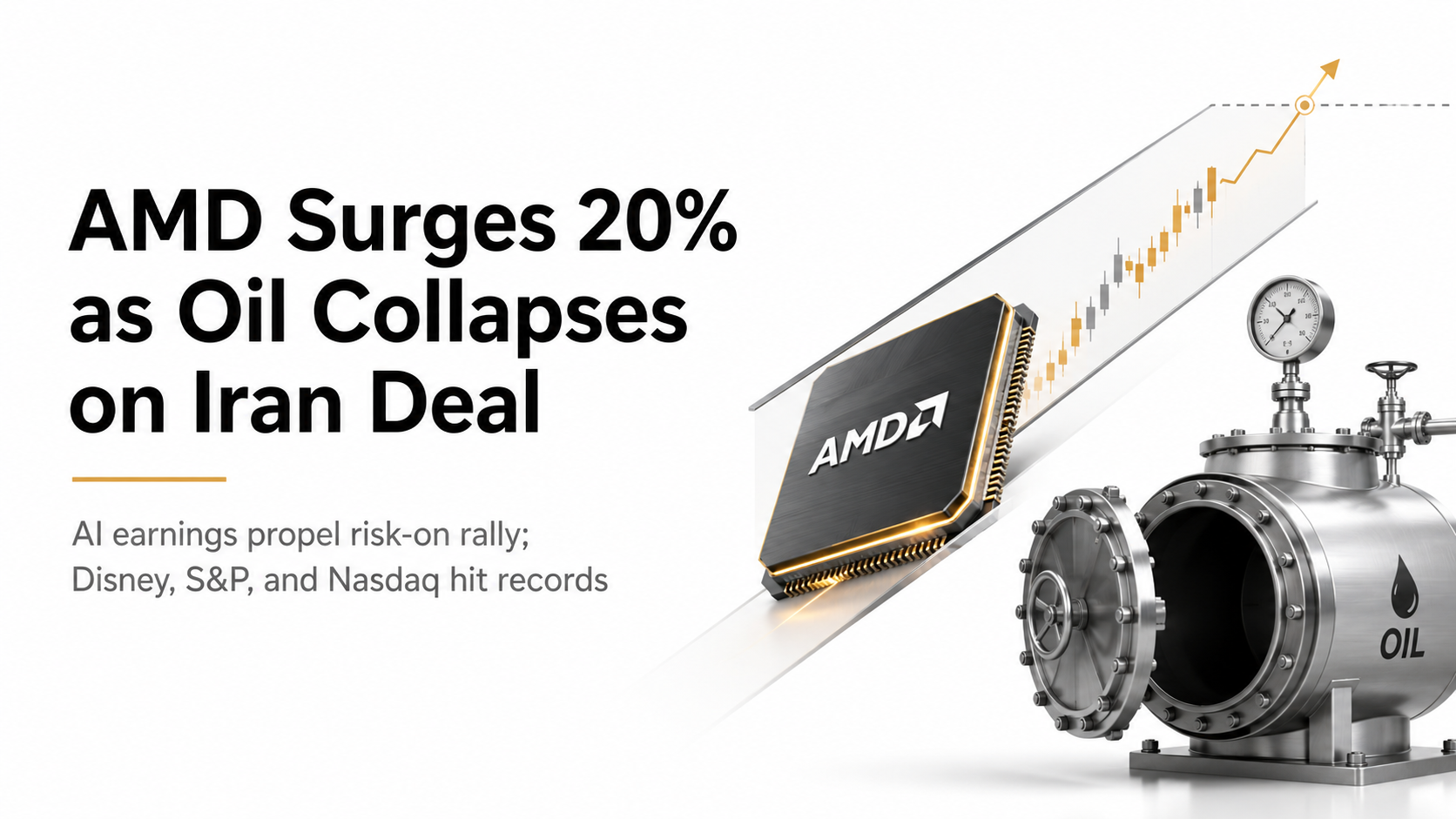
AMD Surges 20% as Oil Crashes on Iran Deal Hopes | US Market Close May 6 2026

May 6, 2026
CSFX
US Closing Session Briefing May 6 2026 — AMD +20% on $10.3B Blowout; Oil Plunges 9% on US-Iran Deal; Disney +8% Under D’Amaro; Records for S&P & Nasdaq; Warsh Full Senate Vote This Week | Capital Street FX
CLOSE
SPX~7,345▲ +1.19% ATH
DJI~49,875▲ +1.17%
NDX~25,590▲ +1.50%
RUT~2,845▲ +1.75%
VIX~16.20▼ −11.4%
WTI~$91.50▼ −10.6%
BRENT~$102.20▼ −6.9%
GOLD~$4,712▲ +3.1%
BTC~$81,290▲ +1.2%
10Y~4.23%▼ −9bp
AMD~$412▲ +20% ON $10.3B BEAT
DIS~$115▲ +8% D’AMARO ERA BEGINS
WARSHMAY 15● FULL SENATE VOTE WK MAY 11
IRANMOU DRAFT▲ DEAL FRAMEWORK NEAR
SPX~7,345▲ +1.19% ATH
DJI~49,875▲ +1.17%
NDX~25,590▲ +1.50%
RUT~2,845▲ +1.75%
VIX~16.20▼ −11.4%
WTI~$91.50▼ −10.6%
BRENT~$102.20▼ −6.9%
GOLD~$4,712▲ +3.1%
BTC~$81,290▲ +1.2%
10Y~4.23%▼ −9bp
AMD~$412▲ +20% ON $10.3B BEAT
DIS~$115▲ +8% D’AMARO ERA BEGINS
WARSHMAY 15● FULL SENATE VOTE WK MAY 11
IRANMOU DRAFT▲ DEAL FRAMEWORK NEAR
Capital Street FX · US Closing Session Briefing

US Close — Wednesday, May 6, 2026
AMD +20% on $10.3B Blowout & $11.2B Q2 Guide; Oil Crashes 9% as US-Iran Deal Framework Emerges; Disney Beats Under D’Amaro; S&P 500 & Nasdaq Hit New Records; Warsh Full Senate Vote Week of May 11

Wednesday’s session was the corrective antidote to Tuesday’s valuation confusion: where PLTR delivered a historic beat and fell, AMD delivered an equally historic beat and surged 20% — a reminder that multiple, not just momentum, determines how the market rewards earnings. AMD’s $10.3 billion Q1 result, data center revenue of $5.8 billion (+57% YoY), and a Q2 guide of $11.2 billion — blowing past the $10.5 billion consensus — validated the AI hardware thesis that Palantir’s software results confirmed one session earlier. Meanwhile, Axios reported that the US believes it is nearing a one-page Memorandum of Understanding with Iran to end the war, triggering a 9–10% collapse in crude oil and a broad risk-on surge in equities. Disney added to the euphoria with its first earnings under new CEO Josh D’Amaro, beating on revenue ($25.2B) and lifting full-year guidance, with its streaming business on track for a 10%+ operating margin. The S&P 500 closed at a fresh all-time high.

Session Overview

Wednesday delivered the market its clearest signal in weeks: the AI hardware thesis is validated, not just at the software layer but straight through to the semiconductor layer. AMD reported $10.253 billion in Q1 revenue — 38% YoY growth, data center revenue of $5.775 billion up 57% and at an all-time high, EPS of $1.37 beating the $1.29 consensus, and a Q2 guide of $11.2 billion that was $700 million above where the Street expected. The stock surged 20%, taking AMD’s YTD gain to approximately 85% and confirming Lisa Su’s thesis that the agentic AI cycle is distributing compute demand across both GPUs and CPUs simultaneously. But the session’s biggest macro event was not in earnings — it was in geopolitics. An Axios report citing US officials stated that Washington and Tehran were working on a one-page Memorandum of Understanding to end the war and establish a framework for nuclear negotiations, sending Brent crude plunging 7–10% intraday to below $103, WTI below $92, and lifting equities across all sectors except energy. Trump simultaneously paused Operation Project Freedom, calling progress in talks “great,” while about 23,000 seafarers remain stranded in the Persian Gulf pending resolution. Disney’s first earnings under Josh D’Amaro — who took over from Bob Iger on March 18 — also impressed, with $25.2 billion in revenue (+7%), streaming on a 10%+ margin trajectory, and parks delivering record growth. The S&P 500 closed at a new all-time high above 7,345, the Nasdaq hit a fresh record above 25,590, and VIX fell sharply to approximately 16.20, signalling that the market’s fear gauge is retreating as geopolitical risk premiums deflate.

💻
AMD +20% — $10.3B Q1 Beat, Data Center +57%, Q2 Guide $11.2B
Revenue $10.253B vs $9.84B est (+38% YoY). EPS $1.37 vs $1.29 est. Data Center $5.775B (+57% YoY, ATH). Free cash flow $2.6B (record). Q2 guide $11.2B ±$300M vs $10.5B est. Lisa Su: “We are in the early stages of the AI infrastructure cycle.” AMD surged 20% to ~$412, 85%+ YTD.
🕊️
US-Iran Deal Framework — Axios MOU Report Sends Oil Crashing
Axios: US officials believe a one-page MOU could be imminent, setting a framework for nuclear negotiations. Iran’s foreign ministry: US proposal “under review,” response via Pakistani mediators expected. Trump pauses Project Freedom, calls talks “great progress.” Brent −7% to ~$102. WTI −10% to ~$91.
🏰
Disney Q2 FY26 — Revenue $25.2B Beat, D’Amaro Sets New Tone
Revenue $25.2B (+7% YoY) vs $24.78B est. Streaming on 10%+ margin target for FY26. Parks record: revenue $9.49B (+7%), profit $2.62B (+5%). FY26 EPS growth +12% affirmed; targeting $8B in buybacks. Q3 total segment income ~$5.3B. DIS +8% on first report under new CEO Josh D’Amaro.
📊
S&P 500 +1.19% to ~7,345 — Fresh All-Time High; VIX Falls to 16.20
S&P 500: ~7,345 (new ATH). Nasdaq: ~25,590 (new ATH). Dow: ~49,875 (+1.17%). Russell 2000: ~2,845 (+1.75%) — small caps outperforming for the first time this week as rate pressure eases. VIX: ~16.20 (−11.4%), lowest since before the Iran-UAE escalation. 10Y yield fell ~9bp to ~4.23% on oil disinflation read-through.
🏛️
Warsh Full Senate Vote — Week of May 11, Confirmation Expected
Banking Committee advanced 13-11 on party lines April 29. Full Senate floor vote expected week of May 11. Republicans hold 53-seat majority; Sen. Fetterman (D-PA) likely to cross. Confirmation before Powell’s May 15 term expiry now the base case. Warsh first FOMC: June 16-17. Rate at 3.5–3.75%.
🖥️
SMCI +15% — Supermicro Beats; AI Infrastructure Wave Broadens
Super Micro Computer surged 15% on strong Q3 results driven by AI server demand. Nvidia +4% in sympathy with AMD beat. Intel +2%+ as Apple-INTC foundry thesis gains continued traction. AI infrastructure trade firing simultaneously across GPUs, CPUs, servers and software — the broadest AI validation of the 2026 earnings season.
Wednesday resolved Tuesday’s paradox definitively. If Tuesday asked whether a historic beat guarantees a stock rally at 233x earnings — and answered “no” via PLTR — Wednesday showed what happens when a stock enters its result at a more reasonable multiple after a 5% pullback: AMD surged 20% on a beat that was, if anything, marginally smaller than Palantir’s in percentage terms, because AMD wasn’t priced for the result it delivered. The oil collapse is the most important macro event of the week: an Axios report citing US officials stated that Washington and Tehran may be within days of a one-page Memorandum of Understanding — not a full peace deal, but a ceasefire framework that would set the architecture for nuclear talks and, critically, allow the Strait of Hormuz to reopen. If the MOU is signed, the $60/barrel Iran war premium begins to unwind, potentially sending Brent back toward $65–$75 over the next quarter. The 10-year yield’s 9bp fall is the equity market’s most important signal from Wednesday: oil deflation reduces the inflation premium in long-term rates, giving the Warsh Fed more room to manoeuvre in June. Wednesday’s session confirmed three simultaneous truths: AI chips are firing at full capacity; the Iran war premium is deflating faster than the market expected; and the rotation from defensive/energy into AI/tech/consumer discretionary is the dominant structural trade of the week.
🟢
Market Alert — AMD Q1 2026 Blowout: $10.3B Revenue, Data Center +57%, Q2 Guide $11.2B
AMD Q1 2026: Revenue $10.253B (+38% YoY, beat $9.84B est) · EPS $1.37 (beat $1.29) · Data Center $5.775B (+57% YoY, ATH) · Free Cash Flow $2.6B (record) · Q2 Guide $11.2B ±$300M (vs $10.5B est) · Non-GAAP GM 55%. AMD surged 20% following results that validated the AI semiconductor thesis on every metric that mattered. CEO Lisa Su confirmed Meta plans to deploy up to 6 gigawatts of AMD Instinct GPUs; AWS, Google Cloud, Microsoft Azure and Tencent expanded EPYC deployments. The Q2 guide of $11.2B — $700M above consensus — was the move that forced the repricing. AMD’s YTD gain extends to approximately 85%.
🕊️
Breaking — US-Iran MOU Framework: Axios Reports Deal Could Be Days Away
Axios: US officials believe a one-page Memorandum of Understanding to end the war with Iran could be imminent, establishing a framework for broader nuclear negotiations. Iran’s foreign ministry stated the US proposal is “under review,” with Tehran’s response expected via Pakistani mediators. Trump paused Operation Project Freedom, citing “great progress” in talks. Brent crude plunged 7–9% to below $103 and WTI to below $92. Iran’s navy stated that “with aggressor’s threats neutralized, safe passage through the Strait of Hormuz will be ensured.” Roughly 23,000 seafarers from 87 countries remain stranded in the Persian Gulf pending resolution. A full deal could unwind the $60/barrel Iran war premium over multiple weeks.
🏰
Earnings Alert — Disney Q2 FY26 Beats; D’Amaro Sets Bullish Tone
Disney Q2 FY26: Revenue $25.2B (+7% YoY, beat $24.78B est) · Streaming on track for 10%+ operating margin · Parks revenue $9.49B (+7%) at record levels · FY26 EPS guidance +12% affirmed · Buyback target raised to $8B. First report under new CEO Josh D’Amaro, who replaced Bob Iger on March 18, 2026. D’Amaro flagged consumer resilience at parks despite the macro backdrop, while noting that a “significant further rise in fuel prices” could eventually impact behaviour. The Epic Games/Fortnite collaboration is “central” to content strategy. DIS +8%, extending gains from Tuesday’s +5% ESPN app expansion news. DIS is now up approximately 7% YTD after having been down 12% YTD earlier this week.
📊

Markets Snapshot — Close of Business, May 6, 2026

US Equity Indices · Official Close 16:00 EDT
May 6, 2026
Index Close Change Session Signal Context
S&P 500 ~7,345 ▲ +1.19% NEW ATH Fresh all-time high. AMD beat + Iran MOU report fuelled a broad risk-on session. Every sector green except energy. Oil deflation removes inflation premium; 10Y yield −9bp enabling P/E expansion.
Nasdaq Composite ~25,590 ▲ +1.50% TECH SURGE AMD +20%, SMCI +15%, Nvidia +4%, Intel +2%. AI infrastructure names leading. Nasdaq posts its second consecutive record close, extending the AI earnings rally through semiconductor validation.
Dow Jones Industrial ~49,875 ▲ +1.17% BROAD RALLY Walt Disney +8% the standout Dow component. Energy names the only drag as oil collapses 9–10%. Industrial recovery continuing as Iran deal scenario reduces the oil cost-push inflation risk.
Russell 2000 ~2,845 ▲ +1.75% OUTPERFORMING Small caps outperforming large caps for the first time this week — a signal that rate pressure is easing. 10Y yield falling 9bp reduces the rate-sensitivity headwind that crushed Russell on Monday and Tuesday.
VIX (Fear Index) ~16.20 ▼ −11.4% DEFLATING VIX falls sharply as the twin risks of the week — AMD binary event and Iran escalation — resolve constructively. From 18.29 to 16.20 in 24 hours is a meaningful vol compression. June FOMC is the next vol catalyst.
10Y Treasury Yield ~4.23% ▼ −9bp RELIEF RALLY Oil’s 9–10% collapse removes near-term inflation premium from long rates. 10Y drops from 4.43% to ~4.23% — the sharpest single-session move since late April. Moves the 10Y out of the critical 4.40–4.50% P/E compression zone.
XLK
+3.40%
Technology — AMD +20%, SMCI +15%, NVDA +4%
XLY
+2.10%
Consumer Disc — Disney +8% on D’Amaro beat
XLF
+1.20%
Financials — Yield curve relief, spread improvement
XLI
+0.85%
Industrials — Oil cost pressure deflating
XLE
−4.50%
Energy — Oil −9%, Iran deal trades unwind energy longs
XLU
+0.95%
Utilities — Rate relief; 10Y −9bp removes key headwind
🎁
Capital Street FX — Trade the Oil Collapse & AI Surge
Oil CFDs, AMD, Nvidia, Disney, S&P 500 & More — From $50
Today’s session delivered the two most tradeable simultaneous events of 2026: a 9–10% crude oil collapse on US-Iran deal progress and a 20% AMD surge on a blowout quarter. Brent oil, WTI, Gold, Bitcoin, S&P 500 CFDs, Nasdaq CFDs, AMD, Nvidia, Disney, Intel — all tradeable at Capital Street FX with raw ECN spreads from 0.0 pips, up to 1:10,000 leverage, and the industry’s most generous 900% deposit bonus to maximise effective margin on every setup in this report.
🛢️

Oil & Geopolitics — Iran MOU Draft Triggers the Week’s Biggest Trade

BRENT CRUDE · ICE
Global Benchmark · Jun 2026 Contract
~$102.20
▼ −$7.67 (−6.96%)
Tue Close: $109.87
R2
$114–$116 (Mon-Tue spike zone)
R1
$107–$110 (Tuesday close)
NOW
~$102.20
S1
$97–$100 (round number / pre-war zone)
S2
$65–$75 (full deal / Strait reopen scenario)

Brent has now retraced nearly half of its Iran war premium in two sessions. The MOU framework — if confirmed — would set the stage for the Strait of Hormuz to reopen, potentially unlocking the 13 mb/d of disrupted supply. The $65–$75 range represents Brent’s pre-war equilibrium assuming normal Strait transit is restored.

WTI CRUDE · NYMEX
US Benchmark · Jun 2026 Contract
~$91.50
▼ −$10.77 (−10.57%)
Tue Close: $102.27
R2
$105–$108 (resistance / Mon spike)
R1
$97–$100 (key psychological ceiling)
NOW
~$91.50
S1
$85 (demand support)
S2
$58–$65 (full Hormuz normalisation)

WTI breaking below $92 on 10%+ intraday moves is its largest single-session decline since the pandemic. Even with Wednesday’s crash, WTI is still up ~60% year-to-date. The deal-risk tail is real and asymmetric: confirmation of an MOU could send WTI toward $70–$80 over the following weeks as shipping normalisation picks up speed.

The geopolitical picture is evolving faster than most macro models predicted. As of Wednesday, the US believes it is days away from an MOU — a one-page document to end hostilities and establish a framework for nuclear talks, not a full peace agreement. Iran’s foreign ministry confirmed it was reviewing the US proposal and would respond via Pakistan. Trump paused Operation Project Freedom, citing “great progress.” Iran’s navy made a notably conciliatory statement, saying that “with aggressor’s threats neutralized, safe and stable passage through the Strait of Hormuz will be ensured” — language that markets read as a green light for Hormuz reopening within days of any signed deal. The key risk that keeps a floor under oil prices: even with an MOU signed, 23,000 seafarers remain stranded and full shipping normalisation is expected to take several weeks. Supply disruption won’t reverse overnight. But the directional momentum in oil is now decisively to the downside, and the inflation premium embedded in the 10-year yield is deflating in step. For the broader market, cheaper oil is the single most powerful macro tailwind available — it reduces input costs for every non-energy company simultaneously, compresses inflation expectations, gives the Warsh Fed cover to be less hawkish in June, and increases real consumer spending power at the pump. Wednesday’s session pricing suggests the market is beginning to model the Iran deal scenario as the base case, not the tail case.

💻

AMD Q1 2026 Earnings — The AI Chip Thesis Is Now Confirmed

AMD Q1 2026 — Actual Results vs Consensus · Reported After Bell May 5
Stock +20% · Wed, May 6, 2026
Metric Actual Consensus Signal Commentary
Total Revenue
AMD · Q1 2026
$10.253B $9.84B BEAT +4.2% +38% YoY from $7.44B in Q1 2025. AMD beat the midpoint of its own guide ($9.8B) and the Street consensus by $413M. Revenue effectively flat sequentially from Q4 2025’s $10.27B — but Q1 is seasonally weaker, making the beat against consensus all the more significant.
Non-GAAP EPS
AMD · Q1 2026
$1.37 $1.29 BEAT +6.2% +43% YoY from $0.96 in Q1 2025. AMD has now beaten EPS in 5 consecutive quarters. GAAP EPS was $0.84 (+91% YoY). Net income nearly doubled to $1.38B. Free cash flow of $2.6B (record) — more than tripling YoY, confirming AI infrastructure cycle translating to real cash generation.
Data Center Revenue
EPYC + Instinct GPU
$5.775B $5.56B BEAT — ALL-TIME HIGH +57% YoY from $3.67B. +7% sequentially — growth in a seasonally weak quarter. Data Center = 56% of total AMD revenue. Meta-AMD deal: up to 6 GW of Instinct GPUs; AWS, Azure, GCP all expanded EPYC. Intel Diamond Rapids delay to mid-2027 clears AMD’s path in H2 2026.
Non-GAAP Gross Margin
AMD · Q1 2026
55.0% ~55% (guided) IN LINE — FLOOR HELD Met guidance of ~55%. Up 170bp YoY. GAAP GM improved from 50% to 53%. The floor held — no margin compression despite higher memory/component costs flagged as a concern by Apple’s Tim Cook. Q2 guide of 56% non-GAAP GM signals further expansion ahead.
Q2 2026 Revenue Guide
Forward Catalyst
$11.2B ±$300M ~$10.5B +$700M ABOVE STREET The guide is the true catalyst. $700M above consensus at midpoint — implies 46% YoY growth and 9% sequential expansion. Lisa Su: server CPU revenue to grow 70%+ YoY in Q2. MI450 GPU and Helios rack-scale platform ramp expected to accelerate in H2 2026. This guide is why AMD +20%.

AMD’s Wednesday session was the mirror image of Palantir’s Tuesday: where PLTR delivered transformative growth at 233x earnings and was sold, AMD delivered equally strong growth at a more modest multiple after a 5% pullback, and was bought emphatically. The +20% single-day move is AMD’s largest since its Q4 2023 result and takes its market capitalisation above $670 billion. The specific data points that drove the repricing: data center revenue of $5.775 billion at an all-time high (+57%), the record free cash flow of $2.6 billion (proof that AI demand translates to real cash), and the Q2 guide of $11.2 billion that was $700 million above where the Street was positioned. Lisa Su’s commentary is the most important forward-looking signal from any chip earnings call this season: she described “strong and increasing confidence” in AMD reaching tens of billions of dollars in data center AI revenue “next year” and exceeding AMD’s long-term growth target of greater than 80% “in the coming years.” That is a statement of multi-year compounding, not a quarterly beat. The competitive read-through is also specific: Intel’s Diamond Rapids CPU — originally scheduled for H2 2026 — has been delayed to mid-2027. During the critical window when AMD’s next-generation EPYC Venice processors ramp, they will face almost no direct same-generation CPU competition. This is the structural tailwind that makes AMD’s Q2 guide not just plausible but conservative.

🏰

Disney Q2 FY26 — The D’Amaro Era Opens With a Beat

Disney Q2 FY2026 — Key Segment Performance vs. Expectations
Reported Pre-Market · May 6, 2026
SegmentRevenueSignalCommentary
Total Revenue $25.2B BEAT +1.7% +7% YoY vs $24.78B consensus. D’Amaro’s first earnings call sets a confident tone. FY26 adjusted EPS growth affirmed at 12%; buyback target raised to $8B from $7B. FY27 double-digit EPS growth guided.
Disney Experiences (Parks) $9.49B RECORD QUARTER +7% YoY. Operating income $2.62B (+5%). Record growth driven by higher domestic guest spending, Disney Adventure & Destiny cruise launches. Pre-opening expenses from World of Frozen partially offset. D’Amaro: consumer behaviour resilient despite macro headwinds.
Entertainment SVOD (Streaming) ~$525M op. income ON TRACK 10%+ MARGIN Disney+ and Hulu SVOD operating income projected 50%+ increase YoY, ~$525M — vs $500M guidance midpoint. Streaming segment on trajectory for 10%+ operating margin for FY26. Epic Games/Fortnite partnership central to engagement strategy.
Sports (ESPN) $4.61B MIXED — RIGHTS COSTS Revenue +2% but operating income −5% on higher rights fees and lower NBA ad revenue. NFL Network acquisition added 3% to ESPN affiliate/subscription revenue. Sports operating income to decline 14% in Q3 on programming expense timing — key risk for DIS near-term.
Q3 FY26 Guidance ~$5.3B op. income STRONG Q3 GUIDE Total segment operating income Q3 guided at ~$5.3B. Offsets the sports headwind. DIS also ended $1B OpenAI/Sora partnership; Epic collaboration replacing content tech strategy. D’Amaro not changing FY26/27 guidance due to macroeconomic or fuel uncertainty.
🏛️

Fed & Macro — Warsh Week of May 11; Oil Deflation Changes the Rate Calculus

10Y YIELD
~4.23%
▼ −9bp today
2Y YIELD
~4.05%
▼ −5bp today
FED FUNDS
3.625%
● 3.5–3.75% target
WARSH VOTE
Wk May 11
▲ 5–9 DAYS
REAL YIELD
~1.9%
▼ Easing
Macro Drivers — May 6 Fundamental Picture
Key signals for this session
DriverLevelSignalImplication
Warsh — Full Senate Vote Week of May 11 IMMINENT CONFIRMATION Full Senate floor vote expected the week of May 11. Republicans hold 53-seat majority. Sen. Fetterman (D-PA) likely to cross party lines. Confirmation now base case before Powell’s May 15 expiry. Warsh’s first FOMC is June 16-17.
Oil Disinflation Impact Brent −7% WTI −10% MACRO TAILWIND If oil falls toward $75–$85 Brent over the next month, headline CPI could decline meaningfully. Reduces the inflation premium in long rates. Creates cover for Warsh’s June FOMC to hold or hint at cuts. The single largest macro variable for the rest of Q2.
Powell — Staying as Governor Through Jan 2028 INSTITUTIONAL ANCHOR Powell cited DOJ actions and Fed independence as reasons to stay on the Board. Retains a voting seat; Warsh has 1 of 12 FOMC votes. Trump reportedly wants Powell off entirely but legal challenge makes forced removal unlikely. Balance-of-power dynamic a feature of June FOMC.
JOLTS Job Openings — May 5 Report 6.87M openings LABOUR RESILIENT Job openings steady at 6.87M (vs 6.8M consensus). Hiring rate surged +655K to 5.55M. Quits +125K. Labour market remains healthy — supports soft-landing narrative that allows Warsh to enter June FOMC with a stable domestic macro backdrop amid the geopolitical resolution.
AI Productivity Thesis AMD + PLTR Confirmed BOTH LAYERS VALIDATED AMD’s $5.8B data center beat confirms AI chip demand accelerating. Palantir’s 145% Rule of 40, 85% revenue growth confirms AI software monetisation compounding. Both the hardware and software stacks of the AI cycle have now reported in the same earnings week — reinforcing Warsh’s own view that AI productivity gains create non-inflationary growth.
🎯

Trade Setups — May 6 Close · Key CFD Positions for the Next Session

Active Setups — May 7 Opening View
All prices indicative at May 6 close · Risk sizing per your own plan
Asset Dir. Entry Zone Target Stop Rationale
BRENT OIL
CFD
SHORT $100–$104 $85–$88 $110 Iran MOU deal framework is base case. Any confirmed signing sends Brent toward $85–$90. Hormuz reopening = structural supply normalisation over 4–8 weeks. Short bounces into $100–$104 with stop above $110. R:R ~1.5:1.
WTI OIL
CFD
SHORT $88–$93 $73–$76 $98 WTI broke below $92 today for the first time since the war began. Next key support at $85. Full deal removes Iran war premium; WTI equilibrium is $58–$65. Short on any dead-cat bounce toward $88–$93. Risks: MOU fails, Iran retaliates, oil spikes back above $100.
NASDAQ CFD
NDX100
LONG Pullback to 25,200–25,400 26,200+ 24,700 AI hardware + software both validated in one week. Oil disinflation removes the biggest P/E compression headwind (10Y was at 4.43%, now ~4.23%). Buy dips on Nasdaq as Warsh confirmation uncertainty is priced and the Iran deal tail becomes a macro tailwind.
GOLD
XAU/USD
LONG $4,650–$4,720 $4,900+ $4,500 Gold +3.1% today despite risk-on — unusual. Market may be buying gold on Warsh uncertainty (potential de-anchoring of Fed credibility) and Iran deal hedging (deal fails scenario). The $4,700 handle is new territory; $5,000 is the next major psychological resistance.
XLE (ENERGY)
SHORT SIDE
SHORT Any bounce −15 to −20% further Oil back above $105 Energy sector −4.5% Wednesday is the start of the unwind, not the end. XLE remains leveraged long to oil prices. If Brent falls to $85–$90, energy stocks face a structural repricing. Short XLE vs long NDX is the dominant sector rotation trade of the week.
Trade all of these setups — oil CFDs, Nasdaq CFD, Gold, Bitcoin, Energy sector CFDs — at Capital Street FX with 1:10,000 leverage, ECN spreads from 0.0 pips, and up to 900% deposit bonus. All trades involve risk. Manage your position sizing carefully.

📌 Analyst Q&A — Five Questions Wednesday’s Session Demands

The market is not being inconsistent — it is being precisely rational in both cases, and the comparison reveals something important about how AI valuations work in 2026. Palantir’s sell-the-news happened despite a stronger-than-expected result because the stock entered the print at 233x trailing earnings, a multiple that already priced in not just the beat Palantir delivered but several years of continued compounding at that rate. At 233x earnings, the floor for a positive stock reaction is not “beat the consensus” — it is “beat the consensus by so much that the implied future is now better than the implied future the stock was already discounting.” Palantir delivered 85% revenue growth and still fell, because 233x already assumed something close to that trajectory. AMD entered its print at approximately 120–130x forward earnings — still elevated, but meaningfully below Palantir’s multiple — and after a 5% single-day pullback on Monday that reduced the immediate “priced for perfection” risk. More importantly, AMD’s guidance of $11.2B for Q2 versus the $10.5B consensus represented a gap that the market had not priced. Palantir’s guidance raise to $7.66B was significant but landed closer to what the consensus already expected given the trajectory. In short: both stocks behaved exactly as valuation theory predicts. At extreme multiples, the probability of a beat being “enough” drops sharply, because the stock is already discounting a future that only materialises if everything goes right for years. AMD’s 20% move is not a contradiction of Tuesday’s PLTR lesson — it is its confirmation.
The Axios report citing two US officials and two additional sources is credible by sourcing standards — four independent sources saying the same thing is not a leak, it is a signal from Washington that a deal is being prepared for public consumption. However, the critical word in the report is “framework”: the MOU is a one-page document establishing the architecture for nuclear negotiations, not the nuclear deal itself, and not a full peace agreement. The ceasefire between the US and Iran technically remains in place despite the week’s military engagements, and the MOU would formalise what the ceasefire implied — that both sides want to stop fighting — while creating a structure for talks. What oil does on a signed MOU versus a full deal is quantitatively different. A signed MOU immediately removes the acute escalation tail risk premium from oil — roughly $10–$15/barrel. A full deal that reopens Hormuz sustainably removes the full $60/barrel Iran war premium that has accumulated since February. The timeline for full Hormuz normalisation, even after a deal, is 4–8 weeks — the 23,000 seafarers need to transit, shipping insurance needs to normalise, and vessels need to navigate any remaining sea mines. The realistic Brent path on a confirmed deal: $95–$100 within days, $80–$85 within 30 days, and a return toward $65–$75 equilibrium over 60–90 days. The risk that keeps a floor under oil: the MOU collapses (as previous Iran talks have multiple times), Iran retaliates for the Tuesday boat destructions, or the Senate blocks the administration’s negotiating authority. But the market’s move Wednesday — pricing in something close to a 50% probability that a deal is signed within a week — appears consistent with the sourcing quality of the Axios report.
Gold’s 3.1% rally on a day where oil crashed (deflationary signal) and equities surged (risk-on signal) is one of the most analytically interesting price moves of the week, because in normal market conditions, gold falls when both of those things happen simultaneously. Gold typically declines when oil deflates (less inflation hedge demand) and when equities rally (less safe-haven demand). Wednesday’s gold rally tells you that the marginal buyer of gold on Wednesday is not hedging oil inflation or equity downside — they are hedging something else: the Warsh Fed transition risk. The argument runs as follows: the Federal Reserve under Powell has 15+ years of credibility as an independent, inflation-targeting institution. Warsh’s unorthodox views on Fed independence, swap lines, and his closeness to the Trump administration introduce non-trivial uncertainty about whether the Fed’s reaction function will remain predictable and anchored to the dual mandate under new leadership. For central bank credibility risk, gold is the classic hedge — it is the asset that performs when confidence in fiat monetary institutions is uncertain. The second hypothesis is simpler: gold rallied on Wednesday because the Iran deal, if it materialises, changes the global geopolitical order in ways that are uncertain and not entirely positive. A world where the US and Iran strike a deal is not obviously a stable world — it is a world with new power dynamics, and gold historically rallies on geopolitical restructuring as much as on conflict. The price at $4,712 is in uncharted territory above $4,700, and the $5,000 psychological level is now within reach. Whether gold holds these levels depends on whether the Warsh transition introduces the institutional uncertainty the market appears to be pricing.
Disney’s 8% pop on Wednesday has structural underpinnings that distinguish it from a one-day event reaction, but the full re-rating thesis will require two more quarters of validation. The structural case for Disney begins with the streaming business: operating profit growing 50%+ YoY and the company now projecting a 10%+ operating margin for Disney+ and Hulu in FY26 — a trajectory that, if sustained, would transform Disney from a parks-and-content company with an expensive streaming drag into an integrated entertainment platform with compound FCF growth. Streaming was the $5 billion annual loss that weighed on DIS for four years; turning it into a 10%+ margin business changes the fundamental equity story. The second structural positive is the parks business: record Q2 revenue of $9.49B despite consumer concerns about fuel costs and international travel, driven by premium spend per guest and the Disney Adventure and Destiny cruise launches, suggests demand for Disney’s high-ticket experiences remains resilient even at $4.50 gas prices nationally. The risk is the sports segment: ESPN operating income fell 5% on higher rights costs, and the Q3 guide includes a 14% decline in sports operating income from programming expense timing. This is manageable — it is timing, not structural — but it caps the near-term upside. The D’Amaro wildcard is unknowable from a single earnings call: Bob Iger ran Disney in a media environment he helped define over 20 years; D’Amaro is an unknown quantity at the strategic level, even if the operational handoff appears clean. The stock at 15x forward earnings — well below its five-year historical average — suggests the market is pricing significant uncertainty about the new CEO’s strategic vision. If D’Amaro can show two more quarters of streaming margin expansion and park resilience, the discount to historical valuation closes and DIS trades back toward $130–$140.
Wednesday’s oil collapse changes the Fed’s June meeting in ways that are specific and material. The FOMC’s primary concern entering the year was the oil-driven inflation impulse: Brent at $114–$116 in early May represented a meaningful upside inflation shock that, if sustained, would have forced the new Warsh-led Fed to adopt a hawkish stance at its very first meeting or risk appearing soft on inflation. Brent at $100–$102 — and potentially heading toward $85–$90 if the MOU is confirmed — removes that constraint. The oil-to-CPI transmission mechanism is well-documented: every $10/barrel decline in Brent reduces annualised headline CPI by approximately 0.3–0.5 percentage points with a 4–6 week lag. If Brent averages $90 in May and June versus the $110–$116 it averaged in April-May, the June CPI print released ahead of the FOMC meeting could show a meaningful headline decline, creating the narrative conditions for Warsh to take office, signal stability, and indicate that the easing bias remains intact without triggering an inflation credibility concern. Warsh’s stated view — that AI productivity gains create non-inflationary growth — becomes much more credible to the market if headline inflation is declining simultaneously. The practical implication: Warsh’s first FOMC on June 16-17 is more likely to be a hold with a neutral-to-dovish tone than the hawkish fireworks that markets feared when oil was at $114. The 4-dissent split from Powell’s last meeting — 3 wanting to remove the easing bias — remains a risk, but a falling oil price and falling 10-year yield (now at ~4.23% vs 4.43% Tuesday) changes the distribution of likely outcomes materially. Wednesday’s session reduced the probability of a June surprise hawkish shock from approximately 25% to approximately 10%. That re-pricing alone is worth several Nasdaq percentage points of P/E expansion.

Closing Summary — Wednesday, May 6, 2026

Wednesday delivered clarity on three fronts that had been the market’s dominant uncertainty all week. The first clarity is AI’s most complete validation in a single earnings week: Palantir confirmed AI software monetisation is real, compound, and accelerating — $1.633B in revenue, 85% YoY, 145% Rule of 40. AMD confirmed AI hardware demand is distributing across both GPUs and CPUs simultaneously — $10.3B in revenue, data center +57% at an all-time high, record free cash flow, and a Q2 guide that was $700 million above consensus. Two sessions, two layers of the AI stack, both confirming each other. The market’s response — S&P 500 and Nasdaq at all-time highs — is the only rational read. The AI bull cycle is not a story about one company or one chip. It is a story about every layer of a new infrastructure compounding together, and this earnings week proved it.

The second clarity is geopolitical: the US-Iran MOU framework reported by Axios represents the most significant de-escalation signal since the Strait closed in February. If signed, the oil-inflation premium that had been the market’s most persistent headwind — the $60/barrel increment embedded in Brent since February — begins an irreversible unwind. Oil falling 10% in a single session, the 10-year yield dropping 9 basis points, and the VIX falling from 18.29 to 16.20 are the market’s simultaneous pricing of a world in which the Iran war ends, the Strait reopens, and the Warsh Fed inherits an economy where energy-driven inflation is deflating rather than compounding. The third clarity is the rate picture: Brent at $102 rather than $114 changes the entire calculus for Warsh’s first June FOMC meeting. The hawkish 4-dissent split from Powell’s last meeting was responding to a world with oil near $115 and inflation risk to the upside. In a world with oil potentially heading toward $85–$90, that calculus changes — and Warsh’s opening meeting has room to be a stabilising, credibility-establishing hold with a neutral tone rather than the confrontational first statement that markets were beginning to dread.

Wednesday’s session is the week’s verdict, and the week’s verdict is the year’s most important confirmation: the AI economy is real, the Iran war premium is deflating, and the Federal Reserve transition, while uncertain, is navigating into a more favourable macro environment than feared 48 hours ago. The open question heading into next week is not whether the trends are right — they are — but whether the Iran MOU gets signed, and whether Kevin Warsh’s first FOMC on June 16-17 confirms what this week’s macro data is now signalling: that the path to a soft landing, AI-driven productivity growth, and a reopened global energy market is not only possible but is the base case.

Risk Disclosure: This closing session briefing is published by Capital Street FX (capitalstreetfx.com) for informational and educational purposes only. It does not constitute financial advice or a solicitation to trade. Prices referenced reflect estimated closing data sourced from public market feeds as of approximately 16:00–16:30 EDT May 6, 2026. Pre-market/intraday price levels for S&P 500, Nasdaq, Dow, VIX, oil, gold and Bitcoin are estimated based on live data from Yahoo Finance, Investing.com, TradingEconomics, and related feeds as of the time of writing and may differ from official settlement prices. AMD Q1 2026 earnings are based on reported data published after the May 5 close via GlobalNewswire, CNBC, Investing.com, Yahoo Finance, and AMD’s investor relations. Disney Q2 FY2026 earnings sourced from Disney investor relations, The Wrap, CNBC, and MarketScreener as of May 6 morning. US-Iran MOU report sourced from Axios (May 6, 2026); no deal has been confirmed by the US government, the Iranian government, or Pakistani mediators as of press time. Brent and WTI crude prices sourced from TradingEconomics, Investing.com, and Fortune as of intraday May 6. Kevin Warsh Senate confirmation status based on CNBC, CBS News, and Kiplinger reporting as of April 29–May 6, 2026. 10-year Treasury yield and VIX levels from Investing.com historical data. Gold and Bitcoin levels from Yahoo Finance. CFD trading involves significant risk and is not suitable for all investors. You may lose more than your initial deposit. Past market analysis does not guarantee future results. Capital Street Intermarkets Limited is regulated by the FSC of Mauritius (Licence No. C112010690). Capital Street Bancclear Corporation is regulated by the FSA of Saint Vincent and the Grenadines (Licence No. 22064-IBC-2014). Always conduct your own due diligence and consult a licensed financial advisor before trading.

Lets Get Started