
Market Close Trading Analysis: S&P 500 Drops, Tesla Shock, Oil Surge — Key Setups for Tomorrow
US Close — Thursday, April 23, 2026
Hormuz Mine Order Escalates Conflict, Tesla Capex Shock, Tech Double-Miss Breaks Record Run
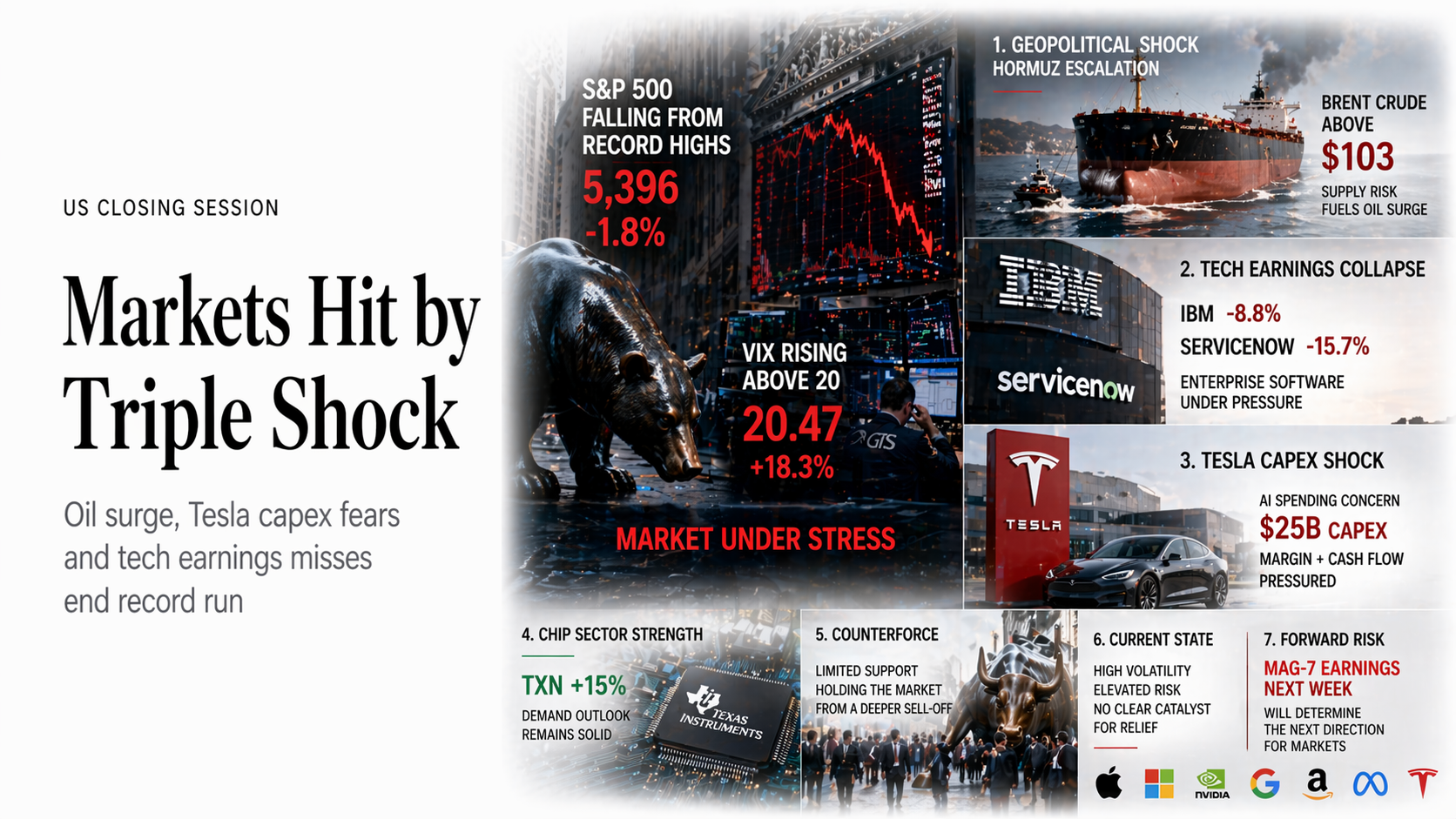
The S&P 500 snapped its record-high streak as three simultaneous negative catalysts converged: Trump ordering the Navy to shoot Iranian mine-layers pushed Brent above $103, Tesla’s after-hours $25B capex revelation repriced the AI spend thesis downward, and a gut-punch double-miss from IBM (−8.8%) and ServiceNow (−15.7%) ignited an enterprise SaaS rout. VIX reclaimed the 20-level danger zone. The bulls’ one lifeline: Texas Instruments surged +15.4% on blockbuster guidance and chipmakers extended their historic 17-session winning streak.
Thursday reversed Wednesday’s relief rally with a triple-headed shock that the market could not absorb in a single session. Trump’s Truth Social post ordering the Navy to “shoot and kill any boat” laying mines in the Strait of Hormuz arrived pre-market and immediately broke the ceasefire’s de-escalation narrative. Brent crude punched through $103 — the first triple-digit close since the conflict began — while the US announced it boarded another Iranian tanker (M/T Majestic X) in the Indian Ocean. Simultaneously, Tesla’s overnight $5B capex hike stunned investors who had expected reassurance after the headline EPS beat, and the IBM/ServiceNow double-miss confirmed growing fears that AI disruption is now actively cannibalising enterprise software revenue, not just threatening it theoretically. The VIX’s return above 20 is a structural warning signal.
Market Snapshot — Official Close · 16:00 EDT
| Asset | Close | Change | % Change | Signal | Context |
|---|---|---|---|---|---|
| S&P 500 (SPX) | 7,086 | −51.90 | −0.73% | PULLBACK | VIX reclaims 20. Record close at 7,138 now 52pts away. Triple negative catalyst session. |
| Dow Jones (DJI) | 49,109 | −381.03 | −0.77% | RISK-OFF | IBM, Salesforce, Microsoft drag. URI partially offsets. Sub-49,500 closes bearish near-term. |
| Nasdaq 100 (NDX) | 24,409 | −248.57 | −1.01% | TECH SELLOFF | Worst index today. IBM/NOW/TSLA combined drag. TXN offsets partially. AI SaaS reckoning. |
| Russell 2000 (RUT) | 2,758 | −27.38 | −0.98% | RISK-OFF | Small-caps took the risk-off hit; rate sensitivity resurfaces with 10Y at 4.33%. |
| CBOE VIX | 20.58 | +1.66 | +8.78% | DANGER ZONE | Returns above 20. This is the key structural warning level. Sustained >20 = bear regime risk. |
| WTI Crude Oil | $95.20 | +$2.80 | +3.11% | MINE PREMIUM | Navy mine order drives fresh bid. Range 92.33–97.19 today. Supply disruption risk premium expanding. |
| Brent Crude | $103.10 | +$1.19 | +1.17% | TRIPLE DIGITS | Breaks above $103. Largest supply disruption in history continues. $110+ if mines close strait further. |
| Gold (XAU/USD) | $4,739 | −$14 | −0.28% | HOLD ZONE | Down modestly. Caught between Iran safe-haven demand and Warsh hawkish rate pressure. $4,700 support holds. |
| DXY (USD Index) | 98.45 | +0.33 | +0.33% | USD STRENGTH | Geopolitical risk-off + Warsh hawkish repricing. EUR/USD pressure continuing. DXY 99 in view. |
| Bitcoin (BTC/USD) | $77,820 | −$720 | −0.92% | HOLDING | Modest pullback from $79,388 overnight high. Tested $78K support. De-correlation thesis intact above $76K. |
| 10Y Treasury Yield | 4.33% | +3 bps | +0.70% | RISING | Iran escalation + Warsh confirmation hearings. 4.40% remains the critical danger level for equities. |
US Equities — Session Analysis
Thursday opened with futures already under pressure from the overnight Tesla capex revelation and Trump’s Navy mine-order post on Truth Social, before the US equity cash session even began. The market opened approximately −0.4% and sold off steadily through the afternoon, with the mid-session bounce attempt near 7,100 failing as institutional sellers absorbed every dip. The session’s narrative accelerated into the final hour when IBM’s full-year guidance stagnation and ServiceNow’s subscription growth warning — both released before the open — fully rippled through positioning. The S&P 500 settled at 7,086, erasing Wednesday’s entire recovery and placing the index back below the April 17 all-time closing high of 7,138 by a margin of 52 points. The session’s depth was narrow on the selloff side — energy and utilities bucked the trend — but the Technology sector’s −1.8% session ensures the market leadership question is firmly back on the table. With VIX above 20 for the first time since the pre-ceasefire fear spike, the structural question is whether this is a healthy pullback within a bull trend or the beginning of a more sustained distribution phase ahead of the Mag-7 earnings parade next week.
- 7,138 (Wednesday’s ATH close) is now firm resistance. The market needs to re-establish above this level with conviction — not just a single-session bounce — to resume the bull trend.
- VIX above 20 is the single most important structural signal from Thursday’s session. The last time VIX closed above 20 and stayed there for more than two sessions, the S&P dropped 3.5% from that point. Monitor closely at Friday’s open.
- The IBM/ServiceNow double-miss is not idiosyncratic — it is an AI disruption signal affecting the entire enterprise software tier. Salesforce’s sympathetic −8.84% without any earnings release confirms the market is repricing the entire category. Watch Alphabet and Microsoft on April 29 through this lens.
- The TXN/chipmaker divergence is the bull market’s most critical remaining pillar. If the 17-session chip winning streak extends through next week’s Mag-7 prints, the bull thesis can survive Thursday’s setback. A chip sector reversal would be a more structural bear signal.
Fixed Income, Commodities & Macro
The macro picture deteriorated modestly on Thursday. Initial jobless claims came in at 228K — above the 220K forecast and the third consecutive week of rising claims — adding a subtle softening of the labour market signal to the day’s geopolitical and earnings pressures. More consequentially, April’s S&P Global flash manufacturing PMI printed 48.7, below the 50-expansion threshold for the second month in a row, with the services PMI at 51.4 narrowly holding above contraction. The combination of a contracting manufacturing sector, $103 Brent crude, and a Fed on hold suggests stagflation risks are re-entering analyst vocabulary — precisely the macro environment Kevin Warsh warned about in his Senate confirmation testimony.
The 10-year Treasury yield edging up to 4.33% on a risk-off day is the most telling detail from the fixed income market. Normally, equity selloffs are accompanied by a Treasury rally (yields falling). The fact that yields rose alongside the equity decline signals that the selloff is stagflationary in character — the market is pricing higher inflation (via oil) and reduced growth simultaneously, with no Fed cut as relief. This is the most dangerous macro configuration for equities: neither bonds nor rate cut expectations are providing a cushion. The 4.40% 10-year level — which sparked a significant equity correction earlier this month — is now only 7 basis points away.
Earnings — Q1 2026 Season: April 23 Results
| Company | EPS Actual | EPS Est. | Verdict | Key Detail | Context | Stock |
|---|---|---|---|---|---|---|
Texas Instruments TXN · Semiconductors |
Beat | — | Beat + Raise ▲ | Strong guidance for Q2 — well above consensus | Analog chips rebounding on industrial/auto demand recovery. Q2 guidance triggered buying across the entire chip sector. Extended chipmakers’ historic 17-session winning streak. | +15.4% ▲ |
United Rentals URI · Industrial Services |
Beat | — | Beat + Raise ▲ | Raised full-year guidance; record fleet utilisation | World’s largest equipment rental company. Infrastructure build-out and AI datacenter construction driving unprecedented rental demand. One of the session’s strongest fundamental beats. | +20.3% ▲ |
Comcast (CMCSA) CMCSA · Media & Telecom |
$0.79 | $0.73 | Beat ▲ | Rev $31.46B vs $30.43B est. | Super Bowl + Olympics | “Legendary February” — Super Bowl LX (125M viewers) + Milan Cortina Winter Olympics drove NBCUniversal media revenue +61%. Peacock approaching first-ever profitability Q2. Broadband losses narrowed to 65K from 183K year-ago. Mobile +435K lines. | +6.5% ▲ |
IBM IBM · Enterprise Technology |
— | — | Guidance Miss ▼ | Full-year guidance unchanged — AI upside not materialising | Investors expected IBM to raise 2026 guidance on AI consulting and hybrid cloud momentum. Unchanged guidance signalled that AI disruption is pressuring IBM’s traditional consulting business faster than new AI-native revenue can replace it. Consulting margins compressed. | −8.76% ▼ |
ServiceNow NOW · Enterprise SaaS |
— | — | Growth Miss ▼ | Subscription growth slowing; AI competitors displacing workflows | ServiceNow’s platform automates enterprise IT workflows — the exact category AI agents are now targeting directly. Management flagged that AI-native competitors are winning greenfield deals that historically would have been ServiceNow wins. This is an existential signal for legacy SaaS platforms. | −15.69% ▼ |
Lockheed Martin LMT · Aerospace & Defense |
$6.44 | $6.79 | Miss ▼ | Rev $18.0B (in-line); FCF $(291)M vs +$955M YoY | EPS missed by $0.35 — unfavourable profit booking adjustments at Aeronautics (F-35 classified program) and lower classified RMS volumes. Cash flow collapse from +$955M to -$291M is most alarming data point. Despite Iran conflict defence tailwind, execution headwinds dominate near-term. | −3.52% ▼ |
American Airlines AAL · Airlines |
Beat | — | Beat / Guide ▼ | Beat Q1 but cut 2026 EPS outlook on oil price surge | American beat Q1 forecasts on strong travel demand but slashed its full-year 2026 EPS outlook, explicitly citing oil prices elevated by the US-Iran conflict. At $95 WTI, airlines cannot hedge effectively at a profit. Every $5/barrel increase in WTI reduces AAL’s annual free cash flow by ~$500M. | −2.1% ▼ |
Tesla (Post-AH) TSLA · Consumer Disc. / AI |
$0.41 | $0.37 | EPS Beat / Capex Shock ▼ | Rev $22.39B (miss $22.64B est.) | Capex raised $5B to $25B | Beat EPS but missed revenue. The capital expenditure guidance of $25B for 2026 — up from $20B guidance last quarter and $8.6B in 2025 — is the market’s focal concern. Tesla holds 11,509 BTC untouched. Robotaxi expanding in Texas but no accelerated timeline for new cities. Energy segment revenue fell 12% YoY. | −3.33% ▼ |
Thursday’s earnings tableau tells two stories simultaneously. The first story is hardware and real assets: Texas Instruments, United Rentals, and Comcast all delivered genuine beat-and-raise results, confirming that physical infrastructure, semiconductor hardware, and live-event media are thriving in the current environment. TXN’s +15.4% is the single best earnings move of the week and extends the semiconductor sector’s extraordinary 17-session streak — a signal that AI hardware investment is accelerating, not decelerating. The second story is enterprise software and AI narrative names: IBM, ServiceNow, and Tesla’s capex reset are a unified signal that the AI revolution is actively disrupting traditional software revenue models faster than new AI-native revenue arrives. The question for next week’s Alphabet, Microsoft, Meta, and Amazon prints is whether the cloud and AI infrastructure layer (AWS, Azure, GCP) confirms the TXN hardware thesis — or whether the IBM/NOW enterprise disruption signal is the correct read on the broader AI transition.
Tesla Q1 2026 — Post-Earnings Deep Dive & Forward Framework
The Tesla post-earnings story is a masterclass in market psychology. An EPS beat of $0.41 against a $0.37 consensus — an 11% beat — should, in isolation, be a positive catalyst. Instead, the stock fell −3.33% because the market is not valuing Tesla on trailing EPS but on its ability to fund a multi-year AI and autonomy transition without destroying free cash flow. Raising full-year capex to $25B — a level exceeding Tesla’s total free cash flow generation from the last three years combined — fundamentally challenges the self-funding narrative that underpins Tesla’s premium valuation.
The energy segment’s −12% revenue decline is equally alarming. Tesla’s energy storage and solar business was supposed to be the second growth engine as EV growth moderated — its contraction in a quarter where AI datacenter power demand is at all-time highs suggests Tesla is losing market share in a market it should be winning. Dan Ives of Wedbush has long argued that Tesla is “more an AI company than a car company” — but Thursday’s results challenge that thesis on both sides: the car business is losing ground to BYD and Xiaomi globally, and the AI/energy business is not yet filling the gap. The path forward requires Robotaxi to work at commercial scale in new cities by Q3, and Optimus robots to generate meaningful revenue by year-end. Both timelines remain entirely speculative.
Overnight Trade Setups — April 23–24, 2026
Rationale: Brent at $103 and WTI at $95+ already prices in a significant mine-risk premium above the structural blockade premium. The ceasefire technically remains in place — Trump’s order is a deterrent, not an execution. If Iran stands down on mine-laying in response, or if any diplomatic signal emerges from the UK/France London meeting, oil would flush $6–$8 in hours. The risk-reward of waiting for the $97–$99 entry zone with a tight $102 stop gives the best asymmetric structure in the current setup book.
Invalidation: Daily close above $102 = Citi’s $110 tail scenario activating; exit immediately and reassess.
Rationale: Gold’s dual role as a safe-haven (Iran mines = geopolitical risk premium) and inflation hedge (oil at $103 Brent = stagflationary) should sustain demand at these levels. The primary risk is the Warsh framework — if he’s confirmed as Fed Chair with an explicit tightening bias, gold faces a valuation re-rating. But that risk is already partially priced. Any fresh Iran escalation overnight (mine detonation, ship seizure, military exchange) would send gold through $4,800 before the NYSE open. Best R:R in the book at 1:2.9. The gold long is the most versatile overnight position: it wins in both risk-off (Iran flare) and stagflation (oil-driven inflation) scenarios.
Invalidation: Daily close below $4,655 = demand structure broken; reassess the structural bull thesis.
Rationale: The GBP/USD long is a relative value trade rather than a pure directional one. Sterling is less exposed to European energy costs than EUR, and the UK’s London Hormuz summit role gives it a marginal diplomatic safe-haven status. The BoE’s May rate cut is a headwind, but the Warsh hawkish USD bid is already priced. Buy the GBP/USD dip at the 1.3340–1.3370 level as USD strength creates the entry opportunity rather than preventing the trade.
Invalidation: Close below 1.3295 = higher-low structure broken; pound bull trend damaged.
Rationale: The structural short thesis: (1) Warsh’s hawkish Fed posture widens the US/ECB rate differential vs. EUR, (2) Brent at $103 is a stagflationary headwind for European industry specifically, (3) EUR failed to hold the 1.1800 level this week and the evening-star reversal gives a clean technical structure to work from. Selling bounces to the 1.1700–1.1730 zone is the disciplined entry. If the London Hormuz military talks generate any positive signal (de-escalation language), EUR would bounce — that’s the optimal short entry opportunity.
Invalidation: Close above 1.1780 = EUR bulls reasserting, divergence trade temporarily exhausted; cover and re-evaluate.
Rationale: ServiceNow is the bellwether for the “AI replaces enterprise SaaS workflows” thesis. When management explicitly flags AI agents winning deals that ServiceNow would historically have closed, it’s an admission of structural displacement — not a cyclical softness. The IBM result on the same day (unchanged guidance, consulting margin compression) confirms AI disruption is broad-based across enterprise technology. Any bounce in NOW toward $88–$90 on Friday or early next week — likely driven by sector bargain-hunters — represents a short entry into the repricing trend. The Mag-7 cloud earnings next Wednesday (Alphabet, Microsoft, Amazon) will either confirm or refute this thesis with hard data on AI-native revenue cannibalising enterprise software spend.
Invalidation: Close above $97 = technical damage repaired, short thesis wrong at this entry level; cover and reassess.
Rationale: TXN’s result is the most credible confirmation yet that the chip cycle has turned and the 17-session streak is fundamentally driven, not just sentiment-driven. Analog and mixed-signal chips (TXN’s speciality) sit at the intersection of AI infrastructure, industrial automation, and electric vehicles — the three fastest-growing capital expenditure categories globally. Any dip in TXN toward the $263–$272 entry zone on broad market weakness (Iran headlines, Friday risk-off) is a buying opportunity within an established fundamental and momentum trend.
Invalidation: Close below $252 = post-earnings gap fill complete, momentum exhausted at this level; exit and reassess next earnings cycle.
Today’s session presented six high-conviction setups spanning crude oil, gold, two forex pairs, and two equity CFDs — all tradeable simultaneously from a single Capital Street FX account. Here’s exactly how CSFX’s trading infrastructure gives active traders a structural edge in markets like today’s.
Closing Summary — Thursday, April 23, 2026
Thursday delivered the market’s most complex session of the month: a triple-catalyst shock that simultaneously repriced oil upward, tech downward, and the broader risk regime from “cautious optimism” back into “structural uncertainty.” The Navy mine-layer order is not a ceasefire; it is the ceasefire’s outer edge — the point where diplomatic language and military posture diverge. Brent at $103 is the market’s verdict. And for the first time since the initial Iran conflict outbreak, the US and its allies are not just responding to Iranian actions but proactively threatening them — a qualitative escalation that the S&P 500’s 52-point decline today only partially captures.
The session’s most important data point was not the index close but the IBM/ServiceNow double-miss — a paired confirmation that AI disruption of enterprise software is now a current revenue event, not a future hypothetical. The implications extend far beyond two companies: every legacy enterprise software name — Salesforce, Oracle, SAP, Workday — is now on watch for the same dynamic. The counter-narrative that keeps the bull case alive is Texas Instruments’ extraordinary +15.4% session and the 17-consecutive-day chip rally, which confirms that AI infrastructure hardware demand is accelerating even as AI software revenue timelines disappoint. The market’s debate going into next week’s Mag-7 earnings is precisely this tension: hardware vs. software, capex acceleration vs. revenue realization.
The critical risk heading into Friday: VIX above 20 means options market makers are delta-hedging more aggressively, amplifying any move in either direction. A bad Hormuz headline overnight could generate a 2–3% gap down at the Friday open; a positive deterrence signal could generate a 1–2% relief bounce. The week is not over — and next week’s Mag-7 parade (Alphabet, Meta, Microsoft, Amazon on April 29; Apple on April 30) will be the most consequential earnings week of the year. Until those results are in: gold long on $4,695–$4,720 dips remains the highest-conviction overnight position; TXN long on any Iran-driven equity weakness is the clearest near-term fundamental trade; and the IBM/NOW short-bounce setup is the session’s emerging structural theme. Watch the Hormuz headlines and the VIX — they will set Friday’s tone before NYSE opens.