Daily Market Analysis – Morning Session | 29-04-2026 | Capital Street FX
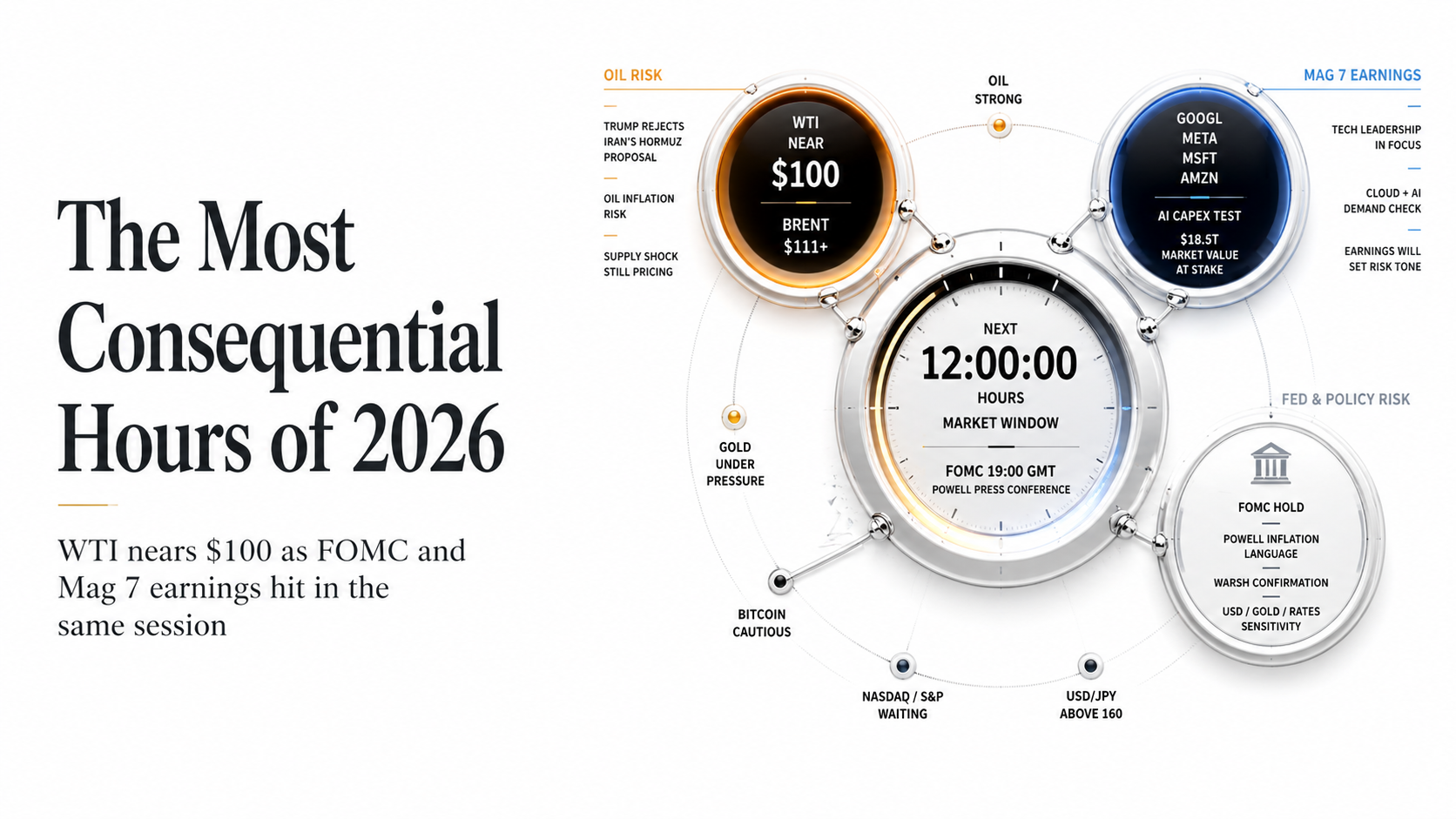
WTI Pushes $100 · Brent $111 · FOMC Holds Today · Mag 7 Report Tonight — The Most Consequential Hours of 2026
Trump rejects Iran’s Hormuz proposal: WTI spikes to $99.93, Brent hits $111.26. Gold sells off below $4,580 as rate-hike fears resurface. FOMC announces at 19:00 GMT — 100% hold, all eyes on Powell’s final press conference. GOOGL · META · MSFT · AMZN all report after the close tonight. AAPL Thursday. Kevin Warsh Senate confirmation vote underway. The next 12 hours will reset every market.
The most event-dense single session of 2026. Four Mag 7 giants + Powell’s final press conference. Position accordingly.
Wednesday April 29, 2026 — Four Things Driving Every Market Today
Pre-Market Snapshot — 07:00 GMT, April 29, 2026
| Asset | Level | Change | Key Notes | Bias |
|---|---|---|---|---|
| WTI Crude (Jun) | $99.93 | ▲ +3.1% | Trump rejected Iran Hormuz deal; Rubio called conditions unacceptable; 9-week high | BULL — $100 THRESHOLD |
| Brent Crude (Jun) | $111.26 | ▲ +2.8% | Hormuz effectively closed, IEA warns “biggest energy security threat in history” | BULL — ESCALATION |
| Gold XAU/USD | $4,569 | ▼ −2.5% | Weekly selloff; oil inflation reducing non-yielding appeal; lowest since late March | SELL — RATE FEAR |
| Silver XAG/USD | $73.80 | ▼ −1.8% | Industrial demand uncertainty; gold correlation drag; $74 support broken | BEAR — $72 RISK |
| S&P 500 Futures | 7,138 | ▲ +1.05% | Rebounding into Mag 7 earnings; ATH at 7,168 from Apr 24; oil headwind vs AI optimism | BULL — MAG7 CATALYST |
| Nasdaq Futures | 24,658 | ▲ +1.64% | GOOGL/META/MSFT/AMZN all tonight; Azure 38% growth expected; strongest day setup | BULL — EARNINGS EV |
| Dow Futures | 49,490 | ▲ +0.69% | Lagging tech; energy inflation headwind on industrials; XOM reports too | WATCH — ENERGY DRAG |
| Bitcoin BTC/USD | $76,342 | ▼ −1.4% | Fell from $79K; support test at $76K; FOMC risk weighs; high OI + negative funding = squeeze risk | WATCH $76K SUPPORT |
| EUR/USD | 1.1520 | ▼ −0.85% | Oil stagflation kills euro; ECB catch-22 intact; USD firming on FOMC hawkish language risk | SHORT — STRUCTURAL |
| GBP/USD | 1.3200 | ▼ −0.72% | UK energy import headwind; BoE expected to hold too; watch 1.3150 support | NEUTRAL-BEAR |
| USD/JPY | 160.10 | ▲ +0.88% | BOJ held rates — “not-so-hawkish Ueda”; yen weakening; 160 psychological level key | BULL — 165 TARGET |
| VIX (CBOE) | 18.92 | ▼ −2.97% | Markets confident into earnings; oil capped at 19 despite Iran; FOMC vol expected tonight | WATCH — EVENT RISK |
Geopolitical Status & Macro Context — Iran Rejection / FOMC / Warsh / Earnings
Wednesday April 29 is the single most consequential session of 2026. Three separate macro forces converge today: the FOMC rate decision at 19:00 GMT (100% hold — but Powell’s statement language on oil inflation is the market-moving variable), the simultaneous after-hours earnings of four Mag 7 hyperscalers (GOOGL, META, MSFT, AMZN), and the continued oil supply shock from the US–Iran Hormuz standoff now in its ninth week. WTI at $99.93 is the visible price — the invisible price is the $600 billion in AI infrastructure spending that tonight’s earnings must justify.
President Trump’s rejection of Iran’s Hormuz reopening proposal — which required the US to lift its naval blockade and defer nuclear discussions to a later date — was the overnight detonator. WTI jumped more than 3% to close at $99.93; Brent advanced nearly 3% to $111.26. Secretary of State Rubio publicly dismissed the Iranian offer, stating that Tehran wanted to retain control of the strait. Gold, normally a crisis beneficiary, has sold off sharply — down 2.5% to below $4,580 — because surging oil is reinforcing inflation expectations, reducing the likelihood of rate cuts and thereby diminishing the non-yielding metal’s appeal. This “inflation trap” for gold is the defining paradox of the current market environment. Commodity traders at Capital Street FX need to navigate both the oil long and gold short simultaneously.
Mag 7 Tonight + FOMC Today — The $18.5 Trillion Simultaneous Referendum
12 Active Trade Signals — Updated April 29, 2026 at 07:00 GMT

Highest-conviction position of the week. The supply disruption is structural — the Strait of Hormuz, which previously carried ~20% of global daily energy supply, remains effectively closed in its ninth week of disruption. Trump’s rejection of Iran’s latest reopening proposal eliminates the near-term de-escalation catalyst. Every day the strait remains closed, the market tightens further. Goldman Sachs raised its oil forecast Sunday; ING strategists note the supply deficit compounds daily.
This trade benefits from both the Iran escalation scenario AND the economic growth scenario — if Mag 7 earnings confirm the AI supercycle tonight, energy demand assumptions rise. Use commodity CFDs with Capital Street FX’s 1:10,000 leverage for optimal exposure. Trail stop to $95 if WTI breaks $102. CFD trading involves significant risk of loss. This is educational market analysis.

Brent extended to its highest price since March after Trump rejected Iran’s latest proposal. The strait now handles just a fraction of its pre-war 20 million barrels per day. Tanker traffic remains light as shipping companies face dangerous security conditions. Iran’s IRGC has conducted multiple vessel seizures as leverage in the standoff. Commonwealth Bank of Australia noted the longer the strait stays closed, the greater the economic costs — raising the probability one side blinks.
Brent is the superior position for international traders given its global benchmark status. The $119 high from early March represents the peak of the initial escalation spike — a retest is the realistic higher target if diplomatic channels remain closed throughout May. Trade Brent crude → Educational analysis only. CFD trading involves significant risk.

The Inflation Trap for Gold: While gold is traditionally a safe-haven and inflation hedge, surging oil prices at $100+ WTI are creating the paradoxical scenario where oil-driven inflation makes rate cuts less likely — reducing the appeal of gold as a non-yielding asset. The gold market faces the pressure of oil-fueled rate-hike expectations versus geopolitical safe-haven demand. Currently, the rate-hike fear is winning. CME FedWatch shows 99.5% probability of a hold today, but the rate-hike probability for later in the year has risen materially.
If Powell uses hawkish language on oil inflation in today’s 19:30 GMT press conference, gold likely re-tests $4,580. The short entry opportunity is on any recovery rally toward $4,720–$4,760 pre-FOMC. Wait for confirmation before entering — the FOMC press conference is the key catalyst for this signal’s direction. Trade gold CFDs →

Silver is caught between two forces: its industrial exposure (solar energy, electronics, semiconductors) benefits from the AI infrastructure build-out, while high oil and transport costs pressure industrial margins. Higher energy prices can slow industrial activity and reduce cyclical demand. This nuance makes silver more complex than gold in the current crisis — geopolitical stress is bullish for investor interest, but not automatically bullish for industrial demand. The near-term technical picture is bearish with $74 now broken as support-turned-resistance.
The silver short is less clean than the gold short but confirms the directional view. Wait for any bounce toward $75.50–$76.50 as a short entry. The structural deficit (sixth consecutive year of supply shortfalls) means this is a near-term positioning trade only — not a fundamental short. Trade silver → Educational only. Significant CFD risk.

Bitcoin has pulled back from near-$80,000 highs on risk aversion ahead of the FOMC + Mag 7 earnings dual catalyst. The technical setup is interesting: high open interest combined with negative perpetual funding rates (shorts paying longs) creates the conditions for a short squeeze-driven rally that CoinDesk analysts call the “most hated rally.” Large traders on Hyperliquid have shifted to their most aggressively net-long positioning since early March. The $76K level is the critical pivot — hold here and the squeeze toward $80K+ is on.
This is a conditional long: BTC needs to hold $76K AND tonight’s FOMC/Mag 7 tone needs to be broadly constructive (neutral Powell + cloud beats). If WTI breaks above $102 on continued Iran escalation, risk assets including BTC face further pressure and the stop at $73K would be triggered. Trade BTC/USD → Educational analysis only.

The structural EUR/USD short thesis remains fully intact. Europe imports approximately 85% of its crude oil needs, making it the most energy-import-exposed major economy globally. With Brent above $111, the Eurozone faces the stagflation catch-22: oil-driven inflation that should require ECB rate hikes, combined with a growth slowdown from higher energy costs that requires rate cuts. The ECB cannot do both simultaneously. ING notes the pricing now shows 51bp of ECB rate hikes versus 33bp for the BoE — the ECB’s dilemma is increasingly recognised. Additionally, markets are pricing EUR/USD toward 1.15 as of this week’s forecasts.
The FOMC press conference at 19:30 GMT is the near-term catalyst for this signal. Any hawkish language from Powell on oil inflation widens the US–Eurozone rate differential and accelerates EUR/USD downside. The 1.1500 level is the key support to watch — a confirmed break opens the path to 1.1350 and potentially 1.1150 into May. Trade EUR/USD →

Cable has retreated from early-April highs alongside EUR/USD as the dollar firms on FOMC hawkish risk. The UK is also heavily energy-import dependent, and Brent at $111 creates a significant terms-of-trade headwind for the pound. The BoE faces the same ECB catch-22 though with slightly less intensity (ING: 33bp of BoE hikes priced vs 51bp ECB). UK fiscal headroom remains constrained entering May’s local elections, which create political risk to the current Labour leadership. NBC research projects GBP/USD toward 1.32 this week.
This is a secondary trade — less clean than the EUR/USD short but directionally aligned. The GBP/USD short requires the same triggers: hawkish FOMC tone and continued oil escalation. The 1.3150 level is the nearest strong support; a break below confirms the next leg to 1.2950. Trade GBP/USD → Educational only.

BOJ’s less-than-hawkish hold yesterday removed the primary near-term yen-strengthening catalyst. USD/JPY broke above 160 and the path of least resistance is now higher — toward 161.95 and potentially 165. The FOMC hold today at 3.5–3.75% with potentially hawkish inflation language creates the rate-differential widening that keeps USD/JPY supported. ING notes the market is under-pricing a future BoJ hike, but that is a medium-term story — today’s setup is bullish USD/JPY. The Nikkei at record highs also reduces pressure on the BoJ to tighten urgently.
This is a high-conviction central bank divergence trade: US rates holding high + BOJ staying dovish = USD/JPY goes up. The key risk is a formal BoJ intervention if the pair surges too rapidly past 165. The Ministry of Finance has talked tough about USD/JPY near 160 — watch for verbal intervention first, then watch for actual market operations above 165. Trade USD/JPY →

The AI capex validation trade. Four hyperscalers collectively guiding $600–645 billion in 2026 AI infrastructure spend report tonight. If even three of four beat and maintain capex guidance, the AI infrastructure trade extends sharply — Nvidia, the semiconductor supply chain, and Nasdaq itself all benefit. Intel’s +27% last Friday validated the supply-constrained demand thesis. Tonight is the full-scale referendum. Wall Street’s AI bull case rests on this earnings cluster.
Do NOT hold individual Mag 7 stocks through after-hours — gap risk is extreme on any single name. Use Nasdaq 100 futures or QQQ to gain diversified exposure across all four prints simultaneously. The post-close move is rarely the final move — after-hours liquidity is thin. Wait for Thursday’s regular session to assess the full AI capex narrative before adding. Trade Nasdaq →

The S&P 500 is rallying toward ATH ahead of tonight’s earnings. S&P 500 earnings growth of +14.5% (138 companies already reported) provides fundamental support for the index level. The oil-energy sector benefits from higher oil prices and is providing upside, while the tech sector is rerated upward on AI earnings validation. The VIX declining to 18.92 signals markets are pricing in positive outcomes from tonight’s reports. Exxon Mobil (XOM), Eli Lilly (LLY), Visa (V), and Mastercard (MA) also report this week as additional S&P catalysts.
The S&P long is less focused than the Nasdaq long — use the Nasdaq signal (09) for pure AI leverage and this signal for broader market allocation. The oil headwind on industrials and energy companies capping valuations is the primary risk to this trade. Trail stop to 6,900 if Mag 7 beats come through tonight. Trade S&P 500 →

The Dow is the weakest of the three major indices — lagging both the S&P and Nasdaq because its composition is more heavily weighted toward industrials, consumer staples, and traditional sectors that are directly impacted by $100+ WTI oil costs. Domino’s Pizza’s 10.5% drop Monday on higher living costs and cautious consumer spending is a Dow bellwether for the broader consumer stress theme. Caterpillar (CAT) reporting this week is another key industrial read. Energy cost inflation hammering margins across traditional sectors.
Avoid the Dow long in this environment. Capital is better deployed in the Nasdaq (Signal 09) for AI leverage or in Oil (Signals 01/02) for the Iran trade. If the Dow must be traded, wait for a Caterpillar beat and clear WTI stabilisation below $98 before entering long. Trade indices →

Copper is a second-order AI infrastructure trade. Data centres are copper-intensive structures — the $600–645 billion in hyperscaler AI capex that the four giants are expected to confirm tonight translates directly into copper demand. Intel’s +27% earnings beat last Friday proved AI chip demand is supply-constrained, not demand-limited, which means the entire AI infrastructure buildout accelerates. Semiconductor, data centre, EV, and grid infrastructure are all copper demand drivers. This is the picks-and-shovels version of the AI trade.
Do NOT enter this position before tonight’s earnings reports. Wait for Thursday morning after the Mag 7 results are assessed. If three or four of the hyperscalers raise or maintain capex guidance, initiate the copper long. If two or more soften capex plans, the copper thesis weakens significantly — stay out. This is a post-event entry signal only. Trade commodities →
Frequently Asked Questions — April 29, 2026
1. Size all positions at 50–60% of normal. The simultaneous FOMC + four Mag 7 earnings is the highest-density event cluster of 2026. Preserve capital flexibility for post-event reloading when direction is confirmed.
2. Do NOT hold individual Mag 7 stocks through the AH prints. Gap risk on any single name can exceed 10% (MSFT implied move: ~6%, META: ~7%). Use Nasdaq 100 futures (Signal 09) to distribute risk across all four prints.
3. The oil long (Signals 01, 02) is the safest position today — it does not depend on tonight’s earnings. Iran’s continued Hormuz closure is the catalyst, and it remains firmly in place regardless of what GOOGL or MSFT report.
4. Take partial profits at 19:00 GMT before FOMC — reduce exposure to 40% of normal before Powell speaks at 19:30 GMT. Re-enter after the press conference tone is clear.
5. Do NOT leave significant short positions open overnight into Thursday. If Mag 7 beats are strong, the gap risk to the upside on Nasdaq and S&P can be violent. The “most hated rally” in BTC could also accelerate sharply.
CFD trading involves significant risk. Capital Street FX’s VIP account provides advanced order types for stop and limit management essential for this type of event-dense session. Always consult a licensed financial advisor before trading.
This is the “Inflation Trap” for gold in the current environment. Gold is simultaneously a geopolitical safe-haven AND a rate-environment-sensitive asset. Under normal geopolitical crises, gold rises because central banks typically cut rates to stimulate growth — making gold, which pays no interest, relatively more attractive. But the US–Iran war has created the opposite scenario: oil at $100+ WTI is driving inflation higher, which forces central banks to keep rates high or even hike. Higher interest rates make bonds (which do pay interest) more attractive vs gold.
Gold fell 2.5% last week and hit its lowest level since late March. The Fed holds today at 3.5–3.75% with zero cut probability. BOJ held yesterday. The ECB is pricing 51bp of hikes. This is the most rate-hostile environment gold has faced since the conflict began. Gold’s traditional “buy in a crisis” logic is being overridden by the “sell in a high-rate environment” logic. The LiteFinance range for today is $4,485–$4,620, consistent with continued bearish pressure. Daily market analysis from Capital Street FX Research Desk tracks this evolving situation. This is educational — not financial advice.
Kevin Warsh is President Trump’s nominee to succeed Jerome Powell as Federal Reserve Chair. Powell’s term as chair ends May 15, 2026. The Senate Banking Committee votes on Warsh’s nomination today (April 29) at 10am ET, and he is expected to be confirmed in time for the June FOMC meeting. A former Fed governor and Wall Street veteran, Warsh has publicly endorsed rate cuts and suggested the Fed needs fundamental structural change. His nomination has already provided some reassurance to markets, reflected in a modest DXY rally after the announcement.
The key forex implication: markets are reading Warsh as slightly more accommodative than the current trajectory suggests, which could weaken the USD medium-term if he signals rate cuts sooner than the current dot plot implies. However, the MUFG analysis notes his Warsh selection does not alter the medium-term dollar depreciation view. For USD/JPY (Signal 08), the Warsh transition is a near-term neutral — his policy stance won’t be clear until the June meeting. The immediate focus remains today’s Powell press conference language on oil inflation. Forex market analysis at Capital Street FX covers these central bank dynamics in depth. Educational content only.
The single most important metric across all four reports is AI capital expenditure guidance — specifically whether the four hyperscalers raise, maintain, or soften their 2026 capex plans. The four companies collectively guide to $600–645 billion in 2026 AI infrastructure spend. Any softening pressures the entire AI supply chain (Nvidia, AMD, the semiconductor sector). Any raise is the maximum bull catalyst for Nasdaq and the copper/energy infrastructure trade.
Secondary metrics by company: MSFT — Azure growth rate (consensus +38%); any beat above 40% is maximum bullish. GOOGL — Google Cloud growth (consensus +48% acceleration from +48% last quarter); must confirm the AI monetisation thesis. META — Revenue per user and Advantage+ AI ad targeting growth; watch for Q2 guidance on ad pacing. AMZN — AWS growth and custom silicon (Trainium/Graviton) revenue — CEO Jassy hinted at $20B+ run rate. Conference call commentary on capex and segment guidance is where the real signal lands — not the initial press release. After-hours liquidity is thin and algorithms often overreact to the headline before the call clarifies. Stock trading analysis at Capital Street FX. Educational only — not financial advice.
No — the pullback from $79K to $76K is consistent with normal pre-event risk reduction ahead of the FOMC + Mag 7 simultaneous catalyst. The more important Bitcoin statistic is the derivatives structure: high open interest (~775K BTC) combined with negative perpetual funding rates (bearish traders paying to hold short positions) creates the conditions for what CoinDesk analysts call a “most hated rally” — a short squeeze that can be violent and rapid. The large traders on Hyperliquid have already shifted to their most aggressively net-long bitcoin positioning since early March.
The $76,000 level is the critical support: if BTC holds here, and tonight’s FOMC tone is neutral-to-accommodative (not hawkish), and the Mag 7 results are broadly positive for risk assets, the conditions for a short squeeze toward $80,000+ are firmly in place. Bitcoin broke out from a $63,000–$75,000 range that held since early February — a retest of the bottom of that range is not the bear scenario here. The bear case is a hawkish Powell + Mag 7 disappointments simultaneously, which would be an extreme tail risk scenario. For BTC, $73,000 is the stop — below that, the breakout thesis is invalidated. Trade crypto → Educational analysis only.
Market Analysis Summary — Wednesday, April 29, 2026
Wednesday April 29 is the most consequential single session of 2026: three macro forces detonate simultaneously. The US–Iran standoff enters its ninth week with Trump’s rejection of the Hormuz reopening proposal driving WTI to $99.93 and Brent to $111.26 — the $100 WTI psychological threshold is hours away. Simultaneously, GOOGL, META, MSFT, and AMZN all report after the close tonight, with $600–645 billion in AI capex guidance hanging in the balance. And at 19:00 GMT, the FOMC holds rates at 3.5–3.75% in what is likely Jerome Powell’s final meeting as chair — with Kevin Warsh’s Senate Banking Committee confirmation vote happening this morning.
The cleanest, most conviction positions this week are: Signal 01 (WTI long toward $100+) — benefits from both Iran escalation and AI growth scenarios regardless of tonight’s earnings; Signal 06 (EUR/USD short) — the structural stagflation trade with Brent at $111 creating the ECB catch-22; Signal 08 (USD/JPY long) — BOJ held dovishly yesterday, FOMC holds hawkishly today, central bank divergence is the driver. The Nasdaq long (Signal 09) and BTC (Signal 05) are high-reward but event-dependent — require tonight’s reports to confirm the AI capex supercycle before adding aggressively. For forex trading, commodity trading, and crypto trading across all 12 signals, Capital Street FX provides the 900% deposit bonus and 1:10,000 leverage that gives traders a structural edge entering this historic session.
Critical risk management for today: Size all positions at 50–60% of normal. Do NOT hold individual Mag 7 stocks through AH prints. Take partial profits at 19:00 GMT before Powell speaks. Trail stops on all oil longs — WTI to $94 if above $102. Do not leave significant short positions open into Thursday if Mag 7 reports confirm AI capex. The FOMC press conference at 19:30 GMT is the first catalyst — get positioned before then. CFD trading involves significant risk of loss and is not suitable for all investors. This briefing is educational market analysis and does not constitute personal financial advice.