Daily Market Analysis – Asian Session | Samsung Record · Trump Lands Beijing — Thu May 14, 2026 | Capital Street FX
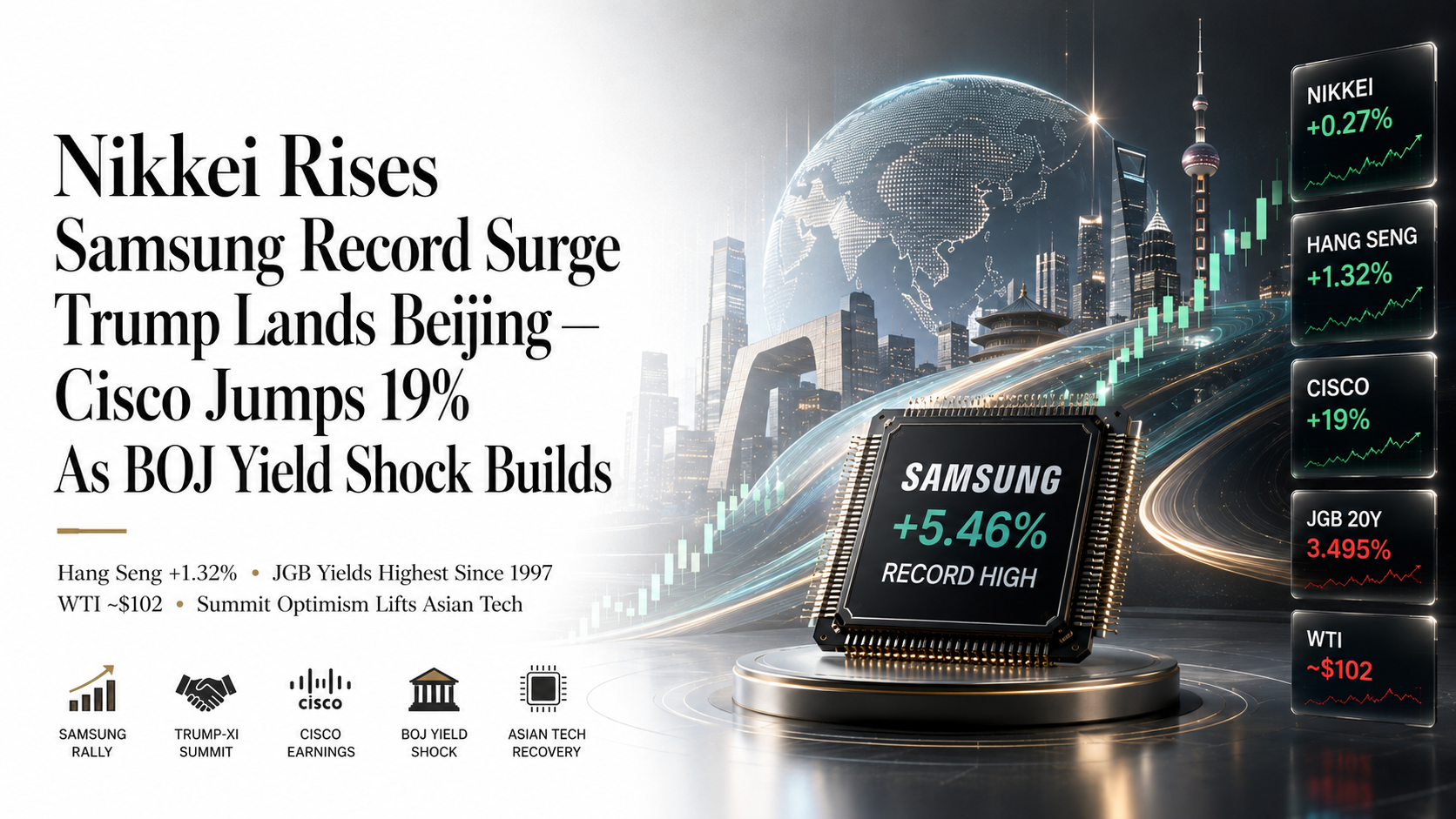
Nikkei +0.27% · Samsung Hits Record +5.46% — Strike Risk Fades · Trump Lands in Beijing for Xi Summit · Cisco Surges 19% After-Hours on Record Q3 · JGB 20-Year Yields Breach 1997 High at 3.495% · BOJ Hike Clock Ticking · Hang Seng +1.32% on Summit Optimism
Thursday, May 14, 2026 — Asian markets digested the overnight US session selloff (S&P −0.83%, Nasdaq −1.50%) and rebounded with selective optimism as the dominant narrative of the day became the Trump-Xi Beijing summit, now under way. Samsung Electronics defied Wednesday’s strike-fear rout to reach a fresh record high, lifting the Kospi to a new closing record. JGB yields broke through multi-decade resistance, with the 20-year Japanese government bond yield hitting 3.495% — its highest since 1997 — as BOJ rate-hike hawkishness intensifies. Meanwhile, Cisco’s +19% after-hours surge on record Q3 earnings provided a tech-positive counterpoint to the previous session’s inflation-driven selloff.
Asian Session Macro Scorecard — Thursday, May 14, 2026
Technical Chart Analysis — May 14, 2026


| Asset | Level / Price | Change | Session Note | Bias |
|---|---|---|---|---|
| Nikkei 225 (N225) | 63,448.87 | +0.27% | Tech names recover on Cisco beat; JGB yield spike limits broader upside; Topix splits negative | MIXED |
| Topix (Japan broad) | 3,840.93 | −0.23% | Diverges from Nikkei; rate-sensitive financials and smaller caps under JGB yield pressure | BEARISH |
| Kospi (South Korea) | 6,191.92 | +0.38% | New closing record; Samsung recovery from −5.7% to +5.46% drives index; Kosdaq +1.31% | BULLISH |
| Samsung Electronics | Record High | +5.46% | Erases Wednesday’s $66B market-cap wipeout; strike risk partially priced out for now | BULLISH |
| Hang Seng (Hong Kong) | 26,388.44 | +1.32% | Summit optimism drives mainland and HK tech; MiniMax, Zhipu AI developers extend gains | BULLISH |
| CSI 300 (Mainland China) | 4,948.05 | +0.27% | Modest green; market pricing moderate Trump-Xi outcome rather than transformative deal | CAUTIOUS |
| S&P/ASX 200 (Australia) | 8,665.80 | −0.16% | Resources and energy weigh; commodities steady; banks cautious on global rate trajectory | SLIGHT BEAR |
| Nifty 50 (India) | ~24,280 | −0.34% | Mild profit-taking; India relatively insulated from US-China summit but oil cost remains headwind | NEUTRAL |
| WTI Crude Oil | ~$102.00 | Flat | Holds ~$102 level; IEA warns markets may remain undersupplied until October; Hormuz week 12+ | WATCH SUMMIT |
| Brent Crude | ~$107.00 | Flat/+0.2% | Asian refiners scrambling for non-Gulf supply alternatives; IEA OPEC+ production at 1990 lows | ELEVATED |
| Gold (XAU/USD) | $4,701 | −0.30% | Profit-taking ahead of summit; range-bound $4,689–$4,749; geopolitical safe-haven offset by USD strength | NEUTRAL RANGE |
| USD/JPY | ~157.80 | Flat/−0.1% | BOJ intervention risk elevated; Masu warns yen weakness fuels inflation; JGB yield spike provides modest JPY support | BOJ WATCH |
| JGB 20-Year Yield | 3.495% | +5bps — 1997 HIGH | 1997 cycle high broken; fiscal budget supplement fears driving issuance concerns; BOJ hawks emboldened | HAWKISH BOJ |
| Cisco Systems (CSCO) | ~+19% AH | +19% (after-hours) | Record Q3 revenue $15.8B; AI order target raised to $9B; sharpest surge since 2002; jobs cut 4,000 | STRONG BUY |
| AUD/USD | ~0.648 | −0.15% | China risk appetite guides AUD; summit optimism partially offset by US rate hike repricing; resources cautious | SUMMIT-LINKED |
Asian Session Live News & Data Flow — Thursday, May 14, 2026
Asian Session Fundamentals & Macro Analysis — May 14, 2026
🇯🇵 Japan: BOJ Hike Countdown — JGB Yields at Generational Highs
Japan’s bond market is sending the clearest hawkish signal in three decades. The 20-year JGB yield at 3.495% represents the culmination of a multi-month bear trend driven by three converging forces: (1) sustained core inflation above the BOJ’s 2% target for over 46 consecutive months; (2) Iran-driven energy cost pass-through feeding into PPI and CPI; and (3) a growing majority faction within the BOJ board favouring a move to 1.0% — with three of nine members having already voted for it in April.
The OECD’s projection of 2.0% BOJ rates by end-2027 implies four additional 25bps hikes from the current 0.75% level. For currency markets, the structural implication is yen appreciation once the BOJ acts — but the timing remains unclear due to the uncertain global environment. For Japanese equities, a rate hike cycle is ambiguous: it favours banks and insurers (who benefit from steeper yield curves) but weighs on highly leveraged export-driven names and the Topix small-cap universe.
Key risk: If the fiscal supplement budget is confirmed, JGB supply expands materially, creating the paradox of rising yields and BOJ hesitancy to raise rates if it fears destabilising the bond market — a trap that resembles the “fiscal dominance” constraint Japan has navigated since the 1990s. Watch: BOJ emergency statement; MOF JGB issuance calendar update.
🇰🇷 South Korea: Samsung Recovery — Strike Risk Remains Live Threat
Samsung’s +5.46% reversal of Wednesday’s rout is technically impressive but should not be mistaken for structural resolution. The labour union’s 18-day strike threat — affecting 41,000+ workers — remains a live event from May 21, with less than one week until the deadline. Samsung and SK Hynix together constitute nearly 50% of the Kospi index weight, meaning individual stock developments cascade directly into index-level volatility.
The strategic stakes extend well beyond Korea. Samsung’s HBM3E memory chips are the critical component underpinning the AI infrastructure supercycle currently fuelling Nvidia, Nebius, Cisco, and Meta’s data-centre build-outs. A prolonged 18-day disruption to Samsung’s Pyeongtaek and Hwaseong fabs would tighten global HBM supply materially at a moment of peak demand — potentially boosting SK Hynix’s near-term revenue while raising system-level costs for every AI company reliant on leading-edge DRAM.
Bull case: Management-union deal reached before May 21 → Samsung extends record high run, Kospi breaks decisively higher. Bear case: Strike proceeds → HBM supply disruption, Kospi gives back record gains, global AI hardware cost inflation worsens. Finance Minister Koo’s market-moving warning Wednesday suggests government will facilitate resolution — but government pressure alone does not bind unions.
🇨🇳 China: Summit Pricing — Hang Seng Optimism vs CSI 300 Caution
The 1.05 percentage point divergence between Hong Kong’s Hang Seng (+1.32%) and mainland CSI 300 (+0.27%) during Thursday’s session reveals a structurally important split in investor positioning. International investors — who dominate Hang Seng flows via the Stock Connect mechanism — are pricing a materially higher probability of a breakthrough deal (especially on AI chips) than domestic mainland investors.
The CFR’s analysis notes that both Xi and Trump face domestic constraints: Xi cannot appear to be capitulating to US technology export demands (which would undermine the “East is rising” narrative he has cultivated internally), while Trump needs visible wins he can headline at home amid record-low approval ratings. The consensus expectation — limited but symbolically significant agreements — is already largely priced into the Hang Seng rally. Upside surprise risk is real if Jensen Huang’s presence directly catalyses H200 chip delivery commitments.
Key indicator to watch: Post-summit press conference language on AI chips, Taiwan, and Iran. If the joint communiqué includes language on “facilitating technology cooperation” or “resuming commercial semiconductor flows,” Hang Seng and Chinese AI stocks could rally another 3–5%. If it focuses exclusively on agricultural purchases and Boeing orders, the Hang Seng rally is likely to fade.
💻 Cisco Beat — AI Infrastructure Bull Case Reinforced
Cisco’s Q3 2026 results are the third major data point in 72 hours — after Nebius’s +684% revenue surge and the Huang-Beijing chip catalyst — confirming that the AI infrastructure supercycle has moved from narrative to genuine financial returns. Cisco’s networking segment grew 25% YoY, and its AI hyperscaler order pipeline has now reached $5.3B year-to-date against a $9B full-year target — implying another $3.7B of AI orders expected in Q4 alone.
The 4,000-job cut alongside this record revenue is the AI era’s defining corporate paradox: human capital is being reallocated from legacy networking configuration and maintenance roles toward AI-driven infrastructure design, security, and cloud observability. CEO Robbins’ comment that “companies that win in the AI era will have focus and discipline” is a direct statement of capital allocation priorities that every large-cap tech competitor is internalising simultaneously.
For Asian markets: Cisco’s beat validates the capex spending cycle that benefits Asian semiconductor suppliers — Samsung (DRAM), SK Hynix (HBM), TSMC (custom silicon) — and creates a positive read-across for Thursday’s Asian trading despite the broader US market selloff. Risk: Cisco’s 19% after-hours gain creates an elevated entry point that could see profit-taking at the US open Thursday. Watch for confirmation or reversal at NYSE open (~13:30 GMT).
Trump-Xi Beijing Summit — Three Market Scenarios
Trigger: H200 chip export authorisation confirmed, rare earth stability pact signed, China commits to Iran Hormuz diplomatic pressure.
Equities: Hang Seng +3–5%, Nikkei +1–2%, Nasdaq +2–3% at open, Nvidia +8–12%, Cisco extends gains.
Commodities: WTI drops to $90–$92 on Hormuz mediation signal; Gold drops $150–$200 on risk-on surge.
FX: AUD/USD spikes to 0.665+; CNH strengthens; JPY weakens on global risk-on.
Probability assessment: Low but non-trivial — Jensen Huang’s last-minute invitation signals chip deal is at least being negotiated. One positive headline can trigger significant upside momentum in Asia-Pacific tech.
Trigger: Boeing/soybean purchase commitment, tariff pause framework, general AI cooperation language — but no chip delivery breakthrough, no Hormuz guarantee.
Equities: Hang Seng consolidates gains +0.5–1%; Nikkei flat-to-slightly positive; Nasdaq neutral; AI names give back some gains.
Commodities: WTI stays $98–$104 range; Gold stable $4,640–$4,750.
FX: AUD/USD holds 0.645–0.655; USD broadly stable; JPY defined by BOJ alone.
Probability assessment: Consensus base case per CSIS, CFR, Goldman Sachs, Al Jazeera analysis. Both leaders need visible wins without strategic concessions. This is the “sell the news” scenario for markets that have partially priced optimism.
Trigger: Trump Taiwan language concession sparks Beijing triumphalism OR Trump abruptly walks out OR Taiwan arms sale dispute escalates publicly.
Equities: Hang Seng −3–5%; Nikkei −1–2%; Nasdaq −1.5% at open; VIX spikes above 22.
Commodities: WTI spikes to $108–$115 if Hormuz mediation hope collapses; Gold rallies $150–$250 on geopolitical risk.
FX: JPY safe-haven bid; AUD/USD drops below 0.635; USD broadly stronger.
Probability assessment: Trump’s history of unscripted remarks on sensitive topics (he publicly discussed Taiwan arms sales in a Feb call with Xi) creates a non-trivial tail risk. Heritage Foundation analysis flags Taiwan language as the single most dangerous negotiating point. Any unfavourable Taiwan language could trigger immediate sell-off in US equities.
Asian Session FAQ — Trader Questions Answered
The Nikkei 225 and Topix divergence is one of the most informative signals in Japanese equity analysis because they measure fundamentally different slices of the market. The Nikkei 225 is a price-weighted index of 225 large-cap, globally oriented Japanese companies — heavily weighted toward technology, electronics exporters, and consumer names that benefit from a weaker yen and global AI demand. The Topix, by contrast, is a market-cap weighted index of all TSE Prime Market companies (~2,000 stocks), giving much greater weight to domestically oriented banks, insurers, real estate companies, and mid-cap industrials.
On Thursday, the divergence (Nikkei +0.27%, Topix −0.23%) reflects two simultaneous and competing forces. Cisco’s +19% after-hours result lifted technology and networking-adjacent names within the Nikkei universe — companies like Fujitsu, NEC, and Advantest, which supply AI infrastructure components. This drove the Nikkei 225 positive. Simultaneously, JGB 20-year yields spiking to a 1997 high created headwinds for rate-sensitive sectors that dominate the Topix: banks (net interest margins improve long-term but bond portfolios are mark-to-market), real estate (higher discount rates), and utility stocks. The Topix small-cap and mid-cap universe is also more domestically exposed and therefore more directly impacted by rising borrowing costs.
Trading implication: A Nikkei-Topix divergence of this polarity (Nikkei up, Topix down) typically signals that international momentum is supporting large-cap exporters while domestic macro concerns — in this case, BOJ hike risk and JGB yield volatility — are pressuring the broader economy. If the BOJ announces a rate hike, expect this divergence to reverse: banks would rally (boosting Topix), while yen appreciation would compress Nikkei exporter earnings. CFD trading involves significant risk. This is educational market analysis and does not constitute personal financial advice.
Thursday’s Samsung recovery is technically impressive — erasing the full market-cap loss of approximately $66 billion in a single session — but it does not represent a fundamental resolution of the strike risk. The labour union’s 18-day strike threat from May 21 remains fully intact, and the negotiating positions of management and the union are reported to be still significantly apart on wage demands and profit-sharing arrangements.
The bounce is more accurately characterised as a mean-reversion reaction after what many institutional investors assessed as an overreaction to Wednesday’s selloff. The actual probability of an extended Samsung production disruption is, according to historical base rates for Korean chaebol labour disputes, probably in the 30–40% range — meaningful, but not the near-certainty implied by a 5.7% one-day decline. South Korea’s Finance Minister intervened verbally Wednesday, which historically precedes government pressure to mediate resolution before critical deadlines.
The strategic complication is the HBM3E supply chain. If Samsung’s Pyeongtaek fabs are disrupted for 18 days, global HBM supply tightens materially at a moment of peak AI-driven demand. This creates a divergent trade: Samsung itself faces near-term production risk, but SK Hynix — the main HBM3E competitor — would see spot pricing power increase. The best AI hardware beneficiary of a prolonged Samsung strike is paradoxically SK Hynix, not Samsung.
For Samsung specifically: The risk-reward is asymmetric. If the strike proceeds, Samsung likely gives back the full +5.46% gain plus more. If talks succeed, the record high is confirmed and sustainable. Given the 7-day countdown to the May 21 deadline, patience is warranted. CFD trading involves significant risk. This is educational market analysis and does not constitute personal financial advice.
The Bank of Japan’s next rate hike — now substantially priced in for H2 2026 — would be one of the most consequential FX events of the year, given the enormous scale of yen-funded carry trades that have accumulated since 2022. The yen carry trade is a structural position where investors borrow cheaply in JPY (at 0.75%) and invest in higher-yielding assets (US Treasuries at ~4.46%, Australian bonds, emerging market debt). The carry premium is currently one of the widest in modern history.
A BOJ hike to 1.0% would trigger a partial unwinding of these carry positions. Historically, carry unwind events are non-linear: small yield differentials do not matter until they do, and then the unwind happens quickly as leveraged players rush to close positions simultaneously. The August 2024 BOJ hike to 0.25% provides the clearest recent precedent — USD/JPY fell approximately 12% in under three weeks (from 161 to 142), S&P 500 dropped 9% in five days, and Nifty 50 fell 3%. The Nasdaq VIX spiked to 65 intraday.
The 2026 version would be larger in impact because (1) the carry position has rebuilt significantly since August 2024; (2) USD/JPY is again above 155; and (3) the BOJ is likely to hike more aggressively given inflation has remained above target for four years. BOJ policy rate at 1.0% with 10-year JGB at 2.60% means JPY assets become genuinely competitive with US Treasuries for the first time since the late 1990s — creating a structural repatriation incentive for Japanese institutional investors.
For FX traders: A BOJ hike is JPY bullish, USD/JPY bearish. Initial target on hike announcement: USD/JPY 145–148. If followed by guidance for further hikes: 138–142. Gold would initially sell off on JPY carry unwind, then recover on geopolitical premium. AUD/USD would fall (risk-off, reduced carry). EUR/USD would be less affected but would see some volatility. CFD trading involves significant risk. This is educational market analysis and does not constitute personal financial advice.
Gold’s position at approximately $4,701 ahead of the Trump-Xi summit reflects a carefully balanced market premium: geopolitical risk (Hormuz closure, US-Iran war, nuclear stakes) is priced in, but so is the possibility of a summit de-escalation that reduces the safe-haven bid. The technical picture (21-day SMA at $4,688, 50-day SMA at $4,749) places gold in a narrow range with limited directional conviction — confirmed by RSI near neutral 50.
The bullish case for gold over a 3–6 month horizon remains structurally strong for three reasons: (1) US CPI at 3.8% YoY with PPI at +1.4% MoM means real rates are negative or near-zero, historically gold’s most supportive environment; (2) The Strait of Hormuz closure is unlikely to resolve rapidly — IEA warns markets remain undersupplied until October — meaning the geopolitical premium is durable; (3) Central bank gold buying by non-Western nations has remained robust in 2026, particularly from BRICS members seeking USD reserve diversification.
The short-term risk around the summit is a 2–4% pullback if a breakthrough deal on Iran is announced and WTI drops sharply — reducing the geopolitical premium simultaneously with a risk-on USD rally. The 200-day SMA at $4,335 represents the true structural support; current levels offer approximately 8% downside to that level in a bear scenario.
Position guidance: Gold is a hold at current levels for positions with 3+ month horizons. For traders looking at the next 48–72 hours, the summit outcome is binary. Range-trade $4,640–$4,750 with tight stops. Add on any break below $4,640 if the Hormuz situation does not materially improve. Do not chase above $4,750 unless WTI spikes again. CFD trading involves significant risk. This is educational market analysis and does not constitute personal financial advice.
Asian Session Report Summary — Asian Session Only · Thursday, May 14, 2026
Thursday’s Asian session opened against the backdrop of Wednesday’s US twin-inflation shock (PPI +1.4% MoM, CPI 3.8% YoY) and produced a nuanced, differentiated regional response. Rather than the wholesale risk-off selloff implied by US overnight futures, Asian markets parsed the news with surgical precision: technology names caught Cisco’s +19% after-hours tailwind, Korean equities recovered on Samsung’s dramatic reversal, and Hong Kong surged on Trump-Xi summit optimism — while Japan’s bond market staged a generational technical break that has long-term structural implications for the entire region.
The dominant macro force structurally is still the Hormuz closure. The IEA’s warning that markets could remain severely undersupplied until October — even if the conflict ends tomorrow — sets a long-duration floor under energy inflation that makes the US Federal Reserve’s position almost impossibly constrained. Kevin Warsh, confirmed as Fed Chair on Wednesday, will chair his first FOMC meeting (June 16–17) with rate hike odds at 39%, CPI at 3.8%, and a geopolitical oil shock that no amount of rate policy can resolve. The structural stagflation narrative from the May 13 US session report remains fully intact entering Thursday.
Thursday’s Asian session action plan: (1) Nikkei/Japan: Favour large-cap AI-linked exporters (Fujitsu, NEC, Advantest, Keyence) over domestic-facing Topix names. JGB yield spike creates structural headwind for rate-sensitive sectors — underweight banks if positioned for short-term momentum. (2) Samsung/Kospi: The record high is technically constructive but the May 21 strike deadline creates binary risk within one week. Take partial profits on the +5.46% recovery; maintain core position if duration allows waiting through the deadline. (3) Hang Seng / China tech: Wait for first substantive summit headlines before adding new long exposure. The 1.32% gain has already priced moderate optimism. A disappointment produces 3–5% downside risk; a chip deal breakthrough produces 3–5% additional upside. (4) Gold: Range-trade $4,640–$4,750 ahead of summit conclusion. Do not hold unhedged short gold positions — the structural geopolitical premium is durable well beyond any summit outcome. (5) USD/JPY: Lean short on any rally above 158.50 — BOJ hike risk is rising weekly, and the JGB 20-year yield at a 1997 high is not a price level the BOJ can ignore indefinitely. (6) Cisco (CSCO): The +19% after-hours reaction is price discovery for genuine AI infrastructure demand. Watch the NYSE open carefully — if the price holds above +15% on volume, the market is confirming the move. If it fades to under +10% quickly, the move was positioning-driven and should not be chased. (7) WTI / Brent: Do not short oil ahead of summit conclusion — a failed Hormuz mediation attempt (bear scenario 3) sends WTI toward $108–$115. Summit success with credible Hormuz reopening signal could take WTI to $90–$92. The risk is asymmetric to the downside only in a breakthrough scenario. CFD trading involves significant risk. This Asian session report is educational market analysis and does not constitute personal financial advice.