ECB Hike Incoming, Silver Slides & Bund Yields Surge | Technical Analysis -European Session | 4 June 2026
ECB Hike Incoming, Silver Slides & Bund Yields Surge as Iran Tensions Rattle Europe
The European session opens under the shadow of two powerful forces: an ECB almost certain to hike rates on 11 June, and a Middle East conflict that refuses to de-escalate. The result is a market simultaneously bracing for tighter monetary policy and rising geopolitical risk premium — a toxic cocktail for equities and crypto, and a bittersweet backdrop for European sovereign bonds.
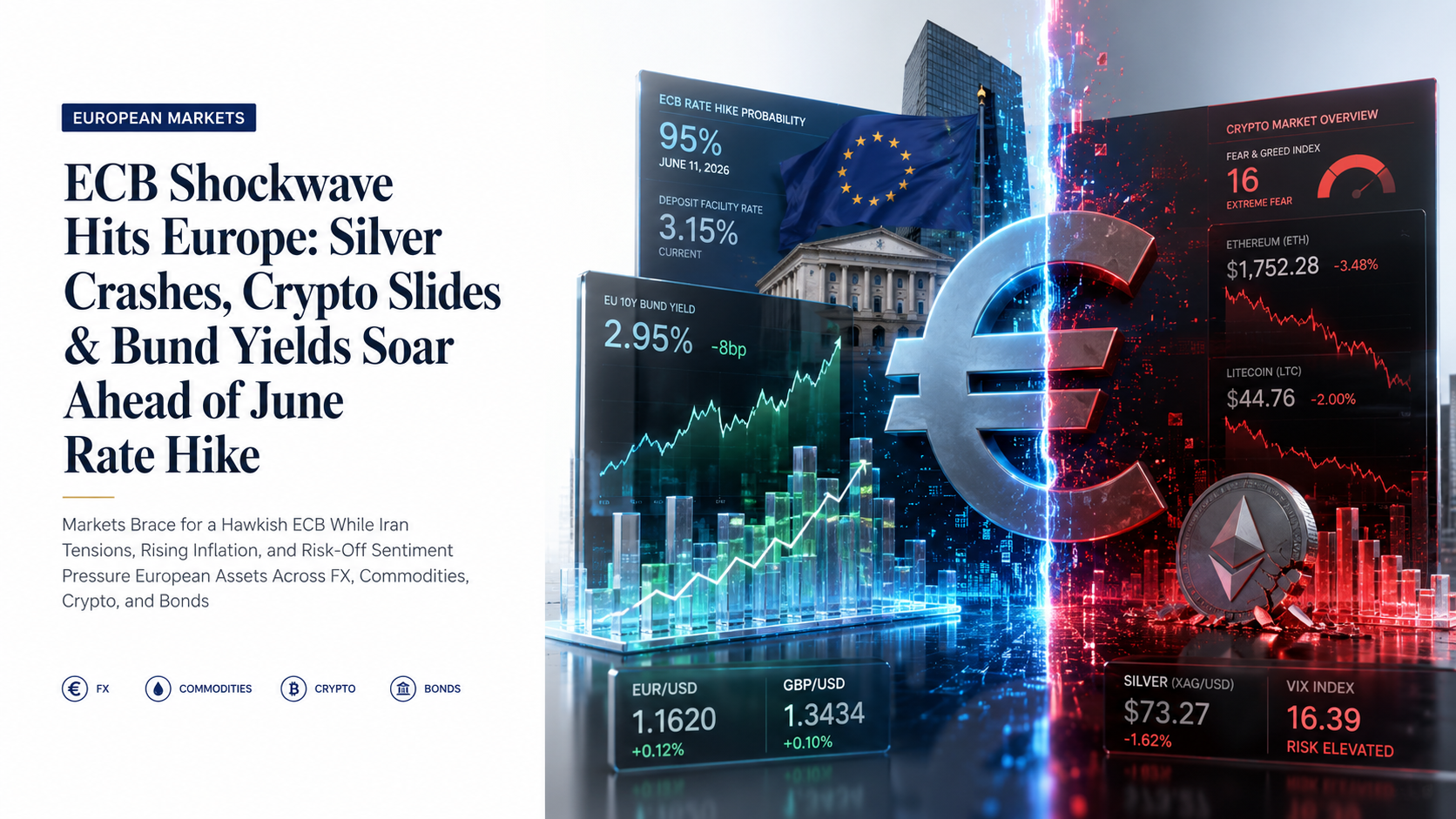
Eurozone headline inflation printed 3.2% in May — the highest since late 2023 — with core at 2.5% and services inflation surging to 3.5%. This broadening of price pressures across the economy has all but cemented a 25-basis-point ECB hike on June 11, with markets now pricing it at a 95% probability. Germany’s 10-year Bund yield pulled back slightly to 2.95% on Thursday — retracing 8bp from Monday’s spike — as oil prices eased slightly after Iran issued mixed signals on ceasefire negotiations. But the yield remains near its highest levels since 2011, reflecting a profound regime change in European monetary policy.
The British pound is outperforming modestly. GBP/USD is holding above 1.3434, buoyed by steady UK economic data and the BoE’s hold stance at 3.75%. EUR/USD hovers at 1.1620, compressed in a tight range as traders await next week’s ECB press conference for guidance on the pace of further tightening. With ECB’s Schnabel cautioning against pre-committing to additional hikes, the post-hike path remains the key debate — and that ambiguity is capping EUR/USD upside despite the hawkish pivot.
In commodities, Silver has been the session’s casualty — tumbling 1.62% to $73.27 as the USD firmed modestly and industrial demand expectations dimmed on fears of European stagflation. Wheat futures at 587.57¢/bu sit near multi-month lows despite being 10.9% above last year’s prices, weighed by profit-taking after China’s recent purchase agreement rally. Shell Plc is the rare bright spot in London trading, up 1.66% to 3,268p, benefiting from resilient crude oil prices and strong Q1 earnings momentum. Ethereum and Litecoin continue their retreat, down 3.48% and 2.00% respectively, as crypto correlates tightly with broader risk-off sentiment.
European Session Price Board
All prices as of European session, 4 June 2026
Key Stories Driving European Markets Today
High-impact geopolitical, central bank and macro developments as of the London open
EUR/USD & GBP/USD — Trade Ideas
European session FX analysis under ECB hike expectations and Iran geopolitical pressure

Technical Analysis
EUR/USD has been range-bound between 1.1414 and 1.2080 throughout 2026 — one of the tightest annual ranges in recent memory given the monetary policy drama. The pair is currently trading near 1.1620, which sits just above the 200-day SMA (~1.1675 acts as near-term reference). The daily RSI is around 48 — neutral territory — signalling neither momentum nor directional commitment. The rising channel from the April lows remains intact, with channel support at approximately 1.1580. A hold above 1.1580 keeps the bullish pre-ECB case alive, targeting the 1.1830 February high. A break below 1.1500 would create a lower low, flipping the short-term structure bearish toward 1.1414.
Fundamental Context
The fundamental backdrop for EUR/USD is paradoxically complex. The ECB is about to hike rates — normally EUR-bullish — but the hike is driven by an energy-war inflation shock rather than an overheating economy, and growth forecasts have simultaneously been revised down. This is stagflation-lite: higher rates without economic strength. The result is a muted EUR reaction. Meanwhile, the USD is holding firm on sticky US inflation and the Fed’s hold. The pivot point for EUR/USD will be the June 11 ECB press conference: if Lagarde signals two more hikes through 2026, EUR/USD could sprint toward 1.20. If she emphasises data-dependence and caution (as Schnabel suggested), the pair could fade back toward 1.14–1.16.

Technical Analysis
GBP/USD has been in a measured uptrend since the 1.27 lows of early 2026, trading inside a rising channel. The pair is currently near 1.3434 — just below the 1.3480 level that served as a recent intraday high. The 50-day EMA is rising and sits near 1.3300, providing dynamic support. The 200-day SMA is approximately 1.3150. Daily RSI is around 55 — mildly bullish but not extended. A clean break above 1.3480 opens the path to the 2026 swing high at 1.3850. The bears need a daily close below 1.3300 to reverse the structure. EUR/GBP at 0.8650 suggests sterling is holding its own against the euro even as the ECB pivots hawkish — a sign of the pound’s underlying resilience.
Fundamental Context
Sterling is caught between two forces: relatively stable UK economic data and the BoE’s patient stance at 3.75%, versus a broadly firm USD driven by Fed hold. The key variable is the divergence trade. As the ECB prepares to hike, the EUR/GBP rate gap is narrowing — this creates headwinds for sterling against the euro, but not necessarily against the USD. UK CPI data due this week is critical: a hot print would reignite BoE hike speculation and push GBP sharply higher. A cool print would validate Bailey’s “no hurry” stance and cap sterling gains. Friday’s US NFP remains the single most important macro event for the USD leg of GBP/USD.
Silver & Wheat — Trade Ideas
Agricultural and precious metal analysis under USD pressure and supply/demand dynamics

Technical Analysis
Silver (XAG/USD) is trading near $73.27, well below both its short-term EMA at $75.51 and its medium-term EMA at $76.43. Every recovery attempt is being capped by these dynamic resistance levels. The H4 chart shows a bearish continuation setup after a significant horizontal support break — with the nearest historical support zone at $71.00 now acting as the primary downside target. Daily technical indicators are uniformly bearish: moving averages, MACD, and momentum readings all point lower. A confirmed daily close below $72.50 would accelerate the move toward $71.00. The gap-down at the weekly open (driven by the Iran-negotiations collapse) reinforces the breakdown. Bulls need a sustained reclaim of $76.00 on a daily close to invalidate the bearish thesis.
Fundamental Context
Silver’s dual nature — both a precious metal and an industrial metal — makes it particularly vulnerable in the current environment. On the precious side, competition from gold (which has a firmer safe-haven bid from Iran) is diverting safe-haven flows. On the industrial side, European stagflation fears are dampening demand expectations from manufacturing. The broader commodity sell-off, triggered by Iran’s ceasefire disruption and a firmer USD, has hit silver disproportionately. The 52-week range of $31.64–$121.67 reflects extraordinary volatility over the past year — silver remains in a compression regime as markets await resolution of the geopolitical overhang before committing to directional trades. The ECB rate hike, when delivered, could further firm the euro and USD simultaneously, maintaining dual pressure on silver.

Technical Analysis
Wheat futures at 587.57¢ are pulling back from the mid-May highs of approximately 660¢ — a 4.28% monthly decline driven by profit-taking after the China purchase agreement drove a sharp rally. The pullback is corrective in nature, not structural: the YoY gain of 10.9% over last year’s levels confirms the broader uptrend. The 585¢ psychological level is acting as near-term support; a hold above this level suggests buyers are defending the range. USDA new crop US stocks at 762 million bushels — well below analyst estimates of 845 mbu — confirm the supply constraint thesis and provide fundamental support for prices. A clean break below 580¢ would signal a deeper correction toward the 550¢ zone.
Fundamental Context
Two forces are shaping wheat in opposite directions. Bullish: China pledged at least $17 billion annually in US agricultural imports through 2028, with spillover benefits for wheat; Iran’s Strait of Hormuz risk would disrupt Black Sea wheat shipping routes from Russia (the world’s largest wheat exporter), creating supply disruptions; and fuel and fertilizer costs remain elevated from ongoing geopolitical tensions. Bearish: milder weather in Western Europe following a recent heatwave has eased near-term crop stress, reducing the weather premium; and the USDA export sales data showed net cancellations of 807,348 MT in old crop — a marketing-year low. On balance, the geopolitical floor under wheat is solid; dips toward 565–575¢ represent tactical long opportunities with the Iran-escalation scenario as the key upside catalyst.
FTSE 100 & Shell Plc — Trade Ideas
London equity market analysis under Iran risk, oil exposure, and ECB hike expectations

Technical Analysis
The FTSE 100 has pulled back from its record high of 10,935 to the 10,312 area, finding support near the multi-month rising trendline. The recovery from the 9,665 low — a 200-SMA test — to above the 50-SMA and the multi-month trendline is technically constructive, and the 10,200–10,300 zone is now the critical support to defend. The FTSE is underperforming today relative to the DAX (−0.54%), primarily because of the pound’s relative strength (a stronger GBP is headwind for the export-heavy FTSE) and caution ahead of this week’s UK CPI and labour data. A daily close below 10,200 would signal a deeper pullback toward 9,900. A recovery above 10,725 — the recent recovery peak — would re-open the path toward the all-time high at 10,935.
Fundamental Context
The FTSE 100’s composition is its key differentiator in the current environment. The index is heavily weighted to energy (Shell, BP), mining (Glencore, Rio Tinto), and financial stocks — all of which benefit from elevated commodity prices driven by Iran tensions. Shell alone is up 1.66% today and is one of the index’s largest weights. However, the FTSE is simultaneously dragged by rate-sensitive sectors (banks facing flatter yield curves, real estate under pressure from higher rates) and by sterling strength (large-cap UK exporters lose revenue competitiveness when GBP rises). Bank of England Governor Bailey’s cautious tone and the BoE’s hold at 3.75% provide a macro backdrop that is neither stimulative nor aggressively restrictive — the path of least resistance for the FTSE remains sideways-to-higher, driven by energy outperformance.

Technical Analysis
Shell Plc’s all-time high of 3,591p was set on 31 March 2026 — a 23% gain year-on-year. The subsequent pullback to the 3,200p area (roughly 9% from the ATH) represents a classic bull-market correction within the context of the rising channel from the 2,468p 52-week low. The stock’s beta of -0.07 means it is largely uncorrelated with the broader market — it moves on its own fundamentals and oil prices, not the S&P 500. The EBITDA margin of 17% and EBITDA of £40.73B demonstrate operational efficiency. The 200-day moving average sits far below current prices, confirming the bullish trend structure. Any pullback to the 3,150–3,200p zone is an attractive entry for medium-term longs targeting the all-time high retest at 3,500–3,600p.
Fundamental Context
Shell’s investment case is strengthened by every day the Iran conflict persists. The company’s integrated gas segment — LNG trading and GTL — is particularly valuable when pipeline gas supply is disrupted, as Iran tensions affect Strait of Hormuz LNG shipments from Qatar (a key competitor to Shell’s LNG portfolio). Q1 2026 EPS of $2.44 beat consensus by 14.6%, and the Next earnings release on July 30 is expected at $2.92 per share, implying another strong quarter. The dividend yield of approximately 2.95–3.71% (depending on the share series) provides income support. Eight consecutive $3.5B buyback programs have materially shrunk the share count, underpinning EPS growth. Analyst consensus is overwhelmingly bullish: 8 Buy recommendations, 0 Sells, with an average target of 3,800p — a 16% upside from current levels.
Ethereum & Litecoin — Trade Ideas
Crypto market analysis under extreme fear conditions and macro headwinds

Technical Analysis
Ethereum has broken below both key EMAs — the short-term at $1,942 and the medium-term at $2,080 — confirming a bearish continuation setup on the H4 chart. The 50-day moving average is falling sharply, flagging a deteriorating short-term trend. A corrective wedge has formed after the most recent sharp sell-off, but this appears to be consolidation before a further leg lower rather than a reversal pattern. The bearish H4 setup from TradingView analysts places the stop at $2,155 (50% Fibonacci level) and the target at $1,850, but a broader breakdown targets $1,600 — the next meaningful structural support. The $1,100 black-swan scenario (a Wave 5 into October 2026) is an extreme tail risk that remains on the table given the macro headwinds.
Fundamental Context
Ethereum faces a convergence of macro headwinds unique to the European session: rising real European yields (German Bund at 2.95% creates competition for crypto allocations), geopolitical risk-off from Iran tensions, a firmer USD, and the ECB’s upcoming rate hike. The Fear & Greed Index at 11 (Extreme Fear) reflects a market in near-capitulation — historically, these extreme readings precede short-term bounces, but they do not guarantee recoveries in the face of persistent macro selling pressure. The 43% green days in the last 30-day window and 5.97% price volatility confirm the underlying instability. A catalyst for recovery would be: a ceasefire agreement in the Middle East (reduces risk-off), a weak US NFP on Friday (reprices Fed cuts, weakens USD), or a major ETH protocol upgrade that drives fresh institutional interest.

Technical Analysis
Litecoin has declined 8% over the past 7 days, from $52.23 to $44.76, in a broad market de-risking move. The 50-day moving average is falling — a confirmed short-term bearish signal. LTC is trading near session lows, with the $43–$45 zone now the critical battleground, and macro pressures preventing a clean directional breakout. On-chain data shows weakening speculative inflows and an increasing proportion of long-term holders, which is structurally positive for longer-term supply dynamics but does not create near-term buying urgency. The recent Nexus Wallet upgrade and LitVM speculation have been unable to offset the macro headwinds. A break below $43.00 on high volume would open downside toward $40–$41. A recovery above $48 would shift short-term momentum back to neutral.
Fundamental Context
Litecoin’s fundamental position is notably healthier than many altcoins: well-distributed ownership (top holders control just 0.8% of supply), high circulation at 92% of maximum supply, and a derivatives market showing 2.1x more bullish than bearish positions. These factors support the thesis that LTC’s current weakness is cyclical and macro-driven rather than structural. The coin’s primary use case — fast, low-cost payments — remains intact, and the Mimblewimble privacy upgrade continues to differentiate it. However, until macro headwinds from the ECB hike cycle, Iran geopolitics, and USD strength abate, LTC is likely to remain under pressure alongside the broader crypto market. A weak US NFP on Friday is the most actionable catalyst for a relief rally across LTC and the crypto complex.
EU 10-Year Bund — Trade Idea
European sovereign bond analysis under ECB regime change and geopolitical energy shock

Technical Analysis
The German 10-year Bund yield declined 8bp to 2.95% on Thursday — a partial reversal of Monday’s 8bp spike — as oil prices eased modestly on mixed Iran signals. However, the broader technical picture remains yield-bullish (bond price bearish): yields have broken above 3.00% already this year (first time since May 2011), reflecting a fundamental re-pricing of the European rate regime. The current pull-back to 2.95% appears corrective. Key technical resistance on the way higher sits at 3.10–3.15% (recent monthly high range), and beyond that 3.20%+ becomes achievable if the ECB June 11 hike is accompanied by hawkish forward guidance. Support for yields (bond prices find support) is at 2.80% — the pre-war equilibrium before Iran tensions escalated in early 2026.
Fundamental Context
Three structural forces are conspiring to push Bund yields sustainably higher. First, the ECB’s regime change: from an institution that had negative rates as recently as 2022, the ECB is now hiking into an inflationary shock, with markets pricing two or potentially three hikes in 2026. Each hike pulls the short-end of the German curve higher and the long-end follows with a lag. Second, Germany’s fiscal revolution: the country plans to issue a record €512 billion in bonds in 2026 to fund infrastructure and defense upgrades — the sheer volume of supply depresses prices and lifts yields. Third, Iran-driven inflation: the energy shock feeding European CPI means the ECB cannot pause easily even if growth softens, creating a stagflationary dynamic that keeps real yields under pressure and nominal yields elevated. The Bund yield at 2.95% is not the peak — 3.20–3.50% is the more likely range through year-end 2026 if the ECB delivers two or more hikes.
Key Events This Week & Today
High and medium-impact releases driving European session volatility — all times BST
| Date / Time (BST) | Region | Event | Impact | Previous | Forecast | Actual |
|---|---|---|---|---|---|---|
| Thu Jun 4 · 07:00 | 🇩🇪Germany | Factory Orders (Apr MoM) | MEDIUM | +0.6% | +0.4% | Pending |
| Thu Jun 4 · 09:00 | 🇪🇺Eurozone | Retail Sales (Apr YoY) | MEDIUM | +1.2% | +0.8% | Pending |
| Thu Jun 4 · 09:00 | 🇪🇺Eurozone | Final Services PMI (May) | HIGH | 51.8 | 51.5 | Pending |
| Thu Jun 4 · 09:30 | 🇬🇧UK | Final Services PMI (May) | HIGH | 52.3 | 52.0 | Pending |
| Thu Jun 4 · 10:00 | 🇪🇺Eurozone | GDP Growth (Q1 Final) | HIGH | +0.3% | +0.2% | Pending |
| Thu Jun 4 · 12:00 | 🇵🇱Poland | NBP Rate Decision | LOW | 3.75% | 3.75% (hold) | Pending |
| Thu Jun 4 · 13:30 | 🇺🇸USA | Initial Jobless Claims | HIGH | 229K | 225K | Pending |
| Thu Jun 4 · 15:00 | 🇺🇸USA | ISM Services PMI (May) | HIGH | 51.6 | 51.3 | Pending |
| Wed Jun 11 · 13:15 | 🇪🇺Eurozone | ECB Rate Decision | HIGH ★ | 3.15% | 3.40% (hike 25bp) | Pending |
| Fri Jun 5 · 13:30 | 🇺🇸USA | Non-Farm Payrolls (May) | HIGH | +53K | +130K | Pending |
| Fri Jun 5 · 13:30 | 🇺🇸USA | Unemployment Rate (May) | HIGH | 4.3% | 4.3% | Pending |
Key Analyst Note: Thursday’s EU data triple — Eurozone GDP final, Services PMI, and Retail Sales — will set the tone for the ECB’s June 11 decision. A weak GDP revision or Services PMI miss would amplify stagflation fears and put the ECB in an impossible position: hiking into a slowing economy. That could paradoxically weaken the euro (as traders price in a “dovish hike” with no follow-up) while pressuring European equities. The ISM Services in the US afternoon session (15:00 BST) is the key transatlantic crossover: a beat would reinforce USD strength and weigh on EUR/USD; a miss would revive Fed cut bets and weaken the dollar, providing EUR/USD relief ahead of next week’s ECB. Reduce EUR/USD position sizing today — the data flow is binary.
Frequently Asked Questions
Clarity on today’s key European market dynamics
European Session Summary — 4 June 2026
Thursday’s European session is defined by pre-ECB positioning, persistent Iran geopolitical uncertainty, and the first serious stagflation debate in the eurozone since the 1970s. The ECB’s June 11 hike is all but confirmed by the data — 95% market probability, 3.2% headline inflation, 49 out of 80 economists in the Reuters poll expecting two hikes in 2026. But the ECB’s communications challenge is immense: it is tightening policy into a growth slowdown driven by an external energy shock it cannot control. The result is a market that respects the hike but is deeply uncertain about what comes next.
For European traders, the actionable playbook is clear: EUR/USD dips toward 1.1580–1.1590 are tactical long opportunities into the June 11 ECB, with the press conference the true binary event. Shell Plc remains the structural long in European equities — buybacks, strong earnings, and energy sector tailwinds create a fundamentally supported bull case with an analyst consensus target of 3,800p. German Bund yields at 2.95% are not the peak; the structural forces of ECB hikes and record German sovereign issuance point toward 3.20–3.50% by year-end. Short duration in European fixed income is the prudent positioning.
Silver and crypto remain under macro siege — Silver lacks a clear buyer at $73.27, caught between gold’s stronger safe-haven bid and industrial demand weakness. Ethereum and Litecoin face a minimum two-catalyst path to recovery: a ceasefire and/or a weak NFP. Until then, the Fear & Greed Index at 11 (Extreme Fear) may sustain tactical bounces, but the trend remains down. Reduce crypto risk sizing ahead of Friday’s NFP and next week’s ECB — both are binary events capable of moving crypto ±15–20% in 24 hours.
Access Live European Markets →