EUR/USD Weakness Builds Into ECB Decision | Asia Session | Forex & CFD Analysis | 30 April 2026
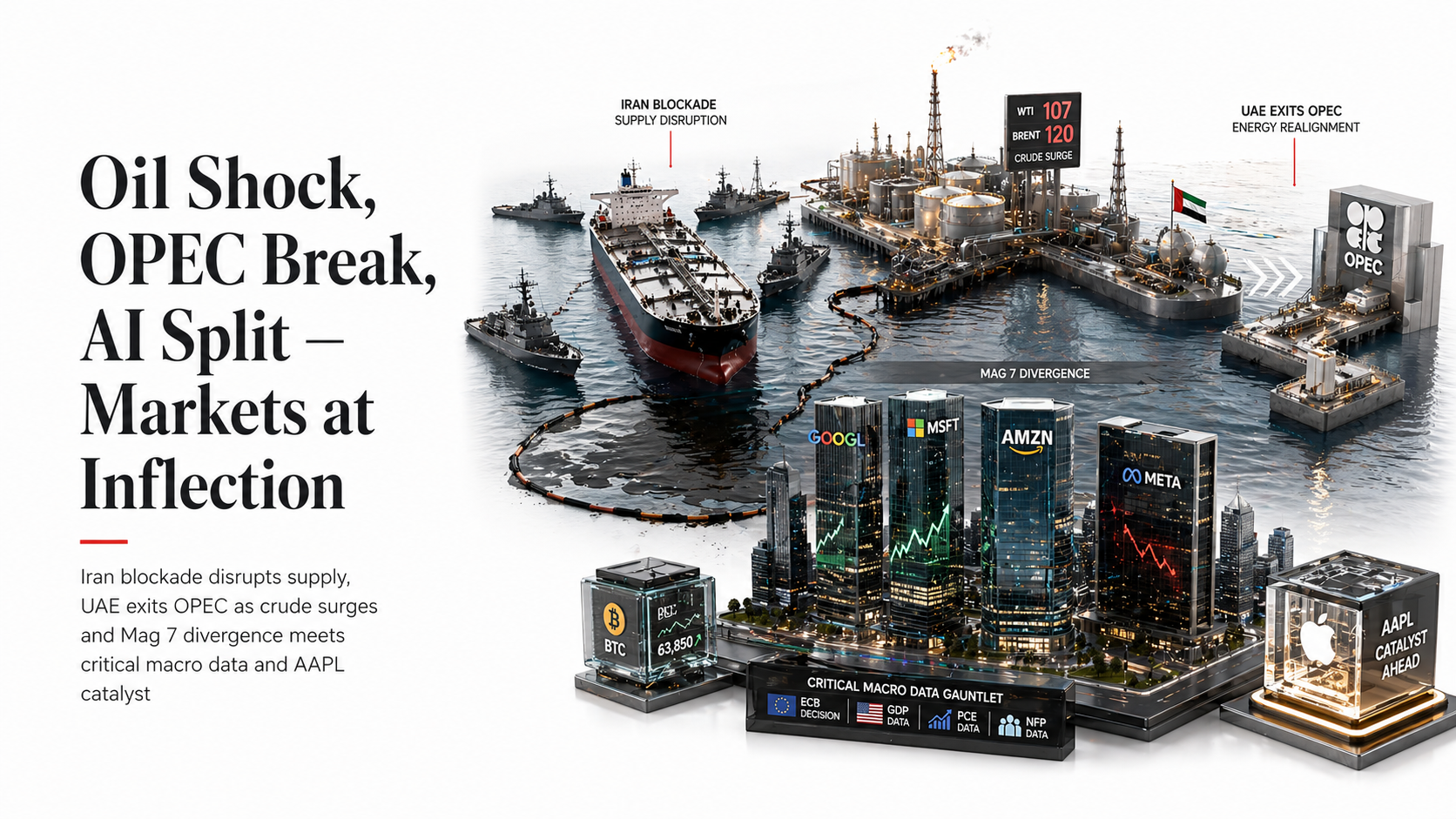
WTI Surges to $107 · Brent Hits $120 · UAE Exits OPEC · Mag 7 Mixed: GOOGL +7%, META −7% · AAPL Reports Tonight — The Energy Crisis Escalates
Trump orders extended Iran blockade, UAE shocks OPEC with exit: WTI spikes to $107, Brent hits $119+ — highest since June 2022. Last night’s Mag 7 results split the market: GOOGL surged 7% AH on Google Cloud acceleration, META slumped 7% on $135B capex shock. MSFT and AMZN both beat. Today: ECB rate decision, Q1 GDP first estimate, March Core PCE all land before noon. AAPL reports tonight AH — the final act of the most consequential earnings week of 2026.
Thursday April 30 adds a second macro gauntlet. Eurozone data and ECB decision arrive first; Q1 US GDP and Core PCE drop at 13:30 London. AAPL closes the Mag 7 cycle after the bell.
Thursday April 30, 2026 — Four Things Driving Every Market Today
Pre-Market Snapshot — 07:00 GMT, April 30, 2026
| Asset | Level | Change | Key Notes | Bias |
|---|---|---|---|---|
| WTI Crude (Jun) | $107.01 | ▲ +6.9% | Extended US blockade of Iran confirmed; UAE exits OPEC; today’s range $98.43–$107.01; highest since early 2022 | BULL — OPEC SHOCK |
| Brent Crude (Jun) | $119.53 | ▲ +7.4% | Highest since June 2022; $120 is next psychological target; UAE departure removes 3M+ bpd supply buffer | BULL — ESCALATION |
| Gold XAU/USD | $4,588 | ▲ +0.82% | Recovery from $4,522 intraday low on Apr 29; oil-driven inflation still caps upside; safe-haven bid returning | WATCH — CONFLICT BID |
| Silver XAG/USD | $73.00 | ▼ −1.1% | Industrial demand uncertainty; $74 resistance re-established; gold correlation mixed in oil shock environment | BEAR — $70 RISK |
| S&P 500 Futures | 7,186 | ▲ +0.22% | Mixed Mag 7: GOOGL, MSFT, AMZN beats offset META capex shock; oil headwind vs AI bull; ECB + GDP ahead | WATCH — MIXED SIGNAL |
| Nasdaq Futures (NDX) | 27,305 | ▲ +0.93% | GOOGL cloud beat the primary bull catalyst; MSFT Azure confirmation; META drags but 3 of 4 beat; AAPL tonight | BULL — CLOUD BEAT |
| Dow Futures | 49,396 | ▲ +0.20% | Lagging tech rally; oil inflation headwind on industrials; CAT reports today — key industrial read | WATCH — OIL DRAG |
| Bitcoin BTC/USD | $78,568 | ▲ +3.8% | Post-FOMC neutral tone + Mag 7 cloud beats triggered short squeeze; cleared $76K support decisively | BULL — SQUEEZE ON |
| EUR/USD | 1.1310 | ▼ −0.96% | ECB holds, oil stagflation deepens; EUR stagflation catch-22 intensifies at $120 Brent; USD strengthening | SHORT — STRUCTURAL |
| GBP/USD | 1.3080 | ▼ −0.78% | UK energy import headwind; BoE hold next week expected; UK local election uncertainty; 1.3050 key support | NEUTRAL-BEAR |
| USD/JPY | 161.55 | ▲ +0.90% | BOJ dovish hold yesterday + hawkish FOMC language = yen sell-off accelerating; 163 is next resistance target | BULL — 163 TARGET |
| VIX (CBOE) | 17.83 | ▼ −5.8% | Falling sharply on Mag 7 relief; ECB + GDP + PCE today could re-elevate; AAPL print tonight is final event risk | WATCH — AAPL RISK |
Geopolitical Status & Macro Context — Extended Blockade / UAE OPEC Exit / Mag 7 Aftermath
Thursday April 30 arrives as one of the most event-dense mornings of 2026. The Mag 7 earnings gauntlet is 80% complete — three of four hyperscalers beat strongly, one (Meta) shocked the market with capex that markets deemed excessive, and Apple now closes the cluster tonight. Simultaneously, the oil crisis has escalated decisively overnight: President Trump’s order to prepare an extended naval blockade of Iran, combined with the UAE’s shocking announcement that it will exit OPEC next month, delivered the largest single-day supply shock since the standoff began in early March. WTI hit $107.01, Brent $119.53 — both at multi-year highs that are rewriting energy market assumptions globally.
The UAE decision carries enormous structural weight. As OPEC’s third-largest producer at roughly 3 million barrels per day of capacity, its departure removes the bloc’s primary moderate voice. UAE officials cited the need to “adapt to shifting market conditions,” with infrastructure damage from the Iran conflict cited as the primary driver. Markets are now absorbing the reality that the oil supply shock is not temporary — it is structural. Goldman Sachs revised its 2026 Brent forecast to $130+ intraday yesterday; the IEA called this an energy security crisis without historical precedent. For macro context today, the US Q1 GDP first estimate (Atlanta Fed nowcast: 1.2%) arrives at 13:30 GMT alongside March Core PCE — the Fed’s preferred inflation gauge — at a moment when oil-driven inflation is running hot globally. The ECB, which also decides today, faces the same stagflation dilemma the Fed navigated yesterday: hold rates to fight inflation while the economy softens. Forex traders at Capital Street FX must navigate three distinct currency catalysts before European markets close.
Mag 7 Results Review + AAPL Tonight — The Full Picture
12 Active Trade Signals — Updated April 30, 2026 at 07:00 GMT

The UAE OPEC Exit Is the Structural Game-Changer. The Strait of Hormuz disruption was already the largest supply shock on record — removing ~20% of global daily oil flow. The UAE’s departure from OPEC eliminates the bloc’s primary moderating voice and signals that even America’s Gulf allies believe this standoff will last for months, not weeks. Combined with the US extended blockade order, the supply equation has now fundamentally repriced. Every day the strait remains closed, the structural supply deficit deepens. This is not a geopolitical premium that will fade — it is a new baseline.
Partial profits should have been taken at $100 WTI (yesterday’s target). Trail stop to $98 now that $107 has been traded. The next targets are $113 (Brent parity reversion) and potentially $120 WTI. Use commodity CFDs with Capital Street FX’s 1:10,000 leverage. This is educational market analysis. CFD trading involves significant risk.

Brent’s surge to a 4-year high has been swift and decisive. The UAE’s departure from OPEC changes the supply arithmetic for the global benchmark in ways that will take weeks to fully price. The UAE was OPEC’s moderating voice — without it, the cartel becomes more hawkish by default. Goldman Sachs raised its 2026 Brent forecast above $130 intraday yesterday. Commonwealth Bank of Australia noted the US extended blockade increases the probability of a prolonged disruption scenario significantly.
Brent is the preferred position for international traders. Trail stop to $110 from entry. The $120 level is the immediate psychological target — a clean break above opens the GS forecast target of $130. If diplomatic back-channels re-open unexpectedly, Brent can gap down $8–10 quickly. Size accordingly. Trade Brent crude → Educational only. CFD trading involves significant risk.

Gold Recovering From One-Month Lows — Inflation Trap Dominates. Gold fell to $4,522.97 on April 29 — its lowest since March — dropping 1.59% as stalled US-Iran diplomacy and the ongoing Strait of Hormuz closure intensified inflation fears. As of April 30, spot gold has recovered to $4,588 per Investing.com, up from session lows as safe-haven demand partially offsets rate-hike headwinds. While gold is traditionally an inflation hedge, rising rates from prolonged energy-driven inflation reduce its appeal as a non-yielding asset. USD strength (DXY ~98.6) and 10-year Treasury yields near 4.35% are the primary headwinds. The extended blockade order and UAE exit from OPEC provide a geopolitical floor. Goldman Sachs’ end-2026 gold target remains $4,900.
Use pullbacks toward $4,450–$4,540 as cautious long entries. The inflation trap still limits upside — if Core PCE today surprises above 2.8%, expect gold to give back gains quickly. Q1 GDP data and PCE at 13:30 GMT are the key catalysts for gold direction today. Trade gold CFDs → Educational analysis only.

Silver faces structural headwinds from oil-driven industrial cost inflation. While the Silver Institute projects a sixth consecutive year of supply deficit in 2026 at ~67M oz — which is long-term bullish — the near-term picture is bearish on industrial demand destruction. At $107 WTI, manufacturing margins across the solar panel, semiconductor, and electronics supply chains face severe pressure. High energy costs reduce AI-linked data centre buildout momentum at the margin.
Silver is the secondary metals trade this week. The near-term short setup (bounce to $74.50–$75.50 as entry) remains valid. However, the safe-haven recovery in gold could drag silver higher — only trade this if gold fails to hold above $4,700. Trade silver → Educational only. Significant CFD risk.

The signal yesterday was conditional: hold $76K + neutral FOMC + constructive Mag 7 = short squeeze. All three conditions were met simultaneously. Bitcoin surged 3.8% as the “most hated rally” mechanism engaged — negative perpetual funding rates forced shorts to pay longs, and with high open interest, the closing of those shorts created cascading upward price pressure. The key difference from yesterday: BTC is now above $76K, which was the critical support. The next resistance is $80,000, which has capped the market twice. A clean break above $80K opens $85–88K.
With the squeeze confirmed, the trade shifts to trailing the move. Trail stop to $74,000. AAPL earnings tonight are the next potential catalyst for broader risk sentiment. If AAPL beats and crypto sentiment holds, $80K re-test is on. If oil escalation accelerates and risk-off returns, BTC could give back gains quickly. Trade BTC/USD → Educational only.

The EUR/USD Short Thesis Is Accelerating. Europe imports ~85% of its crude oil needs. At $120 Brent, the Eurozone is absorbing the largest energy cost shock in its history. The stagflation catch-22 deepens: oil-driven inflation should require rate hikes, but oil-driven growth destruction requires cuts. The ECB decides at 09:00 GMT today — hold is certain, but Lagarde’s language on the oil inflation trajectory will determine whether the EUR recovers or extends losses. Any hawkish ECB language widens the perception that rate rises are coming — which paradoxically is EUR-negative in a stagflation context because it signals growth destruction.
The 1.1350–1.1420 zone is the current short entry window if the position was missed yesterday. The structural thesis — EUR at $120 Brent faces an impossible monetary policy choice — is now more validated than ever. Trail stop to 1.1520. First target: 1.1150. Second target: 1.0900. Watch Lagarde’s press conference at 09:30 GMT today. Trade EUR/USD →

Cable has retreated to 1.3080 from yesterday’s 1.3200 as USD strength on post-FOMC hawkish residue combines with UK energy import headwinds. The UK imports a significant share of its energy and faces the same oil-driven stagflation the Eurozone does — with the added dimension that UK local election results are expected today, providing political noise. The BoE holds next week, with markets pricing 33bp of hikes for the year — less than the ECB’s 51bp but still a stagflationary signal.
Secondary trade — prefer EUR/USD short for cleaner expression of the oil-stagflation thesis. GBP/USD at 1.3050 is the next key support; a break below opens 1.2950. BoE policy meeting next week is the next major GBP catalyst. Trail stop to 1.3250 if short from yesterday. Trade GBP/USD → Educational only.

USD/JPY broke above 160 yesterday with the BOJ’s less-than-hawkish hold, and has extended to 161.55 as today’s FOMC hawkish residue combines with yen weakness to create the perfect rate differential divergence trade. The BoJ is at 0.75% while the Fed holds at 3.5–3.75% — a 300bp differential that ING analysts describe as the structural driver of yen weakness. The under-pricing of future BoJ hikes is a medium-term story; for now, the path of least resistance is USD/JPY higher.
Trail stop to 159.00 from 157.50. New entry on pullbacks to 160.50–161.50. The Ministry of Finance has verbal intervention triggers near 160 — yesterday’s close above was telling: no intervention happened. The 165 level is where actual BoJ market operations become likely. Scale down position as 165 approaches. Trade USD/JPY →

The AI Capex Validation Trade Is Holding — Three of Four Beat. Yesterday’s four-way Mag 7 earnings delivered the key outcome the market needed: cloud infrastructure spending is being validated by accelerating revenue. Google Cloud accelerating above 48% with $70B+ run rate, Azure clearing the 38% bar, and AWS remaining robust on AI workloads all confirm that the $600B+ collective capex cycle is generating returns. META’s capex shock is the outlier — and even Meta beat on revenue. The net read for the Nasdaq AI bull case is constructive.
The Nasdaq signal remains active. Trail stop to 25,500. AAPL tonight is the final Mag 7 catalyst — if Apple beats on iPhone and Services, and provides constructive guidance on the CEO transition, the Nasdaq can extend through 28,500. Use Nasdaq 100 futures (QQQ) to maintain diversified Mag 7 exposure rather than individual names. Trade Nasdaq →

The S&P is navigating a split personality: the tech sector (Nasdaq-heavy) is getting the AI earnings validation it needed, while the industrials, consumer staples, and energy-sensitive sectors face margin pressure from $107 WTI. Caterpillar (CAT) reports today — a key bellwether for whether industrial earnings can hold up against fuel cost inflation. Visa (V) and Mastercard (MA) also report today; consumer spending resilience from Visa yesterday (+6%) is a positive signal for the services economy.
The S&P long is supported by the Mag 7 net-positive print but held back by oil inflation headwinds on the non-tech sectors. US Q1 GDP today (1.2% nowcast) and Core PCE are the near-term catalysts. If GDP surprises below 1% or Core PCE surprises above 2.9%, risk-off may temporarily dominate. Trail stop to 6,900. Trade S&P 500 →
Frequently Asked Questions — April 30, 2026
The net read is constructive for the AI trade — but with an important nuance on capex discipline. Three of the four hyperscalers (GOOGL, MSFT, AMZN) validated the core thesis: AI infrastructure spending is generating accelerating cloud revenue. This is the most important signal for the entire AI supply chain — from Nvidia to copper to data centre REITs. The market does not need all four to beat; it needs the capex cycle confirmed as revenue-generative.
META’s -7% move is more nuanced. Meta beat on EPS and revenue — advertising grew ~30% driven by AI-powered targeting (Advantage+). The selloff was entirely about the $115–135B capex guide, which investors interpreted as spending without near-term AI revenue justification. This is the “show me the ROI” reaction that will define how markets price capex-heavy tech stocks in 2026. Meta’s long-term AI infrastructure thesis may still be right — but the market is demanding evidence of monetisation before rewarding the spend. CFD trading involves significant risk. Always conduct your own due diligence. Daily market analysis →
The UAE’s departure from OPEC is structurally significant in several dimensions. First, it removes the cartel’s primary moderate voice — the UAE has historically been the bloc member most willing to break with Saudi Arabia on production discipline to prioritise revenue. Without the UAE, OPEC becomes more hawkish by default. Second, it signals that even Gulf states that are nominally US-aligned believe the conflict will last long enough to justify restructuring their energy policy entirely. Third, it introduces uncertainty about whether other Gulf producers might follow — Qatar, Kuwait, and Bahrain have all faced infrastructure disruption from the Iran conflict.
For oil prices in May, Goldman Sachs revised its 2026 Brent target above $130 immediately following the UAE announcement. The IEA now characterises the Hormuz closure as the largest supply disruption in history. Absent a rapid diplomatic breakthrough — which the extension of the blockade makes less likely, not more — oil prices are likely to remain elevated through May. The key risk to the downside is an unexpected US-Iran back-channel deal; the key risk to the upside is further escalation toward direct military engagement. Neither appears imminent based on available reporting. This is educational market analysis, not financial advice. Trade crude oil →
US Q1 2026 GDP and March Core PCE release at 13:30 GMT today and represent the most important US economic datapoint of the week. The Atlanta Fed’s GDPNow model tracks at approximately 1.2% — which represents a deceleration from Q4 2025’s revised 0.5% (downward revised from 1.4%). This is the first quarter to fully incorporate the oil price shock from the Strait of Hormuz closure; energy costs rose sharply in Q1 and are expected to show up in both growth (downside) and inflation (upside) measures.
For Core PCE specifically: the Fed’s 2026 projection is 2.7%, but with oil at $107 WTI, oil-driven inflation is materialising faster than the March SEP assumed. A Core PCE reading above 2.8% will renew rate-hike speculation and pressure gold, Bitcoin, and risk assets. A reading at or below 2.6% would be interpreted as “inflation under control despite oil” — supportive of the AI equity trade. The market is most sensitive to the combination: weak GDP + high Core PCE = stagflation confirmation = USD strong, EUR weak, gold mixed, oil up. That is the scenario the current EUR/USD short is designed to capture. This is not financial advice. Economic calendar →
Apple reports Q2 2026 after the bell tonight (approximately 21:00 GMT) with analysts expecting EPS of $1.92 and revenue of $109.45B. Several dimensions make this report particularly significant beyond the headline numbers.
1. Services revenue — This is the highest-margin segment and the primary multiple driver. Services grew to $30B in Q1 2026 (+14% YoY). Continued double-digit growth confirms the premium that justifies Apple’s $4 trillion market cap. 2. iPhone demand in China — Q1 saw strong recovery in China following Apple AI localisation. Q2 will show whether that momentum sustained. 3. CEO transition commentary — The announcement of John Ternus replacing Tim Cook in September will generate significant analyst questions about strategy continuity and product roadmap. 4. Apple AI on-device adoption rate — This is the emerging driver of the next iPhone upgrade cycle; any update on AI feature usage metrics is market-moving. 5. Tariff and supply chain commentary — with significant manufacturing in China and Vietnam, the US trade environment (still elevated tariff regime) will be discussed. Apple has historically beaten by 5–7% on revenue when iPhone and Services both exceed expectations. Trade stocks → Educational analysis only. Not financial advice.
Based on the derivatives structure going into yesterday’s session, the short squeeze is likely in its early stages, not its late stages. The “most hated rally” setup — high open interest + negative perpetual funding rates — typically runs until funding turns positive (meaning the squeeze has exhausted most short positions). As of the last available data, perpetual funding on major exchanges remained negative heading into yesterday’s close, which means there were still shorts being forced to pay longs.
The $80,000 level has acted as significant resistance twice in recent weeks. A clean break above $80K — confirmed by a daily close above — is the technical signal that the squeeze has extended beyond initial resistance and that $85–88K becomes the next target. The risk to this thesis: AAPL earnings tonight. If Apple disappoints and risk sentiment deteriorates broadly, Bitcoin’s correlation with risk assets could pull it lower even as the short squeeze wants to push it higher. The $74,000 stop level remains relevant — a close below that would invalidate the squeeze thesis entirely. This is educational market analysis only. Crypto markets are highly volatile. Trade crypto →
Market Analysis Summary — Thursday, April 30, 2026
Thursday April 30 opens as the direct continuation of the most consequential week of 2026 — but with the macro landscape materially shifted. Oil has entered a new price regime: WTI at $107, Brent at $119 following Trump’s extended blockade order and the shock UAE exit from OPEC. These are not temporary risk premiums — they are structural repricing events. Every major inflation forecast, every central bank dot plot, and every Eurozone growth projection written before yesterday is now undercooked. The ECB makes its rate decision today; Q1 US GDP and Core PCE drop this afternoon; Caterpillar, Mastercard, Visa (reported), and Apple all provide earnings data points on how the real economy is absorbing $107 oil.
On the AI trade: the Mag 7 gauntlet delivered a constructive if complex outcome. GOOGL’s Google Cloud beat is the strongest validation of AI capex returning revenue — a structural positive for the entire hyperscaler thesis. MSFT and AMZN confirmed the same. META’s -7% move on capex excess is the market’s warning that “spend to build” without a near-term monetisation path will be punished regardless of headline beats. Apple tonight closes the loop — with the lowest bar of the Mag 7 and a powerful services engine, the probability of an AAPL beat is high.
The cleanest, highest-conviction positions for today are: Signal 01 (WTI long toward $113+) — UAE OPEC exit + extended blockade = structural supply repricing; Signal 06 (EUR/USD short) — $120 Brent stagflation accelerates the ECB catch-22; Signal 08 (USD/JPY long) — dovish BOJ + hawkish Fed = maximum rate differential. For forex trading, commodity trading, and crypto trading across all 12 signals, Capital Street FX provides the 900% deposit bonus and 1:10,000 leverage for traders entering what may be the most structurally shifted energy and macro environment in a generation.
Critical risk management for today: Trail all oil longs with stops at $98 WTI / $110 Brent — a diplomatic breakthrough can gap these markets down $8–10 quickly. Size AAPL-adjacent positions at 50% until the print tonight. Reduce EUR/USD size before Core PCE — if PCE surprises to the downside, EUR could recover 0.5% rapidly before reversing. Do not hold positions into thin overnight liquidity without stops in place. CFD trading involves significant risk of loss and is not suitable for all investors. This briefing is educational market analysis and does not constitute personal financial advice. Consult a licensed financial advisor before trading.