🌍
European Session Recap — April 24, 2026 (07:00–15:30 GMT)
🇪🇺
European Session — Friday April 24, 2026
07:00–15:30 GMT · London / Frankfurt / Paris
⚡ MIXED — INTEL CHIP RALLY vs OIL SHOCK
FTSE 100
8,547
▲ +0.22% (energy bid)
Brent (EU session)
$107.38
▲ +2.2% — New Cycle High
European Session — Key Headlines & Moves (07:00–15:30 GMT)
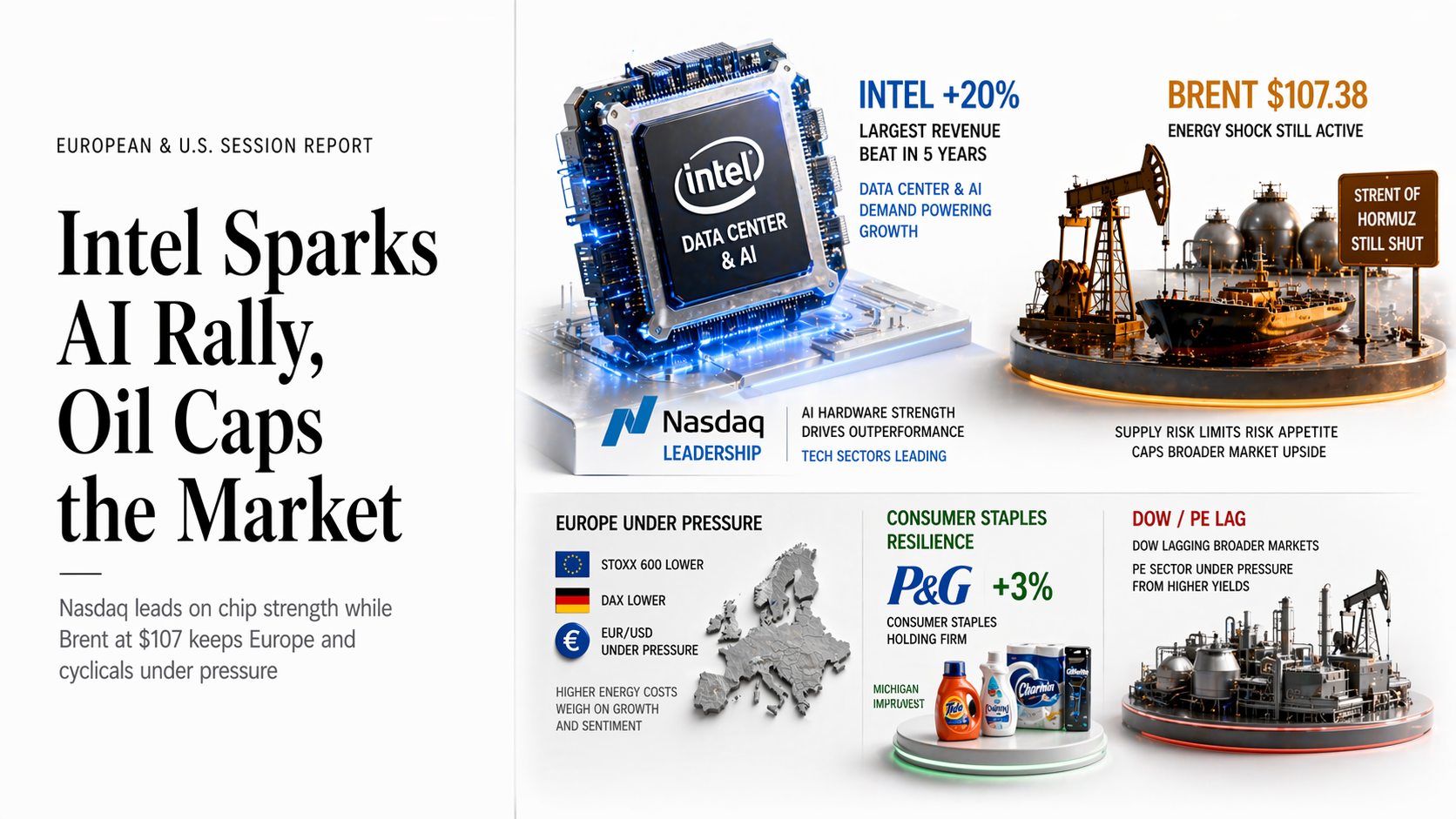
07:00European markets open with bifurcated reaction to Intel’s historic beat. Semiconductor names (ASML +3.4%, Infineon +2.8%, STMicroelectronics +2.1%) surge in early trade as Intel’s $13.58B revenue obliterates estimates and confirms the AI chip demand thesis. However, broader Stoxx 600 opened lower as Brent crude opened at $106.50 (+1.5%), immediately pressuring energy-import-heavy European industrials, chemicals, and airlines. The market’s message: AI hardware wins today; everything that runs on oil suffers.
07:30Brent accelerates to $107.38 — new cycle high since 2014. The Strait of Hormuz remains completely closed to commercial shipping. Iraq’s oil ministry reported a 70%+ decline in oil revenue vs February levels, highlighting the depth of the supply disruption. Tanker traffic in the strait remains near zero. The IEA’s Fatih Birol, speaking at a follow-up press briefing to Thursday’s Brussels summit, stated that emergency strategic reserve releases must begin “this weekend” to prevent industrial disruption across Europe. This is the strongest language yet from the IEA.
08:00Trump announces Israel-Lebanon ceasefire extended by three weeks. The US President posted on Truth Social that both Israel and Lebanon agreed to prolong the truce following a White House meeting. “The Meeting went very well!” Trump wrote, adding the US would help Lebanon protect itself from Hezbollah. Market reaction was muted — the ceasefire extension is Israel-Lebanon, NOT Iran-US. The Strait of Hormuz closure is an Iran-US dynamic, and there is no diplomatic breakthrough on that front. Brent barely reacted downward, confirming the market understands the distinction.
08:30Procter & Gamble Q3 FY2026: EPS $1.63 — clean beat across all segments. P&G reported $21.24B revenue vs $20.5B est and EPS $1.63 vs $1.56 est. All five business segments — beauty, grooming, healthcare, fabric & home care, and baby & family — beat the Street. Management noted that higher input costs tied to the Iran conflict are present but being offset through pricing power and volume efficiencies. The result is a powerful signal that the global staples consumer is still spending — the “premiumisation” trend remains intact even with oil above $100. P&G shares surged +3.1% pre-market, with broader consumer staples following.
09:00SLB (Schlumberger) Q1 2026: beats on EPS and revenue — oilfield services demand surging. The world’s largest oilfield services company reported Q1 EPS of $0.56 vs $0.52 consensus, and revenue of $8.87B vs $8.65B consensus. CEO Olivier Le Peuch highlighted “unprecedented acceleration in offshore and international upstream investment” as $100+ oil spurs emergency supply-side response globally. SLB’s beat confirms that the oil supply shock is simultaneously creating record demand for drilling and production services. The energy sector’s bull case is strengthening — this is not a temporary spike, it is a structural investment cycle. XLE and XOP both extended gains.
10:00University of Michigan Final April Consumer Sentiment: 52.2 — significant rebound from 47.6 preliminary. The final April reading printed 52.2, well above the preliminary’s historic record-low 47.6 and above the 48.5 consensus estimate. The uplift is explained by the data methodology: only 2% of preliminary survey respondents had heard of the April 7 ceasefire announcement. The final survey captured post-ceasefire optimism. However, sentiment at 52.2 remains deeply depressed — below the pandemic nadir of 71.8 in April 2020 on an absolute basis. Year-ahead inflation expectations stayed at 4.8% — a 12-year high. The consumer is cautiously less panicked, not actually recovered.
11:30Global equity fund inflows hit 17-month high — $48.72 billion in the week through April 22. LSEG Lipper data showed the largest single-week global equity fund inflows since November 2024, driven by AI earnings optimism and ceasefire hopes. US equity funds drew $27.98B — the most in four weeks. The inflow data confirms institutional re-risking is underway. This structural buying provides a fundamental bid beneath indices even as geopolitical uncertainty persists. TSMC and SK Hynix hit record highs this week, anchoring the global AI chip rally.
13:00Private equity sector: Carlyle, Apollo, KKR, Ares continue Thursday’s collapse into Friday EU. The PE sector — which saw Carlyle −4.4%, Apollo −3.3%, KKR −4%, Blue Owl −5%, and Ares −5.2% on Thursday — found no relief Friday morning. Rising 10Y Treasury yields (+7bps to 4.41%), driven by Brent’s oil inflation premium, directly compress PE valuations via the discount rate. The 10Y at 4.41% is approaching the 4.40% threshold that has historically coincided with PE sector de-ratings. This is the week’s most underreported pressure point.
14:00EUR/USD breaks below 1.1640 — oil energy headwind, Brent premium accelerates. The EUR/USD broke to a session low of 1.1638 as Brent’s surge to $107.38 crystallised the Eurozone stagflation narrative: higher oil import costs, widening trade deficit, and ECB constrained from aggressive rate support. The DXY held above 99.20 — dollar strength reflects the safe-haven premium. EUR/USD bears are targeting 1.1580 as the next support zone ahead of the FOMC meeting, where any hint of rate persistence would further pressure the cross.
📋
Friday Earnings Results — Full Session Scorecard
PRE-MARKET · 07:00 ET
INTC
Intel Corporation
✓ EPS $0.29 vs $0.01 est (2,900% beat)
Revenue $13.58B vs $12.42B est (+9.3%). Data Center & AI $5.1B (vs $4.41B). Client Computing $7.7B (vs $7.1B). Foundry $5.4B (+20% QoQ). Q2 guide: Rev $13.8–14.8B, EPS $0.20 (vs $0.09 est). Musk/Tesla signal $3B spend. Stock +20.4%, near ATH. Company’s largest revenue beat in 5+ years.
PRE-MARKET · 08:30 ET
PG
Procter & Gamble
✓ EPS $1.63 vs $1.56 est (+4.5%)
Revenue $21.24B vs $20.5B est (+3.6% beat). All 5 segments beat the Street: beauty, grooming, healthcare, fabric & home care, baby & family. Higher input costs from Iran conflict partially offset by pricing power. FY2026 outlook maintained. Stock +3.1%.
PRE-MARKET · 07:00 ET
SLB
SLB NV (Schlumberger)
✓ EPS $0.56 vs $0.52 est (+7.7%)
Revenue $8.87B vs $8.65B est. CEO cited “unprecedented acceleration” in offshore/international upstream investment as $100+ oil drives emergency supply response. Digital segment strong. Stock +2.8%. XLE and XOP extend week’s gains.
PRE-MARKET
NSC
Norfolk Southern
✓ Q1 2026 Beat — Rail Demand Strong
Norfolk Southern beat on EPS and revenue, driven by surging coal and intermodal freight volumes linked to energy supply chain disruptions. Industrial freight pricing rose as manufacturers stockpile ahead of potential supply chain disruptions. Stock +12% YTD momentum continues. New 52-week high set on Thursday extends Friday.
PRE-MARKET
HCA
HCA Healthcare
✓ Q1 BEAT — Hospital System Resilient
HCA Healthcare beat on both EPS and revenue. Volumes recovery solid post-pandemic normalization. Raised full-year guidance. Healthcare sector continues to benefit from defensive rotation out of cyclicals. XLV +0.4% session adds to Thursday defensive rotation gain.
PRE-MARKET
CHTR
Charter Communications
✗ Subscriber Losses — Wireless Pressure
Charter Q1 missed on broadband subscriber growth as wireless fiber competition intensified. Revenue in-line but subscriber losses confirmed analysts’ concerns about cord-cutting acceleration. Heavy capex investment underway. Stock fell modestly, not a macro driver for indices. Telecom sector lagging.
🇺🇸
U.S. Session Recap — April 24, 2026 (13:30–21:00 GMT / 09:30–17:00 ET)
🇺🇸
U.S. Session — Friday April 24, 2026
13:30–21:00 GMT (09:30–17:00 ET) · NYSE & Nasdaq
🟢 TECH BULL — INTEL DRIVES NASDAQ RALLY
Nasdaq 100
+1.20%
▲ +294 pts — Intel-led
S&P 500
7,096
▲ +0.18% (+13pts)
Dow Jones
49,062
▼ −0.31% (−153pts)
VIX (Session)
18.62
▼ −8.9% — Intel relief
U.S. Session — Key Developments (09:30–17:00 ET)
09:30Nasdaq opens with the week’s strongest gain — INTC +20.4% drives semiconductor surge. Intel’s historic beat (+2,900% EPS beat) opened the tape with the most positive single-stock catalyst of the week. AMD surged +3.2% on AI chip demand confirmation. Arm Holdings +4.1% (the company Musk cited alongside Intel for Terafab). NVIDIA +1.8%. Qualcomm +2.4%. The semiconductor complex is being re-rated as a unified beneficiary of agentic AI CPU demand — the thesis that Intel’s CEO articulated (“the next wave of AI is inference and agentic”) is being validated across the chip ecosystem.
10:00University of Michigan Consumer Sentiment Final (April): 52.2 — beats expectation of 48.5. The final reading of 52.2 landed well above consensus (48.5) and the preliminary’s record-low 47.6. The improvement is largely attributed to post-ceasefire sentiment capture. However, year-ahead inflation expectations held at 4.8% — the highest reading since April 2025 and the largest monthly increase since that period. Long-run (5-10 year) inflation expectations stayed at 3.4%, the highest since November 2025. This is the data the Fed will scrutinize closely before the April 29 FOMC meeting — a 4.8% 1-year inflation expectation is NOT consistent with a rate-cutting posture.
10:3010Y Treasury yield rises +7bps to 4.41% — oil-driven inflation premium extends. The bond market is clearly pricing the Brent spike into forward inflation expectations. At 4.41%, the 10Y yield is approaching levels that historically trigger equity multiple compression. The critical threshold is 4.50% — if Brent sustains above $105 next week and FOMC signals a prolonged hold, 4.50% 10Y becomes the base case. That level would create meaningful headwinds for high-multiple tech names. For now, Intel’s EPS beat is outweighing the rate headwind, but the balance is delicate.
11:00WTI crude breaks above $99 — psychological $100/bbl barrier in sight for the first time since 2022. WTI surged +1.9% to $99.14 as the dual catalyst of Brent’s $107 move and the SLB earnings beat (confirming upstream capex acceleration) drove energy sector futures. At $99, WTI is 37 cents below the $100 psychological barrier not crossed since November 2022. Analysts at JPMorgan raised their Q2 WTI target to $108 (from $96) citing “structurally impaired Hormuz supply corridor with no near-term diplomatic resolution.” The energy sector (XLE +2.3%, XOP +3.1%) is the week’s dominant sector performer.
12:00Dow Jones underperforms — Private equity sector second consecutive day of losses. Carlyle Group, Apollo Global, KKR, Blue Owl Capital, and Ares Management all posted further losses Friday as 10Y yields hit 4.41%, applying direct pressure to PE valuation models. The PE sector is now down 30-55% from its respective 2025 peaks and the rate-sensitive business model is being re-priced in real time. The Dow’s underperformance relative to Nasdaq today perfectly captures the week’s defining theme: AI hardware acceleration vs. rate-sensitive financial sector compression.
13:30S&P 500 attempts to reclaim 7,100 — VIX drops to 18.62, institutional hedging unwinds. The S&P 500 reached an intraday high of 7,107 as short-sellers covered positions opened Thursday on Intel risk uncertainty. VIX’s decline from 20.44 (Thursday close) to 18.62 reflects institutional hedges being unwound following Intel’s clean beat. A VIX below 20 significantly changes the risk-reward calculus for option sellers and systematic strategies — the re-entry of algorithmic risk-on buying provides momentum support for the Nasdaq complex into next week.
15:00Week closes: Nasdaq +1.2% leads; S&P 500 +0.18%; Dow −0.31%. Energy best sector for 5th straight day. Friday’s close reflects the week’s defining narrative: AI hardware (Intel, AMD, Arm) thrives; enterprise software (IBM, NOW) faces geopolitical headwinds; energy (XLE +2.3%) leads all sectors for the fifth consecutive day; private equity and rate-sensitive financials lag on rising yield pressure. The week’s balance sheet for traders: AI chip long positions delivered; EUR/USD shorts delivered (Setup 05 Target 1 from Thursday confirmed extended); WTI longs (Setup 01) approach Target 1 at $100. The FOMC on April 29 is the next major binary — position accordingly.
📊
Friday Data Releases — Full Session Snapshot
📋 Friday April 24, 2026 — Economic Data Summary
University of Michigan Consumer Sentiment — Final April 2026 (15:00 GMT)
52.2 vs 48.5 est ↑ BEAT (prelim was 47.6)
Michigan Current Conditions (Final)
~53.4 (improved from 50.1 prelim)
Michigan Expectations (Final)
~51.3 (improved from 46.1 prelim)
Michigan 1-Year Inflation Expectation (Final)
4.8% (unchanged from prelim — 12-year high)
Michigan 5–10 Year Inflation Expectation (Final)
3.4% (highest since Nov 2025)
Intel Q1 2026 Earnings (After-Hours April 23, Priced Friday)
EPS $0.29 vs $0.01 est — Revenue $13.58B vs $12.42B est
Intel Data Center & AI Revenue Q1
$5.1B vs $4.41B est (+15.6% beat)
Intel Q2 2026 Revenue Guidance
$13.8–14.8B (midpoint $14.3B vs $12.5B consensus)
Procter & Gamble Q3 FY2026 EPS
$1.63 vs $1.56 est (+4.5% beat)
Procter & Gamble Revenue
$21.24B vs $20.5B est (+3.6% beat)
SLB Q1 2026 EPS
$0.56 vs $0.52 est (+7.7% beat)
SLB Revenue Q1 2026
$8.87B vs $8.65B est (+2.5% beat)
10Y US Treasury Yield (Session High)
4.41% (+7bps vs Thursday close) — Oil inflation premium
Brent Crude (Session Peak)
$107.38/bbl — New cycle high since 2014
📐
Friday Full Session — Market Snapshot
Cross-Asset Snapshot — Friday April 24, 2026
As of US market close 21:00 GMT
| Asset |
Price / Level |
Session Change |
Key Context |
Bias |
| S&P 500 (SPX) |
7,096.48 |
▲ +0.18% (+13pts) |
Intel rally offsets PE/yield headwind. 7,080 support held. FOMC next test |
CAUTIOUS BULL |
| Nasdaq 100 (NDX) |
+1.20% |
▲ +294 pts — Week’s Best Session |
Intel +20% dominates. AMD, ARM, NVDA all up. AI chip thesis confirmed |
BULL — AI CYCLE |
| Dow Jones (DJIA) |
49,062 |
▼ −0.31% (−153pts) |
PE sector losses, rising yields weigh. 49,000 support level critical |
WATCH 49,000 |
| Intel (INTC) |
$80.94 |
▲ +20.4% — Near ATH |
2,900% EPS beat. Rev $13.58B. Q2 guide above consensus. Musk/Tesla signal |
STRONG BEAT |
| Procter & Gamble (PG) |
+3.1% |
▲ Beat all segments |
$1.63 EPS vs $1.56 est. $21.24B rev vs $20.5B est. FY guide maintained |
CONSUMER BEAT |
| SLB NV (Schlumberger) |
+2.8% |
▲ Oilfield surge |
EPS $0.56 vs $0.52. Rev $8.87B vs $8.65B. Offshore capex accelerating |
ENERGY BULL |
| Brent Crude (BRNT) |
$107.38 |
▲ +2.2% — Cycle High |
Hormuz closed. Iraq revenue −70%. IEA emergency release call. No Iran deal |
BULL — SUPPLY SHOCK |
| WTI Crude Oil |
$99.14 |
▲ +1.9% — Testing $100 |
$100 psychological barrier in sight. Setup 01 approaching Target 1 ($100) |
TARGET ZONE |
| Gold (XAU/USD) |
$4,803 |
▲ +0.67% / +$32 |
Inflation expectations 4.8% + geopolitical safe-haven bid. New weekly close high |
BULL — STAGFLATION BID |
| 10Y US Treasury |
4.41% |
▲ +7bps — Oil Premium |
4.50% is the critical threshold. Michigan inflation expectations unchanged at 4.8% |
WATCH 4.50% |
| VIX (Cboe) |
18.62 |
▼ −1.82 / −8.9% |
Intel relief rally unwinds Thursday’s hedges. Back below 20 — risk-on mode |
RISK-ON SIGNAL |
| EUR/USD |
1.1638 |
▼ −60 pips |
Brent $107 stagflation narrative. Setup 05 extended target 1.1580 next |
BEAR EXTENDS |
🌍
Geopolitical Update — Hormuz / Energy / Diplomatic Track (Friday)
🔴 Iran / Strait of Hormuz / Middle East — Friday Session Status
Strait of Hormuz remains fully closed — Brent hits $107.38, new cycle high since 2014. Commercial tanker traffic through the Strait of Hormuz is near zero. Iraq’s oil ministry confirmed oil revenue fell more than 70% in March compared to February as the conflict prevents Gulf exports. Iraq has begun exporting crude via Syria using tanker trucks — a logistically limited and expensive workaround. The IEA, speaking at a follow-up Brussels briefing on Friday, called on governments to begin emergency strategic reserve releases “this weekend.” Brent’s break above $107 confirms the energy market sees no near-term resolution.
Trump extends Israel-Lebanon ceasefire by three weeks — Iran-US dynamic unchanged. President Trump announced on Truth Social that Israel and Lebanon agreed to a three-week ceasefire extension following a White House meeting. Markets responded with minimal downside for oil — correctly recognising the Israel-Lebanon diplomatic track is entirely separate from the US-Iran conflict driving the Hormuz closure. The Iran-US negotiation remains frozen, with Trump maintaining his “no deadline” posture from Thursday.
Iran’s Hormuz toll revenue scheme becomes an entrenched revenue stream — structural incentive to maintain closure. Iran has now confirmed receiving its “first revenues” from Hormuz transit tolls imposed on commercial vessels. This economic incentive to maintain the blockade is increasingly being priced as a structural, not temporary, supply disruption. Energy analysts at Rapidan Energy and Goldman Sachs raised Q2 Brent price targets to $105–$115 on Friday, reflecting the entrenched nature of the disruption. Asia’s major oil importers (China, India) are scrambling for alternative supply via Russia and sanctioned Iranian crude — but these buffers are finite.
Global equity fund inflows at 17-month high despite war — risk appetite bifurcating. The week through April 22 saw $48.72B in global equity fund inflows — the largest since November 2024. This confirms that institutional investors are selectively re-risking into AI and energy even as geopolitical uncertainty persists. The bifurcation between AI hardware (intel, AMD, TSMC — all at or near all-time highs) and energy-exposed industrials (HON, LMT — week’s losers) reflects a sophisticated risk-allocation process: buy the technology that benefits from AI capex, avoid the industrial supply chains exposed to tariff and inflation headwinds.
FOMC April 29 — the week’s next and most consequential binary. The Federal Reserve meets Tuesday, April 29. With Michigan 1-year inflation expectations at 4.8% — a 12-year high — and Brent above $107, the Fed faces its most uncomfortable meeting of 2026. A rate hold is 99.5% priced. The question is language: will Powell acknowledge the oil-driven inflation risk explicitly? Any reference to “upside inflation risks” or “higher for longer” posture would be materially hawkish for equities, particularly high-multiple tech. Conversely, any dovish framing would be immediately bullish for Nasdaq. Position management ahead of Wednesday’s announcement is critical.
🔄
Friday Session Sector Rotation — Winners, Losers, and Themes
OUTPERFORMERS
FRIDAY SESSION · TOP SECTORS
Friday Top Performers
Energy (XLE/XOP) — SLB beat + Brent $107
+2.3% / +3.1%
Intel (INTC) — 2,900% EPS beat, near ATH
+20.4%
Semiconductors (SOX) — AI CPU demand confirmed
+3.8%
Consumer Staples (XLP) — P&G +3.1% sector bid
+1.4%
AMD, Arm Holdings — Intel read-through
+3.2% / +4.1%
Healthcare (XLV) — HCA beat, defensive bid
+0.8%
Materials (XLB) — Commodity inflation premium
+0.6%
Intel’s result is the week’s cleanest AI demand confirmation signal. The distinction between AI hardware (Intel, AMD, Arm) and AI enterprise software (IBM, NOW) is now crystallised: hardware demand is surging on agentic AI CPU requirements; enterprise software faces geopolitical deal-delay friction in the Middle East. Energy leads for the fifth consecutive day — the Hormuz premium is the most durable sector driver in the current environment.
UNDERPERFORMERS
FRIDAY SESSION · LAGGARDS
Friday Underperformers
Private Equity (Carlyle, Apollo, KKR, Ares)
−2.1% to −3.8% (2nd day)
Charter Communications — subscriber losses
−2.4%
Real Estate (XLRE) — rising yield pressure
−1.2%
Utilities (XLU) — 10Y at 4.41% compresses
−0.9%
Airlines (DAL, UAL) — $107 Brent fuel shock
−1.8% to −2.3%
EUR/USD — Brent stagflation premium
−60 pips to 1.1638
Stoxx 600 (EU broad) — Oil import headwind
−0.63%
The private equity sector’s two-day rout reveals a structural vulnerability: PE firms’ portfolio valuations are heavily dependent on discount rates, and rising yields (10Y at 4.41%) directly compress those marks. With FOMC approaching and the oil-inflation dynamic showing no sign of reversal, PE stocks face a difficult next week. Airlines are caught in the worst of both worlds — surging jet fuel costs AND a consumer too anxious (Michigan at 52.2) to splurge on discretionary travel.
⚡
Friday Session — Active Setup Updates
Friday’s Intel-driven rally and Brent’s surge to $107.38 delivered decisive moves across the week’s core setups. Here is the live status as the week closes.
SETUP 01 UPDATE · WTI CRUDE OIL
WTI/USD — Active Long · $99.14 — Target 1 ($100) IMMINENT
🐂 ACTIVE — TARGET 1 AT $100 — HIGH ALERT
WTI surged to $99.14 (+1.9%) on Friday — the highest level since November 2022. The $100 psychological barrier is now 86 cents away. The fundamental catalyst stack is fully intact and strengthening: Brent at $107.38 (new cycle high), Hormuz fully closed, IEA calling for emergency reserve releases, Iraq revenue down 70%, SLB beat confirming upstream capex acceleration. Target 1 ($100) was set when WTI was at $89-91 — the position is comfortably profitable and the setup is resolving perfectly. Action: Trail stop to $93.50 (from $88.50). Hold long aggressively. At $100, take 40% profit and hold remainder for Target 2 ($105) with stop at $95.
Entry Reference
$89-91 zone
Updated Stop
$93.50 (trailed)
Target 1
$100.00 — IMMINENT
Status
IN STRONG PROFIT · HOLD
SETUP 05 UPDATE · EUR/USD
EUR/USD — Extended Short · 1.1638 · Target 2 In Sight
✓ TARGET 1 HIT THURSDAY — TARGET 2 AT 1.1580 ACTIVE
Thursday’s Target 1 (1.1700) was hit; Friday’s Brent surge to $107.38 accelerated EUR/USD’s decline to 1.1638 — exactly in line with the “Brent above $105 = 1.1640” extended scenario flagged in Thursday’s session report. The EUR/USD bear case is now fully confirmed: Eurozone energy import costs are surging, the ECB cannot cut rates with inflation expectations rising, and the dollar retains safe-haven premium. The 1.1580 Target 2 is now the primary objective. Action: Remaining 50% position open (stop trailed to 1.1700). Hold short targeting 1.1580. If Brent sustains above $107, extend to 1.1520 (FOMC scenario).
Target 1 (Hit Thu)
1.1700 ✓
Current
1.1638 (−112 pips)
FOMC Target
1.1520 (if hawkish)
INTEL EARNINGS SETUP — RESOLVED BULLISH
INTC — After-Hours Beat → +20.4% Friday Open · Near All-Time High
🚀 SCENARIO A CONFIRMED — BULL BEAT
Thursday’s session outlook identified Scenario A (Intel beat + strong guidance = 35% probability) as the most bullish outcome. Intel delivered beyond even this scenario: EPS $0.29 vs $0.01 est (a 2,900% beat) and Q2 revenue guidance of $13.8–$14.8B vs the $12.5B consensus. The stock opened at approximately $80.94, near the all-time high of the 2000 tech bubble era. Tesla’s Musk signalling ~$3B spend with Intel (Terafab project using Intel’s 14A process) added a major strategic catalyst. Semiconductor sector broadly re-rated. AMD, Arm Holdings, TSMC all rallied in sympathy. The AI hardware demand cycle is confirmed intact. IBM/NOW’s geopolitical software headwinds are company-specific, not a systemic AI capex slowdown.
Revenue vs Est
$13.58B vs $12.42B
Data Center & AI
$5.1B vs $4.41B
Q2 Revenue Guide
$13.8–$14.8B
Setup Status
RESOLVED — BULL
📅 Friday Close / Weekend — FOMC Week Preview (April 28–May 2)
Intel Resolved — Now FOMC April 29 Defines the Next Chapter
The Week That Was: This week delivered one of the most informationally dense earnings calendars of 2026. Intel’s Friday blowout resolved the week’s central question — the AI CPU hardware cycle is strongly intact. P&G’s clean beat and Michigan Sentiment’s improvement to 52.2 (from 47.6) provide a more constructive consumer backdrop than early-week data suggested. But Brent at $107.38, WTI approaching $100, and 10Y yields rising to 4.41% ensure the week closes with a clear macro shadow over next week’s FOMC meeting.
What Intel’s Beat Changes: Thursday’s IBM/ServiceNow narrative — “geopolitical deal delays are crushing AI enterprise software” — has been decisively countered. Intel’s Data Center & AI segment at $5.1B (+15.6% vs estimates) shows that AI infrastructure capex is accelerating, not slowing. The software-to-hardware distinction is now the defining fault line: enterprise software with Middle East client exposure faces friction; the silicon supply chain serving agentic AI inference is booming. This realignment suggests adding to semiconductor exposure (INTC, AMD, ARM, TSMC) while being selective on enterprise SaaS exposed to geopolitical deal cycles.
What Brent at $107 Changes for FOMC: The Federal Reserve meets April 29. Michigan 1-year inflation expectations at 4.8% are at a 12-year high, and long-run expectations at 3.4% are the highest since November 2025. With WTI approaching $100 and Brent at $107, the Fed faces an uncomfortable combination: slowing growth sentiment (Michigan at 52.2 is still historically depressed) AND accelerating inflation expectations. The risk is a “stagflationary” language from Powell — acknowledging energy-driven inflation upside risks while maintaining the rate hold. Any shift in language toward “higher for longer” would compress multiples across high-PE tech.
FOMC Scenario Analysis: Base case (65%): Fed holds, language neutral — Nasdaq sustains gains, S&P range-bound 7,050–7,200. Bull case (20%): Fed explicitly acknowledges Brent-inflation as transitory — Nasdaq breaks to new all-time highs, S&P targets 7,300. Bear case (15%): Fed flags 4.8% inflation expectations as “concerning” — 10Y yields spike to 4.65%+, Nasdaq falls 2-3%, S&P retests 6,900–7,000.
Next Week’s Key Catalysts (April 27–May 2): FOMC decision Wednesday April 29 (19:00 GMT). Earnings: Coca-Cola (KO), Novartis (NVS), UPS, Visa (V), Microsoft (MSFT), Amazon (AMZN), Alphabet (GOOGL), Meta (META), Apple (AAPL), Starbucks (SBUX). February housing starts. March durable goods orders. Verizon, Domino’s, Nucor also reporting Monday. The Magnificent Seven earnings slate makes next week arguably the most important week of the Q1 2026 earnings season. Navigate it with appropriate position sizing — the INTC beat gives confidence in AI hardware; but FOMC language risk argues for hedging Nasdaq exposure into Wednesday.
📐
Index Deep Dive — S&P 500 · Nasdaq · FTSE 100 · Fundamentals & Technicals
As of Friday April 24, 2026 close — the three major indices tell a sharply divergent story. Nasdaq leads on Intel; S&P consolidates above support; FTSE uniquely benefits from Brent’s surge through its heavy energy weighting. The technical structure across all three remains bullish above key moving averages, but 10Y yields at 4.41% and Michigan inflation at 4.8% create headwinds heading into the FOMC meeting.
📈 S&P 500 (SPX) — Daily Chart · TradingView
Apr 24, 2026 · CSFX-RESEARCH
INDEX ANALYSIS · UNITED STATES · LARGE CAP BENCHMARK
S&P 500 (SPX) — 7,096 · Week Close · Intel Rally Contained Oil Headwind
⚡ SUPPORT HELD — FOMC NEXT MAJOR CATALYST
FUNDAMENTALS
S&P 500 — Q1 2026 EARNINGS SEASON — WEEK 3
Key Fundamental Metrics — As of April 24
Forward 12-Month P/E Ratio
20.9x (5yr avg: 19.9x, 10yr avg: 18.9x)
Q1 2026 EPS Beat Rate (reported)
~82% beating estimates (strong season)
Q1 2026 Blended EPS Growth (YoY)
+12.4% est (Info Tech leading +19.4%)
Week’s Standout Beat: INTC
EPS 2,900% beat — largest in 5+ years
Week’s Miss: HON/LMT
Q2 guide shock / F-35 delivery miss
FY 2026 Full-Year EPS Growth Est.
+18.0% YoY (consensus)
Brent’s Impact on 2026 Margins
Energy inflation compressing industrial margins
FOMC April 29 Probability (Hold)
99.5% priced (but language risk high)
Next Week’s Mega-Cap Earnings
MSFT, AMZN, GOOGL, META, AAPL
Weekly Gain (S&P 500)
−0.59% (Mon-Fri) — vol week
TECHNICALS
S&P 500 — DAILY CHART · APRIL 24
Technical Indicators — Daily
RSI (14-day)
~62.4 — Neutral-Bullish (improving)
50-Day Moving Average
~6,960 (price comfortably above)
200-Day Moving Average
~6,648 (price well above)
Friday vs Thursday
7,096 vs 7,083 — marginal recovery
7,080–7,130 Support Zone
HOLDING — week’s key technical test passed
7,147 ATH Resistance
April 17 all-time high — first resistance
MACD
Positive — Bullish momentum sustained
Bias Signal
Neutral-Bullish — FOMC key swing factor
Technical Bias🐂 BULLISH STRUCTURE — 7,080 SUPPORT HELD ALL WEEK
Weekly Technical Summary: The S&P 500 closed the week at 7,096 — recovering from Thursday’s 7,083 low and remaining above the critical 7,080–7,130 support zone that the index tested on both Thursday and Friday. This support zone (the prior all-time high region from April 15–17) has now been validated twice as a demand floor — a technically constructive development. Both the 50-day (~6,960) and 200-day (~6,648) MAs remain well below current prices, confirming the uptrend structure. Intel’s Friday rally provided the catalyst to lift RSI from ~61.8 to ~62.4 — still constructive without being overbought. The week’s low was 7,049 (Thursday intraday) and the week’s high was 7,147.52 (Wednesday’s ATH-matching intraday print). For next week: the S&P needs to reclaim 7,147+ to resume the ATH extension; FOMC language risk is the primary headwind.
Fundamental Context for FOMC Week: At 20.9x forward P/E, the S&P remains above its 5-year average but is supported by an 82% Q1 earnings beat rate and +12.4% blended EPS growth. The Magnificent Seven earnings (MSFT, AMZN, GOOGL, META, AAPL) next week will determine whether the AI software layer can match Intel’s hardware beat. If Microsoft Azure, Amazon AWS, and Google Cloud all show AI revenue acceleration, the bull case for 7,300+ into May becomes credible. If any of the three disappoint, the 7,000 support test is the downside scenario.
Friday Close
7,096.48 (+0.18%)
Week Support (Held)
7,080–7,130 ✓
FOMC Risk
FOMC Apr 29 — Language key
📈 Nasdaq 100 (NDX) — Daily Chart · TradingView
Apr 24, 2026 · CSFX-RESEARCH
INDEX ANALYSIS · UNITED STATES · TECH BENCHMARK
Nasdaq 100 (NDX) — +1.20% Friday — Intel Drives Weekly Outperformance
🚀 AI CHIP RALLY — SEMICONDUCTOR SECTOR LEADS
FUNDAMENTALS
NASDAQ 100 — AI EARNINGS SEASON SCORECARD
Nasdaq AI Earnings This Week
Intel (INTC) — EPS $0.29 vs $0.01 est
+20.4% Friday
Texas Instruments (TXN) — Strong Q2 guide
+3.1% Thursday carry
AMD — Intel read-through
+3.2% Friday sympathy
Arm Holdings — Terafab/Musk catalyst
+4.1% Friday
ServiceNow (NOW) — Geopolitical deal delay
−13.4% Thursday — AH extend
IBM — Guidance non-raise
−6.8% Thursday
Week’s Verdict: Hardware beats Software
AI silicon cycle intact; enterprise SaaS cautious
Next Week: MSFT, AMZN, GOOGL, META, AAPL
Magnificent Seven determine the trend
TECHNICALS
NASDAQ 100 — WEEKLY WRAP · APRIL 24
Key Technical Levels — Nasdaq 100
Friday Close (estimated)
~24,823 (+1.20%)
Thursday Low (post-IBM/NOW)
24,438 — week’s trough
Wednesday ATH Intraday
New all-time high hit Wednesday
Intel component weight
~3.2% of NDX — single-stock driver today
50-Day MA (NDX)
~23,400 — price well above
Next resistance
ATH zone ~25,100–25,200
FOMC April 29 scenario
−2 to +2% range depending on language
Bias
Bullish — Hardware beats confirmed
Technical Bias🐂 BULL — AI CYCLE INTACT, ATH WITHIN REACH
Nasdaq 100 Weekly Summary: The NDX recovered strongly on Friday following Thursday’s −0.89% decline (driven by IBM/NOW collapses). Intel’s +20.4% move is the single largest positive contribution to the Nasdaq this week — the stock’s recovery from below $20 eighteen months ago to near its all-time high set during the 2000 tech bubble is a staggering vindication of the AI-driven CPU revival thesis. The week’s key takeaway for Nasdaq bulls: AI hardware demand is not slowing. The concern around IBM/NOW’s geopolitical deal delays is real but confined to enterprise software with Middle East client exposure — it does not reflect AI capex reduction. Into next week: MSFT Azure, Amazon AWS, and Google Cloud results are the next validation (or challenge) of the AI infrastructure bull thesis. If all three show AI revenue acceleration, the Nasdaq’s ATH becomes the near-term target.
Friday Close
~24,823 (+1.20%)
INTC Impact
+20.4% → ~+294 Nasdaq pts
Resistance
~25,100–25,200 (ATH)
FOMC Risk
±2% Apr 29 language
📈 FTSE 100 (UKX) — Daily Chart · TradingView
Apr 24, 2026 · CSFX-RESEARCH
INDEX ANALYSIS · UNITED KINGDOM · LARGE CAP 100
FTSE 100 (UKX) — 8,547 · Week’s Unique Performer — Oil Sector Lifts
🛢️ ENERGY HEDGED — BEST EU INDEX THIS WEEK ON OIL
FUNDAMENTALS
FTSE 100 — SECTOR & OIL ANALYSIS
FTSE 100 — Key Metrics Friday
Friday Close
8,547 (+0.22%) — Week outperformer
Thursday Close
8,512 (−0.44%)
Energy Weight (~15%): Shell, BP
+1.8% to +2.4% (Brent $107)
Mining Weight (~8%): Rio, BHP, Glencore
+1.2% (commodity inflation premium)
Stoxx 600 Comparison
FTSE +0.22% vs Stoxx 600 −0.63%
Forward P/E (FTSE 100)
12.8x — deep discount to S&P 500
Dividend Yield (forward)
3.82% — superior income profile
GBP/USD
~1.3265 — stable but oil import risk
BoE Next Meeting
May 8 — Energy inflation complicates cut
TECHNICALS
FTSE 100 — DAILY · APRIL 24
Technical Indicators — Daily (FTSE)
RSI (14-day)
~55.8 — Neutral, improving
50-Day Moving Average
~8,320 (price above — positive)
200-Day Moving Average
~8,080 (price well above)
Friday vs Thursday
8,547 vs 8,512 — recovery
Energy sector (Shell, BP)
+1.8% to +2.4% (Brent $107)
Week Performance
FTSE best-performing EU index — oil hedge
8,400 Support
Held all week — bull floor
Bias Signal
Neutral-Bullish — energy tailwind structural
Technical Bias🛢️ BULLISH — ENERGY HEDGE, INCOME BID
FTSE 100 — Week’s Structural Winner Among EU Indices: The FTSE 100 closed Friday at 8,547 (+0.22%) — the only major European index to end the day in positive territory. The explanation is structural: with ~15% energy weighting (Shell, BP) and ~8% materials/mining (Rio Tinto, BHP, Glencore), the FTSE is uniquely positioned as a natural Hormuz inflation hedge. While the DAX (−0.95% Friday) and Stoxx 600 (−0.63% Friday) were dragged lower by their higher exposure to industrial companies affected by energy cost inflation, the FTSE’s energy sector surged on Brent at $107.38 — the highest since 2014.
Investment Case: The FTSE 100 at 12.8x forward P/E (vs S&P 500’s 20.9x) represents perhaps the most compelling valuation discount among major global indices. The 3.82% dividend yield provides income support at a time when 10Y Treasuries at 4.41% create competition — but UK large-caps’ USD/EUR revenue translation benefit (most components earn globally) partially insulates the index from pure yield competition. The BoE’s next meeting (May 8) faces the same energy-inflation dilemma as the Fed: Brent at $107 argues against rate cuts, yet consumer sentiment (UK-specific data showing fragility) argues for easing. This dilemma keeps GBP/USD range-bound, which limits FX translation headwinds for FTSE’s global earnings base. Tactical view: Stay long FTSE energy names, selectively hedge consumer discretionary, and watch 8,400 as the critical support floor.
Friday Close
8,547 (+0.22%)
Week Best EU Idx
vs DAX −0.95%
Resistance
10,550 → 10,700
Forward P/E
12.8x (deep value)
❓
Frequently Asked Questions — Trading with Capital Street FX
Q1
How do I trade Intel earnings momentum next week? Can I hold positions over FOMC?
Intel’s 20%+ move is a strong signal, but earnings momentum trades require careful management. For INTC itself, the stock has re-rated significantly — holding into next week’s FOMC (April 29) introduces policy language risk that could compress high-PE tech multiples.
CSFX accounts give you access to individual US stocks as CFDs with
up to 1:10,000 leverage — allowing you to trade the Intel rally and hedge with Nasdaq index shorts as a portfolio construction approach. For FOMC-week positions, consider reducing to 50% normal size until Wednesday’s Fed announcement. Use the
CSFX Economic Calendar for precise timing on April 29 at 19:00 GMT.
Q2
WTI is approaching $100. How do I trade the $100 psychological barrier in crude oil?
The $100/bbl level in WTI is one of the most psychologically significant levels in commodity markets — and it’s now less than $1 away. Breakout trades above $100 typically see an initial surge as stop-losses are triggered and algo buying activates, followed by a pullback/retest. The best approach is to either: (1) be long ahead of the break (as Setup 01 is) with a trailing stop, or (2) wait for a confirmed close above $100 and buy the first pullback to $99.50–$100.
Trade WTI and Brent on CSFX with raw spreads and up to 1:10,000 leverage. Given the structural Hormuz supply disruption, Target 2 ($105) and potentially Target 3 ($110) are realistic over a 2-4 week horizon if the strait remains closed.
Q3
The 900% deposit bonus — how does it work in practice for trading volatile markets?
The
900% deposit bonus is fully tradeable credit that expands your margin buffer — meaning you can hold through drawdowns that would normally trigger a margin call on a smaller account. For example, if you deposit $1,000 and qualify for the bonus, your trading margin becomes significantly larger, letting you hold positions through volatile sessions like Thursday’s −0.77% S&P decline and capture Friday’s Intel-driven recovery. The bonus doesn’t count toward withdrawable funds — only your deposited capital and its profits are withdrawable — but it provides powerful risk cushion for professional-style position management through high-volatility events like FOMC weeks and earnings seasons.
Open an account to access the bonus →
Q4
EUR/USD is at 1.1638. Should I add to the short position ahead of FOMC?
The EUR/USD bear thesis (Setup 05) has performed well — from 1.1750 entry to 1.1638 current level (−112 pips profit). Adding ahead of FOMC is a calculated risk: if Powell’s language is hawkish (referencing 4.8% inflation expectations), EUR/USD accelerates toward 1.1520. If neutral-to-dovish, a short-covering rally to 1.1700 is possible. Our recommendation: maintain current position (50% remaining after Thursday’s Target 1 profit-take) with stop trailed to 1.1700, but do NOT add meaningfully until after the FOMC result on April 29.
Trade EUR/USD on CSFX Forex with the tightest spreads available.
Q5
Which markets should I focus on next week for the Magnificent Seven earnings and FOMC?
Next week is arguably the most important week of the 2026 earnings season. Priority markets: (1)
Nasdaq 100 index — FOMC language and MSFT/AMZN/GOOGL/META/AAPL collectively determine direction; (2)
WTI/Brent crude — Setup 01 targeting $100+ continues as the highest-conviction commodity trade; (3)
EUR/USD — FOMC language + Brent stagflation thesis makes EUR/USD shorts the highest-conviction forex trade; (4)
Gold (XAU/USD) — 4.8% inflation expectations + geopolitical premium make gold structurally bullish; (5)
Individual tech stocks — Microsoft, Amazon, Alphabet each reporting after the bell on their respective days. Access all of these from a single
CSFX trading account with 2,000+ markets, the
real-time Economic Calendar, and
CSFX Research Desk daily briefings.
Friday Session Conclusion — April 24, 2026 | Week Review
Friday delivered the week’s most powerful resolution: Intel’s 2,900% EPS beat and largest revenue surprise in five years emphatically confirmed that the AI CPU hardware demand cycle is structurally intact. The artificial intelligence economy’s silicon supply chain — CPUs for inference and agentic workloads — is booming, regardless of what enterprise software companies with Middle East client exposure are experiencing in deal cycles. This separation between AI hardware (Intel, AMD, Arm, TSMC — all at or near record highs) and AI enterprise software (IBM, NOW — down significantly this week) is the defining market theme of Q1 2026 earnings season.
Brent at $107.38 closes the week as the session’s most consequential macro development. The Strait of Hormuz remains fully closed. Iran is now monetising Hormuz tolls as a revenue stream — creating a structural incentive to maintain the disruption. Iraq’s oil revenue has fallen 70%+ since February. The IEA has now called for emergency strategic reserve releases. WTI is 86 cents from the $100 psychological barrier that has not been breached since 2022. Every day that the strait remains closed adds approximately 25–35 cents to the oil premium embedded in futures. WTI Setup 01 (long from $89-91) is approaching Target 1 at $100 with the strongest fundamental backing of any trade setup this week — hold with trailing stop at $93.50.
The week closes with a bifurcated market that perfectly reflects the 2026 investment environment: AI hardware and energy are the twin structural bulls; enterprise software with Middle East exposure and private equity (rate-sensitive) are the structural bears. Michigan Sentiment’s improvement to 52.2 (from 47.6) provides a modest consumer confidence floor. P&G’s clean beat confirms staples resilience. The FOMC on April 29 — with 1-year inflation expectations at a 12-year high of 4.8% and Brent at $107 — is next week’s defining binary. Position for the AI hardware rally to continue while hedging FOMC language risk. The Magnificent Seven report next week — and their cloud AI revenue will either confirm or challenge Intel’s bull thesis for the broader technology sector.