Oil Spike to $126 & Meta Selloff Lead US Close | FX & CFD’s Technical Analysis | April 30, 2026
US Close — Thursday, April 30, 2026
Mag-7 Verdict Splits the Market: Alphabet Soars +9%, Meta Sinks −10% on $145B AI Capex Shock; Brent Spikes to $126 Intraday Then Retreats; Best Month for S&P Since 2020; Apple Reports Tonight
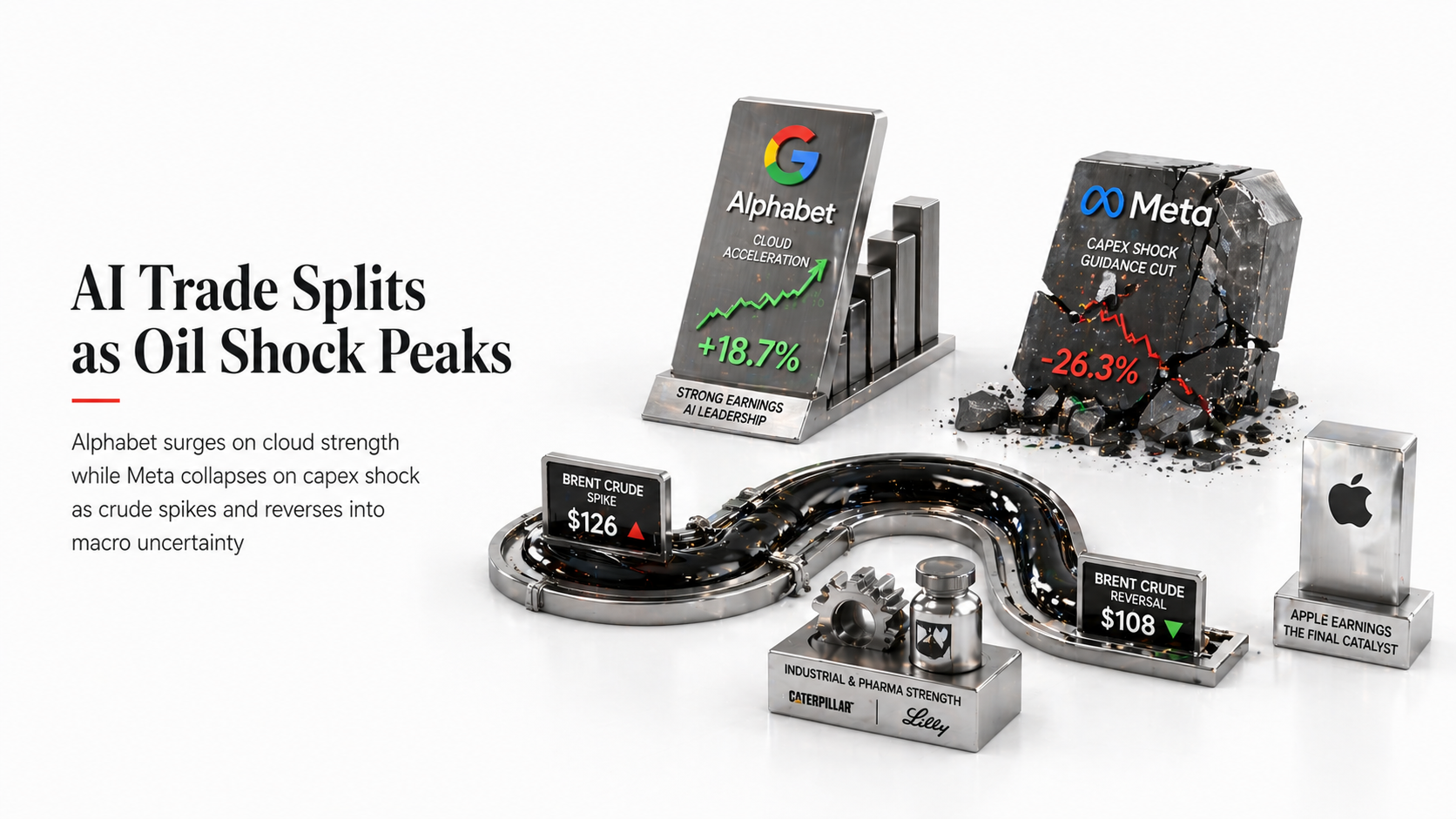
Thursday delivered the Mag-7 results the market had been waiting 48 hours for — and the verdict is deeply divided. Alphabet exploded higher on a 63% Google Cloud surge; Meta tumbled on a shocking capex upgrade to $125–$145 billion. Microsoft beat on earnings but disappointed on capex. Amazon delivered solid AWS growth. Meanwhile the Dow surged 1.5% led by Caterpillar (+10%) and Eli Lilly (+9%), powering a split-market session: old economy thrived while AI-heavy tech fractured. Brent crude spiked to a wartime high of $126 intraday on US military briefing reports before pulling back sharply to $108 as demand destruction fears emerged. GDP missed estimates at 2.0%; PCE inflation came in largely in line. April closes as the best month for US equities since 2020 — S&P +9%, Nasdaq +13%.
Thursday sealed the most consequential two-session window of H1 2026 with a verdict no analyst modelled cleanly: a market fracture along a new fault line — hardware-driven AI infrastructure versus software-driven AI capex risk. Alphabet’s 63% Google Cloud surge confirmed that hyperscaler AI spending is generating cloud revenue at scale; its stock jumped 9%. Meta’s $125–$145 billion capex guidance shock — up from a prior $115–$135 billion — triggered a 10% collapse as investors questioned whether the return on this AI infrastructure cycle can justify the capital destruction. Microsoft beat on EPS and revenue but disclosed $31.9 billion in Q1 capex, amplifying the same concern. Amazon’s AWS grew 28%, meeting expectations. Brent crude spiked to a wartime-era intraday high of $126 — the highest since 2022 — before pulling back to $108 as US military escalation reports were digested alongside IEA demand destruction warnings. GDP came in at 2.0% annualised (below the 2.2% consensus), core PCE rose 0.3% in line with estimates, and Apple now reports after the bell as the last major Mag-7 name of the season — with a CEO transition narrative as important as any financial metric.
Market Snapshot — Official Close · 16:00 EDT
| Asset | Close | Change | % Change | Signal | Context |
|---|---|---|---|---|---|
| S&P 500 (SPX) | 7,164 | +36 | +0.50% | ALL-TIME HIGH | S&P 500 hit an intraday all-time high Thursday. Month of April closes up ~9% — best performance since November 2020. The tariff panic bottom of early April has been fully erased. Industrials and healthcare led; tech fractured. |
| Dow Jones (DJI) | 49,612 | +750 | +1.53% | OLD ECONOMY SURGE | Biggest single-day gain of the week, led by Caterpillar (+10%), Eli Lilly (+9%), and Verizon (+2.2%). AI data center capex flowing through to industrial and power companies. Best month since November 2024 for the Dow. |
| Nasdaq Composite | 24,620 | +46 | +0.19% | AI CAPEX FRACTURE | Alphabet’s +9% surge partially offset Meta’s −10% and Microsoft’s −5% plunge. Nasdaq best month since April 2020 (+13% MTD) but intraday reversal from highs reflects tech sector’s internal capex debate far from resolved. |
| Russell 2000 (RUT) | 2,756 | +19 | +0.70% | RATE RELIEF RALLY | Small-caps caught a lift as 10-year yields declined 9 basis points. GDP missing estimates slightly reduces the urgency of a hawkish Warsh pivot. Russell 2000 +10% for April — best month since 2024. |
| CBOE VIX | 17.54 | −1.27 | −6.75% | DECLINING | VIX falls as the Mag-7 binary unwinds — Alphabet’s beat absorbed the worst of the bull-case uncertainty. Meta’s miss adds idiosyncratic risk rather than systemic fear. Apple earnings will temporarily re-compress VIX tonight. |
| WTI Crude Oil | $105.00 | −$1.84 | −1.72% | VOLATILE PULLBACK | WTI briefly touched $111 on Iran military briefing reports before reversing. Settled lower as IEA demand destruction warning hit — oil demand now expected to contract 80kb/d this year. Still structurally bullish on Hormuz supply shock. |
| Brent Crude | $108.80 | −$7.73 | −6.63% | SPIKE-REVERSAL | Intraday high of $126 — the highest since the 2022 Ukraine shock — followed by a 14% collapse to $108 at settlement. IEA demand destruction and profit-taking drove the reversal. Still elevated vs yesterday’s $116.53 close on an intraday basis. |
| Gold (XAU/USD) | $4,637 | +$114 | +2.52% | SAFE-HAVEN BID | Gold surges as dollar weakens and 10-year yields ease. Mag-7 capex uncertainty adds to safe-haven demand. The Warsh hawkish repricing is being offset by GDP miss — rate cut odds improved marginally, removing the prior headwind. |
| Bitcoin (BTC/USD) | ~$76,460 | −$293 | −0.38% | CONSOLIDATING | BTC slightly lower in a risk-off/risk-on session that ultimately provides no directional clarity for crypto. Warsh hawkish medium-term backdrop remains a headwind. Apple results and any surprise macro data could move BTC overnight. |
| 10Y Treasury Yield | 4.17% | −9 bps | −2.11% | GDP MISS RELIEF | 10-year yield falls sharply — the best single-session decline in weeks — after GDP missed estimates. The 4.40% danger zone that was 2 basis points away yesterday is now a full 23 basis points distant. Significant equity market relief. |
Oil & Geopolitics — Brent Spikes $126, Reverses to $108 on Demand Destruction
Intraday High: $126.00
The most violent intraday oil move of 2026: Brent surged from the $116 Wednesday settle to a $126 high — nearly $10 intraday — before losing all gains and settling at $108.80. The initial spike came after Axios reported that CENTCOM Admiral Brad Cooper briefed Trump on plans for a “short and intense” wave of airstrikes against Iranian nuclear sites. The reversal came as the IEA’s demand destruction data hit: global oil demand is now expected to contract 80,000 barrels per day in 2026, with the 2Q26 decline of 1.5mb/d the sharpest since Covid-19.
The structural supply picture remains unresolved: Hormuz exports are at just 4% of normal levels per Goldman Sachs. US crude exports have surged to record highs above 6mb/d as buyers reroute. Air France-KLM cut its capacity guidance citing rising jet fuel costs. The $126 ceiling now functions as a technical resistance level; the $104–$108 zone is the new support band where demand destruction meets supply disruption equilibrium pricing.
- $126 Intraday high — the new psychological ceiling; a close above would trigger a fresh wave of inflation panic
- $104 Support — demand destruction equilibrium; break would signal market pricing a deal resolution
- Trump-Iran talks via Pakistan envoys this weekend — if confirmed, expect $8–$12 gap lower in Brent at Monday open
The threat of direct US military action against Iran reached its most acute point yet Thursday. Axios reported that CENTCOM will brief Trump on a plan for a “short and intense” wave of strikes against Iranian nuclear facilities — a signal that the White House is seriously considering military escalation beyond the current naval blockade. Trump had earlier rejected Tehran’s compromise proposal to reopen Hormuz while deferring nuclear talks.
The counterweight: Pakistan’s foreign ministry signalled that a second round of US-Iran peace talks is expected, with Iranian Foreign Minister Abbas Araghchi reportedly travelling to Pakistan. CNN reported Trump may send two envoys to Pakistan this weekend. The market’s $17 intraday Brent reversal is pricing a non-trivial probability of a diplomatic breakthrough.
The demand destruction dynamic is now a structural force: IEA expects 1.5mb/d demand destruction in Q2 2026 — the deepest since Covid-19. At $126 oil, the destruction of demand becomes self-limiting to price — higher prices cure high prices, eventually.
- If Trump envoys meet Iran in Pakistan: Brent could gap $8–$15 lower Monday open — oil SHORT is the overnight weekend hedge
- If talks collapse: CENTCOM briefing suggests strikes could be imminent — Brent would re-test $120+
- IEA demand destruction creates a natural cap at $130 — above that level, demand collapses fast enough to self-correct
Earnings Scorecard — April 30 Sessions Winners & Losers
| Company | EPS Act. vs Est. | Revenue | Key Result | Stock Reaction |
|---|---|---|---|---|
Alphabet (GOOGL) Q1 2026 · Post-Wed Bell |
Beat est. ~$2.83 |
$109.9B vs $107.2B est. |
Google Cloud +63% to $20B (vs $18.05B est.). Search +19%. AI Overviews monetising. Pichai: “AI lighting up every part of business.” | +9% ▲ |
Meta Platforms (META) Q1 2026 · Post-Wed Bell |
$10.44 vs $6.66 est. (+57%) |
$56.3B +33% YoY |
Earnings massive beat. But 2026 capex raised to $125–$145B (from $115–$135B). Capex shock overshadowed EPS beat entirely. | −10% ▼ |
Microsoft (MSFT) FQ3 2026 · Post-Wed Bell |
$4.27 vs $4.04 est. |
$82.9B +18.3% YoY |
Azure growth on-target ~35%. AI business hit $37B annual run rate (+123% YoY). But $31.9B quarterly capex (up 89% YoY) raised margin concerns. | −5% ▼ |
Amazon (AMZN) Q1 2026 · Post-Wed Bell |
Beat vs $2.11 est. |
$181.5B +17% YoY |
AWS +28% to $37.6B (vs $36.79B est.). Net income nearly doubled to $30.3B. Retail margins pressured by oil logistics costs. Overall solid, in-line. | −2% ▼ |
Caterpillar (CAT) Q1 2026 |
Beat Strong EPS beat |
Beat Guidance raised |
Power generation revenue +48% on data center turbine demand. Tariff headwind reduced to $2.2–2.4B. Long-term sales growth target 6–9% p.a. through 2030. | +10% ▲ |
Eli Lilly (LLY) Q1 2026 |
$8.55 vs $6.85 est. (+25%) |
$19.80B +56% YoY |
Zepbound +80% YoY; Mounjaro +125%. Full-year sales outlook raised by $2B. GLP-1 market share growing vs Novo Nordisk. CEO expects 30M global patients by year-end. | +9% ▲ |
Qualcomm (QCOM) Q2 FY2026 |
$2.65 vs $2.56 est. |
Beat Strong data center |
“Leading hyperscaler custom silicon engagement on track for initial shipments later 2026.” Q3 guidance below consensus on memory supply constraints but data center momentum drives stock. | +16% ▲ |
Chipotle (CMG) Q1 2026 |
Beat | SSS +0.5% vs −0.7% est. |
Same-store sales beat significantly as core lower-income customers showed resilience. Reiterated no full-year SSS growth guidance — economic pressure acknowledged. Stock +3–4% after hours. | +4% ▲ |
Thursday’s earnings scorecard crystalises the session’s defining structural split: Companies directly in the path of AI capital expenditure flows — Caterpillar (power equipment), Qualcomm (custom silicon), and Alphabet (cloud revenue) — are generating extraordinary returns. These names confirm that the AI build-out is real, accelerating, and generating measurable economic activity. Companies that are funding that build-out — Meta and Microsoft — are facing an inverse calculus: the larger their capex commitment grows, the more investors discount their near-term free cash flow generation. The market is beginning to draw a distinction between AI infrastructure winners and AI infrastructure funders — a distinction that may define sector rotation for the rest of 2026.
Apple Q2 FY2026 — After-Bell Preview: Numbers & CEO Transition Narrative
Apple’s Q2 FY2026 result carries narrative weight that no purely financial analysis can capture. The consensus expects $1.92 EPS and $109.45 billion in revenue — a +16–17% year-on-year increase that would represent Apple’s fifth consecutive quarter of acceleration. JP Morgan models a bullish $112.7 billion in revenue and $2.05 EPS. Apple has beaten estimates in three consecutive quarters, and its Q1 2026 revenue of $143.8 billion was a record. The Services segment is expected to cross the $30 billion quarterly milestone for the first time — a milestone that, at 70%+ gross margins, would further tilt Apple’s mix toward its highest-quality revenue stream.
But the numbers are not the primary story tonight. Apple confirmed in early April that Tim Cook will transition from CEO to executive chairman effective September 1, 2026, with hardware engineering chief John Ternus taking the CEO role. Every sentence of the earnings call will be interpreted through this succession lens: what is Ternus’s strategic vision for AR, Apple Intelligence monetisation, and the iPhone 18 cycle? How does Cook frame his legacy? The market will be watching for any early indication that Ternus is a visionary hardware leader who can define Apple’s next decade the way Jobs defined the prior one.
The risk factor: Apple faces geopolitical headwinds in China — a market that represents approximately 20% of iPhone revenue. Any commentary on China demand softness, supply chain pressures from memory pricing inflation, or App Store regulatory headwinds could overshadow an otherwise strong quarter. The question of whether Apple Intelligence (Apple’s AI suite) is generating meaningful monetisation — or is still a feature story without a revenue line — will also surface prominently.
| Metric | Consensus Est. | JP Morgan Bull Case | Watch Point | Bull Signal | Bear Signal |
|---|---|---|---|---|---|
EPS (Adjusted) Q2 FY2026 |
$1.92 | $2.05 | Apple has beaten in 3 straight quarters. Historical beat rate is high — $1.92 likely the floor, not the target. | EPS > $2.00 with raised Q3 guidance | EPS miss + China revenue warning |
Revenue Q2 FY2026 |
$109.45B | $112.7B | +16% YoY growth. iPhone expected at 52% of revenue. Services milestone: $30B+ for first time. | Revenue > $112B; Services > $30B | Revenue misses $107B; iPhone China soft |
CEO Transition Cook → Ternus, Sep 1 |
Confirmed | Key narrative | John Ternus hardware-led vision vs Cook’s services-led era. iPhone 18, AR glasses, Apple Intelligence monetisation all under the succession lens. | Ternus articulates bold product roadmap; market re-rates on hardware innovation premium | Vague transition commentary; no new product category hints; market discounts leadership uncertainty |
- Scenario 1 — Beat + Raise + Ternus Vision (20% probability): Revenue > $112B, EPS > $2.00, Ternus delivers compelling product roadmap for iPhone 18 / AR. AAPL gaps +5–8%. Nasdaq adds 0.8–1.2% at Friday open.
- Scenario 2 — Beat + Neutral Transition Commentary (40% probability): Strong numbers, in-line guidance, Ternus transition acknowledged but no fireworks. AAPL +2–3%. Most likely outcome.
- Scenario 3 — In-Line Results + Weak China Signal (25% probability): Revenue meets estimates but iPhone China softness flagged. AAPL −2–3%. Focus shifts to whether China demand is a structural risk.
- Scenario 4 — Miss + Transition Uncertainty (15% probability): Revenue below $107B, EPS miss, vague Ternus commentary. AAPL −5–8%. Nasdaq under pressure Friday. Would test broader tech sentiment already strained by Meta’s capex shock.
Fixed Income & Macro — GDP Misses, Yields Fall, Warsh Premium Eases
The 10-year Treasury yield’s 9 basis point decline is the most important macro development of the session — and it fundamentally changes the equity market’s near-term risk calculus. Yesterday, the 10Y at 4.38% was just 2 basis points from the 4.40% level that triggered March’s equity correction. Today’s 4.17% settle puts 23 basis points of cushion between equities and that danger zone — a margin that materially reduces the probability of a rate-driven equity multiple compression event in the near term.
The GDP and PCE data provided the catalyst for the yield decline: Q1 GDP came in at 2.0% annualised (below the 2.2% consensus), signalling that the economy is absorbing the Iran energy shock but not immune to it. Core PCE rose 0.3% month-on-month, exactly as expected, while the annual headline PCE of 3.5% and core of 3.2% remain well above the Fed’s 2% target — but the in-line print removes the worst-case upside inflation surprise that Warsh hawks had been pricing. The Employment Cost Index rose 0.9% in Q1, slightly above the 0.8% consensus — a wage inflation signal that will keep Warsh’s team from cutting rates in June. The market is still pricing effectively zero rate cuts in 2026, but the GDP miss has pushed that expectation to the edge of one symbolic cut by year-end under extreme conditions.
Key Macro Events — April 30 Data & Looking to May
Sector & Stock Performance — Session Movers
Overnight Trade Setups — April 30–May 1, 2026
| # | Asset | Direction | Entry Zone | Stop | Target | R:R | Thesis |
|---|---|---|---|---|---|---|---|
| 1 | Alphabet (GOOGL) | LONG | $195–$202 | $185 | $220–$230 | 1:2.3 | Google Cloud +63% is the cleanest AI-revenue-to-capex proof point in the market. This is the hyperscaler to own as the AI capex ROI debate intensifies — Alphabet is already generating the returns others are still spending to build. |
| 2 | Gold (XAU/USD) | LONG | $4,620–$4,660 | $4,560 | $4,750–$4,800 | 1:2.1 | GDP miss reduces Warsh’s ability to tighten aggressively. Dollar weakening, yields falling. Apple miss tonight would send gold higher immediately. Oil diplomatic weekend risk also supports the safe-haven case for gold. |
| 3 | Brent Crude | SHORT | $110–$114 | $120 | $96–$100 | 1:2.0 | Weekend Pakistan talks conditional: if US-Iran envoys meet and any diplomatic framework is announced, Brent gaps $10–$15 lower at Monday open. IEA demand destruction is now a real structural force. Size small — headline risk extreme. |
| 4 | S&P 500 CFD | LONG | 7,140–7,170 | 7,090 | 7,260–7,310 | 1:2.0 | Conditional on Apple Scenario 1 or 2 (beat or in-line). 10Y at 4.17% removes the March correction risk catalyst. Caterpillar and Eli Lilly confirm old economy health. If Apple beats, this setup activates fully. Reduce to 40% size until AAPL results. |
| 5 | Meta (META) | SHORT | $580–$600 | $620 | $530–$540 | 1:1.9 | $145B upper-end capex guidance is a structural overhang. Free cash flow compression will weigh on the stock for multiple quarters. Analyst downgrades are likely Friday. Bounce from today’s −10% to $580–$600 provides a clean short entry with technical confluence. |
| 6 | Caterpillar (CAT) | LONG | Dips to $365–$380 | $350 | $410–$425 | 1:2.3 | Power generation +48%, raised long-term growth targets 6–9% p.a., reduced tariff headwinds. CAT is the purest expression of the AI data center construction capex theme — without any of the AI software ROI uncertainty that is weighing on Meta and Microsoft. Buy dips to VWAP. |
Closing Summary — Thursday, April 30, 2026
Thursday delivered the Magnificent Seven verdict that the market had been positioning for over 48 hours — and the outcome is neither the clean bull case nor the clean bear case, but something more structurally interesting: a market that has definitively separated AI infrastructure winners from AI infrastructure funders. Alphabet’s 63% Google Cloud growth is not just a quarterly beat — it is the first large-scale proof that the $650 billion hyperscaler capex cycle is generating proportional cloud revenue, not just consumption. That is the most important single data point for equity markets in Q1 2026. But Meta’s $145 billion upper-end capex guidance — eclipsing its own prior range, following an already massive EPS beat — has opened a new chapter in the AI investment debate: when does “building the future” become “overcapitalising against uncertain demand”? That question will define sector rotation for the rest of H1 2026.
The Brent crude situation reached its most dramatic expression yet Thursday: an intraday $126 spike — a wartime high — followed by a $17 reversal to $108 represents oil’s internal war between the Hormuz supply shock and IEA demand destruction. The Pakistan diplomatic channel offers the first credible off-ramp since the Strait closed. If that channel produces results over the weekend, Monday’s open could see the sharpest single-day oil price decline since the early days of the conflict. If it fails, CENTCOM’s military briefing to Trump signals that the next escalation is being actively planned. The weekend gap risk in oil is the highest since the conflict began — position sizing must reflect that binary.
April 2026 closes as the best month for US equities since 2020: S&P 500 +9%, Nasdaq +13%, Dow +6%, Russell +10%. The tariff panic bottom of early April has been fully erased — surpassed. The economy absorbed the Iran energy shock without breaking: GDP at 2.0%, core PCE in-line, consumer spending supported by Chipotle’s SSS beat and Visa’s earlier resilience. But the month-end celebration is immediately complicated by what comes next: Apple reports tonight in a result that will not just set the Nasdaq’s Friday direction, but will be interpreted as the final verdict on whether Big Tech’s AI-era consumer hardware franchise is generating the returns that justify a $4 trillion valuation through a CEO transition. Tonight’s AAPL call — especially John Ternus’s first public appearance as CEO-designate — is the most consequential earnings conference call of Q2, not because of the numbers (which are likely strong), but because of what it signals about the next decade of Apple’s strategic direction. The Caterpillar and Eli Lilly results today confirm the most durable theme of the entire earnings season: the companies that build the infrastructure, deliver the energy solutions, and treat the human consequences of this technological and geopolitical upheaval are the market’s most reliable performers — regardless of where the AI software debate lands.