Iran Deal Watch, RBA Hike & Yen on the Edge | Technical Analysis – Asia Session | 20 May 2026
Iran Deal Watch, RBA Hike
& Yen on the Edge
Nikkei 60,210 · ASX 200 8,604 · Hang Seng 25,797 · CSI 300 4,951
Gold $4,472 · WTI $107.20 · BTC $76,200 · JGB 10Y 2.545%
Full Trade Ideas · Technical Charts · Economic Calendar · Central Bank Watch · FAQ
Wednesday’s Asian session is defined by three intersecting forces. First, the Iran diplomatic clock is ticking: Pakistani mediators and both Washington and Tehran have signalled proximity to a one-page framework agreement that would end hostilities and reopen the Strait of Hormuz. Markets are treating each headline as a binary catalyst — a signed deal would trigger a sharp selloff in oil, a re-rating of gold lower, and a USD rebound as inflation fears ease. Failure would send WTI back above $110 and reignite risk-off across Asia-Pacific.
Second, the RBA confirmed its hawkish stance. May meeting minutes released this week showed eight of nine board members backed the hike to 4.35% — the third consecutive increase — framing it as insurance against Iran war-driven inflation. AUD/USD has pulled back from cycle highs as the USD broadly recovered in Tuesday’s session, but the rate-differential story remains AUD-supportive on dips. The ASX 200 is outperforming regional peers, rising over 1% as energy-sector resilience offsets the broader risk-off tone.
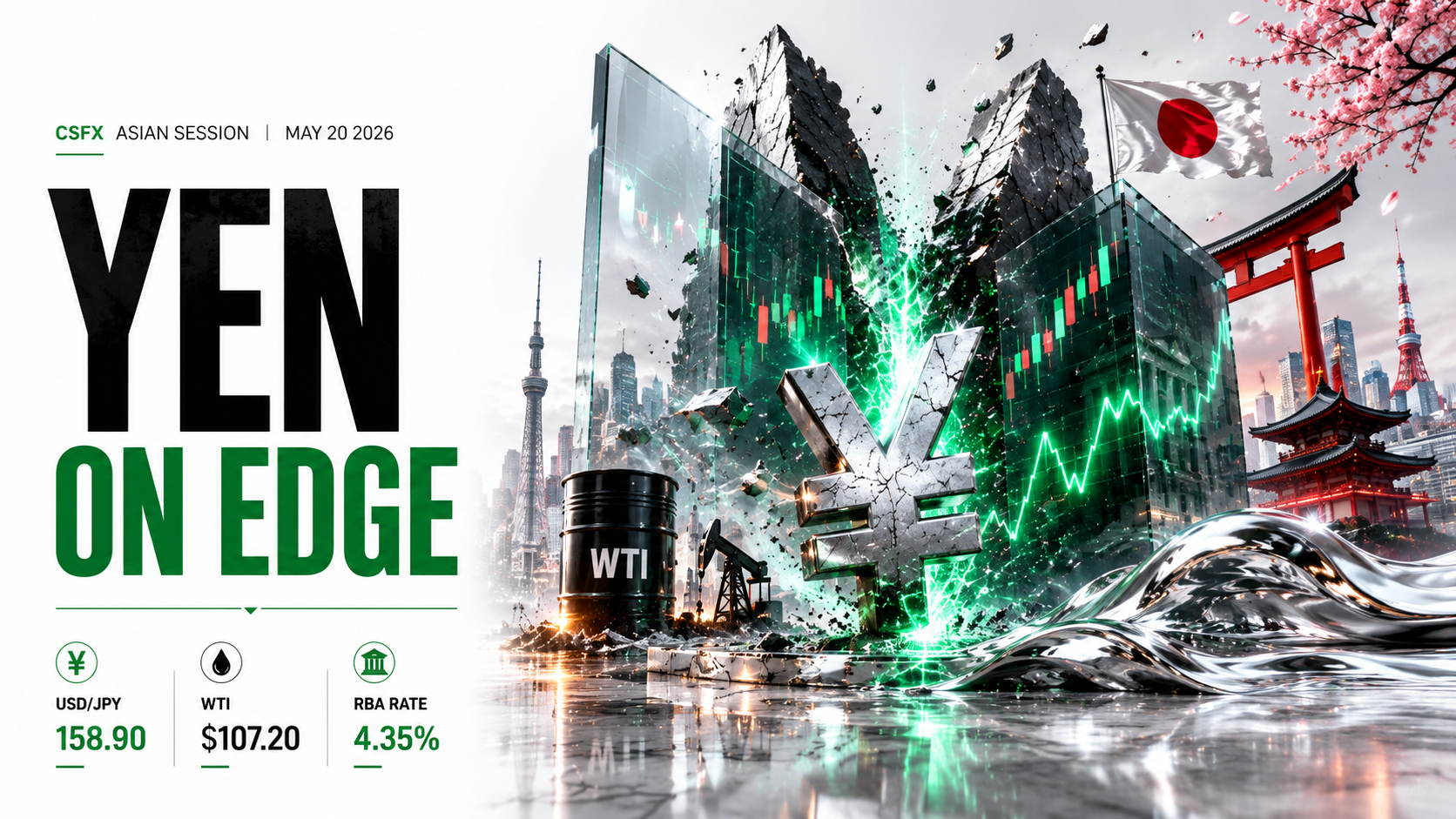
Third, USD/JPY is testing intervention patience. The pair pushed to 158.90 overnight — within sight of the 160 level that Japan’s Ministry of Finance has identified as its line in the sand. Japan Q1 GDP printed 2.1% annualised, beating estimates of 1.7%, but the Nikkei has failed to hold gains for a fourth straight session as technology heavyweights track US chip stocks lower. JGB 10-year yields hit 2.545% — a 27-year high — reflecting BOJ tightening bets that are building despite the central bank’s gradualist rhetoric.
Live Prices — 20 May 2026, Asian Hours
Key Asian session instruments as of the morning session window (00:00–09:00 GMT / Tokyo open)
⚡ Session Alert — USD/JPY Watch: USD/JPY tested 158.90 overnight. Japan’s MoF has verbally flagged 160 as an intervention threshold. Any push through 159.50 should be treated with extreme caution — intervention risk is elevated. Reduce position size on JPY shorts near 159.
Five Stories Driving Asian Markets
Geopolitics, central banks, and energy markets in focus on 20 May 2026
USD/JPY · AUD/USD · NZD/USD — Trade Ideas
The three dominant pairs of the Tokyo session — all at critical technical and fundamental junctions today
Technical Analysis
USD/JPY has been in a relentless uptrend driven by the Fed–BOJ policy divergence and the Iran war energy shock, which increases Japan’s import costs and widens the current account deficit. The pair hit a two-year high of 160.72 last week before Japan’s MoF intervened. It has since pulled back and is now re-approaching those levels at 158.90. RSI on the 4H chart is at 65 — elevated but not yet overbought. The key level is 159.50: a sustained break here with daily close above 160.00 would likely trigger another MoF intervention round. The structural trend is bullish — but the intervention ceiling creates a asymmetric risk/reward profile that favours fading rips near 159–160.
Fundamental Context
Japan’s Ministry of Finance has signalled it will intervene to shield the yen from disorderly moves. The BOJ faces an impossible trilemma: rising inflation (energy-driven), weak yen, and fragile growth. With 10-year JGB yields at a 27-year high of 2.545%, bond market dysfunction is becoming a serious concern. Some BOJ board members have reportedly called for more rapid rate normalisation. The Iran war energy shock is the dominant macro driver: Japan imports nearly 90% of its energy needs, making JPY uniquely sensitive to Hormuz closure. A peace deal closing the strait would be the single most bullish catalyst for JPY — potentially sending USD/JPY back to the 152–154 range in a single session. Use leverage very carefully around the 160 threshold.

Technical Analysis
AUD/USD has pulled back from cycle highs near 0.7200 as the USD broadly recovered during the Asian session. The daily structure remains bullish: the pair has printed higher highs and higher lows since late March. The 20-day EMA at 0.7080 and the prior breakout zone at 0.7060 are the first key support regions — a pullback to these levels offers a favourable long entry. RSI at 52 is neutral with room to push higher. A close below 0.7040 on a daily basis would shift the structure neutral and warrant reassessment.
Fundamental Context
The RBA is the most hawkish developed market central bank in the current cycle. Three consecutive hikes to 4.35% — with August still live — provides meaningful interest rate support for the Australian dollar. RBA Assistant Governor Hunter specifically cited inflation expectations as a risk that the board “cannot ignore,” supporting further tightening into Q3 if data warrants. Australia’s commodity exports (iron ore to China, LNG to Asia) benefit from China’s improving demand signals — today’s stronger CSI 300 (+0.92%) and the PBOC’s firmer yuan setting are both positive spillovers for AUD. PM Albanese’s jet fuel deal with China reflects the pragmatic trade relationship that underpins Australia’s economic resilience. The key risk is a USD surge on Iran deal disappointment — leverage should be sized accordingly.

Technical & Fundamental
NZD/USD is underperforming AUD/USD today — the NZD/AUD cross is therefore softening, reflecting the RBA’s more aggressive tightening path versus the RBNZ. New Zealand data released earlier this week showed inflation pressures building through producer prices, while retail sales dipped. This stagflation-lite profile is less supportive than Australia’s cleaner growth + inflation dynamic. The 0.6155 area (100-day SMA zone) is the key buy-on-dips level with a tight stop below 0.6105. The Iran deal is a risk for NZD too — reduced global inflation pressure would reduce hawkish rate expectations, which is NZD-negative from a carry perspective. The pair is a second-tier trade today compared to AUD/USD or USD/JPY.

Nikkei 225 · ASX 200 · Hang Seng — Trade Ideas
Three distinct sector stories across Asia-Pacific’s major benchmarks
Technical Analysis
The Nikkei 225 has now declined for four consecutive sessions from its recent highs. The index is trading below both the 20-day and 50-day SMAs, and the daily RSI has crossed below 45 — into mild bearish territory. The 59,500 area is the next key support (prior consolidation zone from March); a break below here targets 58,200. The bearish structure is reinforced by a rising JGB yield environment — as 10-year JGB yields hit 27-year highs at 2.545%, the discount rate for Japanese equities rises, compressing price-to-earnings multiples on the growth end of the market. Any bounce toward 60,800–61,000 offers a short entry opportunity.
Fundamental Context
Three bearish drivers are converging on Japanese equities. First, technology heavyweights (Softbank, Tokyo Electron) are tracking overnight weakness in US chip stocks, which fell on semiconductor export restriction concerns. Second, the JGB yield shock is a genuine structural headwind — as bond yields rise, the Bank of Japan’s yield curve control framework comes under pressure, and equity risk premia must adjust upward. Third, Japan’s energy import burden (90% of energy is imported) means elevated WTI above $100/bbl is a persistent drag on corporate margins, especially for energy-intensive manufacturers. The GDP beat of 2.1% in Q1 is backward-looking — Q2 data will show the full Iran war energy shock impact. Nintendo’s Switch 2 price hike announcement, which saw its shares fall 8%+, was an additional index drag. The Nikkei’s broad Topix index managed a 0.37% gain, showing some resilience in cyclicals and value names, but the large-cap, tech-heavy Nikkei 225 remains under pressure.

Technical Analysis
The ASX 200 is the clear outperformer in the Asian session today, rising 1.17% — a recovery from Monday’s sharp 1.45% decline driven by Trump’s Iran threats. Technically, the index has bounced from the 8,480 region (50-day SMA) and is reclaiming ground. The daily structure remains in a broad range of 8,480–8,900. RSI at 55 is constructive. A sustained move above 8,700 on a daily close would suggest momentum is resuming toward the 8,900 all-time high resistance. The risk to the long thesis is an Iran deal signing — while bullish for equities generally, it would remove the energy-sector tailwind that has been a key ASX support pillar.
Fundamental Context
The ASX 200 benefits from the same RBA hawkishness that supports AUD/USD — higher rates attract international capital into Australian assets and reflect underlying economic resilience. The energy sector (Woodside, Santos) is buoyant with oil above $100/bbl. Financial stocks (CBA, Westpac) benefit from the rate-hiking cycle as net interest margins improve. China demand recovery — evident in today’s CSI 300 +0.92% and the stronger PBOC yuan fixing — provides a tailwind for Australian iron ore and LNG exporters. PM Albanese’s jet fuel deal with China is a micro-signal of the bilateral trade relationship’s durability. Watch the commodities space carefully — oil volatility driven by Iran headlines will be the primary intraday driver for ASX energy stocks today.

Technical & Fundamental
The Hang Seng is holding gains of 0.48%, supported by the PBOC’s stronger-than-expected yuan midpoint fixing at 6.8375 — the firmest since March 2023. This policy signal reduces CNH depreciation fears and supports Hong Kong-listed Chinese equities. China’s CPI and PPI rose more than expected in April (driven by commodity cost pressures from the Middle East conflict), which paradoxically supports equities here because it reinforces the reflation narrative for Chinese companies. The CSI 300’s +0.92% is a stronger signal than the Hang Seng today. Key risk: Taiwan tensions remain a structural overhang — Xi warned Trump at the summit that Taiwan mishandling could trigger conflict, and any escalation in that narrative would hit Hong Kong markets hard given proximity risk pricing. Buy pullbacks to 25,400 on the Iran deal scenario; reduce exposure if Taiwan headlines worsen.

Gold & WTI — The Iran Peace Deal Pivot Point
Technical Analysis
Gold is in a bearish near-term phase after falling nearly 4% last week. The 4-hour RSI remains in oversold territory, which explains the current move at $4,472, but the negative MACD histogram — with red bars contracting — signals slowing downside momentum rather than a clear reversal. The $4,500 support (May 4 and May 18 lows) has now been breached, opening the path toward $4,280 (next swing target). The first meaningful resistance on any bounce is $4,500 (now resistance), with the next at $4,560. The broader bull case (central bank buying, de-dollarisation demand) remains structurally intact — this is a tactical short within a bigger bull market.
Fundamental Context
Two forces are weighing on gold simultaneously. First, the global bond rout has pushed US 10-year Treasury yields to one-year highs at 4.60% — rising real rates are gold’s traditional Achilles heel as the non-yielding metal becomes relatively less attractive. Second, Iran deal optimism is unwinding the war-risk premium that drove gold’s peak above $4,700 earlier this month. As FX Street noted, Peter Grant of Zaner Metals pointed out that “optimism about a final deal has caused short-term relief in gold, with lower oil prices and moderated inflation concerns.” The medium-term structural bull case — central bank buying running at 860+ tonnes per year — remains a powerful structural floor for any sustained decline. India’s fuel price hike (the second in under a week) reflects ongoing Asian energy cost pressure that may limit how far gold falls even on deal optimism.

Technical Analysis
WTI Crude surged from pre-war levels of ~$73.50 (February 27) to a peak of ~$120 in early March as the Strait of Hormuz closure strangled global supply. It has since retraced to $107.20 as ceasefire hopes have ebbed and flowed. Technically, WTI is in a compression range of $95–$112. The Iran deal is the primary directional catalyst: a signed framework agreement would likely send WTI toward $85–90 in short order (pre-conflict normalisation pricing), while deal breakdown and escalation would target $115–120 again. The EIA projects Brent at $115 in Q2 2026 and $90 by Q4 if a deal is struck. Position sizing around oil should be reduced compared to normal given the binary headline risk — this is a news-driven market, not a technical one today.
Fundamental Context
The Strait of Hormuz carries approximately 20% of global oil shipments daily. Iran’s launch of a Bitcoin-backed ship insurance scheme for Hormuz transit (a novel geopolitical move flagged this week) suggests Tehran is adapting to the blockade rather than seeking a quick resolution — mixed signal for deal optimism. Trump’s comments that there is a “good chance” of a nuclear deal, combined with his assertion that the US has effectively “won” the war, have eroded market credibility with the diplomatic signals. India’s state-run refiners raised fuel prices for the second time in less than a week — a tangible sign of how Middle East supply disruption is feeding through Asian domestic energy markets. Oil bulls need to consider that even with a deal, the Hormuz shipping lane takes weeks to normalise, so any immediate price collapse would likely be followed by partial re-pricing as logistics reality sets in.

Bitcoin & Ethereum — Consolidation After Sell-the-News
Technical & Fundamental
Bitcoin has gained approximately 10% since the Iran war started in late February 2026, functioning partly as an alternative hedge during periods of geopolitical and financial uncertainty. South Korean investors — traditionally a leading indicator for Asian crypto demand — are currently rotating back toward their domestic equity market as the Kospi hits record highs, reducing one source of BTC demand pressure. Bitcoin is currently at $76,200 with bears probing the $75,000 psychological support level. A sustained hold above $75,000 keeps the bullish structure intact and targets $80,000. Iran’s launch of a Bitcoin-backed ship insurance scheme for Strait of Hormuz transit is an extraordinary fundamental development — it represents the first sovereign-level use of Bitcoin for sanctioned shipping logistics, a long-term positive for crypto adoption. Short-term, the $75K level is the battleground.

Key Events — 20 May 2026 (GMT)
Scheduled releases during the Tokyo/Sydney session window and into the European open
| Time GMT | Flag | Event | Impact | Prior | Forecast | Actual |
|---|---|---|---|---|---|---|
| 00:30 | 🇯🇵Japan | Balance of Trade (Apr) | High | ¥−1.21T | ¥−1.35T | Pending |
| 01:30 | 🇦🇺Australia | RBA Minutes (May Meeting) | High | — | Hawkish | 8-of-9 Voted Hike ✔ |
| 01:30 | 🇦🇺Australia | Westpac Consumer Confidence (May) | Medium | 80.1 | 80.5 | 83.0 ✔ +3.5% m/m |
| 02:00 | 🇨🇳China | PBOC Loan Prime Rate (May) | High | 3.10% | 3.10% Hold | Pending |
| 03:00 | 🇯🇵Japan | Machine Tool Orders (May, prelim) | Low | +8.2% y/y | +6.5% y/y | Pending |
| 05:30 | 🇸🇬Singapore | Non-Oil Domestic Exports (Apr) | Medium | +3.4% y/y | +2.8% y/y | Pending |
| 06:00 | 🇳🇿New Zealand | Producer Price Index (Q1) | Medium | +1.2% q/q | +1.5% q/q | +1.8% q/q ✘ (inflationary) |
| 07:00 | 🇺🇸US (EU open) | Fed Speak: Musalem, Bostic | High | — | Hawkish lean | London overlap |
| 08:00 | 🇩🇪Germany | Producer Price Index (Apr) | Medium | +0.2% m/m | +0.4% m/m | EU Session |
⚡ Key Calendar Watch: The PBOC Loan Prime Rate decision (02:00 GMT) and Japan Trade Balance (00:30 GMT) are the two most market-moving prints of the Asian session today. A PBOC cut would be CNH-negative and ASX/commodity positive; a hold (expected) is neutral. The Japan trade deficit is expected to widen sharply as the Hormuz closure inflates energy import costs — a wider-than-expected deficit would be JPY-bearish and push USD/JPY closer to 160.
BOJ · RBA · PBOC · RBNZ — Policy Matrix
Bank of Japan (BOJ) — Cautious Tightener Under Pressure
The BOJ is in an impossible position. Inflation is rising (energy-driven), the yen is weakening (JPY-negative for imports), and 10-year JGB yields have hit a 27-year high at 2.545% as markets price faster normalisation. Some board members have publicly called for more rapid rate hikes. Governor Ueda continues to signal “gradual and cautious” tightening — a formulation that is increasingly being tested by the market. The MoF’s FX intervention readiness (confirmed this week) operates alongside the BOJ but is a separate instrument. The key question: if JGB yields continue to rise and threaten bond market dysfunction, the BOJ may be forced to conduct emergency yield curve control purchases — which would be JPY-negative and confuse the intervention narrative. Watch the 2.60% JGB yield level as the next critical threshold.
Reserve Bank of Australia (RBA) — Most Hawkish in the G10
The RBA is now the most aggressive tightener in the G10, having hiked three consecutive times to 4.35%. The May minutes confirmed the hawkish consensus: eight of nine members backed the move, framing it as an insurance policy against Iran war-driven inflation expectations becoming unanchored. Assistant Governor Hunter’s explicit statement that drifting inflation expectations is an “elevated risk” the board “cannot ignore” removes any dovish interpretation. June is signalled as a likely pause — but August remains live. The AUD/USD bullish case is built on this rate differential: the RBA is hiking while many other G10 central banks are holding or cutting. The key risk is a sharp drop in commodity prices from an Iran deal — which would reduce Australian terms of trade and potentially ease RBA hawkishness.
People’s Bank of China (PBOC) — Managed Stability
The PBOC is pursuing a strategy of managed yuan strength. Today’s USD/CNY midpoint at 6.8375 — the strongest since March 2023 — is a deliberate policy signal. China is navigating higher domestic commodity costs (CPI and PPI beat expectations in April due to Middle East-driven energy costs) while trying to avoid a USD/CNH depreciation that would amplify import inflation. A PBOC rate cut today (if it surprises consensus) would risk CNH weakening against the PBOC’s preferred trajectory. The PBOC is likely to hold at 3.10% and use reserve requirements and open market operations for fine-tuning.
Reserve Bank of New Zealand (RBNZ) — Inflation Risk Building
New Zealand’s Q1 PPI came in at +1.8% q/q — above the 1.5% consensus — reinforcing that inflation pressures are building even as retail sales dipped. This stagflation-lite dynamic is the RBNZ’s challenge. The market now prices less easing from the RBNZ than was priced two months ago. NZD/USD is supported by these repriced rate expectations, but the cross rate AUD/NZD is drifting higher as the RBA is seen as the more committed hiker. Watch RBNZ Governor Orr’s next communication closely.
Traders’ Questions — 20 May 2026
Asian Session Verdict — 20 May 2026
Today’s Asian session is built around two binary outcomes that markets cannot price simultaneously: an Iran peace deal that collapses oil and gold while lifting equities and JPY, or deal breakdown that sends WTI back to $115 and forces risk-off across all Asian assets. The honest answer is that nobody knows which way the Pakistan mediation goes — and any trader who says otherwise is not trading, they are gambling.
What we know with greater confidence: the RBA is the G10’s most hawkish central bank, providing structural support for AUD/USD on dips. USD/JPY is dangerously close to MoF intervention territory — the 159–160 zone is a trap for USD bulls unless they have wide stops. The Nikkei will continue underperforming as long as JGB yields rise, US tech sells off, and Japan’s energy import costs remain elevated. Gold’s near-term bias is bearish on bond yield headwinds and Iran deal optimism — but the structural bull case is real and limits the downside.
The commodity complex, Asian FX pairs, and regional indices are all driven by one overriding factor today: Iran headlines. Reduce position sizes, keep stops wider than normal, and treat the session as a news-driven environment where technical levels can be blown through in minutes.
Open Your Account — Trade the Asian Session