
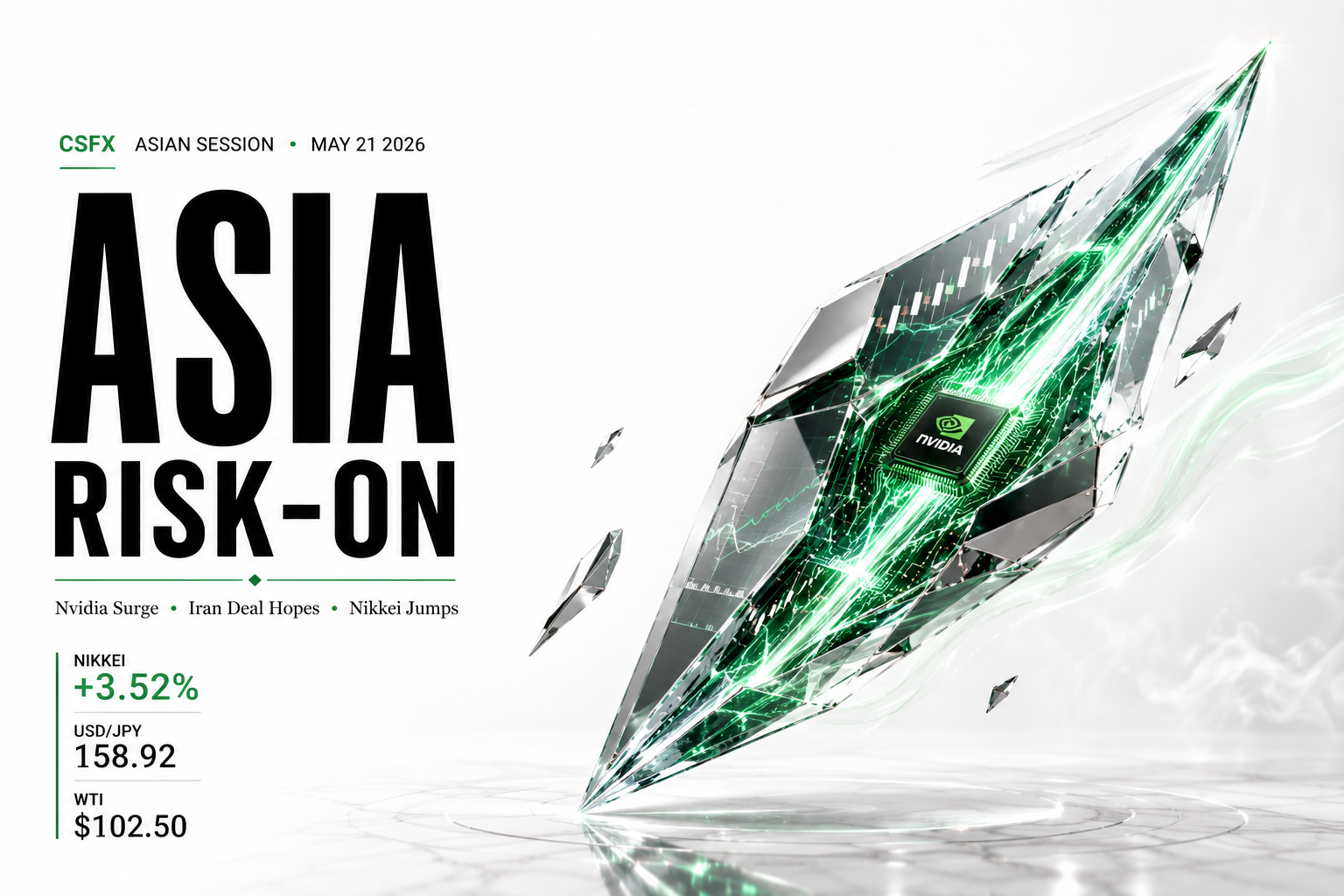
Iran Peace Talks, Nvidia Surge & Asian Equity | Technical Analysis – Asian Session | Capital Street FX Daily Brief · 20 May 2026
Iran Peace Talks, Nvidia Surge
& Asian Equity Rally
Gold $4,535 · Silver $75.40 · Natural Gas $3.11 · WTI $102.50
Full Trade Ideas · Technical Charts · Asian Economic Calendar · Macro FAQ
Asia surges on the double catalyst of Nvidia’s blockbuster earnings and reports that the US-Iran peace deal is in its “final stages” — but hawkish FOMC minutes and a spiking US 10-year yield keep gold under pressure and the yen caught between two competing forces.
The Asian session on Thursday, 21 May 2026 opened to extraordinary momentum. Nvidia’s earnings overnight — revenues of $44.1 billion, crushing estimates — triggered a tech-led rally across the Asia-Pacific that saw SoftBank Group surge nearly 20%, South Korea’s semiconductor giants Samsung (+6%) and SK Hynix (+11%) rocket higher on AI momentum, and the Nikkei 225 log its best single-day gain in months at +3.52%. The Kospi put in an extraordinary 7.68% advance.
Overlaid on the tech euphoria is a significant geopolitical development: reports from multiple senior officials suggesting the US-Iran deal is in its “final stages.” President Trump stated the war would end “very quickly,” with Vice President Vance highlighting tangible progress in Tehran talks. Three US LNG vessels are anticipated to arrive in China in June — the first such shipments since February 2025 — signalling de-escalation is being priced into energy supply chains. This lifted silver, eased some energy risk premium, and broadly boosted risk sentiment across the region.
However, the session is not without headwinds. The FOMC minutes released Wednesday confirmed a majority of Fed policymakers believe additional rate hikes may be necessary if inflation stays above 2%. US 10-year Treasury yields climbed to 4.62%, the highest in weeks. This twin pressure — rising yields reinforcing a structurally stronger USD — is the dominant drag on gold and keeps the yen under pressure despite Iran deal optimism. Japan’s trade data showed April exports rose 14.8% YoY — the fastest since January — fuelled by semiconductor shipments; but the yen remains weak near ¥159 as the Bank of Japan’s cautious stance contrasts with Fed hawkishness.
Asia-Pacific Dashboard
Live prices as of the Asian session open — 21 May 2026 (IST 05:30–11:30)
Section 1 · Breaking News
The Four Drivers of Today’s Asian Session
Nvidia earnings, Iran de-escalation, FOMC hawkishness, and Japan trade data are the four forces shaping every trade idea below
Section 2 · FX Trade Setups
USD/JPY & AUD/USD — Asian Session Ideas
The two premier Asian session FX pairs — both caught between competing macro currents today
Technical Analysis
USD/JPY is trading on the back foot below 159.00 in Thursday’s Asian session, unable to sustain yesterday’s push toward a nearly three-week top. The daily structure shows the pair trapped in a compression range between 157.50 (strong horizontal support, 20-day EMA confluence) and 159.50 (weekly resistance). RSI on the 4H chart is at 53 — neutral. The candlestick pattern shows a series of indecision wicks at 159.00, consistent with trapped longs. A clear break below 158.00 would open the move toward 157.50 on a 4H close basis. Conversely, a daily close above 159.50 opens 160.50 and the 161.80 52-week high.
Fundamental Context
Two powerful macro forces are fighting for USD/JPY direction. Bullish USD: the FOMC minutes confirmed a majority of Fed policymakers see further rate hikes as warranted, with markets pricing ~50% odds of a December hike. US 10Y yields at 4.62% provide structural upward pressure on the pair. Bullish JPY (bearish pair): Iran peace deal optimism is weakening the USD’s safe-haven demand while Japanese authorities have signalled readiness to intervene in currency markets if the yen weakens further. Japan’s trade surplus data — exports +14.8% YoY — reinforces the fundamentals supporting yen strength. The result is a deadlocked range that requires a clear catalyst (US PMI data or confirmed Iran deal) to break out. Manage leverage carefully in this environment.

Technical Analysis
AUD/USD has recovered from the session low of 0.6980 and is building a bullish structure above the key 0.7090 support zone. The pair is now attempting to establish a higher low pattern above the 20-day EMA. RSI on the daily is at 49 — recovering from oversold territory. The 0.7200 round number is the immediate resistance; a clean break with conviction targets 0.7250 and the swing high cluster near 0.7280. The structural downside risk requires a break below 0.7040 on a daily close — which would open a re-test of the 2026 low near 0.6980. Today’s risk-on environment from Nvidia and Iran optimism favours the bullish case.
Fundamental Context
The AUD is uniquely positioned as a risk-on, commodity-linked, China-dependent currency. All three of those drivers are providing tailwinds in today’s session: global risk appetite is surging on Nvidia AI momentum, iron ore and LNG export prospects to China are improving as Iran trade normalisation opens Pacific shipping lanes, and the RBA’s hawkish hold at 4.10% provides rate support. UBS raised their year-end AUD/USD target to 0.74 this week, citing improved terms of trade. The headwind is the strengthening USD from rising US yields and FOMC hawkishness — but in a risk-on day, the AUD’s beta to equities tends to dominate. Watch US PMI data today for the next directional catalyst on AUD/USD.

Section 3 · Commodities
Gold · Silver · Natural Gas — Asian Session Commodity Playbook
Three commodities, three distinct stories — all shaped by the same three macro forces: the Fed, Iran, and the weather
Technical Analysis
Gold is struggling to capitalise on the previous day’s goodish rebound from near the $4,450 level — the lowest price since March 30. The daily RSI is at 41, in mildly oversold territory but not at an extreme. The 50-day SMA at approximately $4,620 is now acting as resistance rather than support — a bearish structural shift. A close back above $4,620 would neutralise the bearish bias. The downside scenario targets $4,441 (the March 30 low) and then $4,380 — the lower bound of the May forecasted range. The rebound from yesterday’s low needs a daily close above $4,580 to be taken seriously. Watch for a potential rebound near $4,441 on any confirmed Iran deal positive headline.
Fundamental Context
Three forces are working against gold in today’s Asian session. First, the FOMC minutes reinforced rate-hike expectations — hawkish monetary policy strengthens the USD and increases the opportunity cost of holding non-yielding gold. Second, Iran peace deal optimism is reducing the geopolitical risk premium that has kept gold elevated despite rising yields. Third, US military briefings to Trump on potential Iran operations create uncertainty — a potential wildcard that could re-ignite safe-haven demand rapidly. The structural bull case (central bank buying at 860+ tonnes/year, dedollarisation) remains intact for the medium term, but the near-term setup is bearish. May forecasts put gold in the $4,380–$5,100 range; we are currently at the lower third of that band.

Technical Analysis
Silver climbed above $76 on Wednesday before moderating to $75.40 in early Asian trade. The daily chart shows a bullish impulse off the $69–$70 support base, with prices now in a defined range between $72.50 (strong horizontal support) and $79.00 (prior swing high and resistance cluster). RSI is at 55 — bullish territory with room to extend. Silver’s dual identity as both a precious metal safe haven and an industrial metal (solar panels, electronics, EV components, and AI server infrastructure) makes it uniquely positioned to benefit from both an Iran deal (reduced inflation risk) and the AI capex supercycle that Nvidia’s results are validating. A sustained break above $76 opens a move toward $79.
Fundamental Context
The key silver narrative in May 2026 is Iran de-escalation. A peace deal ending the Strait of Hormuz disruption would significantly ease the oil-driven inflation that has pushed the Fed toward rate hikes — and rate hike pressure is the single largest headwind for precious metals. Markets currently price a ~50% chance of a December Fed hike; that probability falling sharply on a deal would be bullish for both silver and gold. Additionally, silver has an industrial demand tailwind from AI infrastructure buildout (AI servers require extensive copper and silver cabling) which is now being validated in real earnings by Nvidia. The 126% year-over-year gain demonstrates the structural shift in silver’s demand profile. Use leverage prudently given silver’s historically high volatility.

Technical Analysis
Natural gas futures are trading at a seven-week high above $3.10/MMBtu. The daily chart shows a clean breakout from the $2.75–$3.05 consolidation range that has held since early April. Volume on the breakout is constructive. The RSI is at 62 — bullish with moderate room to run. Key resistance is at $3.30 (50% retracement of the 2026 decline) and $3.45 (prior swing high). Support at $3.00 is now the line in the sand — a break below on a daily close would signal a false breakout and target a return to $2.88. The 15.23% one-month gain is significant; momentum oscillators suggest some near-term consolidation is possible before the next leg higher.
Fundamental Context
Natural gas is being driven by three simultaneous forces. Demand side: sustained above-average heat forecasts across the southern and eastern United States through mid-June are boosting power sector consumption for air conditioning. Supply side: producers including EQT have curtailed output in response to persistently weak spot prices earlier in the year, with daily production falling to a 15-week low. Export side: LNG flows dipped from April’s record 18.8 bcfd to ~17 bcfd in May due to seasonal maintenance at Golden Pass and Freeport — a limiting factor for upside. The longer-term catalyst is the anticipated resumption of US LNG shipments to China in June, the first since February 2025, which would open a structurally bullish demand channel into Asia’s largest LNG import market. Iran deal materialising would further reduce Middle East energy supply risk, providing context for why gas prices are at multi-week highs even as the Hormuz situation eases.

Section 4 · Asian Indices Trade Ideas
Nikkei 225 · Hang Seng — Index Playbook
Two distinct stories: Japan’s AI-driven tech surge and Hong Kong’s China policy pivot sensitivity
Technical Analysis
The Nikkei 225 has broken decisively above the 62,000 resistance zone that had capped the index for three sessions, printing a large bullish engulfing candle on today’s open. The daily RSI has jumped from 52 to 68 — approaching overbought territory but not yet at an extreme. Volume is exceptionally elevated, consistent with a momentum-driven breakout rather than a low-conviction spike. The immediate structure targets 64,500 (the pre-correction high from late April), with the all-time high area near 65,180 as the ultimate bull target. On the downside, the 62,000 breakout level now becomes key support — a 4H close back below would signal a failed breakout and warrant exiting longs. The 50-day SMA sits at approximately 61,400, providing a secondary floor. Buy intraday pullbacks toward 62,200 for an asymmetric risk-reward entry.
Fundamental Context
Three simultaneous catalysts are driving the Nikkei’s extraordinary performance today. First, Nvidia’s earnings validated the global AI capex supercycle — and the Nikkei is uniquely exposed to this theme via SoftBank Group (Vision Fund AI investments), Tokyo Electron (chipmaking equipment), Ibiden (semiconductor substrates), and Sumco Corp (silicon wafers). Second, Japan’s April trade data showed exports rising 14.8% YoY, driven by semiconductor and AI hardware shipments — a direct confirmation that Japan is a net beneficiary of the AI infrastructure buildout. Third, Iran peace deal optimism has boosted global risk sentiment broadly. The yen’s persistent weakness near ¥159 is a structural tailwind for Nikkei exporters — a weaker yen makes Japanese goods cheaper globally and inflates overseas earnings when repatriated. The Bank of Japan’s cautious policy stance means this yen dynamic is unlikely to reverse sharply near-term. Access index CFDs with tight spreads at Capital Street FX.

Technical Analysis
The Hang Seng Index is advancing more cautiously than Japan or Korea, reflecting the more complex China macro backdrop. The daily chart shows the index consolidating in a defined range between 23,200 (strong support, 50-day SMA confluence) and 25,200 (resistance at the prior swing high from early April). The current level of 25,660 sits near the mid-range. RSI is at 54 — neutral to mildly bullish. The candlestick structure over the past week shows a series of higher lows building from the 23,200 base — a constructive accumulation pattern. A sustained break above 24,800 would signal momentum resuming toward 25,200. The high-beta Hang Seng Tech index is outperforming, with Chinese internet names (Alibaba, Tencent, Meituan) benefiting from the global AI sentiment lift. However, the property sector (Evergrande restructuring overhang, new developer stress) remains the structural drag preventing a more forceful rally.
Fundamental Context
The Hang Seng is caught between two competing narratives. Bullish: the Iran peace deal progress reduces global energy inflation risk, benefiting China’s import-heavy economy; the PBOC is expected to hold the Loan Prime Rate at 3.10% today but markets are pricing in potential targeted stimulus measures for the property sector in H2 2026; and AI sector optimism from Nvidia’s earnings is lifting Hong Kong tech names via global sentiment contagion. Bearish: the China property sector crisis remains unresolved, with developer defaults continuing to weigh on financials; US-China trade tensions, though reduced after the Trump-Xi summit, have not been fully resolved; and the HKD peg to the USD means Hong Kong monetary conditions tighten automatically with every Fed hike — a direct structural headwind. Watch the PBOC Loan Prime Rate announcement and any accompanying policy guidance closely; a surprise rate cut or property sector backstop announcement would be strongly bullish for the Hang Seng and a clear entry signal for the 25,200 target.

Section 5 · Economic Calendar
Asian & Global Events — 21 May 2026
All times IST (India Standard Time, UTC+5:30)
| Time (IST) | Region | Event | Impact | Previous | Forecast | Actual / Status |
|---|---|---|---|---|---|---|
| 04:30 | 🇯🇵 Japan | April Trade Balance (Exports +14.8% YoY) | HIGH | ¥643B | ¥380B est. | ¥301.9B (Beat) |
| 07:00 | 🇨🇳 China | PBOC Loan Prime Rate Decision | HIGH | 3.10% | 3.10% hold | Pending |
| 07:30 | 🇦🇺 Australia | RBA Meeting Minutes (May) | HIGH | Hawkish hold 4.10% | Hawkish tone expected | Pending |
| 09:00 | 🇸🇬 Singapore | Q1 GDP Final Reading | MED | +2.8% YoY | +2.6% YoY | Pending |
| 11:30 | 🇮🇳 India | RBI Monetary Policy Minutes | MED | 6.00% hold | Neutral tone | Pending |
| 14:00 | 🇩🇪 Germany | Flash PMI Manufacturing (May) | HIGH | 48.4 | 48.8 est. | Pending (EU open) |
| 17:15 | 🇺🇸 USA | US Flash PMI Manufacturing & Services (May) | HIGH | Mfg 50.2 / Svcs 52.8 | Mfg 50.5 / Svcs 52.5 | Pending (US open) |
| 18:30 | 🇺🇸 USA | US Initial Jobless Claims (weekly) | HIGH | 231K | 229K est. | Pending (US open) |
| 23:30 | 🇺🇸 USA | Fed Speaker: Williams (NY Fed) | MED | — | Post-FOMC Minutes tone key | Pending |
Calendar Alert: The US Flash PMI data at 17:15 IST is the critical event for the US session handoff. A strong Manufacturing PMI above 51 would reinforce FOMC hawkishness and likely push USD/JPY above 159.50, gold toward $4,450, and pressure AUD/USD back below 0.7090. A weak print (below 50) would be the first sign that Fed tightening is biting demand — a catalyst for a gold recovery and USD pullback. Initial Jobless Claims 30 minutes later add further colour to US labour market health.
Section 6 · Macro Intelligence FAQ
Your Asian Session Questions Answered
Fundamentals, catalysts, and trade context for today’s key markets
Asian Session Verdict: Risk-On, But Remain Selective
Today’s Asian session is defined by two powerful competing currents. On one side: Nvidia’s earnings have validated the AI capex supercycle, sending semiconductor stocks soaring across the region and lifting the Nikkei and Kospi to multi-week highs. Iran peace deal reports are reducing the geopolitical risk premium that has been the dominant macro narrative of 2026. Risk appetite is clearly elevated.
On the other side: the FOMC has drawn a line in the sand. A majority of policymakers believe more rate hikes are warranted. US 10-year yields at 4.62% are not consistent with a dovish Fed pivot. Gold is struggling precisely because the asset class that benefits most from a dovish Fed is being squeezed by the very monetary hawkishness that Iran de-escalation might eventually resolve.
The cleanest trades in today’s environment are: long AUD/USD on dips (risk-on proxy with China and commodity tailwinds), long silver on the Iran de-escalation + AI industrial demand thesis, and long natural gas on heat demand fundamentals. Gold shorts are viable but require discipline given structural central bank buying support. USD/JPY is a range trade until the PMI data breaks the deadlock.
The US Flash PMI at 17:15 IST is the session handoff catalyst. A strong reading extends USD strength, pressures gold and AUD. A weak reading — the first data point that might justify a dovish pivot — would be the most significant market mover of the week. Position accordingly, and use leverage thoughtfully ahead of it.
Access Live Markets at CSFX →