
Trump Tariff Escalation & EasyJet Drop | Technical Analysis | Capital Street FX European Session Brief · 2 June 2026
ECB Rate Hike Fears, Trump
Tariff Escalation & EasyJet Drop
Lead $2,029.56/t · Corn 441.6¢/bu · BNB $673.36 · EU 20Y 3.82%
Full Trade Ideas · Technical Charts · Economic Calendar · European Equity Spotlight · FAQ
European equities are broadly softer in early Tuesday trade. The DAX 40 extended Monday’s 0.40% loss (closing at 25,003), with futures pointing to a further drift toward 24,900 at the open as energy-sensitive industrials continue their retreat. Rheinmetall and Airbus were the session’s heaviest DAX laggards Monday, while SAP’s 8% surge on strong cloud revenue growth was the sole bright spot. The pan-European Stoxx 600 faces a second consecutive session of mild pressure, buffeted by the same trilogy of Iran anxiety, tariff uncertainty, and monetary tightening expectations.
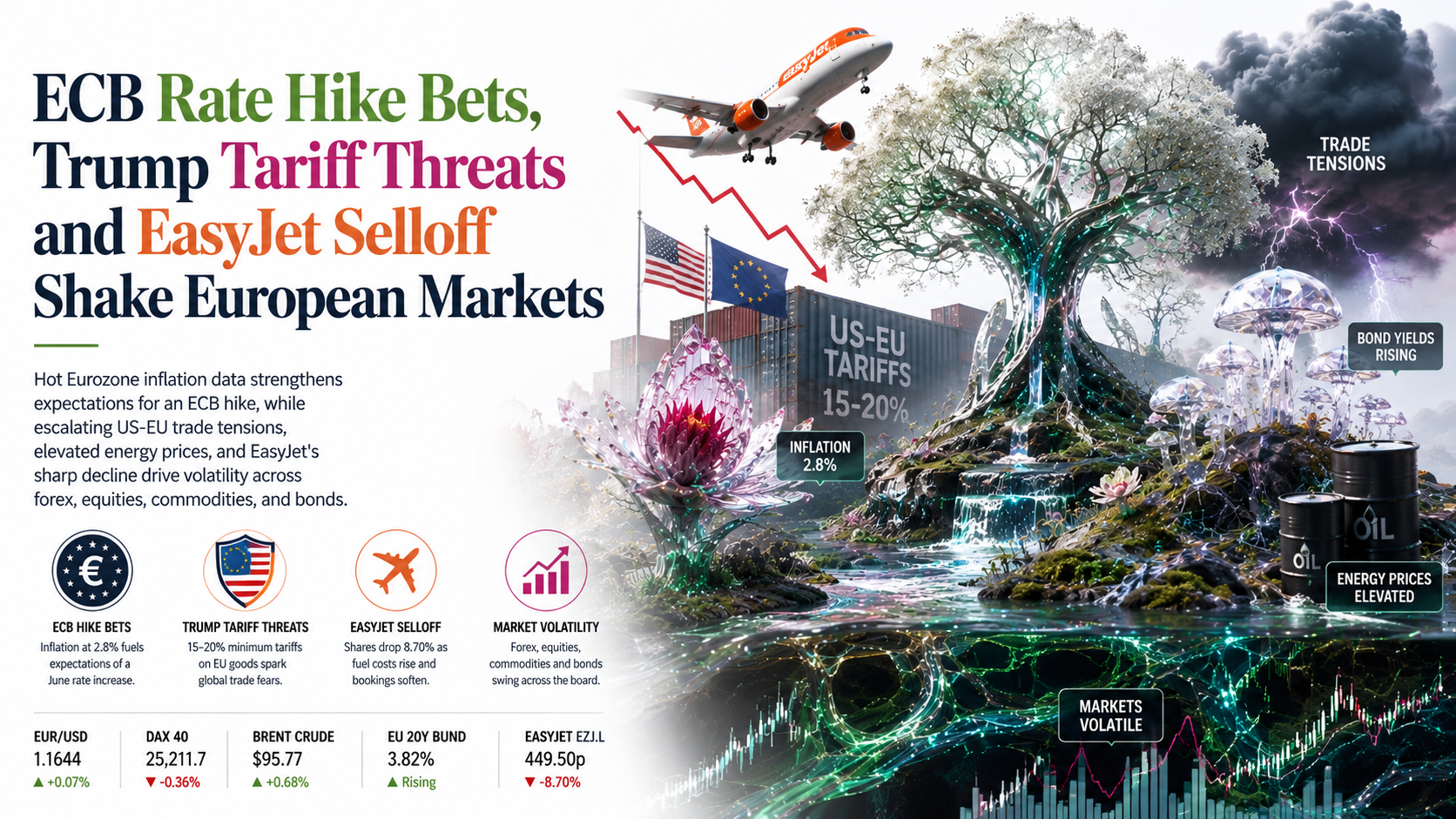
The key macro overlay for today is the Eurozone May HICP flash estimate, released this morning: headline inflation rose to 2.8% year-on-year — the highest reading since September 2025 and above the consensus of 2.6%, driven by a fresh energy price surge as the Iran-led oil premium refuses to fade. Core HICP held at 2.2%. The hot print locks in the June ECB hike at 25bps — a move that pushes the ECB’s deposit rate to 2.25%, reversing its entire 2025 cutting cycle. EUR/USD trades at 1.1644 as markets simultaneously price ECB tightening (euro-positive long-term) and near-term growth pessimism (euro-negative) — a stagflationary compression producing a tightly coiled range.
The standout story for the session is EasyJet (EZJ.L), today’s most volatile European equity — sliding −8.70% to 449.50p as renewed fuel cost concerns and softening forward booking sentiment weigh on the stock. The retreat erases recent gains and brings the stock closer to its May lows, raising caution for near-term bulls.
Live News Driving Markets This Hour
Macro, geopolitical, and corporate catalysts shaping the European session · 2 June 2026
Live Rates — 2 June 2026 European Session
Key instruments across forex, indices, commodities, and crypto as of European morning
EasyJet — Today’s Most Volatile European Stock
LON: EZJ · The UK budget carrier slides as fuel cost fears and softening booking sentiment overshadow the hedging story
Why EasyJet is falling today: The market is repricing EasyJet’s near-term risk profile as two concerns converge. First, with Brent crude at $95.77, the unhedged 20% of peak summer fuel exposure is increasingly in focus — any further oil spike toward $100+ would hit margins directly. Second, softening booking conversion data for Mediterranean routes has tempered the earlier optimism, as elevated European inflation begins to bite into consumer discretionary budgets. The stock is unwinding its recent recovery rally.
Fundamentals context: EasyJet’s FY2026 earnings report is due 1 December 2026. The stock’s 52-week range (401.40p – 590.60p) reflects the volatile impact of the Iran conflict and energy uncertainty throughout 2026. At 449.50p, the stock trades 23.9% below its 52-week high and sits closer to its 52-week low of 401.40p. EPS (TTM) stands at 54 pence, with dividends reinstated at a 3.32% yield. The dividend yield provides some floor support, but the near-term technical and sentiment picture has deteriorated sharply today.
Key risk factors: A further Brent rally toward $100–$105/bbl would intensify pressure on the unhedged 20% of fuel costs. ECB rate hikes compressing European consumer spending remain a structural demand headwind. The 401.40p 52-week low is the key downside level to watch if today’s sell-off accelerates.
European Session Data — 2 June 2026
Key events scheduled during today’s European trading hours and their market implications
| Time (CET) | Country | Event | Impact | Forecast | Actual / Status |
|---|---|---|---|---|---|
| 07:00 | 🇩🇪Germany | Retail Sales MoM (Apr) | Medium | +0.3% | −0.2% ✘ Miss |
| 08:00 | 🇪🇸Spain | Manufacturing PMI Final (May) | Low | 52.4 | 52.9 ✔ Beat |
| 08:50 | 🇫🇷France | Manufacturing PMI Final (May) | Medium | 48.3 | 47.8 ✘ Miss |
| 08:55 | 🇩🇪Germany | Manufacturing PMI Final (May) | High | 49.2 | 49.6 ✔ Beat |
| 09:00 | 🇪🇺Eurozone | Manufacturing PMI Final (May) | High | 51.4 | 51.6 ✔ Beat |
| 10:00 | 🇪🇺Eurozone | HICP Flash Estimate YoY (May) | High | 2.6% | 2.8% ✘ Hot Beat |
| 10:00 | 🇪🇺Eurozone | Core HICP Flash YoY (May) | High | 2.3% | 2.2% In-line |
| 11:00 | 🇬🇧UK | S&P Global UK Manufacturing PMI Final (May) | Medium | 47.9 | 47.6 ✘ Miss |
| 14:30 | 🇺🇸US | Trade Balance (Apr) | Medium | −$89.2B | Pending |
| 15:45 | 🇺🇸US | S&P Global US Manufacturing PMI Final (May) | Medium | 52.1 | Pending |
| 16:00 | 🇺🇸US | JOLTS Job Openings (Apr) | High | 7.52M | Pending |
9 Setups for Today’s European Session
Technical levels, fundamentals, entry, stop, and target for each instrument · 2 June 2026
Fundamental Driver
EUR/USD is caught in a stagflationary trap: the Eurozone May HICP beating expectations at 2.8% is theoretically euro-bullish (ECB hike fully priced for June 11), but the simultaneous Composite PMI collapse to 47.5 — the sharpest contraction since October 2023 — signals the eurozone economy is entering contraction at the same time as energy-driven inflation surges. This growth-versus-inflation conflict suppresses EUR upside. The US side of the equation provides the bear catalyst: US ISM Manufacturing hit a 4-year high of 54.0 yesterday, reinforcing Fed “higher for longer” expectations and keeping the dollar structurally bid at DXY 104+. Trump’s FT-reported push for 15–20% minimum tariffs on EU goods is an additional downside risk for EUR/USD — a tariff escalation directly targets European export competitiveness.
Technical Setup
EUR/USD has been consolidating between 1.1500–1.1750 since April. The 50-day SMA is at 1.1690 — today’s HICP beat has lifted EUR/USD to 1.1644, approaching the 50-day SMA, confirming the SMA as resistance. Below 1.1600 opens a move toward the 1.1540 April low. The MACD remains near the zero line without a clear signal. A sell on a bounce to 1.1660 offers a 1:1.6 risk/reward to 1.1550, with a stop above the 50-day at 1.1730.

Fundamental Driver
The EUR/GBP bear case rests on a structural interest rate differential that heavily favours sterling. The Bank of England’s rate stands at 3.75% — 175 basis points above the ECB’s current 2.00% deposit rate. Even after the expected June 25bps ECB hike to 2.25%, the BoE holds a 150bps advantage, making sterling-denominated assets significantly more attractive on a carry basis. UK CPI at 3.3% keeps the BoE on hold while the eurozone’s stagflationary picture — 2.8% HICP alongside a -47.5 Composite PMI — creates a more chaotic policy backdrop for the ECB. France’s services PMI at 42.9 (worst since 2020) is particularly alarming. Analyst consensus targets EUR/GBP in the 1.13–1.17 GBP/EUR range through 2026, implying EUR/GBP broadly capped around 0.8770.
Technical Setup
EUR/GBP is trading at 0.8644, testing the upper boundary of its recent range. The 0.8680 level is a key resistance zone. A sell entry at current levels targets 0.8540, with a stop above 0.8710 to protect against a BoE dovish surprise. The structural rate differential of 150bps in sterling’s favour remains the dominant driver.

Fundamental Driver
Lead is trading at $2,029.56/t, holding modest year-to-date gains in the LME base metals complex. The bear case is primarily demand-side: 80% of global lead consumption is in battery manufacturing (automotive, industrial), and two headwinds are converging. First, the US dollar’s strength (DXY 104+) makes dollar-denominated commodities expensive for non-US buyers, suppressing physical demand. Second, China’s Commerce Ministry effectively walked back the $17 billion agricultural commitment agreed at the Trump–Xi summit — a broader signal that China-US trade normalisation is moving slower than hoped, dampening expectations for a Chinese industrial metals demand rebound. Supply side remains ample: Australian mine production is running ahead of seasonal norms. Trading Economics consensus projects Lead consolidating, with $2,050/t as the near-term resistance.
Technical Setup
Lead has reclaimed its 50-day SMA, now trading at $2,029.56/t with a buy entry at $2,010. The $2,050/t level is the next key resistance — a clean break opens a move toward $2,080. The long setup offers a 1:1.75 risk/reward with a stop at $1,970. LME warehouse stocks have declined 12% in 30 days, tightening the supply picture and underpinning the recent recovery from lows.

Fundamental Driver
Corn (CBOT ZC) fell to 444¢/bu in early June trade, near its lowest level since April 2026. The dominant bearish pressure comes from two sources: first, a potential US–Iran peace deal that could reopen the Strait of Hormuz and restore fertiliser supply chains (reducing production cost fears); second, China’s Commerce Ministry’s hedging on the $17 billion agricultural goods commitment reduced the immediate demand outlook. However, the downside is structurally limited. A sustained Iran ceasefire that restores Gulf fuel and fertiliser flows would be a medium-term cost positive for corn farmers, while USDA data suggests any recovery in Chinese corn imports would be a “notable shift” after nearly two years of subdued buying — a potential demand catalyst. The 430¢ support has held on three prior tests since May, suggesting a range-trade rather than a directional breakdown.
Technical Setup
A bounce entry near 432¢ — at the lower boundary of the May–June range — offers a mean-reversion trade toward 462¢ resistance, with a stop below the April low at 418¢. This is a range trade, not a trend trade. The USDA’s next major supply/demand update and any developments in the China trade situation are the key binary catalysts that could force a breakout in either direction.

Fundamental Driver
The DAX’s near-term bear case is constructed from three pillars. First, defence and aerospace stocks — historically heavy DAX constituents (Rheinmetall was −6.51% on Monday, Airbus −4.3%, MTU Aero Engines −3.81%) — are under extreme pressure as Iran ceasefire talks stall. A resolution would be bearish for defence stocks on “peace dividend” selling; continued escalation pressures margins via fuel and supply chain costs. It is a lose-lose for these components in the near term. Second, the ECB hike on June 11 is a headwind for German valuations: higher rates compress German manufacturing P/E multiples, and Germany’s retail sales already missed at −0.2% today. Third, Trump’s tariff escalation — potentially raising minimum EU goods tariffs to 15–20% — specifically targets German auto (BMW, Mercedes-Benz, Volkswagen) and machinery exports to the US. SAP’s 8%+ AI-driven surge on Monday provides a counter-trend support but is insufficient to offset the cyclical and geopolitical drag.
Technical Setup
The DAX is trading at 25,211.7, up 0.83% on the session after closing Monday at 25,003. The index has bounced back above the 25,000 psychological level, but a sell-the-rally strategy remains valid: a sell entry at 25,280 targets 24,850 (near-term support), with a stop above 25,520 (recent swing high). The 200-day SMA sits near 24,100 as a deeper support if geopolitical risks re-escalate.

Fundamental Driver
EasyJet’s sharp −8.70% drop to 449.50p reflects a re-rating of near-term risk. With Brent at $95.77, the unhedged 20% of peak summer fuel is becoming an increasingly material cost concern. Softening booking conversion data for Mediterranean routes has added to bearish pressure, as ECB rate hikes begin to crimp European consumer discretionary spending. The stock now trades 23.9% below its 52-week high of 590.60p and is approaching structurally important support. A sell-on-bounce setup offers the cleaner risk/reward given the deteriorating short-term technical picture and macro headwinds around fuel costs and consumer confidence.
Technical Setup
EasyJet has broken sharply below its 50-day SMA (near 490p), which now acts as resistance. Today’s day range of 445.20p–458.60p confirms heavy selling pressure. A sell entry on any technical bounce toward 455p — near the broken SMA support — targets 420p (near the May consolidation base), with a stop above 472p. The 401.40p 52-week low becomes the next major support level if the selling extends. Risk/reward on the short: 1:2.0.

Structural Observation
USDT is not a directional trade — it is the world’s most important crypto plumbing asset, and its behaviour as a real-time confidence indicator for the broader digital asset market is instructive. Trading at $1.0001 today, just 0.01% above its $1.00 peg, USDT is functioning normally — there is no stress signal in the stablecoin market despite the broader altcoin sell-off (BNB −1.12% today). In genuine crypto risk-off events (2022 LUNA collapse, 2023 USDC temporary depeg), USDT typically trades above $1.00 as capital floods into the safe harbour — today’s minor 0.01% premium is consistent with mild risk caution rather than systemic fear. Tether’s market cap of ~$146B continues to grow, reflecting ongoing adoption of dollar-denominated settlement in global crypto markets. The key monitoring level is any sustained break below $0.9990 — that would signal genuine peg stress and would be bearish for all crypto assets.
Euro-Session Relevance
EU crypto regulation (MiCA — Markets in Crypto-Assets) directly affects USDT. Tether has faced EU compliance questions around MiCA requirements for stablecoins (reserves transparency, issuance caps). Any EU regulatory action on USDT would be a significant market event. No new developments today, but traders should monitor European Commission announcements carefully.

Fundamental Driver
BNB sits at $673.36, nearly 50% below its all-time high of $1,369.99. The BNB Chain ecosystem remains active — 58 AI agent projects deployed, 0.45-second block times achieved, roadmap targeting 20,000 TPS. Grayscale’s BNB Trust filing (January 2026) signals growing institutional interest. However, the structural macro headwinds that crushed Bitcoin and Ethereum in H1 2026 apply equally to BNB: the Federal Reserve’s “higher for longer” posture under new Chair Kevin Warsh keeps real yields elevated, compressing risk appetite for non-yielding crypto assets. A strong DXY above 104 is historically bearish for BNB. BNB consolidated near $613 in late February 2026 before recovering — today’s $673.36 sits near the mid-range. A failure to sustain above $690 would confirm the current range top.
Technical Setup
BNB has pulled back to $673.36 from highs near $700, with the $690 level now acting as near-term resistance. RSI near 52 suggests neutral momentum. A sell entry on a push toward $690 — the top of the recent range — targets a retest of $625 support, with a stop above $720. The key upside catalyst that could negate the short: a Bitcoin breakout above $80,000, which historically pulls BNB and other major altcoins sharply higher as retail capital rotates. MiCA regulatory clarity from EU authorities could also be a positive structural catalyst if compliance requirements are deemed manageable for Binance’s European operations.

Fundamental Driver
The EU 20-year Bund yield rising to 3.82% reflects the market’s increasing conviction that the ECB will be forced into a sustained tightening cycle — not just a one-and-done 25bps hike in June. Today’s hot HICP print (2.8% vs 2.6% forecast) adds urgency. ECB projections from March 2026 already foresaw HICP at 3.1% in Q2 2026, driven by the Middle East energy shock — the actual data is tracking in line with this worst-case scenario. Conference Board economists are preparing for “at least one further hike after June” — pricing the deposit rate at 2.50% by September 2026. Simultaneously, G7 finance ministers in Paris are grappling with a global bond sell-off: US 10Y at 4.46% is near 15-month highs. Italy’s BTP-Bund spread widening to 178bps reflects peripheral eurozone stress — if this exceeds 200bps, the ECB’s anti-fragmentation tool (TPI) may need activation, a complex and market-moving event.
Trade Structure
Shorting European long-dated bonds (positioning for yield increases) offers a clean expression of the “ECB hiking into weakness” thesis. An entry at a 20-year Bund yield of 3.78% — on any temporary pullback driven by risk-off bond demand — targets 4.05% as the ECB’s projected endpoint for this cycle. The stop at 3.62% represents a scenario where a major geopolitical de-escalation (ceasefire) rapidly cuts the energy risk premium, pulling yields sharply lower. Risk/reward: 1:1.5 expressed as basis point moves.

⚠️ Key Risk Event — ECB Decision: 11 June 2026: All EUR-denominated trades and European equity positions face significant binary risk at the ECB’s June 11 meeting. A 25bps hike is fully priced; any larger move (50bps) would spike EUR/USD and crush European bank stocks. Any pause would be deeply euro-bearish and ignite a DAX rally. Position sizes should be reduced around the announcement window.
Traders’ Questions Answered
Common questions on today’s European session market conditions and trade ideas
“The ECB is being asked to do something no central bank has managed cleanly in the post-war era: raise rates into a recession driven by an external energy shock without triggering a sovereign debt crisis at the periphery.” — Capital Street FX Research Desk · European Session Brief · 2 June 2026
European Session Verdict — 2 June 2026
The European session opens under a three-way macro compression: an ECB that is now firmly committed to hiking into a weakening economy, an unresolved Iran ceasefire situation that keeps energy prices elevated and industrial risk premiums high, and a transatlantic trade relationship that is deteriorating under fresh Trump tariff threats. This combination — stagflation risk, geopolitical premium, trade headwinds — creates a structurally difficult environment for European equities and the euro.
The standout trade for the European session is EUR/GBP short — the cleanest expression of the BoE-ECB rate differential story, with a 150–175bps advantage for sterling that is unlikely to close materially in the next 90 days. The EUR/USD bear bias is less clean given the stagflation trap, but a sell on HICP-driven bounces toward 1.1650 remains tactically valid. EasyJet is the session’s equity story — a sharp −8.70% drop to 449.50p driven by fuel cost repricing and softening booking sentiment, offering a sell-on-bounce setup targeting 420p.
Lead and Corn remain in bear-range territory — Lead’s demand headwinds from China and dollar strength create a structural short bias, while Corn is best treated as a range trade between 430–465¢. The EU 20-Year Bund short (targeting yield rise to 4.05%) is the bond market expression of the ECB hiking cycle thesis. BNB/USD is cautiously bearish absent a Bitcoin breakout catalyst. USDT remains a peg-monitoring exercise rather than a directional trade.
Trade smart, manage risk around the June 11 ECB decision, and let price structure guide your decisions.
Trade the European Session →