US Closing Briefing April 21 2026 – Stocks Fall, Oil Hits $90, Warsh Hawkish Outlook
US Close — Tuesday, April 21, 2026
Stocks Extend Losing Streak, Oil Back at $90, Warsh Plays Hawk
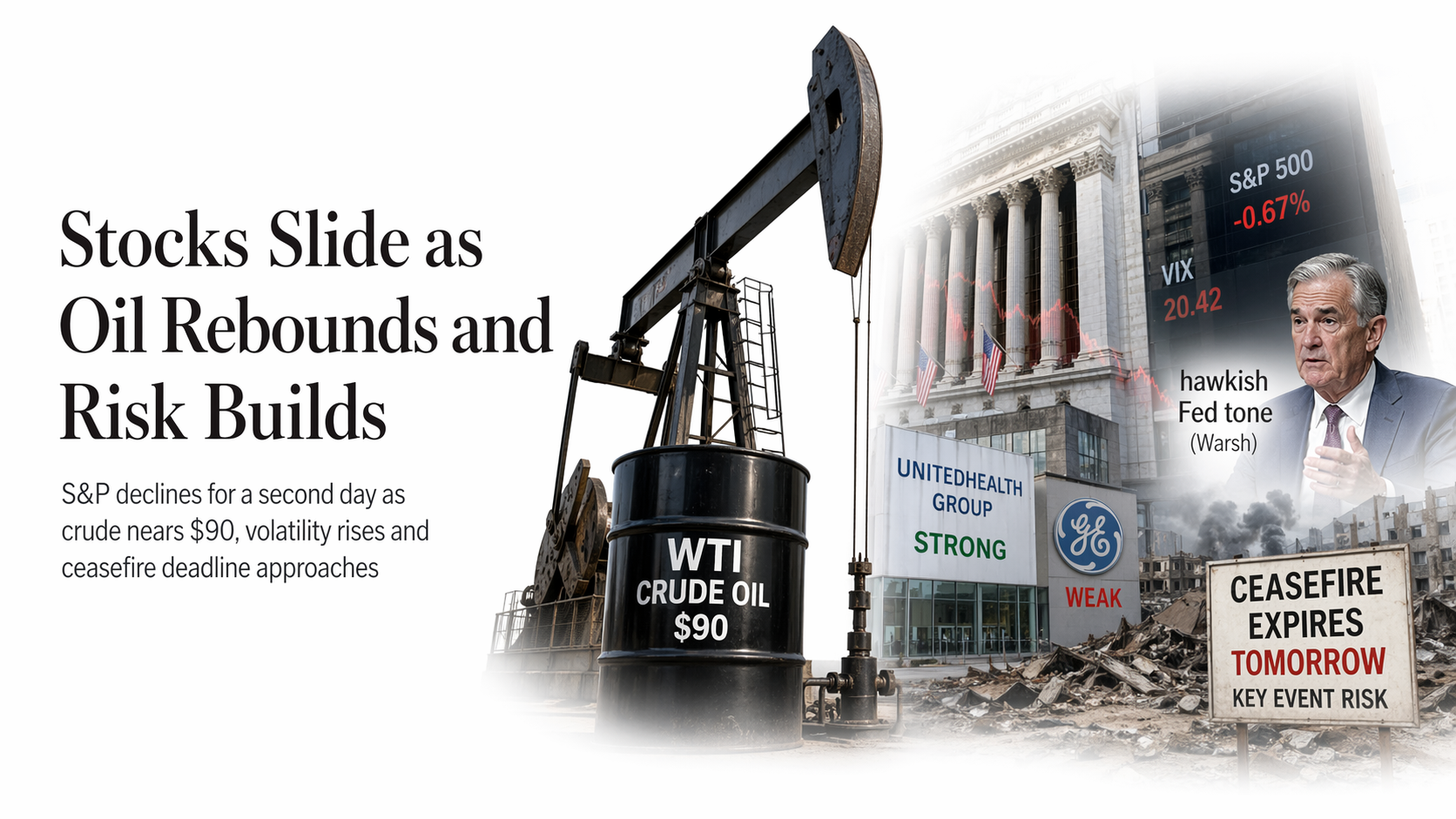
The S&P 500 fell for a second consecutive day as WTI crude rebounded to $90, the VIX breached 20, and Fed Chair nominee Kevin Warsh struck a hawkish tone at his Senate confirmation hearing. A blockbuster earnings session — UNH +8.6%, GE −5.8% — and Apple’s CEO change (Tim Cook → John Ternus) competed for attention. With the Iran ceasefire expiring tomorrow (Wednesday April 23) and Tesla earnings after the close, every overnight headline matters.
Tuesday’s session opened with optimism — Trump’s early CNBC comment “We’re going to end up with a great deal” briefly lifted futures — but optimism faded as oil reversed Monday’s partial decline, climbing back toward $90. The VIX crossed 20 for the first time since the conflict’s early escalation phase. A record US Retail Sales print (+1.7% MoM) showed consumers spending through the geopolitical stress, but mixed earnings reactions and the Warsh hearing’s hawkish subtext put renewed downward pressure on equities. UnitedHealth’s spectacular beat (+8.6%) was the session’s clearest bright spot. GE Aerospace’s guidance hold (−5.8%) captured investor anxiety around the macro “uncertainty” of the still-unresolved Iran conflict.
CEASEFIRE DEADLINE: TOMORROW — WEDNESDAY, APRIL 23, 2026. Trump told CNBC he is “unlikely” to extend and that the US military is “ready” to strike if no deal is reached. Iranian officials responded they will not negotiate “under the shadow of threat.” VJ Vance is reportedly en route to Islamabad for a second round of talks. Strait of Hormuz remains effectively closed. Oil is pricing back toward $90 — a deal could send WTI to $82–84; a failure could push WTI toward $100–110.
WARSH CONFIRMED HAWKISH: Fed Chair nominee Kevin Warsh told the Senate Banking Committee “inflation is a choice” and pledged he would not be Trump’s “sock puppet.” Sen. Thom Tillis (R-NC) said he would oppose advancing the nomination until the criminal investigation into Jerome Powell is resolved. Rate cut odds for 2026 dropped to ~40% from 50% last Friday. 10Y yield ticked up 3bps to 4.29%, compressing equity multiples further.
Cross-Market Closing Snapshot
| Instrument | Close | Change | % Chg | Bias | Note |
|---|---|---|---|---|---|
| S&P 500 (SPX) | 7,078 | −31.14 | −0.44% | BEARISH | 2nd down day. Two-session decline from ATH 7,126. |
| Dow Jones | 49,293 | −149.56 | −0.30% | NEUTRAL | UNH +8.6% cushioned losses; GE −5.8% dragged. |
| Nasdaq Composite | 24,310 | −94.39 | −0.39% | BEARISH | Tech under pressure. AAPL −0.8%, CEO transition uncertainty. |
| Russell 2000 | 2,773 | −19.96 | −0.71% | UNDERPERFORM | Small-caps flip red after Monday’s new ATH close. |
| VIX | 20.07 | +1.20 | +6.35% | DANGER ZONE | VIX >20 = elevated fear. Breach signals protective buying. |
| WTI Crude Oil | $90.00 | +$2.77 | +3.17% | BULLISH | $90 psychological resistance re-cleared. Hormuz still blocked. |
| Brent Crude | ~$97.30 | +$2.2 | +2.3% | BULLISH | Citi $110 risk scenario in focus if Hormuz stays closed 30 days. |
| Gold (XAU/USD) | $4,742 | −$83 | −1.78% | DIP-BUY | 2-day pullback. Bull structure intact. $4,720 demand zone key. |
| DXY (USD Index) | 97.96 | flat | 0.00% | NEUTRAL | DXY holding lows at 97.6 support. Warsh hawkish = mild USD bid. |
| Bitcoin (BTC/USD) | $75,783 | +$401 | +0.53% | RESILIENT | Second green close vs. geopolitical fear. $75K breakout intact. |
| 10Y Treasury Yield | 4.29% | +3 bps | +0.70% | WATCH | Warsh hawkishness + oil inflation risk. 4.40% = equity danger. |
US Equities — Session Analysis
The S&P opened higher on Trump’s CNBC optimism (“great deal”) but rotated south through the session as oil re-climbed to $90 and the Warsh hearing delivered a hawkish surprise. The S&P 500’s forward P/E at 20.9× (28% above the 25-year average of 16.3×) leaves the index vulnerable to earnings disappointments. Notably, 88% of S&P 500 reporters this season have beaten estimates — but many are withholding guidance upgrades, citing “macro uncertainty” tied to Iran energy costs. Bank of America’s global economist flagged that markets may be underpricing ceasefire failure risk, drawing parallels to how trade war “escalate-to-de-escalate” logic is being applied to the Iran war — a playbook that breaks down when de-escalation is no longer a unilateral decision.
- The 7,022 prior ATH level is the line in the sand for bulls. A daily close below that on ceasefire failure = confirmed bull trap and the start of a deeper correction toward 6,900–6,950.
- VIX closing above 20 is a regime change signal — historically, when VIX crosses 20 from below during an ongoing geopolitical risk event, the market re-evaluates its risk premium by 3–5% before finding a floor.
- S&P 500 forward P/E of 20.9× leaves virtually no margin for earnings disappointments from the remaining Mag-7 reporters (Tesla Wednesday, then Alphabet, Meta, Microsoft, Amazon next week).
- Healthcare sector strength (UNH +8.6%, Quest Diagnostics +5.8%) points to defensive rotation — a bearish read for overall risk appetite.
Earnings — Q1 2026 Season Spotlight
| Company | EPS Actual | EPS Est. | Surprise | Revenue | Guidance | Stock |
|---|---|---|---|---|---|---|
UnitedHealth Group UNH · Healthcare |
$7.23 | $6.58 | +$0.65 ▲ | $111.7B vs $109.6B est. | FY 2026 raised to >$18.25 (from $17.75 floor). Medical cost ratio improved to 83.9% vs 85.5% est. | +8.6% ▲ |
RTX Corporation RTX · Aerospace & Defense |
Beat +$0.26 | — | +$0.26 ▲ | Beat estimates | FY guidance raised +$0.10. War-cycle defense demand intact. Missile systems backlog at record levels. | +1.2% ▲ |
GE Aerospace GE · Industrials |
$1.86 | $1.61 | +$0.25 ▲ | $11.61B vs $10.65B est. | FY held at $7.10–$7.40 (mkt exp. $7.49). CEO Culp: “macro uncertainty … prudent to maintain.” Oil hurt commercial aviation demand outlook. | −5.8% ▼ |
3M Company MMM · Industrials |
Beat +$0.16 | — | +$0.16 ▲ | Beat estimates | FY guidance affirmed. Management signaling watchfulness on energy cost pass-through. No upgrades despite strong Q1. | +0.3% → |
Northrop Grumman NOC · Defense |
Beat +$0.08 | — | +$0.08 ▲ | Beat estimates | FY guidance reiterated. Iran conflict boosting defense backlog. B-21 Raider production on track. | +0.8% ▲ |
Halliburton HAL · Energy Services |
$0.55 | $0.49 | +$0.06 ▲ | $5.4B vs $5.27B est. | +11.95% EPS surprise. Revenue slightly down YoY ($5.42B prior year). Up ~30% YTD — oil services boom on conflict premium. | +1.5% ▲ |
Quest Diagnostics DGX · Healthcare |
Beat | — | Beat ▲ | Beat estimates | Raised FY profit guidance. Riding defensive healthcare demand + diagnostic volume growth. | +5.8% ▲ |
The earnings theme of this week crystallised on Tuesday: beat the quarter, hold (or barely raise) the guidance. Companies are acutely aware that the Iran conflict’s impact on energy prices — and hence input costs, consumer spending, and Fed policy — creates a wide range of outcomes for H2 2026 that makes confident forward guidance imprudent. GE Aerospace CEO Larry Culp’s language is the clearest expression of this posture: “If not for current events, we would have raised guidance, but given the environment it’s prudent to maintain.” Markets are punishing guidance holds with steep declines (GE −5.8%), rewarding guidance raises (UNH +8.6%), and treating guidance reiterations with indifference (3M, NOC). The bifurcation between healthcare and industrials is likely to persist until the Hormuz situation resolves.
Looking ahead: Tesla reports Wednesday after close — the most important single-company catalyst of the week outside of the ceasefire binary. Tesla’s energy revenue (Powerwall, Megapack) may offset any EV demand weakness, and the stock has already pulled back from highs, providing a lower bar. IBM also reports Wednesday. The Amazon–Anthropic deepening ($25B, up to $100B over 10 years on AWS) keeps AI capex narrative bullish and gave Amazon a rare outperforming session (+1.4%).
Economic Data — April 21 Releases
March Retail Sales came in at +1.7% MoM — the largest monthly gain in a year and a significant beat versus the +1.3% consensus estimate. However, context matters: higher gasoline prices are partially inflating the headline figure, as gas station revenues are counted directly in the retail sales number. Core sales (ex-autos, ex-gas) were solid but less dramatic. The takeaway is that the US consumer is proving resilient despite the Iran energy shock, but the durability of that resilience into Q2 — if oil prices remain elevated — is the key risk to monitor.
The Warsh hearing was the market’s most hawkish Fed signal in months. Warsh’s assertion that “inflation is a choice” places the Fed firmly in anti-inflation mode. His pledge of independence from the White House — “absolutely not” a sock puppet — removes one market hope that a Warsh-led Fed would mechanically cut rates on Trump’s demand. The 10Y yield’s 3bp rise to 4.29% partially reflects this re-pricing. If confirmed, Warsh’s term would begin when Powell’s expires on May 15. Prediction markets give a 30–34% probability of confirmation by that date.
Geopolitics — Iran Ceasefire: T-Minus 24 Hours
The two-week US–Iran ceasefire expires Wednesday, April 23. Trump told CNBC Tuesday he expects a “great deal” but added the US military is “ready” to bomb if no agreement is signed and that he sees no reason to extend the truce. Iranian state TV said no delegation had yet departed for Pakistan, casting doubt on Round 2 talks — though Pakistani officials reported Tehran was preparing to send negotiators to Islamabad. The Strait of Hormuz remains effectively closed to tanker traffic. WTI’s $90 recapture on Tuesday reflects the market pricing in a non-trivial probability of ceasefire failure. Citi analysts estimate that a further month of Hormuz disruption could reduce global crude and product inventories by 1.3 billion barrels, with WTI potentially reaching $110/bbl.
Commodities — WTI Crude Oil & Gold
WTI’s recovery to $90 (+3.17%) — exactly reversing yesterday’s partial retreat — underscores how sensitive oil is to every diplomatic headline. The Citi estimate of $110 if Hormuz stays closed 30 days is now being circulated widely, keeping a floor under the market. The $90 level is not only a round-number psychological barrier; it’s also the approximate level at which US consumer sentiment surveys historically begin showing meaningful deterioration in confidence — a key watch for Q2 economic data.
- Break above $93 = market pricing ceasefire failure; immediate $95–$100 risk.
- Break below $86 overnight = ceasefire optimism returning; potential deal catalyst.
- A ceasefire deal could send WTI back to $82–$84 within 24–48 hours — a 7–9% collapse from current levels.
Gold’s two-day pullback (−1.78% today, −1.11% Monday) is being driven by a firmer USD and the hawkish Warsh repricing — higher rates mechanically reduce gold’s opportunity cost attractiveness. Morgan Stanley has already trimmed its H2 2026 gold target from $5,700 to $5,200, citing war-driven energy inflation reducing rate-cut expectations. However, the structural bull case for gold remains intact: central bank demand, de-dollarisation flows, and the $4,720 demand zone that has held twice in the past three weeks all support dip-buying.
- $4,720 is the must-hold demand zone. A daily close below $4,680 = bull trend broken; risk to $4,580–$4,600.
- On a ceasefire failure, gold surges: safe-haven buying + oil-driven inflation both supportive. Target $4,900–$4,950.
- On a ceasefire deal, gold dips briefly (risk-on) but should find solid bids near $4,680–$4,700 on any sustained pullback.
FX Markets — Dollar, Euro, Sterling
The DXY (Dollar Index) held flat at 97.96 on Tuesday, testing the critical 97.6 lower-range support identified by FXStreet’s cross-asset map. The dollar had a conflicting set of signals: Warsh’s hawkish hearing tone is USD-positive (higher for longer rates), but oil’s rise to $90 is ambiguously negative for risk sentiment and the growth outlook — which can cap USD strength. EUR/USD pulled back to 1.1745 as European natural gas exposure continues to weigh structurally on the single currency. Cable (GBP/USD) eased modestly to 1.3430 but maintained its bull structure, as the UK’s relative insulation from European gas contracts provides relative support versus the EUR.
Bonds & Rates — Warsh Hawkishness + Oil Inflation
The 10-year Treasury yield’s move to 4.29% (+3 bps) reflects a dual shock: Warsh’s hawkish confirmation hearing posture removes the assumption that the new Fed chair would be an ally for near-term rate cuts, and oil’s re-ascent to $90 keeps the inflation-via-energy pathway alive. The 2s10s spread remains mildly positive — a reading consistent with a slowdown-without-recession environment, but one where rate cuts are being priced further out. The 4.40% level remains the critical threshold: a sustained break above there would significantly compress equity multiples at current S&P P/E levels of 20.9×. The CME FedWatch Tool puts May pause probability at 99%. The rate-cut-in-2026 probability has slipped to approximately 40% from 50% as of last Friday.
Corporate Developments — Apple, Amazon, Avis
Overnight Trade Setups — April 21 to 22, 2026
SIZING ADVISORY: With the Iran ceasefire expiring Wednesday April 23 and Tesla + IBM earnings Wednesday after close, all six setups carry binary event risk. Maximum recommended position size is 40–50% of normal with wider stops than standard. These are scenario-weighted setups — not momentum trades. Confirm ceasefire news before sizing up.
Rationale: Citi’s $110 scenario is a tail risk, not a base case. The diplomatic pattern (VP Vance in Pakistan) resembles Round 1 talks that produced the original ceasefire. Resolution is possible and would be the larger relative move. The asymmetry of WTI’s reaction to a deal (−$7–9) vs. failure (+$5–6 to $95) actually favors the short into $92 resistance on a risk-adjusted basis.
Invalidation: Trump announces strikes have resumed / WTI daily close above $95.00 = failure confirmed; maximum loss taken.
Rationale: Gold faces two possible catalysts for a significant move tomorrow: (a) ceasefire failure = safe-haven buying surge toward $4,900+; (b) ceasefire deal = brief dip to $4,680–$4,700 that remains above the structural support, providing another entry point. Both scenarios favour eventual higher prices. Morgan Stanley maintains a $5,200 H2 2026 target. The $4,720 demand zone is the highest-conviction technical level on the gold chart.
Invalidation: Daily close below $4,680 = structural demand broken; stand aside entirely.
Rationale: Cable has been one of the best G10 FX performers since the Iran conflict began. The UK’s energy exposure is partially hedged through Brent-linked LNG contracts, making GBP less vulnerable to European gas price swings than EUR. The bull structure is intact while price holds above 1.3350.
Invalidation: Daily close below 1.3350 = bull structure fails; flip to neutral and reassess.
Rationale: European natural gas futures surged 8–11% on Monday, a direct structural headwind for the Euro given Europe’s energy import dependency. The ECB’s rate dilemma — hiking to fight energy-driven inflation while that very hiking crushes eurozone growth — creates a paradox that is net-negative for EUR regardless of direction. The DXY’s lower range hold at 97.6 also limits EUR/USD upside. EUR’s 57.6% weight in the DXY basket means any DXY recovery would mechanically weigh on EUR/USD.
Invalidation: EUR/USD daily close above 1.1825 = evening star structure broken; stand aside.
Rationale: The $75K breakout level has held on two geopolitical shock retests now. Bitcoin’s intraday drawdowns during each Iran shock have been progressively smaller, consistent with accumulation at these levels. The 200-day EMA sits near $83,000. ETF inflows remain robust. If the ceasefire resolves (deal scenario), risk-on would push BTC toward $80K+. If it fails, BTC’s initial dip is likely contained to $73K before buyers re-emerge.
Invalidation: Daily close below $72,000 = breakout fully invalidated; stand aside entirely.
Rationale: Earnings momentum setups work best when: (a) the beat is large, (b) guidance is raised, and (c) the stock was significantly below fair value. UNH checks all three boxes. The forward P/E now looks attractive relative to peers, and the improved medical cost ratio suggests the turnaround is structural rather than one-quarter luck. Healthcare (XLV +1.8%) was the session’s top sector, and defensive rotation to healthcare is likely to continue if geopolitical risk escalates further tomorrow.
Invalidation: Close below $332 = gap fill complete, thesis broken; step aside.
Closing Summary — Tuesday, April 21, 2026
Tuesday’s session added another layer of complexity to an already compressed risk calendar. The S&P 500’s second consecutive decline from last Friday’s 7,147 ATH — now at 7,078 — is not yet a structural breakdown, but it is an uncomfortable position heading into the most consequential 24-hour window of the year. The VIX crossing 20 is a warning sign: it historically marks the threshold where passive hedging strategies begin systematic options buying, which can mechanically amplify market moves in either direction.
The earnings season itself is sending a clear message: fundamentals are solid (88% beat rate, 13.2% estimated Q1 earnings growth), but CFOs are collectively refusing to commit to H2 guidance while the Hormuz situation remains unresolved. This “beat-and-maintain” pattern (GE, 3M, Northrop) is market-neutral at best and punishable at worst, as GE’s −5.8% session demonstrated. The notable exceptions — UNH’s +8.6% on a genuine operational turnaround and RTX’s guidance raise — show that markets remain willing to reward companies with identifiably improving fundamentals regardless of macro noise.
Wednesday, April 23 is the fulcrum of the quarter: Iran ceasefire expiry + Tesla earnings after close + IBM earnings — all in the same 8-hour window. Optimal positioning: 40–50% of normal size, gold dip-buy in $4,720–$4,745, WTI short on bounces to $90.50–$92, and BTC held long above $75K. The correct instinct is not to chase the breakdown or the bounce — it is to identify the levels where the market’s reaction to tomorrow’s binary will provide the clearest trade expression, and to be patient until those levels are reached. Wednesday night is when the week’s real alpha will be made.