USD/CAD at BoC Crossroads, Gold Collapses on NFP Shock & Bitcoin Hits 19-Month Low | Technical Analysis – US Weekly | 6 June 2026
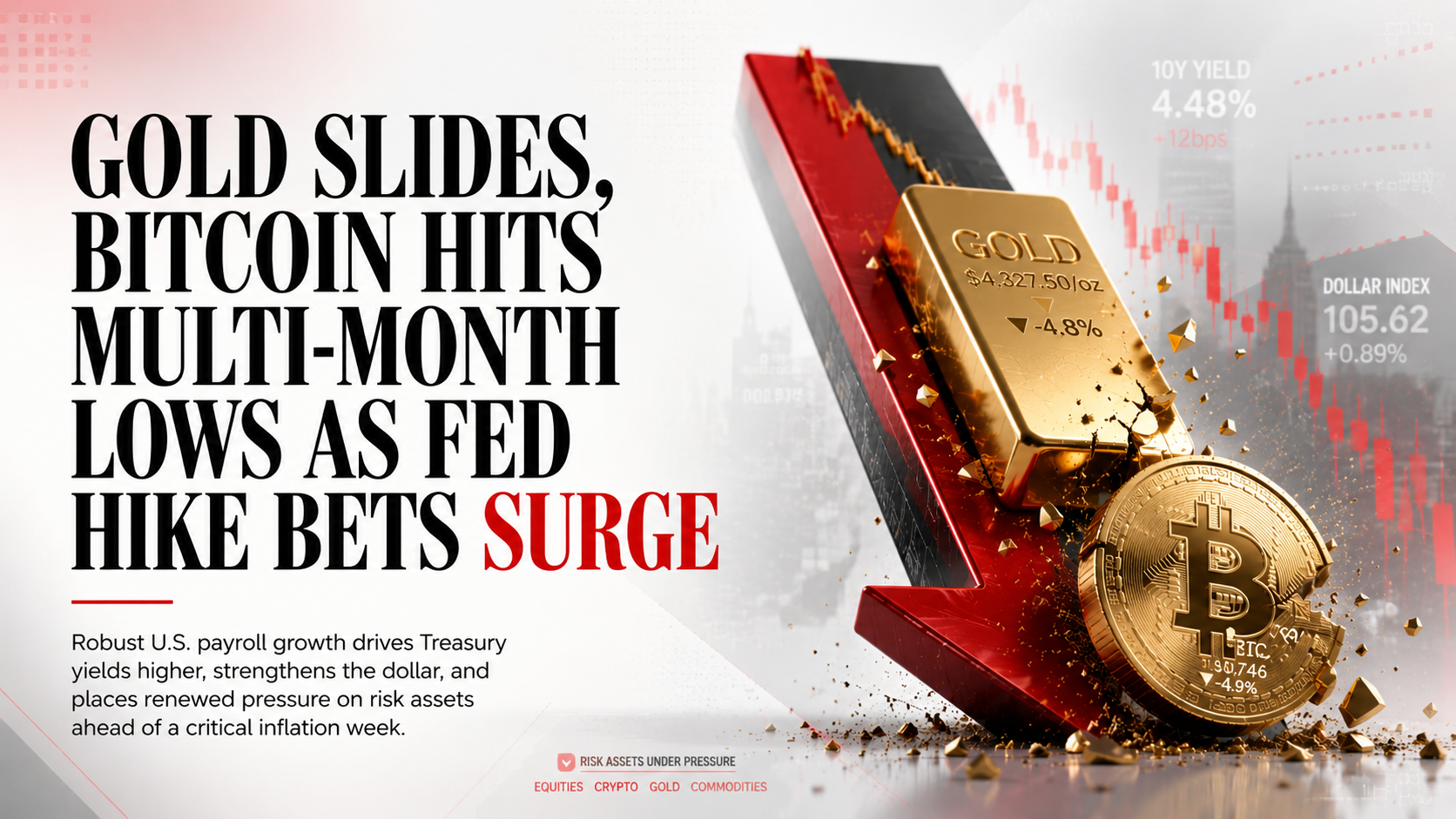
NFP Shock Crushes Gold & Equities, Bitcoin Hits 19-Month Low as Fed Rate Hike Fears Grip US Markets
Fed Rate Hike Repricing · Iran-US Strait of Hormuz Risk · Stablecoin Disruption for Visa · Crypto at 19-Month Lows
USD/CAD at 1.3939 is navigating a battle between two opposing forces: the surging US dollar from NFP-driven rate hike repricing on one side, and a collapsing WTI crude price on the other — crude fell 2.69% on Friday alone on optimism that Iran-US negotiations may be nearing a Strait of Hormuz resolution, which would remove the geopolitical premium that has lifted Canadian dollar-supporting oil prices throughout May. The BoC-Fed rate differential is a secondary driver: the Bank of Canada’s next meeting on July 9 carries growing probability of a hold or cut given Canada’s slowing domestic activity, while the Fed is now being priced for a potential hike by year-end. This divergence is structurally USD/CAD bullish — the pair’s weekly range of 1.3859–1.3925 suggests directional uncertainty, but the balance of forces favours a USD/CAD grind higher toward 1.4000 if CPI Wednesday validates the NFP signal.
USD/CHF at 0.7960 broke above the 0.7870 resistance zone on post-NFP dollar strength, but faces a structural dilemma: the Swiss franc is a safe-haven currency, and if equities continue their correction driven by rate hike fears, CHF demand could cap upside. The SNB’s latest intervention framework is explicitly oriented against CHF appreciation — the central bank has intervened three times since March 2026 to suppress franc strength — meaning CSFX views any CHF rally toward 0.7800 as SNB-constrained. The base case is range trading between 0.7850 and 0.7980 ahead of Wednesday’s CPI.
Gold at $4,327.50/oz is at a critical juncture. The metal has shed $200/oz in a week — from near $4,565 to its current level, reaching its lowest since March 2026. The mechanism is straightforward: higher real yields from rate hike repricing increase the opportunity cost of holding non-yielding gold. With the 10-year yield at 4.48% and markets pricing a year-end Fed hike, gold’s inverse relationship with real rates is driving the selloff. The $4,300 level — the prior March consolidation zone — is the critical support. A break below targets $4,100 in a continuation move; a reversal in CPI Wednesday (soft print = lower yields = gold recovery) would target $4,500. Crude oil at $91.77 holds weekly gains of 4%+ driven by Middle East supply disruption fears but faces the Strait of Hormuz resolution wildcard — any concrete ceasefire progress could release $5–$8 of embedded geopolitical premium quickly.
In equities, the Dow Jones at 50,721.50 has corrected from recent highs as the NFP-driven yield surge hit rate-sensitive technology names hardest. Visa at $323.57 faces dual headwinds: the broad equity selloff and the stablecoin narrative, with CoinDesk confirming Stripe, Visa, and Mastercard are developing a joint stablecoin payment platform. In crypto, Bitcoin at $60,746 is at a 19-month low with $58,500 representing the next major structural support, while Chainlink at $7.36 has broken below the $8.00 level despite on-chain whale accumulation data suggesting medium-term buyers are active. The US 10-year yield at 4.48% is the gravitational force linking all these narratives — Wednesday’s CPI print is the catalyst that either validates or reverses the NFP-triggered repricing.
Three Forces Shaping the US Session
The dominant narratives for the week of 9–13 June 2026 across FX, commodities, equities, and digital assets
US Session Weekly Trade Ideas
Nine instrument-specific setups with entry, stop, and target levels for the week of 9–13 June 2026. All levels for reference only; not financial advice. Visit capitalstreetfx.com for live signals.
Macro Setup: Fed-BoC Divergence + WTI Headwinds for CAD
The NFP-driven Fed hike repricing is the primary bullish USD/CAD driver. With the US economy adding 172,000 jobs against an 85,000 expectation, markets now price a Fed rate hike by Q4 2026 — while the Bank of Canada faces a slowing domestic economy, with RBC and TD both flagging rising delinquency rates in consumer credit and softening housing activity. This BoC-Fed divergence is structurally USD/CAD bullish. The secondary driver is oil: WTI crude’s sharp Friday decline on Iran peace optimism threatens CAD’s traditional oil-correlation support. If the Strait of Hormuz reopens even partially, WTI could fall toward $85, removing 200–300 pips of CAD support.
The entry at 1.3860 represents a technical pullback to the prior week’s support zone and offers a defined risk framework with a stop at 1.3780 (below the week’s support). The 1.4050 target aligns with the psychological resistance zone that capped the pair in late April 2026. Wednesday’s CPI is the event risk — a hot print accelerates the move; a soft print could trigger a reversal to the 1.3800 zone before resuming the uptrend. CSFX’s conviction level: HIGH, contingent on CPI not printing below 3.0%.

Structural Tension: SNB Cap on CHF Appreciation vs Safe-Haven Demand
USD/CHF presents a range-trading opportunity defined by two opposing structural forces. The SNB has intervened three times since March 2026 to prevent excessive CHF strength — the central bank’s mandate explicitly includes currency stability, and with EUR/CHF near 0.91, the SNB is actively managing CHF appreciation risk. This creates a structural floor for USD/CHF near 0.7860–0.7900. On the upside, the equity correction driving safe-haven CHF demand, combined with the SNB resistance to further USD/CHF gains above 0.7980, creates a natural ceiling.
CSFX’s preferred setup is a short entry at 0.7960 — the zone where post-NFP momentum exhausts against SNB resistance — with a stop above the 0.8090 structural level. The target at 0.7860 aligns with the prior June support zone. If Wednesday’s CPI prints soft, USD/CHF pullback accelerates toward 0.7820 quickly, offering an attractive entry for the medium-term long on any subsequent risk-off episode.

Real Yield Headwind: Fed Hike Repricing + Strong Dollar = Gold Pressure Sustained
Gold’s near-$200/oz weekly decline reflects one of the most significant rate expectation shifts in 2026. The mechanism: higher nominal yields (10Y at 4.48%) combined with a sticky inflation print would push real yields higher — and gold has a strong inverse relationship with real yields. With markets pricing a Fed rate hike by Q4 2026 after the 172,000 NFP print, the real yield environment is fundamentally hostile to gold for as long as this pricing holds. The $4,327.50 close represents the lowest level since March 2026, breaking below the prior May support zone of $4,420–$4,450.
CSFX’s setup is a sell-the-rally approach: any bounce toward $4,380 — the prior breakdown level — represents a technically clean short entry with a stop above $4,440. The $4,200 level is the next major structural support from March consolidation; a break of $4,300 on confirmed hot CPI would target $4,200. The only scenario that breaks this bear thesis is a materially soft CPI print on Wednesday that triggers rate hike expectations to unwind rapidly — in that case, gold could recover $4,500+ inside a week. CSFX advises against being long gold ahead of Wednesday unless CPI consensus estimates shift meaningfully lower.

Hormuz Binary: Ceasefire = Selloff to $82; Breakdown = Rally to $100+
WTI crude oil is a binary instrument this week — its direction is overwhelmingly determined by the US-Iran diplomatic trajectory. The current $91.77 price embeds a $5–$8 geopolitical risk premium above what demand fundamentals alone would justify. If President Trump’s “final stage” negotiation characterisation proves accurate and Iran agrees to a Strait of Hormuz memorandum of understanding, the premium could unwind in hours — WTI could fall to $82–$85 within a session. Conversely, any military escalation (further Oman terminal attacks, Strait closure expansion) sends WTI back toward $100–$105 rapidly.
CSFX’s framework: do not chase WTI at $90 ahead of the geopolitical binary. The preferred entry is a pullback to $88 (near the weekly open zone) with a stop at $86.00 below the prior consolidation support. This entry is conditional on Iran-US talks NOT showing breakthrough progress — if a deal is imminent, hold fire until $82–$85. The EIA inventory report on Thursday provides the fundamental demand signal: another large draw (like last week’s 7.97M barrel draw, nearly double estimates) would provide additional support for the buy thesis at $88.

Rate Hike Repricing + Tech Rout: Dow Faces Multiple Compression Headwind
The Dow Jones faces a structurally challenging environment entering the week of 9 June. The 10-year yield at 4.48% — approaching the 4.5% threshold — creates P/E multiple compression pressure for equities. When yields rise above 4.5%, the equity risk premium (ERP) narrows to levels that historically trigger forced institutional de-risking. The Nasdaq’s 3.97% decline and semiconductor sector’s 4.8% drop on Friday demonstrate how quickly technology-heavy indices respond to rate shock. The Dow’s defensive composition (consumer staples, healthcare, industrials) provided relative insulation, but this cushion is limited when yield expectations shift this dramatically.
CSFX’s setup: sell any Monday or Tuesday rally toward 51,200 (the prior support that now acts as resistance) with a defined stop at 51,900. The target at 49,000 aligns with the March 2026 consolidation zone and represents a 3.3% correction from current levels — well within the range of a normal rate-shock correction. Wednesday’s CPI is the key risk: a soft print reverses the trade immediately (cover at 50,900 on a miss scenario). The base case is that CPI prints in line or hot, sustaining the rate hike narrative through month-end.

Stablecoin Threat vs Structural Moat: The Narrative Battle Defining Visa in June 2026
Visa at $323.57 is navigating a narrative crossroads. The stablecoin platform development — confirmed by CoinDesk to involve Stripe, Visa, and Mastercard — creates short-term headline risk but CSFX views this as an indication that Visa is proactively adapting to digital payment evolution rather than being disrupted by it. Visa’s participation in the platform development means it is positioning to capture stablecoin transaction flows, not simply watching them erode its market share. The Cuba suspension of Visa/Mastercard is geopolitically noise — Cuba represents negligible transaction volume for Visa’s global network.
The fundamental case: Visa’s Q2 2026 results showed strong top-line growth from consumer spending resilience, and its 52-week low of $293.89 represents the technical floor with high conviction. At $323.57, the stock offers a risk-defined long entry if it pulls back to $310 — near the 200-day moving average support zone — with a stop at the 52-week low area of $294. The Q3 FY2026 earnings (expected July 22–23) will be the next major catalyst. Congress advancing cryptocurrency legislation this week could create additional short-term volatility around Visa’s payments franchise narrative.

The 4.5% Threshold: Does the 10Y Break Above and Force Systemic Equity Re-Rating?
The US 10-year yield at 4.48% is the single most important macro variable for US session traders this week. The 4.5% level has historically served as a friction point for equity markets — when the risk-free rate exceeds 4.5%, the equity risk premium compresses to levels that justify institutional de-risking from equities toward bonds. The NFP beat has already re-priced the terminal Fed funds rate higher, with futures markets now implying a 25bp hike by December 2026 — a scenario that would push the 10Y toward 4.75%–5.00% on a sustained basis.
CSFX’s framework: short US Treasuries (betting on yields rising further) represents a high-conviction macro trade entering the week, conditional on Wednesday’s CPI not surprising significantly to the downside. An entry on any yield dip to 4.42% (near the pre-NFP level) offers a risk-defined position with the stop at 4.20% (which would signal the market has fully reversed the NFP repricing). The 4.75% target aligns with the technical resistance zone from late Q1 2026 and represents the level at which CSFX would reassess the degree of equity and gold pressure embedded in the trade.

19-Month Low With Multi-Front Pressure: NFP Risk-Off, Strong Dollar, Stablecoin Regulation
Bitcoin’s $60,746 close represents a 19-month low and the convergence of multiple negative catalysts: the post-NFP risk-off environment pressures BTC as a high-beta risk asset; the stronger dollar reduces offshore purchasing power for crypto; regulatory uncertainty around stablecoins creates systemic contagion risk for the broader digital asset ecosystem; and the absence of a near-term positive catalyst (next Bitcoin halving was April 2024 and is now 18+ months in the past, with institutional flows subdued post the Goldman Solana ETF exit). The $58,000 level is the next major structural support — the 2025 pre-institutional-surge accumulation zone.
CSFX’s framework: do not chase Bitcoin lower from $60,746. The entry is $58,500 — the structural support — with a defined stop at $54,000 (a break there opens $49,000). The $69,000 target represents the prior June support zone where buyers should re-emerge. The key risk to this thesis is a further escalation in regulatory action against stablecoins that triggers contagion selling across the crypto market, in which case $53,500 becomes the next relevant level. CSFX will issue an alert if the $58,000 level is approached during the week.

EU Tokenised Securities Catalyst + Whale Accumulation vs Macro BTC Correlation Drag
Chainlink at $7.36 presents one of the more nuanced setups in CSFX’s US session coverage. The 14.7% weekly decline reflects macro BTC correlation more than any LINK-specific negative development — on-chain data from Coinbase confirms 3,446 buyers vs 1,063 sellers in the past 24 hours, and large wallet (whale) accumulation is clearly visible in the address data, with recent articles identifying $6.80–$8.00 as the accumulation band. The medium-term bull thesis rests on two catalysts: Chainlink’s EU tokenised securities partnership (active addresses hit record highs this week) and the broader real-world asset (RWA) tokenisation narrative where Chainlink’s oracle infrastructure is the critical data layer.
CSFX’s framework is small-size accumulation across the $6.80–$7.50 zone — not a single all-in entry — with a defined stop at $5.60 (below which the thesis is structurally broken) and a target at $11.00 (the prior resistance zone from February 2026). The immediate risk is further BTC-correlated selling that drives LINK to $7.00 or below this week; the medium-term opportunity is the RWA tokenisation theme becoming a market focal point as Congressional crypto legislation advances. CSFX recommends position sizing at 50% of normal allocation given the macro headwind environment.

Events That Could Move US Markets This Week
Ranked by anticipated market impact for the week of 9–13 June 2026
US Session Key Events — Week of 9–13 June 2026
All times in ET (Eastern Time). Impact ratings: HIGH = market-moving; MED = directional influence; LOW = context/positioning.
| Day | Time (ET) | Event | Impact | Consensus | CSFX Instrument Impact Notes |
|---|---|---|---|---|---|
| Monday — 9 June 2026 | |||||
| Mon | All Day | Iran-US Diplomatic Developments (Ongoing) | HIGH | No data | Any ceasefire MOU = WTI −$5–8, CAD weakens, USD/CAD toward 1.40; breakdown = WTI back to $96, stagflationary equity pressure |
| Mon | 08:30 ET | Canada Employment Change May | HIGH | +18K | Strong print vs weak = USD/CAD directional catalyst Monday. Weak Canadian jobs = bullish USD/CAD, confirms BoC-Fed divergence |
| Mon | 15:00 ET | Fed Speak — Governor Williams (NY Fed) | HIGH | — | Any endorsement of year-end rate hike = 10Y spikes toward 4.55%, gold and BTC pressured. Pushback on NFP = short-covering in risk assets |
| Tuesday — 10 June 2026 | |||||
| Tue | 08:30 ET | US NFIB Small Business Optimism May | MED | 89.5 | Below 87 = economic softness signal; above 92 = validates NFP strength and extends rate hike pricing. Read-through for Dow Jones direction |
| Tue | 10:00 ET | JOLTS Job Openings April | MED | 7.8M | Above 8.2M = confirms labour tightness, supports rate hike thesis. Below 7.2M = cools NFP narrative. Directional for 10Y yield and gold pre-CPI |
| Tue | All Day | Congressional Crypto Legislation — Senate Committee | HIGH | — | Permissive stablecoin framework = BTC relief rally to $62–64K, LINK positive. Restrictive amendments = BTC retest $58K, LINK below $7.00 |
| Wednesday — 11 June 2026 | |||||
| Wed | 08:30 ET | 🔴 US CPI May (Headline YoY) | HIGH | 3.2% | Above 3.4% = gold −2%, Dow −1.5%, BTC −4%, 10Y spikes to 4.55%. Below 3.0% = gold +3%, Dow +1.5%, BTC relief to $64K. THE pivot event of the week |
| Wed | 08:30 ET | 🔴 US Core CPI May (Ex-Food/Energy YoY) | HIGH | 3.3% | Above 3.4% is the danger zone. Wage-driven services inflation is the Fed’s focus — shelter and services sub-components are the decisive read |
| Wed | 10:30 ET | Fed Speak — Governor Waller | HIGH | — | Post-CPI Waller commentary will either amplify or dampen the market’s reaction to the CPI print. He has been among the most hawkish FOMC members in recent months |
| Thursday — 12 June 2026 | |||||
| Thu | 08:30 ET | US PPI May (Headline MoM) | HIGH | +0.2% | Hot PPI (+0.4%+) after hot CPI = double confirmation of inflation persistence; validates 10Y above 4.5% and gold below $4,300. Watch energy goods sub-component closely |
| Thu | 08:30 ET | US Initial Jobless Claims Week of Jun 7 | MED | 215K | Below 200K = labour market remains extremely tight, validates NFP and rate hike thesis. Above 240K = first sign of labour softening — short-term BTC and gold positive |
| Thu | 10:30 ET | 🔴 EIA Crude Oil Inventory Report | HIGH | −2.5M bbl draw | Draw above 5M barrels = WTI holds $88–92 zone even on Iran talk optimism; WTI supportive for USD/CAD bear (CAD strength). Build of 2M+ = WTI selloff, USD/CAD bullish |
| Thu | 14:00 ET | US Monthly Budget Statement May | LOW | −$230B | Fiscal deficit trajectory relevant for 10Y yield long-term narrative but limited immediate market impact. Note for USD/CHF safe-haven positioning context |
| Friday — 13 June 2026 | |||||
| Fri | 08:30 ET | US Import Price Index May | MED | +0.3% | Oil-price-driven distortion likely; ex-fuel components show pass-through inflation from supply chains. Secondary CPI confirmation signal |
| Fri | 10:00 ET | University of Michigan Consumer Sentiment June Prelim | MED | 66.0 | 1-year inflation expectations sub-component is key. Above 4.5% inflation expectations = validates rate hike pricing. Below 3.5% = softens market fear of persistent inflation. End-of-week positioning driver for Dow and gold |
| Fri | All Day | FOMC Pre-Meeting Blackout Begins | LOW | — | Fed speakers go silent ahead of Jun 17–18 FOMC. Market will be left to price independently — any Friday volatility spikes are mechanical positioning not Fed-driven |
US Markets — Trader Questions Answered
Key questions from CSFX clients ahead of the CPI binary, Hormuz watch, Fed repricing, and Visa’s stablecoin moment
CSFX View: US Markets Enter a Week Defined by the CPI Binary, Real Yield Pressure, and a Geopolitical Oil Wildcard
The week of 9–13 June 2026 presents US session traders with a structurally event-driven environment where Wednesday’s CPI print functions as the pivot for every major trade in this report. The NFP shock of 172,000 jobs — more than double the consensus — has already repriced the Federal Reserve’s terminal rate path and created a hostile near-term environment for gold, equities, and crypto. The 10-year yield at 4.48%, approaching the 4.5% threshold that has historically triggered equity de-rating, is the gravitational force connecting all nine instruments covered this week. Understanding how CPI interacts with rate expectations is the prerequisite for all other trade decisions this week.
In FX, USD/CAD’s directional clarity depends on the resolution of two binaries: CPI on Wednesday and the Strait of Hormuz geopolitical situation daily. USD/CHF offers a range-trade opportunity bounded by SNB intervention risk on the downside and safe-haven demand on the upside. In commodities, gold’s $4,327.50 level is a tactical sell-rally setup ahead of CPI confirmation, while crude oil’s $91.77 price is a binary instrument requiring patience — wait for clarity on the Iran deal before establishing a directional position.
In equities and crypto, the Dow Jones short at 51,400 is CSFX’s highest-conviction tactical position entering the week — the rate hike repricing has created conditions for a multi-point correction. Visa presents a wait-for-$310 long opportunity with a clear fundamental re-entry thesis once the stablecoin narrative noise clears. Bitcoin at $60,746 requires patience — the entry is $58,500 with a defined stop, not a chase below current levels. Chainlink’s whale accumulation data is compelling but demands position discipline — small size across the $7.00–$7.80 zone is the correct approach. The US 10-year yield is the instrument most directly expressing the NFP shock — a short bond (yield long) position with a 4.75% target is the cleanest expression of the macro thesis heading into CPI Wednesday. CSFX will issue intra-week alerts on CPI impact, Hormuz developments, and Congressional crypto legislation outcomes. Follow all updates at capitalstreetfx.com.
Trade US Markets at CSFX →