The Biggest IPO in History Is Loading — And It’s Aimed at the Stars
The Biggest IPO in History Is Loading —
And It’s Aimed at the Stars
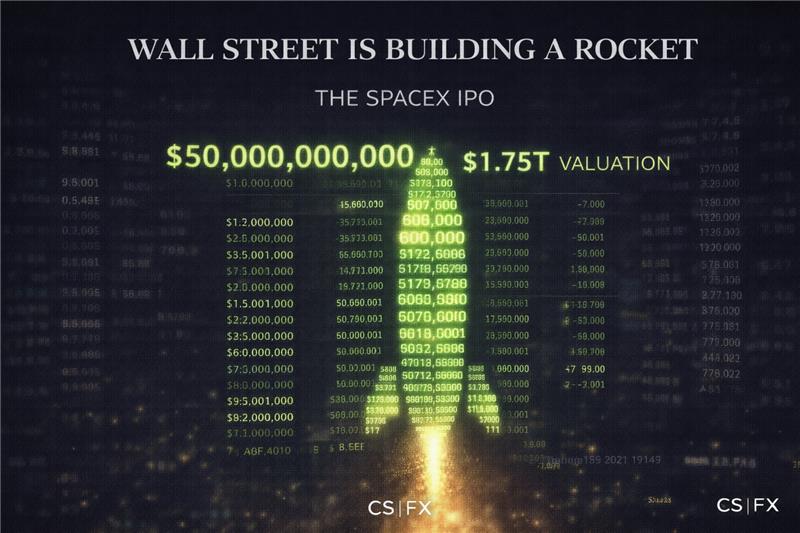
SpaceX is filing confidential paperwork with the SEC this month. The target: a $1.75 trillion valuation and a $50 billion capital raise that would shatter every record in financial history. Behind it, OpenAI and Anthropic are watching and waiting. Welcome to the IPO year of the century — and why every trader on earth needs to understand what happens next.
There are IPOs, and then there are events. Facebook going public in 2012 was an event. Alibaba’s record-shattering NYSE debut in 2014 was an event. Saudi Aramco’s $1.7 trillion listing in 2019 — the largest in human history — was an event so large it briefly made every other company on earth look modestly priced. And now, on a Monday morning in March 2026, the financial world has woken up to the news that SpaceX is filing confidential paperwork with the US Securities and Exchange Commission this month, targeting a $1.75 trillion valuation, a June 2026 stock market debut, and a capital raise of up to $50 billion that would obliterate Saudi Aramco’s record the way a Falcon 9 obliterates the sound barrier.
To put that number in perspective: Aramco raised $25.6 billion and broke every record ever set. SpaceX is targeting twice that. No company in the history of capital markets has raised $50 billion in a single offering. This is not hyperbole. This is the actual number on the table, confirmed by Bloomberg, Reuters, and every major financial news outlet simultaneously on the morning of February 27th, 2026.
And here is the detail that makes the story genuinely extraordinary: this is not a distressed fundraise, a government bailout, or a desperate grab for liquidity. SpaceX is profitable. Starlink is growing at a pace that makes most software companies look slow. The launch division has structural cost advantages that traditional aerospace can only dream of. The company is going public not because it needs the money in the way most companies do — but because 23 years of private compounding have created a machine that the public markets now simply cannot ignore.
At $1.75 trillion, SpaceX would be worth more than the entire GDP of Canada, more than double the GDP of the Netherlands, and roughly equivalent to the combined market capitalisation of every company listed on the London Stock Exchange outside the FTSE 100. It is, in the most literal sense, a number that requires a moment of quiet reflection before anyone continues the conversation.
01 — THE NUMBERS What $1.75 Trillion Actually Means in the Real World
Numbers of this magnitude lose meaning quickly without context. So let’s build the context carefully. At a $1.75 trillion valuation, SpaceX would enter the public markets sitting behind only five companies in the entire S&P 500 — Nvidia, Apple, Alphabet, Microsoft, and Amazon. It would surpass both Meta and Tesla by market value on day one. It would become, instantaneously, the most valuable aerospace company ever to exist — by a margin so wide that Boeing, Airbus, and Lockheed Martin combined would not reach its shadow.
◆ All figures approximate. SpaceX valuation is targeted pre-IPO figure. Sources: Bloomberg, Reuters, public filings.
The engine underneath this valuation is not rockets — though the rockets are impressive. It is Starlink, SpaceX’s satellite broadband division, which has quietly transformed from a moonshot project into a global telecommunications utility. By the end of 2025, Starlink had 9.2 million active subscribers — having effectively doubled its user base in just 15 months. The business crossed $10 billion in annual revenue in 2025, with analysts projecting revenues between $15.9 billion and $24 billion for 2026. It turned profitable in 2024, when its subscriber base was roughly half its current size.
And the margin profile is what is making institutional investors quietly lose sleep with excitement. SpaceX generates estimated EBITDA margins of approximately 50%. Traditional aerospace companies in the S&P 500 — the Boeings, the Raytheons — typically manage around 20%. This is not an aerospace company that happens to have good margins. This is a technology company that happens to own rockets.
02 — THE HISTORY Every Great IPO Rewrote the Rules. This One Rewrites the Rulebook.
To understand what a $50 billion raise would actually mean for global markets, you need to understand what the previous records looked like — and how different this moment is from every one of them.
| Company | Year | Capital Raised | Valuation at IPO | First Day Return | 3-Year Return |
|---|---|---|---|---|---|
| Saudi Aramco | 2019 | $25.6B (record) | $1.7T | +10% | +28% |
| Alibaba (NYSE) | 2014 | $21.8B | $167B | +38% | -15% (political risk) |
| SoftBank Corp | 2018 | $21.3B | ~$60B | -14.5% | Underperformed |
| Facebook (Meta) | 2012 | $16B | $104B | -11% (tech glitch) | +200%+ |
| Visa | 2008 | $17.9B | ~$42B | +28% | +300%+ (10yr) |
| SpaceX (projected) | June 2026 | $50B (target) | $1.75T | TBD | Unknown |
The critical insight from this table is not the size — it’s the structure. Saudi Aramco’s $25.6 billion raise sounds comparable until you realise it represented just 1.5% of the company’s total shares, listed almost entirely to domestic Saudi investors, with most international roadshows cancelled due to lukewarm demand abroad. SpaceX is targeting a real public float accessible to global institutional and retail investors, backed by Bank of America, Goldman Sachs, JPMorgan, and Morgan Stanley simultaneously — the full four horsemen of the investment banking apocalypse.
“The market has never absorbed a trillion-dollar IPO where liquidity was the goal. The largest comparable, Alibaba at $231 billion, was a fifth to a tenth the size of SpaceX’s target.” — Tomasz Tunguz, Theory Ventures, March 2026
Alibaba is the better historical parallel, not Aramco. And even Alibaba — which raised $21.8 billion at a $167 billion valuation — started its float at 15% of the company and expanded to 86% as founders and early investors exited over time. At SpaceX’s target valuation, $50 billion represents roughly 2.9% of the company. The liquidity question that nobody has fully answered yet is: how does the market absorb the rest over time?
One detail buried in the reporting that deserves more attention: there is speculation that Elon Musk has timed the IPO debut for June 2026 — specifically around June 28th, his birthday. Whether or not this is true, it is the most expensive birthday party in the history of the capital markets, and the invitations have been sent to every institutional investor on earth. The dress code is presumably: bring your chequebook.
03 — THE XAI WILDCARD Rockets Meet Artificial Intelligence — One Balance Sheet to Rule Them All
Here is the detail that makes the SpaceX IPO story genuinely novel and not simply a replay of previous mega-listings: in February 2026, SpaceX completed an all-stock merger with Elon Musk’s artificial intelligence company xAI. The combined private valuation at the time of merger was approximately $1.25 trillion. The merger structured xAI as a wholly owned subsidiary, integrating Grok AI and related artificial intelligence products directly with SpaceX’s orbital infrastructure.
The stated vision is something that would have sounded like science fiction five years ago: space-based AI data centres. The idea that the next generation of AI compute infrastructure might literally orbit the planet — powered by solar energy, cooled by the void of space, operating outside terrestrial regulatory jurisdictions — is simultaneously audacious, plausible, and exactly the kind of long-duration story that commands the astronomical valuation multiples the market is currently assigning to this company.
What the combined entity now contains under one balance sheet: Starlink broadband (9.2M subscribers, $10B+ revenue), Falcon 9 and Starship launch vehicles (50%+ of all global orbital launches), Grok AI and associated AI products, and indirect exposure to X (the social media platform formerly known as Twitter) through xAI’s ownership structure. It is, by any measure, the most unusual collection of assets ever assembled for a single public market listing.
04 — MARKET IMPACT Every Asset Class Has a Position in This Trade
A $1.75 trillion listing does not happen in a vacuum. It sends ripples — some of them waves — across every major asset class and sector. Here is what traders and investors need to be watching:
◆ * 2026 projection based on analyst estimates (Quilty Space / Bloomberg). Profitability marker at approx. 4.6M subscribers, mid-2024.
05 — THE PIPELINE SpaceX Is Just the First Domino. OpenAI and Anthropic Are Watching.
Bloomberg described the SpaceX filing as potentially “the first of a trio of mega-IPOs” — and the other two members of that trio are arguably even more consequential for the future of global markets. OpenAI is reportedly pursuing a public valuation of $750 billion to $830 billion, having completed a $10.3 billion secondary sale in 2025 that already began clearing the pent-up selling pressure from early employees and investors. Anthropic — the AI safety company in which Anthropic’s investors include Google and Amazon — is expected to pursue approximately $10 billion in funding at a valuation approaching $350 billion.
If all three list in 2026, the total new market capitalisation entering public markets exceeds $2.9 trillion. To put that in context: the entire annual GDP of France is approximately $3.1 trillion. The global IPO market will need to absorb the equivalent of France’s annual economic output in new public market listings — in a single year. The institutional demand is there. But so is the liquidity risk.
◆ Bar length represents company valuation, not capital raised. SpaceX targets raising $50B (2.9% of $1.75T).
“SpaceX, OpenAI and Anthropic may face less liquidity pressure than feared — all three have run regular tender offers for years, allowing employees and early investors to sell before any IPO.” — Tomasz Tunguz, Theory Ventures, March 2026
06 — THE RISKS Every Star That Burns This Bright Casts a Very Long Shadow
No honest analysis of the SpaceX IPO is complete without a clear-eyed look at the risks — because there are several, and they are not trivial. History is littered with IPOs that entered markets as world-changing events and exited as cautionary tales. Some recovered (Facebook). Some did not (WeWork, Uber’s early years). The question for SpaceX is which category it inhabits.
| Risk Category | The Concern | Severity | Historical Parallel |
|---|---|---|---|
| xAI Integration | All-stock merger adds complexity. xAI’s exposure to X (Twitter) carries reputational and political baggage that institutional investors may price as a discount. | Medium | Conglomerate discount risk |
| Starship Timeline | Starship development is critical to SpaceX’s next revenue tier. Delays would materially affect forward projections and market confidence. | Medium-High | Boeing 737 Max delays |
| Valuation Discipline | At $1.75T, every future disappointment becomes instantly expensive. The market has no tolerance for stumbles at these multiples. | High | Facebook day 1 (−11%) |
| Geopolitical Risk | US government contracts form a significant revenue base. A change in administration policy or international tension could affect contract flow. | Medium | Aramco + Khashoggi (valuation discount) |
| Musk Concentration | Elon Musk’s public profile, political activities, and simultaneous management of Tesla, xAI, and X create unique key-person risk for public market investors. | High | No direct parallel — genuinely novel |
| Market Timing | S&P 500 just posted worst month since March 2025. Tariff uncertainty, inflation, and a new Fed chair arriving in May create a complex macro backdrop for a June listing. | Medium | Alibaba HK 2019 (democracy protests) |
Every serious analysis of SpaceX must contain a sentence acknowledging that Elon Musk is, simultaneously, the company’s greatest asset and its most unpredictable variable. The man who can add $200 billion to Tesla’s market cap with a single tweet is also the man who can subtract it just as quickly. SpaceX’s S-1 filing will almost certainly contain a risk factor that reads something like “our executive chairman’s public communications may materially affect our share price.” It will be the most accurate sentence in the document.
07 — WHAT HAPPENS NEXT The Timeline Every Trader Should Have on Their Calendar
The mechanics of the SpaceX IPO matter as much as the valuation. The company has chosen to file confidentially with the SEC — a procedure that allows it to work through regulatory and financial disclosure requirements privately before making its financials public. Under SEC rules, there must be a minimum 15-day gap between public disclosure and the start of the IPO roadshow. With a March filing, this positions SpaceX for a May/June roadshow and a June listing.
The wildcard in the timeline is Starship. A major test launch of the next-generation Starship vehicle is expected in late March 2026. A successful orbital mission would provide the technical validation necessary to lock in institutional backing for the June IPO. A failed launch — or a partial failure — could complicate the narrative at a moment when the company most needs its story to be pristine. Space is unforgiving, and so are IPO roadshows.
For traders watching this in real time, the critical data points are: the public filing date (triggers the 15-day clock), the Starship launch outcome (technical de-risking), the roadshow dates (final valuation anchoring), and the first day of trading (the moment when 23 years of private compounding meets public market price discovery). Each one is a potential entry or exit signal depending on your positioning.
And beyond SpaceX: watch OpenAI’s response to the filing. If SpaceX’s SEC process goes smoothly, OpenAI is likely to accelerate its own timeline. The IPO market of the second half of 2026 may look unlike anything the financial industry has seen since the dotcom era — only this time, the companies going public are actually profitable.
In 1969, NASA put a man on the moon and the world watched in silence. In 2026, SpaceX is preparing to put a rocket company on the stock market — and the world is watching in a rather different kind of silence: the kind where institutional investors are quietly calculating how much of their quarterly allocation they can direct toward a single $50 billion offering without their compliance department asking too many questions. The moon landing changed humanity’s relationship with space. This IPO is about to change the market’s relationship with it. The countdown clock has started. T-minus approximately 90 days.
◆ DATA SOURCES: Bloomberg · Reuters · SatNews · Financial Times · Prism News · The Kobeissi Letter · Tomasz Tunguz / Theory Ventures · Quilty Space · MoneyCheck · MEXC News · Blockonomi · PANews · DealRoom · DesignRush · StockHoney · CoinCentral · IndexBox