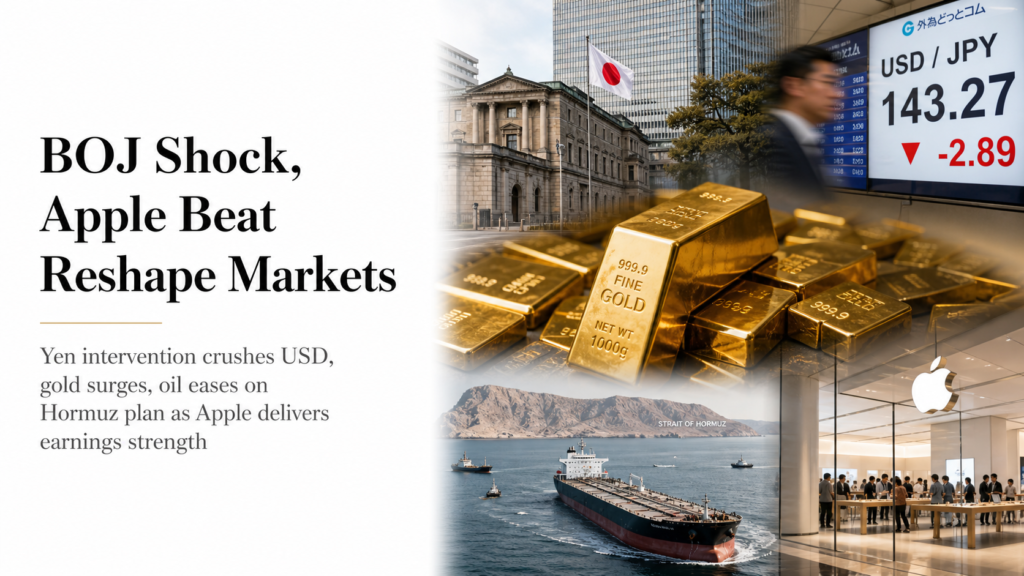

5 Market-Breaking Stories You Cannot Ignore Today — March 2, 2026
Five Stories
Reshaping Every
Market Right Now
War in the Middle East. A nuclear state in open conflict with its neighbour. An AI reckoning sending shockwaves through Wall Street. Inflation that won’t die. A world order unravelling in real time. This is the news you cannot afford to miss.
Analysed
Ongoing
at Hormuz Risk
YTD 2026
Annual Rate
Record High
Operation Epic Fury: The United States and Israel Have Taken the World to the Edge of a New Oil War
In the early hours of Saturday, February 28, the world changed. The United States and Israel launched what they are calling “Operation Epic Fury” — a coordinated, multi-day military assault on Iran unlike anything seen in the modern era. Over 1,000 targets across nine Iranian cities were struck. B-2 stealth bombers flew from Missouri to obliterate hardened ballistic missile facilities. Israeli F-35s established air superiority over Tehran and, in what Israel calls “a historic strike,” killed Supreme Leader Ayatollah Ali Khamenei — a man who had ruled the Islamic Republic for 37 years — along with the country’s defence minister, its armed forces chief, and the commander of the Revolutionary Guards. “The majority of the highest-ranking senior military officials of the Iranian security leadership have been eliminated,” the IDF stated.
⚠ Most Critical Market VariableThe Strait of Hormuz — the narrow chokepoint through which roughly 20 million barrels of oil pass daily — has effectively halted commercial shipping. US maritime authorities told vessels to “keep clear of this area if possible.” One estimate from Oxford Economics projects oil at $115/barrel if Iran succeeds in closing the Strait to traffic. Even without full closure, insurers are refusing cover on ships transiting the Gulf.
Iran’s retaliation has been swift, wide, and real. Ballistic missiles and drones have struck US military bases across the Gulf — Al-Udeid in Qatar, Bahrain’s Fifth Fleet HQ, Al-Salem in Kuwait (where three US soldiers were killed), Al-Dhafra in the UAE. Civilian airports were hit too. Dubai’s Jebel Ali Port caught fire from drone debris. Iran struck 165 ballistic missiles at the UAE alone, according to Abu Dhabi’s Defence Ministry. In the first hour of March 2, a drone reportedly struck RAF Akrotiri on Cyprus — bringing the conflict to European soil for the first time. Ben Gurion Airport remains closed. The US Embassy in Jerusalem has told Americans it cannot help them evacuate.
President Trump, speaking to CNBC, described operations as “ahead of schedule” and projected the campaign would last “one month or less.” The stated objectives — destroying Iran’s missile capability, ending its nuclear programme, and triggering regime change — are vast. Analysts broadly contest whether they can be achieved through airpower alone. As Stimson Center experts wrote: “air strikes alone cannot topple a government.”
For financial markets, the calculus is stark. Brent crude opened Monday up 9–12%, briefly topping $80/barrel. Gold surged 3.3% to $5,278 as safe-haven demand exploded. US equity futures plunged — the Dow is down 800 points pre-market. Every oil-importing economy from Japan to Germany to India faces a potential stagflationary shock. The OPEC+ announcement of a +206,000 barrel-per-day increase for April partially offsets the concern but does nothing to address the shipping risk.
| Asset | Move | Why | Outlook |
|---|---|---|---|
| Brent Crude | +9–12% / ~$80/bbl | Hormuz de facto closure, supply risk | $85–115 if closure persists |
| Gold | +3.3% / $5,278 | Geopolitical safe-haven demand | Elevated; record run continues |
| US Equity Futures | DOW –800, SPX –1.33% | Risk-off; oil inflation fear | Volatile; war duration is key |
| Defence Stocks (BAE, RTX) | Strong bid expected | Conflict escalation; NATO alert | Structural outperformers |
| Shipping/Aviation | Sharply lower | Gulf routes closed; insurers out | Severe disruption if prolonged |
| US Treasuries | Yields falling | Flight to quality | 10Y was 3.98%; heading lower |
Pakistan and Afghanistan Are Now at War — And One of Them Has Nuclear Weapons
The world was so transfixed by Iran that it almost missed the second war breaking out simultaneously in South Asia. Pakistan — a nuclear-armed state with 160+ warheads and a long history of military adventurism — formally declared “open war” on Afghanistan on February 27, after weeks of escalating cross-border strikes. Pakistani jets have now bombed Kabul, Kandahar, and Bagram Airbase. Afghanistan’s Taliban government has retaliated with drone attacks, ground assaults, and artillery strikes on Pakistani border posts, claiming to have killed 55 Pakistani soldiers.
⚠ Why Markets Should CareThis is not a proxy conflict. Pakistan is a nuclear state. Its economy is fragile — it received a critical IMF bailout in 2023 and remains on life support. An open war against Afghanistan disrupts critical trade routes, threatens India-Pakistan stability, and adds a second theatre of geopolitical instability at a moment when global risk appetite is already collapsing from the Iran conflict.
The roots are deep. Pakistan has long accused the Taliban of harbouring the TTP — the Pakistani Taliban — which has launched a string of devastating attacks inside Pakistan, including a massive suicide bombing in Islamabad in February that triggered this escalation. As Pakistan’s Defence Minister Khawaja Asif put it: “our patience has run out.”
The Taliban, battle-hardened from 20 years of fighting the US and NATO, are not an easy opponent. Kabul residents described being woken by explosions and gunfire, watching “bullet-like flames going up in the sky.” Pakistan’s military claims 73 Taliban posts destroyed; Afghanistan claims 19 Pakistani posts taken. CNN, Al Jazeera, and the Washington Post all report cross-border capital strikes in both directions. Qatar is attempting mediation. Prediction markets are currently pricing only a moderate probability of a ceasefire by March 31.
For markets, the Pakistan-Afghanistan war compounds the Iran crisis in important ways. Pakistan is a major transit corridor for Central Asian trade. A prolonged conflict will disrupt supply chains, push up food prices (Pakistan is a major wheat and cotton exporter), and add another layer of instability to already-stressed emerging market portfolios. Watch the Pakistani rupee, Indian equity markets, and any South Asia-exposed ETFs for early signals of contagion.
America’s Inflation Problem Just Got Dramatically Worse — And the Fed Has Run Out of Easy Answers
Just 48 hours before the Iran bombs fell, Wall Street was already reeling. On Friday, February 27, the Bureau of Labor Statistics released January’s Producer Price Index — and it was a genuine shock. Headline PPI rose 0.5% month-on-month, against a consensus of 0.3%. Core PPI, stripping out food and energy, surged 0.8% — more than double the 0.3% forecast — bringing the annual core rate to 3.6%, the highest reading in ten months. The Dow dropped 521 points. The S&P 500 and Nasdaq closed February in the red.
⚠ Why This Is Bigger Than a DatapointServices prices drove the increase with their biggest monthly gain since July 2025. This is the most damning part of the report — it isn’t commodity-driven volatility, it is sticky, embedded inflation. Economists at RBS Capital Markets told CNN directly: “tariffs are being passed through along the supply chain.” The full effect hasn’t hit consumer prices yet. It is coming.
The problem this creates for the Federal Reserve is almost unsolvable. The economy grew just 1.4% in Q4 — less than half of the 2.8% forecast, with a 43-day government shutdown carving out roughly 1 percentage point. Inflation is reaccelerating. The two conditions have a name: stagflation. Jerome Powell’s term ends in May; his replacement, Kevin Warsh, will inherit a trapped institution that can neither cut (inflation is too hot) nor hike (the economy is too fragile) without causing serious damage. Futures markets are now pricing virtually zero chance of a rate cut before June, and the oil shock from the Iran crisis will only harden that outlook further.
Add the Supreme Court’s ruling against Trump’s use of emergency powers for tariff implementation — forcing a pivot to a 10% universal levy via Section 301 — and you have complete policy uncertainty layered on top of economic fragility. As SWBC’s market commentary observed: “markets cannot decide whether to treat this as disinflationary (tariff rollback) or as a deepening policy quagmire.”
| Indicator | Reading | vs Forecast | Implication |
|---|---|---|---|
| PPI Headline (Jan) | +0.5% MoM | +0.2% surprise | Tariff pass-through underway; more CPI pressure ahead |
| Core PPI (Jan) | +0.8% MoM / 3.6% YoY | +0.5% shock | Services inflation sticky; worst reading in 10 months |
| Q4 GDP | +1.4% | –1.4% miss | Economy slowing; shutdown cost ~1%; stagflation risk elevated |
| Core PCE (Jan) | +0.355% MoM (~0.4%) | Above target | Largest monthly gain in 12 months; Fed’s own preferred metric flashing hot |
| Rate Cut Probability (pre-June) | ~0% | — | Fed on hold; oil shock will extend the pause further |
| 10-Year Treasury Yield | 3.981% (falling) | — | Geopolitical flight to safety offsetting inflation: temporary |
Today’s ISM Manufacturing PMI release at 10:00 AM ET arrives in this environment like a lit match near a gas leak. A reading below 50 — the contraction threshold — would combine with the hot PPI, the Iran shock, and the GDP miss to create a powerful triple-threat narrative. Watch the Prices Paid sub-index particularly: if it shows businesses are already absorbing the energy shock, the Fed’s credibility will be tested within days.
The AI Trade Has Fractured — And February 2026 Was the Month Wall Street Finally Admitted It
Something broke in February 2026, and the cracks are not closing quickly. The AI trade — the thesis that has powered markets since 2023 — is experiencing its most severe crisis of confidence yet. Consider the contradictions that defined the month’s final week alone: Nvidia reported earnings that beat estimates by $2 billion and the stock fell 10%, erasing $260 billion in market cap, because investors had priced perfection and received something less. CoreWeave — an actual AI infrastructure company — crashed 20% after posting weak guidance despite revenue of $1.57 billion, because the market suddenly started asking when any of this makes money. Block, Jack Dorsey’s payments company, announced it was firing more than 4,000 employees — nearly half its workforce — betting that AI agents could replace them. Its stock surged 18%. The market cheered the pink slips.
🔍 The Real Disruption SignalBlock’s rally on mass layoffs is the most telling data point of the month. It means the market is now explicitly pricing AI as a labour replacement engine, not just a productivity tool. Companies that can credibly argue “we will need fewer people because of AI” are being rewarded. Companies that need to keep spending to build AI — without showing returns — are being punished. This is a fundamental restructuring of how the market values technology businesses.
The software sector’s collapse is severe. The iShares Expanded Tech-Software ETF closed February down 10% for the month and is now down 23% year-to-date — its worst quarter since the 2008 financial crisis. Salesforce fell more than 4% on Friday alone. Zscaler dropped 11%. Microsoft declined 2%. The “Magnificent Seven” collectively sit 5% lower in 2026. Meanwhile, equal-weighted S&P 500 is up 6.4% and international equities are up 8%. Capital is rotating away from AI narrative plays and toward companies with actual earnings, actual dividends, and actual products.
OpenAI’s own financial position adds a surreal dimension. The company projects it will lose $14 billion in 2026 — and yet just raised $110 billion, largely from the same tech giants whose chips and cloud services it depends upon. “A funding circle that looks like a perpetual motion machine,” as the Market Breakdown newsletter described it. The question the market is beginning to ask, seriously and aloud, is whether AI productivity gains for companies experimenting with the technology are actually materialising — or whether the ROI remains perpetually in the future.
| Company / Index | February Move | What Happened | Market Signal |
|---|---|---|---|
| Nvidia (NVDA) | –10%; negative 2026 YTD | Beat earnings by $2bn; options wall at $200 not cleared | Market mechanics, not fundamentals — reset buying opportunity? |
| CoreWeave (CRWV) | –20% in one day | Revenue beat, Q1 guidance $1.9–2bn vs $2.29bn expected | AI infrastructure profitability under scrutiny |
| Block (SQ) | +18% on layoff announcement | 4,000+ jobs cut; AI replacing nearly half the workforce | Market pricing AI labour replacement explicitly |
| Software ETF (IGV) | –10% Feb; –23% YTD | AI disruption fear; SaaS business model under threat | Worst stretch since 2008 financial crisis |
| Mag-7 Aggregate | –5% YTD vs – | AI narrative fatigue; equal-weight up 6.4% | Great Rotation: quality vs narrative |
| Dell (DELL) | +22% | Strong hardware earnings — sells shovels in the gold rush | Physical AI infrastructure outperforming software |
The World Order Has Split. Europe Is Rearming, Russia Is Escalating, and America Has Changed the Rules — For Good
Step back from the hourly headlines and a deeper story comes into focus. The United States is fighting an undeclared war against Iran without congressional approval. Pakistan and Afghanistan are in open armed conflict. European leaders are pledging the largest defence spending increases since the Cold War. Russia’s hybrid warfare — arson, sabotage, cyberattacks — is escalating against NATO infrastructure across the continent. A drone reportedly struck RAF Akrotiri on Cyprus in the first hour of Monday, bringing active conflict to European soil. The rules of the post-1945 international order — which provided the operating environment for the greatest era of wealth creation in human history — are being discarded one by one.
🔍 The Geopolitical Pricing Shift“Geopolitics is no longer background noise. It is now a core pricing mechanism,” as Patrick Murphy of Hilco Global told CIO Magazine. An estimated $3.5 trillion in cross-border investments have already been reallocated. Investors are migrating toward defence, critical minerals, domestic-production stories, and hard assets. The era of global capital freely seeking optimal returns regardless of political boundaries is ending.
The Iran war is already drawing in European allies. British Prime Minister Keir Starmer said the UK would allow US use of British bases for “defensive” strikes. The EU three — UK, France, Germany — have pledged to back “proportionate military defensive measures” if needed. This brings Europe closer to direct participation in a Middle East conflict than at any point since Suez. Meanwhile, at NATO’s eastern flank, the most dangerous front has shifted from Ukrainian trenches to the hybrid war between Russia and NATO members, with Moscow systematically testing the limits of what provocation the alliance will tolerate.
For traders, the structural implications are profound and durable. Defence and aerospace stocks are structural long positions now — not cyclical plays. BAE Systems, Rheinmetall, L3Harris, RTX, and their peers are pricing in a decade of elevated government procurement. Critical minerals — lithium, cobalt, copper, rare earths — are becoming geopolitical assets as supply chain security becomes a national security priority for every major power. Gold’s record run (best year since 1979 through 2025, and already up 3.3% this morning) reflects a fundamental repricing of political risk, not a temporary spike.
| Theme | Investment Expression | Timeframe | Conviction |
|---|---|---|---|
| Defence & Aerospace | BAE, Rheinmetall, RTX, L3Harris; FTSE heavy defence weighting | Multi-year structural | HIGH — secular trend |
| Critical Minerals | Rio Tinto, Glencore, BHP; copper, lithium, rare earth ETFs | 3–10 year | HIGH — supply chain security |
| Gold / Hard Assets | GLD, XAUUSD; physical gold; miners (GDX) | Ongoing | HIGH — political risk premium |
| Energy Majors | BP, Shell, Chevron, ExxonMobil | Near–medium term | HIGH — oil shock beneficiary |
| International Equities | MSCI World ex-US; European defensives; FTSE 100 | 2026 rotation | MODERATE–HIGH vs US exposure |
| US Tech / AI narrative | Selective; avoid pure-play software; prefer hardware/physical infra | Near term | LOW CONVICTION — risk elevated |
The Trader’s Bottom Line
Today is not a normal trading day. It is a day to diagnose, not to rush. The stories above are interconnected — they are not five separate shocks but five expressions of the same structural shift. The world is becoming more dangerous, more inflationary, and more fragmented. Markets are still pricing the old reality. The gap between those two things is where the trades are.