The 21-Mile Waterway That Just Shut Down the World | The Capital Dispatch
The 21-Mile Waterway
That Just Shut Down the World

On February 28, 2026, the US and Israel launched Operation Epic Fury — killing Iran’s Supreme Leader Ayatollah Ali Khamenei and triggering the most consequential geopolitical event since 9/11. The Strait of Hormuz is now effectively closed. Brent crude is heading toward $100. Gold is above $5,400. Airlines are collapsing. UAE real estate is repricing. Food inflation is loading. And every economy on earth is asking the same question: how long?
01 — THE EVENTWhat Happened: The Strike That Changed Everything
At dawn on February 28, 2026, the United States and Israel launched Operation Epic Fury — coordinated strikes on Iran targeting military command centres, nuclear facilities, and senior leadership. Supreme Leader Ali Khamenei was killed in the operation. By that evening, an IRGC naval commander had declared the Strait of Hormuz officially “closed” — and 70% of the world’s most important shipping lane went dark.
Within 24 hours, vessel tracking data confirmed the collapse. At least five tankers were struck, two crew members killed, and 150 vessels anchored in international waters outside the strait, waiting. Maersk, Hapag-Lloyd, CMA CGM, and MSC suspended all Hormuz transits simultaneously. War risk insurance premiums surged 50% overnight. Several marine insurers issued cancellation notices for Persian Gulf war risk coverage effective March 5, 2026.
Iran retaliated with simultaneous missile and drone barrages targeting US military bases and allied Gulf states — hitting facilities in the UAE, Qatar, Bahrain, Jordan, Saudi Arabia, Kuwait, and Oman. Qatar’s Ras Laffan LNG terminal — responsible for 20% of global LNG exports — was struck and forced to halt production. The cascading effects reached every market on earth within hours.
“Closure of the Strait of Hormuz would disrupt roughly a fifth of globally traded oil overnight — and prices wouldn’t just spike, they would gap violently upward on fear alone.”— Ali Vaez, Director of the Iran Project, International Crisis Group
02 — THE CHOKEPOINTThe 21-Mile Bottleneck That Cannot Be Replaced
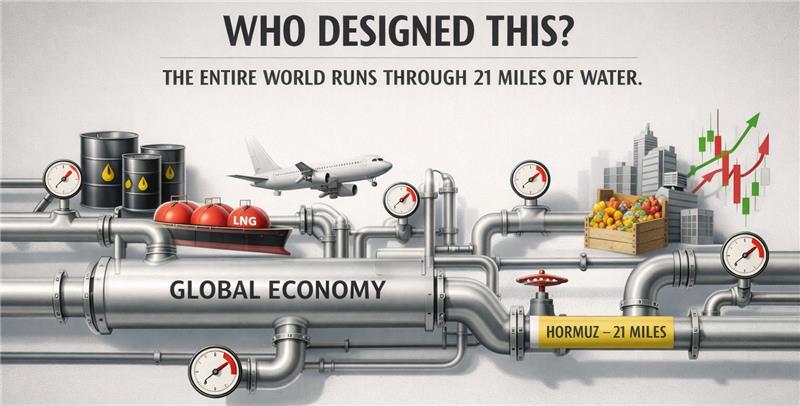
The Strait of Hormuz is the most important single piece of geography in the global economy. Located between Iran and Oman, it measures just 33 kilometres at its narrowest point, with usable shipping lanes of only 3 kilometres in each direction. Through those 6 kilometres of water flows the energy lifeblood of the modern world.
20 million barrels of oil per day (~20% of all globally traded oil) · 20% of global LNG — primarily from Qatar’s North Field · One-third of global fertiliser trade — direct food security consequence · $500 billion in annual global energy trade · 31% of all seaborne crude oil flows (Kpler, 2025)
The alternatives are devastatingly inadequate. Saudi Arabia’s East-West Pipeline handles 5 million barrels per day. The UAE’s Habshan-Fujairah pipeline can handle 1.8 million barrels per day. Combined bypass capacity: 6.8 million barrels per day — against a normal daily flow of 20 million. The remaining 13+ million barrels per day has no alternative route. Ships rerouting around Africa’s Cape of Good Hope add 10-14 days each way, tightening global tanker availability simultaneously.
A standard tanker carries approximately 2 million barrels. Rerouting around Africa adds 10-14 days per voyage each way. At 20 million barrels per day, you would need roughly 140 additional tankers in continuous rotation just to maintain current supply levels. The global tanker fleet does not have that spare capacity. This is not a logistics problem. It is a physics problem.
03 — OIL & ENERGYThe Price Shock That Feeds Everything Else
Brent Crude: From $70 to $100 — and Potentially Far Beyond
Brent crude surged 10-13% in the first 48 hours of the crisis, moving from approximately $70 per barrel to $80. Goldman Sachs has set a baseline target of $100 per barrel if disruption persists beyond 72 hours, with a worst-case scenario of $150 per barrel in an extended blockade. A sustained $100+ oil environment would be the most significant energy price shock since the 1973-74 Arab oil embargo.
◆ Sources: Goldman Sachs, Rystad Energy, Nomura. Analyst estimates, not guarantees.
LNG: Qatar Offline — Europe, Asia, Pakistan All Exposed
Qatar produces approximately 77 million tonnes of LNG annually — the world’s second-largest exporter. All of it transits the Strait. The Ras Laffan strike has forced a production halt, removing 20% of global LNG supply from the market overnight. Pakistan (99% Gulf LNG dependency), Bangladesh (72%), and India (53%) face the most acute immediate exposure. Japan and South Korea have 2-4 weeks of reserves before aggressive spot market bidding begins.
04 — COUNTRY BY COUNTRYWho Gets Hit, How Hard, and How Fast
Asia: The Region With the Most to Lose
Asia accounts for 84% of crude oil and 83% of LNG volumes transiting the Strait. China, India, Japan, and South Korea together absorb 69% of all oil flowing through the waterway.
| Country | Hormuz Oil Dependency | LNG Exposure | Reserve Cover | Risk Level |
|---|---|---|---|---|
| China | ~40-50% of imports | 30% from Gulf | 90+ days (est.) | HIGH — buffered |
| India | ~50% of imports | 53% from Gulf | 30-45 days | CRITICAL |
| Japan | ~85-90% of crude | 6% from Qatar | ~4.4M tonnes LNG | HIGH — price exposed |
| South Korea | 2.7% of GDP in imports | 14% from Gulf | ~3.5M tonnes LNG | CRITICAL · Kospi −5.6% |
| Pakistan | High | 99% from Gulf | Minimal | SEVERE — power risk |
| Bangladesh | High | 72% from Gulf | Very limited | SEVERE — deficit risk |
United States: Low Direct Exposure, High Indirect Inflation Risk
The US imports less than 5% of its oil through the Strait — the least directly exposed major economy. However, oil markets are globally priced. Goldman Sachs estimates sustained $100+ Brent translates to $4-5 per gallon at US pumps, adding 0.4-0.8 percentage points to Core PCE over 3-6 months — on top of the 3.0% already recorded before the crisis. The Federal Reserve’s stagflation trap just snapped shut.
UAE: The Paradox Economy
The UAE occupies the most paradoxical position of any affected economy. As an oil exporter, higher prices boost government revenues. But virtually every other sector faces severe simultaneous stress:
Europe: LNG-Exposed and Already Weakened
Europe imports 6-10% of its LNG from Qatar and the UAE — arriving at the worst possible moment given already-strained energy supplies post-Russia pipeline cuts. Germany’s manufacturing sector faces particular exposure. The ECB’s task — already complicated by persistent inflation — becomes dramatically harder as energy prices spike across the continent. An estimated 30% of Europe’s jet fuel supply also originates from or transits via the Strait.
05 — INDUSTRY BY INDUSTRYThe Ripple Effects Across Every Sector
Aviation: Grounded Routes, Surging Fuel, Collapsing Bookings
Jet fuel prices are up 15-25% within the first week, tracking oil. Gulf airspace closures force reroutes via Central Asia or Africa — adding 3-5 hours and $500K+ per flight in extra fuel. United Airlines fell 6%, American and Delta fell 5%. 30% of Europe’s jet fuel supply originates from or transits via the Strait — airlines face spot market procurement at crisis premiums. Travel insurance claims are surging, with many policies now excluding Middle East coverage entirely.
Shipping & Logistics: The Cape of Good Hope Tax
Every cargo ship rerouting around Africa adds $500,000–$1,000,000 in additional costs per round trip and 10-14 days per voyage. War risk insurance premiums have surged 50%, with cancellation notices arriving for Gulf coverage effective March 5th. For just-in-time supply chains — electronics, pharmaceuticals, automotive components — this is not a cost inconvenience. It is a supply chain rupture.
Food Prices: The Fertiliser Transmission Mechanism
One-third of global fertiliser trade transits the Strait. Fertiliser is the direct input into food production. When fertiliser prices spike, food prices follow with a lag of 4-8 weeks. World food price inflation of 8-15% within two months is not a tail risk — it is a base case.
◆ Estimated 6-8 week lag from fertiliser disruption to retail food prices. Sources: FAO, World Bank commodity data.
Tourism: The Gulf’s Crown Jewel at Risk
Dubai welcomed 18.7 million international visitors in 2025. That success story is on pause. Western government travel advisories have placed Gulf destinations on ‘reconsider travel’ ratings — which historically suppress bookings for 6-18 months regardless of actual security conditions. MICE bookings — Dubai’s highest-value tourism segment — are moving to Singapore, London, and Lisbon. Saudi Arabia, Abu Dhabi, and Qatar all face parallel disruption to their own diversification strategies built on tourism investment.
Defence & Security: The Only Sector Celebrating
Northrop Grumman +6%, Palantir +5.8%, Raytheon, Lockheed Martin, BAE Systems — all surging. Middle Eastern governments are simultaneously accelerating defence procurement. The defence sector will see multi-year demand uplift regardless of how quickly this conflict resolves.
06 — THE INFLATION MACHINEHow This Reaches Every Household on Earth
| Timeline | Event | What Happens | Who Feels It |
|---|---|---|---|
| Week 1 | Oil spike $80-90 | Wholesale energy surges. Shipping costs jump. War risk insurance doubles. | Energy companies, shipping, investors |
| Week 2-3 | Supply chain disruption | Airfreighted goods (electronics, pharma) up 10-15%. Fresh produce rises at supermarkets. | Consumers in UAE, Europe, UK — first movers |
| Month 1-2 | Oil sustains $90-100 | Petrol/gasoline up 15-30%. Electricity bills rising. Fertiliser surging. Food inflation begins. | All households globally |
| Month 2-3 | Fertiliser + food cascade | Wheat, corn, rice up 8-15%. Protein costs rising. Processed food increases. | Global food systems — worst in import-dependent economies |
| Month 3-6 | Core inflation re-accelerates | Central banks face stagflation trap. Emerging market currencies under pressure. | Central banks, governments, every economy globally |
The 1973 Arab oil embargo cut supply by 4-5 million barrels per day and caused a 400% oil price spike that triggered a global recession lasting nearly two years. The 2026 Hormuz closure threatens to remove 20 million barrels per day — five times the 1973 disruption — from an economy already running with high inflation, elevated debt, and central banks with significantly less policy room. History is repeating. In the same sequence. With bigger numbers.
07 — FINANCIAL MARKETSEvery Asset Class Has a Trade
| Asset Class | Direction | Analysis |
|---|---|---|
| Brent Crude Oil | ▲ Strongly Bullish | $80 now, $100 base case, $150 worst case. Every day of disruption is structurally bullish oil. |
| Gold | ▲ Bullish | Above $5,400/oz. JPMorgan target $6,300 year-end. Safe haven + inflation hedge + dollar hedge = three simultaneous tailwinds. |
| Defence Stocks | ▲ Bullish | Northrop +6%, Palantir +5.8%, Raytheon, Lockheed, BAE Systems all surging. Multi-year demand uplift virtually guaranteed. |
| Agricultural Commodities | ▲ Bullish | Wheat, corn, rice, palm oil exposed to fertiliser transmission. Agriculture commodity funds and soft commodity futures relevant. |
| Airlines | ▼ Bearish | United -6%, American -5%, Delta -5%. Fuel costs + route disruption + demand collapse = structural quarterly EPS miss across the sector. |
| Shipping / Logistics | ▼ Bearish | Maersk, Hapag-Lloyd suspended. Cape reroutes add massive cost. War risk premiums hit margins severely. |
| EM Currencies | ▼ Bearish | Indian Rupee, Pakistani Rupee, Korean Won, Indonesian Rupiah under pressure. Current account deficits worsen with rising oil import bills. |
| Gulf Real Estate | ▼ Bearish (mid-market) | Dubai mid-market: 15% correction risk per Fitch. ‘Safe haven’ positioning under direct challenge. Luxury resilient but not immune. |
| Global Equities | ⟺ Mixed | Short term: selling pressure on growth, tech, consumer. Bifurcation: energy/defence bullish, everything else bearish. MSCI Asia -2.2%. |
| US Treasuries | ⟺ Complex | Safe haven buying vs. rising inflation expectations vs. fiscal deficit concerns. Short-term flight to quality; yields will ultimately rise. |
08 — HISTORICAL PARALLELSWhat the Past Tells Us About Duration and Recovery
| Crisis | Year | Supply Removed | Oil Price Peak | Duration & Outcome |
|---|---|---|---|---|
| Arab Oil Embargo | 1973-74 | 4-5M bpd | +400% | 5 months · Triggered global recession lasting ~2 years |
| Iranian Revolution | 1979 | 2-3M bpd | +150% | 12+ months · Stagflation decade followed |
| Gulf War (Iraq) | 1990-91 | 4-5M bpd | +130% (brief) | 7 months · Resolved by US-led coalition |
| Post-9/11 | 2001 | Demand shock | -35% initially | 6-12 months · Demand-led slowdown |
| 2019 Tanker Attacks | 2019 | Partial disruption | +15% brief spike | Weeks · War risk premiums elevated for months |
| 2026 Hormuz Crisis | 2026 | 13-20M bpd risk | +11% and rising | ONGOING — resolution unknown |
09 — DURATION & RESOLUTIONHow Long Does This Last?
| Scenario | Timeline | Conditions Required | Economic Impact |
|---|---|---|---|
| Rapid Ceasefire | 2-4 weeks | Iran’s successor government stabilises; US offers security guarantees; Saudi Arabia mediates | Oil elevated 3-6 months. Tourism recovery 6-12 months. Markets recover within weeks of ceasefire. |
| Protracted Conflict (Base Case) | 2-6 months | Military ops continue. Partial shipping under naval escort. Diplomacy begins but moves slowly. | Oil above $90 for 3-6 months. Global inflation +1.0-1.5% CPI. Gulf real estate 15-20% correction. |
| Extended Blockade | 6+ months | Full-scale regional war. Multiple state actors. No clear diplomatic pathway. | Oil $100-150+. Global recession risk. Inflation crisis. Gulf real estate 25-35% correction. |
| Escalation / Pipeline Strike | Months+ | Saudi Aramco infrastructure targeted. Multiple Gulf assets struck. | Oil $150-200+. Structural shift in global energy routes. Multi-year economic damage. |
The critical indicator to watch is not news headlines — it is tanker transit data and Lloyd’s war risk insurance rates. When those two data points begin normalising, the shipping lane is reopening regardless of what official statements say. MarineTraffic and Kpler provide real-time vessel data. Lloyd’s war risk pricing is published daily.
10 — THE BOTTOM LINEWhat Traders, Investors and Citizens Need to Know Right Now
The Strait of Hormuz crisis of 2026 is not a crisis that can be modelled with conventional tools. It does not fit neatly into a discounted cash flow analysis or a Fed reaction function. It is a geopolitical rupture that is simultaneously an energy shock, an inflation accelerant, a humanitarian catastrophe, a real estate repricing event, a supply chain collapse, and a test of whether the post-1945 international order has any remaining structural integrity.
What we know with high confidence: oil prices will remain elevated for weeks to months regardless of ceasefire timing, because shipping insurance markets and tanker rerouting decisions move slowly. Food inflation will follow with a 6-8 week lag. Tourism and aviation disruption in the Gulf will persist for months regardless of resolution, as travel advisories, insurance markets, and consumer confidence all move slowly. The UAE’s ‘safe haven’ positioning has been materially damaged and will require years of diplomatic stability to fully restore.
What we know with moderate confidence: the Fed is now in a genuine policy trap. Core PCE was at 3.0% before the crisis; it will be higher after it. Kevin Warsh, arriving as Fed Chair in May 2026, may open his chairmanship with a hike — not a cut.
In 1973, an oil embargo changed humanity’s relationship with energy. In 2026, a 21-mile strait is changing the global economy’s relationship with fragility. The most optimised supply chains are also the most breakable ones. The tuition for this lesson — measured in GDP lost, inflation sparked, real estate repriced, and tourism cancelled — has already been paid. The question now is who is still writing the cheque when it finally clears.
◆ DATA SOURCES: Bloomberg · Reuters · Al Jazeera · CNBC · Goldman Sachs · Fitch Ratings · Kpler · Rystad Energy · International Crisis Group · IEA · EIA · FAO · Khaleej Times · Gulf News · Nomura · SpecialEurasia · Convera · Wikipedia · MarineTraffic
Frequently Asked Questions
The most searched questions about the Strait of Hormuz crisis, Iran conflict, oil prices, and global economic impact — answered.
Conclusion: The World After the Strait
The Strait of Hormuz crisis of 2026 is not simply a geopolitical event. It is a stress test of the entire architecture of globalisation — the network of assumptions, logistics routes, financial instruments, and diplomatic relationships that the modern world economy is built upon. When those 21 miles of water went dark, they did not just disrupt oil supply. They exposed how much of the world’s daily functioning depends on a single, narrow, unredundant chokepoint.
The immediate consequences are clear: oil above $80 and rising, gold above $5,400, airline stocks collapsing, food inflation loading in the supply chain, and the UAE’s “safe haven” positioning taking its first serious credibility hit in two decades. The secondary consequences — the ones that will matter most to investors, businesses, and households over the next 6 to 18 months — are still unfolding.
The inflation transmission mechanism is now running. Fertiliser prices will push food costs higher within 6-8 weeks. Jet fuel surcharges appear on airline tickets within days. Utility bills in LNG-dependent countries — Pakistan, Bangladesh, Japan, South Korea — will rise sharply within weeks. And the Federal Reserve, already trapped between 3.0% Core PCE and a slowing economy, now faces the most complex monetary policy environment since the Volcker era. Kevin Warsh may begin his chairmanship with a rate hike, not a cut.
The longer structural lesson is one the world has been offered many times and refused to learn: the most efficient supply chains are also the most fragile ones. The Hormuz chokepoint risk was known, documented, and modelled in every energy security report since the 1970s. The crisis of 2026 may finally force the infrastructure investment to build a real alternative. As with most expensive lessons in history, the tuition has already been paid.
Published March 3, 2026 by The Capital Dispatch at Capital Street FX (capitalstreetfx.com). For informational purposes only. Not financial advice. Sources: Bloomberg, Reuters, Goldman Sachs, Fitch Ratings, Kpler, IEA, and publicly available market data.