The Almighty Dollar: A Complete History of USD Price Movements | The Capital Dispatch
The Almighty Dollar:
A 100-Year History of America’s
Most Powerful Export

From gold-backed empire to floating fiat — the complete story of the US Dollar: every crash, every surge, every secret hotel meeting, and every force that makes the world’s reserve currency tick. Spoiler: it’s still standing. Barely.
Feb 1985 · Volcker Era
Mar 2008 · Pre-GFC
End-2025 · Down from 71%
Record · Nov 2025
Worst in 50 Years
Base Value = 100.00
There are roughly 180 currencies on this planet. Only one gets called “the Almighty.” If you’ve ever wondered why the price of oil, gold, your morning coffee, and a Pakistani rupee all sneeze simultaneously when Washington changes its interest rate — this is the article you’ve been waiting for.
The US Dollar’s story is not merely a financial one. It is a saga of wars, political miscalculations, brilliant policies, spectacular blunders, Camp David secrets, international hotel lobbies, and one very uncomfortable phone call between a sitting US president and a gold bar. It is a story about power — who has it, who wants it, and how a small green rectangle became the closest thing to a universal language that seven billion people have ever agreed upon.
This deep-dive traces the dollar’s journey from its gold-shackled past through the chaos of floating exchange rates, Volcker’s brutal shock therapy, the Plaza Accord conspiracy, the dot-com boom, the 2008 near-death experience, COVID pandemonium, the 2022 supercharge, and where the greenback stands today — battered, questioned, and stubbornly, infuriatingly dominant.
Approximately 65% of all US dollar banknotes circulate outside the United States. The dollar isn’t just America’s currency — it is the world’s. Roughly $2 trillion in physical bills float around foreign economies right now, from Buenos Aires to Kabul to Lagos.
■ PART I · ORIGINS Before the Dollar Was King: The Road to Bretton Woods
The US dollar’s formal establishment as dominant global force didn’t happen overnight. It was a slow, grinding, occasionally violent process spanning two centuries. The dollar was first introduced as the official currency of the United States in 1792, pegged to silver. By the Gold Standard Act of 1900, it was locked exclusively to gold at $20.67 per troy ounce.
Then World War I happened. Then World War II happened. When the dust settled from the second one, only one major economy was left standing with its factories intact, its gold reserves full, and its people hungry to sell goods to a broken world. You know the one.
1944: The Most Important Hotel Conference in History
In July 1944, with the war still raging, 730 delegates from 44 nations converged on the Mount Washington Hotel in Bretton Woods, New Hampshire. Their mission: design the post-war financial system from scratch. Led by British economist John Maynard Keynes — who wanted a new global currency he called the “bancor” — and American Harry Dexter White, who very much did not want that — the conference resulted in what America wanted: the US dollar as the world’s reserve currency, convertible to gold at a fixed rate of $35 per troy ounce.
Every other currency was pegged to the US dollar. The dollar alone was convertible to gold at $35/oz. The US effectively became the world’s central bank. In exchange, America had to maintain enough gold to back all those dollars — a promise that proved impossible to keep for even 27 years.
The IMF and World Bank were also born at Bretton Woods — two institutions still shaping global finance today. It was an extraordinary surrender of national monetary sovereignty in pursuit of stability. And it worked — spectacularly — for about two decades. Then it didn’t.
■ PART II · THE END OF CERTAINTY The Nixon Shock (1971): The Day the Dollar Grew Up
By the late 1960s, the Bretton Woods system was cracking under the strain of the Vietnam War and President Johnson’s “Great Society” domestic programs. The printing presses ran hot. By 1971, foreign holdings of dollars exceeded $50 billion while US gold reserves held barely $10 billion. The math was unsolvable — and every finance minister in Europe could see it.
France, led by Charles de Gaulle — who publicly called the dollar’s reserve status an “exorbitant privilege” — began aggressively converting dollar reserves into gold. Others followed. In August 1971, Britain requested $3 billion worth of gold from US reserves. The game, as Paul Volcker reportedly remarked, was indeed over.
Camp David, August 13–15, 1971
In a move of almost theatrical secrecy, President Nixon convened 15 top advisers at Camp David for a clandestine weekend meeting. The US public, the State Department, and even most of Congress were kept completely in the dark. What emerged was one of the most consequential economic decisions of the 20th century — delivered on a Sunday night broadcast while Americans were watching television.
Nixon announced the suspension of dollar-gold convertibility, a 10% import surcharge, and a 90-day wage-and-price freeze. The Bretton Woods era was over. The dollar was now, officially, a fiat currency — backed by nothing except the US government’s promise, and more importantly, global trust. (Whether the world would extend that trust indefinitely was a question nobody wanted to answer out loud.)
■ PART III · THE WILD YEARS Volcker’s Iron Fist & the Plaza Accord (1973–1987)
The 1970s were, to put it diplomatically, a disaster for the dollar. The 1973 OPEC oil embargo sent energy prices soaring, inflation ran wild, and the newly floating dollar experienced stomach-churning volatility. The decade ended with the DXY down over 30%, inflation touching 13.5%, and an interest rate environment bordering on economic hostage-taking.
Volcker Raises Rates to 20% — Yes, 20%
Enter Paul Volcker — the 6-foot-7 Fed Chairman who smoked cheap cigars and had precisely zero tolerance for inflation. Appointed by President Carter in 1979, Volcker did what no central banker wants to do but every economy occasionally needs: he deliberately caused a recession. Rates hit 20% by 1980. Unemployment climbed to 10.8% by 1982. Farmers drove tractors to Washington in protest. Homebuilders mailed Volcker lumber offcuts as symbolic gestures of fury.
It worked. Inflation broke. And as the disinflationary environment of the early 1980s took hold alongside Reagan’s fiscal expansion and sky-high yields, capital flooded into US assets from every corner of the globe. The result was the greatest dollar bull run in recorded history.
The Plaza Accord: When Five Men Killed a Bull Market Over Afternoon Tea
By September 1985, the dollar’s strength had become everyone’s problem. US exporters were being priced out of global markets. The trade deficit with Japan had exploded. Congress was threatening protectionist legislation. Something had to give.
On September 22, 1985, the finance ministers and central bank governors of the G5 — the US, Japan, West Germany, France, and the UK — met at the Plaza Hotel in New York. Their agreement was remarkable in its simplicity: collectively sell dollars and buy other currencies. No formal treaty. No complex mechanism. Just a press release and a collective commitment to act.
The Plaza Accord was a gentlemen’s agreement — no legally binding document, no treaty, just a press release. It moved the world’s largest currency market by trillions of dollars. By 1987, DXY had crashed 45% from its 1985 peak. The Accord remains the most effective coordinated currency intervention in history.
Japan, whose currency appreciated so violently in response, cut interest rates to cushion domestic demand. The result: the infamous late-1980s Japanese asset bubble — the greatest financial bubble in modern history, where the land under the Imperial Palace in Tokyo was theoretically worth more than the entire state of California. The bubble’s collapse shaped Japanese economic policy for the next three decades.
■ HISTORY TREE The Dollar Timeline: 100 Years of Defining Moments
Dollar officially pegged to gold at $20.67/oz. The era of “sound money” begins.
The Fed is established to manage monetary policy, money supply, and banking stability.
Dollar becomes world reserve currency, convertible to gold at $35/oz. IMF and World Bank created.
Dollar severed from gold. Fiat era begins. Dollar loses 31.7% vs. major currencies over the next 7 years.
OPEC embargo triggers stagflation. DXY index launched at base 100. Petrodollar system quietly emerges.
Fed Chairman Volcker hikes to unprecedented levels to break inflation. Brutal recession — but the dollar’s epic bull run begins.
G5 nations coordinate to sell dollars. DXY falls 45% from all-time high of 164.72 over two years.
US tech dominance and global crises (Asia 1997, Russia 1998) push DXY from ~80 to 120. A 41% gain.
Euro replaces several DXY basket currencies. Dollar reserve share at peak: 71%.
Post dot-com bust and Iraq War spending push DXY 40% lower, bottoming near 70.70 in March 2008.
Lehman collapses. Dollar surges paradoxically — the crisis started in America, yet global panic drives capital into US Treasuries.
Fed tapers QE. Rate hike cycle begins. Dollar gains 25%+ as global economies diverge. Brexit adds further safe-haven demand.
Dollar surges ~10% in one month as global panic freezes dollar liquidity. Then reverses as $6T+ in US stimulus floods the system.
Most aggressive Fed hike cycle in 40 years pushes DXY above 114. Euro falls below parity. Yen hits 150/USD triggering BoJ intervention.
DXY drops 10.7% in H1 2025 — worst H1 since 1973. Tariff uncertainty, fiscal concerns, and global rebalancing reshape the dollar narrative.
■ PART IV · THE MECHANICS 7 Forces That Control the World’s Reserve Currency
Understanding what moves the dollar is like understanding the weather — dozens of variables, complex interactions, and anyone who claims they can predict it with certainty is definitely trying to sell you something. That said, here are the forces that actually matter:
🏦 Federal Reserve Policy
The single most powerful driver. When the Fed raises rates, higher yields attract global capital — dollar strengthens. When the Fed cuts, capital flows out. The 2022 hike cycle was the fastest in 40 years and drove DXY above 114.
📈 US Economic Strength
Strong GDP, low unemployment, and robust earnings make the US an attractive capital destination. The “American exceptionalism” narrative of 2023–2024 was a significant dollar support factor that eventually overstretched.
⚠️ Global Risk Sentiment
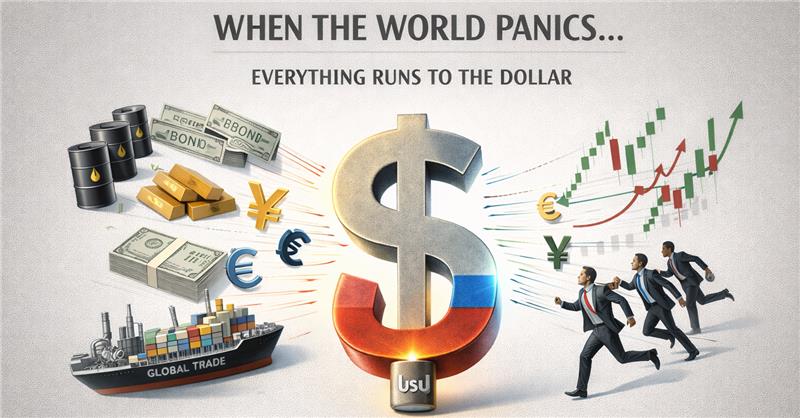
During crises, the dollar surges — it is the world’s safe haven. The 2008 GFC, COVID-19 panic, and Ukraine war all triggered dollar spikes. This is the “Dollar Smile Theory”: USD wins when conditions are very good OR very bad.
🛢️ Commodity Prices & the Petrodollar
Oil is priced in dollars. When oil demand rises, so does dollar demand. The petrodollar system — born in 1973–74 — created structural global USD demand that persists today, though it faces its first serious challenges in decades.
📊 Interest Rate Differentials
The yield spread between US Treasuries and foreign bonds is a primary driver. When US 10-year yields are higher than German, Japanese, or British equivalents, capital naturally flows toward the dollar for better returns.
🏛️ US Fiscal Policy & Debt
Government spending, tax policy, and the national debt affect confidence. A $2 trillion+ deficit raises long-term sustainability questions. A $36T+ national debt is the slow-motion conversation markets haven’t had yet — but will.
🌐 Geopolitics & Trade Policy
Tariffs, sanctions, and dollar weaponisation all influence global appetite for USD. When the US froze Russia’s dollar reserves in 2022, many central banks began quietly diversifying — a trend that has not reversed.
■ PART V · THE LEVERS Dollar Strengtheners vs. Weakeners: The Definitive Cheat Sheet
| Factor | Strengthens USD When… | Weakens USD When… |
|---|---|---|
| Fed Policy | ↑ Rate hikes / Hawkish Fed tone | ↓ Rate cuts / Dovish pivot signals |
| Inflation | ↑ High CPI before Fed acts | ↓ Persistent inflation erodes purchasing power |
| GDP Growth | ↑ US outperforms global peers | ↓ US recession or deep underperformance |
| Geopolitics | ↑ Global instability / War / Crisis | ↓ US political dysfunction / Sanctions overuse |
| Trade Balance | ↑ Surplus / Narrowing trade deficit | ↓ Widening deficit (more dollar outflows) |
| Yield Spread | ↑ US yields higher than global peers | ↓ Foreign yields close the gap |
| Reserve Demand | ↑ Central banks accumulate USD | ↓ De-dollarisation / Gold diversification |
| Fiscal Health | ↑ Deficit reduction / Budget discipline | ↓ Surging debt / Debt ceiling crises |
■ PART VI · THE MODERN ERA The Dollar in the 2020s: Pandemic, Superpower, and the 2025 Reckoning
2020: COVID’s Dollar Paradox
March 2020 produced one of the most dramatic dollar moves in recent memory. As COVID-19 froze the global economy, dollar liquidity evaporated worldwide. The DXY surged nearly 10% in a single month — an extraordinary move for a reserve currency. The Fed opened currency swap lines with 14 central banks to prevent global dollar starvation.
Then the paradox kicked in. As the US unleashed $6+ trillion in fiscal and monetary stimulus, the dollar reversed its entire COVID spike and then some. By early 2021, the DXY had significantly undershot its pre-COVID levels. The market’s message was clear: unlimited money-printing is not bullish for the currency being printed.
2022: The Most Aggressive Hike Cycle in 40 Years
With inflation hitting 40-year highs following post-COVID supply shock and commodity surge, the Federal Reserve embarked on the fastest rate-hiking campaign since the Volcker era. Between March 2022 and July 2023, rates climbed from near zero to over 5%. The dollar went on a tear. The euro fell below parity for the first time in decades. The Japanese yen hit 150 per dollar. Emerging market central banks burned through reserves defending their currencies. It was, by some metrics, the most globally disruptive US monetary policy tightening cycle in a generation.
2025: The Dollar’s Worst First Half in 50 Years
In a stunning reversal, the US dollar fell 10.7% in the first half of 2025 — its worst H1 performance since the DXY index was created in 1973. The drivers were multiple and interconnected: tariff uncertainty, questions about Fed independence, a $4.1 trillion fiscal deficit, and a broad rebalancing by global investors who had accumulated an extraordinary overweight to US assets over the preceding decade.
As of early 2026, DXY continues to trade in a weaker range following 2025’s historic correction. In January 2026 alone, the dollar fell another 1.2%. Context matters, however: the dollar had risen roughly 40% between 2010 and 2024, so the current weakness may represent healthy mean-reversion rather than structural collapse. Foreign holdings of US Treasuries hit a record $9.35 trillion in November 2025 — not the picture of global abandonment.
■ PART VII · THE BIG QUESTION Is Dollar Dominance Ending? The De-Dollarisation Debate
Every few years, someone declares the dollar’s reserve currency reign finished. They have been wrong every single time. But the questions are becoming more pointed, and some numbers are genuinely worth watching.
The dollar’s share of global foreign exchange reserves has declined from 71% in 1999 to approximately 56.3% at end-2025. China now settles roughly one-third of its foreign trade in yuan, up from 20% in 2022. Several BRICS nations actively seek dollar alternatives. And when the US froze Russia’s $300 billion in dollar reserves following the Ukraine invasion — effectively weaponising the reserve currency for the first time in modern history — it sent a chill through global central banking circles that has not fully dissipated.
🔴 Arguments for Decline
Reserve share falling from 71% to 56%. Rising US debt ($36T+). Dollar weaponisation via sanctions. BRICS payment discussions. China’s yuan internationalisation. Record central bank gold accumulation globally.
🟢 Arguments for Continued Dominance
No viable alternative exists — TINA. US capital markets unmatched in depth. Foreign Treasury holdings at record $9.35T in 2025. Euro share barely moved since 2000. Yuan still below 3% of global reserves. No political consensus on any alternative.
What would actually replace the dollar? The euro is controlled by 20 countries who frequently disagree. The yuan is not freely convertible and China tightly manages its value. Gold pays no yield. Bitcoin remains a speculation, not a monetary anchor. The dollar’s dominance is partly a function of the world’s inability to agree on anything better — and that hasn’t changed.
Frequently Asked Questions
Conclusion: The Dollar Is Battered, Questioned — and Still Ruling the World
The US dollar has survived the Nixon Shock, two oil embargoes, the Plaza Accord, the dot-com bust, the Global Financial Crisis, a global pandemic, and its own government’s most aggressive monetary tightening cycle in 40 years. Each time the obituaries are written, the greenback finds a way to remain the world’s indispensable currency.
But the world is changing. De-dollarisation, while slow, is real. The 2025 dollar weakness — its worst in half a century — is a signal that the global financial system is gradually reassessing its dependence on a single nation’s currency. The rise of yuan-denominated trade, BRICS payment systems, and record central bank gold accumulation are structural shifts, not noise.
The dollar’s story for the next decade will be shaped by three questions: Can the US restore fiscal credibility? Will the Federal Reserve maintain its independence and institutional trust? And will any alternative currency — the yuan, a BRICS basket, a digital reserve asset — develop the depth and legal underpinning to offer a genuine alternative?
Until those answers become yes — which, based on the evidence, is not imminent — the dollar, battered and bruised as it may be, remains exactly what it has been for 80 years: the closest thing this world has to a universal store of trust.
Published March 4, 2026 by The Capital Dispatch at Capital Street FX (capitalstreetfx.com). For informational and educational purposes only. Not financial advice. Sources: Federal Reserve, ICE, Bloomberg, Goldman Sachs, J.P. Morgan, BIS, IMF, and publicly available historical data.