
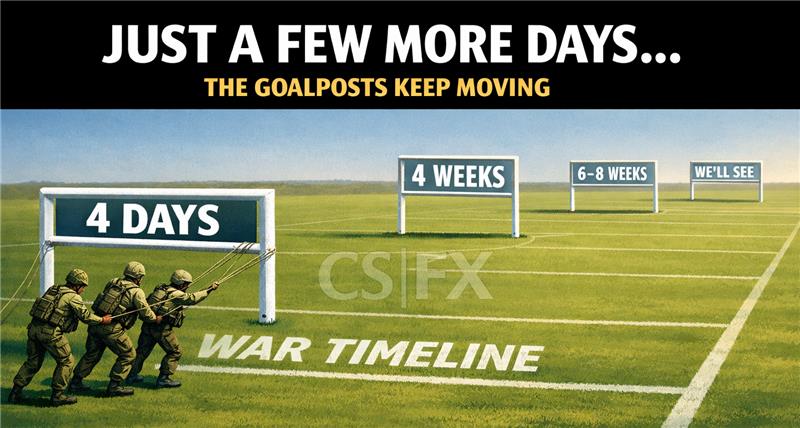
Operation Epic Fury: The 4-Day War That Forgot to End
OPERATION
EPIC FURY:
THE 4-DAY WAR
THAT FORGOT TO END

They promised “four days.” Then “four weeks.” Now Hegseth says “three, six, eight — whatever.” Iran’s Foreign Minister is posting scorching warnings on X. Thousands of Americans are stranded. Six soldiers are dead. And somewhere in Washington, someone is quietly Googling “exit strategy.”
Geneva — Iran & US Were at the Negotiating Table
Iranian FM Araghchi called a nuclear deal a “historic opportunity within reach.” US envoy Steve Witkoff and Jared Kushner were in the same building. Tea was presumably being served. Progress was reportedly being made.
“A historic opportunity to reach a nuclear agreement is within reach.” — Araghchi, Feb 25, 2026Trump’s Truth Social Post: “Ready, Willing & Able”
Trump announced a US armada — including the USS Abraham Lincoln — was heading to the Middle East. “Like Venezuela,” he wrote, it was “ready, willing, and able to fulfil its mission, with speed and violence, if necessary.” The diplomatic mood at Geneva shifted somewhat.
Operation Epic Fury Begins — “This Will Be Short”
US and Israeli strikes hit Tehran, Isfahan, Qom, Karaj, and Kermanshah simultaneously. Ayatollah Khamenei is killed. The MAGA social-media machine confidently declares the whole thing essentially over already. Trump says the operation will last “a few days.” Hegseth calls Iran “toast.”
“Their air defense, Air Force, Navy, and Leadership is gone. Iran will not be able to fight for much longer.” — Trump, Day 3 Truth SocialSix Americans Killed. Friendly Fire Downs Three F-15s.
Iranian drones hit a command center in Kuwait — a “makeshift office space,” per CNN — killing 6 US Army Reserve soldiers. Kuwait accidentally shoots down 3 US F-15 fighter jets. The war is emphatically not over.
“We expect to take additional losses.” — Gen. Dan Caine, Joint Chiefs Chairman, Day 2“Four to Five Weeks” — The Timeline’s First Upgrade
Trump, speaking to the Daily Mail: “It’s always been a four-week process.” This was, shall we say, not the original framing. Iran hits 14 additional countries in the region. Lebanon’s ceasefire collapses. Israel launches a ground invasion of Lebanon. The word “days” quietly retires from the administration’s vocabulary.
A US Submarine Sinks an Iranian Frigate — Near Sri Lanka
The IRIS Dena — which had just left India’s naval exercises as a diplomatic guest — was torpedoed in international waters, 2,000 miles from Iran. 87 sailors killed. 32 survivors. First ship sunk by a US submarine since World War II. Hegseth calls it “quiet death.” The Indian Ocean did not expect to become a war zone this week.
“Frigate Dena, a guest of India’s Navy carrying almost 130 sailors, was struck in international waters without warning.” — Araghchi, X, Mar 5Hegseth: “Three, Six, Eight Weeks — We Set the Tempo”
Asked about the timeline, Hegseth essentially shrugged: “You can say four weeks, but it could be six, it could be eight, it could be three.” This is what military analysts call “not having a plan.” Meanwhile, Iran hits Azerbaijan, Israel escalates in Beirut, and Amazon’s data center in Bahrain is taken offline by Iranian drones.
“We’re only five days into the war and already the goalposts are in full retreat.” — Jezebel, Mar 4TODAY: Iran Refuses All Talks. War Spreads. Nobody Knows the Endgame.
Iran’s FM tells NBC there is “no reason why we should negotiate” with Washington. The Senate blocked a War Powers resolution 47–53. Cost is now estimated above $5 billion. And Trump, asked about rising gas prices, said: “If they rise, they rise.” Somewhere, an economics professor weeps softly into their textbook.
There is a specific genre of political communication that military historians call “optimistic timeline creep.” It begins with bold declarations of swift, clean victory, proceeds through a series of quiet schedule adjustments, and eventually arrives at some variation of “we never said it would be short — that was always a misreading of our position.” The United States of America, now seven days into Operation Epic Fury, appears to be speedrunning the entire genre.
Let us start at the very beginning. On February 25, 2026 — three days before the first bomb fell — Iran’s Foreign Minister Abbas Araghchi was in Geneva calling a nuclear deal a “historic opportunity within reach.” US envoy Steve Witkoff and Jared Kushner were reportedly at the same table. Progress was being made. Three days later, the US and Israel launched the largest joint military operation in decades, killing Iran’s Supreme Leader and hitting 174 cities in a country whose population is 90 million people.
Araghchi’s subsequent mood on social media has been, understandably, frosty.
“The U.S. has perpetrated an atrocity at sea, 2,000 miles away from Iran’s shores. Frigate Dena, a guest of India’s Navy carrying almost 130 sailors, was struck in international waters without warning. Mark my words: The U.S. will come to bitterly regret the precedent it has set.”
And in an NBC Nightly News interview, the FM was equally blunt about the prospect of returning to the negotiating table: “We negotiated twice last year and this year, and then in the middle of negotiations, they attacked us. So we see no reason why we should engage once again with those who do not enter into negotiation in good faith.”
In diplomatic terms, this translates roughly as: “You bombed us during a tea break. We’re done.” Which, one has to admit, is a reasonably coherent position.
THE SHIFTING STORY:
A MASTERCLASS IN GOALPOST RELOCATION
The Trump administration has, in the span of seven days, offered the American public at least four distinct versions of what this war is, why it started, and when it will end. This is either flexible strategic communication, or it is what former Pentagon Middle East adviser Jasmine El-Gamal called a “contradictory mess.” The administration might prefer the first description. Historians will likely prefer the second.
To be fair, military timelines rarely survive contact with the enemy. History is littered with “home by Christmas” promises that aged like warm milk. What makes this particular case somewhat special is the velocity of the revision — from “days” to “maybe eight weeks” in less than one news cycle — and the simultaneous contradiction between Hegseth’s “not a regime change war” and Trump’s Day 1 call for Iranians to “rise up and take over your country’s government.”
“It is ludicrous to expect the American people to believe that Iran would have attacked the US preemptively — in the middle of negotiations.”
— Jasmine El-Gamal, Former Pentagon Middle East AdviserThe contradictions are stacking up like a poorly packed suitcase. Defense Secretary Hegseth says it’s “not a regime change war.” Trump literally posted a video calling for regime change. Secretary of State Rubio says it was a pre-emptive strike because Iran was about to attack. Trump says he “might’ve forced their hand” when Israel struck first. These aren’t just mixed messages — they’re active theological debates about the same war, conducted publicly, in real time, by the same administration.
THE ARAGHCHI FACTOR:
THE DIPLOMAT WHO WON’T SIT DOWN
While the US administration conducts its rotating cast of press conferences, Iran’s Foreign Minister Abbas Araghchi has emerged as the conflict’s most consistent voice — and, increasingly, its sharpest one. In the span of seven days he has given interviews to NBC News, posted on X, condemned a submarine attack, rejected negotiations twice, and declared Iran “confident” it could counter a US ground invasion.
Consider the geometry of his position. Last Thursday he was in Geneva, talking nuclear deals. By Saturday the bombs were falling. By Wednesday a US submarine had torpedoed one of his country’s frigates — a ship that had just been a diplomatic guest at India’s International Fleet Review, attended by 74 countries — in international waters near Sri Lanka, 2,000 miles from Iranian shores. The frigate was on its way home from a friendly naval exercise when it was sunk.
His response on X — “Mark my words: The US will come to bitterly regret the precedent it has set” — was simultaneously a diplomatic note, a threat, and something that reads, in the cold light of geopolitical analysis, like a man who has genuinely had enough.
Objectives: Fluid
Stop missiles. Destroy navy. No nukes. No proxies. Not regime change. Also please have a revolution. Cost: $1B/day. Duration: unknown.
MISSION UNDEFINEDObjectives: Remarkably Consistent
No ceasefire. No negotiations. Fight Americans “wherever they are.” The IRGC is now acting “independently and in isolation” per Araghchi himself — which raises its own alarming questions.
STUBBORNLY COHERENTWar Powers Resolution: Failed
Senate blocked 47–53. House blocked 212–219. Speaker Johnson: “We are not at war.” (The Pentagon’s KIA list says otherwise.)
TECHNICALLY ABSENTThousands Stranded
Airports closed. Flights cancelled. State Department “unresponsive,” per a sitting congresswoman. No evacuation plan was apparently made. Nobody thought to ask “what if this gets messy?”
SURPRISE CHAOSWHAT THIS MEANS FOR YOUR MONEY
The financial markets, to their credit, have been paying far more attention to this than Washington’s messaging suggests they should need to. Here is the scorecard as of Day 7:
| Asset | Day 1 Level | Day 7 Level | Change | What’s Driving It |
|---|---|---|---|---|
| Brent Crude | $72.48 | ~$84.00 | +16% | Hormuz fear + no ceasefire signal |
| Defense ETF (ITA) | Baseline | +6–8% | +6–8% | War timeline keeps extending |
| Gold | ~$2,900 | ~$3,124 | +7.7% | Classic nobody-knows-anything hedge |
| S&P 500 | 6,890 | ~6,852 | –0.6% | Markets shrugging, nervously |
| EU Natural Gas | ~€42/MWh | ~€48–82 | +14–95% | Qatar LNG disruption |
| Airlines (IAL, DAL) | Baseline | –4–7% | –4–7% | Fuel costs + route cancellations |
| US War Cost (running) | $0 | $5B+ | $1B/day | Rep. Morelle’s estimate |
The key insight the markets are wrestling with is the same one Washington hasn’t publicly answered: what does “done” look like? In the Gulf War of 1991, the objective was clear — remove Iraq from Kuwait — and when it was achieved, oil fell back and markets rallied. In Iraq 2003, the stated objective (WMDs and liberation) produced two decades of quagmire because there was no blueprint for “after.”
Here, Trump has publicly listed four objectives — stop new missiles, destroy the navy, prevent a nuclear weapon, end proxy funding — while simultaneously calling for regime change and then denying he meant regime change. Former diplomat Hala Rharrit put it plainly: “This is exactly what American diplomats have been trying to avoid for two decades.”
And here is the brutal market arithmetic of ambiguous objectives: every day of uncertainty is another day of elevated oil prices, suppressed equities, and a central bank that cannot cut rates. The Fed, already frozen by inflation fears, now watches oil march toward $100 with all the enthusiasm of someone watching their soufflé collapse in slow motion.
“We were not going to sit there and absorb a blow before we responded.” — Rubio, Day 2. Iran FM’s response: “You attacked us in the middle of negotiations.” Both of these statements are simultaneously true, which is part of the problem.
— Compiled from CNBC & NBC News, March 2–3, 2026HISTORY’S VERDICT:
WARS THAT WERE GOING TO BE QUICK
History’s graveyard of “this will be swift” promises is large enough to have its own zip code. The list is instructive: Germany’s “home before the leaves fall” in 1914 (it took four years). Lyndon Johnson’s advisers telling him Vietnam would be “wrapped up” within 18 months (it took a decade). Dick Cheney’s “weeks rather than months” for the Iraq reconstruction (it lasted until 2011). The Taliban’s estimated 6-month post-invasion irrelevance (they’re still there).
The common thread isn’t military incompetence — US forces are, by any objective measure, devastatingly effective. It’s the gap between military capability and political objective. You can destroy an air force in 48 hours. You cannot, it turns out, destroy a nation’s willingness to fight in the same timeframe — particularly when its Foreign Minister is on X, posting warnings in fluent English, and its IRGC commander is telling state television that his forces have “decided to fight Americans wherever they are.”
The financial implication is direct: markets price duration. A 4-day war has a very different oil premium, defense-stock premium, and inflation premium than a 4-month war. Right now, the market is pricing somewhere in between — which is why Brent is at $84 and not $100, and why the S&P 500 hasn’t cratered. But that pricing is deeply dependent on a ceasefire signal that currently does not exist and an Iranian Foreign Minister who has explicitly said he has no interest in providing one.
THE BOTTOM LINE
📌 Operation Epic Fury is now on Day 7 — against an original claim of “a few days” that has since been revised to 4 weeks, then 6–8 weeks, and is now simply “we set the tempo.”
📌 Iran’s Foreign Minister has rejected all negotiations, publicly, multiple times, with increasing sharpness. The diplomatic window that existed on February 25 — three days before the bombs fell — is now, officially, rubble.
📌 The financial consequences compound daily: $1 billion in war costs per day, oil near $84 and rising toward a $100 threshold that would add 0.6–0.7% to global inflation, a frozen Fed, and a defense sector that is the only corner of the market actively benefiting from the chaos.
📌 The market is currently betting on a medium scenario — messy but finite. If that bet is wrong, and this conflict drags beyond 8 weeks, the repricing across energy, rates, and equities will be significant and rapid.
📌 And somewhere in Geneva, there’s a half-finished cup of tea from February 25 that nobody has gone back to drink. That cup of tea represents the $5 billion (and counting) cost of what diplomacy looked like before it was replaced with something called “death and destruction from the sky, all day long.”