Black Gold Burns, Yellow Gold Gleams: When the Strait Closes, Every Commodity Changes | The Capital Dispatch
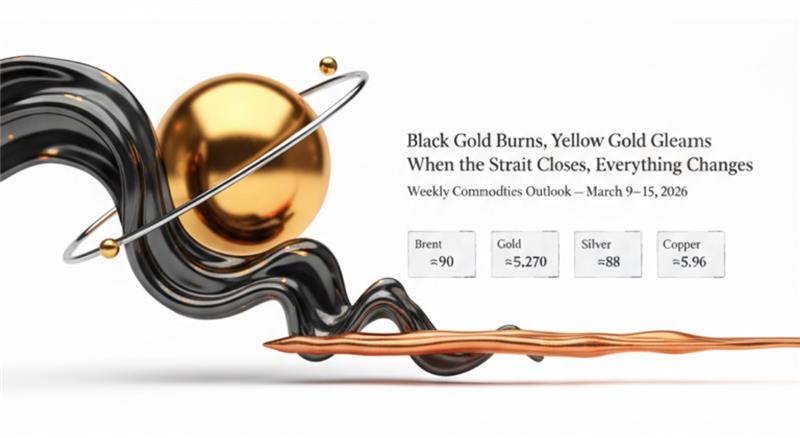
Black Gold Burns,
Yellow Gold Gleams:
When the Strait Closes,
Everything Changes.
The Strait of Hormuz is closed for the first time in history. Brent crude is at $90 a barrel. Goldman is warning of $100 if the blockade extends beyond four weeks. Gold is heading to $6,500 by year-end. Silver is tracing a textbook cup-and-handle to $120. Five commodity markets. Five trade setups. One war that rewrote every price target simultaneously.
Biggest 5-Day Surge in 5 Years
Strait of Hormuz Closed
Goldman Target: $6,500
Cup-and-Handle → $120
vs Henry Hub Flat
Watch $5.60 — Recession Signal
On February 28, 2026, Operation Epic Fury — a joint US-Israeli military campaign — struck Iran’s nuclear and military infrastructure, killing Supreme Leader Khamenei. Iran’s response was immediate: the formal declaration that the Strait of Hormuz was closed to commercial shipping. Approximately 20% of global oil supply and a significant portion of LNG flows instantly found themselves in transit limbo. No commodity market on earth was unaffected.
The Strait of Hormuz has been threatened many times in the modern era but has never been fully closed — until now. The strait, at its narrowest only 34 kilometres wide, is the most strategically critical waterway on the planet for energy markets. Approximately 17–21 million barrels of oil per day transit the strait — roughly one-fifth of total global daily consumption. Saudi Arabia, the UAE, Kuwait, Iraq, and Iran all use the strait as their primary or sole oil export route. Qatar’s entire LNG export infrastructure routes through it. The closing of the strait, even for weeks, is an energy supply shock of a magnitude the modern global economy has never experienced in precisely this form — sudden, declared, and enforced by a state with demonstrated missile capability against tanker traffic.
Goldman Sachs Commodities Research published its initial framework within 48 hours of the closure announcement: the market is currently pricing approximately a four-week disruption at the current price level of $87–90/bbl. Goldman’s base case fair value for Brent without the war premium is approximately $65/bbl — meaning the war premium itself is worth $22–25/bbl at current prices. If the disruption extends to 8 weeks or beyond, Goldman’s models point to $100+ Brent in a base case and $115–120 in a tail-risk escalation scenario where Gulf Arab state infrastructure is directly threatened. Every commodities trader this week is, fundamentally, making a probabilistic bet on the duration and geographic scope of the conflict.
17–21 million barrels of crude oil per day flow through the Strait of Hormuz — roughly 20% of global daily consumption. Qatar exports approximately 77 million tonnes of LNG per year through the strait — nearly one-third of global LNG trade. Saudi Arabia’s eastern oil fields, which produce approximately 10 million bbl/day, cannot be routed around the strait without massive infrastructure investment that would take years. The UAE has a limited overland pipeline (Habshan–Fujairah), but its capacity is approximately 1.5 million bbl/day — a fraction of UAE exports. In practical terms: there is no short-term alternative routing for most Gulf oil. The strait is not a bottleneck. It is the only exit.
Chapter 01 — WTI & Brent Crude Oil The War Premium Is Real — But How Long Does It Last?
Crude oil’s reaction to the Strait closure was fast, large, and — in the context of historical oil shocks — completely rational. Brent’s surge from approximately $65/bbl (the pre-war structural fair value Goldman had estimated based on supply/demand fundamentals) to $90/bbl in five trading sessions represents the market pricing a genuine, material, near-term supply disruption. This is not speculative excess — it is the correct market mechanism responding to a real disruption to ~20% of global supply with no short-term alternative routing.
The analytical framework for trading crude this week is therefore not “is oil expensive?” — it clearly is relative to pre-war fundamentals. The question is: how long does the disruption last? Goldman’s four-week base case is actually fairly conservative relative to the physical realities of the conflict. Even a negotiated ceasefire does not immediately reopen tanker traffic if Iranian missiles remain operational and Iranian naval forces retain the ability to threaten shipping. The insurance premium on tanker traffic through a “reopened” but still-contested strait could keep effective oil costs elevated for months beyond any political resolution.
◆ WTI Trade Setup: BUY dips to $83–85 · SL firm at $80 · TP1 $90 · TP2 $95 · TP3 $100 · Risk ~$3–5/bbl · Reward $5–15/bbl · R:R min 2.5:1. Sell discipline: reduce position on any credible ceasefire headline above $92.
The technical picture for WTI confirms the fundamental bullish thesis. The weekly close at $87.50 represents a clean breakout above the $80 resistance that had held for most of Q4 2025 and Q1 2026. The prior range high of $72–75 has now become the floor of the new range. The 50-week moving average sits at approximately $74 — well below current prices, confirming the trend reversal. For traders who missed the initial surge from $65 to $90, the correct strategy is patience: wait for a pullback to the $83–85 zone (which represents the first meaningful support level and a partial retracement of the five-day surge) before initiating long positions. Chasing at $90 creates an asymmetric risk profile — your stop must be below $80 (significant structure level) but your entry is near the recent high, leaving poor risk/reward.
Saudi Arabia and the UAE face a genuinely ambiguous incentive structure in this crisis. On one hand, $90 oil is extraordinarily profitable for their government budgets. Saudi Arabia’s budget breakeven is approximately $80/bbl — $90 crude generates significant fiscal surplus. On the other hand, both countries are technically OPEC+ production-curtailment signatories, and both have alternative pipeline capacity that could theoretically route around the strait. The key question: will the Saudis and UAE declare force majeure on deliveries (implicitly endorsing the closure) or will they quietly use overland alternatives? The answer will determine whether Gulf supply partially replaces disrupted volumes or whether the supply shock is total. Watch Saudi OSP (official selling price) revisions and tanker tracking data as your leading indicators this week.
Chapter 02 — Gold XAU/USD Three Tailwinds Arriving at Once — The Goldman $6,500 Case
Gold at $5,270/oz is operating in a structural bull market that was already in place before Operation Epic Fury, and the Iran conflict has layered a third and powerful catalytic force on top of two pre-existing drivers. The pre-war bull thesis rested on: (1) the Federal Reserve’s movement toward rate cuts compressing the opportunity cost of holding non-yielding gold, and (2) relentless central bank buying — 1,000+ tonnes per year for three consecutive years — representing the most sustained institutional demand in 70 years. The war added a third: pure geopolitical safe-haven premium. All three forces are simultaneously active and reinforcing each other in a way that occurs perhaps once a decade in gold markets.
Goldman Sachs’ $6,500/oz year-end target, published in their revised commodities outlook following the Iran conflict, is predicated on the continuation of all three tailwinds. The model assumes: Fed cuts 2–3 times in 2026 (reducing the USD rate premium that competes with gold), central bank buying continues above 1,000 tonnes per year, and the Iran geopolitical premium persists in some form for 6–12 months even after any ceasefire (markets price residual risk long after the peak of a crisis). The $6,500 target is not a ceiling — it is the base case. Goldman’s bull scenario reaches $7,000+.
◆ Trade Setup: BUY dips to $5,200–5,230 · SL firm at $5,080 (below trend support) · TP1 $5,390 · TP2 $5,500 · TP3 $5,600+ · Risk ~$150/oz · Reward $160–370/oz · R:R 1:1 to 2.5:1 · Use partial size pre-CPI Wednesday, scale in post-confirmation.
The specific tactical setup this week is defined by the same Wednesday CPI event that governs the forex report. A hot CPI confirms the stagflation environment — which is historically the single most bullish macro scenario for gold because it means the Fed cannot cut (removing rate-pressure relief) while inflation expectations rise (increasing gold’s store-of-value appeal) while geopolitical stress persists (maintaining the war premium). Stagflation in the 1970s produced gold’s greatest bull run in modern history — from $35 to $850 between 1971 and 1980. We are not in 1970s conditions, but the directional dynamic rhymes closely enough that every professional gold analyst recognises the analogy.
Chapter 03 — Silver XAG/USD The Cup-and-Handle That Points to $120 — If You Know Where to Look
Silver is operating under a dual mandate that makes it one of the most asymmetrically positioned commodities of the cycle. Unlike gold — which is primarily a monetary metal with limited industrial demand — silver derives approximately 50% of its demand from industrial applications: solar panels, electric vehicle components, 5G infrastructure, electronics, and medical applications. The green energy transition has structurally increased silver industrial demand while above-ground inventories have tightened. The silver market was already in a structural deficit before the Iran conflict added a safe-haven premium that mirrors gold’s.
The technical picture is the most compelling in the precious metals complex. Silver from August 2025 to March 2026 has traced a near-perfect cup-and-handle pattern on the weekly chart — one of the most reliable continuation patterns in technical analysis. The cup base was formed at the $72–75 support zone in October–November 2025. The cup rim is approximately $90–92. The handle (the consolidation prior to breakout) formed between $84 and $90 through January–February 2026. The measured move from a cup-and-handle breakout projects the height of the cup above the breakout level: $90 base + $18 cup height = $108 minimum measured target, with $120 as the extended bull case if the pattern holds with volume confirmation.
Silver’s industrial demand story is frequently underappreciated by traders who view it purely as a “poor man’s gold.” Global solar capacity additions in 2025 consumed approximately 140 million troy ounces of silver — roughly 15% of total annual mine supply. Electric vehicle production consumed an additional 60–70 million oz. 5G infrastructure rollout in Asia added 30–40 million oz. AI data centre construction (silver contact points in circuit boards, server components) represents a new and growing demand category. Combined, these industrial uses now account for approximately 50% of total silver demand and are structurally growing at 8–12% per year as the global energy transition accelerates. This industrial floor on silver demand is a structural bull factor completely independent of the precious metals/safe-haven narrative.
◆ Trade Setup: BUY pullback to $85–87 · SL firm at $82 · TP1 $95 · TP2 $108 · TP3 $120 · Risk ~$3–5/oz · Reward $7–32/oz · R:R 2:1 to 7:1 · Wait for $92 breakout confirmation before adding to position. Silver carries 2–3× the volatility of gold — size accordingly.
Chapter 04 — Natural Gas The Transatlantic Divergence Trade of the Year
Natural gas in 2026 has split into two completely different markets operating under almost opposite supply/demand dynamics — and the divergence between European TTF gas prices and US Henry Hub prices represents one of the cleanest structural trade setups in the commodity complex this week, regardless of the Iran conflict outcome.
European TTF gas prices have surged 20%+ since the Hormuz closure announcement. The mechanism is direct: approximately one-third of global LNG trade routes through the Strait — and Qatar, the world’s largest LNG exporter, sends the majority of its exports through it. Europe, which has been importing LNG at record rates since Russia’s 2022 invasion of Ukraine (to replace pipeline gas), is now facing a supply shock at precisely the moment European storage levels are seasonally low (late-winter drawdown). European gas is priced at scarcity — the market is correctly pricing the real possibility that spring refill season (April–September) will face significantly tighter LNG availability.
US Henry Hub, by contrast, has barely moved. The United States is now the world’s largest LNG exporter — but US LNG facilities on the Gulf Coast predominantly use Gulf of Mexico gas that has no routing through the Strait of Hormuz. US domestic gas supply is ample. US storage is at normal seasonal levels. The only US gas market connection to the Hormuz story is the demand-side: higher US LNG export demand (as European buyers scramble to contract alternative sources) could tighten US domestic supply marginally over 6–12 months. But in the near term (this week, this month), Henry Hub remains de-linked from the European crisis.
The TTF vs. Henry Hub spread trade is accessible to sophisticated traders through futures (ICE TTF vs. NYMEX Henry Hub) or through equity proxies: long European gas utility companies with significant LNG import exposure (E.ON, RWE, Engie) vs. short US utilities with high natural gas generation exposure. The spread is currently at historically extreme levels — TTF trading at approximately 8× the Henry Hub equivalent on a BTU-equivalent basis. This extreme ratio historically mean-reverts, but the timing is driven by physical market rebalancing which takes months, not weeks. The trade is a medium-term position (3–6 months), not a day trade. Use small size and wide stops, as European energy policy intervention risk (price caps, emergency supply deals) can cause sudden TTF spikes to reverse partially and unexpectedly.
Chapter 05 — Copper Don’t Trade It — Read It. The Market’s Best Recession Indicator.
Copper is included in this week’s commodities report not as a trade recommendation but as a macro indicator that professional traders cannot afford to ignore. Copper’s correlation with global industrial activity and economic growth is so consistent and so well-documented over decades that it has earned the semi-affectionate nickname “Dr. Copper” — for its supposed PhD in economics. When copper rises, it typically signals that global manufacturing, construction, and industrial activity are expanding. When copper falls, it signals the opposite.
Copper’s current price at $5.96/lb is sitting at a pivotal zone. On one hand, the Iran conflict and its implied supply chain disruption is mildly copper-positive in the short term (supply disruption to some Middle Eastern mining and refining activity). On the other hand, the US NFP miss of −92,000 and the growing evidence of a US economic slowdown are copper-negative: if the world’s largest economy is slowing sharply, global industrial copper demand falls. The critical level to watch is $5.60/lb — if copper breaks that support with conviction, it is one of the cleaner recession confirmation signals available in any asset class. Below $5.60, the macro backdrop for all risk assets becomes materially more negative.
Oil in War:
Four Historical Precedents
and What 2026 Breaks New.
Every major oil supply shock in the modern era has followed a recognisable pattern: initial panic spike, partial stabilisation as alternative supplies or demand destruction emerge, and then a prolonged period of elevated prices as the geopolitical risk premium becomes semi-permanent. The Strait of Hormuz closure of 2026 is unprecedented in its directness — previous crises threatened the strait; this one closed it. But the historical precedents still offer the closest framework available for timing and magnitude expectations.
What makes 2026 different from all previous oil shocks: the closure is formal, declared, and enforced by a state with demonstrated anti-ship missile capability. Previous incidents involved threats and incidents — not a state declaration of closure with active enforcement. This removes the “bluff premium” that moderated previous oil spikes and makes the war premium structurally larger and more durable than the historical analogues suggest.
The Commodities Bull Case vs. the Bear Case: How Long Does the War Premium Last?
- Strait of Hormuz closure is formal and declared — not a bluff. Physical tanker traffic genuinely disrupted.
- No alternative routing for most Gulf oil within months. Saudi-UAE overland capacity is a fraction of needs.
- Goldman’s 4-week base case is conservative. Historical conflicts in this region have lasted months, not weeks.
- Gold’s three simultaneous tailwinds (Fed cuts, central bank buying, war premium) are independent of oil.
- Silver industrial demand from solar, EV, AI data centres creates a structural demand floor completely independent of the war premium.
- Stagflation confirmation (hot CPI Wednesday) would be gold’s most bullish macro scenario — historically.
- Insurance premiums on Gulf tanker traffic will remain elevated even after any political ceasefire, keeping effective oil costs high.
- Historical Gulf War I precedent: oil surged 170% then collapsed when military resolution came faster than feared.
- US strategic petroleum reserve (SPR) can release up to 1 million bbl/day into the market to suppress prices.
- Demand destruction: at $100+ oil, global economic slowdown accelerates, reducing oil demand simultaneously.
- NFP −92,000 signal: if the US is already entering recession, oil demand falls structurally regardless of the war.
- Copper below $5.60 would signal global industrial recession — directly bearish for oil and silver’s industrial component.
- A surprise ceasefire or mediated reopening (Saudi/UAE facilitated) could collapse the war premium from $25 to $5 in one session.
- Gold’s 2022 precedent: initial +14% war spike reversed within weeks as markets realised the macro consequences were more important than the geopolitical premium.
The bull case for commodities is structurally stronger this week than the bear case — but the asymmetry of risk is more complex than a simple “buy everything.” Gold is the cleanest structural long because its thesis (Fed cuts + central bank buying + war premium) is partially independent of the oil conflict duration. Even in a rapid ceasefire scenario, gold’s fundamental bull drivers (rate cuts, de-dollarisation, central bank demand) remain fully intact. Gold does not need the war to stay elevated.
Oil is a conditional trade — bullish as long as the disruption persists, but vulnerable to a sharp reversal on any ceasefire headline. The correct oil trade is not “buy at current prices” but “buy the pullback to $83–85 with a disciplined $80 stop,” accepting that the risk/reward after the initial 38% surge is less attractive than it was on day one.
Silver is the highest conviction medium-term trade in the commodities complex this week, because even if the war premium evaporates, the cup-and-handle pattern and industrial demand structure remain intact. The war premium is pure optionality on top of a trade that already has technical and fundamental justification.
Frequently Asked Commodities Questions
Six questions every experienced commodities trader is asking this week — answered in full.
Conclusion: When the Strait Closes, Every Commodity Becomes a Different Animal.
The Hormuz closure is the most consequential single event for commodities markets in a generation. But the most important analytical discipline this week is recognising that not all commodities are equally and permanently affected. The crisis creates a hierarchy of conviction and a hierarchy of duration.
Gold sits at the top of the conviction hierarchy because its bull case is only partially dependent on the war premium. Remove the war entirely, and gold is still heading higher because the Federal Reserve is still approaching cuts, central banks are still buying above 1,000 tonnes per year, and the de-dollarisation trend is still compounding. The war is acceleration, not the engine.
Silver is the highest upside trade in the complex, combining the war premium optionality with a structural industrial demand story (solar, EV, AI data centres) and a textbook technical pattern that points to $108–120. The risk/reward from $85–87 with a $82 stop is one of the cleaner setups available in any commodity market this cycle.
Oil is a trade, not an investment. Buy the pullback to $83–85, set your stop at $80, take profits progressively toward $100, and do not allow conviction in the geopolitical thesis to override the discipline of a clean exit if the strait reopens faster than expected. History says oil war premiums reverse more abruptly than they form.
In every commodity market, the most dangerous words are “this time the disruption is permanent.” History says nothing in energy markets is permanent — it’s always a question of how long, and at what price, normalisation arrives.
Published March 9, 2026 by The Capital Dispatch at Capital Street FX (capitalstreetfx.com). For informational and educational purposes only. Not financial advice. Not investment guidance. Sources: Goldman Sachs Commodities Research, EIA, IEA Monthly Oil Market Report, World Gold Council, OPEC+ Secretariat, CoinCodex, Bloomberg Commodities Index.