Bitcoin at the Crossroads: Why $70,500 Is the Only Number That Matters When War Meets the Federal Reserve | The Capital Dispatch
Bitcoin at the Crossroads:
Why $70,500 Is the Only
Number That Matters When
War Meets the Federal Reserve.
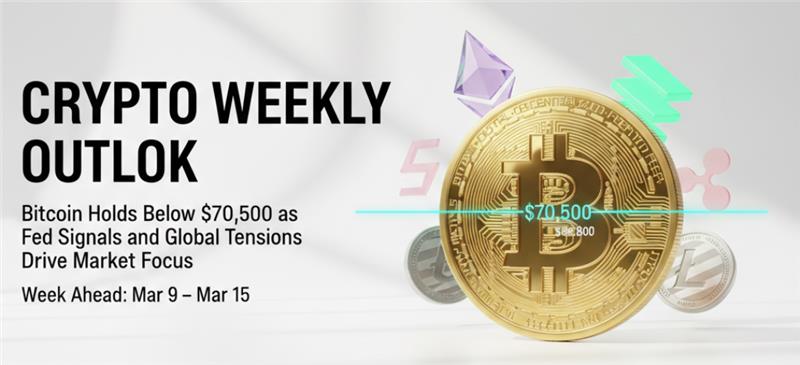
Bitcoin at $68,800 is sitting just below the structural key level that separates cautious optimism from confirmed bull continuation. Ethereum is tracing a falling wedge reversal. Kraken just applied for a Federal Reserve master account — the single most important regulatory development in crypto since the ETF approvals. Five assets, five setups, one macro framework that governs everything. This is the crypto playbook for the most complex week of Q1 2026.
Below Key $70,500 Level
Falling Wedge Reversal
Cautious Long Setup
Buy $83–86 · TP $100
Halving Cycle Tailwind
The Line Everything Depends On
The crypto market in the week of March 9–15, 2026 is operating under a three-way tension that has no clean resolution until Wednesday’s CPI print. Bitcoin is in a war premium tug-of-war — caught between safe-haven demand from the Iran conflict and risk-off selling pressure from a stagflation macro. Ethereum is forming one of the cleaner reversal setups it has produced in six months. And the Kraken Federal Reserve master account application is the regulatory event that every serious crypto participant should understand deeply, because it changes the structural landscape for the industry permanently.
Three rules govern every crypto trade this week, and if you cannot honestly answer yes to all three before entering any position, the correct answer is to wait. Bitcoin must be above $70,500 before any meaningful altcoin long is justified — this is not superstition, it is the consistent historical pattern of how capital flows through the crypto ecosystem. Standard position size should be reduced 30–50% until CPI resolves the macro ambiguity on Wednesday. And Wednesday’s CPI is not just an event to survive — it is the event that determines whether the risk-on trade is open or closed for the remainder of the week. These three rules are not suggestions. They are the structural architecture of professional crypto risk management in a binary-event environment.
Chapter 01 — Bitcoin BTC The $70,500 Line: Structural Gateway or Week-Long Ceiling?
Bitcoin at $68,800 is in a position that rewards patience and punishes impatience with unusual clarity this week. The $70,500 level is not arbitrary — it is the confluence of the prior range high that capped BTC in October 2025, the 50-day moving average on the daily chart, and the psychological significance of the $70,000 round number. Markets respect price levels that are simultaneously technically significant AND psychologically meaningful. $70,500 is both. What makes the current setup particularly important is that CoinCodex’s March 2026 forecast band of $70,350–$79,539 sits almost entirely above the current price — suggesting the market’s consensus expectation is for a breakout above this key level, while the actual price is testing the base of that forecast range.
The macro context creates the ambiguity. Bitcoin’s relationship with the Iran war is genuinely contested among serious analysts. The “digital gold” narrative — that Bitcoin is a safe-haven asset that benefits from geopolitical stress and dollar debasement — would argue for BTC to surge alongside physical gold’s 12% move since Operation Epic Fury. The reality so far has been more nuanced: BTC initially rallied approximately 8% in the days following the February 28 strikes, but has since given back most of those gains as the stagflation narrative — amplified by the −92,000 NFP print — reasserted risk-off pressure. Bitcoin in 2025 demonstrated increasingly consistent correlation with risk assets (Nasdaq, tech stocks) in the short term, which means a stagflation-confirming CPI print this week applies negative pressure through the risk-off channel, even if the inflation narrative is simultaneously positive for the longer-term “hard money” BTC thesis.
◆ Trade Setup: BUY pullback $67,500–68,500 · SL $65,000 · TP1 $72,500 · TP2 $75,000 · Size at 50% normal pre-CPI · Scale in to full size on confirmed break above $70,500 with volume. Alternative: WAIT for $70,500 breakout then buy the first retest of that level as support.
Kraken’s application for a Federal Reserve master account — confirmed by multiple sources this week — is the single most consequential regulatory development in crypto since the Bitcoin and Ethereum ETF approvals. A Federal Reserve master account would allow Kraken to hold reserves directly at the Fed (rather than through a commercial bank intermediary), access the Fed’s payment systems in real time, and potentially offer crypto and fiat products with the same tier-one banking infrastructure as JPMorgan or Citibank. The strategic implications are profound: if granted, it normalises crypto exchanges as legitimate financial infrastructure at the highest regulatory level. Watch the reaction from traditional banking lobbyists — they will fight this vigorously, because a master account for Kraken is the beginning of the end of their monopoly on Federal Reserve access.
Chapter 02 — Ethereum ETH The Falling Wedge That Points Higher — If BTC Cooperates
Ethereum at $2,070 is forming what technical analysts classify as a falling wedge — one of the most reliably bullish reversal patterns in any asset class when it forms after a sustained downtrend. The anatomy of the pattern in ETH: from its December 2025 high of approximately $2,650, Ethereum has declined in a pattern where both the highs and the lows are declining, but the lows are declining more slowly than the highs. This creates a converging channel that slopes downward — the falling wedge. The pattern resolves when price breaks above the upper trendline of the wedge, typically with a surge of volume that represents buyers overpowering the gradually weakening selling pressure.
The fundamental case for Ethereum’s recovery complements the technical setup. The Pectra upgrade, deployed in Q4 2025, significantly increased the efficiency of ETH staking and reduced validator queue times — making staking yields more predictable and attracting institutional allocators. ETH staking yields of approximately 4.2% annually now compare favourably with US 10-year Treasury yields in a falling rate environment, a dynamic that was not available to institutional allocators during previous ETH cycles. Net ETH supply has been deflationary since the Merge in September 2022, and while EIP-1559 fee burns slowed during the lower-activity period of late 2025, the structural supply dynamic remains positive at higher network utilisation levels.
◆ Trade Setup: BUY $2,020–2,050 (wedge lower boundary) · SL $1,920 · TP1 $2,200 · TP2 $2,380 · TP3 $2,650 · Risk ~$130/ETH · Reward $150–600/ETH · R:R 1.2:1 to 4.6:1 · CONDITION: Only enter if BTC is above $70,500. At 40% normal size pre-CPI.
Chapter 03 — XRP Post-SEC Relief Meets a Macro Crossroads — Playing the Range
XRP enters the week of March 9 in a structurally cleaner position than it has occupied for years. The resolution of the SEC lawsuit in 2025 — with the court’s final ruling that XRP token sales on exchanges did not constitute securities transactions — removed the regulatory overhang that had suppressed XRP’s price relative to its actual utility metrics for more than three years. Since the ruling, Ripple’s institutional cross-border payment network has added 12 new central bank digital currency partnerships and expanded its RippleNet to cover 47 additional currency corridors.
The short-term technical picture is a range trade. XRP is consolidating between $1.37 support (the lower boundary of the post-SEC consolidation range) and $1.70 resistance (the upper boundary tested twice in January 2026 without a clean breakout). At $1.42, it sits in the lower third of that range — making it a cautious long rather than a high-conviction directional trade. The key for XRP is what happens to BTC and the broad crypto risk sentiment after Wednesday’s CPI. XRP behaves as a high-beta risk asset in short-term market moves — meaning it falls harder than BTC in a risk-off move and rises faster in a risk-on surge. The $1.967 psychological level (the prior year high) represents the medium-term bull target if the broader risk-on environment is confirmed.
◆ Trade Setup: BUY $1.37–1.42 · SL $1.28 · TP1 $1.60 · TP2 $1.967 · Risk ~$0.14 · Reward $0.18–$0.55 · R:R 1.3:1 to 3.9:1 · CONDITION: BTC above $70,500. Size at 30% of normal — XRP carries 3–4× BTC’s volatility in short-term moves.
Chapter 04 — Solana & Litecoin Two Different Stories, One Shared Requirement: Bitcoin Above $70,500
Solana enters the week at $88 with one of the stronger fundamental backdrops in the altcoin complex. The Solana ecosystem’s daily active address count reached a new all-time high in February 2026, driven by the continued growth of its DeFi protocol suite (particularly Jito, Raydium, and Drift), a surge in new token launches on its launchpad infrastructure, and the network’s ability to sustain sub-second finality at scale without the congestion issues that plagued it in 2023. Institutional interest in Solana-based products has grown substantially following the approval of several spot Solana ETF applications in late 2025. The technical setup mirrors the fundamental strength: Solana is consolidating in a healthy base structure between $80 and $95, with the $83–86 zone representing the intersection of the 50-day MA and a prior breakout level that has held as support on three separate tests.
Litecoin at $83 is a different kind of trade — driven more by cycle mechanics than ecosystem fundamentals. The LTC halving cycle (the automatic reduction in miner rewards that occurs every four years) historically produces a price surge 6–12 months ahead of the halving event as the market begins pricing the reduced supply issuance. The most recent LTC halving occurred in August 2023, and the 2027 halving is beginning to appear on the medium-term horizon. At $83, LTC is consolidating in the $75–92 range with the $80–83 zone representing solid structural support. The trade thesis is simple: halving mechanics + BTC-correlated beta + any risk-on catalyst from Wednesday’s CPI. The trade does not require a fundamental narrative beyond the cycle dynamic.
Four Scenarios.
One Binary Event.
Wednesday, 8:30 AM ET.
The crypto market’s direction for the remainder of the week — and potentially for the balance of Q1 2026 — is contingent on a single data point. This is unusual clarity in what is usually a multi-variable analytical environment. Professional traders use binary-event environments to prepare, not to act impulsively. The four scenarios below should be written in your trading plan before Wednesday morning, not decided in the heat of the moment after the release.
ETH → $1,780–1,900
XRP → $1.10–1.20
SOL → $72–75
LTC → $68–72
Action: REDUCE all positions immediately
ETH → $1,980–2,200 range
All pairs: two-way chop
Action: Maintain small positions, tight stops
ETH → $2,200–2,380
XRP → $1.60–1.70
SOL → $100–108
LTC → $95–100
Action: Scale to full size, add altcoins
ETH → follows BTC but with amplification
Altcoins → avoid entirely
Action: No new positions. Protect capital.
Bitcoin Bull Case vs. Bear Case: Is the Crypto Market Ready for What Comes Next?
- CoinCodex forecasts $70,350–$79,539 for March — current price is a discount to consensus expectation.
- NFP −92,000 signals recession → Fed cuts → rate differentials compress → risk assets, including BTC, surge on lower rates.
- Kraken Fed master account application begins a regulatory normalisation wave that reduces institutional risk premium on crypto allocation.
- Bitcoin halving cycle is in the established bull phase — historically, BTC reaches its cycle peak 12–18 months after halving (April 2024 halving = peak late 2025 to mid-2026).
- ETH/BTC ratio at historic lows → when BTC breaks up, ETH tends to outperform on the relative rotation.
- On-chain data shows long-term holder (LTH) supply near cycle highs — patient money is not selling at these levels.
- A soft CPI print (15% probability) produces the cleanest, strongest risk-on surge of Q1 — the asymmetric upside case.
- BTC has failed to close above $70,500 for three consecutive weeks — repeated failure at the same resistance is a distribution signal, not accumulation.
- NFP −92,000 is a recession signal — and in recessions, risk assets including crypto get sold for liquidity, not bought as alternatives.
- Hot CPI (40% probability) triggers the most damaging scenario: Fed cannot cut, DXY short-squeezes, and crypto’s correlation with Nasdaq ensures it falls with tech.
- BTC dominance remains elevated at 52% — altcoin season conditions are absent, suggesting weak market breadth and lack of conviction.
- Iran war created a geopolitical risk premium, but BTC’s “digital gold” safe-haven narrative is not consistently supported by price action — it held in the 2022 Russia invasion episode, then reversed.
- Spot Bitcoin ETF inflows have slowed materially from the peak levels of Q3 2025 — the institutional demand wave is not currently accelerating.
- The most likely scenario (40% probability hot CPI) is the worst outcome for crypto — asymmetric downside in the base case.
The honest analytical assessment of the crypto market this week is that the base case probability-weighted outcome is slightly negative. The most likely single scenario (40% hot CPI) is also the worst for crypto. The second most likely (35% in-line) is range-bound and unresolved. The positive scenarios (15% soft CPI, which would be the best outcome) carry the least probability. This does not make crypto uninvestable this week — it makes position sizing and pre-defined stop losses the most critical variables, not which asset to buy.
The structural bull case for Bitcoin over the medium term (6–18 months) remains intact. The halving cycle, regulatory normalisation (Kraken master account being the latest signal), and the potential for 2–3 Fed cuts in 2026 are all genuinely positive for crypto. The problem is the short-term: the macro environment between now and the FOMC on March 18–19 is the most hostile it has been for risk assets in Q1. Stagflation does not create good conditions for speculative assets, regardless of the longer-term thesis.
The correct position for most traders: small long in BTC at $67,500–68,500 with a $65,000 stop. Prepare your altcoin shopping list. Wait for $70,500 to break on volume before executing any of it. Wednesday is not a day for bold positions. It is a day for patience and pre-prepared reaction plans.
Frequently Asked Crypto Questions
Six questions every experienced crypto trader is asking this week — answered in full.
Conclusion: One Key Level. One Data Point. Five Trades That All Depend on the Same Answer.
The crypto market of March 9–15, 2026 is defined by an unusual analytical simplicity beneath the surface complexity. Everything — Bitcoin’s direction, Ethereum’s wedge resolution, XRP’s range break, Solana’s ecosystem momentum, Litecoin’s halving trade — depends on two sequentially linked answers. First: does BTC break $70,500 with conviction? Second, and prior to that: does Wednesday’s CPI give it permission to do so?
The structural bull case for Bitcoin over 6–18 months is intact. The halving cycle is in the established bull phase. Regulatory normalisation — exemplified by the Kraken master account application — is reducing the institutional risk premium on crypto allocation. The Fed is closer to cutting than hiking, and every cut compresses the opportunity cost that competing with Bitcoin’s non-yielding nature. These are not short-term trading narratives. They are structural forces that operate over quarters, not weeks.
The tactical picture this week is more challenging. The most likely single CPI outcome (40% hot) is the worst for crypto. BTC has failed to close above $70,500 for three consecutive weeks. Stagflation — the confirmed macro environment — is historically an environment where risk-asset correlations dominate the hard-money narrative in the short term, even while supporting it in the long term.
The correct response to this tension is not paralysis — it is precision. Small long in BTC. Prepare your altcoin list. Have your CPI reaction plan written before Wednesday morning. Size every position to survive the hot CPI scenario without a material account drawdown. The medium-term thesis will be right. This week, it is the risk management that determines whether you are still in the trade when it is.
In crypto, the difference between a good trader and a great one is rarely the thesis. It is almost always the position size and the stop loss on the three days the thesis is temporarily wrong.
Published March 9, 2026 by The Capital Dispatch at Capital Street FX (capitalstreetfx.com). For informational and educational purposes only. Not financial advice. Not investment guidance. Crypto assets are highly speculative and volatile. Sources: CoinCodex, CoinDesk, Glassnode, Delphi Digital, Bloomberg Crypto, Federal Reserve, Prime Market Terminal.