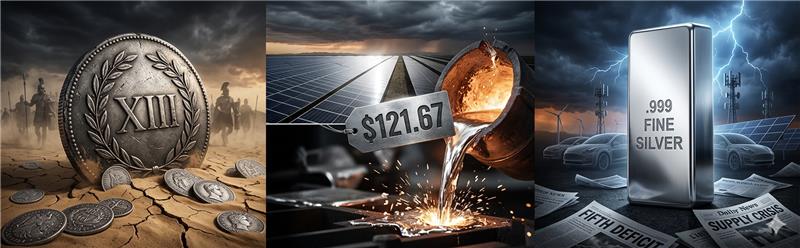
There is a metal older than coinage itself. Older than the Roman Republic. Older than the Greek city-states. Older, in its monetary function, than every financial instrument the modern world has invented. It funded the navy that defeated Persia at Salamis. It paid the legions that built the Colosseum. Spanish galleons sank under its weight. American cowboys counted it as change. For five thousand years, silver was not merely an investment — it was money. The base currency of civilisation. The metal that conducted not just electricity, but commerce, empire, and survival.
Then, in the second half of the twentieth century, something strange happened. The world collectively decided to forget silver. Demonetised. Delisted from central bank vaults. Relegated to jewellery boxes and novelty coins while gold hogged the headlines. And while the world looked away, a very different story was quietly unfolding inside every solar panel, every electric vehicle battery pack, every 5G antenna, and every semiconductor wafer rolling off a production line in Shenzhen.
Silver — the metal governments abandoned — became the metal the future could not function without.
The numbers tell a story that should have dominated financial news three years ago. Five consecutive annual supply deficits. A cumulative shortfall of approximately 820 million ounces since 2021. Industrial demand that hit a new all-time record in 2024 for the fourth straight year. An all-time price high of $121.67 per troy ounce on January 29, 2026 — the highest silver has ever traded in nominal history. And analysts from Bank of America to independent commodity strategists producing price targets that range from a conservative $65 to an eye-watering $300.
This is not a speculative story about a metal that might become important. This is the story of a metal that has always been important — and is finally being priced accordingly. To understand where silver goes next, you need to understand where it has been. And where it has been is everywhere.
Part I: The Metal That Made Money — 5,000 Years of Silver History
Silver’s story begins not in the vaults of a central bank but in the mines of ancient Anatolia, in what is today Turkey, around 3000 BCE. Smelters there discovered that heating galena ore — lead sulphide — to extreme temperatures through a process called cupellation could separate pure silver from its mineral host. The technique spread quickly. By 3000 BCE, litharge residues indicating silver extraction were found across the Near East, the Aegean, and southeastern Europe. Silver, once discovered, moved fast.
The First Money on Earth
Before coins, before paper, before digital entries in a central bank ledger, there was hacksilver. Cut pieces of silver metal, weighed out for each transaction on hand-held balance scales. In Mesopotamian markets as early as 2800 BCE, silver rings and coils served as proto-currency. By 2400 BCE, Sumerian cuneiform tablets recorded silver shekels — weighing 8.3 grams each — as the standard unit of payment for fields, houses, and slaves.
📜 The Oldest Recorded Silver Price
A Sumerian tablet from Ur dated approximately 2400 BCE records 1 shekel of silver (8.3 grams) as the standard payment for “1 month’s labour of a skilled craftsman.” The same tablet notes the exchange rate: 1 silver shekel equals 300 litres of barley. This is the world’s oldest documented currency transaction. Silver — not gold — was the coin of everyday commerce for four thousand years of human history.
The reason is simple, and it holds a lesson that modern investors often miss. Gold was too valuable for everyday transactions. You could not buy bread, pay wages, or settle small debts in gold without cutting it into impractically tiny pieces. Silver struck the perfect balance: scarce enough to hold value, abundant enough to be practical. While gold sat in the treasuries of pharaohs and kings, silver moved through markets. Silver was the people’s money.
A Timeline: From Mesopotamia to March 2026
3000 BCE
Anatolia’s Cupellation Revolution Large-scale silver smelting begins in modern-day Turkey. Silver extraction technology spreads across the Near East and Mediterranean. The world’s first monetary metal supply chain is born.
2400 BCE
The Sumerian Silver Shekel Mesopotamian city-states formalise the silver shekel as the standard unit of economic value. All major prices — grain, land, labour — are denominated in silver. Gold is the luxury; silver is the economy.
480 BCE
Athens Defeats Persia With Silver The discovery of massive silver seams at the Laurium mines near Athens generates a windfall that finances 200 triremes. The Battle of Salamis is won. Western civilisation is arguably saved — by silver.
600 BCE
The World’s First Coin The kingdom of Lydia (modern Turkey) mints the first standardised metallic coins from electrum (a natural gold-silver alloy). Within decades, Greek city-states adopt silver coins — the drachma — as the dominant monetary standard of the ancient Mediterranean.
211 BCE
The Roman Silver Denarius Rome introduces the silver denarius weighing 4.5 grams of 95% pure silver. It becomes the backbone of the most powerful economy in history. Roman legions, roads, aqueducts, and the Colosseum are all financed in silver denarii. For five centuries, the denarius is the world’s reserve currency.
268 CE
Rome’s Great Silver Debasement Centuries of “coin clipping” — melting denarii and reminting with lower silver content — reaches its endpoint. By the reign of Claudius II, the denarius contains just 2–5% silver, down from 95%. The result: rampant inflation, economic collapse, and the beginning of Rome’s unravelling. The world’s first lesson in monetary debasement.
1545
Potosí: The Mountain of Silver Spanish conquistadors discover the Cerro Rico silver mountain in modern Bolivia — one of the largest silver deposits in human history. Over the next 200 years, approximately 41,000 tonnes of silver flow from Latin America into the Spanish Empire and onward into global commerce. Spain’s pieces of eight become the world’s first truly global currency, accepted from London to Manila.
1792
America’s Bimetallic Standard The US Mint Act fixes the silver-to-gold ratio at 15:1 — meaning 15 ounces of silver equals one ounce of gold by law. The US dollar is defined in silver: one dollar equals 371.25 grains of pure silver. For over a century, America runs on silver.
1873
“The Crime of ’73” The US Congress quietly removes silver from the bimetallic standard, shifting to gold alone. Silver farmers and debtors, who benefited from silver’s inflationary properties, are outraged. The “Free Silver” movement and William Jennings Bryan’s famous “Cross of Gold” speech define the politics of an era. Silver’s demonetisation has begun.
1971
Nixon Ends the Gold Standard — Silver Long Gone Nixon’s closing of the gold window completes the demonetisation of precious metals. Silver, already stripped from coinage in 1965 (US dimes and quarters reduced from 90% to 0% silver), is now purely a commodity. Its price, once fixed by government fiat, is left to the markets. What happens next shocks everyone.
1980
The Hunt Brothers’ Corner — and Crash Nelson Bunker Hunt and William Herbert Hunt accumulate over 100 million troy ounces, attempting to corner the global silver market. Silver surges from $2/oz to $49.45 — a 2,400% rise in under a decade. COMEX enacts Silver Rule 7 restricting leveraged buying. The market crashes. Silver falls to $11 within two months. The brothers declare bankruptcy with $1.5 billion in debts.
2020
The COVID Shock: Gold/Silver Ratio Hits 105:1 March 2020 sees silver collapse as industrial demand evaporates during lockdowns. Gold, with its purely monetary character, holds. The gold-to-silver ratio reaches 105:1 — the widest in modern history. Silver briefly trades at $12/oz.
2021
The Reddit Silver Squeeze Wallstreetbets-inspired retail investors attempt to squeeze the silver market, briefly pushing prices above $29. While the squeeze fizzles, it exposes the paper-versus-physical market disconnect that analysts had been warning about for years. More importantly, the Silver Institute records the first of what will become five consecutive structural supply deficits.
2024
Industrial Demand Goes Nuclear Silver’s industrial use reaches a new all-time record of 680.5 million ounces, driven by a 64% year-on-year explosion in photovoltaic solar demand. The global supply deficit reaches 148.9 million ounces. Solar panels alone consume 197.6 million ounces — a figure that barely existed a decade earlier.
Jan 2026
New All-Time High: $121.67 On January 29, 2026, silver sets a new nominal all-time high of $121.67 per troy ounce — eclipsing every record in the metal’s five-thousand-year monetary history. The Iran war, stagflation fears, and mounting supply deficits converge. After a correction, silver trades around $83–89 in early March, setting up what analysts call the next leg of the supercycle.
Part II: The Dual Engine — Why Silver Is Unlike Any Other Asset
Gold has one job: store value. It does that job extraordinarily well. But silver has two jobs, and that duality — dismissed by investors who don’t understand it — is precisely what makes the current silver thesis so compelling.
Silver is simultaneously the world’s premier monetary safe haven and its most critical industrial metal. No other asset on the planet occupies both roles at the same time. And in 2026, both engines are firing simultaneously for the first time in a generation.
Engine One: The Monetary Metal
Silver’s monetary properties are chemically intrinsic. It is scarce — the Earth’s crust contains roughly 7 parts of silver per billion, only marginally more abundant than gold. It is durable — silver does not corrode or degrade in normal conditions. It is divisible — unlike a gold bar, a silver coin can be split or exchanged at practical denominations. And it is universally recognisable — every civilisation on Earth has independently discovered and valued silver.
These properties made silver the world’s money for four millennia. And while governments officially demonetised it in the 19th and 20th centuries, the markets never quite agreed. Every major financial crisis since 1971 has produced a silver spike. The 1973 oil shock. The 1979 stagflation peak. The 2008 Global Financial Crisis. The 2020 COVID panic. Silver does not merely react to crises — it anticipates them, often moving before the broader market has processed what is happening.
“Silver is the metal that governments pretended to demonetise. But you cannot legislate away 5,000 years of trust.”
— CapitalStreetFx Markets Desk
Engine Two: The Industrial Revolution That Never Stops
Here is the number that changes everything: in 1990, approximately 30% of silver demand came from industrial applications. By 2024, that figure had risen to over 55%. And it is still rising.
The reason is physics. Silver possesses properties that no other commercially viable metal replicates:
⚡
Electrical Conductivity
Silver is the most electrically conductive metal on Earth — 6% more conductive than copper. Every switch, relay, and contact in precision electronics uses silver. Substitution is technically possible; commercially viable substitution is not.
429 W/m·K conductivity
☀️
Solar Photovoltaics
Each solar panel contains 15–25 grams of silver in its conductive pathways. Solar demand jumped 64% in 2024 to 197.6 million ounces and now represents 29% of all industrial silver consumption. By 2030, solar alone may need 250+ million ounces per year.
197.6Moz in 2024
🚗
Electric Vehicles
A single EV uses up to 50 grams of silver — roughly twice that of a conventional combustion car. Charging infrastructure requires additional silver in high-current contacts. As EV production scales globally, automotive silver demand is projected to grow at 3.4% CAGR through 2031.
~50g per EV
🤖
AI & Data Centres
The explosion in AI infrastructure requires silver for high-efficiency electrical components, precision contacts, and thermal management systems. Global IT power capacity has grown 53x since 2000, reaching nearly 50 GW in 2025. Silver is inside every server rack.
53x growth since 2000
📡
5G Infrastructure
5G networks require silver in antenna connection components, with 13 million base stations deployed globally. Each base station uses significantly more silver than 4G equivalents due to higher-frequency signal requirements and denser antenna arrays.
13M base stations
🏥
Medical & Antimicrobial
Silver’s antimicrobial properties (99.9% bacterial kill rate) make it essential in wound dressings, medical implants, and hospital surface treatments. Post-COVID awareness of infection control has driven sustained growth in medical silver applications.
99.9% antimicrobial
Part III: The Supply Crisis Nobody Is Talking About (Loud Enough)
The single most important fact in the silver market is one that the financial media has chronically underreported: silver has been in structural supply deficit for five consecutive years. The global silver market has not produced enough silver to meet global demand in any year since 2021. Not once.
2021
First Year of Structural Deficit
237.7Moz
2022 Deficit — Largest Since Modern Records
148.9Moz
2024 Deficit (Silver Institute)
~95Moz
2025 Deficit (Projected)
~820Moz
Cumulative 2021–2025 Deficit Total
To put 820 million ounces in context: total global silver mine production in 2024 was approximately 819.7 million ounces. The five-year cumulative deficit is, in other words, roughly equal to one entire year of global production — consumed in excess of what was mined. That silver came from above-ground stockpiles. And those stockpiles are not infinite.
🚨 The Supply Problem Nobody Can Fix Quickly
72% of silver is produced as a by-product of copper, lead, and zinc mining. This means silver producers cannot simply decide to mine more silver when the price rises — they have to wait for primary metal miners to expand, which takes years. The Fraser Institute estimates new mine permitting timelines average 7–10 years in major jurisdictions. The current deficit is structural, not cyclical. No supply response is coming soon enough to matter.
The Solar Demand Calculation That Changes Everything
Here is the mathematics of the silver shortage, done plainly.
In 2024, solar photovoltaics consumed approximately 197.6 million ounces of silver — up 64% from the prior year. The International Energy Agency projects global solar installations will continue at record pace, targeting 500+ gigawatts of annual installations by 2030. Each gigawatt of solar capacity requires approximately 15–25 tonnes of silver in photovoltaic cells.
By 2030, solar alone could require 250–320 million ounces of silver per year. Current total global mine production is approximately 820 million ounces. If solar consumes 320 million ounces, that leaves only 500 million ounces for all other industrial uses (680 million ounces in 2024), jewellery, silverware, coins, bars, ETFs, and every other application. The mathematics do not add up. They cannot add up without either a dramatic increase in price or a dramatic reduction in demand — and the clean energy mandates of the EU, US, China, and Saudi Arabia make demand reduction politically impossible.
SILVER DEMAND BY SECTOR — 2024 vs PROJECTED 2030
Source: Silver Institute World Silver Survey 2025, Oxford Economics, CapitalStreetFx projections. 2030 figures are estimates based on IEA solar growth scenarios and Silver Institute demand models. Not financial advice.
Part IV: The Gold-Silver Ratio — The Most Important Number You’re Not Watching
The gold-to-silver ratio measures how many ounces of silver it takes to purchase one ounce of gold. It is simultaneously the oldest ratio in financial history and one of the least-watched in modern investing. That is a mistake.
| Era / Period | Gold/Silver Ratio | Context |
|---|
| Ancient Egypt (circa 1500 BCE) | 2:1 | Gold extremely rare; silver more accessible. Gold twice as valuable per ounce. |
| Roman Empire (circa 1 CE) | 12:1 | Established by Augustus. The denarius (silver) and aureus (gold) anchored the ratio. |
| Medieval Venice (1284) | 14:1 | Stable monetary standard across European commerce. |
| US Bimetallic Standard (1792) | 15:1 | Set by law in the Mint Act. Both metals legally defined as US dollars. |
| Late Gold Standard Era (1900) | 32:1 | Silver’s demonetisation beginning. Ratio widens as gold becomes sole monetary metal. |
| Hunt Brothers Peak (1980) | 17:1 | Extreme silver bull market. Silver briefly near parity with historical averages. |
| Post-Hunt Crash (1991) | 95:1 | Silver at multi-decade lows. Industrial demand not yet a factor. |
| COVID Panic (March 2020) | 105:1 | Widest ratio in modern history. Silver treated as industrial, not monetary. |
| Silver ATH (Jan 29, 2026) | ~44:1 | Rapid compression as silver price soared to $121.67. |
| Current (March 10, 2026) | ~57:1 | Post-correction. Gold $5,095 / Silver ~$89. Below historical averages. |
The historical message of this table is unmistakable: at 57:1, silver remains dramatically undervalued relative to its entire monetary history. The ancient world priced it at 2:1. The Roman Empire at 12:1. The American monetary system at 15:1. The modern paper currency era expanded the ratio to absurd extremes (105:1 in 2020) precisely because governments stripped silver of its monetary recognition — not because silver became less useful. In fact, it has become far more useful.
💡 The Ratio Maths — What Different Ratios Mean for Silver’s Price
With gold currently at approximately $5,095 per ounce:
At 57:1 (current): Silver = $89 ✓
At 40:1 (historical range): Silver = $127
At 30:1 (1970s bull market compression): Silver = $170
At 20:1 (approaching historical average): Silver = $255
At 15:1 (Roman/US Mint historical average): Silver = $340
None of these numbers require gold to move. They simply require the ratio to return toward its historical norms — which it has done, repeatedly, at the end of every silver bull market in history.
Part V: The Hunt Brothers — The Most Audacious Silver Trade in History
Hunt Brothers Silver Corner: 1973–1980
Nelson Bunker Hunt — one of the richest men in America, son of Texas oil tycoon H.L. Hunt — had a theory. The US had abandoned the gold standard in 1971. The dollar was being debased. Hard assets would outperform. And no hard asset was more undervalued than silver.
Beginning in 1973, the Hunt brothers — Nelson Bunker and William Herbert — began systematically accumulating physical silver. Not silver futures. Not silver ETFs. Physical silver, stored in vaults in Zurich and New York. By 1979, they had accumulated approximately 100 million troy ounces — roughly one-third of the world’s total privately held above-ground silver supply.
The price responded. Silver climbed from $2/oz in 1973 to $10 in 1979, then $25, then $35, then an intraday peak of $49.45 on January 17, 1980. In seven years, silver had risen 2,400%. The brothers’ position was worth approximately $5 billion at the peak.
Then COMEX struck. On January 21, 1980, the exchange enacted Silver Rule 7 — effectively banning the use of borrowed money to buy silver. Panic selling cascaded. By March 1980, silver had fallen to $11/oz. The Hunt brothers, leveraged to the hilt, faced $1.7 billion in margin calls they could not meet. Silver Thursday — March 27, 1980 — saw them default. The brothers eventually declared personal bankruptcy in 1988 with $1.5 billion in debts.
The lesson is double-edged. The Hunts were ultimately right about the monetary value of silver — and ultimately destroyed by the leverage they used to express that view. For unlevered investors, however, silver from $2 to $49 remains one of the greatest commodity bull markets in history. And the inflation-adjusted equivalent of that $49 peak? Approximately $200 per troy ounce in 2026 dollars. Silver has never reached its real historical high.
Part VI: The 2025 Bull Run — Silver’s Biggest Year in 45 Years
If you missed silver in 2025, here is what happened in compressed form: one of the greatest precious metals bull markets in modern history played out in slow motion, and most retail investors were too busy watching technology stocks to notice.
Silver opened 2025 at approximately $28.92 per ounce. It closed the year above $64 — after touching a new all-time nominal high of $54.48 on October 17, 2025. That is a gain of approximately 121% in a single calendar year. When silver then extended its run to $121.67 on January 29, 2026 — driven by the Iranian crisis, stagflation panic, and relentless supply deficit data — the total gain from the January 2025 opening price exceeded 320%.
SILVER’S PRICE JOURNEY — KEY MOMENTS
Source: APMEX, Fortune, USAGOLD. Past performance does not guarantee future results.
The 2025 rally was driven by a rare convergence: five consecutive supply deficits draining above-ground inventories, record solar manufacturing from China consuming silver at unprecedented rates, ETF inflows of 95 million ounces in the first half of 2025 alone, and the beginning of the Federal Reserve’s rate-cutting cycle, which reduced the opportunity cost of holding non-yielding assets like silver.
Then the Iran war began on February 28, 2026, and stagflation fears added a fifth engine. Silver’s dual character — monetary safe haven AND industrial growth metal — was firing on all cylinders simultaneously for the first time in a generation.
Part VII: Silver vs Gold — Why Silver Wins the Bull Market Race (and Loses the Stability Contest)
The relationship between silver and gold during bull markets follows a predictable but often forgotten pattern: gold moves first, silver moves further. Gold is the safe haven that institutional money rushes to in a crisis. Silver is the asset that follows — but when it follows, it tends to more than compensate for its late start.
| Bull Market | Gold Peak Gain | Silver Peak Gain | Silver Outperformance |
|---|
| 1971–1980 (Post-Nixon + Stagflation) | +2,300% | +3,600% | Silver wins by 1,300pp |
| 2008–2011 (GFC Recovery) | +170% | +440% | Silver wins by 270pp |
| 2020 (COVID Panic to Recovery) | +40% | +150% | Silver wins by 110pp |
| 2024–2025 (Current Cycle) | ~40% | +147% (full year 2025) | Silver wins by ~107pp |
The pattern is consistent across six decades. In every precious metals bull market, silver has delivered larger percentage returns than gold. The reason is structural: silver’s smaller market (about 1/20th the size of gold by value) means smaller flows create larger price moves. A single large ETF inflow that barely dents the gold price can significantly move silver.
The trade-off is equally clear: silver is also more volatile on the downside. The COVID crash of March 2020 saw silver fall 33% in a month while gold fell only 12%. Investors who cannot stomach that volatility should hold gold. Investors seeking maximum upside in a confirmed precious metals bull market have historically been better rewarded in silver — with the explicit understanding that the ride is considerably rougher.
Part VIII: Where Does Silver Go From Here? The 2-5 Year Forecast
Silver currently trades at approximately $89/oz, having corrected from its $121.67 all-time high set in January 2026. The correction has been driven primarily by a resurgent US dollar (strengthened by higher-for-longer Fed expectations), some industrial demand softness as manufacturers “thrift” silver usage in solar cells at elevated prices, and profit-taking after the extraordinary 2025 gains.
The question is not whether silver has a structural bull case — it does, and virtually every major analyst agrees. The question is timing, magnitude, and risk. Here is what the major voices are saying.
| Institution / Analyst | 2026 Target | 2027–2028 | Bull Thesis |
|---|
| GoldSilver / Alan Hibbard |
$100+ |
N/A |
Structural deficits deepening; industrial demand accelerating; $100 in 2026 as base case |
| Bank of America |
$56–$65 avg |
Higher |
Strong industrial demand (especially solar); persistent deficits; policy shifts |
| CME Silver Futures |
~$91 |
$94–$96 |
Market-based pricing of tight supply-demand; highest market-implied forecast |
| HSBC |
$57–$88 |
~$57 |
Conservative; notes potential macro headwinds and slower industrial expansion |
| WisdomTree |
$56 |
Rising |
Investment inflows accelerating; inflation expectations re-emerging; monetary support |
| EBC Financial Group (Bullish) |
$70–$100 |
$120+ |
ETF inflows + China demand + weak dollar = extended delivery squeeze scenario |
| Peter Krauth (‘Great Silver Bull’) |
$100+ |
$300 |
Gold at $5,000 forces ratio compression; technical analysis + structural deficit thesis |
| TD Securities |
$46–$49 |
Conservative |
Bearish outlier; sees macro headwinds; possible Chinese supply response |
| LiteFinance / LongForecast |
$52–$229 |
$88–$339 |
Wide range reflects high volatility; consensus midpoint bullish through 2028 |
The Three Scenarios for 2026–2028
🐻 BEAR CASE
$35–$50
A strong US dollar, Fed rate hike cycle resumption, or a major economic recession reduces industrial demand significantly. Chinese solar manufacturers find viable silver substitutes. ETF outflows accelerate. Speculative longs unwind. Silver corrects to pre-2025 levels. The structural deficit persists but is insufficient to prevent a significant price decline. Probability: Low, but non-zero given silver’s inherent volatility.
⚖️ BASE CASE
$75–$110
Silver consolidates at elevated levels. Fed rate cuts in H2 2026 provide tailwinds. Solar and EV demand continue growing at 10–15% annually. The supply deficit persists at 80–120 million ounces per year. The gold/silver ratio compresses gradually toward 50:1. Silver tests its January 2026 ATH of $121.67 again in 2027 and breaks through in 2028 as cumulative above-ground stockpile drawdown creates genuine physical tightness. Probability: Most likely outcome, per analyst consensus.
🚀 BULL CASE
$150–$300
A 1970s-style stagflation cycle, continued geopolitical instability, and accelerated de-dollarisation drive institutional silver demand. ETF inflows exceed 300 million ounces. The gold/silver ratio compresses toward 20–30:1 as investors recognise silver’s dual role. Solar thrifting efficiency improvements are offset by volume growth. Physical delivery stress at COMEX and LBMA forces paper-to-physical repricing. By 2028–2030, silver approaches its inflation-adjusted 1980 high of ~$200. The truly bullish scenario sees $300+ as the gold thesis expands to include silver. Probability: Lower probability, but historically precedented.
📊 CapitalStreetFx Verdict — The 2026–2028 Macro Alignment
Three forces are converging simultaneously that did not coexist in any previous silver bull market:
1. A structural industrial demand surge unlike anything in silver’s history (solar, EVs, AI)
2. A genuine monetary crisis environment (stagflation, $36T debt, Iran war)
3. Five years of cumulative supply deficit that has demonstrably depleted above-ground inventories
Silver in 2026 is not the same asset it was in 1980 (pure monetary play) or 2011 (QE liquidity play). It is both simultaneously, with an industrial demand floor that neither of those previous cycles possessed. That structural combination has never existed before in silver’s 5,000-year history.
Part IX: The Risks — What Could Go Wrong
No honest silver analysis omits the risks. Silver is called “the devil’s metal” not as affection — it earned that nickname through spectacular volatility that has destroyed leveraged investors repeatedly throughout its history. The risks are real, and they deserve the same serious treatment as the bull case.
1
Solar Thrifting — Technology Reducing Silver Per PanelManufacturers have aggressively reduced the silver content per photovoltaic cell. PERC cells use less than half the silver of older designs. TOPCon and SHJ cells use more — but the overall trajectory of silver efficiency improvements could reduce demand growth. Volume growth from more panels has so far more than offset efficiency gains, but this remains a genuine risk to the demand thesis.
2
Dollar Strength and Rising Real RatesA strongly rising US dollar increases the cost of silver for non-dollar buyers, reducing global demand. Rising real interest rates increase the opportunity cost of holding a non-yielding asset like silver. The “higher for longer” Fed narrative in early 2026 has already created near-term headwinds. If oil inflation drives rates higher rather than lower, the monetary tailwind for silver weakens considerably.
3
China Economic SlowdownChina has cut its GDP growth target to 4.5–5% for 2026 — the lowest since the 1990s. China is the world’s largest silver consumer through solar manufacturing. Any significant slowdown in Chinese industrial activity would reduce demand meaningfully. A Chinese real estate crash or trade war escalation could depress silver prices even if the structural deficit persists on paper.
4
Paper Market Disconnect and Regulatory RiskCOMEX and LBMA silver markets trade many times the physical silver that actually exists. Large short positions from bullion banks create artificial price ceilings that can suppress spot prices despite genuine physical tightness. If regulators intervene — as they did with Silver Rule 7 in 1980 — the result can be sudden, violent corrections. The paper-to-physical disconnect is both a bull argument (eventual repricing) and a near-term risk (regulatory suppression).
The CapitalStreetFx Silver Verdict — March 2026
🥈 PHYSICAL SILVER
STRUCTURALLY BULLISH
Five years of deficits. 820Moz cumulative shortfall. Solar demand explosion. The structural case is the strongest in silver’s modern history. For patient, unlevered investors with a 3–5 year horizon, physical silver — coins, bars, vault-stored bullion — represents a compelling asymmetric trade. Volatility is high. The structural floor is real.
📈 SILVER ETFs
BULLISH / LIQUID
Silver ETPs absorbed 95 million ounces in H1 2025 alone, pushing global holdings near their all-time peak. ETF exposure provides liquidity without the storage costs of physical silver. SLV and equivalent products are the institutional vehicle of choice. Watch for discount/premium to NAV as a leading indicator of physical tightness.
⛏️ SILVER MINERS
WATCH / SELECT
Silver miners offer leveraged exposure to silver prices — gains of 3–5x the metal move in a sustained bull market. However, 72% of silver is mined as a by-product, making pure-play silver miners rare. First Majestic Silver (AG), Pan American Silver (PAAS), and Endeavour Silver (EXK) are the primary pure-play names. High operational risk. High reward. Not for conservative investors.
⚡ SILVER + SOLAR
SUPERCYCLE THESIS
The intersection of the silver supply crisis and the global solar energy buildout represents what some analysts call the “silver supercycle” — a multi-decade demand shift that fundamentally reprices the metal. EU 700GW solar target by 2030 alone requires hundreds of millions of ounces annually. This is not cyclical. This is structural. The supercycle thesis, if correct, suggests silver’s next decade looks nothing like its last.
⚠️ LEVERAGED SILVER
EXTREME CAUTION
Silver can correct 30–50% in weeks even in structural bull markets. The Hunt Brothers were correct about silver’s value and bankrupt anyway, destroyed by leverage. CFDs, futures, and leveraged silver products are for experienced traders with defined risk parameters. The structural thesis does not protect against short-term volatility. Size positions accordingly. The devil’s metal earned its nickname.
📊 GOLD/SILVER RATIO
SILVER UNDERVALUED
At 57:1, the ratio suggests silver is historically cheap relative to gold. Ratio compression toward 40:1 — without any move in gold — implies silver at $127. At 30:1, $170. The ratio trade (long silver / short gold) is a classic precious metals strategy during monetary crises. Current conditions — stagflation, war premium, monetary uncertainty — have historically driven significant ratio compression.
12 Questions Every Silver Investor Is Asking
What is driving silver prices higher in 2026?
Five consecutive years of structural supply deficits, record industrial demand from solar panels (now representing 29% of all industrial use), electric vehicles, and AI data centres are the primary structural drivers. Simultaneously, investment demand has surged through ETF inflows and safe-haven buying tied to the Iran war, stagflation fears, and growing monetary instability. Both the industrial and monetary engines of silver demand are firing at the same time — an alignment that has not occurred since the 1970s stagflation cycle.
What is the gold-to-silver ratio and why does it matter?
The gold-to-silver ratio measures how many ounces of silver it takes to buy one ounce of gold. Historically, through most of human monetary history, the ratio averaged between 12:1 (Roman Empire) and 16:1 (US bimetallic standard). In 2020, it reached 105:1 — a modern record. As of March 2026, it sits around 57:1. A compression toward the 40–50:1 range historically associated with silver bull market peaks would push silver to $102–$127 with gold at current levels, without requiring any move in the gold price.
What is silver’s all-time high price?
Silver’s all-time nominal high is $121.67 per troy ounce, set on January 29, 2026. However, in inflation-adjusted terms, the 1980 peak of $49.45 — driven by the Hunt Brothers’ market corner — equates to approximately $194–$200 per troy ounce in today’s money. Silver has never reached its real historical high. Many analysts cite this discrepancy as evidence that the current silver bull market has significant further to run before achieving parity with its inflation-adjusted record.
How much silver does a solar panel use?
A standard solar photovoltaic panel uses approximately 15–25 grams of silver in its conductive pathways (the exact amount depends on the cell technology — newer TOPCon and SHJ designs can use more than older PERC cells). In 2024, solar PV consumed 197.6 million ounces of silver globally — up 64% from 2023. With global solar installations projected to reach 500+ gigawatts per year by 2030, the sector could require 250–320 million ounces of silver annually — approaching 40% of total global mine supply from solar alone.
Will silver reach $100 per ounce again?
Silver already reached $121.67 in January 2026 before correcting. As of March 10, 2026, it trades around $83–89/oz. Analyst targets for the 2026–2028 period range from $55 (TD Securities, conservative) to $91 (CME futures market consensus), $100+ (GoldSilver’s Alan Hibbard), $120+ (EBC Financial bullish scenario), and $300 (Peter Krauth’s ‘Great Silver Bull’ thesis). The consensus view is a return to $100+ within the 2026–2027 timeframe, contingent on continued deficit data, sustained industrial demand, and a Fed easing cycle that lowers real interest rates.
Why has silver been in a supply deficit for five consecutive years?
Silver mine supply has grown less than 1% per year since 2016, while industrial demand has exploded. The fundamental constraint is that 72% of silver is produced as a by-product of copper, lead, and zinc mining — meaning silver producers cannot simply decide to mine more when the price rises. They are constrained by the economics of primary metal mining. New dedicated silver mines take 7–10 years from discovery to production. The current deficit is structural: demand is growing at 5–10% annually while supply is flat. No supply response capable of closing this gap is coming in the near term.
Is silver a good hedge against inflation and stagflation?
Silver has historically served as an inflation hedge, rising sharply during the 1970s stagflation alongside gold. In that decade, silver rose approximately 3,600% — outperforming gold’s 2,300% gain. Unlike gold, however, silver also benefits from industrial demand growth, giving it a dual engine. In the current March 2026 environment of elevated core PCE, $113 oil, a frozen Federal Reserve, and geopolitical instability, both silver’s monetary and industrial characteristics are being repriced simultaneously — precisely the conditions that drove its strongest historical performances.
What happened to the Hunt Brothers and silver in 1980?
Nelson Bunker Hunt and William Herbert Hunt accumulated over 100 million troy ounces of silver between 1973 and 1980, attempting to corner the global market. Their aggressive buying drove silver from approximately $2/oz to a peak of $49.45 on January 17, 1980. COMEX then enacted Silver Rule 7, restricting leveraged silver purchases. The market collapsed to $11 within two months. The brothers filed for personal bankruptcy in 1988 with $1.5 billion in debts. The lesson: the silver bull thesis was correct — the leverage was the mistake. Unlevered investors who bought silver in 1971 and sold at the 1980 peak made approximately 2,400%.
How does silver compare to gold as an investment in a bull market?
Silver consistently delivers larger percentage gains than gold in precious metals bull markets — but with significantly higher volatility. In every major bull cycle since 1971 (1970s stagflation, 2008–2011 GFC recovery, 2020 COVID recovery, 2024–2025 current cycle), silver has outperformed gold by 100–1,300 percentage points. The trade-off: silver also falls harder and faster in corrections. The COVID crash saw silver fall 33% in a month versus gold’s 12%. Silver is not a substitute for gold — it is a higher-beta version of the gold trade, appropriate for investors who understand and accept the additional volatility.
What percentage of silver demand now comes from industrial use?
As of 2024, industrial fabrication accounted for approximately 55% of total silver demand — reaching a record 680.5 million ounces. This compares to roughly 30% in 1990. Solar photovoltaics alone represent 29% of industrial demand (up from just 11% in 2014), growing at an annualised rate of 12.6%. EVs, 5G infrastructure, AI data centres, semiconductors, and medical applications make up most of the remainder. Industrial demand has grown 51% since 2016, according to Sprott, and continues to accelerate.
What is the cumulative silver supply deficit since 2021?
According to the Silver Institute’s World Silver Survey 2025, the cumulative silver supply deficit from 2021 through 2025 totals approximately 820 million ounces. This is equivalent to roughly 10 months of total global mine supply — a sustained drawdown of above-ground stockpiles with no modern precedent. The 2022 deficit alone (237.7 million ounces) was the largest single-year shortfall in modern records. The deficit has persisted every year since despite modest supply increases, driven purely by industrial demand growth exceeding supply growth by a widening margin.
How should I think about silver as part of a portfolio in 2026?
Financial advisors typically suggest a maximum 10–15% precious metals allocation within a diversified portfolio, with silver representing a portion of that (alongside gold). Silver offers: inflation protection, exposure to the green energy megatrend, historical outperformance in precious metals bull cycles, and a supply deficit thesis unlike any previous silver market. The risks are real: high volatility, sensitivity to USD strength, and industrial demand softness in a recession. A minimum 3–5 year holding period is generally recommended to capture full market cycles. This is educational commentary, not financial advice.