Iran’s $200 Oil Threat: Will Oil Prices Double? | Economic Analysis 2026
Iran’s $200 Oil Threat: When Energy Becomes a Weapon of Economic Warfare
The Threat Is Real, The Precedent Exists, The Consequences Are Calculable
On March 11, 2026, Iranian officials delivered a stark warning to regional intermediaries: the world should prepare for crude oil prices to reach $200 per barrel. This is not mere rhetoric. With the Strait of Hormuz effectively closed, Iraqi terminals shut down, and Omani facilities evacuated, Iran has demonstrated both the capability and willingness to weaponize global energy supply.
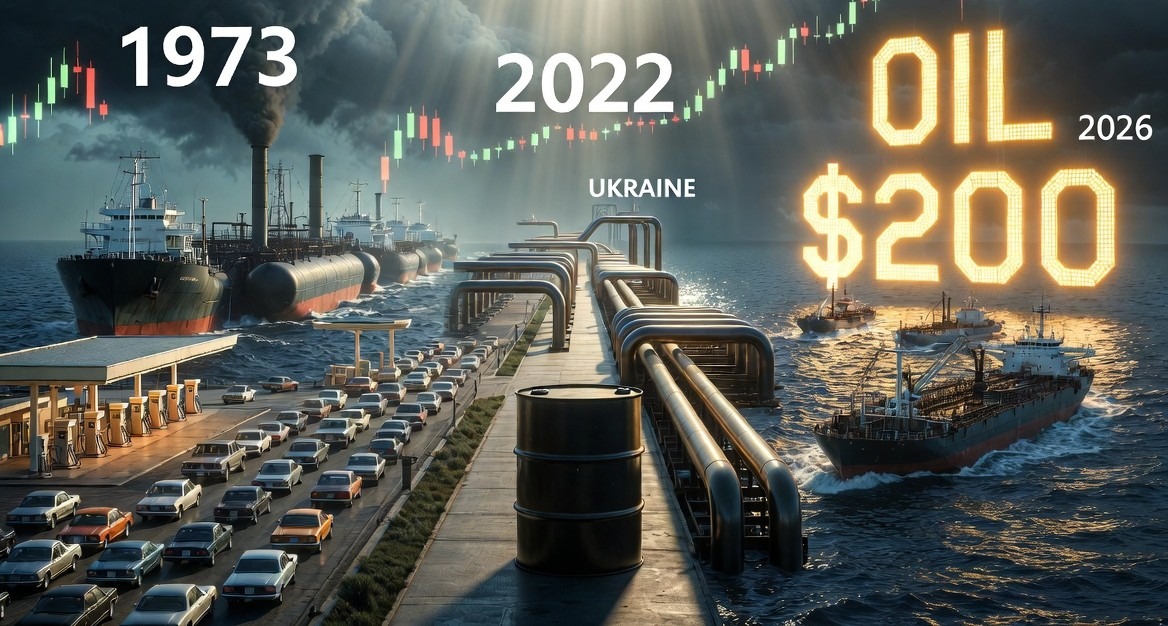
The current Brent crude price of $101.59 per barrel represents a 50% increase from pre-war levels of $67. The journey from $100 to $200 requires not escalation, but merely continuation of the status quo. History provides a clear roadmap: the 1973 oil embargo saw prices quadruple in six months. The 1979 Iranian Revolution sent oil from $15 to $40 in less than a year. The 2022 Ukraine crisis pushed Brent from $70 to $120 in three weeks.
What makes 2026 different is the concentration of disruption. Previous oil shocks involved supply reductions of 4-7% of global consumption. The current Strait of Hormuz closure has eliminated 20 million barrels per day — approximately 20% of global oil supply. This is not a shortage. This is structural decapitation of energy markets.
📜 Historical Context: How Oil Shocks Reshape Economies
To understand where we’re going, we must first examine where we’ve been. Oil price shocks are not novel events — they are recurring features of the global economic system, each leaving distinct scars on the economies they touch.
Major Oil Price Shocks: 1973-2026
The pattern is clear: supply shocks matter more than demand shocks. Duration matters more than magnitude. And geopolitical oil shocks have consistently triggered recessions in oil-importing economies while creating inflationary spirals that persist long after prices normalize.
Historical Data Sources
Oil price data: U.S. Energy Information Administration (EIA), Historical Crude Oil Prices
US GDP and unemployment data: Bureau of Economic Analysis and Bureau of Labor Statistics
S&P 500 data: Bloomberg Historical Market Data
Global trade data: World Trade Organization Statistical Database
🔬 The Mechanics: Why $200 Oil Is Economically Plausible
The question is not whether oil can reach $200 per barrel. The question is what conditions would drive it there, and whether those conditions currently exist.
Supply Math: The 20 Million Barrel Problem
Global oil consumption averages 102 million barrels per day. The Strait of Hormuz normally handles 21 million barrels per day — approximately 21% of global supply. With the strait effectively closed since early March, this represents the largest supply disruption in modern history.
The arithmetic is straightforward. A 20% reduction in supply, absent demand destruction, would require a 20% reduction in consumption to reach equilibrium. In economic terms, this means price must rise until enough consumers cannot afford to purchase oil at current levels. Historical data shows oil demand is highly inelastic in the short term — consumption falls only 0.3% for every 10% price increase.
To reduce global consumption by 20 million barrels per day through price alone would require crude prices to rise approximately 650% from pre-war levels, or roughly $430 per barrel. This is the theoretical market-clearing price with zero supply response and zero behavioral change.
In reality, three factors prevent prices from reaching this extreme: strategic reserve releases (like the IEA’s current 400 million barrel intervention), demand destruction (recession-induced consumption decline), and supply response (increased production from non-OPEC sources). These factors typically cap oil price spikes between 100-150% of pre-crisis levels before market forces reassert equilibrium.
A $200 oil price represents a 198% increase from pre-war $67 levels. This sits comfortably within historical precedent — the 1973 embargo saw 300% increases, the 1979 revolution 167%, the 1990 Gulf War 112%.
The Demand Destruction Threshold
Every dollar oil prices rise imposes quantifiable economic costs. Research from the International Monetary Fund estimates that a sustained $10 increase in oil prices reduces global GDP growth by 0.15 percentage points and raises inflation by 0.4 percentage points within the first year.
Current oil prices of $101 per barrel represent a $34 increase from pre-war levels. This translates to approximately 0.5% reduction in global GDP growth and 1.4% inflation increase. If oil reaches $150 per barrel (an $83 increase from baseline), global GDP growth would decline by 1.2% and inflation would rise by 3.3%. At $200 per barrel (a $133 increase), we’re looking at 2.0% GDP reduction and 5.3% inflation increase.
For context, global GDP growth in 2025 was 3.2%. A 2.0% reduction would bring growth to 1.2% — effectively a global slowdown bordering on recession. Advanced economies, being more oil-dependent, would likely see negative growth. Emerging markets would fare better due to lower per-capita energy consumption, but would still experience significant slowdowns.
Iran’s Strategic Calculation
Iran’s $200 oil warning is not aspirational — it is strategic. The Islamic Republic’s economy, paradoxically, benefits from high oil prices even as its own exports are constrained. Higher prices mean maximum revenue from limited sanctioned sales to China and other non-compliant buyers. Meanwhile, elevated prices inflict maximum economic pain on Western economies supporting Israel.
The IRGC has demonstrated willingness to escalate attacks on shipping and infrastructure, maintaining pressure on supply routes. As long as the war continues, the threat of further disruption keeps a significant risk premium built into oil prices. Markets are currently pricing Brent at $101, but this incorporates expectations of eventual resolution. Remove those expectations, and prices rise mechanically.
If we’re going down, we’re taking the global economy with us.
This is not empty rhetoric. It is economically rational scorched-earth strategy.
📈 Month-by-Month Projections: April 2026 Scenarios
Projections are inherently uncertain, but economic modeling allows us to construct plausible scenarios based on historical patterns, current data, and mechanical market relationships. The following projections assume no major policy interventions beyond the already-announced IEA reserve release.
🔮 SCENARIO 1: WAR CONTINUES — BASELINE PROJECTION (60% PROBABILITY)
🕊️ SCENARIO 2: DIPLOMATIC BREAKTHROUGH (25% PROBABILITY)
⚠️ SCENARIO 3: MAJOR ESCALATION (15% PROBABILITY)
🇺🇸 US Economic Impact: Wartime Patterns and Current Reality
The United States has fought numerous wars since 1945, each with distinct economic fingerprints. Understanding these patterns provides context for the current Iran conflict’s likely economic trajectory.
The US Wartime Economic Pattern
Post-World War II American military conflicts fall into two categories: those that coincided with oil price shocks, and those that did not. The distinction is economically determinative.
The Korean War (1950-1953) occurred during stable oil markets. US GDP grew 20% during the conflict despite massive military spending. Inflation rose modestly from 1.3% in 1950 to 2.2% in 1951, but never became destabilizing. Unemployment fell from 5.3% to 2.9%. The war was economically stimulative.
The Vietnam War (1955-1975) presents a more complex picture. During the 1960s expansion phase, GDP grew robustly (averaging 4.5% annually from 1961-1968) and unemployment fell from 6.7% to 3.6%. However, war spending contributed to inflationary pressures that materialized violently when OPEC imposed its 1973 embargo. The combination of war expenditure and oil shock produced stagflation — simultaneous high inflation (12.3% in 1974) and recession (GDP decline of 0.5% in 1974, 0.2% in 1975).
The Gulf War (1990-1991) coincided with an oil price spike from $17 to $36, but the conflict’s brevity (43 days) limited economic damage. The US entered a mild recession in 1990-1991 (GDP decline of 1.4%) but recovered quickly. Military spending was offset by the fact that allied nations (Saudi Arabia, Kuwait, others) paid $54 billion of the $61 billion cost.
The Iraq War (2003-2011) and Afghanistan War (2001-2021) spanned a period of generally rising oil prices, from $25 at the start to peaks of $147 in 2008. However, the 2008 spike was primarily demand-driven (China, India, speculation) rather than war-driven. The wars’ economic impact manifested primarily through deficit spending ($2.4 trillion in direct costs) rather than oil-shock transmission mechanisms. GDP growth averaged 2.1% during the Iraq War, unemployment varied cyclically but reached 10% during the 2008 financial crisis (not war-caused).
Applying the Pattern to 2026
The current Iran conflict resembles the 1973 and 1979 patterns more than recent wars. It combines military action with severe oil supply disruption. Historical precedent suggests the following economic impacts for the United States:
First quarter 2026 GDP will likely contract. The Atlanta Fed’s GDPNow model has already revised Q1 projections down from 3.0% growth to 2.1% as of early March, before the full oil shock materialized. By quarter-end, Q1 GDP could show contraction of 0.5% to 1.5%, depending on oil price trajectory. This would mark the first negative quarter since Q2 2022.
Inflation will accelerate sharply. February CPI of 2.4% reflects pre-war conditions. March CPI (reported April 10) will likely show 3.2-3.8% annual inflation as energy costs surge. April CPI could reach 4.5-5.5% if oil sustains above $120. The Federal Reserve faces an impossible choice: raise rates to combat inflation (risking deeper recession) or maintain current policy (accepting higher inflation).
Unemployment will rise, but with a lag. Initial jobless claims typically begin rising 8-12 weeks after economic shock onset. Current claims remain low (approximately 215,000 per week as of early March). By late April, claims could reach 275,000-325,000 weekly as energy-intensive sectors (airlines, transportation, manufacturing, hospitality) implement layoffs. Unemployment rate, currently 3.7%, could reach 4.5-5.0% by mid-2026 if recession materializes.
Corporate earnings will deteriorate. Energy costs flow through every sector. S&P 500 earnings estimates for 2026, currently projecting 12% growth, will be revised downward. Actual earnings growth could fall to 0-3% if oil averages $120-150 in Q2 2026, and could turn negative (-5% to -10%) if oil reaches $180-200. Energy sector profits will surge, but this is only 4% of S&P 500 market capitalization and cannot offset broader margin compression.
Consumer behavior will shift dramatically. Gasoline at $5+ per gallon eliminates discretionary spending for middle and lower-income households. Retail sales in non-essential categories (restaurants, apparel, entertainment, travel) will decline 10-20%. Vehicle miles traveled will fall 5-8% as consumers consolidate trips and seek alternatives. E-commerce will see modest gains as consumers avoid driving to stores, but overall consumption declines.
The federal budget deficit will explode. Current military operations are costing $1.5+ billion per day ($11.3 billion in the first 6 days). A one-month conflict costs $45 billion. A three-month conflict costs $135 billion. Simultaneously, recession reduces tax revenue while increasing automatic stabilizer spending (unemployment insurance, food assistance). The deficit, currently projected at $1.6 trillion for fiscal 2026, could reach $2.0-2.2 trillion if war continues through summer.
Economic Data Sources
US GDP data: Bureau of Economic Analysis, National Income and Product Accounts
Inflation data: Bureau of Labor Statistics, Consumer Price Index
Unemployment data: Bureau of Labor Statistics, Current Population Survey
War cost estimates: Congressional Research Service, “The Cost of Wars” reports (various years)
Federal deficit projections: Congressional Budget Office, “Budget and Economic Outlook”
🌍 Global Cascading Effects: When Energy Becomes Contagion
Oil shocks do not respect borders. A supply disruption in the Persian Gulf radiates through global trade networks, currency markets, and financial systems with mathematical precision.
Europe: The Vulnerable Flank
Europe enters this crisis from a position of weakness. The 2022 Ukraine war forced rapid decoupling from Russian natural gas (previously 40% of supply). This transition cost Europe dearly — GDP growth of just 0.5% in 2023, inflation peaking at 10.6%, industrial production declining 6.8% in energy-intensive sectors.
The current oil shock hits Europe harder than the United States for three reasons. First, European economies import 90% of their oil (versus 40% for the US). Second, energy costs represent a larger share of European manufacturing input costs. Third, Europe has less fiscal capacity to cushion the blow — government debt averages 90% of GDP across the eurozone versus 120% for the US, but European political constraints limit deficit spending.
Eurozone GDP growth will likely turn negative in Q1 2026. Germany, the bloc’s largest economy, is particularly vulnerable — manufacturing represents 21% of German GDP versus 11% for the US, and German industry consumes 50% more energy per unit of output than American counterparts. German GDP could contract 1.5-2.5% in the first half of 2026.
Inflation will reignite across Europe. Having finally brought inflation down from 10.6% to 2.6% by late 2025, the European Central Bank now faces resurgence to 4-5% by April 2026. The ECB’s policy options are limited — raising rates would deepen recession, but maintaining current policy risks unanchoring inflation expectations.
Asia: The Demand Destruction Zone
Asian economies, particularly China, Japan, and South Korea, import virtually all their oil from the Middle East. The Strait of Hormuz closure directly affects their energy security.
China’s economy was already slowing (GDP growth of 4.5% in 2025, down from 5.2% in 2024). Oil at $120-150 could reduce Chinese growth to 3-3.5% in 2026 — the slowest pace since 1990 excluding COVID. This matters globally because China accounts for 30% of global GDP growth. Slower Chinese growth means reduced demand for commodities (iron ore, copper, coal), harming Australia, Brazil, and other commodity exporters.
Japan faces a particular vulnerability. The country imports 99.7% of its oil. Current account surplus provides buffer, but prolonged high oil prices would force difficult choices between maintaining consumption and maintaining currency stability. The yen could depreciate to 165-175 per dollar (from current 159) if oil sustains above $150, importing inflation and forcing Bank of Japan policy shifts.
South Korea’s export-driven economy relies on energy-intensive manufacturing (semiconductors, chemicals, steel, ships). Korean industrial production could decline 8-12% if energy costs remain elevated through Q2 2026, with cascading effects on global supply chains.
Emerging Markets: Divergent Fates
The developing world will experience this crisis along two distinct paths: oil exporters will benefit, oil importers will suffer.
Oil-exporting nations (Mexico, Brazil, Nigeria, Angola, Kazakhstan) will see windfall revenues. Mexico’s Pemex exports approximately 1 million barrels per day — at $150 oil versus $70 baseline, this generates an additional $29 billion in annual revenue. Brazil’s Petrobras produces 3 million barrels per day, capturing similar gains. These nations can use windfall revenues to pay down debt, build reserves, or finance domestic programs.
Oil-importing emerging markets face potential crisis. India imports 85% of its oil (5 million barrels per day). At $150 oil, India’s import bill rises by $150 billion annually compared to $70 baseline — equivalent to 4% of GDP. This widens current account deficit, pressures the rupee, forces subsidy cuts or fiscal expansion, and raises inflation (current 1.3% could reach 5-6% by mid-2026).
Turkey, Pakistan, Egypt, and other chronic current-account-deficit nations face similar pressures, potentially requiring IMF assistance if high oil prices persist beyond Q2 2026.
Financial Contagion: When Oil Shocks Become Credit Shocks
High oil prices trigger mechanical financial stress through multiple channels. Airlines, cruise lines, and transportation companies face existential profit threats. Credit spreads for these sectors have already widened 150-200 basis points since early March. Further widening to 400-500 basis points would cut off refinancing access, forcing asset sales, route cuts, and potential bankruptcies.
Emerging market sovereign debt faces repricing. Countries like Egypt (debt-to-GDP 95%), Pakistan (77%), Turkey (38%), Kenya (68%) have dollar-denominated debt but oil-import-driven deficits. Credit default swap spreads for these nations have risen 100-180 basis points. Further deterioration could trigger sovereign defaults similar to Sri Lanka’s 2022 crisis.
Corporate high-yield debt is vulnerable. The US high-yield market is currently $1.4 trillion. Approximately 30% of issuers are in energy-intensive sectors or have oil-price-sensitive revenues. Default rates, currently 2.1%, could rise to 4-6% if oil sustains above $150 through mid-2026.
When oil becomes a weapon, every economy becomes a target. The question is not whether damage will occur, but how widely it will spread.
❓ Your Questions About $200 Oil, Answered
Can oil really reach $200 per barrel?
Yes. Historical precedent shows oil prices can double or triple within months during supply shocks. The 1973 embargo saw a 300% increase, the 1979 Iranian Revolution 167%, and the 2022 Ukraine crisis 71%. The current Strait of Hormuz closure eliminates 20 million barrels per day — 20% of global supply. A $200 price represents a 198% increase from pre-war $67 levels, well within historical norms for supply disruptions of this magnitude.
How long would it take for oil to hit $200?
Based on current trajectory and historical patterns, oil could reach $150-180 by late April 2026 if the war continues at current intensity. The final move from $180 to $200 would likely occur rapidly — within days — as markets panic over sustained disruption. The 1973 embargo took 6 months to quadruple prices. The 2022 Ukraine crisis reached peak prices in 3 weeks. Current pace suggests 6-8 weeks from war start to $200 ceiling.
What happens to the economy if oil reaches $200?
A sustained $200 oil price would reduce global GDP growth by approximately 2.0% and increase inflation by 5.3% within 12 months. For the United States, this translates to recession (GDP contraction of 0.5-2.5%), unemployment rising from 3.7% to 5.5-7.0%, and inflation spiking from 2.4% to 7.0-9.0%. Consumer spending would collapse as gasoline exceeds $6-7 per gallon nationally. Airlines, transportation, and manufacturing would face existential crisis. Global recession probability exceeds 85%.
Has oil ever been $200 before?
No. The highest oil price in history was $147.27 per barrel (Brent crude) in July 2008. However, adjusted for inflation, this would be approximately $208 in 2026 dollars. The 1980 peak of $39.50 equals $148 in today’s dollars. So while nominal $200 oil is unprecedented, inflation-adjusted $200 oil has near-precedent from 2008.
Why can’t strategic reserves prevent $200 oil?
The IEA’s 400 million barrel release represents 20 days of lost Hormuz supply (20 million barrels/day). If the war extends beyond 20 days — which it already has — reserves become insufficient. Additionally, reserve releases take time to reach markets (120 days for full US delivery) while supply disruption is immediate. Reserves can soften the blow but cannot prevent high prices if physical infrastructure remains inoperable.
What would bring oil prices back down?
Four factors would reduce prices: (1) Ceasefire and Hormuz reopening — prices would fall 30-50% within days; (2) Demand destruction — recession-induced consumption collapse of 5-10% would reduce prices 15-25%; (3) Alternative supply — OPEC spare capacity (3 million bpd) and US production increases (1-2 million bpd possible over 6-12 months); (4) Behavioral change — remote work, reduced travel, industrial cutbacks reducing demand 8-12%.
How does $200 oil affect gasoline prices?
Crude oil represents approximately 55% of gasoline’s cost. At $200/barrel crude, gasoline would cost approximately $6.50-7.50 per gallon nationally (current average: $3.54). California and Northeast markets would likely exceed $8.00-9.00 per gallon. Diesel fuel would reach $7.00-8.50 nationally. Jet fuel would approximately double from current levels, forcing airlines to raise ticket prices 60-80% or cut capacity 25-40%.
Which countries benefit from $200 oil?
Oil-exporting nations experience massive windfalls: Saudi Arabia (12 million bpd exports × $130 above baseline = $567 billion annually), UAE ($146 billion), Kuwait ($117 billion), Russia ($234 billion), Canada ($88 billion), Norway ($52 billion). However, benefits are partially offset by global recession reducing demand and commodity prices. Net oil importers — Japan, South Korea, India, most of Europe — suffer severe economic damage.
Is Iran’s $200 warning a negotiating tactic?
Partially. Iran benefits strategically from high oil prices — maximizing revenue from limited sanctioned exports while inflicting economic pain on adversaries. However, the warning is also economically realistic. Iran doesn’t need to “cause” $200 oil through additional action — merely maintaining current disruption allows market mechanics to drive prices upward. The warning is both threat and prediction.
What can investors do to protect themselves?
Defensive positioning includes: energy sector equities (benefit from high prices but face recession risk), Treasury bonds (flight to safety during crisis), gold (inflation hedge, up 16% year-to-date), utilities (defensive sector with pricing power), consumer staples (necessary goods maintain demand). Avoid: airlines, cruise lines, transportation, discretionary retail, high-yield credit, emerging market debt. Consider: inflation-protected securities (TIPS), commodity futures (if sophisticated), defensive options strategies.
❓ Your Questions About $200 Oil, Answered
What would $200 oil mean for gas prices in the United States?
At $200 per barrel crude oil, US gasoline prices would reach approximately $6.50-7.50 per gallon nationally, with California, Hawaii, and Northeast states potentially seeing $8-9 per gallon. The calculation is straightforward: crude oil represents roughly 54% of gasoline’s pump price. With crude at $67 (pre-war), national average gas was $3.32. A $133 increase in crude translates to roughly $3.40-3.60 increase in gasoline, bringing total to $6.70-6.90 before state taxes and regional premiums.
Has oil ever been this expensive before?
In nominal terms, oil briefly reached $147 per barrel in July 2008. However, adjusted for inflation, that equals approximately $210 in 2026 dollars. The all-time inflation-adjusted peak was during the 1979-1980 Iranian Revolution crisis, when oil hit $40 nominal ($168 in 2026 dollars). So $200 oil would represent the second-highest inflation-adjusted price in history, exceeded only by the 2008 spike.
How long can oil stay at $200 before the economy collapses?
Historical patterns suggest economies can sustain extreme oil prices for 3-6 months before severe recession becomes unavoidable. The 2008 period saw oil above $100 for approximately 6 months (March-September), with prices above $130 for about 4 months (May-August). The recession that followed was triggered more by financial crisis than oil alone, but sustained high prices contributed significantly. At $200, demand destruction would accelerate — consumption would likely fall 8-12% within 90 days as consumers and businesses drastically reduce energy use.
Can strategic reserve releases actually bring oil prices down?
Reserve releases can moderate price spikes but cannot solve supply disruptions of the magnitude we’re currently experiencing. The 2022 IEA release of 180 million barrels helped bring oil from $120 to $80-90 range, but that was against a 3 million bpd disruption. The current Hormuz closure eliminates 20 million bpd. The proposed 400 million barrel release represents 4 days of global consumption — helpful but insufficient if the strait remains closed for weeks or months.
Which countries benefit from $200 oil?
Oil-exporting nations experience massive revenue windfalls: Saudi Arabia (9 million bpd production × $133 premium = $436 billion annually), Russia (10 million bpd = $486 billion), UAE (3 million bpd = $146 billion), Iraq (4 million bpd = $194 billion), Canada (4.5 million bpd = $219 billion). However, many of these nations also suffer from global recession reducing demand. The net winners are typically exporters with low production costs and diversified economies: Norway, Qatar, and Canada fare best.
What happened to oil prices after previous Middle East wars?
Every major Middle East conflict since 1973 has produced oil price spikes, but outcomes varied by duration. The 1973 embargo (5 months) saw prices quadruple and stay elevated for years. The 1979 revolution (ongoing instability) kept prices high through 1981. The 1990 Gulf War (43 days) saw prices spike from $17 to $36 then quickly normalize to $20 within 6 months post-war. The 2003 Iraq invasion saw prices rise from $30 to $40 initially, then climb to $147 by 2008 due to other factors. Pattern: brief wars produce brief spikes; prolonged instability produces sustained high prices.
Could $200 oil trigger a global depression?
A global depression (defined as GDP decline exceeding 10% or unemployment exceeding 25%) is unlikely even at $200 oil, but a severe global recession is highly probable. The mechanism: $200 oil for 6+ months would reduce global GDP by approximately 3-4%, raise unemployment by 3-5 percentage points across advanced economies, and potentially trigger sovereign debt crises in oil-importing emerging markets (Turkey, Pakistan, Egypt, Kenya). This is severe recession territory, not depression, but the worst economic contraction since 2008-2009.
What can governments do to prevent $200 oil?
Government options are limited but include: (1) Diplomatic resolution of the Iran conflict (most effective), (2) Coordinated strategic reserve releases (already attempted, limited impact), (3) Demand reduction policies (fuel rationing, work-from-home mandates, reduced speed limits), (4) Emergency production increases from spare capacity (Saudi Arabia has ~3 million bpd spare, insufficient for 20 million bpd gap), (5) Temporary suspension of fuel taxes and regulations, (6) Price controls and subsidies (economically distortive but politically popular). None of these prevent $200 oil if the Strait of Hormuz remains closed — they merely moderate the speed of price increase.
How does $200 oil affect inflation?
Energy costs directly represent 7-9% of the Consumer Price Index basket, but indirect effects multiply the impact. Direct effect: $133 oil price increase translates to approximately 3.8% direct contribution to CPI inflation. Indirect effects: transportation costs increase for all goods (adding 1.2-1.8% to CPI), petrochemical inputs increase for plastics, fertilizers, and materials (adding 0.8-1.4%), and wage pressures emerge as workers demand compensation (adding 0.5-1.2%). Total inflation impact: 6-8 percentage points above baseline. With February 2026 CPI at 2.4%, this would push inflation to 8-10% range.
Is there any way to profit from $200 oil as an investor?
While we do not provide investment advice, historical patterns show certain sectors outperform during oil shocks: energy companies (oil majors, exploration, services), alternative energy (solar, wind, nuclear), tanker shipping companies (due to route diversions increasing demand), gold and commodities (inflation hedges), and defensive consumer staples (utilities, food, essential goods). Sectors that underperform: airlines, cruise lines, automobiles, chemicals, plastics manufacturing, transportation/logistics, and discretionary retail. However, timing is critical — if $200 oil triggers recession, even energy stocks often decline as demand destruction overwhelms profit margins.
The $200 Question: Not If, But When
Iran’s warning to prepare for $200 oil is not bluster. It is an economically rational threat backed by demonstrated capability. The Strait of Hormuz remains closed. Iraqi terminals remain offline. Omani facilities remain evacuated. The IRGC continues attacking shipping. Every day the war continues brings $200 oil closer to reality.
Historical precedent shows oil shocks of this magnitude reliably trigger recessions in importing economies. The arithmetic of supply disruption supports price levels of $180-200 if current conditions persist through April. Economic modeling suggests global GDP decline of 1.5-2.0% and inflation increases of 4-5 percentage points if these price levels sustain.
The question is no longer whether $200 oil is possible. The question is whether diplomatic or military resolution can occur before market mechanics drive prices to that level. Current trajectory suggests arrival in late April. Each week of continued conflict increases probability.
Markets are forward-looking mechanisms. They do not wait for $200 oil to arrive before pricing in its consequences. The economic damage has already begun. Corporate earnings are being revised. Consumer behavior is shifting. Credit is tightening. Recession probabilities are rising.
The $200 warning is not a prediction. It is a promise. And Iran has shown it keeps its promises.
The only remaining question is how much the world is willing to pay before finding an alternative to conflict.