Forex Weekly Analysis: March 16–21, 2026 | EUR/USD, GBP/USD, USD/JPY, AUD/USD Trade Setups & FOMC Preview
Forex Market Analysis
March 16 – 21, 2026

A triple central bank week. FOMC, BoE, and BoJ all decide within 48 hours. Geopolitical risk from the US–Iran conflict keeps the dollar bid as safe-haven demand collides with rate-cut expectations. Here is everything experienced traders need to know — technically, fundamentally, and tactically.
Macro Overview & Market Themes
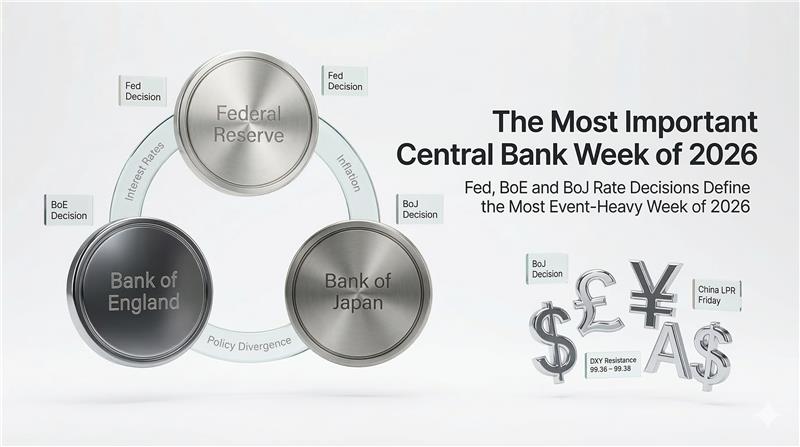
The week of March 16–21 is arguably the most event-dense trading week of the first half of 2026. Three of the world’s most market-moving central banks — the Federal Reserve, the Bank of England, and the Bank of Japan — all announce their rate decisions within a compressed 48-hour window on Wednesday-Thursday. Layer over that the ongoing US–Iran war premium in oil prices, the DXY pressing against a critical technical ceiling at 99.36–99.38, and China’s Loan Prime Rate decision on Friday, and you have a week where staying flat overnight is as much a strategy as any trade.
The dominant macro narrative entering this week is one of profound policy divergence under stress. The dollar’s paradoxical strength — simultaneously a structurally weakening reserve currency and the world’s preferred wartime safe haven — is the defining tension in every major pair. With US CPI at 2.4% YoY (still above the Fed’s 2% target) and oil-driven inflation fears clouding the path to rate cuts, markets have sharply repriced Fed easing expectations: futures now imply just 20 basis points of cuts for all of 2026, down from 50bp priced at end-February.
Meanwhile, UK rate expectations have undergone a dramatic 100bp swing in just two weeks — from three expected cuts to a 70% probability of a rate hike by year-end — driven by PM Starmer’s energy support package hints and BoE Governor Bailey’s hawkish tilt. Japan’s yen remains structurally weak despite safe-haven demand, as PM Takaichi’s expansionary fiscal policy undermines BoJ credibility. Australia’s RBA has already hiked once in February (to 3.85%) and markets price further tightening, making AUD one of the most yield-supported major currencies.
| Central Bank | Current Rate | Meeting Date | Market Expectation | Key Risk | FX Implication |
|---|---|---|---|---|---|
| Federal Reserve | 3.50–3.75% | Mar 17–18 | Hold (99% probability) | Dot plot, SEP projections, Powell press conference | Hawkish hold → USD up; Dovish dot plot → USD down |
| Bank of England | 3.75% | Mar 19 (Mar 21) | Hold (markets expect hold after Iran shock) | Vote split; Energy inflation path | Any hike or hawkish split → GBP rally |
| Bank of Japan | <0.75% | Mar 18–19 | Hold; watching wage data | Hawkish surprise could trigger yen spike | Hike → USD/JPY drops sharply |
| RBA (Australia) | 3.85% | Hiked Feb; Next: May | Hold — but hike bias retained | Trimmed mean CPI above 3% | AUD supported vs JPY, EUR |
| ECB (Eurozone) | 2.15% | Mar 19 | Hold; ~44bp tightening priced by year-end | Services inflation persistence | EUR supported on policy floor |
| PBoC (China) | LPR 1Y / 5Y | Mar 20 | Hold on both LPR rates | Stimulus expectations vs yuan weakness | Cut → AUD/USD supportive via iron ore |
Economic Calendar — High-Impact Events (Mar 16–21)
The following table covers exclusively high-impact events from the USA, UK, Japan, Australia, Eurozone, and China as confirmed from major calendar sources. All times shown in GMT.
| Date | Time (GMT) | Country | Event | Previous | Forecast | Impact |
|---|---|---|---|---|---|---|
| Mon 16 Mar | All Day | 🇯🇵 Japan | Spring Wage Negotiations (Shunto) — Final Data | 5.1% (2025) | ~5.3% | HIGH |
| Mon 16 Mar | 09:30 | 🇬🇧 UK | Rightmove House Price Index | +0.5% | +0.3% | MED |
| Tue 17 Mar | 00:30 | 🇦🇺 Australia | RBA Meeting Minutes (March meeting) | — | Hawkish tone expected | HIGH |
| Tue 17 Mar | 00:30 | 🇦🇺 Australia | NAB Business Confidence | 5 | 4 | MED |
| Tue 17 Mar | 09:00 | 🇪🇺 Eurozone | ZEW Economic Sentiment | 26.0 | 24.5 | MED |
| Tue 17 Mar | 13:30 | 🇺🇸 USA | US Retail Sales (MoM, Feb) | −0.9% | +0.6% | HIGH |
| Tue 17 Mar | 14:15 | 🇺🇸 USA | US Industrial Production (Feb) | +0.5% | +0.3% | MED |
| Wed 18 Mar | 13:30 | 🇺🇸 USA | US PPI (MoM, Feb) | +0.4% | +0.3% | HIGH |
| Wed 18 Mar | 13:30 | 🇺🇸 USA | US Building Permits | 1.47M | 1.45M | MED |
| Wed 18 Mar | 02:00 Thu | 🇺🇸 USA | 🔴 FOMC Rate Decision + Dot Plot + SEP | 3.50–3.75% | Hold (99% prob.) | HIGH ★ |
| Wed 18 Mar | 02:30 Thu | 🇺🇸 USA | 🔴 Powell Press Conference | — | Hawkish or data-dependent tone | HIGH ★ |
| Thu 19 Mar | 03:00 | 🇯🇵 Japan | 🔴 BoJ Rate Decision | <0.75% | Hold expected; tone crucial | HIGH ★ |
| Thu 19 Mar | 07:00 | 🇬🇧 UK | UK Employment / Average Earnings (Jan) | 5.9% YoY | 5.8% YoY | HIGH |
| Thu 19 Mar | 12:00 | 🇬🇧 UK | 🔴 Bank of England Rate Decision (MPC Vote) | 3.75% (5-4 hold) | Hold; watch vote split | HIGH ★ |
| Thu 19 Mar | 13:15 | 🇪🇺 Eurozone | 🔴 ECB Rate Decision | 2.15% | Hold expected | HIGH ★ |
| Thu 19 Mar | 13:30 | 🇺🇸 USA | Initial Jobless Claims | 214K | 210K | HIGH |
| Thu 19 Mar | 13:30 | 🇺🇸 USA | Philadelphia Fed Manufacturing | 18.1 | 15.0 | MED |
| Fri 20 Mar | 01:15 | 🇨🇳 China | PBoC Loan Prime Rate (1Y & 5Y) | 3.10% / 3.60% | Hold expected | HIGH |
| Fri 20 Mar | 23:30 | 🇯🇵 Japan | National CPI (Feb) | 3.9% YoY | 3.7% YoY | HIGH |
| Fri 20 Mar | 00:30 | 🇦🇺 Australia | Australia Employment Change (Feb) | +17.8K | +20.0K | HIGH |
| Fri 20 Mar | 00:30 | 🇦🇺 Australia | Australia Unemployment Rate (Feb) | 4.1% | 4.2% | HIGH |
★ = marquee events most likely to drive outsized FX volatility. All times GMT. Forecasts based on consensus economist surveys as of 14 March 2026.
EUR/USD — Euro vs US Dollar

Fundamental Driver Summary
EUR/USD has dropped to fresh 2026 lows near the 1.1430–1.1450 zone, pressured by the dollar’s safe-haven bid as the Middle East crisis escalates. The pair has lost roughly 300+ pips from its January 2026 highs above 1.1800, as the US dollar’s paradoxical strength combines a structurally bearish long-term trajectory with acute wartime haven inflows. On the ECB side, President Lagarde reiterated a data-dependent, cautious stance. Markets price approximately 44 basis points of ECB tightening by year-end, but the ECB is broadly expected to hold at the March 19 meeting, providing a policy floor for the euro but not a near-term catalyst. The Fed’s March 18 meeting is the dominant driver: any hawkish signals in the dot plot (fewer cuts projected) would push EUR/USD toward 1.1380–1.1400. A dovish surprise (dot plot showing two cuts) could trigger a sharp short-covering rally back toward 1.1550–1.1600.
Technical Analysis — Key Levels
| Level Type | Price | Significance |
|---|---|---|
| Major Resistance | 1.1543 | Former support zone, now resistance — double bottom neckline |
| Resistance | 1.1480 | 23.6% Fib retracement; pivot cluster |
| Immediate Resistance | 1.1500 | Psychological round number; prior H4 high |
| Current Price Zone | 1.1430–1.1450 | Fresh 2026 lows; potential double-bottom forming |
| Support S1 | 1.1400 | Round number / psychological support |
| Support S2 | 1.1380 | Structural swing low — key invalidation zone |
| Major Support | 1.1230 | Long-term secular support (OANDA/IG consensus) |
| DXY Context | 99.36–99.38 | DXY at 78.6% Fib resistance — EUR/USD inversely correlated |
Candlestick & Chart Patterns
Potential Double Bottom forming at the 1.1430 level — two distinct tests of this zone with a neckline at 1.1543. A confirmed break above the neckline would project a measured move toward 1.1720.
On the daily chart, the pair is testing the lower boundary of a descending channel. The RSI has returned toward oversold territory (sub-35 on the 4H), historically a mean-reversion signal for this pair. However, the MACD remains bearish with the histogram well below zero — confirming short-term selling pressure dominates. Look for a Morning Star or Hammer daily close above 1.1450 as the early signal of a potential reversal.
Tags
FOMC-Driven Geopolitical Risk Double Bottom Watch DXY Resistance ECB HoldGBP/USD — British Pound vs US Dollar

Fundamental Driver Summary
Cable is navigating the most complex macro backdrop of any major pair this week. The pair has dropped from a recent 42-day high above 1.3787 to test the 1.3265 area, as UK GDP data disappointed in January and the dollar’s safe-haven bid applied relentless pressure. Yet the medium-term story is structurally more interesting: BoE market expectations have undergone a dramatic hawkish repricing — swinging from three expected rate cuts in 2026 to a 70% probability of a hike by year-end, a 100bp swing in two weeks. This hawkish tilt, driven by energy inflation risks from the Iran conflict, has kept GBP relatively supported against EUR and AUD even as it struggles against the USD. The March 19 BoE decision is expected to be a hold, but the vote split is critical: the February decision was a narrow 5-4 to hold, with four members preferring to cut. Any shift toward a hawkish split will be a major GBP catalyst.
Technical Analysis — Key Levels
| Level Type | Price | Significance |
|---|---|---|
| Major Resistance | 1.3710 | Current “sell zone” — prior ceiling |
| Resistance | 1.3650 | Key pivot — weekly close level to watch |
| Resistance | 1.3492 | 50 SMA; short trade stop reference |
| Current Price | 1.3265 | Testing support cluster |
| Support S1 | 1.3300 | Previous swing zone — psychological |
| Support S2 | 1.3320 | Short-term invalidation level |
| Critical Support | 1.3480 | Primary defense line; must hold for bulls |
| Bearish Invalidation | 1.3320 | Break below shifts medium-term trend to bearish |
| Fibonacci | 1.3414 | 61.8% Fib of recent swing — retracement zone |
Candlestick & Chart Patterns
Descending Channel on the H4 chart — price is making lower highs and lower lows since the 1.3787 peak. The pair is approaching the lower boundary of this channel near the 1.3265–1.3300 zone, which historically produces either a bounce or an accelerated breakdown. The daily RSI has fallen toward the 35 zone — oversold but not yet at extremes. Watch for a Bullish Engulfing candle on the daily chart around the 1.3265–1.3300 support zone as an early reversal signal ahead of the BoE decision. If UK employment data on Thursday surprises to the upside (higher wages), a sharp reversal is possible.
Tags
BoE Decision Vote Split Watch Energy Inflation UK Employment Descending ChannelUSD/JPY — US Dollar vs Japanese Yen

Fundamental Driver Summary
USD/JPY is the week’s most high-stakes pair. The pair has extended its winning streak to four consecutive sessions, trading near 159.40 — approaching the critical 160.00 level that has historically prompted Japanese Ministry of Finance (MoF) currency intervention. The pair’s strength reflects a paradox: the yen is both a safe-haven currency and a high-carry short, and the Iran conflict has created conflicting pressures. Safe-haven flows support JPY, but PM Takaichi’s expansionary fiscal policy has undermined long-term BoJ credibility on normalisation, structurally weakening the yen. The March 18–19 BoJ meeting is the week’s wildcard: a hold is expected, but hawkish Shunto wage data (Japan’s spring wage negotiations showing increases above 5%) could force the BoJ to signal earlier tightening, triggering a sharp yen rally and USD/JPY selloff. The Fed’s dot plot will also be critical — fewer projected cuts would extend USD/JPY’s rally toward 160–161.
Technical Analysis — Key Levels
| Level Type | Price | Significance |
|---|---|---|
| Intervention Zone | 160.00 | Historical MoF intervention trigger — critical ceiling |
| Major Resistance | 158.88 | Current resistance zone — 2026 highs |
| Resistance | 159.40 | Current price — 4-session high area |
| Support S1 | 157.70 | Immediate floor; H4 pivot |
| Support S2 | 158.00 | Breakout zone (prior resistance now support) |
| Key Support | 156.00 | Medium-term structural support |
| Critical Support | 150.77 | Major support; 200 DMA confluence |
| Bearish Target | 148.00 | Invalidation of current bullish structure |
| RSI (Daily) | ~64 | Elevated but not overbought — momentum intact |
| MACD | Marginally + | Histogram turned positive; signal near zero |
Candlestick & Chart Patterns
USD/JPY has formed a clear Ascending Channel on the daily chart since the 155.00 breakout, with higher lows intact. The RSI at ~64 remains below overbought, suggesting buyers remain in control without exhaustion signals. However, at 158.88–159.40, the pair is approaching a historically significant resistance cluster. Watch for a Shooting Star or Doji at the 159.00–160.00 zone as a potential warning of exhaustion. On the 4H chart, a Falling Wedge is forming within an uptrend — classically a bullish continuation pattern that suggests a pullback to 157.70–158.00 before another push higher. This is the ideal entry zone for longs.
Tags
BoJ Decision MoF Intervention Risk Shunto Wages Safe-Haven Paradox Carry TradeAUD/USD — Australian Dollar vs US Dollar

Fundamental Driver Summary
AUD/USD is pulling back from recent highs near 0.7147 to consolidate around 0.7094, but the medium-term structural backdrop remains the most bullish of any major pair. The RBA hiked 25bp in February 2026 (to 3.85%), its first hike since November 2023, in a dramatic inflation-driven pivot. Markets are pricing a further hike to 4.10–4.20% by year-end, making AUD one of the highest-yielding major currencies. The Australia–US 2-year yield spread has widened to multi-year highs (~+43 basis points), making AUD assets attractive to international capital. This week’s key catalysts: the RBA Meeting Minutes on Tuesday (March 17) — which will provide detail on the Board’s discussion around further tightening — and Australia’s Employment data on Friday (March 20). China’s LPR decision on Friday matters too: iron ore (Australia’s largest export) is sensitive to China stimulus signals, and any cut could provide a secondary tailwind for AUD.
Technical Analysis — Key Levels
| Level Type | Price | Significance |
|---|---|---|
| Major Resistance | 0.7147 | Recent 2026 high — highest since June 2022 |
| Resistance | 0.7100 | Psychological level; current consolidation ceiling |
| Current Price | 0.7094 | Consolidating above 23.6% Fib |
| Fibonacci | 0.6976 | 23.6% Fib of 0.6421–0.7147 swing — near-term support |
| Support S1 | 0.7050 | Minor intraday support |
| Support S2 | 0.7000 | Psychological round number — major support |
| Key Support | 0.6940–0.6950 | September 2024 high — now key structural support |
| 200-DMA | ~0.6700 | Long-term trend anchor; far below current price |
| RSI (Daily) | ~55 | Retreated from overbought; still positive momentum |
| ADX | ~27 | Maturing trend; not fresh impulsive strength |
Candlestick & Chart Patterns
AUD/USD is displaying a classic Bull Flag structure on the daily chart — a sharp impulsive move up from 0.6421 to 0.7147, followed by a controlled, shallow retracement consolidation. This is a high-probability continuation pattern when the broader trend is intact. The pair is consolidating just above the 23.6% Fibonacci retracement at 0.6976, consistent with a shallow bull-flag pullback. All three major SMAs (55-, 100- and 200-day) are rising and well below current price, confirming a healthy uptrend. Watch for a Three White Soldiers or Bullish Engulfing pattern above 0.7000 as confirmation of the next upward leg.
Tags
Hawkish RBA Bull Flag China LPR Iron Ore Correlation Yield AdvantageWeekly Scenario Matrix & Risk Radar
The week’s direction hinges primarily on two data points: the FOMC dot plot (does it signal fewer or more cuts?) and the BoE vote split. Below are the key scenario trees for each pair.
| Scenario | Trigger | EUR/USD | GBP/USD | USD/JPY | AUD/USD | Probability |
|---|---|---|---|---|---|---|
| Base Case | FOMC holds; Hawkish dot plot (0–1 cuts); BoE holds; BoJ holds | → 1.1380–1.1420 | → 1.3200–1.3280 | → 159.50–160.50 | → 0.7020–0.7080 | ~50% |
| Dovish Surprise | FOMC dot plot signals 2+ cuts; Soft US data | ↑ 1.1600–1.1720 | ↑ 1.3480–1.3650 | ↓ 157.00–156.00 | ↑ 0.7147–0.7200 | ~20% |
| BoE Hawkish Shock | BoE vote shifts 6-3 hawkish OR surprise hike | → Range 1.1450 | ↑ 1.3650–1.3710 | → Range | → Slight up | ~15% |
| BoJ Hawkish Surprise | BoJ hikes or signals imminent hike given Shunto wages | → Modest EUR/JPY gains | → GBP/JPY up | ↓ 155.00–153.00 | → AUD/JPY up | ~10% |
| Risk-Off Escalation | Major Iran/Strait of Hormuz escalation; Oil >$100 | ↓ 1.1380–1.1300 | ↓ 1.3200–1.3100 | → 158–159 (mixed) | ↓ 0.6940–0.6850 | ~5% |
If the FOMC dot plot removes one of the projected 2026 cuts (going from 1 cut to 0), DXY would likely break above 99.38 resistance toward 100.16–100.34. EUR/USD would test 1.1380, GBP/USD would breach 1.3200, and USD/JPY would challenge 160.00. This is the “higher for longer” outcome that oil-driven inflation fears are building toward.
If the FOMC dot plot signals two cuts for 2026, or if Powell’s language turns more dovish than expected, DXY would fail at 99.38 and retrace toward 98.50. EUR/USD would reclaim 1.1543 and possibly 1.1600. GBP/USD would recover toward 1.3480+. AUD/USD would push back toward 0.7147. This is the “short-covering rally” outcome.
Frequently Asked Questions
Conclusion — Navigating the Triple Central Bank Week
The week of March 16–21, 2026 presents experienced traders with a rare convergence of mega-event risk and high-clarity technical setups. Three of the world’s most influential central banks — the Fed, the BoE, and the BoJ — will define the market’s direction for the next four to six weeks, all within 48 hours. The base case is that all three hold rates, but the nuances — the Fed’s dot plot, the BoE’s vote split, the BoJ’s tone on wages — will create significant intraday volatility and potentially reshape multi-week trends.
The dominant framework remains one of USD safe-haven strength colliding with structural USD weakness. DXY at 99.38 is testing a critical technical ceiling — how it resolves this resistance zone will set the direction for Q2. Our preferred risk-reward trade remains AUD/USD longs on dips to the 0.7000–0.7020 zone, backed by the strongest fundamental tailwind (hawkish RBA, yield advantage, China commodity support). EUR/USD and GBP/USD offer reactive trades around the central bank events rather than pre-positioning.
Watch: 1.1543 neckline break
Key: FOMC dot plot
Watch: BoE vote split
Key: 1.3480 resistance
Watch: 160.00 MoF trigger
Key: BoJ tone on wages
Watch: 0.7000 dip-buy zone
Key: RBA Minutes + Employment