
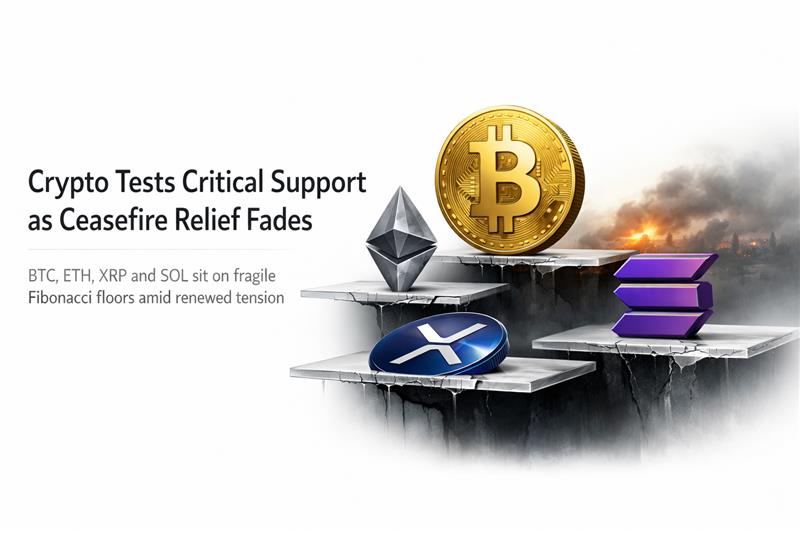
April 9 Crypto Update: Fear Index 14 & BTC Golden Cross Rally Countdown!
Fear Index at 14, But Bitcoin’s Golden Cross Signals the Rally Is Just 2 Weeks Away
The Crypto Fear & Greed Index is screaming extreme fear — yet Bitcoin’s Inter-exchange Flow Pulse just printed a Golden Cross identical to the setups that preceded the 2019 and 2023 bull runs. BTC holds $70,749 (-1%) as the Fed warns of slow inflation and the US Treasury drafts strict new stablecoin AML rules. Bhutan quietly offloads 319 BTC. ETH at $2,173, XRP at $1.331, SOL at $81.38. Here’s exactly what the on-chain data, Fibonacci levels, and institutional flows are telling you to do next. Capital Street FX Crypto Research Desk · April 9, 2026
Ceasefire Relief Evaporates — Fibonacci Support Lines Are Now the Only Defence
Wednesday’s ceasefire-fuelled rally — which briefly sent BTC above $72,000 and ETH to its highest since March 18 — is being systematically unwound on Thursday as Iran’s state media reports three clauses of the deal have been breached. Oil prices are rebounding toward $97 per barrel, the Strait of Hormuz remains effectively closed, and Iran has halted tanker traffic through the strait. Every crypto asset in today’s report is now testing or sitting on its critical Fibonacci support level. For traders, today’s session is binary: either these support floors hold and provide the next bounce entry, or a confirmed break lower reopens the February crash lows.
- ₿ BTC at $70,749 (-0.87%): Fails to confirm above 0.236 Fib resistance ($67,152) — now retreating. Intraday session shows O: $71,368 / H: $71,744 / L: $70,461. Saylor says BTC has likely bottomed at $60K Feb low
- 🔷 ETH at $2,173 (-1.50%): Drops back to test the 0.236 Fib zone ($2,043). Yesterday’s +6.31% ceasefire rally fully at risk. CLARITY Act roundtable April 16 remains the binary catalyst
- 🔵 XRP at $1.331 (-1.31%): Falls back below its 0.236 Fib level ($1.3708) — technically bearish unless bulls recover this level on today’s close. XRP ETFs attracted $3.3M inflows on April 7, bucking the broader trend
- 🟣 SOL at $81.38 (-1.68%): Price sits directly on the 0.236 Fib at $85.21 — a confirmed break below $80 re-opens the base at $65.78. Alpenglow upgrade remains the pending H1 2026 structural catalyst
- 📊 Morgan Stanley MSBT debuts with $34M inflows: The first bank-issued spot Bitcoin ETF trades under ticker MSBT at a market-low 0.14% fee — undercutting BlackRock’s IBIT at 0.25%. Top-1% ETF launch by Bloomberg’s Eric Balchunas
Today’s Crypto Opportunities — April 9, 2026
Full Technical & Fundamental Breakdown
Technical Analysis
Bitcoin’s chart today delivers the clearest possible read: the 0.236 Fibonacci resistance level at $67,152 (from the $98,769 swing high to the $57,386 base) was never convincingly broken, and Wednesday’s ceasefire-driven spike to $71,744 is now being retraced. The daily session shows a bearish wick at the top of the prior day’s range, and BTC is currently trading at $70,749 — below the session open of $71,368.
The descending trendline connecting the January high and the February bounce peak continues to define the macro structure. Price is now trading below this trendline, confirming the structural downtrend remains intact despite recent relief rallies. The 50-day EMA sits near $70,500 and is providing marginal intraday support — a close below this level on a daily basis would be technically significant.
The two-month consolidation range between $62,000 and $75,000 remains the dominant structure. K33 Research noted this pattern most closely resembles the July–September 2022 slow grinding bear market consolidation — which eventually resolved to the downside. Options data from Bitfinex shows traders are still buying downside protection, with call/put skew reflecting defensive positioning despite the recovery attempt.
Fundamental Drivers
Iran ceasefire breach (primary bearish driver): Tehran has claimed that three clauses of the two-week ceasefire agreement have been violated, and Iranian media reports the IRGC has halted oil tanker traffic through the Strait of Hormuz. Oil prices are rebounding toward $97/barrel — each $5 increase in Brent crude translates directly into higher inflation expectations and a more hawkish Federal Reserve, both of which are headwinds for Bitcoin.
Morgan Stanley MSBT launch (structural bull): The Morgan Stanley Bitcoin Trust debuted on NYSE Arca with $34 million in first-day inflows, landing in the top 1% of all ETF launches per Bloomberg’s Eric Balchunas. At 0.14% annual fee — the lowest in the market — MSBT leverages Morgan Stanley’s 16,000 advisors and $9.3 trillion in client assets. The bank has also filed for ETH and SOL trusts, with E*Trade retail crypto trading planned for H1 2026.
Michael Saylor — “Bitcoin has bottomed”: Speaking at a Mizuho event, Strategy’s executive chairman argued BTC likely bottomed near $60,000 in February when forced sellers were flushed out. Saylor cited ETF inflows absorbing daily supply, companies shifting treasury assets into BTC, and the coming formation of banking credit paired with digital credit as the catalyst for the next bull market.
The pattern structure for Bitcoin on April 9 is straightforward: the failed test of 0.236 Fib resistance during yesterday’s ceasefire spike, followed by today’s reversal, is a textbook failed breakout pattern. Failed breakouts — where price briefly exceeds a resistance level but closes back below it — are statistically bearish signals in technical analysis. The next key downside level is the recent consolidation support around $68,000–$69,000. If that fails, the $62,000–$63,000 range (which held during the February crash lows) becomes the next major test.
The only scenario that shifts the technical picture to bullish today is a sustained close above $72,000 with follow-through — which would require either a definitive improvement in the Iran situation or a major positive macro surprise. The Morgan Stanley ETF launch and Saylor’s bottom commentary are structural positives, but they are not sufficient on their own to overcome the geopolitical headwinds driving today’s session.
| Level | Price | Type | Significance |
|---|---|---|---|
| 0.382 Fib | $73,194 | Resistance | Next recovery target if 0.236 broken |
| 0.236 Fib | $67,152 | Resistance | Critical ceiling — failed to close above |
| Current Price | $70,749 | Current | Session close as of report time |
| 50-Day EMA | ~$70,500 | Support | Near-term intraday floor |
| 0 Base | $57,386 | Major Support | February crash low — structural floor |
Technical Analysis
Ethereum is now testing one of the most critical technical levels in its current structure: the 0.236 Fibonacci support at $2,043. Yesterday’s session high of $2,219 — fuelled by the ceasefire announcement and ETH’s role as the clearest regulatory catalyst trade — has given way to a -1.50% session as geopolitical uncertainty returns. The key question for today’s close is whether ETH can hold above the $2,043 floor.
The chart shows ETH has been consolidating between the 0.236 Fib ($2,043) and the 0.382 Fib ($2,235) for most of March and early April — a range-bound structure that is now being tested from above. A daily close below $2,043 would be technically significant and open the path to the base at $1,733. Conversely, a recovery above $2,235 (0.382 Fib) would restore the bullish setup from yesterday’s report.
RSI momentum on the daily has turned lower after the brief surge above neutral, confirming the ceasefire relief is fading from ETH’s structure. Volume during today’s session is below yesterday’s ceasefire spike, suggesting the selling pressure is consolidative rather than capitulatory — which is marginally constructive for support-hold thesis.
Fundamental Drivers
CLARITY Act roundtable — April 16 (primary catalyst): The SEC’s digital asset roundtable on April 16 remains the single most important scheduled event for Ethereum. The CLARITY Act’s commodity classification framework, if progressed, would directly remove the legal ambiguity that has constrained institutional ETH allocation. Ethereum’s role in the CLARITY Act narrative is as a commodity, not a security — a distinction worth billions in institutional deployment.
Morgan Stanley ETH Trust filing: Morgan Stanley filed an S-1 for a spot Ethereum Trust in January 2026. Combined with the successful debut of MSBT, the ETH trust filing positions Ethereum for a similar institutional distribution channel — Morgan Stanley’s 16,000 advisors could channel significant new ETH demand once approved. This is a structural tailwind that operates independently of daily price action.
Fusaka upgrade narrative: Ethereum’s development roadmap continues to advance. The Fusaka upgrade, which targets further improvements to staking economics and Layer-2 interoperability, remains on track for H2 2026. Layer-2 ecosystems (Arbitrum, Base, Optimism) continue to absorb transaction volume from the mainnet, sustaining network utility even during price consolidation. The bear case — that Fusaka weakens ETH tokenomics by collapsing fee revenues — remains a concern for some analysts.
Ethereum’s setup today is the best-defined risk/reward of the four assets — not because it is bullish, but because the support level ($2,043) is clear and the stop placement is unambiguous. If you are a buyer, you buy here with a stop below $2,000 and a target at $2,390 (0.5 Fib). If $2,043 breaks, you do not buy until the next support zone or until the April 16 outcome is known. The macro headwind from the ceasefire breach is real, but ETH has the strongest fundamental catalyst pipeline of any asset in today’s report.
| Level | Price | Type | Significance |
|---|---|---|---|
| 0.618 Fib | $2,545 | Resistance | Full recovery target if structure turns bullish |
| 0.5 Fib | $2,390 | Resistance | Midpoint — key medium-term target |
| 0.382 Fib | $2,235 | Resistance | Immediate ceiling — must break for bull setup |
| Current Price | $2,173 | Current | Between 0.236 and 0.382 Fib |
| 0.236 Fib | $2,043 | Critical Support | Must hold to avoid test of base |
| 0 Base | $1,733 | Major Support | February crash low |
Technical Analysis
XRP is today’s technically weakest asset. The -1.31% session has pushed price back below the 0.236 Fibonacci level at $1.3708 — the level yesterday’s ceasefire spike briefly recovered. This represents a technical failure: XRP rallied into resistance during Wednesday’s risk-on session, and is now retreating, placing it back in the lower risk zone between the 0.236 Fib and the base at $1.1156.
The daily chart shows a pattern of lower highs and lower lows dating back to the January peak at $2.9968 — an intact downtrend of more than three months. Each recovery attempt (February, March, early April) has failed to produce a sustained close above the 0.236 Fib. Today’s rejection, coinciding with geopolitical risk returning, continues this pattern.
The session range of $1.3251–$1.3573 is narrow, suggesting a degree of seller exhaustion rather than aggressive distribution. XRP ETF inflows of $3.3 million on April 7 — bucking the trend of outflows across BTC and ETH ETF products — indicate selective institutional accumulation is occurring at these levels. This provides a floor, but not a reversal signal.
Fundamental Drivers
CLARITY Act — April 16 binary risk: The SEC’s digital asset roundtable on April 16 is the most important near-term catalyst for XRP specifically. The CLARITY Act’s framework for digital asset classification would directly impact XRP’s legal status and the broader regulatory environment for Ripple’s operations. Polymarket odds for the CLARITY Act’s passage have declined from 82% to 53% following tariff-related macro disruption — reflecting the increased uncertainty.
XRP ETF inflows — relative strength: While Bitcoin and Ethereum ETFs saw net outflows of $159 million and $64.67 million respectively on April 7, XRP-focused products attracted $3.3 million in net inflows, led by Bitwise and Franklin funds. This selective institutional confidence suggests the XRP regulatory narrative remains compelling even during broader market weakness — a structural positive that is visible in the data but not yet in the price.
Ripple Treasury Management System launch: Ripple unveiled the first Treasury Management System natively handling both XRP and fiat currencies on April 8 — a product development that advances XRP’s utility case in institutional treasury and cross-border payments. Singapore’s central bank continued testing cross-border financial settlements on the XRP Ledger in Q1 2026, adding real-world validation. These utility developments support a long-term case even as short-term price action remains pressured.
XRP’s risk-reward today is the most asymmetric of the four assets — but in a way that demands patience rather than action. The April 16 CLARITY Act roundtable is the trigger that could deliver 20–30% moves higher if it resolves favourably. However, entering XRP before that event — with the perpetual funding rate elevated and the technical structure bearish — is a high-risk proposition. The optimal approach is to wait for the roundtable outcome and enter on the session immediately following a positive result. Until then, XRP is a watchlist trade, not an active one.
| Level | Price | Type | Significance |
|---|---|---|---|
| 0.5 Fib | $1.6562 | Resistance | Medium-term recovery target |
| 0.382 Fib | $1.5286 | Resistance | First bull target after 0.236 cleared |
| 0.236 Fib | $1.3708 | Resistance | Must recover on daily close to turn bullish |
| Current Price | $1.3310 | Current | Below 0.236 — bearish zone |
| 0 Base | $1.1156 | Major Support | Full retracement base — max downside |
Technical Analysis
Solana is in the most technically precarious position of the four assets today: at $81.38, it is sitting below its 0.236 Fibonacci level at $85.21, and the session low of $81.21 represents a test of the intermediate support zone. The chart shows a descending trendline from the January high ($148.13) that continues to cap recovery attempts — each bounce over the past three months has found sellers at lower and lower levels.
The -1.68% session is the largest percentage decline among today’s four assets, reflecting SOL’s higher beta characteristics versus Bitcoin. The daily candle shape — open at $82.93, spike to $83.12, collapse to $81.21 — is consistent with a failed intraday recovery attempt, with sellers re-asserting control near the descending trendline intersection.
A confirmed daily close below $80.00 would be a significant technical development, opening a path toward the 0 Fibonacci base at $65.78. Above $85.21 (0.236 Fib), the structure neutralises; above $97.24 (0.382 Fib), it turns constructively bullish. Until then, SOL remains in the lower half of its retracement range with a bearish technical bias.
Fundamental Drivers
Alpenglow upgrade — pending H1 2026: Solana’s next major consensus upgrade, developed by Anza (a Solana Labs spinoff), would replace the current Proof of History and Tower BFT systems with Votor (100–150ms finality) and Rotor (more efficient data relay). Sub-second finality would position Solana as the go-to Layer-1 for high-frequency financial applications — a narrative that provides structural support for SOL’s long-term case even during price weakness.
Morgan Stanley SOL Trust filing: As part of its broader digital asset strategy, Morgan Stanley filed for a spot Solana ETF in January 2026 alongside its Ethereum trust. Combined with E*Trade retail crypto trading plans (Bitcoin, Ethereum, Solana) for H1 2026 via Zero Hash, Morgan Stanley’s involvement provides Solana with an institutional distribution channel that no other Layer-1 outside Ethereum currently enjoys at this scale.
Macro headwinds — Iran and oil: Solana’s correlation with risk sentiment is higher than Bitcoin’s on a beta-adjusted basis. The resumption of Iran conflict uncertainty and rising oil prices directly increase the cost of risk for institutional allocators — and SOL, as a higher-beta crypto asset, typically experiences larger percentage drawdowns in risk-off environments. The Drift Protocol security breach narrative from Q1 2026 has added idiosyncratic risk to the Solana ecosystem narrative, though the foundation’s security overhaul is reportedly in progress.
Solana’s setup today does not offer a clean long entry. The asset is below its 0.236 Fib support level, in a confirmed descending channel, and the primary macro driver (Iran ceasefire) is deteriorating. The wait-and-see approach applies: monitor for a reclaim of $85.21 on a daily close before re-engaging on the long side. If the Alpenglow upgrade announcement comes with a specific date, that would be the high-conviction fundamental catalyst to buy the dip regardless of short-term technical weakness. Until then, defensive positioning is appropriate for SOL.
| Level | Price | Type | Significance |
|---|---|---|---|
| 0.5 Fib | $106.95 | Resistance | Medium-term bull recovery target |
| 0.382 Fib | $97.24 | Resistance | First major target on recovery |
| 0.236 Fib | $85.21 | Resistance | Must reclaim to neutralise bearish bias |
| Current Price | $81.38 | Current | Below 0.236 — in danger zone |
| Key Floor | $80.00 | Psychological Support | Break here accelerates downside |
| 0 Base | $65.78 | Major Support | Full retracement — max bear scenario |
The Big Picture: Ceasefire Breach, MSBT Launch & Saylor’s Bottom Call
1. Iran Ceasefire Frays — The Primary Macro Risk for April 9
The two-week US-Iran ceasefire, announced by President Trump on Tuesday via Truth Social and celebrated by crypto markets with a broad rally on Wednesday, has deteriorated within 48 hours. Iranian state media (Tasnim, Fars) report that Tehran claims three clauses of the agreement have been breached, with Israel continuing strikes on Lebanon — which Iran considers a violation of the ceasefire’s geographic scope. Iran has responded by halting oil tanker traffic through the Strait of Hormuz, pushing Brent crude back toward $97 per barrel. Pakistan’s Prime Minister Shehbaz Sharif, who brokered the original agreement, has publicly expressed concern about the violations and urged restraint.
The practical impact on crypto markets is direct: oil at $97 sustains the inflationary environment that has kept the Federal Reserve on hold, preventing the rate cuts that would be the primary monetary tailwind for risk assets. Every dollar increase in Brent crude is a headwind for Bitcoin, Ethereum, and the broader digital asset market. The market is now in a holding pattern waiting for the next geopolitical development — either a confirmed ceasefire restoration (which would repeat Wednesday’s rally) or further escalation (which would test the February lows).
2. Morgan Stanley MSBT — The Most Important ETF Launch Since January 2024
Morgan Stanley’s Morgan Stanley Bitcoin Trust (MSBT) began trading on NYSE Arca on April 8 with $34 million in first-day inflows and 1.6 million shares traded — landing in the top 1% of all US ETF launches per Bloomberg Intelligence analyst Eric Balchunas. At 0.14% annual fee, MSBT is the cheapest spot Bitcoin ETF in the market, undercutting BlackRock’s IBIT (0.25%), Grayscale’s Bitcoin Mini Trust (0.15%), and Bitwise (0.20%).
The structural significance extends well beyond the fee war. Morgan Stanley becomes the first major US commercial bank to issue a spot Bitcoin ETF under its own name — a milestone that signals the financialization of Bitcoin has reached into the core of traditional wealth management. With 16,000 financial advisors managing $9.3 trillion in client assets, Morgan Stanley’s distribution network is unlike any previous ETF issuer. In the ETF industry, distribution is kingmaker. If even a fraction of Morgan Stanley’s advisor network begins directing client allocations toward MSBT, the resulting flows would dwarf the fund’s day-one performance. The bank has also filed for Ethereum and Solana trusts, and plans E*Trade retail crypto trading in H1 2026 — making this the beginning of a broader institutional buildout, not a one-off.
3. Michael Saylor — “Bitcoin Has Likely Bottomed Near $60,000”
Speaking at a Mizuho event on April 8, Strategy’s executive chairman Michael Saylor argued that Bitcoin’s bottom was likely reached in early February near $60,000 — when forced sellers were exhausted and capitulation completed. Saylor’s framework for identifying bottoms focuses on seller exhaustion and capital structure rather than valuation metrics or investor sentiment. He cited three converging factors as support for his view: ETF inflows absorbing daily Bitcoin supply from miners, corporate treasury adoption accelerating (with companies following Strategy’s playbook), and the emerging formation of banking credit paired with digital credit as the next major price catalyst.
Saylor also addressed the quantum computing threat to Bitcoin directly, calling it overblown and “theoretical and likely decades away” from posing a practical risk. Lightning Labs CTO Olaoluwa Osuntokun had demoed a prototype quantum-resistant wallet rescue tool on April 9, responding to the debate. For traders, Saylor’s commentary is not a short-term timing signal — it is a framework for patience. If the February $60,000 low holds as the structural bottom, the current $70,000–$71,000 range represents a constructive medium-term entry zone, not a sell.
Key Events — April 9, 2026 & Week Ahead
| Time (GMT) | Asset | Event | Forecast | Prior | Status | Impact |
|---|---|---|---|---|---|---|
| Ongoing | All Crypto | US-Iran Ceasefire Breach — Strait of Hormuz Closure Update | Reopening | Closed | Monitoring | HIGH |
| Ongoing | BTC / ETH | MSBT Day-2 Inflow Data — Morgan Stanley Bitcoin ETF | +$20–40M | $34M Day 1 | Monitoring | HIGH |
| 12:30 | USD | US Jobless Claims — Labour Market Signal for Fed Policy | 225K | 219K | Pending | HIGH |
| Ongoing | All Crypto | Oil Price Trajectory — Brent Crude / Strait of Hormuz Status | Below $95 | ~$97 | Monitoring | HIGH |
| Ongoing | BTC | Bitcoin Spot ETF Daily Flow Data (IBIT, MSBT, FBTC) | Positive | Mixed | Monitoring | HIGH |
| Ongoing | XRP / ETH | CLARITY Act Senate Banking Committee — Progress Updates | 53% Pass | 82% Peak | Monitoring | HIGH |
| Apr 11 | USD | US Producer Price Index (PPI) — Inflation Upstream Signal | +0.1% | +0.2% | Upcoming | HIGH |
| Apr 16 | XRP / ETH | SEC CLARITY Act Roundtable — Digital Asset Classification | Bullish | — | Upcoming | HIGH |
| H1 2026 | SOL | Solana Alpenglow Upgrade Announcement — Launch Date TBC | Bullish | — | Pending | MEDIUM |
| H1 2026 | BTC/ETH/SOL | Morgan Stanley E*Trade Retail Crypto Launch — via Zero Hash | Bullish | — | Upcoming | MEDIUM |
Traders’ Questions — April 9, 2026
Trade Crypto with Capital Street FX — Zero Slippage, Maximum Leverage
Your stop executes at your exact price, even during Iran headline volatility and $2,000 BTC moves in under 10 minutes.
Trade BTC, ETH, XRP and SOL with up to 1:500 leverage. 24/7 market access, no weekend gaps.
Fibonacci-mapped technical analysis with Fibonacci levels, fundamental catalysts, and trade setups delivered every trading day.
Raw spreads, fast fills, and a platform built for the volatility of crypto — including geopolitical news events.