Pre-Open Brief: Hormuz Re-Closed, IRGC Fires on Tankers | CSFX
Hormuz Re-Closed.
IRGC Gunboats Fire on Tankers.
Ceasefire Expires Wednesday.
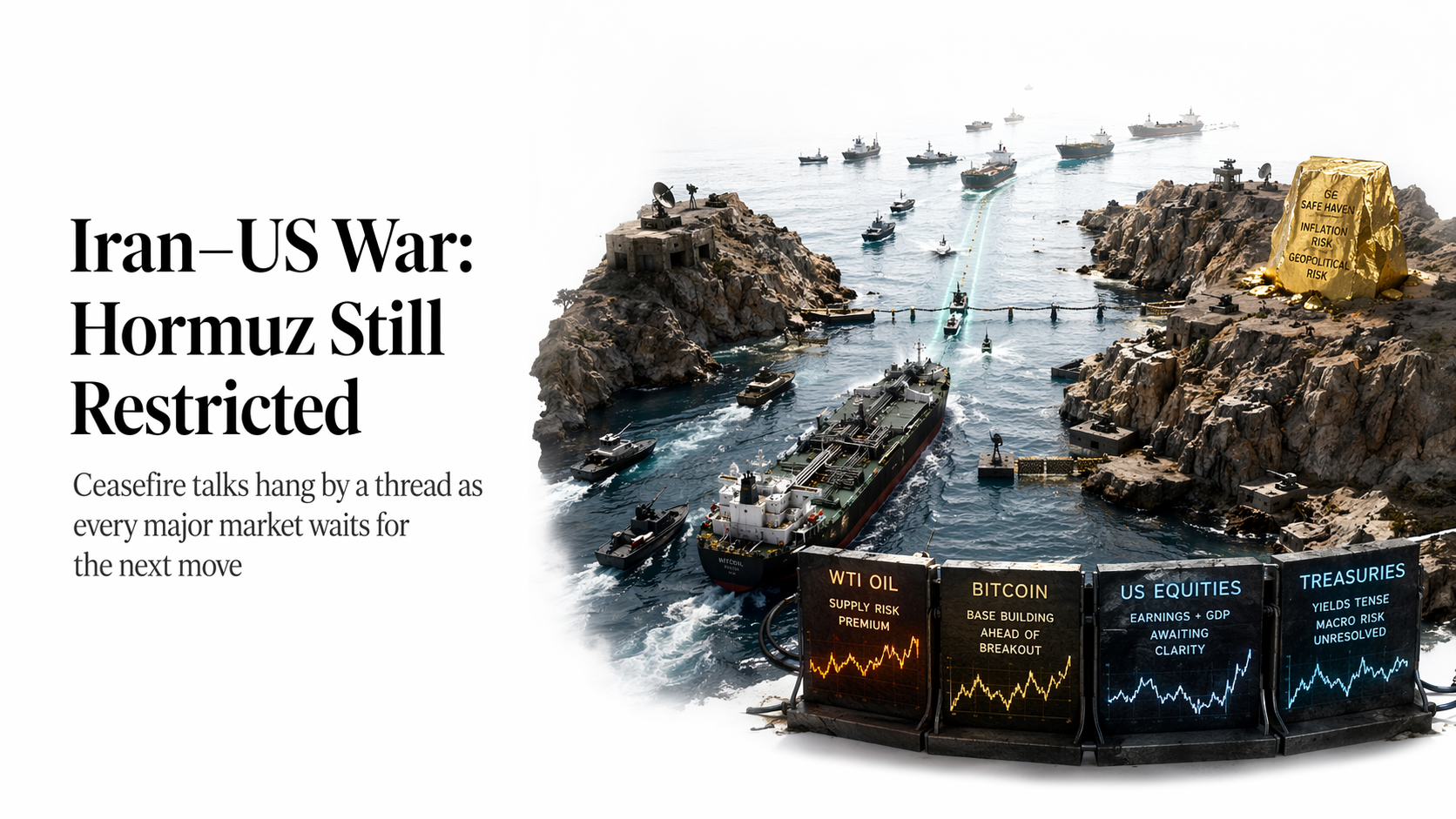
Everything that was expected for Monday’s open as of Friday’s close has changed. Between Saturday morning and Sunday night, the situation escalated through at least five distinct developments — none of which point toward de-escalation. The Strait of Hormuz is closed again after a 24-hour window of partial reopening. Iranian Revolutionary Guard gunboats fired on ships without radio warning. Trump accused Iran of a “total violation” of the ceasefire. The ceasefire itself expires on Wednesday. US negotiators are flying to Pakistan for talks on Monday with a deadline that is two days away. Markets open into this — not into the ceasefire-progress narrative that was circulating on Friday afternoon.
Evening
Strait of Hormuz declared open. Iran announced commercial passage was available during the Lebanon truce. A convoy of approximately eight tankers, including one VLCC and several LPG carriers, successfully crossed. Trump celebrated on social media, said a deal was “very close.” Markets had priced in de-escalation into Friday’s close.
Late
Trump clarifies: US blockade of Iranian ports remains in place. Despite the Hormuz reopening, Trump confirmed the naval blockade on vessels departing or docking at Iranian ports would not be lifted. Around 20 ships that had been prepared to pay Iran’s $2 million per vessel transit toll turned back toward Oman upon receiving radio warnings that passage conditions had changed.
Morning
Iran reverses Hormuz reopening. Strait declared closed again. Iran’s joint military command announced that “control of the Strait of Hormuz has returned to its previous state under strict management and control of the armed forces.” The IRGC warned that any vessel movement from anchorage in the Persian Gulf or Sea of Oman toward the strait would be considered cooperation with the US blockade and treated as a hostile act. Iran’s National Security Commission head stated the re-closure was a response to “America’s untrustworthiness.”
Afternoon
IRGC gunboats fire on tankers. No radio warning issued. The UK Maritime Trade Operations Centre (UKMTO) issued Warning 037-26: an IRGC gunboat approached and fired on a tanker 20 nautical miles northeast of Oman — the ship’s master reported “no radio challenge before opening fire.” A second UKMTO advisory (038-26) reported a container ship struck by an unknown projectile off the coast of Oman, with damage to several containers. No fires or injuries reported in either incident. The VLCC Sanmar Herald, carrying 2 million barrels of Iraqi crude oil for India, was fired upon and forced to turn back despite having prior Iranian clearance to pass. A separate vessel reported being threatened with destruction by IRGC forces if it continued toward the strait.
Evening
India summons Iran’s ambassador. India’s Foreign Secretary Vikram Misri summoned Iran’s ambassador to New Delhi, conveying “deep concern” at the firing on two Indian-flagged vessels, including an oil tanker. India noted that Iran had previously granted clearance to Indian-flagged ships as a “friendly nation” — that designation was apparently no longer operative. This marks a significant diplomatic deterioration involving a non-belligerent party.
Morning
Trump accuses Iran of “total violation” of ceasefire. Issues new ultimatum. In a Truth Social post, Trump accused Iran of violating the ceasefire by “firing bullets in the Strait of Hormuz” on Saturday. He offered Iran what he called a “reasonable deal” but threatened that if Iran refuses, “the United States is going to knock out every single Power Plant, and every single Bridge, in Iran. NO MORE MR. NICE GUY!” Trump referred specifically to firing on “French and UK ships” in addition to Indian vessels. The Strait remained closed as of Sunday evening.
Afternoon
Trump dispatches Kushner and Witkoff to Pakistan. Talks set for Monday. US special envoys Jared Kushner and Steve Witkoff are travelling to Islamabad for a new round of negotiations beginning Monday, April 20. An Iranian official confirmed Iranian negotiators will attend. The ceasefire framework expires on Wednesday, April 22. Trump said he may not extend it and repeated that if no deal is reached, bombing will resume. The previous round of Islamabad talks on April 11–12, led by Vice President Vance, ended without agreement. Bloomberg reported as of 12:50 PM UTC Sunday that Hormuz remains at standstill and is “denting US-Iran peace deal hopes.”
Evening
Treasury extends Russian oil sanctions pause. The US Treasury Department confirmed an extension of its pause on sanctions related to Russian oil shipments — a direct acknowledgement that the Hormuz disruption is creating supply shortages that require compensatory measures. Treasury Secretary Scott Bessent had explicitly ruled out this move as recently as Wednesday, April 15, making the reversal within 72 hours a significant policy shift reflecting the severity of the energy supply situation.
What Traders Are Walking Into on Monday Morning
Friday’s market close reflected a narrative that has now been materially overtaken by events. At the close on Friday, April 17, markets were pricing a trajectory toward de-escalation: the Strait of Hormuz had just been announced open, a 10-day Lebanon ceasefire was in place, Trump said a deal was “very close,” and Iran’s foreign minister sounded optimistic. The implied probability of a formal peace deal within days was reflected in equity futures, oil’s partial pullback from $95, and gold consolidating below $4,900.
That framework no longer holds. The Hormuz is closed again. Tankers have been fired upon. The ceasefire — which was already described by Vice President Vance as a “fragile truce” — expires on Wednesday with no agreement in place. Trump has issued an ultimatum threatening strikes on power plants and bridges. The only counterpoint is that US negotiators are in Pakistan on Monday, which introduces deal-possibility into a backdrop that is otherwise unambiguously escalatory. Markets will have to resolve a genuine binary: negotiations succeed by Wednesday and the war premium reverses, or talks fail again and military action resumes.
The key factor that changes Monday’s open vs. Friday’s close: On Friday evening, markets believed the Hormuz was open and a deal was imminent. On Monday morning, markets know the Hormuz is closed, ships have been fired on, and the ceasefire expires in 48 hours. Every asset that was priced for de-escalation on Friday needs to be repriced for re-escalation. The magnitude of that repricing will depend on how much of this weekend’s news was absorbed via overnight futures and how aggressively institutional desks act at the open.
What to Expect Across Each Market Segment
The following is not a set of trade recommendations. It is an assessment of how each market segment is likely to react to the information that has accumulated between Friday’s close and Sunday evening, and the dominant directional pressure each faces at Monday’s open. Given the binary nature of the Pakistan talks, the range of possible outcomes across each asset class is unusually wide. Position sizing should account for gap-risk in both directions.
Hormuz Re-Closure Is A Harder Supply Shock Than Last Week’s Blockade
WTI closed Friday near $91. Monday’s open faces direct upward repricing pressure from the Hormuz re-closure and the IRGC’s active enforcement through live fire. This is materially different from the US-imposed blockade that markets had partially priced — it reintroduces supply disruption to 20% of global seaborne oil volumes from the demand side of the chokepoint, not just the supply side. The IEA April report confirmed global oil supply had already fallen 10.1 million barrels per day in March to 97 million bpd — the largest disruption in recorded history. Global observed oil inventories fell 85 million barrels in March alone.
The prior ceasefire announcement on April 8 sent oil down sharply from $116+ as energy stocks sold off 5–9%. That move is now partially reversing. Brent futures were already pricing closer to $95–$98 in overnight Asian trading on Sunday. If Monday opens with no progress signalled from Pakistan talks, the range extends toward $100–$105. The Bloomberg scenario analysis from earlier in April noted that at $170 per barrel, the stagflationary impact on growth roughly doubles. We are not there, but the direction of travel has reversed.
Shipping insurance premiums, which had briefly begun to normalise following the April 8 ceasefire, are widening again. The energy commodity market faces a week where the headline risk is entirely to the upside if talks fail and to the downside only if a deal is announced before Wednesday.
War Premium Returns; Structural Bid Reinforced
Gold ended Friday near $4,803 after the Hormuz opening allowed a partial de-escalation dip from $4,850. With the Hormuz closed again and the ceasefire’s survival in doubt, the war premium that had partially unwound on Friday is expected to reassert on Monday. The prior ceasefire relief rally on April 8 saw gold rise 2.2% despite the de-escalation — a signal that the structural bid from central bank accumulation, de-dollarisation and real-rate dynamics is operating independently of geopolitical news flow. An escalation re-pricing adds the war premium back on top of that structural bid.
The relevant ceiling to watch is the February 2026 all-time high above $5,050. Central bank buying has not paused — China, South Korea and Malaysia all added to reserves in Q1 2026. The US Treasury’s overnight decision to extend the Russian oil sanctions pause, while a separate matter, adds further signal that US fiscal and energy policy is operating in crisis-management mode, which historically reinforces gold demand from institutional portfolio allocators. Watch for gold to gap to the upside at the open unless Pakistan talks produce an early-morning breakthrough announcement.
Dollar Safe-Haven Complicated; JPY and CHF the Cleaner Plays
The Dollar’s response to escalation in this conflict has been more nuanced than in previous geopolitical crises. In prior Hormuz-tension episodes, oil price spikes drove stagflationary fears that complicated the Dollar’s safe-haven bid — higher inflation expectations raised yields, but growth concerns offset risk appetite. This dynamic played out again after the April 13 blockade announcement, where the Dollar strengthened modestly (+1.4% DXY since war start) but underperformed compared to its traditional safe-haven role.
For Monday, the USD is likely to see mixed demand: safe-haven buying against risk currencies (AUD, NZD, ZAR) but continued pressure against JPY and CHF, which are increasingly absorbing the pure safe-haven flow that would previously have gone entirely to USD. EUR/USD may weaken modestly on energy inflation concerns for Europe, which sources 12–14% of its LNG through Hormuz. USD/JPY is the pair to watch most closely — the BoJ’s normalisation trajectory combined with Yen safe-haven demand could produce outsized moves if the ceasefire formally collapses. Currency markets will also monitor whether the Pakistan talks produce any headline during Asian or early European hours Monday.
Gulf sovereign wealth fund flows — particularly into US Treasuries and global equities — will be influenced by regional energy price dynamics. A prolonged escalation affects Gulf state fiscal calculations in ways that eventually influence capital flows.
Dual Pressure: Re-Escalation Overhang Meets Peak Earnings Week
This is the most complex market segment to assess for Monday. Equities face simultaneous pressure from two directions. The re-escalation news over the weekend argues for a risk-off open — energy sector up, tech and consumer down, energy input cost concerns rising. However, this is simultaneously peak earnings week: Alphabet and Tesla report Tuesday, Meta and Microsoft report Wednesday, Amazon reports Friday. These five companies represent approximately 21% of S&P 500 market capitalisation. A clean earnings beat from any of them creates a competing narrative that could partially offset the geopolitical discount.
The prior pattern in this conflict has been instructive. When the US blockade was announced on April 13, equities fell modestly — the CNBC analysis from that week noted that “markets have reached peak uncertainty” and “the reaction function is no longer as extreme as before.” However, that was after six weeks of conditioning. The Hormuz re-closure, the IRGC firing on ships without warning, and the ceasefire expiry Wednesday represent a qualitative escalation beyond the blockade, not merely a continuation of it. The S&P 500 had only just reclaimed its all-time high on April 15 amid ceasefire optimism. That level is at risk Monday morning.
The Nasdaq faces specific risk this week from the earnings-guidance dynamic on top of the macro backdrop. Asian markets opened broadly lower Sunday night. European futures are expected to gap down at the open. US futures will track the overnight tone and any Pakistan talks headlines. The index market is priced for a week of high volatility with a downward bias unless early Pakistan talks news is constructive.
Correlation With Risk Assets Likely to Reassert in Re-Escalation Phase
Bitcoin has been navigating a partial de-correlation from equities in the current cycle, but during acute risk-off phases triggered by specific geopolitical events, the correlation reasserts in the short term before diverging again. The most recent acute risk-off phase — the March Hormuz closure — initially sent Bitcoin lower before it recovered as a dollar-alternative narrative took hold. The current setup is similar: re-escalation at the open likely produces short-term crypto selling, but the medium-term direction depends on the Dollar’s performance.
Ethereum is additionally constrained by the regulatory uncertainty around staked ETF approval, making it more vulnerable to macro-led selling than Bitcoin in this environment. For crypto specifically, the key variable is not the geopolitical news directly but how equities trade on Monday — if equity selling is orderly (1–2%), crypto stabilises; if equity selling is disorderly or accelerates into Wednesday, crypto follows aggressively.
Flight-to-Safety Bid Returns; Stagflation Limits Depth of Rally
The US 10-year yield ended Friday at approximately 4.31%. In a straightforward risk-off event, Treasuries would rally and yields would fall. However, this conflict has consistently complicated that mechanism: higher oil prices raise inflation expectations, which argue against buying duration even as the risk-off impulse argues for it. The net result has been a yield curve that has steepened and remained volatile rather than rallying cleanly. Following the April 8 ceasefire, 10-year yields fell 9 basis points in one session — that move is likely to reverse partially on Monday.
The Bloomberg article from April 9 noted yields on 10-year Treasury had added more than 333 basis points since the war started — a stagflationary backdrop in which the traditional flight-to-safety dynamic is muted. Monday’s open will likely see a modest Treasury bid (yields down 5–10 bps) but not the full flight-to-safety rally that would occur in a non-inflationary crisis. The 30-year at 4.89% and the 2s30s spread of +111 bps reflect the market’s structural scepticism about the long-term fiscal outlook — that dynamic does not improve with energy prices rising again. Core PCE and advance GDP still release Thursday; their importance is unchanged.
Energy ETFs Reverse Friday’s De-Escalation Selling; Tanker ETFs Surge
Energy sector ETFs (XLE) were among the biggest fallers when the April 8 ceasefire was announced — XOM fell 5.5%, CVX fell 4.5%, APA fell more than 9%. That partial selloff has been interrupted by the re-escalation. XLE, which had been trending lower since its 34%+ Q1 gain, faces a reversal on Monday as oil prices reprice. The BWET (Breakwave Tanker Shipping ETF), which had surged above 620% YTD on Hormuz rerouting dynamics, will receive direct support from the firing on tankers and the renewed closure — tanker freight rates and war risk insurance premiums are the direct inputs to that fund.
Gold ETFs (GLD, GDX) will open with upward pressure reflecting gold’s re-escalation bid. Tech-heavy ETFs (QQQ) face the dual headwind of re-escalation and the earnings event risk that peaks midweek. The sector rotation trade for Monday is: add energy/gold, reduce tech/consumer discretionary — but the Pakistan talks mean this rotation could fully reverse within 24–48 hours if a deal is announced.
Mega-Cap Earnings Reports Cannot Be Analysed in Isolation This Week
Under normal circumstances, Alphabet (Tuesday), Tesla (Tuesday), Meta (Wednesday), Microsoft (Wednesday) and Amazon (Friday) would each be analysed on their individual Q1 fundamentals and forward guidance. This week, each of those reports lands in a geopolitical environment that is actively repricing risk and energy input costs in real time. A beat from Alphabet on cloud margins is more muted in its market impact if oil is at $100 on Tuesday than if oil is at $88. A miss from Microsoft on Azure growth guidance is more damaging if the ceasefire has collapsed by Wednesday evening than if a deal has been announced.
The energy sector — ExxonMobil and Chevron specifically — benefits directly from re-escalation. XOM had already recovered from the April 8 post-ceasefire selloff; it enters Monday’s session with renewed upside if oil prices reprice to $100+. Defense contractors (Lockheed Martin, RTX, Northrop Grumman) are expected to receive support from the re-escalation narrative. Stock market participants face a week where macro and geopolitics sit above company-level fundamentals in the hierarchy of price-setting forces — an unusual but not unprecedented situation that requires wider than normal risk parameters on individual position sizing.
Wednesday April 22: The Market’s Binary Event of the Week
The original two-week ceasefire announced on April 8 expires on Wednesday, April 22. Trump has stated explicitly that he may not extend it, and that if Iran does not agree to terms, bombing of infrastructure will resume. The Pakistan talks beginning Monday are the last opportunity to produce an agreement before that deadline. The prior Islamabad talks on April 11–12 — led by Vice President Vance alongside Kushner and Witkoff — ended without agreement after Iran rejected a 45-day two-phase ceasefire framework and proposed its own 10-point plan.
The dynamics entering Monday’s talks are more hostile than those of two weeks ago. Iran has just fired on ships — including vessels that had received prior clearance — and has publicly stated it will not reopen Hormuz until the US blockade of Iranian ports is lifted. The US has not indicated it will lift the blockade. Trump is threatening infrastructure strikes. The ceasefire has already been violated by both sides. The only constructive signal is that both sides have shown up to Pakistan for another round — suggesting neither has fully abandoned the negotiating track.
Path A — Deal Announced by Wednesday
Oil drops $15–20 in a single session. Gold corrects $200–350. Energy ETFs (XLE, XOM) sell off sharply. Tech and growth assets rally as risk appetite returns. Equities broadly higher. USD strengthens modestly. This is the scenario that was priced into Friday’s close. It requires Iran to accept the US framework and Trump to lift the blockade simultaneously. CNN’s analysis describes this as possible but notes the weekend’s events have made it less likely.
Path B — Talks Extend, Ceasefire Rolls Over
Most probable near-term outcome. Talks produce no formal deal but both sides agree to an extension of the ceasefire framework, with negotiations ongoing. Markets remain range-bound and volatile. Oil stays in the $90–100 zone. Gold holds near ATH. Earnings drive individual stock moves. The week closes without resolution. Uncertainty premium stays in. This is similar to the dynamic that prevailed between April 8 and April 17.
Path C — Ceasefire Collapses, Strikes Resume
If talks fail and Trump follows through on the infrastructure ultimatum, this represents a fresh escalation beyond what markets have priced. Oil would spike toward $110–120 immediately. Gold toward $5,200+. Equity selloff 3–5% on the day. The blockade on Hormuz intensifies. Shipping war risk premiums reach prohibitive levels for most carriers. Fed rate expectations reprice as stagflation fears accelerate. This is a scenario markets have not specifically stress-tested since the initial Hormuz closure in March.
The probability distribution across these three paths is genuinely uncertain. Both CNN and Bloomberg described the situation on Sunday as one where “it does feel as if we are drifting away from a deal — but not irretrievably.” The weekend’s IRGC firing was widely interpreted by regional analysts as a tactical signalling move — executed over the weekend when markets are closed, minimising immediate economic pressure on Trump to act — rather than a decision to abandon the negotiating track entirely. That interpretation, if correct, suggests Path B remains viable. But it requires both sides to show restraint between Monday and Wednesday in a context where both have acted in bad faith within the past 72 hours.
Economic Calendar: What Still Lands This Week
Despite the geopolitical situation dominating market sentiment, the scheduled macro calendar for the week of April 20–26 is among the most consequential of Q2. These releases do not pause for geopolitical events and will interact with the war risk premium in ways that amplify or dampen market volatility depending on their readings.
Wednesday April 22 — Flash PMIs, US & Global
Global flash Manufacturing and Services PMIs for April will be the first major read on whether the Hormuz disruption and energy price shock are showing up in business activity and new orders. US manufacturing PMI in March was 50.2. Any reading below 50 for April would confirm that the energy shock is beginning to suppress industrial activity — a stagflationary signal that pressures equities, supports gold, and complicates the Fed’s already constrained policy path. The Fed Beige Book also releases Wednesday.
Thursday April 24 — Advance GDP Q1 2026
The single most anticipated scheduled release of the week. Consensus is approximately +1.8% annualised — a sharp deceleration from Q4’s +2.9%. The Hormuz disruption materially affected Q1 supply chains and energy costs in the back half of March. A reading below +1.0% would simultaneously confirm recession proximity, force rate-cut repricing, and add to gold’s bid. Core PCE releases alongside GDP. With March CPI already at 3.3%, a hot PCE number alongside weak GDP would be the stagflation confirmation markets have been hedging against since February.
Tuesday–Friday — Peak Earnings Season
Alphabet (Tue), Tesla (Tue), Meta (Wed), Microsoft (Wed), Amazon (Fri) all report Q1 2026 results. These five companies collectively represent ~21% of S&P 500 market cap. The critical variable is not reported EPS but forward guidance tone on AI infrastructure costs, cloud margins, and energy/logistics cost pass-through. Any guidance that explicitly references the Hormuz impact on operational costs will be significant — it would quantify the war’s direct corporate earnings impact for the first time this cycle.
Friday April 25 — University of Michigan Sentiment (Final)
The preliminary April Michigan survey showed consumer confidence at record lows with inflation expectations for the year ahead moving sharply higher. The final reading on Friday will confirm whether the brief Hormuz reopening on April 17 was sufficient to stabilise consumer sentiment or whether the re-closure has driven expectations lower still. This input directly feeds into the Fed’s assessment of whether inflation expectations are becoming unanchored — a threshold that, if crossed, would remove rate cuts entirely from the 2026 outlook.
Data and geopolitics this week are not separable. A weak GDP print on Thursday, landing the day after the ceasefire expires, in a context where oil is at $100 and tankers are being fired upon, produces a very different market response than the same GDP print in a de-escalation environment. Traders need to hold both variables simultaneously — the data releases are not macro inputs into a stable background; they are inputs into a system that is already under extreme stress from the energy shock.
The Structural Economic Damage Already Done — And What Remains at Risk
The 2026 Iran war began on February 28 when US and Israeli forces launched Operation Epic Fury, opening strikes that killed Supreme Leader Khamenei and destroyed large portions of Iran’s military and nuclear infrastructure. The immediate market response — oil spike, gold surge, equity selloff, safe-haven bid — has since evolved into a more complex stagflationary macro environment. The IEA’s April report captured the structural damage: global oil supply fell 10.1 million barrels per day in March; global oil demand is expected to contract by 800,000 barrels per day year-on-year in April; global crude throughputs have been cut by around 6 million bpd. The largest geopolitical oil supply disruption in recorded history — two to three times larger than the 1973 OPEC embargo in volumetric terms — is still unresolved 51 days in.
A brief April 8 ceasefire announcement triggered a partial relief rally — oil fell from $116+ toward $90, equities recovered, the S&P 500 briefly reclaimed its all-time high on April 15. But the ceasefire was never a peace deal; it was a two-week pause that Iran immediately contested by charging $2 million per vessel tolls and that the US immediately qualified by maintaining its port blockade. Saturday’s events confirm that the ceasefire was more a pause in hostilities than a structural reduction in risk.
The Bloomberg scenario analysis published during the peak crisis period noted that at $170 per barrel, the stagflationary impact on growth roughly doubles, G7 energy and finance ministers would convene emergency calls, and some countries would begin demand rationing. Oil is not at $170. But the trajectory — Hormuz re-closed, active IRGC enforcement, ceasefire deadline in 48 hours — is pointing toward renewed supply disruption rather than resolution. Analysts who spoke to Bloomberg in late March described a situation where “the world still hasn’t grasped the severity” and warned of fuel crunches in Asia spreading west if the disruption persisted.
The Treasury’s overnight extension of the Russian oil sanctions pause — reversing a position Bessent held as recently as Wednesday — is evidence that the administration is acutely aware of the supply shortage risk and is deploying compensatory measures. It is also evidence that those compensatory measures are necessary, which is itself a bearish signal for the broader energy supply outlook.
What Has Been Priced In
Approximately 6–8 weeks of Hormuz disruption at partial capacity. Energy sector outperformance. Gold near all-time highs. Dollar underperformance vs. safe-haven alternatives. Fed on hold. Consumer confidence decline. US 10-year at 4.31% reflecting stagflation ambiguity. Equity market trading below January ATH but with earnings growth partially offsetting multiple compression.
What Has Not Been Fully Priced In
A second Hormuz closure of material duration after markets had begun unwinding the first. Active IRGC military enforcement with live fire. Formal ceasefire collapse and resumption of US strikes on civilian infrastructure. A GDP contraction confirmed by Thursday’s print. Inflation expectations becoming unanchored as Michigan survey data suggests. The potential for the conflict to widen beyond Iran’s current geographic scope.
Market Behaviour Patterns and the Week’s Key Inflection Points
Based on the information available as of Sunday evening, the following patterns are the most relevant frameworks for understanding how markets are likely to behave across the week, not as trade recommendations, but as context for risk management and position assessment.
The weekend’s news flow was entirely one-directional — escalatory. Absent a pre-open deal announcement from Pakistan, Monday will open with re-escalation premium being rebuilt across oil, gold and energy equities, and risk assets facing a discount from the Friday close level. However, because Pakistan talks are actively underway at the Monday open, any deal-progress headline during Asian or European trading hours could rapidly compress those moves. This is a week where overnight price action is as important as intraday price action. Gap risk — both up and down — is elevated.
The most important market-determining period of the week is the 48 hours between Monday’s open and Wednesday’s ceasefire expiry. Every significant news headline from Islamabad will move markets. The prior Islamabad talks produced no agreement after two days of discussions. There is no structural reason to expect a faster resolution this time, given that the fundamental gap — Iran demands blockade lift, US refuses to lift blockade — has not changed. If Wednesday passes without extension and without agreement, and if Trump activates his stated threat to strike power plants and bridges, the market response would be a fresh escalation event of the type markets have not experienced since the initial Hormuz closure in early March.
Alphabet and Tesla Tuesday evening, Meta and Microsoft Wednesday evening. These reports land against a ceasefire deadline backdrop that makes guidance tone unusually important. If either Alphabet or Microsoft explicitly quantifies the cost impact of the Iran war on their cloud infrastructure and AI data centre buildout — something they have not done in prior quarters because the conflict is only 51 days old — it would be the first direct corporate earnings casualty of the conflict to be named and measured. That would have a broader re-rating effect on tech multiple assumptions regardless of reported EPS.
The advance Q1 GDP print arrives the day after the ceasefire either extends or collapses. The combination of a ceasefire collapse (oil at $100+, market volatility elevated) with a GDP miss below 1.5% would be the worst-case data-plus-geopolitics combination of the week. It would simultaneously confirm recession proximity, eliminate near-term rate cuts as a policy tool, and place the S&P 500 on a direct test of 5,400 critical support. Conversely, a GDP beat above 2.5% in a context where Pakistan talks are progressing constructively would be the cleanest relief signal of the week.
One variable that does not reverse quickly regardless of diplomatic progress: shipping insurance premiums and vessel rerouting decisions. The IRGC’s firing on tankers — including vessels that had received prior clearance — establishes a new operational reality for maritime shippers that cannot be undone by a diplomatic announcement alone. Protection and indemnity insurance for Gulf-transiting vessels will remain elevated even if a ceasefire extension is announced, because the physical enforcement capacity has been demonstrated. This sustained cost will continue to feed through into energy, LNG, and fertiliser prices (30–35% of global urea exports transit Hormuz) regardless of the political outcome this week.
Trading Markets in High-Volatility Conditions
Capital Street FX provides direct access to all markets covered in this brief — Forex, Commodities, Indices, Crypto, Stocks and ETFs — across 2,000+ instruments with negative balance protection, no slippage, and flexible leverage up to 1:10,000. Compare accounts to find the right fit for current market conditions.
The Single Most Important Thing to Know Before Monday’s Open
The market narrative that prevailed at Friday’s close — imminent ceasefire, Hormuz reopening, deal “very close” — did not survive the weekend. The situation as of Sunday evening, April 19, is materially more hostile than it was 48 hours earlier. The Strait of Hormuz is closed. The IRGC has demonstrated willingness to fire on vessels without warning, including on ships it had previously cleared. Trump has issued an ultimatum with a Wednesday expiry. Diplomatic talks are underway but operating under severe time pressure with a poor track record from their previous round.
At the same time, the signal embedded in Iran’s weekend timing — executing the Hormuz re-closure and the tanker firings on a Saturday when markets were closed — is consistent with a posture of tactical leverage rather than strategic abandonment of the negotiating track. Both CNN and Bloomberg coverage on Sunday noted the situation had not become “irretrievably” hostile. The Pakistan talks on Monday are a genuine opportunity for de-escalation, and markets are aware of that.
The result is a week where both the upside case (deal by Wednesday → oil falls, equities rally, gold corrects) and the downside case (ceasefire collapses → oil spikes, equities selloff, gold to new ATH) are live and roughly symmetrical in terms of market impact magnitude, but asymmetric in terms of speed: a deal announcement produces an immediate and orderly repricing over hours; a ceasefire collapse and resumption of strikes produces a faster, more disorderly move. Both directions have historical precedent from earlier phases of this conflict.
The most disciplined approach to Monday’s open, in the absence of a pre-open announcement from Pakistan, is to enter the week aware that Friday’s close represented a de-escalation narrative that has since been invalidated, and to size positions in a manner that accounts for gap risk in either direction on any headline that emerges from Islamabad between now and Wednesday’s deadline.
For ongoing daily market analysis and updates throughout the week, including as developments emerge from the Pakistan talks, visit the Capital Street FX Market Insights page. The full weekly economic calendar with all data release times is available at the CSFX Economic Calendar.