Daily Market Analysis – Evening Session | April 28, 2026 | Capital Street FX
BoJ Hawkish Hold Rattles USD/JPY · Brent Extends to $111 · European Equities Edge Lower · Barclays Beats · FOMC Day 1
Session Timeline — April 28, 2026
European Session Key Events — April 28, 2026
European Session Market Snapshot · ~14:00 GMT
| Asset | Price | Change | Key Level | Session Note | Bias |
|---|---|---|---|---|---|
| WTI Crude | $99.64 | ▲+3.39% | R: $100 | S: $96.26 | Testing $100 psychological resistance; Iran deal stalled on nuclear terms | BULL |
| Brent Crude | $111.57 | ▲+5.21% | R: $115 | S: $106 | Highest since March 2026; Trump dissatisfied with Iran proposal; Hormuz Week 9 | BULL |
| Gold (XAU/USD) | $4,628 | ▼−1.58% | R: $4,733 | S: $4,650 | Geopolitical premium partially unwound; pre-FOMC USD bids; range $4,769–$4,833 seen earlier | WATCH |
| EUR/USD | 1.1791 | ▲+0.06% | S: 1.1667 | R: 1.1850 | Marginally firmer; USD softened briefly on BoJ hawkish hold; ECB Thursday risk remains | WATCH |
| GBP/USD | 1.3544 | ▲+0.12% | S: 1.3400 | R: 1.3596 | Barclays beat supported GBP; UK gilt yields surge to 2008 highs on oil inflation concerns | WATCH |
| USD/JPY | 158.32 | ▼−0.50% | S: 157.66 | R: 160.00 | BoJ hawkish hold (6–3) + Ueda hawkish tone drove JPY strength from 159.50 | BEAR |
| DAX (Germany) | 24,154 | ▼−0.22% | R: 24,400 | S: 23,800 | Energy cost concerns offset Barclays-driven financial optimism; manufacturing PMI watch | WATCH |
| FTSE 100 (UK) | 10,590 | ▼−0.51% | R: 10,800 | S: 10,400 | UK gilt yields at 2008 highs pressuring equities; oil sector outperforming vs rest of market | WATCH |
| CAC 40 (France) | 8,263 | ▼−0.14% | R: 8,500 | S: 8,100 | Luxury and energy mixed; Eurozone inflation at 2.6% in March sustains ECB uncertainty | WATCH |
| Euro Stoxx 50 | 5,933 | ▼−0.12% | R: 6,100 | S: 5,800 | Banks sector +1.2% (earnings); energy +2.1%; all other sectors negative on oil headwinds | WATCH |
| German Bund (10Y) | 2.88% | ▲+4bps | R: 3.00 | S: 2.70 | German yields rising on oil-driven inflation; ECB Thursday rate hold widely expected at 2.15% | WATCH |
| UK Gilt (10Y) | 4.91% | ▲+6bps | R: 5.00 | S: 4.70 | Surging to 2008 highs; Barclays beat can’t offset UK stagflation risk from sustained oil shock | BEAR |
European Session Observations — Key Themes
Brent extended its bullish sequence across the European session — now up over 5% on the day and sitting at its highest level since March 2026. The primary driver remains the stalled Iran–US negotiations. Trump’s national security team reviewed Iran’s Hormuz reopening proposal (via Pakistani mediators) and the President was reportedly dissatisfied. The proposal’s deferral of nuclear talks is reportedly unacceptable to Washington. The IEA has characterized the ongoing Strait disruption as the largest energy supply shock on record, with up to 13 million bpd of supply effectively disrupted. Goldman Sachs Q4 2026 Brent target is $90 — but that is premised on a gradual normalisation deal materialising over the summer. No deal scenario keeps Brent supported well above $105 through Q2. European equity energy sectors (BP, TotalEnergies, Shell) outperformed all other sectors this session on Brent’s rally.

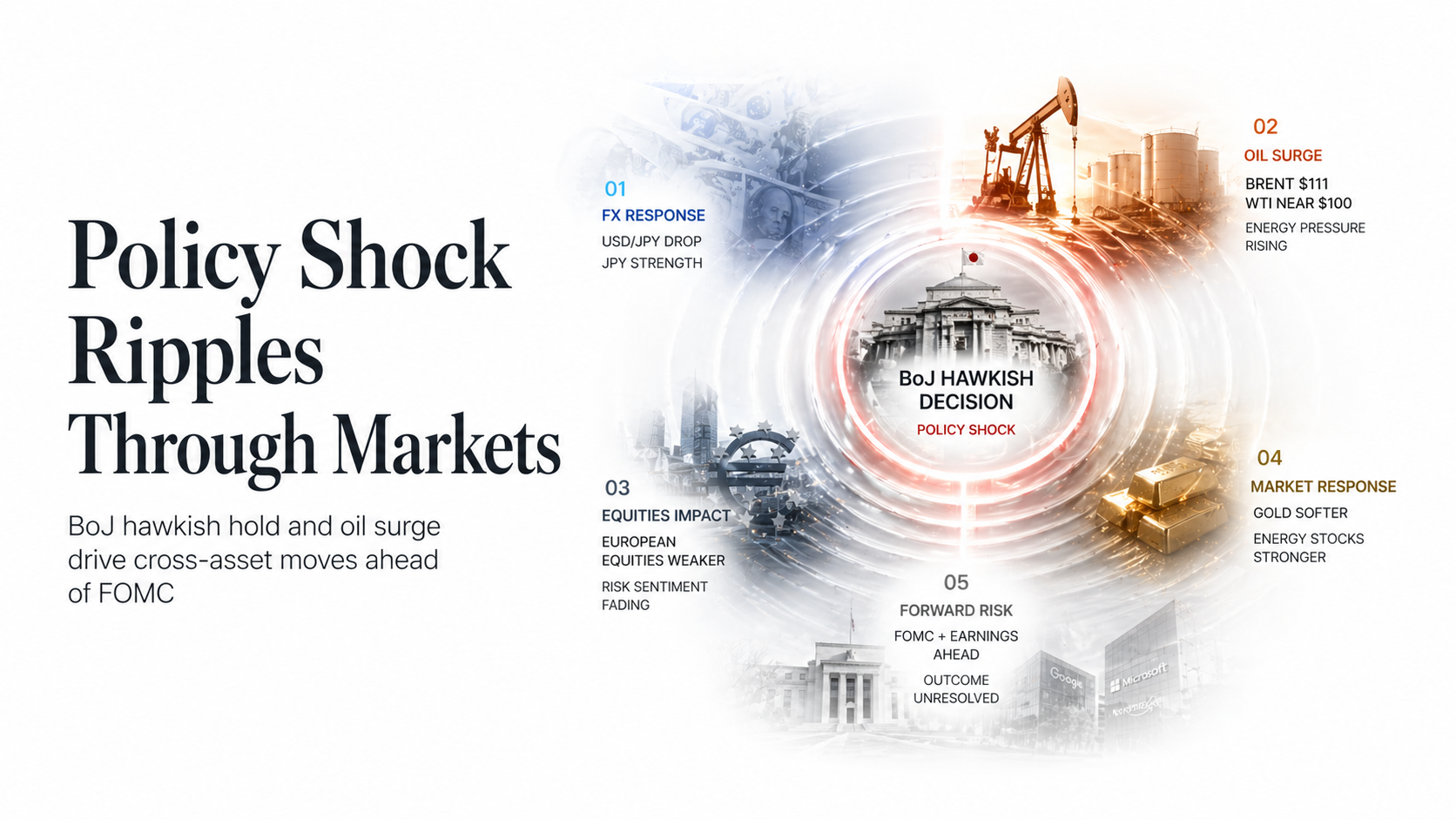
The Bank of Japan’s 6–3 vote (three members calling for an immediate hike to 1.0%) delivered a hawkish shock that markets had only partially priced. USD/JPY fell from 159.50 to 158.32 across the European morning as the hawkish vote split was interpreted as a signal of imminent rate hikes — either in June or July. Governor Ueda’s press conference confirmed the BOJ sees upside price risks, particularly from Iran-driven second-round inflation effects. Per FXStreet analysis, Ueda “must signal readiness to continue hiking to prevent further yen weakness” — and he appears to have done exactly that. Nearly two-thirds of economists in a Reuters poll still expect the BoJ benchmark rate to reach 1.0% by end of June, and the 6–3 vote accelerates that timeline in market pricing. Intervention risk remains acute near 160.00.

Gold exhibited notable intraday volatility across the European session. The pair had traded as high as $4,833 in early Asian/European crossover trade (per Investing.com data, daily high $4,833.09) before reversing sharply to $4,628 as the session progressed. The sell-off reflects three concurrent pressures: first, brief Iran diplomatic optimism reduced the safe-haven bid; second, pre-FOMC USD strengthening weighs on non-yielding gold; third, elevated US interest rate expectations from March CPI (3.3% YoY) limit the rate-cut-driven gold rally. LiteFinance forecasts the April 29 range at $4,645–$4,760, suggesting the current level near $4,628 is approaching the lower end of the expected support range. The 200-day SMA sits at $4,534 — a meaningful buffer below current prices.

European equities opened the session under modest pressure as investors weighed the BoJ’s hawkish 6–3 split — a signal of upcoming tightening in Japan — against the continued surge in Brent crude above $110, which compounds the Eurozone’s stagflation dilemma. The one bright spot was the banking sector (+1.2%), driven by Barclays’ Q1 beat (£2.81B pre-tax, +3% YoY) and anticipation of further quarterly results from Deutsche Bank, UBS, and BNP Paribas later this week. Airbus traded 0.6% lower on energy-driven supply chain concerns. UK gilt yields reached 2008 highs at ~4.91% during the session, limiting UK equity upside and adding credit spread pressure to European financials. The pan-European picture is one of a market bracing for Wednesday’s FOMC binary while digesting persistently elevated oil as a structural headwind to corporate margins.

European Session Summary — Tuesday, April 28, 2026
The European session was dominated by two major developments: the BoJ’s unexpectedly hawkish 6–3 vote confirming upside inflation risks and signalling imminent future rate hikes, and Brent crude’s surge to $111.57 — its highest level since March — as Trump’s national security team reviewed and appeared dissatisfied by Iran’s Hormuz reopening proposal. The session confirmed the week’s central theme: maximum event concentration with a concurrent FOMC day 1, BoJ hawkish signal, major European corporate earnings (Barclays beat, Airbus cautious), and the Mag 7 megaprint looming tomorrow.
For traders carrying positions into Wednesday: oil longs (Brent and WTI) remain structurally supported as long as no deal is confirmed. Gold’s $4,628 level is a decision point — a hold above $4,620 keeps the weekly bull structure intact, while a break opens $4,500. European equity indices face headwinds from both sides — oil-driven stagflation on the macro front and a binary ECB/FOMC event risk Wednesday–Thursday. USD/JPY bears gained ammunition from the BoJ’s hawkish vote split; the pair faces resistance at 160.00 and support at 157.66.
Key risk consideration: The US session opens into a compressed pre-FOMC environment. Thin liquidity and stop-hunting activity ahead of tomorrow’s rate decision can create sharp intraday moves. Size positions conservatively — 50–60% of normal — and maintain all trail stops. CFD trading involves significant risk of loss. This report is published for informational purposes and does not constitute personal financial advice. Elevate your edge with our exclusive 150% Welcome Bonus, 1:10,000 leverage trading advantages, and superior trading conditions at CapitalStreetFX.com.
S&P 500 +1.05% · Nasdaq +1.64% · WTI Tests $100 · Bitcoin Reclaims $78K · VIX Falls to 18.92 · FOMC Blackout Active

US Session Key Events — April 28, 2026
US Session Market Snapshot · Close / ~21:00 GMT
| Asset | Price | Change | Key Level | Session Note | Bias |
|---|---|---|---|---|---|
| S&P 500 | 7,137.90 | ▲+1.05% | R: 7,300 | S: 7,100 | ATH run continues; pre-Mag 7 earnings positioning; 84% beat rate YTD | BULL |
| Nasdaq 100 | 24,657 | ▲+1.64% | R: 24,900 | S: 24,000 | Tech-led recovery; GOOGL, META, MSFT, AMZN all rallying into tomorrow’s prints | BULL |
| Dow Jones | 49,490 | ▲+0.69% | R: 50,000 | S: 48,800 | Broad-based rally; industrial and financials contributing; energy sector a tailwind | BULL |
| Russell 2000 | 2,785.38 | ▲+0.74% | R: 2,850 | S: 2,720 | Small caps participating in the risk-on tone; less oil sensitivity than large caps | BULL |
| VIX | 18.92 | ▼−2.97% | Watch: 20 | Low: 15 | Below 20 = risk appetite intact; FOMC + Mag 7 earnings tomorrow could spike above 25 | WATCH |
| WTI Crude | $99.64 | ▲+3.39% | R: $100 | S: $96.26 | Intraday high $100.10 — first tag of $100 resistance; Hormuz ninth week | BULL |
| Brent Crude | $111.57 | ▲+5.21% | R: $115 | S: $108.50 | Highest since March; Iran deal stalling on nuclear terms; Trump dissatisfied | BULL |
| Gold (XAU/USD) | $4,755 | ▲+0.77% | R: $4,833 | S: $4,620 | Recovered from $4,628 EU session low; US risk-on helped; FOMC binary tomorrow | WATCH |
| Bitcoin (BTC/USD) | $78,471 | ▲+3.65% | R: $80,000 | S: $74,000 | Sharp recovery from $76,596 low; Strategy +3,273 BTC; $80K breakout conditional on Mag 7 beat | WATCH |
| EUR/USD | 1.1791 | ▲+0.06% | S: 1.1667 | R: 1.1850 | Marginally firmer vs morning; USD broadly softened in US session risk-on tone | WATCH |
| GBP/USD | 1.3544 | ▲+0.12% | S: 1.3400 | R: 1.3596 | Resistance 1.3596 still intact; Barclays Q1 beat provided modest GBP support | WATCH |
| USD/JPY | 158.32 | ▼−0.50% | S: 157.66 | R: 160.00 | BoJ hawkish 6–3 hold keeps JPY supported; Ueda hawkish at presser; intervention risk at 160 | BEAR |
| DXY (USD Index) | 98.577 | ▲+0.26% | R: 99.48 | S: 98.00 | Modest USD strength on pre-FOMC positioning; ceasefire gap at 99.18–99.48 key resistance | WATCH |
| 10Y UST Yield | 4.55% | ▲+3bps | R: 4.65 | S: 4.40 | Rising on FOMC hawkish-hold expectations; Powell’s final meeting tone the key watch Wednesday | WATCH |
US Session Observations — Key Themes
The US session closed decisively positive with the S&P 500 +1.05% and Nasdaq +1.64% — driven by pre-earnings positioning in mega-cap tech ahead of Wednesday’s Mag 7 megaprint. GOOGL is the standout pre-earnings performer — up ~2% Monday and +19.77% month-to-date, with Google Cloud consensus at +49.6% YoY. The Nasdaq’s RSI above 85 (per the morning report) signals technical overbought conditions, but the Mag 7 earnings catalyst is the force that can sustain the move. The SOX semiconductor index has gained 33% over three months — providing a high bar for the upcoming capex guidance numbers. Market breadth improved today vs. Monday — 53% of S&P 500 names above 50-day MA, suggesting the rally is not solely a Mag 7 phenomenon. 84% Q1 earnings beat rate YTD is a structural support.
Bitcoin staged a notable intraday recovery during the US session, bouncing from $76,596 to $78,471 (+3.65% on the day, +$2,856). The recovery was supported by three factors: improved risk-on sentiment in US equities; Strategy’s confirmed 3,273 BTC purchase ($255M) bringing total holdings to 818,334 BTC (3.9% of total supply); and technical support at the $76,000–$77,000 zone which has held multiple times in April. CoinMarketCap shows BTC at $77,058 in real-time, suggesting some softening from the intraday high. The Fear & Greed Index remains at 33 (Fear) — historically a contrarian buy signal but consistent with limited retail participation. BTC’s 4-hour chart shows a bullish structure with a rising 50-day MA, per Changelly analysis.
WTI touched $100.10 intraday during the US session — the first test of the $100 psychological resistance level since the early weeks of the Iran conflict. The 52-week range is $54.98–$117.63; current $99.64 sits near the middle of that range but well above the pre-conflict norm. The Investing.com daily range of $96.26–$100.10 confirms an expansive $3.84 intraday move. Oil rose by nearly 2% per Reuters citing ongoing stalled Iran negotiations and the continuation of Hormuz supply disruption. The IEA’s characterisation of this as “the largest energy supply shock on record” with up to 13 million bpd disrupted provides the fundamental backdrop. Even if a deal were struck tomorrow, Lipow Oil Associates notes normal market conditions would take months to restore.
The US session closed in FOMC blackout — no Fed speakers, no guidance. Markets priced a hawkish-hold scenario: rates unchanged at 3.50–3.75% (99.5% per CME FedWatch), but Powell expected to acknowledge oil-driven inflation concerns in his final press conference as Fed Chair. Powell’s term expires May 15; Kevin Warsh (nominated successor) is watching from the sidelines. Warsh is viewed as more hawkish on inflation — meaning markets may front-run a tighter-for-longer regime even before his tenure begins. The 10Y UST yield pushed to 4.55% (+3bps) as pre-FOMC positioning favoured USD. DXY at 98.577 remains below the critical ceasefire gap resistance at 99.18–99.48 — a break above that level would be a bullish USD catalyst for EUR/USD bears (Signal 04 in the morning report).
US Session — Commonly Raised Questions
Three factors drove today’s equity strength despite the headwinds. First, pre-Mag 7 earnings positioning — with GOOGL, META, MSFT, and AMZN all reporting after close Wednesday, institutional investors were building pre-earnings longs ahead of what the market expects to be a strong set of AI-driven results. The SOX semiconductor index has rallied 33% in three months on AI infrastructure demand — investors want exposure going into these prints.
Second, the VIX falling to 18.92 (below 20) confirmed that professional investors are not panic-hedging into the FOMC — they are calibrating risk rather than exiting. VIX below 20 is historically consistent with a risk-on market posture. Third, the 84% Q1 earnings beat rate across the S&P 500 is a powerful fundamental backdrop that makes dip-buyers more aggressive. None of this means tomorrow’s FOMC is not a risk — it is. But markets are evidently willing to hold longs into the event, betting that Powell will deliver a neutral-to-slightly-hawkish hold that doesn’t materially change the rate outlook.
The 6–3 vote split — with three members calling for an immediate hike to 1.0% — is the strongest hawkish signal from the BoJ since before the Iran conflict began. It resets the market’s pricing of the next BoJ rate hike. Nearly two-thirds of economists in the latest Reuters poll expected the benchmark rate to reach 1.0% by end of June 2026, and the 6–3 vote split effectively validates that timeline. This directly weakens the USD/JPY carry trade thesis — if the BoJ is tightening, the JPY interest rate differential with the USD narrows, making JPY shorts less attractive.
For traders, this means USD/JPY has a lower ceiling near 160.00 (already reinforced by Ministry of Finance intervention rhetoric) and a potentially stronger floor near 157.66–158.00. The pair fell from 159.50 to 158.32 across the session on the vote news alone. Governor Ueda’s press conference hawkish tone — confirming upside price risks — added to JPY support. The FOMC Wednesday could temporarily push USD/JPY back toward 159–160 if Powell sounds hawkish, but that move would likely be sold by JPY bulls who now have a fundamental BoJ tightening story to work with.
WTI’s tag of $100.10 intraday is a significant psychological event. The market has been anticipating this level for weeks as the Strait of Hormuz disruption entered its ninth week without resolution. The question is whether $100 becomes a resistance level (and oil consolidates below it) or a breakout level (and oil continues toward $105–$110).
The primary variable remains the Iran deal. Trump’s reported dissatisfaction with the latest proposal — which defers nuclear negotiations — means no deal is imminent. Lipow Oil Associates notes that even a confirmed deal would take months to restore normal supply conditions. On the upside, if Iran’s proposal is formally rejected, oil traders would likely push WTI toward $105 and Brent toward $115. On the downside, any credible progress in negotiations — even just positive diplomatic language — could trigger a $5–7 correction within hours. The safest positioning is to trail stops on existing longs (to $96 for WTI, $108.50 for Brent) rather than chasing new entries at the $100 resistance level. New longs should wait for a confirmed daily close above $100 as a technical entry signal.
The single most important metric across all four companies is AI capex guidance for full-year 2026. The four companies have collectively guided to roughly $300 billion in 2026 capex, mostly AI infrastructure. Any softening of that guidance — even subtle language like “we are monitoring returns carefully” — would cascade into a Nvidia selloff and a broad chip sector unwind, reversing the 33% SOX gain of the past three months.
By company: Microsoft — Azure cloud growth rate (Street consensus ~38%). Deceleration below 35% is bearish. Alphabet — Google Cloud growth (consensus ~+49% YoY). Cloud growth has been accelerating from +34% in Q3 2025 to +48% in Q4 2025. Amazon — AWS growth (consensus ~25.6%, $36.8B). Operating income margin expansion is the secondary signal. Meta — Ad revenue growth and whether $115–135B in 2026 capex guidance is maintained or raised. Market breadth at only 53% of S&P 500 above 50-day MA means a beat-and-raise is needed to extend the ATH rally. A mere in-line print may not be enough to sustain current prices.
US Session Summary + Full-Day Recap — Tuesday, April 28, 2026
Tuesday April 28 was defined by three interlocking themes: a hawkish BoJ hold that strengthened the JPY narrative and set the stage for a June hike; Brent crude extending to $111.57 as the ninth week of Strait of Hormuz disruption continued without a credible deal breakthrough; and a risk-on US equity session (+1.05% S&P 500, +1.64% Nasdaq) driven by pre-Mag 7 earnings positioning that overshadowed the macro headwinds of oil inflation and FOMC uncertainty.
Entering Wednesday — the week’s pivotal day — the risk-reward framework across asset classes looks as follows: Oil bulls remain structurally supported (WTI at $99.64, Brent at $111.57) as long as no deal is confirmed; Bitcoin recovered to $78,471 with $80K the key breakout threshold conditional on Mag 7 beats; Gold stabilised at $4,755 after an intraday reversal from $4,833 to $4,628, with the $4,620–$4,650 zone as critical Wednesday support; EUR/USD at 1.1791 is marginally firmer but the medium-term bear thesis via a hawkish Powell + dovish ECB scenario remains intact for Thursday; USD/JPY at 158.32 has a lower ceiling following the BoJ’s hawkish vote split.
Wednesday Risk Management Protocol: Size all positions at 50–60% of normal. Do NOT hold large individual Mag 7 positions through Wednesday AH — use index futures (Nasdaq/QQQ) to distribute risk. Take partial profits before FOMC at 18:30 GMT. Trail stops on all oil longs. The concurrent FOMC + Mag 7 earnings binary creates maximum cross-asset gap risk — protecting capital for post-event reloading is the priority. CFD trading involves significant risk of loss. This report is published for informational purposes and does not constitute personal financial advice. Claim your 900% Mega Bonus and discover industry-leading trading conditions at CapitalStreetFX.com.