
Market Close Trading Analysis: AI Selloff, Oil Breakout Above $111, Volatility Rising | 28 April 2026
US Close — Tuesday, April 28, 2026
OpenAI Revenue Miss Sinks AI Chip Stocks, UAE Exits OPEC, Iran Claims “State of Collapse” as Brent Breaks $111
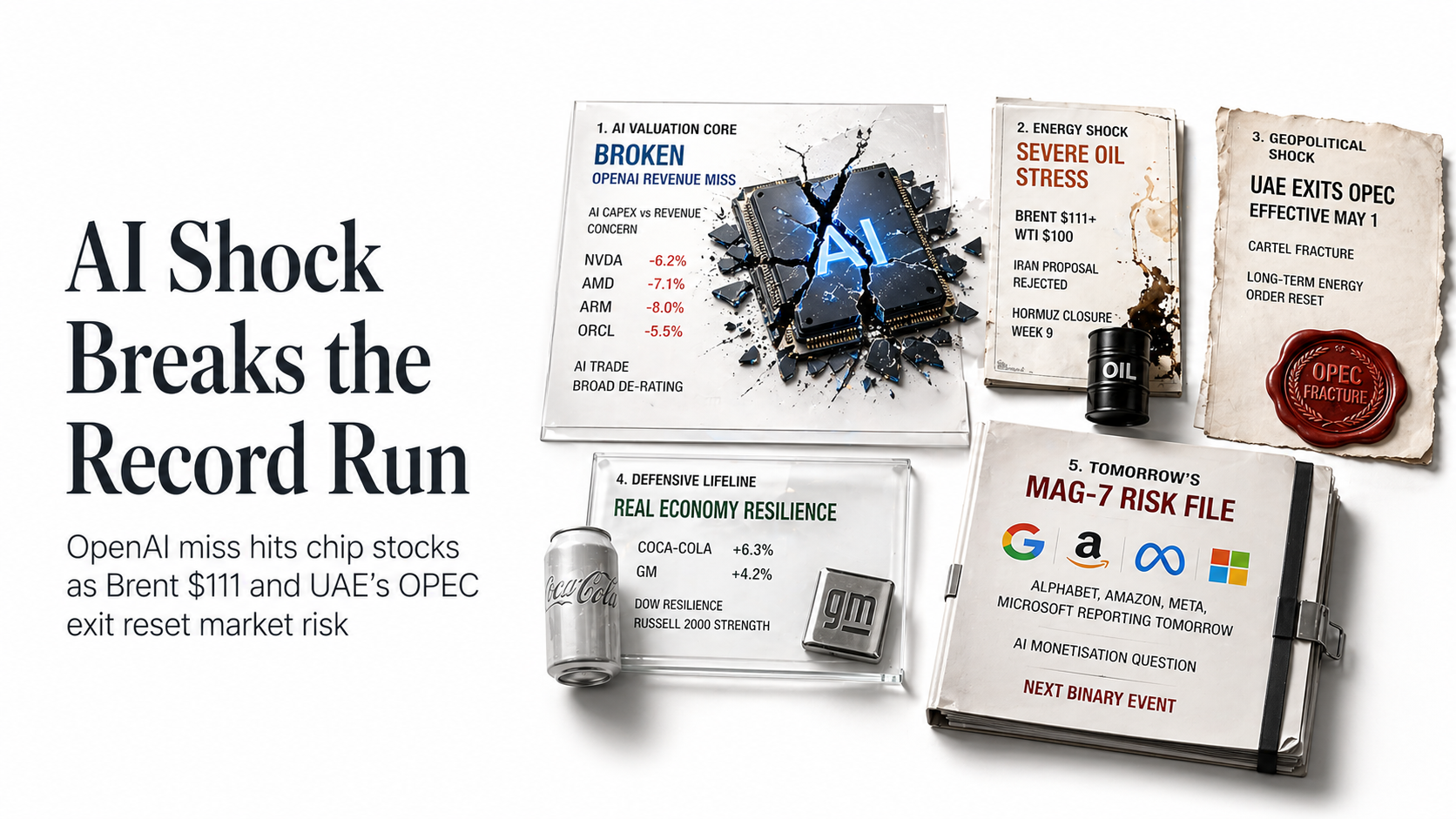
The S&P 500 retreated −0.70% from Monday’s record close as three simultaneous shocks converged: a Wall Street Journal report revealing OpenAI missed its own revenue and user targets sent Nvidia −3.3%, AMD −5.5%, ARM −7.4%, and Oracle −5.2% into sharp declines, reopening the AI capex-vs-revenue debate that has haunted the market for months. Brent crude punched above $111 — its highest level since the conflict began — after Trump declared Iran is in a “state of collapse” and flatly rejected Tehran’s latest Hormuz peace proposal. The UAE’s stunning OPEC exit, effective May 1, reshuffled the entire energy order mid-session. The bulls found their one lifeline: Coca-Cola surged +6.3% on a blockbuster Q1 beat and guidance raise, while General Motors jumped +4.2% after crushing earnings estimates by 41%. Tomorrow’s Mag-7 parade — Alphabet, Amazon, Meta, Microsoft — is now the most consequential single day of the earnings season.
Tuesday reversed Monday’s record-high celebration with a technology-led selloff rooted in the most fundamental question haunting AI markets: is the AI revenue story catching up to the AI spending story? The Wall Street Journal’s report that OpenAI missed both user growth and revenue targets — and that CFO Sarah Friar warned internally about the company’s ability to fund future compute contracts — arrived at the worst possible moment: the eve of Mag-7 earnings week. Simultaneously, Trump rejected Iran’s Hormuz peace proposal as insufficient, calling Tehran “in a state of collapse” while declaring any deal must address nuclear ambitions — a stance that sent Brent through $111 and signalled the strait remains closed for the foreseeable future. And in the most structurally significant geopolitical energy development of the year, the UAE announced it will exit OPEC effective May 1, dealing a historic blow to the cartel’s price-management architecture at the worst possible moment for Gulf producers. The Dow Jones, shielded by Coca-Cola’s extraordinary defensive performance, eked out a +0.22% gain, masking the Nasdaq’s −1.35% rout.
Market Snapshot — Official Close · 16:00 EDT
| Asset | Close | Change | % Change | Session Bias | Key Driver |
|---|---|---|---|---|---|
| S&P 500 | 7,124 | −50.62 | −0.70% | BEARISH | OpenAI miss drags Nasdaq; Dow partially offsets on KO, GM strength |
| Dow Jones Industrial Average | 49,274 | +106.21 | +0.22% | NEUTRAL | KO +6.3%, GM +4.2% anchor index; IBM lagging again −1.6% |
| Nasdaq Composite | 24,553 | −334.10 | −1.35% | BEARISH | OpenAI revenue miss triggers broad AI infrastructure selloff; 37/100 NDX components green |
| Russell 2000 | 2,796 | +10.62 | +0.40% | BULLISH | Small-caps resilient; less AI infrastructure exposure; consumer confidence beat |
| VIX (Volatility Index) | 19.06 | +1.04 | +5.77% | ELEVATED | Re-approaching 20 danger zone ahead of Mag-7 earnings; options pricing elevated uncertainty |
| WTI Crude Oil | $100.03 | +$3.66 | +3.80% | BULLISH OIL/BEARISH ECON | Iran deal rejected; 7th consecutive session gain; psychological $100 reclaimed |
| Brent Crude | $111.57 | +$3.22 | +2.97% | BULLISH OIL | 9-week conflict; strait near-zero traffic; highest since conflict began; UAE OPEC exit adds long-term supply uncertainty |
| Gold (Spot) | $4,586 | −$97.40 | −2.08% | WATCH | Oil-driven inflation raises rate expectations; non-yielding asset repriced lower despite geopolitical risk |
| Bitcoin (BTC/USD) | $76,705 | −$1,333 | −1.71% | BEARISH | DXY strength pressures crypto; -0.90 BTC-DXY correlation at 4-year extreme; risk-off tech tone |
| US Dollar Index (DXY) | 98.74 | +0.25 | +0.25% | BULLISH USD | Safe-haven demand + Iran deal breakdown + rate hold expectations support dollar |
| US 10-Year Treasury Yield | 4.35% | +3bp | +3bp | CAUTIOUS | Oil at $111 raises inflation fears; Fed hold tomorrow but hawkish signals possible; Warsh transition looms |
Geopolitics — Iran Peace Proposal Rejected · UAE OPEC Exit · Brent $111
Tuesday delivered the most consequential geopolitical energy development since the conflict began: three simultaneous seismic shifts in the energy order that individually would each move markets, but together represent a structural repricing of the entire global oil supply architecture.
Catalyst 1 — Iran Peace Proposal Rejected: Iran delivered, via Pakistani mediators, a proposal to reopen the Strait of Hormuz in exchange for the US lifting its naval blockade and ending the conflict — with nuclear talks explicitly deferred to a later stage. Trump publicly declared Iran is in a “state of collapse” and rejected any deal that does not definitively address Tehran’s nuclear program. Secretary Rubio was even more direct on Fox News: any deal “must definitively prevent them from sprinting towards a nuclear weapon at any point.” Senator Graham, a Trump ally, called Iran’s proposal “playing games.” The rejection eliminates the near-term scenario of a negotiated Hormuz reopening, extending the energy supply shock into at least late May or June. The IEA has already warned of an unprecedented supply shock. The strait, which typically carries approximately 20% of global energy flows, has been effectively closed for nine weeks.
Catalyst 2 — UAE Exits OPEC (May 1): The UAE’s announcement that it will leave OPEC and OPEC+ effective May 1 is the most structurally significant OPEC event in years. The UAE, producing approximately 4 million bpd and with capacity ambitions of 5 million bpd by end-decade, has long chafed under production quotas. UAE Energy Minister Al Mazrouei framed the timing as deliberate: with the Hormuz closure constraining all Gulf exports regardless, the market disruption from the departure is minimised in the short term. However, the long-term implications are profound: OPEC loses a major swing producer, the cartel becomes even more Saudi-centric, and the precedent of a major member departing during a crisis weakens OPEC’s institutional authority precisely when unified supply management is most needed. Analysts at Macro Hive noted this “leaves OPEC even more Saudi-centric as the main holder of spare capacity and reduces the group’s future ability to manage prices.”
Catalyst 3 — Glimmers of Passage: In a small but symbolically significant development, a Japanese-flagged VLCC carrying 2 million barrels of crude oil successfully traversed the Strait of Hormuz in coordination with Iran. Marine tracker MarineTraffic described the voyage as “a notable signal of measured confidence” from an industry historically cautious about regional security risks. This single vessel passage does not reopen the strait commercially, but it establishes a precedent for selective, negotiated passage — and suggests Iran may be selectively allowing traffic as a diplomatic signalling mechanism.
AI Infrastructure — OpenAI Revenue Miss Reprices the Ecosystem
Nvidia’s decline on the OpenAI news reflects a fundamental market re-rating of AI infrastructure demand visibility. The $30B Nvidia-OpenAI agreement — already downsized from the originally announced $100B — now faces scrutiny over whether OpenAI will honour the pace of procurement if revenues disappoint. Nvidia’s broader bull case is not destroyed by one data point; hyperscaler AI spending from Microsoft, Amazon, Google, and Meta remains enormous and will be confirmed (or denied) in tomorrow’s Mag-7 earnings. But the option value of “OpenAI-specific upside” has been meaningfully reduced today.
Oracle carries the most direct OpenAI exposure of any publicly traded company — a $300B, five-year cloud agreement that forms the cornerstone of Oracle’s long-term growth narrative. Bloomberg Intelligence analyst Anurag Rana stated the struggles could “have an impact throughout the entire AI infrastructure ecosystem, with Oracle as the most exposed in terms of risk to its financial goals.” Oracle is simultaneously raising $50B in debt and equity to build out data centre capacity, primarily for OpenAI demand that has not yet materialised at the pace originally projected. Wedbush’s Dan Ives maintained his Outperform rating with a $225 price target, arguing markets are misreading Oracle’s capital investment as liability rather than transformation.
The OpenAI revenue miss is categorically different from the IBM and ServiceNow miss of April 23 — and materially more important. IBM and ServiceNow flagged that they were being disrupted by AI. Today’s WSJ report flags that OpenAI itself — the poster child for AI demand creation — is struggling to convert its enormous compute investments into proportionate revenue. ChatGPT’s web traffic share collapsed from 86.7% a year ago to 64.5% by January 2026, while Google’s Gemini surged from 5.7% to 21.5% over the same period. This is not a story about AI demand declining; it is a story about AI market share shifting away from OpenAI specifically toward Google, Anthropic, and Meta’s own models.
The most important market implication: OpenAI’s $300B cloud agreement with Oracle, its $30B GPU arrangement with Nvidia, and its $60B investment from SoftBank were all priced on assumptions of continued hypergrowth in user acquisition and revenue. If those assumptions are now in doubt, the revenue visibility for every company sitting downstream of OpenAI’s spending — Oracle, CoreWeave, Nvidia, SoftBank — diminishes. Bloomberg Intelligence’s Rana described it plainly: Oracle is “the most exposed in terms of risk to its financial goals” among all publicly traded names.
The counter-narrative that prevents this from being a sector-defining crisis: OpenAI is one customer. Microsoft Azure, Amazon AWS, Google Cloud, and Meta’s internal infrastructure represent collectively far more compute spending than OpenAI alone. Gabelli Funds’ John Belton articulated this precisely: “There is nothing here that suggests this is an issue for the pace of spending across the sector as a whole; instead, this looks more like confirmation about OpenAI’s recent market share trends.” Tomorrow’s Mag-7 earnings are the only arbiter of whether Belton’s thesis holds — or whether Wednesday’s results confirm that AI revenue disappointment extends beyond OpenAI to the entire ecosystem.
Crude Oil — WTI Reclaims $100 · Brent at $111.57 · 7th Consecutive Session Higher
WTI reclaiming the psychologically critical $100 per barrel level for the first time since early April is the session’s most significant commodity development. The $100 threshold is not merely a round number — it represents the level at which airlines, petrochemical producers, and industrial consumers begin making structural operating adjustments. JetBlue has already announced plans to slow hiring; United Airlines is cutting 5% of planned capacity; Delta trimmed growth plans 3.5 percentage points. US jet fuel prices have more than doubled from $2.50 per gallon pre-conflict to over $4.19. Every $5 WTI increase reduces major airline FCF by an estimated $500M annually.
Brent above $111 is the conflict’s highest close and represents a 55%+ premium above pre-conflict levels. Goldman Sachs has raised its Brent Q4 2026 forecast to $90/bbl average, implying they expect normalization — but the current spot print at $111 suggests markets are pricing significantly more persistent disruption. The IEA’s “unprecedented supply shock” language is no longer hyperbole. Flows through Hormuz — roughly 20% of global energy consumption — remain at near-zero commercial volume, entering the ninth week of effective closure.
Gold — Repriced Lower as Oil-Driven Inflation Raises Rate Expectations
Gold’s −2.08% decline today illustrates the paradox at the heart of the current macro environment: rising geopolitical risk (normally gold-positive) is simultaneously generating oil-driven inflation fears that increase the probability of prolonged higher rates (gold-negative). With Brent at $111, inflation expectations have risen meaningfully. Federal Reserve futures now price a hold at tomorrow’s FOMC meeting with near-100% certainty, and the probability of a rate hike by year-end has nudged to 8% — small but non-trivial. A non-yielding asset like gold faces direct competition from a 4.35% risk-free Treasury yield. The gold market’s short-term thesis has inverted: conflict = inflation = higher rates = gold headwind, reversing the traditional conflict = safe-haven = gold tailwind dynamic.
However, the medium-term structural floor remains: JP Morgan and Goldman Sachs both forecast gold in the $4,000–$6,300 range through 2026, supported by central bank purchases, geopolitical uncertainty, and the potential for rate cuts once the Iran conflict resolves. The $4,540–$4,570 demand zone — representing the conflict’s established support level — should contain near-term weakness ahead of tomorrow’s Fed decision and Wednesday’s GDP release.
Earnings — Q1 2026 Season: April 28 Results
| Company | EPS Actual | EPS Est. | Verdict | Key Detail | Context | Stock |
|---|---|---|---|---|---|---|
Coca-Cola KO · Consumer Staples |
$0.86 | $0.81 | Beat + Raise ▲ | Rev $12.5B vs $12.24B est. | Organic rev +10% | EPS guidance raised to 8-9% | First earnings under new CEO Henrique Braun — a flawless debut. Organic growth of 10% driven by 8% concentrate sales + 2% price/mix. Volume up 3% across all segments including US, China, India. Operating margin expanded to 35.0% from 32.9%. Free cash flow ~$1.8B. Full-year EPS guidance lifted 100bps to 8-9% growth. The session’s defensive pillar and primary Dow Jones support. | +6.3% ▲ |
General Motors GM · Automotive |
$3.70 | $2.62 | Beat + Raise ▲ | Rev $43.6B vs $43.38B est. | EBIT-adj $4.3B | FY guidance raised $500M | Crushed estimates by 41.7% — the session’s most dramatic earnings beat. Key driver: ~$500M windfall from US Supreme Court ruling terminating and refunding certain IEEPA tariffs, reducing gross tariff costs to $2.5B–$3.5B from $3B–$4B. Full-year EBIT-adj guidance raised to $13.5B–$15.5B. EV market share reached 13%. OnStar digital services revenue growing. Despite early +4% gain, stock settled lower on profit-taking as broader market pressure weighed. | +4.2% ▲ |
Nucor Corporation NUE · Steel |
$3.23 | $2.82 | Beat ▲ | Q1 EPS $3.23 vs $2.82 est. (+14.5% beat) | Strong steel demand from infrastructure and AI datacenter construction continues. Pricing environment supported by tariffs. Industrial construction pipeline provides multi-quarter visibility. Consistent beat continues Nucor’s track record of earnings outperformance in the current construction boom cycle. | +3.8% ▲ |
LendingClub LC · Fintech / Banking |
Beat | — | Beat ▲ | Comprehensive Q1 beat on revenue and EPS; consumer credit holding | Significant +14% move confirms consumer credit quality is holding despite elevated oil prices weighing on disposable income. The fintech’s strong result alongside consumer confidence beating (92.8) suggests household balance sheets remain resilient — a key macro positive ahead of Thursday’s GDP print. | +14% ▲ |
UPS (United Parcel Service) UPS · Logistics |
$1.07 | $1.02 | Beat / Guide Concern ▼ | Rev $21.2B vs $20.99B est. | Full-year guidance reiterated but cautious tone | Beat Q1 estimates but guidance reiteration without a raise disappointed markets expecting a lift from US e-commerce resilience. Fuel surcharges remain elevated on WTI at $100. Management flagged continued headwinds from higher jet fuel and diesel costs — every $10 WTI increase pressures UPS margins by an estimated $100M+ annually. Stock down −3% despite the technical beat, signalling market frustration with guidance conservatism. | −3% ▼ |
Oracle Corporation ORCL · Cloud Infrastructure |
No report | — | Sympathetic Selloff ▼ | Not reporting — sold off on OpenAI revenue miss concern | Oracle fell −5.2% without reporting, purely on the OpenAI WSJ story and the $300B cloud contract risk it implies. Oracle has raised $50B in debt/equity to build data centre capacity primarily anticipating OpenAI demand. The stock has already fallen roughly 50% from its September 2025 52-week high. 34 of 44 analysts maintain Buy/Outperform ratings with average price target implying ~40% upside from current levels. Wedbush’s Dan Ives reiterated Outperform at $225 PT. | −5.2% ▼ |
Corning Inc. GLW · Specialty Glass/Tech |
Beat | — | Beat / Q2 Guide Miss ▼ | Q1 beat but Q2 sales outlook missed expectations | Despite a Q1 beat and being up 90%+ year-to-date, investors focused on a softer-than-expected Q2 sales outlook. The result illustrates the market’s current unforgiving stance toward any guidance shortfall from AI-adjacent names — Corning’s optical fibre and AI infrastructure glass products had made it a momentum favourite, and any deceleration is sold aggressively. | −9.6% ▼ |
Overnight Trade Setups — April 28–29, 2026
Rationale: The path to $115–$120 is now the market’s working assumption among energy desks. Goldman Sachs’ Brent Q4 forecast of $90 implies normalization upon Hormuz reopening — but at week 9 with the latest deal rejected, that resolution is likely minimum 3–6 weeks away. Pullbacks to the $109.50–$111 zone on any transient Iran-diplomatic noise represent buying opportunities within the established trend.
Invalidation: Trump signals a nuclear precondition softening via Truth Social; any language suggesting imminent deal = SL activated.
Rationale: Gold’s decline today is technically driven by oil-inflation-rate fears, not by a genuine reduction in geopolitical risk. With the Hormuz strait still closed, Iran deal rejected, and UAE departing OPEC, the fundamental safe-haven case for gold has not diminished — only the rate expectations narrative has temporarily dominated. A hold-and-dovish Fed tomorrow re-balances this dynamic. R:R of 1:2.2 makes this the session’s most attractive commodity long.
Invalidation: Fed surprises with hawkish hike signal or language; gold below $4,490 on a daily close.
Rationale: The EUR/USD pair has traded in a 1.1580–1.1780 range over the past two weeks. The combination of Brent $111+, DXY strength on safe-haven demand, and the Warsh Fed transition (potential hawkish regime change in US monetary policy) creates a three-layered USD-positive environment. Any failure to break above 1.1780 resistance on EUR/USD is a sell signal toward 1.1580–1.1610 support.
Invalidation: Surprise ECB hawkish pivot; Trump-Iran softening language weakens DXY below 97.80.
Rationale: A play on DXY overextension and sterling’s diplomatic premium. If the Fed signals a dovish hold tomorrow, DXY would weaken 0.5–1.0%, providing the catalyst for GBP/USD to push toward 1.3440–1.3480. The R:R of 1:2.0 is acceptable given the clean technical structure and the binary-event catalyst (Fed tomorrow).
Invalidation: Sustained DXY break above 99.20; GBP/USD daily close below 1.3240.
Rationale: This is a binary event setup, not a structural trend trade. Sizing must be conservative (40–50% normal) given the two-sided risk: if Alphabet or Microsoft misses AI revenue expectations, NVDA extends the decline. The R:R of 1:1.7 is acceptable only with the Mag-7 earnings catalyst as the defined event risk and tight stop at $845.
Invalidation: Mag-7 AI revenue prints disappoint; multiple Mag-7 names cut capex guidance; NVDA closes below $845.
Rationale: If Wednesday’s Mag-7 earnings confirm broad AI revenue momentum, ORCL could bounce from the $138–$145 zone — which is exactly why the stop is placed above it at $155. A soft AI revenue print from Alphabet or Microsoft extends the OpenAI narrative and ORCL falls to $118–$125, the next structural support level. This is the session’s highest-conviction downside trade given Oracle’s unique exposure profile.
Invalidation: Hyperscaler AI capex confirmed strongly Wednesday; OpenAI delivers public statement with strong Q1 metrics; Oracle announces additional revenue partnerships.
Tonight’s session presented six high-conviction setups spanning crude oil, gold, two forex pairs, and two equity CFDs — all tradeable simultaneously from a single Capital Street FX account. Here is precisely how CSFX’s institutional-grade trading infrastructure gives active traders a structural edge in markets as complex and volatile as today’s.
Closing Summary — Tuesday, April 28, 2026
Tuesday delivered the market’s most consequential single-session repricing of the AI narrative since the Iran conflict began: the OpenAI revenue miss is not a company-specific story — it is the first empirical crack in the assumption that AI spending generates AI revenue at the pace the market has priced. ChatGPT losing 22 percentage points of web traffic share to Gemini in twelve months is a market-share story within an expanding AI market, but it is also a signal that the $300 billion Oracle cloud contract, the $30 billion Nvidia GPU agreement, and the $60 billion SoftBank commitment were all predicated on growth projections that are now in question. The market voted with its order books: Nvidia −3.3%, ARM −7.4%, Oracle −5.2%, CoreWeave −6%, SoftBank −10% in Tokyo.
The session’s most structurally significant development was not the AI headline but the UAE’s exit from OPEC — the most consequential institutional energy event of the year, announcing the fracture of the Gulf’s unified oil management architecture at the precise moment when the Hormuz closure is already pushing Brent above $111. In the short term, the UAE’s production remains constrained by the same Hormuz closure that constrains Saudi Arabia’s. But once the conflict resolves, the UAE can add ~1 million bpd without quota constraint — a powerful post-conflict downward price catalyst that sets up one of the most asymmetric commodity trades of the decade: short Brent at $115–$120 against a Hormuz reopening catalyst, targeting $80–$85 over 90 days.
The critical risk heading into Wednesday: tomorrow is the most binary single day in 2026 market history. Alphabet, Amazon, Meta, and Microsoft all report after the close — and every one of their management teams must answer the question that OpenAI’s revenue miss puts squarely on the table: is your AI revenue growing fast enough to justify your AI capex? If the answer is yes across all four, Tuesday’s selloff becomes one of the great AI-buying opportunities of the cycle. If even one of the four delivers soft AI monetisation language, the selloff extends into territory that questions the entire AI infrastructure bull market’s revenue foundation — not just its speculative excess. VIX at 19.06, approaching the 20 danger zone, tells you what the options market thinks the probability of that second scenario is. Tonight’s highest-conviction positions: Brent long on $109–$111 dips (Iran deal dead, OPEC fracturing, week 9 closure); gold long at $4,540–$4,575 on pre-Fed positioning; and the Nvidia binary trade — long only if you have conviction in the hyperscaler AI revenue story, with hard stop at $845. Watch the Truth Social feed and the FOMC statement — in that order.