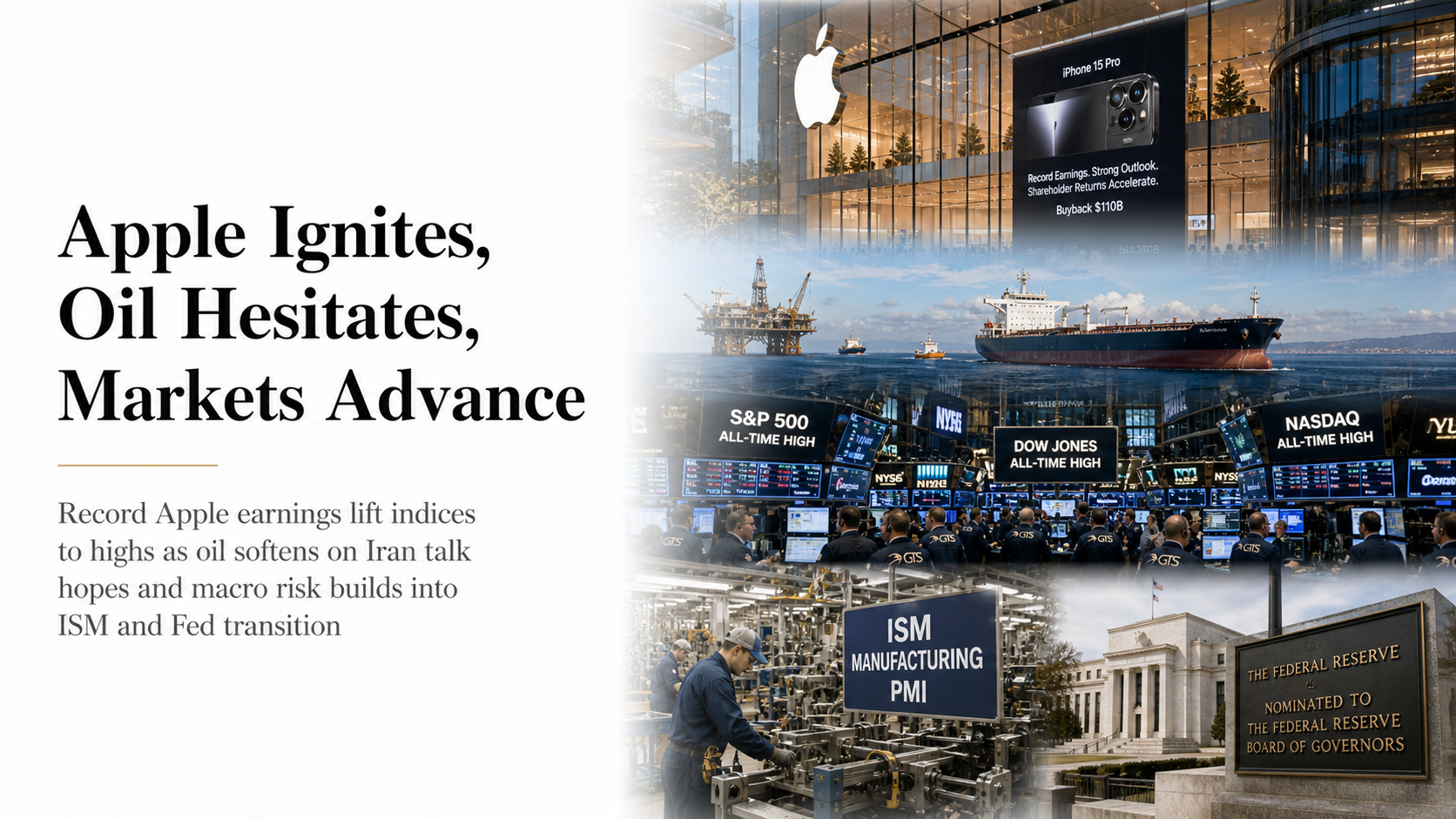
Apple Records, Oil Iran Talks | Evening Session | FX & CFD Analysis | May 1, 2026
Apple Ignites Wall Street Records.
Oil Blinks on Iran Peace Hopes.
Warsh Waits in the Wings.
Today’s Session Macro Scorecard — May 1, 2026
European Session Market Snapshot
| Asset | Price | Change | Context | Bias |
|---|---|---|---|---|
| DAX 40 (DE40) | ~23,840 | ▲+0.40% | Apple beat lifts tech sentiment · Oil decline eases cost pressure on German industry · ISM PMI watched | CAUTIOUS BULL |
| FTSE 100 (UK100) | ~10,320 | ▼−0.55% | BP & Shell give back gains on oil pullback · Energy sector drag · Labour Day closures thin liquidity | BEARISH |
| CAC 40 (FR40) | ~8,050 | ▲+0.20% | Labour Day holiday (partial closures) · Apple optimism lifts tech exposed names · Oil cost relief supportive | NEUTRAL |
| Brent Crude (EU) | $111.84 | ▼−1.51% | Iran peace talk hopes · CNN: Trump envoys to Pakistan this weekend · Hormuz still essentially closed | BEARISH ST |
| Gold (XAU/USD) | $4,577 | ▼−1.12% | Yield pressure persists · Risk-on via Apple dampens safe-haven bid · Ceasefire hopes reduce geopolitical premium | BEARISH |
| EUR/USD | 1.1755 | ▲+0.13% | DXY slightly softer · Apple risk-on mood supports EUR mildly · Warsh hawkish risk keeps upside capped | NEUTRAL |
| BTC/USD | $77,315 | ▲+1.68% | Risk appetite improves on Apple beat · Crypto rallies with Nasdaq recovery · $80K resistance still key | BULLISH |
EU Session — Key News & Catalyst Feed
Today’s Economic Calendar — May 1, 2026
| Time (ET) | Event | Impact | Forecast | Previous | Actual |
|---|---|---|---|---|---|
| 08:45 ET | S&P Global Manufacturing PMI (Apr Final) Final confirmation of flash reading |
54.0 | 52.3 | 54.0 ✓ | |
| 10:00 ET | ISM Manufacturing PMI (Apr) Prices Paid, New Orders subindices key; war impact commentary |
53.1 | 52.7 | PENDING | |
| 10:00 ET | ISM Manufacturing Employment Index (Apr) Leading indicator for Friday NFP sentiment |
49.0 | 48.7 | PENDING | |
| 10:00 ET | ISM Prices Paid Subindex (Apr) War-related inflation signal; was 78.3 in March — historic high |
~75.0 | 78.3 | PENDING | |
| 10:30 ET | Atlanta Fed GDPNow Q2 Update First Q2 estimate after ISM data; prior running estimate 3.7% |
~3.7% | 3.7% | PENDING | |
| 12:00 ET | Baker Hughes US Rig Count Energy production activity tracker; prior 407 oil rigs, 544 total |
~410 | 407 | PENDING | |
| 14:30 ET | CFTC Gold Speculative Positions (Weekly) Net long positioning; prior 164K — watch for unwind signals |
~160K | 164.0K | PENDING |
ISM Manufacturing PMI Deep Dive — What to Watch
April ISM Manufacturing PMI — 10:00 ET · Forecast 53.1 · Prior 52.7
Today’s ISM Manufacturing PMI for April is the macro centrepiece of the session. The March reading of 52.7 was the strongest factory activity reading since August 2022, but the report carried an important caveat: the Prices Paid subindex surged to 78.3 — a 4-year high — as respondents cited the Iran war as a direct new cost driver for the first time. In March, 64% of survey comments were negative, with about 40% citing the Middle East conflict and 20% citing tariff uncertainty.
The S&P Global flash PMI for April already came in at 54.0 — a 47-month high — driven by a surge in production and new orders. This creates a positive baseline expectation for the ISM print. However, the two measures often diverge: ISM samples a broader range of industries and frequently captures war/tariff-related disruptions more acutely in its Prices Paid and Supplier Deliveries components.
The three sub-indices that will move markets most today: (1) Prices Paid — a reading above 75 rekindles stagflation anxiety; below 72 would be a relief. (2) New Orders — the demand pulse, which in March was 53.5; a continued expansion above 53 confirms resilience. (3) Supplier Deliveries — which in March hit 58.9 (the longest delays in 3 years), largely driven by Hormuz routing disruptions. If delays worsen further, it signals the supply-chain shock is deepening.
ISM Manufacturing Employment is also in focus: the subindex has been below 50 (contractionary) since mid-2025 and is forecast at 49.0 today. A further dip toward 47–48 would be a warning sign ahead of next Friday’s April Nonfarm Payrolls. A surprise expansion above 50 would ease recession concerns materially.
Apple Q2 FY2026 Results — Full Analysis
Apple Q2 2026 — Segment Breakdown vs. Consensus
Revenue: $111.18B vs. $109.66B est. — BEAT +1.4%
EPS: $2.01 vs. $1.95 est. — BEAT +3.1%
Gross Margin: 49.3% vs. 48.4% est. — BEAT
iPhone Revenue: $57.0B (+22% YoY) — BEAT. “Extraordinary” demand for iPhone 17 lineup. Second consecutive quarter of >20% iPhone revenue growth — a remarkable feat at Apple’s scale. Supply constraints on advanced SoC nodes limited upside.
Services Revenue: $31.0B vs. $30.39B est. — ALL-TIME HIGH. Double-digit growth in both developed and emerging markets. New ad inventory in App Store contributed. Apple Maps ads (US/Canada) launching summer 2026 — a new revenue stream with significant long-term potential.
Mac Revenue: $8.4B vs. $8.02B est. — BEAT. MacBook Neo seeing “off the charts” demand (Cook’s words). Mac Mini and Mac Studio supply constraints likely to last “several months.”
iPad Revenue: $6.91B vs. $6.66B est. — BEAT
Wearables/Home: $7.9B vs. $7.7B est. — BEAT
Apple — Strategic Outlook & Key Risks
June Quarter Guidance: +14–17% YoY — massively above the 9.5% analyst consensus. This is the single largest consensus beat in guidance since Apple began providing formal guidance ranges. Revenue base for Q3 FY25 was ~$85.8B — so June quarter is guided to approximately $97.8–100.4B.
Key Risk: Memory Cost Inflation. CFO Kevan Parekh warned of “significantly higher memory costs” in Q3, driven by the AI memory boom. Apple is absorbing rather than passing through — margin compression risk is real in Q3. Cost: MAC mini, Mac Studio facing extended supply-demand imbalance.
CEO Transition Risk: John Ternus is a first-time public company CEO. Cook will remain as Executive Chairman (a buffer), but any strategic pivots — especially on AI monetization and the Google Gemini partnership — could create execution uncertainty. Ternus’s first full earnings cycle is Q4 FY2026.
AI Monetization Upside: Apple Maps ads, Siri/Gemini integration, and AI features across 2.5B active devices represent an enormous untapped monetization layer. The Services gross margin (above 70%) means any AI-driven Services increment accrues disproportionately to the bottom line.
Capital Return: $100B buyback + 4% dividend raise ($0.27/share) payable May 14. Apple’s aggressive capital return continues to support EPS growth mechanically regardless of top-line conditions.
Oil & Iran Peace Talks — What’s Moving Energy Markets
Brent $111.84 · WTI $105.08 — Peace Talk Optimism vs. Hormuz Reality
Oil is the day’s most volatile instrument. Prices fell sharply in the EU session after CNN reported that President Trump will dispatch two envoys to Pakistan this weekend for a second round of US-Iran negotiations. Iranian FM Araghchi is expected in Islamabad. The news triggered an immediate ~1.5% drop in Brent as traders priced in a rising probability of Hormuz reopening.
However, the picture remains deeply contradictory: Iran publicly denied any scheduled talks with US officials as of the EU session open. The Strait of Hormuz remains essentially closed, and the energy market’s structural supply deficit — approximately 3–4 million barrels per day of effective disruption since February — has not materially changed. Brent’s decline from April 30’s $115.81 to today’s $111.84 represents a ceasefire hope premium being partially priced out of the war-risk premium.
Key for energy traders: Oil prices in 2026 are up 67–78% YTD (WTI/Brent respectively) from pre-war January levels. Exxon’s CEO cited “historic oil supply disruption.” Even with peace talks, a full Hormuz re-opening would take weeks and would likely see OPEC+ respond with disciplined output management. Goldman Sachs targets $140–150 for Brent if the blockade extends. A genuine ceasefire would see an initial $15–20/bbl pullback before a floor establishes at $85–90, in our view.
Today’s Energy Trades: Exxon and Chevron earnings were dominated by hedging losses rather than operational weakness — adjusted profitability for both was exceptional. Energy sector stocks (up 26%+ YTD) have pulled back 8% in April as the sector got overbought (RSI 82 on March 30). Today’s peace talk-driven oil selloff may extend the April consolidation, but the fundamental supply shock thesis remains intact while Hormuz is closed.
Active Trading Signals — May 1, 2026


U.S. Session Setup — May 1, 2026
The Warsh Era — What Changes May 15
Fed Chair Transition — Powell Out, Warsh In (May 15, 2026)
Jerome Powell chaired his final FOMC meeting this week, delivering a hold at 3.50–3.75% with an 8–4 dissent — the largest since 1992. Three of the four dissenters signalled a hawkish intent: they opposed the hold not because they wanted to cut, but because they believed the easing bias embedded in the Fed’s forward guidance was inappropriate given persistently elevated inflation (core PCE 3.2% annually). Powell stays on as a Governor after May 15.
Kevin Warsh, Powell’s Senate-confirmed successor, is a former Fed Governor (2006–2011) known for his hawkish credentials. During his previous tenure, Warsh was among the first to warn about the inflationary risks of quantitative easing. In the current environment — oil inflation at multi-decade highs, core PCE at 3.2%, ECI accelerating — Warsh is expected to lean into the hawkish dissent bloc and signal a potential rate hike path if inflation doesn’t show convincing deceleration in Q2.
Market Implications of Warsh taking over:
• USD structurally bid — hawkish Fed expectations support DXY
• EUR/USD ceiling likely lower — 1.20 target pushed out significantly
• Rate hike probability rising — CME FedWatch showing ~29% probability of a hike by April 2027
• Energy sector positive — Warsh unlikely to sacrifice energy market stability to cool inflation mechanically
• Gold negative — rising real yields amplify non-yielding asset headwinds
The first Warsh-chaired FOMC meeting will be in June 2026. Markets will parse any pre-meeting speech for signals on whether the June meeting brings a hike or a hold. Traders should position accordingly: the DXY re-rating higher on hawkish Fed re-pricing has materially further to run if Warsh delivers on market expectations.
Trader FAQ — Friday May 1, 2026
Apple’s +3% pre-market move is excellent, and on any other week it would be the dominant index driver. The issue is that Nasdaq futures are fractionally negative (-0.11%) due to two offsetting forces: (1) memory cost inflation. Apple, Qualcomm and Microsoft all flagged significantly higher memory costs in their earnings calls — driven by AI demand overwhelming DRAM supply. This raises near-term margin concerns for the entire semiconductor supply chain. (2) Apple’s June guidance of +14–17% was exceptional, but it came with a major caveat: Mac supply constraints may last “several months,” limiting hardware revenue upside in Q3.
However, once the US cash session opens at 09:30 ET and AAPL’s weight (~8.5% of QQQ) is fully reflected in the index rebalancing, expect Nasdaq to shift into positive territory. The bigger risk is the ISM at 10:00 ET — a stagflation-style print (weak new orders + high Prices Paid) would overwhelm the Apple bid. In summary: Apple is a strong tailwind, but ISM is the deciding factor for Nasdaq’s close today.
This is a critical distinction in financial statement reading. Exxon’s headline net income fell 45% and Chevron’s fell 36% — but both declines were almost entirely attributable to hedging losses (“timing effects”), not operational weakness. Exxon lost ~$4.7B on hedges that became unfavorable when the Iran war triggered a sudden oil price spike — the hedges will ultimately resolve as a net profit in future quarters when the physical oil deliveries catch up. Excluding timing effects, Exxon earned $2.09/share (vs $1.76 expected) and Chevron earned $1.41/share (vs $0.95 expected — its biggest beat since October 2020).
Investors are looking through the headline number to the adjusted operational profitability, which shows both companies are generating exceptional cash flows from their non-Persian Gulf assets (Permian, Guyana, Gulf of Mexico). Both have deliberately diversified away from the Middle East over the past decade. The stock reactions (+1–2%) reflect confidence in operational durability. Watch the Q1 statements of cash flows from operations for the true picture of how much cash these businesses are generating at $105+ WTI.
This requires nuanced judgment. The diplomatic signal — Trump dispatching envoys to Pakistan — is the most concrete peace process step since the Feb. 28 attack. If a genuine ceasefire agreement is reached, Brent could fall $15–20/bbl in a single session to the $92–97 range. That is a legitimate tail risk for WTI long positions.
However, Iran publicly denied any scheduled talks with US officials even as the Pakistani facilitation was being reported. The Hormuz Strait remains closed. There is a pattern of diplomatic signalling followed by Iranian walkbacks — this has happened multiple times since March. The structural supply disruption (~3–4 mbpd offline) is not yet resolved. Goldman Sachs, JPMorgan, and IEA all maintain that a meaningful supply shortfall continues regardless of diplomacy until physical flows resume. Our recommendation: if you are holding WTI long from below $95/bbl, take 25–30% partial profits now to reduce weekend headline risk, raise your trailing stop to your entry level or breakeven, and let the remaining position run. Do not close entirely — the Hormuz closure thesis is still intact. Monitor weekend Pakistan talks for confirmation or denial.
Apple announced on April 20 that John Ternus — Apple’s VP of Hardware Engineering — will succeed Tim Cook as CEO effective September 1, 2026. Cook (28 years at Apple, 15 as CEO) will become Executive Chairman, remaining actively involved in the company. The Q2 earnings call was notable for being Cook and Ternus’s first joint investor appearance, with Ternus making brief remarks about maintaining Apple’s “discipline” in financial decision-making.
Ternus is highly respected internally — he oversaw the development of Apple Silicon (the M-series chips), the iPhone 17, and the MacBook Neo. However, he has never led a $3T+ company or managed investor relations at scale. The near-term market risk is AI strategy clarity: investors want to understand Apple’s path to monetizing AI across 2.5B active devices beyond the Google Gemini Siri integration (which Cook called “going well”). Apple Maps ads are a concrete near-term revenue signal. But whether Apple builds its own LLM, deepens the Google partnership, or pursues a different AI architecture is Ternus’s first strategic challenge. The first full Ternus-led earnings call in Q4 FY2026 will be the real market test.
Three numbers will determine market direction more than the headline figure: First, Prices Paid — in March this hit 78.3, a 4-year high, after the Iran war drove energy and shipping costs through the roof. If Prices Paid stays above 75 in April, the stagflation narrative intensifies: USD rallies, bonds sell off, equities pause. If Prices Paid drops meaningfully below 73, it would suggest the initial war price shock is being absorbed — a relief for the Fed, potentially EUR/USD-positive and gold-positive.
Second, New Orders — in March at 53.5, this remains in expansion. A dip below 50 would be alarming: it would mean demand destruction is beginning to manifest, likely from energy cost pass-through hitting consumer and business budgets. Third, ISM commentary on the Iran war — in March, 40% of negative comments cited the Middle East. If that percentage rises in April, it quantifies the war’s economic transmission to US manufacturing more precisely. Bottom line: focus on Prices Paid and New Orders first; the headline composite is secondary. CFD trading involves significant risk; this is educational analysis only.
Session Report Summary — European & U.S. Session · Friday, May 1, 2026
Friday’s session is defined by two powerful countervailing forces: the massive positive surprise from Apple’s Q2 results, and the tentative but market-moving Iran peace talk signals. Apple delivered a record $111.2B in revenue, record iPhone and Services figures, a $100B buyback, and guidance that trounced consensus by nearly five percentage points — the largest guidance beat in recent memory. AAPL is +3% in pre-market, lifting the S&P 500 futures into positive territory even as oil declines drag Nasdaq energy names lower. Exxon and Chevron’s adjusted earnings beats confirm the oil sector’s underlying profitability despite headline hedging distortions.
The oil market’s 1.5% decline on Iran peace talk hopes is real but fragile. CNN reporting on Trump envoys heading to Pakistan for a second negotiation round was immediately contradicted by Iranian officials. The Hormuz Strait remains closed and the fundamental supply disruption (~3–4 mbpd offline) has not changed. Peace talk optimism creates a legitimate weekend headline risk in both directions — a breakthrough would send oil to $90; a breakdown or Iranian walkback would see Brent retrace to $115+. This week’s Q1 GDP of +2.0%, core PCE of +0.3% MoM, and ECI of +0.9% collectively confirm the “higher for longer” regime that Warsh will inherit on May 15.
Today’s critical action plan: (1) Monitor ISM Manufacturing PMI at 10:00 ET — focus on Prices Paid and New Orders subindices, not the headline. This single print will determine today’s full-session directional bias. (2) AAPL longs via Nasdaq: enter on the pre-market dip, use ISM as the trigger for adding or cutting size. (3) WTI tactical short from $105.50–$106.50: tight stop at $108.50. Take profit at $102 if peace signals strengthen. Close before the weekend if Iran fails to confirm talks. (4) EUR/USD: wait for the post-ISM directional break — 1.1700 short trigger on USD strength; 1.1810 long trigger on USD weakness. (5) Gold: no new longs below $4,640; watch $4,520 support. A break opens $4,250. (6) Berkshire Q2 (Saturday) and Warsh (May 15) are next week’s macro bookends. Size for weekend gap risk accordingly. CFD trading involves significant risk. This session report is educational market analysis and does not constitute personal financial advice.
Apple Ignites Wall Street Records.
Oil Blinks on Iran Peace Hopes.
Warsh Waits in the Wings.
Today’s Session Macro Scorecard — May 1, 2026
European Session Market Snapshot
| Asset | Price | Change | Context | Bias |
|---|---|---|---|---|
| DAX 40 (DE40) | ~23,840 | ▲+0.40% | Apple beat lifts tech sentiment · Oil decline eases cost pressure on German industry · ISM PMI watched | CAUTIOUS BULL |
| FTSE 100 (UK100) | ~10,320 | ▼−0.55% | BP & Shell give back gains on oil pullback · Energy sector drag · Labour Day closures thin liquidity | BEARISH |
| CAC 40 (FR40) | ~8,050 | ▲+0.20% | Labour Day holiday (partial closures) · Apple optimism lifts tech exposed names · Oil cost relief supportive | NEUTRAL |
| Brent Crude (EU) | $111.84 | ▼−1.51% | Iran peace talk hopes · CNN: Trump envoys to Pakistan this weekend · Hormuz still essentially closed | BEARISH ST |
| Gold (XAU/USD) | $4,577 | ▼−1.12% | Yield pressure persists · Risk-on via Apple dampens safe-haven bid · Ceasefire hopes reduce geopolitical premium | BEARISH |
| EUR/USD | 1.1755 | ▲+0.13% | DXY slightly softer · Apple risk-on mood supports EUR mildly · Warsh hawkish risk keeps upside capped | NEUTRAL |
| BTC/USD | $77,315 | ▲+1.68% | Risk appetite improves on Apple beat · Crypto rallies with Nasdaq recovery · $80K resistance still key | BULLISH |
EU Session — Key News & Catalyst Feed
Today’s Economic Calendar — May 1, 2026
| Time (ET) | Event | Impact | Forecast | Previous | Actual |
|---|---|---|---|---|---|
| 08:45 ET | S&P Global Manufacturing PMI (Apr Final) Final confirmation of flash reading |
54.0 | 52.3 | 54.0 ✓ | |
| 10:00 ET | ISM Manufacturing PMI (Apr) Prices Paid, New Orders subindices key; war impact commentary |
53.1 | 52.7 | PENDING | |
| 10:00 ET | ISM Manufacturing Employment Index (Apr) Leading indicator for Friday NFP sentiment |
49.0 | 48.7 | PENDING | |
| 10:00 ET | ISM Prices Paid Subindex (Apr) War-related inflation signal; was 78.3 in March — historic high |
~75.0 | 78.3 | PENDING | |
| 10:30 ET | Atlanta Fed GDPNow Q2 Update First Q2 estimate after ISM data; prior running estimate 3.7% |
~3.7% | 3.7% | PENDING | |
| 12:00 ET | Baker Hughes US Rig Count Energy production activity tracker; prior 407 oil rigs, 544 total |
~410 | 407 | PENDING | |
| 14:30 ET | CFTC Gold Speculative Positions (Weekly) Net long positioning; prior 164K — watch for unwind signals |
~160K | 164.0K | PENDING |
ISM Manufacturing PMI Deep Dive — What to Watch
April ISM Manufacturing PMI — 10:00 ET · Forecast 53.1 · Prior 52.7
Today’s ISM Manufacturing PMI for April is the macro centrepiece of the session. The March reading of 52.7 was the strongest factory activity reading since August 2022, but the report carried an important caveat: the Prices Paid subindex surged to 78.3 — a 4-year high — as respondents cited the Iran war as a direct new cost driver for the first time. In March, 64% of survey comments were negative, with about 40% citing the Middle East conflict and 20% citing tariff uncertainty.
The S&P Global flash PMI for April already came in at 54.0 — a 47-month high — driven by a surge in production and new orders. This creates a positive baseline expectation for the ISM print. However, the two measures often diverge: ISM samples a broader range of industries and frequently captures war/tariff-related disruptions more acutely in its Prices Paid and Supplier Deliveries components.
The three sub-indices that will move markets most today: (1) Prices Paid — a reading above 75 rekindles stagflation anxiety; below 72 would be a relief. (2) New Orders — the demand pulse, which in March was 53.5; a continued expansion above 53 confirms resilience. (3) Supplier Deliveries — which in March hit 58.9 (the longest delays in 3 years), largely driven by Hormuz routing disruptions. If delays worsen further, it signals the supply-chain shock is deepening.
ISM Manufacturing Employment is also in focus: the subindex has been below 50 (contractionary) since mid-2025 and is forecast at 49.0 today. A further dip toward 47–48 would be a warning sign ahead of next Friday’s April Nonfarm Payrolls. A surprise expansion above 50 would ease recession concerns materially.
Apple Q2 FY2026 Results — Full Analysis
Apple Q2 2026 — Segment Breakdown vs. Consensus
Revenue: $111.18B vs. $109.66B est. — BEAT +1.4%
EPS: $2.01 vs. $1.95 est. — BEAT +3.1%
Gross Margin: 49.3% vs. 48.4% est. — BEAT
iPhone Revenue: $57.0B (+22% YoY) — BEAT. “Extraordinary” demand for iPhone 17 lineup. Second consecutive quarter of >20% iPhone revenue growth — a remarkable feat at Apple’s scale. Supply constraints on advanced SoC nodes limited upside.
Services Revenue: $31.0B vs. $30.39B est. — ALL-TIME HIGH. Double-digit growth in both developed and emerging markets. New ad inventory in App Store contributed. Apple Maps ads (US/Canada) launching summer 2026 — a new revenue stream with significant long-term potential.
Mac Revenue: $8.4B vs. $8.02B est. — BEAT. MacBook Neo seeing “off the charts” demand (Cook’s words). Mac Mini and Mac Studio supply constraints likely to last “several months.”
iPad Revenue: $6.91B vs. $6.66B est. — BEAT
Wearables/Home: $7.9B vs. $7.7B est. — BEAT
Apple — Strategic Outlook & Key Risks
June Quarter Guidance: +14–17% YoY — massively above the 9.5% analyst consensus. This is the single largest consensus beat in guidance since Apple began providing formal guidance ranges. Revenue base for Q3 FY25 was ~$85.8B — so June quarter is guided to approximately $97.8–100.4B.
Key Risk: Memory Cost Inflation. CFO Kevan Parekh warned of “significantly higher memory costs” in Q3, driven by the AI memory boom. Apple is absorbing rather than passing through — margin compression risk is real in Q3. Cost: MAC mini, Mac Studio facing extended supply-demand imbalance.
CEO Transition Risk: John Ternus is a first-time public company CEO. Cook will remain as Executive Chairman (a buffer), but any strategic pivots — especially on AI monetization and the Google Gemini partnership — could create execution uncertainty. Ternus’s first full earnings cycle is Q4 FY2026.
AI Monetization Upside: Apple Maps ads, Siri/Gemini integration, and AI features across 2.5B active devices represent an enormous untapped monetization layer. The Services gross margin (above 70%) means any AI-driven Services increment accrues disproportionately to the bottom line.
Capital Return: $100B buyback + 4% dividend raise ($0.27/share) payable May 14. Apple’s aggressive capital return continues to support EPS growth mechanically regardless of top-line conditions.
Oil & Iran Peace Talks — What’s Moving Energy Markets
Brent $111.84 · WTI $105.08 — Peace Talk Optimism vs. Hormuz Reality
Oil is the day’s most volatile instrument. Prices fell sharply in the EU session after CNN reported that President Trump will dispatch two envoys to Pakistan this weekend for a second round of US-Iran negotiations. Iranian FM Araghchi is expected in Islamabad. The news triggered an immediate ~1.5% drop in Brent as traders priced in a rising probability of Hormuz reopening.
However, the picture remains deeply contradictory: Iran publicly denied any scheduled talks with US officials as of the EU session open. The Strait of Hormuz remains essentially closed, and the energy market’s structural supply deficit — approximately 3–4 million barrels per day of effective disruption since February — has not materially changed. Brent’s decline from April 30’s $115.81 to today’s $111.84 represents a ceasefire hope premium being partially priced out of the war-risk premium.
Key for energy traders: Oil prices in 2026 are up 67–78% YTD (WTI/Brent respectively) from pre-war January levels. Exxon’s CEO cited “historic oil supply disruption.” Even with peace talks, a full Hormuz re-opening would take weeks and would likely see OPEC+ respond with disciplined output management. Goldman Sachs targets $140–150 for Brent if the blockade extends. A genuine ceasefire would see an initial $15–20/bbl pullback before a floor establishes at $85–90, in our view.
Today’s Energy Trades: Exxon and Chevron earnings were dominated by hedging losses rather than operational weakness — adjusted profitability for both was exceptional. Energy sector stocks (up 26%+ YTD) have pulled back 8% in April as the sector got overbought (RSI 82 on March 30). Today’s peace talk-driven oil selloff may extend the April consolidation, but the fundamental supply shock thesis remains intact while Hormuz is closed.
Active Trading Signals — May 1, 2026
U.S. Session Setup — May 1, 2026
The Warsh Era — What Changes May 15
Fed Chair Transition — Powell Out, Warsh In (May 15, 2026)
Jerome Powell chaired his final FOMC meeting this week, delivering a hold at 3.50–3.75% with an 8–4 dissent — the largest since 1992. Three of the four dissenters signalled a hawkish intent: they opposed the hold not because they wanted to cut, but because they believed the easing bias embedded in the Fed’s forward guidance was inappropriate given persistently elevated inflation (core PCE 3.2% annually). Powell stays on as a Governor after May 15.
Kevin Warsh, Powell’s Senate-confirmed successor, is a former Fed Governor (2006–2011) known for his hawkish credentials. During his previous tenure, Warsh was among the first to warn about the inflationary risks of quantitative easing. In the current environment — oil inflation at multi-decade highs, core PCE at 3.2%, ECI accelerating — Warsh is expected to lean into the hawkish dissent bloc and signal a potential rate hike path if inflation doesn’t show convincing deceleration in Q2.
Market Implications of Warsh taking over:
• USD structurally bid — hawkish Fed expectations support DXY
• EUR/USD ceiling likely lower — 1.20 target pushed out significantly
• Rate hike probability rising — CME FedWatch showing ~29% probability of a hike by April 2027
• Energy sector positive — Warsh unlikely to sacrifice energy market stability to cool inflation mechanically
• Gold negative — rising real yields amplify non-yielding asset headwinds
The first Warsh-chaired FOMC meeting will be in June 2026. Markets will parse any pre-meeting speech for signals on whether the June meeting brings a hike or a hold. Traders should position accordingly: the DXY re-rating higher on hawkish Fed re-pricing has materially further to run if Warsh delivers on market expectations.
Trader FAQ — Friday May 1, 2026
Apple’s +3% pre-market move is excellent, and on any other week it would be the dominant index driver. The issue is that Nasdaq futures are fractionally negative (-0.11%) due to two offsetting forces: (1) memory cost inflation. Apple, Qualcomm and Microsoft all flagged significantly higher memory costs in their earnings calls — driven by AI demand overwhelming DRAM supply. This raises near-term margin concerns for the entire semiconductor supply chain. (2) Apple’s June guidance of +14–17% was exceptional, but it came with a major caveat: Mac supply constraints may last “several months,” limiting hardware revenue upside in Q3.
However, once the US cash session opens at 09:30 ET and AAPL’s weight (~8.5% of QQQ) is fully reflected in the index rebalancing, expect Nasdaq to shift into positive territory. The bigger risk is the ISM at 10:00 ET — a stagflation-style print (weak new orders + high Prices Paid) would overwhelm the Apple bid. In summary: Apple is a strong tailwind, but ISM is the deciding factor for Nasdaq’s close today.
This is a critical distinction in financial statement reading. Exxon’s headline net income fell 45% and Chevron’s fell 36% — but both declines were almost entirely attributable to hedging losses (“timing effects”), not operational weakness. Exxon lost ~$4.7B on hedges that became unfavorable when the Iran war triggered a sudden oil price spike — the hedges will ultimately resolve as a net profit in future quarters when the physical oil deliveries catch up. Excluding timing effects, Exxon earned $2.09/share (vs $1.76 expected) and Chevron earned $1.41/share (vs $0.95 expected — its biggest beat since October 2020).
Investors are looking through the headline number to the adjusted operational profitability, which shows both companies are generating exceptional cash flows from their non-Persian Gulf assets (Permian, Guyana, Gulf of Mexico). Both have deliberately diversified away from the Middle East over the past decade. The stock reactions (+1–2%) reflect confidence in operational durability. Watch the Q1 statements of cash flows from operations for the true picture of how much cash these businesses are generating at $105+ WTI.
This requires nuanced judgment. The diplomatic signal — Trump dispatching envoys to Pakistan — is the most concrete peace process step since the Feb. 28 attack. If a genuine ceasefire agreement is reached, Brent could fall $15–20/bbl in a single session to the $92–97 range. That is a legitimate tail risk for WTI long positions.
However, Iran publicly denied any scheduled talks with US officials even as the Pakistani facilitation was being reported. The Hormuz Strait remains closed. There is a pattern of diplomatic signalling followed by Iranian walkbacks — this has happened multiple times since March. The structural supply disruption (~3–4 mbpd offline) is not yet resolved. Goldman Sachs, JPMorgan, and IEA all maintain that a meaningful supply shortfall continues regardless of diplomacy until physical flows resume. Our recommendation: if you are holding WTI long from below $95/bbl, take 25–30% partial profits now to reduce weekend headline risk, raise your trailing stop to your entry level or breakeven, and let the remaining position run. Do not close entirely — the Hormuz closure thesis is still intact. Monitor weekend Pakistan talks for confirmation or denial.
Apple announced on April 20 that John Ternus — Apple’s VP of Hardware Engineering — will succeed Tim Cook as CEO effective September 1, 2026. Cook (28 years at Apple, 15 as CEO) will become Executive Chairman, remaining actively involved in the company. The Q2 earnings call was notable for being Cook and Ternus’s first joint investor appearance, with Ternus making brief remarks about maintaining Apple’s “discipline” in financial decision-making.
Ternus is highly respected internally — he oversaw the development of Apple Silicon (the M-series chips), the iPhone 17, and the MacBook Neo. However, he has never led a $3T+ company or managed investor relations at scale. The near-term market risk is AI strategy clarity: investors want to understand Apple’s path to monetizing AI across 2.5B active devices beyond the Google Gemini Siri integration (which Cook called “going well”). Apple Maps ads are a concrete near-term revenue signal. But whether Apple builds its own LLM, deepens the Google partnership, or pursues a different AI architecture is Ternus’s first strategic challenge. The first full Ternus-led earnings call in Q4 FY2026 will be the real market test.
Three numbers will determine market direction more than the headline figure: First, Prices Paid — in March this hit 78.3, a 4-year high, after the Iran war drove energy and shipping costs through the roof. If Prices Paid stays above 75 in April, the stagflation narrative intensifies: USD rallies, bonds sell off, equities pause. If Prices Paid drops meaningfully below 73, it would suggest the initial war price shock is being absorbed — a relief for the Fed, potentially EUR/USD-positive and gold-positive.
Second, New Orders — in March at 53.5, this remains in expansion. A dip below 50 would be alarming: it would mean demand destruction is beginning to manifest, likely from energy cost pass-through hitting consumer and business budgets. Third, ISM commentary on the Iran war — in March, 40% of negative comments cited the Middle East. If that percentage rises in April, it quantifies the war’s economic transmission to US manufacturing more precisely. Bottom line: focus on Prices Paid and New Orders first; the headline composite is secondary. CFD trading involves significant risk; this is educational analysis only.
Session Report Summary — European & U.S. Session · Friday, May 1, 2026
Friday’s session is defined by two powerful countervailing forces: the massive positive surprise from Apple’s Q2 results, and the tentative but market-moving Iran peace talk signals. Apple delivered a record $111.2B in revenue, record iPhone and Services figures, a $100B buyback, and guidance that trounced consensus by nearly five percentage points — the largest guidance beat in recent memory. AAPL is +3% in pre-market, lifting the S&P 500 futures into positive territory even as oil declines drag Nasdaq energy names lower. Exxon and Chevron’s adjusted earnings beats confirm the oil sector’s underlying profitability despite headline hedging distortions.
The oil market’s 1.5% decline on Iran peace talk hopes is real but fragile. CNN reporting on Trump envoys heading to Pakistan for a second negotiation round was immediately contradicted by Iranian officials. The Hormuz Strait remains closed and the fundamental supply disruption (~3–4 mbpd offline) has not changed. Peace talk optimism creates a legitimate weekend headline risk in both directions — a breakthrough would send oil to $90; a breakdown or Iranian walkback would see Brent retrace to $115+. This week’s Q1 GDP of +2.0%, core PCE of +0.3% MoM, and ECI of +0.9% collectively confirm the “higher for longer” regime that Warsh will inherit on May 15.
Today’s critical action plan: (1) Monitor ISM Manufacturing PMI at 10:00 ET — focus on Prices Paid and New Orders subindices, not the headline. This single print will determine today’s full-session directional bias. (2) AAPL longs via Nasdaq: enter on the pre-market dip, use ISM as the trigger for adding or cutting size. (3) WTI tactical short from $105.50–$106.50: tight stop at $108.50. Take profit at $102 if peace signals strengthen. Close before the weekend if Iran fails to confirm talks. (4) EUR/USD: wait for the post-ISM directional break — 1.1700 short trigger on USD strength; 1.1810 long trigger on USD weakness. (5) Gold: no new longs below $4,640; watch $4,520 support. A break opens $4,250. (6) Berkshire Q2 (Saturday) and Warsh (May 15) are next week’s macro bookends. Size for weekend gap risk accordingly. CFD trading involves significant risk. This session report is educational market analysis and does not constitute personal financial advice.