Daily Market Analysis — May 7, 2026 | Morning Session | Capital Street FX
🚨 CPI DAY — APRIL INFLATION 3.7% RELEASED · S&P 7,413 7TH RECORD · IRAN-US HORMUZ CLASHES OVERNIGHT · OIL +2% ~$101 · TRUMP-XI SUMMIT MAY 14-15 · POWELL EXITS MAY 15
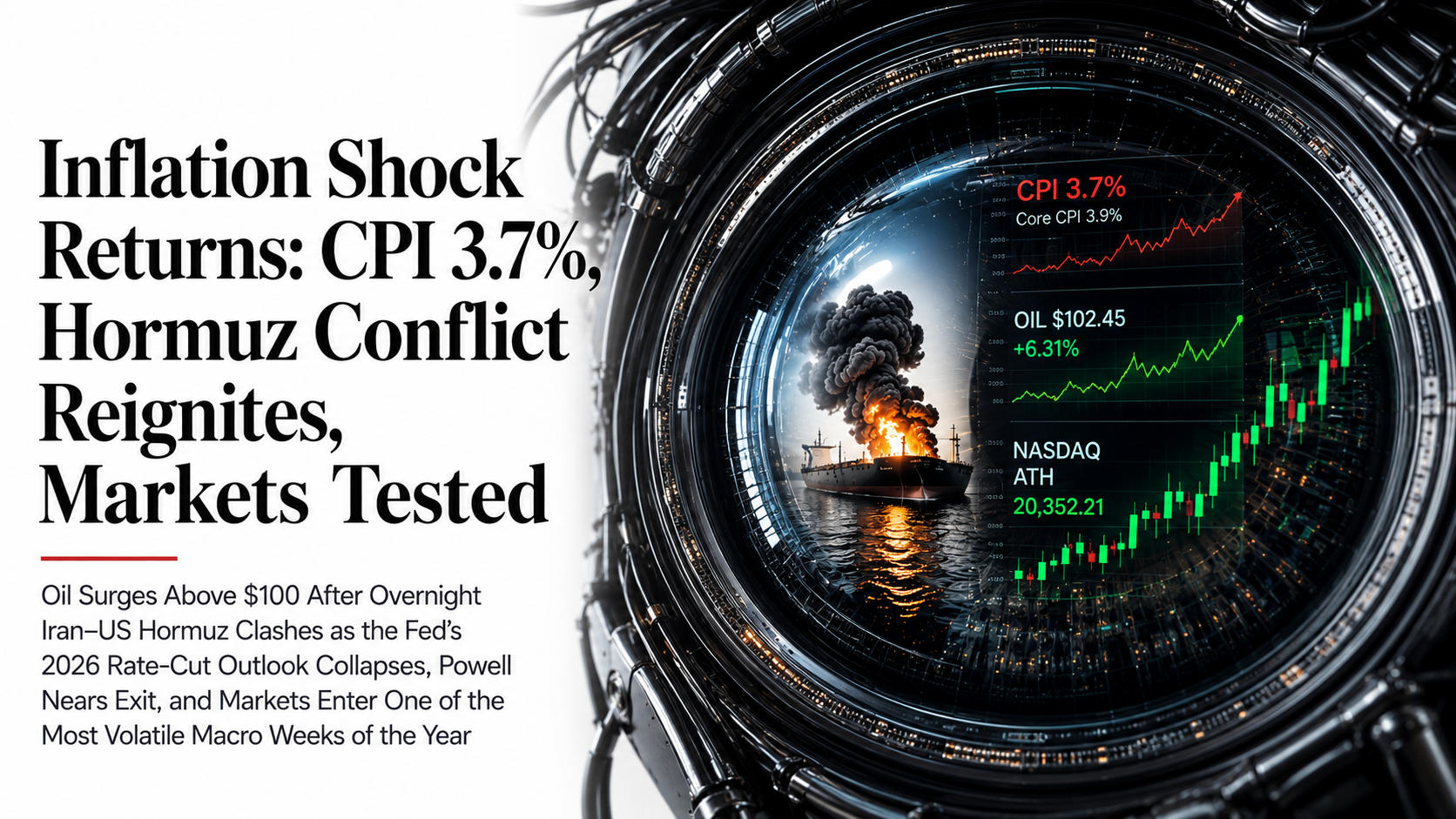
Tuesday May 12, 2026 — The most data-heavy day of the week opens with the CPI report the market has feared. The Bureau of Labor Statistics released April CPI at 8:30 AM ET: +3.7% YoY (up from 3.3% in March) and +0.6% MoM — energy-driven, as Iran’s closure of the Strait of Hormuz for the third consecutive month passes through to consumer gasoline prices. Core CPI (ex-food and energy) came in at +2.7% YoY, above March’s 2.6% — rent and OER adjustments for last fall’s government shutdown contributed. The combined picture eliminates any residual hope of a 2026 Fed rate cut: CME FedWatch now prices zero cuts in 2026, and Bank of America has officially pushed its first rate cut forecast to H2 2027. Overnight, US and Iranian forces exchanged fire in the Strait of Hormuz again — the most serious exchange since the April 7 ceasefire — driving oil prices up 2% to ~$101 WTI, ~$106 Brent. Yet equities held up on Monday: S&P 500 closed at a record 7,412.84 (+0.19%), Nasdaq at 26,274 (+0.10%). The market is resilient — but the CPI print will now test it directly. Looking ahead: Trump-Xi summit May 14-15 (Iran war to dominate agenda), Powell’s term ends May 15, Kevin Warsh Senate confirmation pending, Cisco/Alibaba/Applied Materials earnings this week, PPI Thursday, Retail Sales Thursday.
Tuesday May 12, 2026 — Four Themes Dominating Markets Today
Live Market Snapshot — Tuesday May 12, 2026 · CPI Day
| Asset | Level | Change | Key Notes | Bias |
|---|---|---|---|---|
| WTI Crude (Jun Futures) | ~$101.00 | ▲ +2% Tue · Iran Clash | Overnight Iran-US exchange of fire in Hormuz is the immediate catalyst. The nominal April 7 ceasefire remains intact but severely strained — CENTCOM launched “defensive strikes” and moved destroyers through Hormuz. Oil correctly reprices risk: WTI breaks above $100 again. The CPI 3.7% reading today confirms the energy pass-through — Hormuz closure directly driving consumer gasoline prices. Trump-Xi summit May 14-15 is the next major catalyst: if Xi pushes for Hormuz reopening, WTI could fall $10-15 rapidly. If summit is inconclusive, WTI targets $107-110. Buy dips $93-98. | BULL — BUY $93-98 DIPS |
| Brent Crude (Jul) | ~$106.00 | ▲ +2% Tue | Brent at $106 reflects the physical market’s ongoing tightness — now entering week 12 of Hormuz disruption. The IEA has warned of 14 million bpd structural supply deficit from the conflict. Brent $106 is the “extended conflict, incremental escalation” price. A confirmed ceasefire with Hormuz reopening commitment would drop Brent to $88-92 very quickly. An escalation (Iran fully closing Hormuz, UAE infrastructure attack) would take Brent to $115-120. The Trump-Xi summit is the binary event of the week for energy markets. | BULL — $100 FLOOR RESTORED |
| Gold XAU/USD | $4,699 | ▼ -0.36% Mon Close | Gold’s paradox deepens: the conflict is inflationary (gold should rally) but the CPI’s impact on real yields (higher real rates = gold bearish) outweighs the safe-haven bid. Gold has fallen ~12% since the Iran conflict began in late February — counterintuitive for a “crisis hedge” but consistent with the rate-expectation channel dominating. Today’s 3.7% CPI, combined with Fed cutting zero in 2026, means real yields could stay elevated, capping gold. Key support: $4,580-4,650 (buy zone). Key resistance: $4,780-4,820. The long-term bull case (central bank buying, USD structural weakness) remains intact but the 2026 rate channel is a headwind. | WATCH — $4,580 BUY SUPPORT |
| Silver XAG/USD | ~$81.00 | ▼ Modest softness | Silver tracking gold’s CPI pressure, modestly softer. The industrial demand structural case (solar, electrical infrastructure) is intact. The post-war reconstruction thesis (Gulf rebuilding) becomes a longer-dated catalyst as the conflict extends. Silver’s supply deficit (Silver Institute structural data) is inflation-resistant. Hold existing longs; add on any dip toward $78-80. BofA $309/oz long-term target unchanged. | BULL — HOLD · ADD $78-80 |
| S&P 500 (Mon Close) | 7,412.84 | ▲ +0.19% Mon · 7th Record | The S&P 500’s seventh consecutive record close on Monday (+0.19% to 7,412.84) is the most bullish signal in this report: equities held up against Iran shock AND rising oil, validated by AI-tech earnings dominance. The market is correctly treating Iran as an energy sector and oil problem — not a US growth problem. Monday’s Akamai +25% on a $1.8B AI deal was the day’s headline — the AI infrastructure cycle continues. Today’s CPI at 3.7% may trigger the technical pullback CFRA warned about (S&P RSI overbought). Key buy levels: 7,250-7,350. Deutsche Bank 8,000 year-end target. Mary Ann Bartels (Sanctuary Wealth): “S&P can hit 10,000-13,000 in three years.” | BULL — 7,413 ATH · BUY 7,250 |
| Nasdaq 100 (Mon Close) | 26,274.13 | ▲ +0.10% Mon · Record | Nasdaq at a record 26,274 on Monday, driven by AI-related technology stocks. The AI cycle broadening thesis (GPU → memory → networking → storage) was validated again Monday by Akamai’s $1.8B AI deal. This week: Cisco earnings (networking validation), Applied Materials (semiconductor capex). The Nasdaq is a buy on any CPI-driven dip toward 25,500-26,000. The AI infrastructure buildout is a multi-year cycle that operates independently of Iran geopolitics or Fed policy shifts. Trump-Xi summit’s tech/AI guardrail discussions could add volatility to semiconductor names. | BULL — AI CYCLE ACCELERATING |
| Bitcoin BTC/USD | ~$81,000 | ▲ Holding $80K Floor | Bitcoin holding near $81,000 — the $80K structural support level has held through the Iran deal collapse, Monday’s equity records, and overnight Hormuz clashes. The structural crypto bull (Clarity Act stablecoin framework, BTC ETF AUM $88B+, regulatory tailwind) remains intact. Today’s CPI at 3.7% has mixed implications for crypto: higher real yields = headwind, but inflation-hedge narrative = tailwind. Net: roughly neutral. The $80-82K range is the consolidation zone. Bernstein $150K 2026 target. If equity market dips on CPI, BTC may test $78-79K (buy zone). | BULL — $80K SUPPORT HOLDS |
| EUR/USD | ~1.1750 | ▼ CPI Pressure · USD Bid | EUR/USD softening as today’s CPI 3.7% reinforces zero Fed cuts in 2026, widening the rate differential vs the ECB. The ECB is in a different position — European energy prices are also elevated (Hormuz affects European importers more than the US), but the ECB’s mandate and timing differ from the Fed’s. Key: if today’s CPI causes a significant USD rally, EUR/USD could test 1.1650-1.1700 (buy zone). The structural EUR bull case (JPMorgan 1.20, Nomura 1.20 year-end targets) is intact — USD structural weakness persists, but the near-term CPI catalyst is USD-positive. Buy any dip to 1.1650-1.1700. | BULL — BUY CPI DIP 1.1650 |
| GBP/USD | ~1.3580 | ▼ USD Pressure Today | Cable modestly softer as the USD firms on CPI. UK-specific catalyst today: UK unemployment data shows labour market resilience, which keeps BoE hawkish (June hike probability alive). The BoE’s 8-1 hold at 3.75% and hawkish signal remains the structural GBP support. UK energy inflation from high oil prices is a reason for the BoE to stay hawkish, not dovish. GBP/USD buy zone: 1.3480-1.3540 on any USD rally. TP1: 1.3800, TP2: 1.4000. | BULL — BoE HAWKISH + UK DATA |
| USD/JPY | ~151.00 | ▲ USD Bid on CPI | USD/JPY firming slightly as the CPI 3.7% print reinforces USD rate advantage vs the BOJ’s still-ultra-accommodative stance. The structural yen bull thesis (eventual BOJ hike, Japan energy cost reduction when Hormuz reopens) remains intact but the near-term CPI is USD/JPY bullish. Overnight Hormuz clashes are modestly yen-positive (safe haven), partially offsetting CPI USD bid. Structural trade: short USD/JPY above 152-153. Nomura 140 year-end target. The BOJ is expected to eventually hike in July 2026 — watch for confirmation. | BEAR — SHORT 152-154 ZONE |
| VIX | ~17-18 | ▲ Slight Uptick Expected | VIX expected to tick higher today on CPI print (3.7% eliminates cut hopes, adds policy uncertainty), overnight Hormuz clash (geopolitical risk), and crowded long positioning (S&P RSI overbought per CFRA). The 20 level remains the key threshold: above 20 = genuine risk-off and equity reduction warranted. Below 20 = manageable volatility within the bull trend. The coming week’s events (Trump-Xi summit, PPI, Retail Sales, Warsh confirmation, Powell exit) are the highest policy-uncertainty cluster of 2026 so far. | WATCH — 20 = KEY THRESHOLD |
Geopolitical & Macro Context — CPI Day · Hormuz Clash · Trump-Xi Countdown
Tuesday May 12, 2026 is the most information-dense single trading day in months. Three simultaneous macro developments are colliding: (1) The April CPI release at 3.7% YoY confirms the Iran war’s energy shock is now fully embedded in consumer prices — gasoline up 21% in March alone, now compounding into April. (2) Overnight Iran-US forces exchanged fire in the Strait of Hormuz — the most significant military engagement since the nominal April 7 ceasefire — driving oil back above $100 and raising fresh questions about whether the ceasefire can hold. (3) The Trump-Xi summit (May 14-15) is now confirmed, with Treasury Secretary Bessent explicitly naming Iran as the top agenda item — suggesting China may play a direct mediation role using its leverage as Iran’s dominant oil buyer (80%+ of Iranian exports go to China).
The CPI’s 3.7% reading deserves careful analysis. The headline is energy-dominated: gasoline accounted for the majority of the monthly gain, directly attributable to the Hormuz closure now in its third month. Core CPI’s 2.7% reading — above estimate — reflects two factors: (a) rent/OER index adjustments to compensate for the BLS data gap caused by last fall’s government shutdown, and (b) services inflation that has proven stickier than hoped. The critical market implication: Bank of America has completely revised its rate forecast — no cuts in 2026, first cut pushed to H2 2027. CME FedWatch now shows zero probability of any 2026 cut. JPMorgan’s base scenario has inflation staying above 3% through early 2027.
The Fed Chair transition adds a unique dimension. Jerome Powell’s term ends Friday May 15 — just days away. Kevin Warsh, Trump’s nominee, has been characterized as “more open to rate cuts” but today’s 3.7% CPI will constrain any easing impulse regardless of who chairs the Fed. Three FOMC voters dissented at the April 29 meeting over policy statement language — signaling internal Fed hawkish pressure that transcends the Chair’s individual views. The transition week itself (May 12-15) combines CPI, Trump-Xi, PPI, Retail Sales, and a new Fed Chair — creating an environment that warrants measured position sizing rather than aggressive leverage.
Earnings This Week & Data Calendar — May 12-15, 2026
10 Active Trade Signals — Updated May 12, 2026 · CPI Day

WTI at ~$101 after overnight Hormuz clash. The bull case has never been stronger from a fundamental standpoint: (a) CPI 3.7% confirms Hormuz closure is now fully embedded in consumer prices, (b) overnight military exchange shows the ceasefire is strained, (c) Trump-Xi summit in two days with Iran dominating — the binary outcome is either +$10-15 (no progress) or -$10-15 (China-mediated peace). The asymmetry favors staying long with defined risk: if Xi delivers a Hormuz roadmap, the pullback is buyable on the structural supply deficit. If summit is inconclusive, oil targets $107-115.
Hold longs. Buy any diplomatic-optimism dip to $93-100. Stop $86. TP1 $107, TP2 $115. Trade oil → Educational only.

Brent at ~$106 — the $100 floor is now reinforced by both the overnight clash and today’s CPI 3.7% confirmation that energy prices are fully passing through to consumers. JPMorgan confirmed supply buffers are “eroding” and expects demand destruction signals in coming months — but at $106 Brent, there is still significant upside if escalation occurs. The Trump-Xi summit binary remains: a China-mediated peace deal is the most significant near-term downside risk for Brent. Buy dips $99-105 aggressively.
Buy $99-105 dips. Stop $91. TP1 $112, TP2 $120. Trade Brent → Educational only.

Gold’s paradox: 3.7% CPI is inflationary (gold should rally) but the “no Fed cuts until H2 2027” implication means real yields stay elevated (gold headwind). Gold has fallen ~12% since the Iran war began — counterintuitive but consistent with the real yield channel dominating. Buy $4,580-4,680 on any further CPI-driven dip. The long-term bull (central bank buying, USD structural weakness, BofA $5,000 target) remains intact. Near-term: wait for Trump-Xi summit outcome before adding aggressively — a peace deal would drop oil (inflation relief) = gold bullish.
Buy $4,580-4,680 dips. Stop $4,400. TP1 $4,820, TP2 $5,000. Trade gold → Educational only.

Silver holding near $81 — the industrial demand case (solar, electrical, defence) is inflation-resistant and war-duration-independent. The structural supply deficit (Silver Institute) is the base case. CPI 3.7% is modestly negative for silver (real yields up = precious metals headwind) but industrial demand buffer limits downside. Hold longs. Add $78-80 on any CPI-driven dip. BofA $309/oz long-term target. Post-war Gulf reconstruction remains a longer-dated catalyst as the conflict extends.
Buy $76-81. Hold current positions. Stop $70. TP1 $89, TP2 $100. Trade silver → Educational only.

Bitcoin holds at ~$81K — the $80K structural support zone has held through multiple Iran shocks, the CPI print, and the equity rally to records. Today’s CPI 3.7% has mixed Bitcoin implications: higher real yields = headwind, but “inflation hedge” narrative = tailwind, roughly netting out. The structural bull (Clarity Act stablecoin framework, ETF AUM $88B+, Bernstein $150K 2026 target) remains intact. If equity market dips on CPI, BTC may test $78-79K — that is an aggressive buy zone. Hold existing positions.
Hold longs. Add $78-80K. Stop $74K. TP1 $88K, TP2 $95K. Trade crypto → Educational only.

EUR/USD softening as CPI 3.7% reinforces USD rate advantage — zero Fed cuts in 2026 vs ECB’s eventual easing bias creates a widening rate differential. The CPI-driven USD bid is the near-term headwind. However, the structural EUR bull (JPMorgan 1.20, Nomura 1.20 year-end) is intact because USD structural weakness (fiscal deficit, twin deficit concerns) transcends the cyclical rate differential. Buy any CPI-driven dip toward 1.1650. The Trump-Xi summit (Iran focus = less tariff relief = less USD safe-haven unwind) adds modest USD support this week.
Hold longs. Buy dips 1.1620-1.1700. Stop 1.1480. TP1 1.1900, TP2 1.2000. Trade EUR/USD → Educational only.

GBP/USD modestly softer on CPI-driven USD bid. UK unemployment data released today is the near-term catalyst — resilient labour market data reinforces BoE hawkish stance and June hike probability. UK energy inflation from high oil prices is ironically a reason for the BoE to stay hawkish (inflation above target). The BoE-Fed policy divergence story: BoE at 3.75% with June hike possible, Fed on hold through 2026 at minimum. Buy any CPI-driven dip toward 1.3480-1.3540. TP1: 1.3800, TP2: 1.4000.
Buy 1.3480-1.3580. Stop 1.3360. TP1 1.3800, TP2 1.4000. Trade GBP/USD → Educational only.

USD/JPY with competing forces: CPI 3.7% = USD bullish (zero cuts 2026 = rate differential favors USD) vs overnight Hormuz clash = yen safe-haven demand. The near-term is roughly balanced. The structural trade (short USD/JPY) is intact because: (a) BOJ July 2026 hike expectations building, (b) USD structural weakness thesis, (c) Japan energy cost relief when Hormuz reopens. Short any rally toward 152-154. Nomura 140 year-end target. Don’t chase below 150 — wait for the 152-154 short entry zone.
Short 152-154. Stop 156.50. TP1 149, TP2 145. Trade USD/JPY → Educational only.

Nasdaq at a record 26,274 after Monday’s +0.10% session. The AI cycle broadening thesis got its latest validation on Monday: Akamai +25% on a $1.8B AI cloud deal. Tonight: Cisco earnings — AI networking infrastructure. Thursday: Applied Materials — semiconductor capex leadership indicator. The CPI 3.7% creates a technical headwind (CFRA: RSI overbought), but the structural bull (AI infrastructure multi-year cycle) is independent of CPI. Buy any CPI-driven dip toward 25,500-26,000. The Trump-Xi summit’s tech/AI guardrail discussions could move chip names.
Buy 25,500-26,100 dips. Stop 24,600. TP1 27,500, TP2 29,000. Trade Nasdaq → Educational only.

S&P 500 at a 7th consecutive record close (7,412.84 Monday). The most resilient equity index on the planet: six straight weeks of gains, now seven consecutive daily records, through an Iran war, oil at $100+, and today a 3.7% CPI. The reason: AI earnings (PLTR, AMD, DIS, UBER, Akamai) are driving forward EPS revisions UP, independently of macro headwinds. The CPI 3.7% may trigger the technical pullback CFRA warned about (RSI overbought). Key: any pullback to 7,250-7,350 is a structural buy. Deutsche Bank 8,000 target. Sanctuary Wealth: “S&P can hit 10,000-13,000 in three years.” The bull market is intact.
Buy 7,250-7,400 dips. Stop 7,100. TP1 7,700, TP2 8,000. Trade S&P 500 → Educational only.
Frequently Asked Questions — May 12, 2026 CPI Day
In the current context — yes, almost certainly. April CPI at 3.7% YoY is driven primarily by energy (gasoline), which in turn is driven by the Hormuz closure that began in late February and is now in its third month. For the Fed to cut rates with inflation at 3.7% and rising, it would need to see either: (a) a dramatic economic collapse that justifies cutting despite high inflation (stagflation scenario — possible but not yet the base case), or (b) a rapid energy price reversal from a Hormuz reopening. Neither scenario appears imminent. Bank of America’s official position is now no cuts in 2026, with the first cut pushed to H2 2027. JPMorgan’s most optimistic scenario still has inflation above 3% through early 2027. CME FedWatch now shows zero probability of any 2026 cut. The practical implication for traders: USD is structurally supported by rate differential (US rates staying high vs ECB/BOJ easing paths), gold faces real yield headwinds, and rate-sensitive equity sectors (utilities, REITs) face relative underperformance. However, growth stocks (AI tech) remain supported by earnings momentum, which is independent of rate policy.
Not yet officially. Both US CENTCOM and Iran’s foreign ministry have indicated the situation has “stabilised” following the overnight exchange. However, the characterisation matters: CENTCOM calls them “defensive strikes,” Iran calls US actions “initiatory.” Neither side has formally renounced the April 7 ceasefire. The market-relevant interpretation: the ceasefire was always fragile — it represented a pause in offensive operations, not a genuine end to hostilities. The Hormuz remains partially restricted (some naval escort passage, but commercial volume far below pre-war levels). The overnight clash reinforces the “extended conflict, no imminent resolution” scenario that prices WTI at $95-105. For oil traders: the binary outcome of the Trump-Xi summit (May 14-15) is now even more important — if Xi can mediate a genuine Hormuz-reopening commitment from Iran, that’s the fastest path to oil falling $10-15. If the ceasefire formally collapses, WTI tests $107-115.
The Trump-Xi summit (May 14-15) has shifted dramatically in its market significance since last week. Originally framed as primarily a trade/tariff summit, it is now confirmed to be dominated by Iran — Treasury Secretary Bessent explicitly named it as the top agenda item. China hosted Iran’s Foreign Minister this week for the first time since the war began — signaling Beijing is positioning itself as a potential mediator. This is significant because China is Iran’s dominant trading partner (buying 80%+ of Iranian oil). China has the economic leverage to pressure Iran: if Beijing signals it will reduce Iranian oil purchases unless Tehran reopens Hormuz, that could be a decisive lever. The most bullish oil-bearish scenario: a China-mediated Hormuz reopening commitment announced at or after the summit — WTI falls $15-20 rapidly. The base case: inconclusive on Iran, some Boeing/soybean deals signed, tariff discussion pushed to follow-up meetings. That keeps oil at $95-105. The bearish oil-bullish scenario (for longs): summit fails completely, US-Iran clash overnight worsens, China declines mediator role — oil tests $107-115. For equities: a positive summit outcome (Hormuz progress) is potentially +0.5-1% for the S&P 500 on reduced inflation anxiety. Watch for any joint statement Friday May 15.
Yes — but with calibrated position sizes and an understanding of what is driving this market. The S&P 500 has posted seven consecutive record closes despite: oil at $100+, CPI at 3.3% last month, Iran deal collapse, and overnight Hormuz clashes. The reason the bull continues is that earnings growth — specifically AI-driven EPS expansion — is outpacing macro headwinds. PLTR +85% revenue YoY, AMD best quarter ever, Disney streaming first double-digit margins, Akamai $1.8B AI deal, Cisco (tonight) likely validates AI networking — these are real fundamental drivers that don’t reverse because of energy inflation. The sectors to be cautious on: rate-sensitive equities (utilities, REITs, long-duration dividend payers) face headwinds from zero 2026 cuts. Energy stocks (XLE) benefit from high oil/CPI. AI tech remains the bull’s core. The tactical read: CPI 3.7% today may trigger the technical pullback CFRA’s Sam Stovall warned about (RSI overbought) — a dip to 7,250-7,350 on the S&P would be healthy and buyable. Don’t lever up aggressively into today’s print, but don’t exit longs either. The structural bull is intact. Deutsche Bank’s 8,000 year-end target remains in scope.
📋 CSFX Tuesday May 12, 2026 Summary — CPI Day Playbook
Today is the most consequential single trading day of the week. The April CPI at 3.7% YoY confirms what March’s +0.9% MoM warned: the Iran war’s energy shock is now fully embedded in the US consumer price level. Gasoline led, driven by Hormuz closure now in its third month. Core CPI at 2.7% adds shelter/rent adjustments from last fall’s government shutdown. The Fed implication is unambiguous: Bank of America has officially abandoned all 2026 rate cut expectations, pushing its first cut to H2 2027. CME FedWatch: zero probability of any 2026 cut. This changes the rate environment for 2026 materially — long USD, cautious on rate-sensitive equities, long energy sector (inflation = energy earnings), mixed on gold (real yield headwind vs crisis hedge bid).
The overnight Iran-US exchange of fire in Hormuz is the geopolitical shock layered on top of CPI. WTI surged to ~$101 (+2%), Brent to ~$106. The nominal ceasefire survives — both sides say it has “stabilised” — but the conflict is clearly not over. The Trump-Xi summit (May 14-15) is now the single most important event of the week: if Xi leverages China’s position as Iran’s dominant oil buyer (80%+) into a Hormuz reopening commitment, oil falls $15-20 immediately. If the summit is inconclusive, oil sustains $100-107. That binary is the week’s defining risk.
But the equity market is telling you something important: it doesn’t care. Seven consecutive record closes on the S&P 500. The Nasdaq at a record 26,274 on Monday. Akamai +25% on a $1.8B AI deal Monday. The AI infrastructure cycle is the dominant market narrative — it generates forward EPS revisions that the macro headwinds cannot overpower. Cisco reports tonight. Applied Materials reports Thursday. These earnings will either validate or challenge the AI cycle thesis. Today’s action plan: (1) Hold oil longs — buy WTI $93-100 on any summit-optimism dip. (2) Buy S&P/Nasdaq on any CPI-driven pullback to 7,250-7,350. (3) Gold: buy $4,580-4,680 — CPI headwind is cyclical, long-term bull structural. (4) Short USD/JPY above 152. (5) Buy GBP/USD dips on UK jobs data. (6) Watch Trump-Xi summit (May 14-15) — the most important geopolitical event of the week for energy markets. (7) Watch Cisco tonight and AMAT Thursday for AI cycle confirmation. Open a Capital Street FX account →