Part IThe Morning Everything Changed
The Morning
Everything Changed
On the morning of June 12, 2026, a rocket company listed on the Nasdaq stock exchange and by lunchtime was worth more than the combined GDP of Australia and the Netherlands. By the close of trading on June 16, it had gained another 40%. Rocket Lab, one of its closest competitors, fell 18% the same day it listed — not because anything went wrong with Rocket Lab’s business, but because the gravitational pull of the new arrival was so great that capital simply flew toward it, leaving everything in its orbit diminished by comparison.
The rocket company was SpaceX. The ticker was SPCX. The valuation was $2 trillion. And the price-to-sales ratio — the multiple of annual revenue at which it was trading — was 73 times. To understand what that number means: Amazon went public in 1997 at 7 times sales. Google listed in 2004 at 14 times. Both were called absurdly overvalued by the serious analysts of their day. Both went on to define the next twenty years of economic life. SpaceX listed at 73 times. Whether that is visionary or delusional is the central question of our time.
But here is what makes June 2026 genuinely different from every other technology moment in recent memory. SpaceX is not alone. In the weeks surrounding its listing, two other companies — Anthropic and OpenAI — have filed for what will almost certainly be the two largest IPOs in the history of public markets. Combined, they are valued at close to $2 trillion in private markets. Combined, they are projected to lose approximately $40 billion this year. And running quietly in the background, a collection of quantum computing companies are solving problems that classical computers cannot touch — working in near-total commercial obscurity, the way the internet worked in 1993 before anyone understood what it was going to become.
Three genuinely transformational technologies. Entering public markets simultaneously. At the exact moment the S&P 500 sits at the second-most expensive level in 145 years of recorded financial history.
This has happened before.
The numbers from the last two occasions are worth sitting with for a moment. When the CAPE ratio last approached current levels — it peaked at 44.2 in December 1999 — versus 40.43 today — the NASDAQ fell 78% over the following 30 months, from 5,048 to 1,114. It did not recover its March 2000 peak until April 2015: fifteen years. The S&P 500 dropped 49% and took until May 2007 to recover — then was immediately hit by 2008, losing another 57%. An investor who put money into the S&P 500 in January 2000 and held for a full decade ended the period with a net loss. In the 1929 episode, where the CAPE reached 32 before the crash, the Dow Jones fell 89% over 34 months and did not recover its nominal 1929 peak until 1954 — twenty-five years later. These are not tail risks. They are what actually happened the last two times the market was priced the way it is priced today.
Not with these specific technologies — but with this exact combination of ingredients. A real revolution meeting a priced-for-perfection market. History has two near-perfect parallels. The first was 1920–1929, when radio, automobiles, and commercial aviation arrived together in a market that was pricing in a permanent new era of prosperity. The second was 1997–2000, when the internet, telecommunications, and biotech arrived together in the longest bull market in American history. Both produced identical arcs: extraordinary wealth creation for those who understood the pattern, catastrophic losses for those who only understood the narrative. And both — crucially — were followed by an era of genuine dominance by the technologies that had looked like they were dying in the wreckage.
The question this article answers is not whether AI, space, and quantum computing will change the world. They will. The question is something older and more important:
Does changing the world mean the companies doing it right now are good investments right now?
History’s answer to that question is not the one most people are hoping for. But embedded inside that answer is the most powerful investment insight the historical record contains. And that is what this article is about.
“There is a story humanity tells itself every generation or so, and it always begins the same way: with something real. The technology stops being evaluated as a technology and begins to be valued as a religion. The clock is removed from the calculation. And that, in every recorded episode, is when the catastrophe becomes inevitable.”
Capital Street FX Research Desk · June 2026
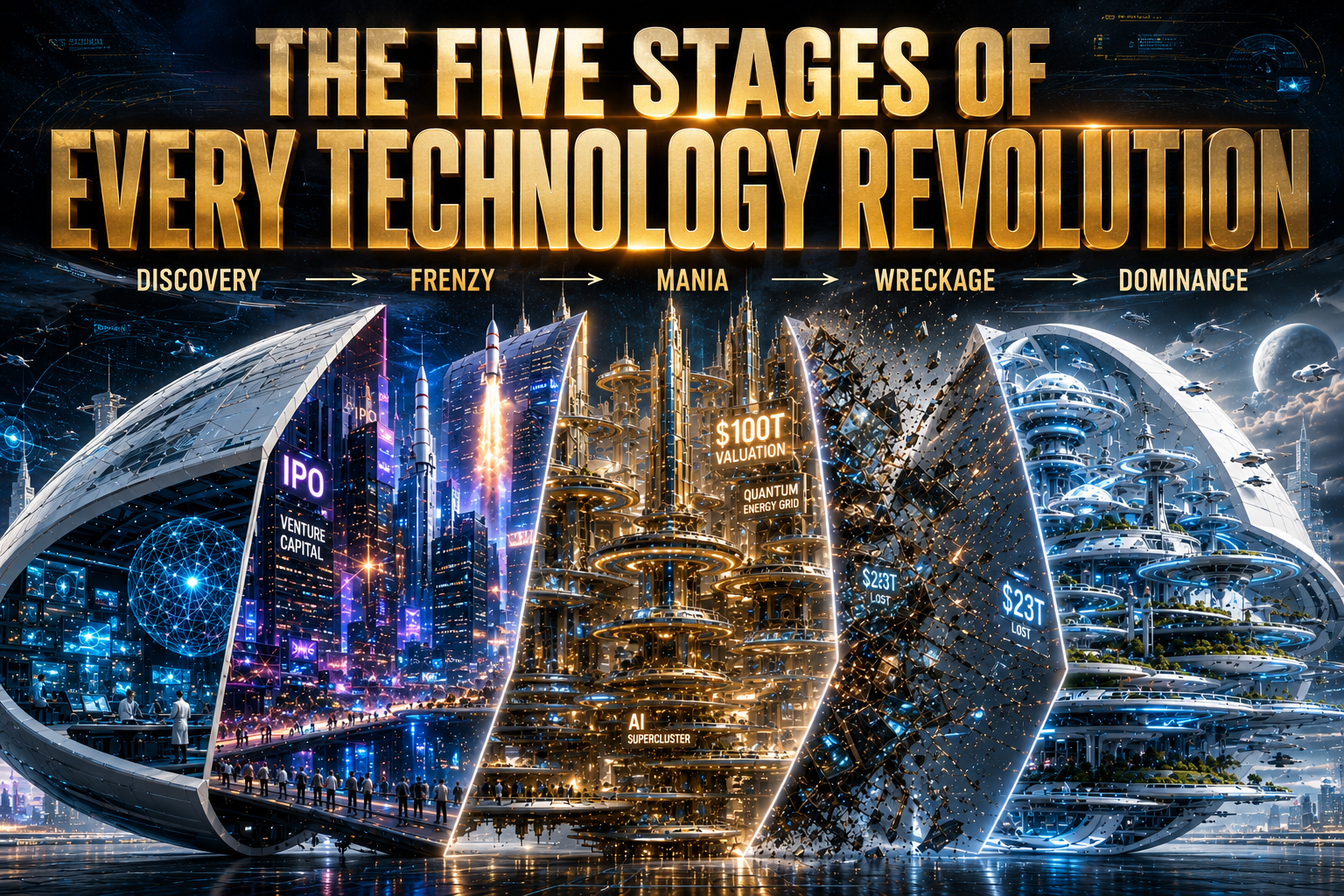
The Five Stages —
How Every Revolution Becomes
a Crash and Then a Fortune
Before we look at the evidence — and there is a great deal of it — it helps to have a map. Across 389 years of documented financial history, every major technology revolution has passed through five stages in the same sequence. The stages are not a theory. They are a description of a mechanism that repeats because the underlying drivers — human psychology, institutional incentives, the pace of technological development — do not change.
Understanding which stage you are in is not merely interesting. It is the most practically valuable piece of investment analysis you can do. The stage determines the right portfolio posture, the right instruments, the right time horizon, and most importantly — it determines who wins and who gets destroyed.
The Five Stages of Every Technology Revolution — From Discovery to Dominance
I
Discovery
The technology works. Early adopters earn extraordinary returns. Most people have never heard of it. Valuations are high but defensible.
II
Frenzy
Mainstream capital arrives. IPOs succeed at breathtaking valuations. The narrative replaces the numbers. Being wrong about the story feels more dangerous than being wrong about the price.
We Are Here
III
Mania
Speculation displaces analysis. Every company becomes a technology company. CAPE exceeds 35. The Buffett Indicator breaks 200%. The word “this time is different” is spoken without irony.
IV
Wreckage
A trigger breaks the loop. Declines of 60–90% arrive faster than anyone prepared for. Most companies fail. The technology continues without them. The infrastructure they built is still there.
V
Dominance
Two or three genuine survivors, building on cheap post-crash infrastructure, capture the transformative value the original investors priced but never earned. Generational wealth is created here.
The most important thing to understand about this framework is what it says about the relationship between the technology and the investment. They are not the same thing. They are governed by entirely different timelines and entirely different logic.
The railways were a real revolution. They transformed Britain, then Europe, then the world. But of the hundreds of railway companies that went public between 1844 and 1847, almost all of them failed. The investors who backed them lost most or all of their capital. Cornelius Vanderbilt — the man who eventually built the dominant railway empire — did not invest during the mania. He waited for the wreckage and bought what was left at sane prices in the 1850s.
The internet was a real revolution. It created tens of trillions of dollars of economic value. But of the 446 internet companies that went public in 1999 alone, fewer than ten account for the overwhelming majority of value that exists today. The other 436 are gone. The investors who bought them — at CAPE ratios that look modest compared to today’s — lost most of what they put in.
The Single Most Counterintuitive Point in This Entire Article
The companies that fail in Stage IV are often the ones that built the most real infrastructure during Stage II and III. WorldCom installed 80 million miles of fibre-optic cable. It went bankrupt in 2002 — the largest bankruptcy in American history at that time. The cables are still in the ground. They carry the internet you are reading this on right now. WorldCom was right about the technology and catastrophically wrong about the economics. Being right about the revolution is not the same as being right about the investment. This distinction is everything.
This is where most analysis of the current moment goes wrong. It confuses two separate questions. The first: will AI, space, and quantum computing transform the world? Almost certainly yes. The second: do the current market prices reflect that transformation in a way that allows investors to profit from it? That is a very different question — and history is much less optimistic about the answer.
The most dangerous investor in any Stage III mania is not the naive amateur who doesn’t understand the technology. It is the sophisticated analyst who understands the technology perfectly and assumes — reasonably, but incorrectly — that understanding the technology is the same as understanding the investment. It is not. It never has been. The pioneer and the winner are different people in almost every case the historical record contains.
Part IIIThe Archive — 389 Years of Evidence
The Record
That Does Not Lie —
389 Years of the Same Story
What follows is not a selection of convenient examples chosen to support a thesis. It is every major technology-driven market cycle in the documented financial record, from the Dutch tulip craze of 1634 to the present. The data varies in reliability by era — the 17th-century numbers come from reconstructed price series and historical accounts, while anything from 1900 onwards comes from primary sources. The pattern, however, is consistent across all eras where sufficient data exists to test it.
Read this table carefully. The column that matters most is the last one.
The Complete Historical Record — Every Major Technology Mania · 1634 to 2026
| Episode | Technology | Peak Signal | Peak → Trough | Time to Bottom | Years to Recovery | Who Actually Won |
|---|
Tulip Mania
1634–1637 |
Novel exotic commodities · financial derivatives |
A single Semper Augustus bulb sold for 10× a skilled craftsman’s annual wage |
−99% |
3 months |
Never (market ceased to exist) |
Dutch East India Company · established trade networks |
South Sea / Mississippi
1719–1720 |
Atlantic trade monopolies · paper money innovation |
Mississippi Co. +6,200% in 18 months · South Sea +1,000% |
−95% (Mississippi) −85% (South Sea) |
18 months |
30+ years |
Sovereign bond markets · Atlantic trade itself |
British Railway Mania
1844–1847 |
Steam railways · mass transit · industrial logistics |
263 new Railway Acts in 1846 · share prices +300% · George Hudson controls 25% of UK track |
−85% average across railway shares |
3–4 years |
~20 years (Vanderbilt era) |
Vanderbilt (NY Central) · Pennsylvania RR · consolidators who bought the wreckage cheap |
US Railroad Panic
1869–1873 |
Transcontinental rail · industrialisation |
Jay Cooke’s Northern Pacific collapse · credit frozen |
US market −30% · 5-year depression followed |
5 years |
6 years |
Standard Oil · Carnegie Steel · rail consolidators |
Roaring Twenties
1924–1929 |
Radio, automobiles, electricity, aviation — three paradigms at once |
CAPE reached 32 · RCA +2,400% (1921–1929) · margin debt record · Dow 381 |
−89% (DJIA peak to trough) |
34 months |
25 years (DJIA nominal recovery: 1954) |
GE · Ford · IBM (founded 1911, dominant 1950s) · AT&T |
Nifty Fifty
1968–1972 |
Consumer brands · conglomerates · “one-decision” growth stocks |
50 stocks at avg P/E 42× · Polaroid 94× · McDonald’s 71× |
−60–90% in real terms (1973–74) |
2 years |
11 years (real terms) |
McDonald’s · J&J · Coca-Cola — now multi-decade compounders |
Japan Bubble
1983–1989 |
Electronics · precision manufacturing · financial liberalisation |
Nikkei CAPE ~90× · Tokyo real estate: ¥1B per square metre · Buffett Indicator >200% |
−82% (Nikkei 1989–2003) |
160 months |
35 years (Nikkei nominal recovery: Feb 2024) |
Toyota · Sony · Nintendo (long-run) |
Dot-Com Bubble
1995–2000 |
Internet, e-commerce, telecom — three paradigms at once |
CAPE 44.19 (Dec 1999) · NASDAQ +400% (1995–2000) · 446 internet IPOs in 1999 |
−78% NASDAQ · −49% S&P 500 |
30 months |
15 years (NASDAQ nominal recovery: Apr 2015) |
Amazon · Google · Salesforce · Microsoft (reconstituted) |
China / Commodity Supercycle
2003–2008 |
Industrialisation · commodities · emerging market growth |
Oil $147/bbl · China +500% (2005–07) · global credit excess |
−57% S&P · commodities −70% |
17 months |
5 years (US recovery by 2013) |
BHP · Vale · China infrastructure names (long-run) |
The Fifth Wave
2020–2026 → |
AI, commercial space, quantum — three paradigms at once |
CAPE 40.43 · Buffett Indicator 233.8% · Top 10 = 40% of S&P · SpaceX 73× P/S |
TBD — history says −40% to −78% |
TBD |
TBD — history says 5–25 years |
TBD — the subject of Part VII |
Notice the rows highlighted in amber. The 1920s and the late 1990s are the only prior episodes where three separate transformational technologies entered public markets simultaneously. In both cases, the peak was followed by the most severe declines in the dataset — 89% for the 1929 episode, 78% for the NASDAQ in 2000–2002. And in both cases, recovery measured in decades, not months.
Notice also what the Japan column says. The Nikkei peaked in December 1989. It did not return to that peak until February 2024. An investor who bought the Nikkei in December 1989 — at a market that was expensive but justifiable against Japan’s extraordinary growth story — waited thirty-five years to break even. Not three years. Not five years. Thirty-five years. Japan is not an anomaly. It is the most extreme version of the mechanism that appears in every row of this table.
The Crash-to-Recovery Timeline — The Numbers Most Investors Never Compute
Railway Mania (1847): −85% · Recovery: 20 years |
1929 Crash (DJIA): −89% · Recovery: 25 years |
Nifty Fifty (real terms): −70% · Recovery: 11 years |
Japan Nikkei: −82% · Recovery: 35 years |
NASDAQ 2000: −78% · Recovery: 15 years |
S&P 500 2008: −57% · Recovery: 5.5 years
The average recovery time across Stage IV episodes where three technologies entered simultaneously: 20 years. That is not a statistic designed to frighten you. It is a calibration tool. When you understand how long the Valley can last, you can plan for it — which changes everything about how you position going into it.
The dot-com parallel deserves extra attention because it is the most recent, the most documented, and the most directly analogous to today. Let us spend a moment with the specific numbers.
In 1999, Cisco Systems was the most important networking company in the world. Its routers and switches built the physical infrastructure of the internet. The technology was absolutely real. The company’s competitive position was genuinely dominant. And the stock fell from $80 to $9 between 2000 and 2002 — a decline of 89%. Twenty years later, in 2020, the stock finally returned to its 1999 high. That is not a story about Cisco failing. That is a story about what happens when a genuinely great company is priced at 100 times sales at a market peak.
Amazon fell from $113 to $5.51 between 1999 and 2001. That is a decline of 95%. The investors who held through that decline and bought more — the ones who believed in the company and could afford to be patient — are now holding one of the greatest investments in financial history. But the investors who bought at $113 in 1999 and sold at $5.51 in 2001 are not those investors. They are the investors who funded the infrastructure Amazon would use to dominate the next twenty years. They were right about everything except the price and the timeline.
The One Insight That Changes How You Read Everything That Follows
The survivors of Stage IV — the companies that eventually achieve Stage V dominance — are almost never the most celebrated names at the Stage III peak. They are the companies with the strongest economics underneath the narrative. The ones that could survive without external capital. The ones whose fundamental competitive position was real, not constructed from story. Amazon at $5.51 in 2001 was not a company that had failed. It was the most important commercial company in the next twenty years, temporarily priced as though it was about to go bankrupt. The investors who made generational wealth from Amazon were not the ones who bought it at the IPO. They were the ones who bought it in the wreckage.
The Fifth Wave —
Space, AI and Quantum
Arrive at Once
The three technologies at the centre of the current moment are not equivalent. They are at different stages of development, different stages of commercial maturity, and different stages of market pricing. Understanding where each one sits in the Five-Stage framework is the entire analytical challenge — and the honest answer is more nuanced than most coverage of this moment allows for.
Commercial Space
SpaceX
SPCX · Listed June 12, 2026 · ATH $225.64 · Now $174.90
Market cap: $2.0 trillion · 73× annual sales
Profitable segment: Starlink — $10B revenue, $6B EBITDA, 4M+ subscribers
Loss-making: Starship — $4.9B net loss in 2025, the bet on Mars and orbital manufacturing
Stage: III Mania · real business, speculative price
Now Trading
Artificial Intelligence
Anthropic
Private · S-1 filed June 1, 2026 · IPO target Oct 2026
Private valuation: $965B · Series H at $65B raised May 28
Revenue run rate: $47B annualised as of May 2026
Milestone: First operating profit expected Q2 2026 (~$559M)
IPO target: $1.0–$1.15 trillion first-day market cap (FutureSearch projection)
IPO Oct 2026
Artificial Intelligence
OpenAI
Private · S-1 filed June 8, 2026 · IPO target late 2026 / Q1 2027
Private valuation: $852B · Goldman Sachs + Morgan Stanley leading
Revenue: ~$25B ARR growing toward $42B by mid-2027
Losses: $14B non-GAAP / $25–27B GAAP projected 2026 · cash flow positive 2030
Infrastructure commitment: $600B — larger than entire dot-com build
IPO Late 2026
Space — The Infrastructure Argument Is Real. The Price Is the Question.
SpaceX is not a speculative technology company. It is the only organisation on earth that has cracked reusable rocket economics at scale, reducing the cost per kilogram to orbit from $60,000 in the Space Shuttle era to approximately $2,700 today — a 96% cost reduction in fifteen years. Starlink is a genuinely profitable satellite internet business serving over 4 million subscribers with a structural moat that no competitor can approach without a decade and tens of billions in investment. These are real assets generating real cash flows.
At 73 times sales, however, the stock price is not asking whether SpaceX is a good business. It is asking whether SpaceX will become the dominant infrastructure company of the next century, commercialise orbital manufacturing, establish a viable Mars economy, and maintain that dominance against well-capitalised competitors for decades to come. All of those things may happen. None of them are priced with any margin of safety at $174.90 per share.
The smaller space companies — Rocket Lab, AST SpaceMobile, Intuitive Machines — sit at more interesting valuations but carry the risk of direct competition from the company that just raised $75 billion and can afford to price aggressively in any market they choose to enter.
Artificial Intelligence — The Most Important Technology in a Generation. The Most Expensive in History.
Artificial intelligence is a General Purpose Technology — the classification economists give to technologies that diffuse across every sector of the economy and generate complementary innovations for decades. The steam engine was one. Electricity was one. The internal combustion engine was one. The evidence that AI fits this category is increasingly strong: measurable productivity gains of 20–40% for knowledge workers using frontier models, enterprise deployments at scale across medicine, law, finance, and engineering, and genuine disruption of workflows that have been unchanged for a generation.
But consider the specific numbers on the table above. Anthropic is valued at $965 billion in private markets. Its revenue run rate is $47 billion annualised. That gives it a price-to-sales ratio of approximately 20 times — high but not insane for a high-growth enterprise software company approaching its first profit. OpenAI, by contrast, is valued at $852 billion with $25 billion in annualised revenue — approximately 34 times sales — and is projected to lose between $25 and $27 billion this year on a GAAP basis. It has committed $600 billion to infrastructure spending and does not expect to generate positive cash flow until 2030. The implicit comparable for OpenAI’s valuation is Microsoft — the operating system on which the next generation of businesses is built. The financials it will disclose look considerably more like Google.
Both companies are real. Both are building something genuinely important. The question — as it was with WorldCom, as it was with Cisco, as it was with every great infrastructure builder at the peak of Stage III — is whether the price reflects the business as it exists in 2026 or the business as it might exist in 2036.
Quantum Computing — The Transistor Moment. The Most Patient Opportunity.
Of the three technologies, quantum computing is the one where honesty demands the most patience and the most humility. In December 1947, three physicists at Bell Labs demonstrated the transistor — a device that would eventually underpin every piece of electronic technology on earth. The first commercial transistor radio appeared in 1954. The integrated circuit arrived in 1958. The personal computer did not appear until 1977. Intel, which would dominate the semiconductor industry for forty years, was founded in 1968 — twenty-one years after the transistor’s invention.
In 2024, Google’s 105-qubit Willow chip achieved what the quantum computing field had been working toward for two decades: below-threshold quantum error correction, meaning that adding more physical qubits actually reduces error rates rather than amplifying them. This is the equivalent of the 1947 transistor demonstration. The physics is proven. The engineering challenge is what remains — and that challenge, if the semiconductor parallel holds, will take the better part of a decade to translate into commercial applications at scale.
The market for quantum computing is projected to grow from $1.4 billion today to $4.2 billion by 2030 and $170 billion by 2040 — a 120-fold expansion. The semiconductor market grew approximately 150-fold in the sixteen years following the integrated circuit. The quantum projections are consistent with the historical parallel. But the timeline implies that the real commercial payoff is a decade away at minimum. The investors who buy quantum companies at speculative valuations today are pricing in a world that may not arrive until 2035. The investors who will make the most money from quantum are probably the ones who will buy in Phase IV — when the technology is real and proven and the market has forgotten it existed.
Stage I–II · Pre-commercial · Venture sizing only
Part VThe Price of Everything
The Price
of Everything —
What the Numbers Actually Mean
There is a question worth asking before we look at the valuation data. Why does it matter that the broad stock market is expensive when the specific technologies driving the current excitement are real and transformative? The answer is the most important structural point in this entire analysis.
When the broad market is priced at extreme valuations, it is because capital has been flowing broadly into equities — including the technology sector — on the assumption that the future will be better than the past. When that assumption cracks, it does not crack selectively. The entire asset class reprices simultaneously. The revolutionary companies fall with the mediocre ones. Amazon fell 95% in the dot-com crash — not because Amazon was a bad company, but because it was a technology company in a technology sell-off in which the price of capital rose dramatically and the tolerance for losses evaporated overnight.
The broad market valuation is not a separate problem from the technology sector valuation. It is the same problem. And the current readings on the three most reliable long-run measures we have are among the most extreme in recorded history.
Valuation Dashboard — US Equity Markets · June 19, 2026
Sources: multpl.com · gurufocus.com · advisorperspectives.com · currentmarketvaluation.com
Shiller CAPE Ratio
40.43
Long-run mean since 1881: 17. Current premium above mean: +138%. This level has been exceeded only once in 145 years: December 1999, when the ratio reached 44.19 immediately before the NASDAQ lost 78% of its value. The 1929 pre-crash level was 32. The 2007 pre-crisis level was 27. At 40.43, we are in the second-most expensive market in recorded history.
Buffett Indicator (Market Cap / GNP)
233.8%
Warren Buffett called this “probably the best single measure of where valuations stand.” At 233.8%, we sit 2.1 standard deviations above the long-run trend line, and 64.9% above the regression trendline. Pre-dot-com: 146%. Pre-2008: 109%. Pre-COVID crash: 152%. The CAPE-implied annual real return for the next 8–10 years: 1.3% per year. Long-run median: 6.4%.
Top 10 S&P 500 Concentration
40%
The ten largest companies now own 40% of the entire S&P 500. This is an all-time record. At the dot-com peak in 1999–2000, the equivalent reading was 27%. In 2015 it was 20%. The top 10 have grown from 22% to 40% of the index in approximately ten years — meaning any correction in the Magnificent Seven hits the entire passive investing universe harder than ever before.
Forward P/E · S&P 500
~22×
The trailing P/E is above 25×. The forward P/E rests near 22× consensus 12-month estimates. Long-run average forward P/E: approximately 16×. At 22×, the index implies either that earnings grow 37% from current levels to justify present prices at the long-run multiple — or that the market accepts permanently elevated multiples. Neither has been a reliable assumption historically.
CAPE-Implied 10-Year Return
1.3%/yr
At CAPE 40.43, the formula-implied annual real return over the next decade is approximately ~1.5% per year (GuruFocus / Robert Shiller data). The long-run median is 6.4%. From the December 1999 CAPE peak of 44.2, 10-year forward returns were approximately −1% annually nominal, −3.5% in real terms. This does not predict when. It predicts how much margin for error remains.
The IPO Signal
3 Waves
SpaceX listed June 12 at $2 trillion. Anthropic is targeting October 2026 at $1 trillion+. OpenAI is targeting late 2026 or Q1 2027 at $850B–$1 trillion. This is the third time in modern history that multiple transformational technology paradigms have entered public markets simultaneously. The previous two occasions — 1920–29 and 1997–2000 — both produced the most severe declines in the dataset.
These numbers do not tell us when the correction arrives. They never do. The dot-com CAPE of 44 was flashing extreme readings for three years before the actual peak. Japan’s valuation signals were extreme for years before December 1989. The mechanism is not a countdown timer. It is a measure of how much margin for disappointment exists in the current price — and at 40.43, the answer is very little.
What the numbers do tell us with reasonable confidence is the shape of the distribution of likely outcomes. At current valuations, the probability of the S&P 500 delivering its historical median return over the next decade is very low. The probability of a significant correction at some point in the next 1–5 years is, by historical precedent, very high. And the probability that the technology companies currently commanding the highest valuations will be the specific companies that dominate in 2040 is — based on every prior cycle in the table above — considerably lower than their current market prices imply.
What the Road
Looks Like From Here
This is not a prediction. Markets are not predictable on any precise timeline, and anyone who claims otherwise is selling something. What follows is a probability-weighted map derived from the historical record — the same record we have just examined in detail. Think of it as the shape of what tends to happen, not a guaranteed schedule of events.
The Three-Phase Road Map · Near Term → Valley → Dominance
Phase 1 — The Extended Mania (0–18 months)
Manias always last longer than analysis says they should. The technology narrative is compelling, the IPO pipeline is full, and institutional career risk of underexposure still exceeds the career risk of overexposure. Anthropic lists in October 2026. OpenAI follows in late 2026 or Q1 2027. Both IPOs succeed. Both likely trade higher in the first weeks. The market continues to look expensive and continues to rise. This is normal Stage III behaviour.
Watch for: Earnings growth stalling as multiple expansion ends · Credit conditions tightening · First major AI company revenue miss vs. expectations
Phase 2 — The Correction (18 months to 5 years from trigger)
The trigger is unknown and unknowable in advance. It is almost never the risk analysts had identified — in 2000 it was not a technology failure, it was a gradual realisation that the timeline was wrong. In 2008 it was not emerging markets, it was US housing. What the trigger breaks is the recursive financing loop: the story attracts capital, capital lifts prices, lifted prices validate the story. When one link in that chain weakens, the whole structure reverses with surprising speed. Based on prior cycles where valuation signals matched today’s, the likely range for a correction is −40% to −75% in technology-heavy indices. Duration: 18 months to 4 years from the peak.
Historical precedent: NASDAQ −78% (30 months, 2000–02) · DJIA −89% (34 months, 1929–32) · This does not need to be that severe — but it needs to be planned for.
Phase 3 — The Valley of Disillusionment (2–10 years after trough)
The technology is real but nobody wants to discuss it. Serious journalists write serious articles about why AI was overhyped and quantum computing may never work commercially. Most public quantum companies trade below their cash value. SpaceX, if it survives the correction, trades at a fraction of its IPO price. This is when Amazon was $5.51. This is when Google was $50 in its post-IPO period. This is the moment the history books later identify as obvious. The investors who act in this phase — who have the cash, the conviction, and the analysis to buy quality at panic prices — are the ones the next generation of financial history is written about.
Target zone for buying: NVDA at $140–$165 · SPCX at $110–$135 · PLTR at $50–$65 · IONQ below $28
Phase 4 — Dominance (5–20 years from trough)
Two or three companies emerge from the Valley and begin generating the cash flows that the Stage III investors priced but never received. AI becomes the infrastructure layer on which the next generation of economic activity is built. Space becomes the logistics network for a $1.8 trillion space economy. Quantum computing solves specific high-value problems in drug discovery, financial optimisation, and materials science. The companies that dominate this phase are probably not all the same companies that dominate the current headlines — they are the ones with the strongest fundamental economics underneath the narrative.
The investors who bought Amazon at $5.51 in 2001 held a position worth $3,500 per share by 2021. 580× their money in twenty years. That is what the Dominance phase looks like from Stage IV.
The Most Important Sentence in This Article
The Valley is not the failure of the technology. It is the failure of the price. The technology always continues. The companies that built it do not always continue. And the investors who bought in Stage III do not always benefit — even if the technology delivers everything it promised. The most important investment action you can take right now is not to buy the current revolution. It is to be in a position — financially and psychologically — to buy it in the wreckage that Stage IV produces. That requires holding something that Stage III mania does not reward: patience and cash.
The Survivors —
Four Tiers, Specific Companies,
Honest Assessments
History provides a very specific profile of the companies that reach Stage V dominance. They are almost never the most celebrated names at the Stage III peak. They share a structural characteristic: their economics work even if you strip away the technology label. If you looked at them purely as businesses — ignoring the AI story, the space story, the quantum story — you would still want to own them. The technology narrative is upside. The business is the foundation.
We have organised every meaningful company in this space into four tiers. The tiers are not a judgment of the technology — they are a judgment of the survivability of the business model through Stage IV and the probability of Stage V dominance.
1
Moated — Own Through All Five Stages
Cash flows that survive a 70% market decline. Network effects that deepen during downturns. Economics that work independent of the AI/Space/Quantum narrative.
Microsoft
MSFT · ~$379
27% OpenAI stake (~$260B at IPO). Azure AI fastest-growing cloud platform. Majorana 1 quantum chip in commercial applications. $30B+ annual free cash flow provides a floor in any market environment. The Vanderbilt trade — defensible across all five stages, best at Stages IV and V. If you own only one company through the cycle, own this one.
Risk: Antitrust action · OpenAI relationship deterioration · AI commoditisation of Azure margins
Alphabet / Google
GOOGL · ~$367
Google Willow chip — the most significant quantum computing milestone in history. Gemini AI competing directly with ChatGPT across 2B+ existing users. Google Cloud fastest-growing AI workload platform. YouTube. Android. Search — $200B+ in cash flows that fund R&D that no pure-play can match. Cheaper on P/E than Microsoft or Nvidia despite comparable or superior technological positioning.
Risk: DOJ antitrust ruling · AI Overviews cannibalising Search profitability
Amazon
AMZN · AWS dominance
AWS controls 31% of the global cloud market — the infrastructure on which every AI application company builds. $50B invested in OpenAI’s latest round. Project Kuiper is a direct Starlink competitor. The logistics empire provides a revenue floor through any technology cycle. Amazon fell 95% in the dot-com crash and came back to become worth $2 trillion. The quality of the underlying business is what made that recovery possible.
Risk: Antitrust · AWS margin compression from custom silicon competition
2
Infrastructure — Win Regardless of Which Application Company Wins
These companies benefit from volume — the more AI models, satellite deployments, and quantum experiments that happen, the more revenue they generate, regardless of which specific company wins.
Nvidia
NVDA · ~$210
Every AI model trained anywhere in the world trains on Nvidia GPUs. The CUDA software ecosystem took 15 years to build and cannot be replicated quickly by any competitor. Cisco’s equivalent in the dot-com era fell 86% — but Cisco’s routers still run the internet. Nvidia’s position is more defensible than Cisco’s was in 2000 because the software lock-in is deeper. The Phase IV entry point — $140–$165 — is where this trade becomes exceptional.
Risk: China export restrictions · AMD gaining GPU share · hyperscaler custom silicon
Energy Infrastructure
(Nuclear + Grid)
CEG · NEE · VST · OKLO
The most overlooked structural beneficiary of AI. Training a single large AI model cluster consumes as much electricity as a small city. Microsoft, Google, Amazon, and Meta have each signed 20-year nuclear power purchase agreements. Power demand from AI data centres is not a speculative forecast — it is already generating signed utility contracts. These companies carry low correlation to the technology sector, providing genuine diversification while capturing AI infrastructure demand.
Risk: Policy reversal on nuclear · regulatory delays · permitting timelines
IBM
IBM · ~$230 · ~4% dividend
Most mature enterprise quantum integration. 127+ qubit systems deployed to Fortune 500 clients. Fault-tolerant modules targeted 2027. Pays approximately 4% dividend while you wait for quantum to mature — one of the very few quantum plays that provides income through Stage IV. TipRanks Smart Score 10/10. The conservative quantum allocation: own the infrastructure, collect the dividend, benefit from adoption regardless of which pure-play wins.
Risk: Legacy business drag · quantum timeline slower than roadmap
3
Enablers — Real Businesses, Real Revenue, Dependent on Technology Timeline
These companies have genuine fundamentals — not just stories. Their survival depends on specific technology outcomes materialising within a defined window. Quality at the right price.
Palantir
PLTR · $128.63 · down 27% YTD
Q1 2026: revenue +85%, US commercial +133%, highest growth in company history. Building the AI operating system for enterprise and government — the Salesforce of AI infrastructure. Down 24% year-to-date despite fundamental acceleration. Government contract base provides revenue floor through any correction. At $50–$65 in a Phase IV decline — where it will likely trade during a broad correction — this is one of the most compelling entry points in the sector.
Risk: P/E 190 at current price · UK contract blocked · earnings deceleration
Rocket Lab
RKLB · $101.27 · 52-wk high $151.00
The best commercial space business outside SpaceX. Electron rocket dominance in small launch. High-margin satellite manufacturing. NASA contracts. Neutron medium rocket in development. Fell sharply on SpaceX IPO day from its 52-week high of $151 as capital rotated into SPCX. It has since largely recovered to $101. The business case — Q1 revenue +63.5%, $2.2B backlog up 108% YoY, NASA contracts expanding — has only strengthened. At $68–$80 in a Phase IV decline, this company’s economics justify significant allocation.
Risk: Neutron delays · SpaceX competition on every contract
ARM Holdings
ARM · Chip architecture royalties
ARM’s chip architectures run in virtually every AI inference device and smartphone on earth. As AI moves from data centre training to edge deployment — on phones, laptops, IoT devices — ARM’s royalty stream grows with every device shipped. The picks-and-shovels equivalent for the AI inference era. SoftBank holds ~90%. The OpenAI IPO, when it occurs, will highlight the AI hardware stack that ARM underpins.
Risk: Licence renegotiation with major clients · RISC-V open-source competition
4
Bets — Real Technology, Uncertain Survival, Venture Sizing Only
These are the internet startups of 1999. Most will fail. A handful will become the defining companies of their sector. Size them accordingly: small enough that being wrong doesn’t hurt you, large enough that being right changes your decade.
IonQ
IONQ · ~$56.55 · 77% Q1 revenue growth
Best-in-class trapped-ion quantum fidelity (99.99%). Available on AWS, Azure, and Google Cloud. 256-qubit system deploying H2 2026. 77% Q1 revenue growth. The most complete pure-play quantum investment case available. Could be the Amazon of quantum computing. Could be Pets.com. The technology is real. The commercial timeline is uncertain. Buy at Phase IV prices — below $28 — not at $45.
Risk: 49× P/S · pre-commercial · expect 70–80% Phase IV decline first
AST SpaceMobile
ASTS · ~$13 · down 33% from high
Connecting ordinary smartphones directly to satellites without special hardware. If it works at scale, the addressable market is 4 billion mobile users globally. Every major telecom carrier becomes a potential customer. BlueBird satellite deployment in progress in June 2026. 8 Buy / 0 Sell analyst consensus. Binary technology risk — but the downside from $13 is more contained than from $20.
Risk: Technology failure · capital intensity · SpaceX Starlink as superior competitor
Rigetti Computing
RGTI · ~$10 · $45M Bessemer funding 2026
Hybrid quantum-classical approach preferred by enterprise clients for near-term applications. $45M from Bessemer Venture Partners. Superconducting qubit architecture is faster than ion-trap for specific workload types. The AMD to IonQ’s Intel — or it disappears entirely. 2% of risk capital maximum. Hard stop. No averaging down. This is a lottery ticket with a real technology behind it.
Risk: Very high binary risk · quantum timeline extending past 2032
Part VII-BHow to Position
Ten Positions —
One Per Market · Logically
Consistent With the Thesis
Every trade below flows from the same argument the article has made. The market is at a historic valuation extreme. A correction is more probable than most investors currently believe. That correction, when it arrives, will precede a period of genuine technological prosperity — the Renaissance the title describes. The trades are positioned for both sides of that arc: short the peak, accumulate in the correction, hold for the era that follows.
These are educational trade frameworks, not personalised investment advice. All levels are based on publicly available market data as of June 20, 2026. All investments carry risk of loss. Seek independent professional advice before trading.
A Real-Time Signal That Has Preceded Every Major Top in Modern History
Anthropic filed its IPO documents on June 1, 2026. OpenAI filed on June 8. Both are targeting listings before the end of 2026. Both are valued near $1 trillion. Both are losing billions annually. The question every serious investor should be asking is not whether these are great companies — they are. The question is: why are they filing now?
The historical record on this is unambiguous. The peak of dot-com IPO activity was Q4 1999 and Q1 2000. The NASDAQ peaked March 10, 2000. The IPO window slammed shut by April. In 1929, the peak of new stock issuance was September — the crash began October 24. The rule that emerges across every cycle: when companies that have waited years to list suddenly accelerate their timelines simultaneously, it is because the bankers are telling them the window may not be open much longer. A CEO who files in June and targets October is not doing it because October is a beautiful month. The rush is the signal. Two simultaneous near-trillion-dollar IPOs targeting the same narrow window is not a coincidence. It is an urgency. And urgency at the top of a cycle has a consistent historical meaning.
● NEAR TERM · Actionable now
● MEDIUM TERM · 6–18 months
● LONG TERM · 2–8 years · GTC orders
Trade 01 · NASDAQ 100 Index · Near Term · Short the Peak
SHORT · NEAR TERM
Short the NASDAQ 100 — The Index Is 1.6% From Its All-Time High While the Thesis Says a Major Correction Is Due
⏱ Near Term · Current ~30,720 · 52-week range 21,566–30,975 · Entry at or near current levels · Stop well above ATH · Targets 25–45% below entry
The NASDAQ 100 at 30,720 is the purest expression of the valuation extreme this article describes. It sits 1.6% from its all-time high of 30,975. The Magnificent Seven alone account for over 55% of its total weight. The CAPE is 40.43 — the second highest in 145 years. The Buffett Indicator is 233.8% — an all-time record. The two prior occasions when these signals aligned simultaneously ended with the NASDAQ falling 78% (2000–2002, 30 months) and 86% (1929–1932, 34 months). The short is not a speculative bet against technology — it is a valuation correction trade. The technology will survive. The multiple will not. Enter in three tranches at current levels. The stop is set well above the recent high to absorb continued momentum. Targets reflect the historical range of prior corrections from similar valuation starting points — 25% decline to Target 1, 45–55% to Target 2 if the full cycle plays out.
Target 1 (−25%)
22,000–23,000
Target 2 (−45%)
14,500–17,000
⚠ Manias extend longer than any analysis suggests. The Anthropic and OpenAI IPOs could push the index to new highs before the reversal. Wide stop at 32,800 is essential. Scale in — never full size at once.
Trade 02 · Gold (XAU/USD) · Near Term + Long Term · The All-Weather Position
LONG · NEAR AND LONG TERM
Long Gold — The One Position That Works in Every Scenario This Article Describes
⏱ Near and Long Term · Current ~$4,154 · 52-week range $3,248–$5,595 · Accumulate now and add on any correction dip · 3–7 year structural hold
Gold is the only trade in this report that is consistent with every scenario the thesis describes — not just one of them. In Scenario A (the correction arrives): gold benefits from the flight to quality as equities fall and central banks cut rates aggressively. Real yields collapse. The dollar weakens. Gold rises. In Scenario B (the mania extends further before the correction): gold benefits from the fiscal backdrop — US debt approaching $37 trillion, a $2 trillion annual deficit, and the monetary consequences of financing two simultaneous near-trillion-dollar infrastructure buildouts in AI and space. In Scenario C (the Renaissance arrives): gold holds value through the transition period and provides capital to deploy into the equity opportunities that the correction creates. Gold at $4,154 has already corrected from its all-time high of $5,595 — a 26% pullback that represents a logical accumulation zone before the next leg. The fiscal arithmetic — not sentiment, not fear — is the structural case. The United States cannot finance $600 billion in AI infrastructure commitments, $37 trillion in existing debt, and $2 trillion in annual deficits without eventually debasing the currency. Gold prices that debasement.
Stop (monthly close)
Below $3,400
Target 1 (1–2yr)
$5,500–$6,000
Target 2 (3–5yr)
$7,000–$9,000
⚠ Gold faces short-term headwind from elevated real yields (10-year TIPS at ~2.1%). This resolves when the Fed cuts. Use monthly close stops — not intraday — to avoid noise-driven exits.
Trade 03 · PLTR · Palantir · Short Now at P/E 190 · Long Later at Sane Valuation
SHORT NOW · LONG TERM LONG LATER
Palantir — The Business Is Exceptional. The Valuation Is the Problem. Short the Multiple. Buy the Business.
⏱ Stage 1 Short: Near term · Current $128.63 · Stage 2 Long: GTC at $45–$60 after correction · Two separate positions, separate risk
Palantir’s fundamentals are genuinely exceptional — Q1 2026 revenue +85% year-on-year, US commercial +133%, government contracts expanding. The business deserves to exist and to be owned. At P/E 190 and $128.63, however, recommending a long position is directly inconsistent with the thesis of this article. A market priced at CAPE 40.43 with a Buffett Indicator of 233.8% is not a market where P/E 190 stocks survive intact. Palantir fell from $45 to $6 between January 2021 and December 2022 — an 87% decline — when rates rose and growth multiples compressed. That decline had nothing to do with the quality of the business. It had everything to do with the price. The trade therefore has two stages. Stage 1: short at current levels targeting a correction to $55–$70, where the P/E resets to approximately 55–70× on current earnings — still a premium but one that reflects the growth rate more honestly. Stop above $155. Stage 2: when the short target is reached, close the short and open the long. The same business at $55 is one of the most compelling AI platform investments available.
Stage 1 Short Entry
$122–$135
Stage 2 Long Entry
$45–$65
⚠ These are two entirely separate positions. Close the short before opening the long. Do not hold both simultaneously. Stage 1 sizing: 5% of portfolio. Stage 2 sizing: 8–10%.
Trade 04 · USD/JPY · Near Term Long · Then Long Term Short · Two-Stage Trade
LONG NOW · FLIP SHORT ON FED PIVOT
USD/JPY — Long While the Fed Is Hawkish. Short When the Fed Has to Blink. The Biggest Currency Trade of the Cycle.
⏱ Stage 1 Near Term: current 160.87 · target 164–168 · Stage 2 Long Term: short 164–170 target 130–140 · flip triggered by Fed first rate cut
USD/JPY at 160.87 sits at the top of its 52-week range of 142.68–160.95, driven by the most extreme US-Japan rate differential in modern history. Stage 1 is directionally long: the Fed under Kevin Warsh is signalling further hikes while the Bank of Japan remains constrained. The rate differential supports continued dollar strength near-term. Target 164–168 before the flip. Stage 2 is the bigger, longer trade: when the US equity correction forces the Fed to pivot from hawkish to accommodative, the rate differential collapses and the yen carry trade — estimated at $450 billion outstanding — begins to unwind. This mechanism drove the August 2024 flash crash. The full unwind from a larger base drives USD/JPY toward 130–140 over 3–5 years. Historical templates: peaked at 147 before LTCM in 1998, fell to 102 by 1999. Peaked at 135 in 2001, fell to 102 by 2004. Current setup is structurally larger in both the carry position and the rate differential.
Stage 1 Long Entry
160–163
Stage 2 Short Target
130–140
⚠ BoJ intervention risk in Stage 1 at these levels — can move 300–500 pips instantly. Stage 1 sizing: 5–8%. Stage 2 is the larger, more important position — size 8–12% when the trigger fires.
Trade 05 · EUR/USD · Medium Term · Dollar Structural Decline on Fed Pivot
LONG · MEDIUM TERM · WAIT FOR FED CUT
Long EUR/USD — The Dollar Loses Both Its Rate Support and Its Safe-Haven Premium the Moment the Fed Blinks
⏱ Medium Term · Current ~1.1590 · Do not enter yet · Trigger: Fed first rate cut announcement · 12–24 months from trigger to targets
EUR/USD at approximately 1.1590 already shows unusual dollar weakness despite elevated US rates — currency markets are beginning to price fiscal risk above rate differentials. The setup is triggered, not immediate: enter the day the Federal Reserve announces its first rate cut. At that moment the dollar loses both its yield support and the safe-haven bid simultaneously. US debt-to-GDP approaching 130% versus Eurozone fiscal discipline creates the structural imbalance. The 2009–2011 template: EUR/USD rose from 1.25 to 1.50 as Fed QE contrasted with ECB discipline. Current US fiscal position is more stretched than 2009, suggesting a potentially larger move. The entry must wait for the trigger — entering before the Fed pivot risks being caught in a continued dollar-strength environment if the correction is delayed.
Entry (post-Fed cut)
1.12–1.18
⚠ Concurrent Eurozone recession would reduce potency. Monitor Euro-area PMI monthly. If Eurozone contracts sharply at the same time the Fed cuts, reduce position size by half.
Trade 06 · USD/CHF · Long Term · Structural Short on Dollar Debasement
SHORT · LONG TERM · ENTER ON USD SPIKE
Short USD/CHF — The Swiss Franc as the Decade’s Structural Safe Haven Against Dollar Debasement
⏱ Long Term · Current ~0.8850 · Enter on USD spike during initial Phase IV risk-off event · 3–8 year structural hold
The Swiss franc is the world’s cleanest safe-haven currency: neutral, fiscally disciplined, current account surplus, no dollar-linked liabilities. The structural trade is short USD/CHF over 3–8 years based on one simple premise: the US fiscal response to a technology-sector equity correction — aggressive rate cuts, expanded money supply, potentially negative real rates — will drive a sustained decline in USD versus the world’s most fiscally conservative major currency. Template: USD/CHF fell from 1.20 in 2009 to 0.71 by 2015 as the Fed’s post-GFC programme contrasted with SNB discipline — a 41% CHF appreciation in six years. Current US debt-to-GDP of 130% versus 70% in 2009 suggests a potentially larger move. Entry tactic: the initial Phase IV risk-off event will cause a flight into dollars as a reflex safe-haven response — that USD spike is the entry into the short. Short dollar strength, not dollar weakness.
Entry (USD spike)
0.90–0.96
Target 1 (3–5yr)
0.78–0.82
Target 2 (5–8yr)
0.70–0.75
⚠ SNB periodically buys USD/sells CHF to limit appreciation — tactical risk to timing, not to the directional thesis. Wide initial stop at 1.00. This is a multi-year position, not a swing trade.
Trade 07 · MSFT · Microsoft · The One Equity Long Consistent With the Thesis Right Now
LONG · NOW AND ADD ON CORRECTION
Microsoft — Already Down 32% From Its Peak. Cash Flows Underpin It. The OpenAI Stake Is Not Priced In.
⏱ Near and Medium Term · Current $379.10 · Down 32% from ATH $555.45 · Partial position now · Add significantly at $285–$310 on correction
Microsoft is the only equity long in this report consistent with the article’s thesis — and only because it has already partially corrected. Down 32% from its all-time high of $555.45, Microsoft has absorbed a significant de-rating while the broader NASDAQ remains near its peak. The valuation is still elevated but considerably less extreme than the rest of the sector. More importantly, the fundamental case is not dependent on narrative: $30 billion in annual free cash flow provides a genuine floor that most AI names lack. The 27% stake in OpenAI — worth approximately $260 billion at IPO valuation — is not in most analyst sum-of-parts models. Azure AI is the fastest-growing enterprise cloud platform by percentage. Majorana 1 quantum chip is in commercial chemistry applications. A starter position now at $379 is defensible. The full conviction entry is at $285–$310 — approximately 25% below current price — which a broader market correction would deliver. At that level, Microsoft trades at approximately 22× free cash flow with the OpenAI stake as free upside.
Add on Correction
$285–$310
⚠ Microsoft faces a securities fraud class action filed June 2026 regarding Copilot functionality. Monitor. Even quality businesses fall 40–50% in severe corrections — the starter position is sized to survive that and add more.
Trade 08 · NVDA · Nvidia · Long Term · GTC Order — The Infrastructure Monopoly at the Right Price
LONG · LONG TERM · GTC ORDER TODAY
Nvidia — Do Not Buy at $210. Set the Order at $140–$165 and Wait. This Is the Most Important GTC Order in This Report.
⏱ Long Term · Current $210.33 · ATH $236.54 · Set GTC limits at $148 and $142 today · Do not chase · 3–5 year hold from entry
Nvidia at $210 is a genuinely exceptional business at a price inconsistent with the article’s thesis. Every AI model trained anywhere in the world runs on Nvidia GPUs. The CUDA software ecosystem took 15 years to build. Blackwell GPU cycle is accelerating. These facts are indisputable. But at $210 and a market cap approaching $5 trillion, the stock prices in years of perfect execution simultaneously across AI spending growth, geopolitical stability, and competitive moat preservation. The precedent is exact: Cisco in 2000 was the most important networking company in the world. Absolutely essential technology. Absolutely dominant. Fell 86% from peak. Its technology ran the internet through the entire crash. At $140–$165 — 30–50% below current price — Nvidia is the equivalent of Cisco at $15 in 2002: the moat intact, the technology indispensable, the speculation stripped out. Set good-until-cancelled limit orders at $148 and $142 today. If the correction never arrives, the orders never fill. If it does, you are positioned exactly where the evidence says to be.
⚠ China export restriction risk could accelerate the decline below even $140. Factor this into tranche sizing — the third tranche activates only below $145 to provide a larger cushion.
Trade 09 · RKLB · Rocket Lab · Near and Long Term · The Reasonable Space Equity
LONG · PARTIAL NOW · ADD ON CORRECTION
Rocket Lab — Real Revenue, Real Backlog, Real NASA Contracts. Down 33% From Its High. The Most Actionable Space Trade Now.
⏱ Near and Long Term · Current $101.27 · 52-week high $151 · Starter position now · Significant add at $58–$72 on correction
Rocket Lab is the only space equity where buying a partial position now is consistent with the thesis. Unlike SpaceX at 73× sales, Rocket Lab’s valuation is anchored by real, growing, contractually committed revenue. Q1 2026 revenue +63.5% year-on-year. Contracted backlog $2.2 billion, up 108% year-on-year. Just added to the Nasdaq-100. Zero analyst Sell ratings. Down 33% from its 52-week high of $151 — the pullback driven by SpaceX IPO capital rotation, not fundamental deterioration. A starter position now at $101 captures the dislocation from SpaceX’s listing. The full conviction entry comes when the broader market correction brings Rocket Lab to $58–$72 — approximately 30–43% below current price — where the business generates enough revenue to justify significant allocation even against the article’s bearish macro thesis.
Full Entry (correction)
$58–$72
⚠ Neutron development delays are common in aerospace. The starter position sizing (25%) is deliberately small to preserve capital for the correction entry where the risk-reward is significantly better.
Trade 10 · IONQ · IonQ · Long Term · The Quantum Amazon Moment · GTC Only
LONG · LONG TERM · GTC ORDER · DO NOT BUY AT $56
IonQ — The Best Pure-Play Quantum Business. The Price Is Wrong Today. It Will Not Always Be.
⏱ Long Term · Current $56.55 · 52-week low $25.89 · GTC limit at $30 · 5–10 year hold · 3–5% of portfolio maximum
IonQ at $56.55 carries Stage III speculation on top of genuine technological leadership. Q1 2026 revenue grew 755% year-on-year to $64.7 million. 99.99% trapped-ion fidelity — the best of any commercial quantum system. Available on AWS, Azure, and Google Cloud. The 256-qubit system targets market introduction in 2027. These facts are real. But at the current price, the stock is priced for a world that does not yet exist commercially — just as Pets.com was priced for an e-commerce world that did not yet exist at scale in 1999. When the correction brings IonQ to $26–34 — near its 52-week low of $25.89 — the technology is the same, the revenue trajectory is the same, and the price has reset to a level where the mathematics are compelling over a 5–10 year horizon. That is the Amazon-at-$5.51 moment for quantum computing. Set the GTC order. Wait. Have patience measured in years, not months.
Target 2 (7–10yr)
$180–$250+
⚠ Quantum commercial advantage may not arrive before 2032. This position will likely be underwater for 3–5 years after entry. Only capital you can genuinely leave untouched for a decade. No leverage. No averaging down below the stop.
Part VIIIThe Closing Letter
What History Has
Always Rewarded
Let us return to that morning.
June 12, 2026. A rocket company lists on the stock exchange. By lunchtime it is worth $2 trillion. In the weeks before and after, two AI companies file for IPOs that will collectively raise more money than any technology companies in history. Quantum computers are solving problems in minutes that would take classical computers longer than the age of the universe. The S&P 500 is priced at the second-most expensive level in 145 years of recorded data.
None of this is an illusion. The rockets are real. The AI is genuinely changing how people work, think, and create. The quantum computers are solving real problems. The transformation that is being priced into today’s markets will, in some form and on some timeline, materialise.
The question has never been whether the transformation is real. Every transformation in the historical record — the railways, the automobile, the electricity grid, the internet — was real. The question has always been the same question, in every era, without exception: does the fact that the transformation is real mean that the current price is a good price to pay for exposure to it?
And the answer — drawn from 389 years of evidence, from every crash-and-recovery cycle in the documented record — is: sometimes yes. Sometimes no. And the difference between those two outcomes is not determined by the technology. It is determined entirely by the price at which you buy it.
George Hudson was not wrong about the railways. He was one of the most important figures in the construction of the British rail network. He was wrong about the price at which his companies were capitalised, the leverage they carried, and the timeline over which the revenues would materialise. The investors who backed him paid for that error with everything they had. The investors who came after him — who bought the surviving railways at prices that made economic sense, who consolidated the wreckage into viable businesses — built the infrastructure of Victorian Britain and the fortunes that came with it.
The investors who bought Amazon in 1997 at 7× sales had conviction in a real transformation and paid a price that, even in retrospect, was not insane. The investors who bought at the 1999 peak at 150× sales had identical conviction in the identical transformation and paid a price that destroyed most of them, even though the company went on to be one of the most valuable in history.
We are not saying the current moment is 1999. We are saying the valuation signals are at approximately 1999 levels. We are saying the same three-technologies-arriving-simultaneously pattern that characterised 1920–1929 and 1997–2000 is present now. We are saying that every prior episode of this specific configuration ended in a Stage IV correction of significant magnitude. And we are saying that after every one of those corrections — every single one — the technologies continued to develop, the best companies continued to grow, and the investors who understood the pattern well enough to hold cash, buy in the wreckage, and stay patient through the Valley came out the other side in possession of something that looks, from a sufficient distance, like wisdom.
The five greatest wealth-creation events in the last century all looked, from the inside, like disasters you would have been lucky to survive. Amazon at $5.51. Google at $50. Microsoft at $16. The NASDAQ at 10,000 in October 2002, which felt like the end of everything.
From the outside — from where we stand now, with the data, with the record, with the pattern clear — they look like the most obvious buying opportunities in history. The difference between those two perspectives is not intelligence. It is patience. And the courage to act on what you understand when everyone else has forgotten it.
The Fifth Wave is real. The technology will change everything. The price it is currently offered at may not allow you to benefit from that change. The Valley will offer a better price. Be ready for it. Set the orders. Build the cash. And when the moment comes — and it will come, because it has always come — you will know exactly what to do.
Because you have been here before. You just didn’t know it until now.
C
Written By
Capital Street FX Research Desk
The Capital Street FX Research Desk covers global macro strategy, market cycle analysis, frontier technology sectors, and currency markets. Our analysts draw on primary historical sources spanning nearly four centuries of documented market cycles to provide long-horizon investment frameworks. All content is for informational purposes only and does not constitute personalised investment advice. Nothing in this article constitutes a solicitation to buy or sell any security.