
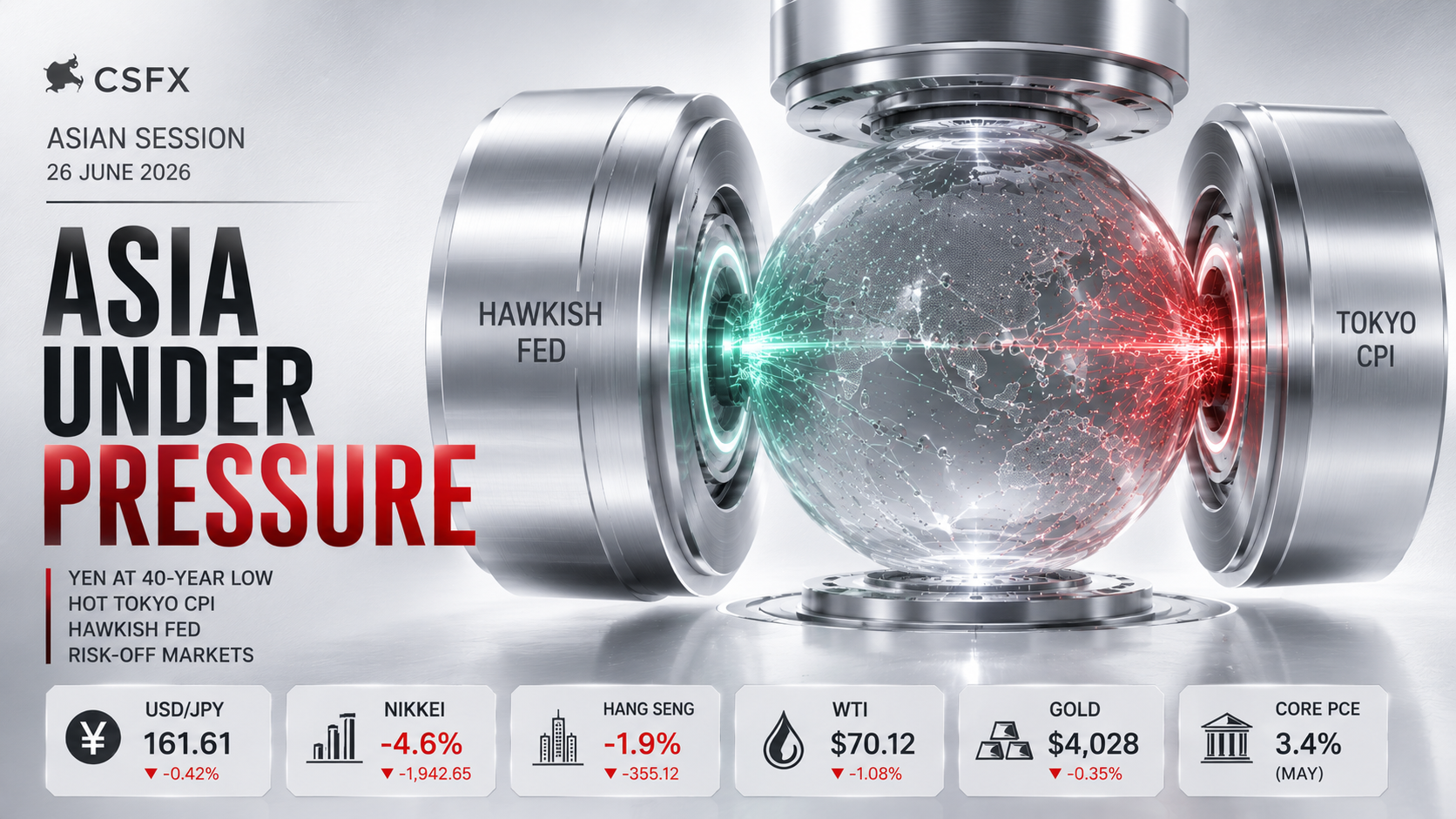
Yen at 40-Year Low · Tokyo CPI Hot · Hot Core PCE Stings Risk · Nikkei Slides Below 69,000 — USD/JPY ~161.61, Hang Seng ~22,648, XRP at $1.00 | Technical Analysis – Asian Session | 26 June 2026
Yen Pinned at a 40-Year Low as Hot Tokyo CPI Meets Hawkish Fed —
Asia’s Tech Rout Deepens Despite Micron’s Blowout Beat
Friday’s Asian session opens with the Japanese yen once again the centre of gravity: USD/JPY is consolidating just below the 162.00 handle, near a four-decade high and the weakest yen since 1986, even after Tokyo’s June inflation report came in hot — headline CPI accelerating to 1.7% year-on-year and the core gauge to 1.6%. At ~161.61 the pair is holding within a whisker of its multi-decade peak: the data hardens the case for further Bank of Japan tightening, yet the colossal US–Japan rate gap and a dollar sitting near a 13-month high keep the carry trade firmly in control, leaving the yen unable to capitalise on its own improving inflation story. Verbal-intervention chatter from Tokyo is the only thing capping the pair, and traders are watching the official rhetoric as closely as the price.
The session’s broader tone is sharply risk-off. Despite a genuinely strong set of memory-chip earnings — Micron flagged roughly $22 billion of committed customer orders and Qualcomm guided to a sizeable data-centre ramp — Wall Street rotated out of high-multiple technology on Thursday, handing the Nasdaq its first four-day losing streak since February. That rotation has followed the sun into Asia and intensified: Japan’s Nikkei 225 has sunk below the 69,000 level to around 69,002 (a drop of roughly 4.6%), with tech bellwether SoftBank among the heaviest fallers, South Korea’s Kospi has plunged hard enough to trigger exchange circuit breakers, and Hong Kong’s Hang Seng is sliding about 1.9% to ~22,648, while only Australia’s ASX 200 clings to a small gain. The narrative driving the selling is no longer an AI-demand scare — Micron’s print arguably dispelled that — but anxiety over the rising cost of building out AI infrastructure, and the discount-rate pressure from a hawkish Fed.
That hawkishness was stamped onto markets by Thursday’s hot US Core PCE, which firmed to 3.4% year-on-year, validating the higher-for-longer thesis, lifting the dollar and keeping gold — near $4,028.90 — on course for a fourth consecutive weekly decline. Commodities are crosscut: aluminium is languishing near a three-month low around $3,150.89 as Gulf supply restarts and Chinese and Indonesian output weigh, while crude, after an intraday bounce on a cargo-ship strike off Oman, has handed most of it back to sit at the $70 line (~$70.12) — a reminder that the geopolitical risk premium is dormant, not dead, but that the supply-glut story still dominates. In crypto, the dollar wrecking-ball and leverage flush have left Solana below every major moving average near $67.91 and XRP sitting right on the psychologically critical $1.00 level after a wave of liquidations. The day ahead brings the University of Michigan sentiment final and Fed speakers (Williams, Kashkari), but the dominant variable remains the same one that has defined the week: a hawkish Fed against a still-strong dollar.
Asian Session Headlines — 26 June 2026
Live market-moving events as Tokyo, Hong Kong and Sydney trade a hot-CPI yen, a renewed tech rotation, and a re-emerging Hormuz risk premium
The Yen’s Paradox: Hot Tokyo Inflation, a Tightening BoJ — and a Currency Still Trapped at a 40-Year Low by the Dollar
The defining tension of Friday’s Asian session is the disconnect between Japan’s domestic inflation story and its currency’s behaviour. On paper, the ingredients for a stronger yen are assembling: Tokyo’s June CPI accelerated across the board, the ex-food-and-energy core reached 1.9%, the Bank of Japan has already lifted its policy rate to 1.00% and board members are openly advocating a march toward a neutral rate around 2%, and the June Summary of Opinions revealed a committee leaning toward further hikes. In an ordinary cycle, a central bank confirming an upward inflation surprise while signalling more tightening would put a firm bid under its currency. Instead, USD/JPY is consolidating within a whisker of a four-decade high.
The reason is the arithmetic of the carry trade. Even at 1.00% — and even pricing a move toward 2% — Japan’s policy rate sits 250 to 275 basis points beneath the Fed’s, and Thursday’s hot US Core PCE (3.4%) has only widened the expected gap by pushing the higher-for-longer narrative further out. With the dollar index near a 13-month high, the incentive to borrow cheaply in yen and deploy into higher-yielding dollars remains overwhelming, and speculative positioning is heavily short the yen. That leaves the pair caught between two forces with very different time horizons: a slow-burning fundamental case for yen appreciation as the BoJ normalises, and a fast, mechanical depreciation pressure from rate differentials and risk flows. The circuit-breaker is not economics but policy — the live threat of Ministry of Finance intervention, which after April 30’s record operation is the one variable capable of forcing a violent, multi-figure reversal at any moment. For every cross examined below, the yen leg is therefore as much a positioning-and-intervention question as a macro one, and AUD/JPY in particular sits at the intersection of that yen dynamic and the session’s broader risk-off rotation.
Asian Session Economic Calendar — 26 June 2026
Key releases and events shaping price action across today’s Asia–Pacific session and into the US close
| Time (JST/local) | Event | Actual / Expected | Impact | Market Read |
|---|---|---|---|---|
| 🇯🇵Released 08:30 JST | Tokyo CPI (June) — Headline / Core / Ex-Food&Energy | 1.7% / 1.6% / 1.9% YoY (all accelerating) | 🔴 CRITICAL | Hot print hardens BoJ hike bets; yen-supportive in theory, but carry & dollar cap any JPY rally |
| 🇺🇸Thu, prior close | US Core PCE Price Index (May) — THE WEEK’S PIVOTAL NUMBER | Actual 3.4% YoY (up from 3.3%) — HOT | 🔴 CRITICAL | Validates higher-for-longer; DXY near 13-mo high, gold to 7-mo low, USD/JPY toward 40-yr high |
| 🇮🇷Ongoing (Asia AM) | Strait of Hormuz — Cargo Vessel Struck off Oman; IMO Pauses Evacuation | WTI/Brent firmer; Switzerland US–Iran meeting reportedly cancelled | 🔴 HIGH | Fresh risk premium lifts crude & caps aluminium downside; escalation = oil/gold spike, risk-off |
| 🇺🇸10:00 ET (tonight) | University of Michigan Consumer Sentiment — Final | Sentiment off historic lows but still weak | 🟢 MED | Hot inflation expectations would reinforce the dollar; soft headline mildly risk-supportive |
| 🇺🇸Fed speakers | NY Fed’s Williams & Minneapolis Fed’s Kashkari Speak | Tone read against this week’s hawkish repricing | 🟢 MED | Any pushback on hike pricing = USD/JPY pullback; hawkish confirmation = fresh dollar leg |
| 🇾🇩This week | BoJ Summary of Opinions / Board Commentary (Tamura: neutral ~2%) | Committee leaning toward continued hikes | 🟢 MED | Hawkish BoJ caps USD/JPY only at the margin while the rate gap dominates; intervention is the real risk |
| 🇦🇺Ongoing | RBA Outlook — Hawkish Hold; Australian Data Watch | RBA still flagging work to do on inflation | 🟢 MED | RBA–BoJ divergence underpins AUD/JPY structurally, but risk-off rotation dominates intraday |
Asian Session Trade Ideas — 26 June 2026
Seven structured setups — USD/JPY, AUD/JPY, Aluminium, Crude Oil, Hang Seng, Solana, XRP — with live prices, levels, and full fundamental and technical analysis

Fundamental Backdrop
USD/JPY is consolidating just below 162.00, near the weakest yen since 1986, and the structure is overwhelmingly driven by the interest-rate differential. The Bank of Japan raised its policy rate to 1.00% last week, and the June Summary of Opinions plus board commentary (Tamura citing a neutral rate near 2%) confirm a tightening bias; Friday’s Tokyo CPI — headline 1.7%, core 1.6%, ex-food-and-energy 1.9%, all accelerating — reinforces that path. Ordinarily yen-supportive, this is being completely overridden by the Fed’s 3.50–3.75% stance, a hot US Core PCE at 3.4% that extends the higher-for-longer narrative, and a dollar index near a 13-month high. The net effect is a 250–275bp policy gap that keeps the short-yen carry trade in motion and the pair bid on dips. The single asymmetric risk is the Ministry of Finance: after April 30’s record-sized buying operation and repeated verbal warnings from FM Katayama, the threat of intervention is the one force that can force a sharp, multi-figure reversal without warning.
Technical Outlook
The trend is unambiguously up — the pair has registered gains for a second consecutive week and Investing.com’s technical summary reads Strong Buy across all timeframes — but it is doing so into stretched territory just beneath the four-decade-high zone, with spot near 161.61. Today’s tight 161.40–161.95 band reflects two-way caution: bulls reluctant to chase into the intervention zone, bears unwilling to fight the carry. The 52-week range tops out at 161.95. Resistance: 162.00 (psychological / intervention trigger) and the 163.00–163.50 extension. Support: 160.50 (preferred buy-dip), 160.13 (recent low) and 158.80 (stop). The cleanest expression here is to buy pullbacks toward 160.50 rather than chase strength above 162, where the risk/reward is poisoned by intervention.
Session Catalysts
Watch for: (1) any MoF / BoJ verbal or actual intervention — the dominant binary; (2) Fed speakers Williams and Kashkari — pushback on hike pricing would deflate the dollar and the pair; (3) US Michigan sentiment & inflation expectations; (4) US long-end yields — a fresh leg higher widens the gap and extends USD/JPY; (5) risk sentiment — a deepening tech rotation can paradoxically support USD/JPY via safe-haven dollar demand while pressuring the yen crosses.

Fundamental Backdrop
AUD/JPY sits near 111.34, down about 0.4% on the day and pressing toward the 200-day SMA around 110.10 that marks the line between a routine pullback and a deeper unwind. The cross embodies two competing structural stories. The bullish carry case is intact at the policy level — the RBA’s relatively hawkish hold versus the BoJ’s still-low 1.00% rate keeps Australia’s yield advantage meaningful, and AUD/JPY has historically been a core long-carry vehicle. But two forces are dominating intraday. First, the session’s risk-off tech rotation hurts the growth-sensitive Australian dollar disproportionately, since AUD trades as a high-beta risk proxy. Second, the live threat of MoF intervention caps the yen-weakness side of the trade, removing the tailwind that would normally let the cross grind higher. With Tokyo CPI hot and the BoJ tightening, the yen leg has a slow fundamental bid that argues against chasing the cross higher.
Technical Outlook
The technical posture is bearish-to-neutral. Price trades below the 100-day SMA, the 14-day RSI is depressed near 31.5 (weak momentum, though approaching oversold), and the cross sits beneath its falling 50-day SMA around 113.50 while holding above the 200-day near 110.10. That 110.10 area is the pivotal support that separates a routine pullback from a deeper unwind. Resistance: 113.00 (preferred sell-rally) and 113.50 (50-day). Support: 110.10 (200-day) and the 109.00 target below it. The setup favours fading rallies into 113.00 with a stop above the 50-day, targeting the 200-day and then 109.00 — while respecting that an oversold RSI plus any intervention-driven yen spike could trigger sharp two-way volatility.
Session Catalysts
Watch for: (1) global risk appetite / the tech rotation — the dominant intraday driver for AUD; (2) MoF intervention — a yen spike would slam the cross lower fast; (3) Australian data and RBA commentary — hawkish surprises support the AUD leg; (4) China sentiment — AUD is a China-growth proxy and weak Chinese data weighs; (5) the 110.10 200-day SMA — a decisive break opens 109.00 and signals broader carry unwind.

Fundamental Backdrop
LME three-month aluminium has corrected toward $3,150.89 per tonne, a three-month low and down roughly 12% over four weeks (though still up about 25% year-on-year), as the macro pendulum swings from wartime scarcity to anticipated surplus. The principal driver is the prospective resumption of Persian Gulf metal exports — the region supplies around 9% of global output — following the US–Iran framework and Hormuz reopening efforts. Layered on top are rising primary output in China (close to 60% of world production) and increasing Indonesian smelter volumes, plus weak Chinese economic data that dents demand from the largest consumer, and a strong dollar that makes greenback-priced metal costlier for non-dollar buyers. Counterbalancing this, Emirates Global Aluminium remains under force majeure on European billet after the March strike on Al Taweelah, keeping European physical premiums elevated and providing an indirect floor — and Friday’s Hormuz vessel attack is a live reminder that the supply-relief narrative can reverse abruptly.
Technical Outlook
Momentum is firmly lower: the metal has unwound the early-June four-year high in a roughly 9%+ slide and trades near multi-week lows with sellers in control. The market is now trading a corrective band off the highs. Resistance: $3,360 (preferred sell-rally) and the $3,500–$3,520 area (stop). Support: the recent $3,100–$3,150 zone and then the $2,950 target. The cleanest expression is to fade rallies into $3,350–$3,360 with a stop above $3,520, targeting $2,950 — while sizing for the asymmetric upside risk that a genuine Hormuz disruption or an EGA ramp-up slip could trigger a fast short-covering spike.
Session Catalysts
Watch for: (1) Hormuz / Gulf shipping headlines — the swing factor for supply restoration; (2) Chinese macro data and stimulus signals — the demand side; (3) the dollar — further DXY strength pressures all base metals; (4) Indonesian and Chinese output news; (5) EGA force-majeure / European premium developments — the physical-tightness counterweight.

Fundamental Backdrop
WTI for August spiked higher earlier in the Asian morning after a cargo vessel was struck by an unidentified projectile off the Omani coast, prompting the IMO to pause its Hormuz evacuation plan and several commercial ships to reverse course; a planned US–Iran meeting in Switzerland was reportedly cancelled in connection. But the benchmark has handed back most of that move to sit back at the $70 line, around $70.12, with Brent near $74. That fade sits inside a heavily bearish structure. WTI printed its first sub-$70 level since early March on Wednesday ($69.63 session low), and the dominant theme has shifted to an anticipated 2026 global surplus: Saudi and Qatari barrels are returning for the first time since the war, a temporary US waiver permits purchases of already-loaded Iranian crude, and Iraq is pressing OPEC for a higher quota. The one genuine tightness signal is US inventories — Cushing stocks sit near operational minimums around 19 million barrels. Net, the risk premium is real but fleeting; crude remains on track for a third straight weekly decline.
Technical Outlook
The trend off the conflict-era peak (a roughly 40%+ collapse) remains down, and price has mean-reverted back to the $70 line after fading the sub-$70 spike and the Hormuz-headline bounce, keeping the tape two-sided but heavy. Resistance: $75 (preferred sell-rally) and $78–$79 (stop, the prior consolidation shelf). Support: $70 (psychological, where price now sits), the $69.63 recent low, and the $66 target. The base case is to fade rallies into $75 with a stop above $79, targeting $66 — but this trade demands explicit recognition that any confirmed escalation in Hormuz (a closure, a tanker sinking) could spike crude well beyond $79 in a session, so position sizing and the stop are doing the real risk management here.
Session Catalysts
Watch for: (1) Hormuz / Strait headlines — the binary that can override the glut narrative; (2) the status of US–Iran talks after the cancelled Switzerland meeting; (3) tanker-tracking and vessel-traffic data; (4) Cushing and US inventory prints — the physical-tightness counterweight; (5) the dollar and broad risk appetite into the US close.

Fundamental Backdrop
The Hang Seng is trading near 22,648, down about 1.9% at a multi-week low, having broken decisively below 23,000 as the global rotation out of technology — the one that handed the Nasdaq its first four-day losing streak since February and dragged the Nikkei more than 4% lower — weighs on Hong Kong’s tech-heavy benchmark. Crucially, the selling is not about an AI-demand collapse: Micron’s strong print arguably eased that fear. It is about discount-rate pressure from a hawkish Fed (hot Core PCE at 3.4%, dollar near a 13-month high) and concern over the rising cost of AI infrastructure, compounded by China-specific worries. A persistent local overhang is the post-IPO lock-up expiry: investment-bank estimates have flagged that a very large volume of restricted shares (on the order of hundreds of billions of dollars) could enter the market over the coming year, a structural supply weight on top of soft Chinese macro data. Index heavyweights such as Tencent, Xiaomi and SMIC have driven much of the recent volatility.
Technical Outlook
The technical picture is decisively weak: the index broke down from a horizontal trend channel and severed the ~23,765 support that formed a head-and-shoulders neckline — a pattern break typically read as a strong continuation-lower signal — with the short-term RSI now below 30, flagging oversold conditions and the risk of a sharp counter-trend bounce. Resistance: 23,765–23,850 (the broken neckline, now resistance, the preferred sell-rally) and 24,500. Support: 22,000 (the target, now close at hand) and, on a deeper unwind, the 20,000 region. With price already near 22,648, the cleanest expression is to fade rallies back toward the broken 23,765–23,850 neckline with a stop above 24,600, targeting 22,000 — while respecting that a sub-30 RSI can produce violent short-covering rallies and that a clean break of 22,000 would open the next leg toward 20,000.
Session Catalysts
Watch for: (1) the global tech rotation and US futures — the dominant driver; (2) China macro data and any policy / stimulus signals; (3) lock-up expiry and new-listing supply; (4) moves in Tencent, Xiaomi, SMIC and the AI-linked names; (5) the 23,765 neckline — a decisive reclaim would neutralise the bearish pattern, while a clean break of 22,000 opens the 20,000 zone.

Fundamental Backdrop
Solana trades near $67.91 inside a $64.90–$70.20 daily band, down roughly 2% and off about 48% over twelve months — a textbook macro-driven crypto sell-off where dollar strength (DXY near a 13-month high), the risk-off tech rotation and a leverage flush are doing the damage rather than any chain-specific failure. Indeed, the fundamental adoption story is arguably the strongest in the altcoin complex: spot Solana ETF assets (Bitwise’s BSOL, Fidelity’s FSOL) have topped $1 billion, MoneyGram has launched a validator, South Korea’s KG Group selected the chain for a payments push, and Forward Industries holds a near-$1bn SOL treasury. On-chain usage remains robust even as price slips. The tension is that improving fundamentals are being overwhelmed by macro: when broad risk appetite contracts and the dollar is bid, high-beta crypto is sold first and asked questions later.
Technical Outlook
The chart is bearish-to-neutral: SOL sits below its 20-, 50-, 100- and 200-day EMAs, the daily and weekly 50-day averages are falling, and the RSI sits in the mid-40s, below the neutral 50 line. The single most important level is the 200-day MA around $65.70, widely cited as the bull/bear pivot — a hold above keeps a recovery toward $72–$78 alive, while a decisive break risks a slide to the $62–$60.20 zone (the 52-week low). Resistance: $70.20 (intraday high), $72.50 (preferred sell-rally) and the $78 area (falling 50-day, stop). Support: $65.70 (200-day), $64.50 and $62 (target). The setup is to fade rallies into $72.50 with a stop above $78, targeting $62 — conditioned on the $65.70 pivot giving way.
Session Catalysts
Watch for: (1) Bitcoin’s direction and broad crypto risk appetite; (2) the dollar and the hawkish-Fed backdrop; (3) Solana ETF flow data — sustained inflows would provide a floor; (4) further institutional adoption headlines (validators, payments, treasuries); (5) the $65.70 200-day MA — the line that decides whether this is a pullback or a deeper leg lower.

Fundamental Backdrop
XRP has fallen to right around $1.00, sitting directly on the psychologically critical level, after roughly $1.48 billion in market-wide crypto liquidations — a leverage-driven flush rather than a fundamental rupture. The token is down about 51% over twelve months despite a constructive structural backdrop: the SEC case was resolved in 2025, spot XRP ETFs were approved in November (issuers include Bitwise, Grayscale, 21Shares, Canary Capital and Franklin Templeton), the XRPL has continued shipping upgrades, and Ripple partner SBI reportedly purchased one of Japan’s largest exchanges — an Asia-relevant adoption signal. As with Solana, the problem is macro, not utility: a strong dollar and a risk-off tape have left XRP, a high-beta payments token, amplifying broad crypto weakness. Holding $1.00 is now both a chart level and a sentiment line in the sand.
Technical Outlook
The technicals are bearish but stretched. XRP trades below both its 50-day (~$1.134) and 200-day (~$1.137) moving averages, the test of $1.00 is the pivotal battleground, and analysts have flagged Bollinger-band downside objectives near $0.91 if the level breaks. Counterbalancing, the RSI is approaching oversold, raising the odds of a sharp relief bounce. Resistance: $1.10 (preferred sell-rally), then the $1.13–$1.14 moving-average cluster (a decisive reclaim would neutralise the bearish structure) and $1.20 (stop). Support: $1.00 (the line in the sand, where price now sits), then $0.91 (target). The expression is to fade rallies into $1.10 with a stop above $1.20, targeting $0.91 — while sizing for an oversold-driven snap-back if $1.00 holds.
Session Catalysts
Watch for: (1) Bitcoin and broad crypto risk appetite — XRP amplifies BTC moves; (2) the dollar and the hawkish-Fed backdrop; (3) spot XRP ETF flow data — sustained inflows could defend support; (4) Ripple / XRPL and SBI-related adoption headlines from Asia; (5) the $1.00 level — a sustained loss confirms the path to $0.91, while a firm reclaim of $1.13–$1.14 flips the near-term bias.
Key Questions for the Asian Session
Detailed answers to Friday’s most important analytical questions
Asian Session Summary — Friday, 26 June 2026
Friday’s Asian session is defined by one paradox and one rotation. The paradox is the yen: Tokyo inflation accelerated, the Bank of Japan is tightening toward a neutral 2%, and yet USD/JPY sits a whisker below 162 at a four-decade high — because a 250–275bp rate gap, a hot US Core PCE (3.4%) and a dollar near a 13-month high overwhelm the domestic story, leaving Ministry of Finance intervention as the only credible circuit-breaker. The rotation is in technology: Micron’s blowout beat answered the AI-demand question, but markets are now selling the cost-of-AI-infrastructure question instead, handing the Nasdaq its first four-day losing streak since February and driving a sharp Asian rout — the Nikkei sinking below 69,000 (~-4.6%), the Kospi tripping circuit breakers and the Hang Seng (~-1.9%) sliding to a multi-week low.
The actionable framework across today’s seven instruments is clear. Highest-conviction macro: USD/JPY buy dips toward 160.50, stop 158.80, target 163.50 — the Fed–BoJ rate gap plus a dollar at 13-month highs is the cleanest structural setup of the session — but the trade is governed by intervention risk above 162, not by the chart.
For the individual instruments: AUD/JPY sell rallies toward 113.00, stop 114.60, target 109.00 — risk-off rotation + sub-100-day-SMA, with the 200-day at 110.10 the pivot. Aluminium sell rallies toward $3,360, stop $3,520, target $2,950 — Gulf supply restart and China/Indonesia output, mind the Hormuz tail-risk. WTI crude sell rallies toward $75, stop $79, target $66 — supply glut intact, but a genuinely two-sided Hormuz trade. Hang Seng sell rallies toward 23,850, stop 24,600, target 22,000 — broken 23,765 neckline, RSI oversold. Solana sell rallies toward $72.50, stop $78, target $62 — below all EMAs, the $65.70 200-day is the bull/bear line. XRP sell rallies toward $1.10, stop $1.20, target $0.91 — lost $1.00 on ~$1.48B liquidations, RSI nearing oversold. The decisive variable into the US close remains the dollar and the Fed: Friday’s Michigan sentiment and the Williams/Kashkari remarks are the nearest catalysts that could deflate it. Size positions accordingly.
Access Live Asian Markets →