
Daily Market Analysis – Morning Session | 04-05-2026 | Capital Street FX
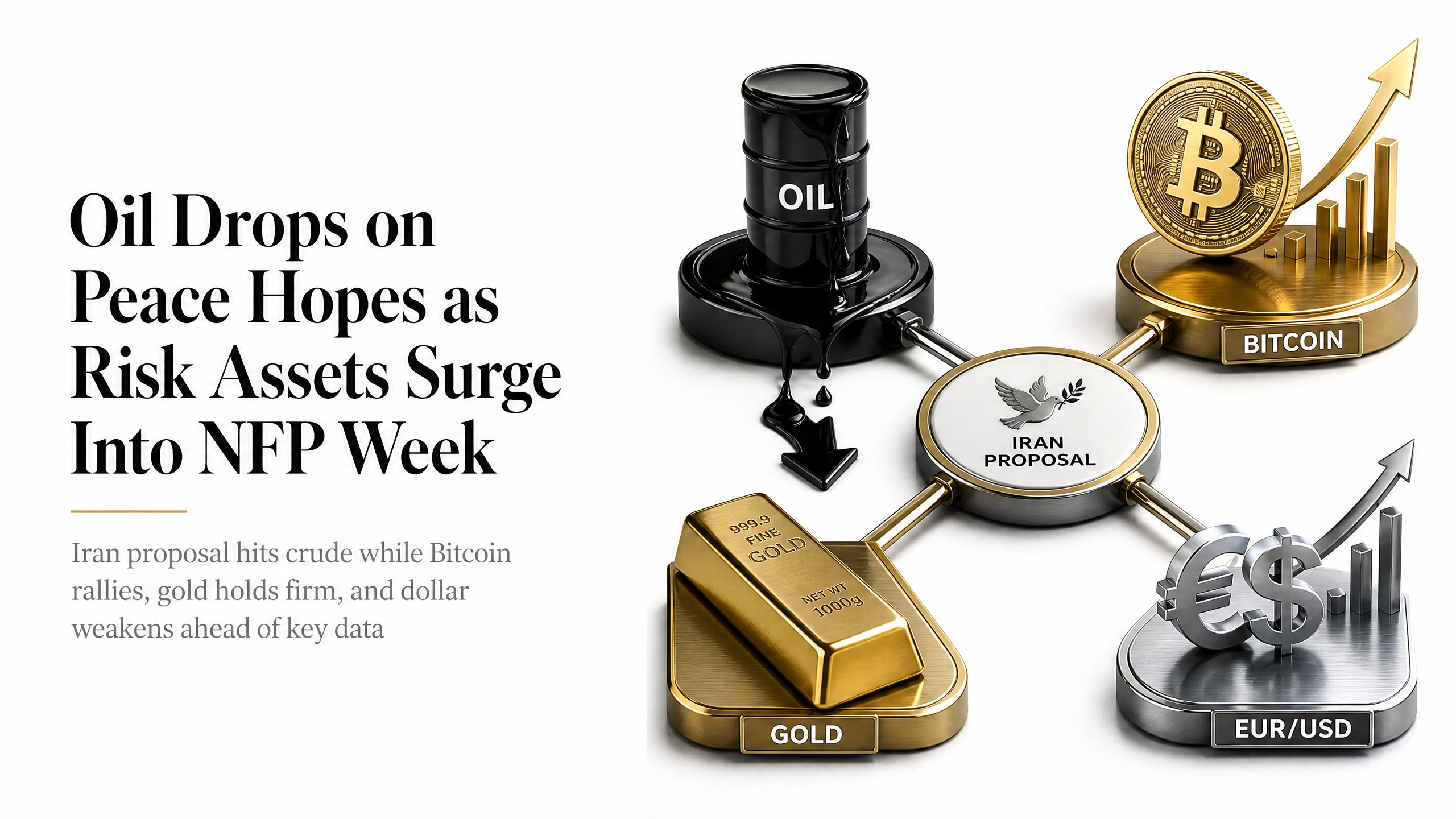
Oil Tumbles 3%+ on Iran Peace Proposal · Project Freedom Launches · Bitcoin Surges to $78,825 · Gold Holds $4,588 · EUR/USD at 1.1750 — NFP Week Begins
Monday May 4, 2026: Markets open the week in risk-on mode as Iran submits a fresh 14-point peace proposal and Pakistan-mediated talks resume, sending WTI crude crashing below $103 for the first time in weeks. President Trump launched “Project Freedom” — an escort initiative for vessels trapped in Hormuz — signalling the US is building workaround capacity even without a formal deal. Bitcoin surges to $78,825 (+0.73%) as risk appetite returns. Gold holds firmly above $4,600 at $4,588, supported by dollar weakness and continued safe-haven demand. EUR/USD breaks above 1.17 for the first time in months as the ECB hawks and USD bears converge. The week’s central focus: April Nonfarm Payrolls on Friday May 8, alongside Palantir (tonight), AMD (Tuesday), Disney/Uber (Wednesday), and ARM Holdings (Thursday).
Monday May 4 opens the most event-heavy week since the Iran war began. Oil tumbled over the weekend on reports Iran submitted a 14-point peace proposal through Pakistan. Project Freedom — the US-led escort initiative — begins operationally today. But the 60-day War Powers deadline is also looming, adding congressional pressure. Markets are balancing de-escalation hope against structural supply deficit reality.
Monday May 4, 2026 — Five Themes Driving Every Market This Week
Pre-Market Snapshot — 07:00 GMT, May 4, 2026
| Asset | Level | Change | Key Notes | Bias |
|---|---|---|---|---|
| WTI Crude (Jun) | $102.10 | ▼ −3.1% | Iran 14-point peace proposal via Pakistan triggers largest single-day oil decline since war began; Project Freedom Hormuz escort launched; IEA still sees record inventory draws; Goldman Sachs maintains $100+ Brent average 2026 forecast; WTI support at $99–$100 | WATCH — DE-ESCALATION DIP |
| Brent Crude (Jun) | $107.40 | ▼ −2.8% | Fell from $110+ range on peace proposal news; Brent-WTI spread widened to $5+ on US supply dynamics; OPEC+ agreed symbolic June production increase post-UAE exit; EIA forecasts Q2 peak near $115; structural bull remains intact on inventory deficit | WATCH — BULL ON DIPS |
| Gold XAU/USD | $4,588 | ▲ +0.65% | Holding firmly above $4,600 key level; WGC records show Q1 2026 demand at record $193B (+74% value); central bank buying +2% YoY to 1,230.9 tonnes; dollar weakness continues to underpin; PCE at 3.5% YoY (March) keeps inflation bid; oil drop mildly bearish but safe-haven demand overrides | BULL — CENTRAL BANK BID |
| Silver XAG/USD | $71.50 | ▲ +0.45% | Recovery bid with gold; Bank of America maintaining $309 silver year-end target — parabolic call based on gold/silver ratio normalisation; industrial demand improving as oil drops modestly boost manufacturing expectations; $70 support holding | WATCH — RECOVERING |
| S&P 500 Futures | 7,203 | ▲ +0.30% | Near all-time highs; oil decline relieves stagflation fear; 84% of S&P 500 companies reporting have beaten EPS (+20.7% aggregate above consensus); earnings season past halfway mark; NFP Friday and Palantir/AMD/Disney earnings this week are the key catalysts; 19.7% EPS growth projected for 2026 | BULL — EARNINGS DRIVEN |
| Nasdaq Futures (NDX) | 27,615 | ▲ +0.90% | Strongest index mover today; Mag 7 beats from last week + AI capex narrative validated; Palantir earnings tonight at $143/share — commercial AIP contract growth is the key metric; AMD tomorrow at $314 — MI300X GPU traction pivotal; Nasdaq +22% in 2025 building 3rd consecutive strong year | BULL — AI CATALYST WEEK |
| Bitcoin BTC/USD | $78,825 | ▲ +0.73% | Highest since early February; ascending triangle formation breaking out; risk-on wave from oil decline; Morgan Stanley Bitcoin Trust (MSBT) launch on NYSE Arca providing institutional demand; Coinbase and Robinhood both up 3.5–4.5%; Bitcoin ETF AUM (all 11 funds) now above $88B collectively; BTC/USD next resistance at $80K | BULL — BREAKOUT TRADE |
| EUR/USD | 1.1750 | ▲ +0.35% | Above 1.17 for first time in months; DXY at multi-month lows, down ~10% YTD under Trump; ECB hawkish signals from Simkus, Rehn; EUR/USD up 13% in 2025 and continuing; PCE at 3.5% pushes Fed into hold; JPMorgan, Nomura target 1.20 year-end; Bank of America targets 1.22; strong structural bull | BULL — STRUCTURAL TREND |
| GBP/USD | 1.3600 | ▼ −0.10% | Holding near 1.36 resistance; slight give-back after strong Friday driven by BoE hawkish hold (3.75%, 8-1 vote with hawkish dissent); UK energy import inflation from Hormuz is ironically supporting BoE tightening case; June BoE meeting live for 25bp hike; cable holding key 1.3550 support | BULL — BOE HAWKISH + USD WEAK |
| USD/JPY | 154.60 | ▼ −0.40% | Drifting lower post-BOJ intervention; pair now testing 154.50 first support after crashing from 161+; BOJ shadow remains from Finance Minister Katayama’s “final advisory”; interventionist threat still active if pair rebounds; NFP this Friday could move the pair significantly; 158 is now firm resistance | BEAR — INTERVENTION THREAT |
| VIX (CBOE) | 17.45 | ▼ −1.20% | Declining further as oil risk premium shrinks on peace proposal; Mag 7 earnings cycle complete with mostly positive results; risk assets broadly rallying; remains above the 15 threshold that signals genuine complacency — war premium not fully removed; NFP Friday could spike VIX if major miss | WATCH — PEACE PREMIUM FADING |
Geopolitical Status & Macro Context — Iran Peace Talks · Project Freedom · NFP Week · War Powers Deadline
Monday May 4, 2026 opens as a week that could determine whether the Iran-Hormuz supply shock evolves from a structural disruption into a diplomatic resolution — or whether geopolitical escalation deepens. The trigger for this week’s risk-on tone is Iran’s submission of a new 14-point peace proposal to the United States through Pakistani mediation. Iran’s foreign minister Abbas Araghchi made a brief return to Islamabad on Sunday as Pakistan’s leadership pushed to revive talks. President Trump acknowledged on Truth Social that “strides” had been made but expressed uncertainty, reflecting the fragile and non-linear nature of these negotiations.
The immediate market impact is a sharp 3%+ decline in oil prices — WTI fell from the $105 range to ~$102, Brent from $110+ to ~$107. This is the biggest single-day oil decline since the conflict began February 28, 2026. However, Goldman Sachs, the IEA, and Platts all caution that a peace proposal is not a resolution. Global inventories are drawing at a record 11–12 million barrels per day. Even if the Strait of Hormuz reopens immediately, the lag in restoring supply and refilling depleted inventories means oil prices would stay elevated for months. The EIA’s Q2 2026 Brent peak forecast of ~$115/bbl has not been revised. The oil bull trend is intact — this is a de-escalation discount within a structural bull, not a reversal.
“Project Freedom” — the US initiative to escort commercial vessels through Hormuz — launched operationally today, Monday May 4. This creates a practical workaround for vessels trapped by the blockade, but does not resolve the geopolitical standoff. A separate and urgent pressure point emerges from the War Powers Resolution: President Trump faces a 60-day deadline requiring Congressional authorisation for the continued military deployment against Iran. The administration argues the ceasefire “terminated” hostilities and the law does not apply. Congressional Democrats dispute this. Markets are watching whether this deadline — arriving this week — forces Trump toward a faster deal or triggers a constitutional confrontation that could re-escalate tensions and reverse the oil decline.
In the macro calendar, the week’s centrepiece is Friday’s April Nonfarm Payrolls (13:30 GMT), with consensus at ~165K. Precursor data arrives Tuesday (JOLTS March job openings), Wednesday (ADP April employment, Services PMI), and Thursday (initial jobless claims). The Fed remains on hold at 3.50–3.75% with the CME FedWatch tool showing a mere 5.1% probability of a June cut — but a significant NFP miss could rapidly shift those probabilities. US PCE came in at 3.5% YoY in March — significantly above the Fed’s 2% target — reflecting energy inflation from the Hormuz disruption. With core PCE at 3.2%, the Fed is trapped between inflation and growth concerns, unable to cut even as GDP disappointed at +2.0% in Q1.
The earnings calendar is packed this week: Palantir reports tonight (Monday) at a premium $143/share valuation — a key test of enterprise AI monetisation outside the hyperscalers. AMD reports Tuesday after close — consensus expects $9.89B revenue (+33% YoY) and the critical metric is MI300X GPU traction and TSMC capacity allocation. Disney and Uber report Wednesday; ARM Holdings Thursday. The earnings gauntlet continues a 2026 season where 84% of S&P 500 reporters have beaten EPS estimates, with aggregate earnings 20.7% above consensus — the strongest season in years, driven by AI capex and resilient consumer spending despite energy headwinds.
This Week’s Earnings Calendar — AI Gauntlet: Palantir, AMD, Disney, ARM
10 Active Trade Signals — Updated May 4, 2026 at 07:00 GMT

This Is a Diplomatic Discount, Not a Supply Resolution. Iran’s 14-point proposal is meaningful diplomatically but does not restore supply. Goldman Sachs, the IEA, and the EIA all maintain bullish oil forecasts because the underlying problem — global inventories drawing at 11–12 million bpd with Hormuz still effectively closed — has not changed. Even if the Hormuz reopens today, the lag in restoring supply, refilling inventories, and restarting Middle Eastern production means oil prices stay elevated for at least 2–3 months. The EIA’s Q2 2026 Brent peak forecast of $115/bbl has not been revised down. WTI support at $99–$100 (the pre-breakout level from April) is now a buy zone.
The $99–$103 zone is the buy-the-dip opportunity created by the peace proposal’s diplomatic discount. Position with a stop below the $95 structural level. Take profit 1 at $108 (modest recovery target); take profit 2 at $115 (EIA’s Q2 peak forecast). Do not over-size — the War Powers deadline and ongoing talks create binary risk. Trade oil → Educational only. CFD trading involves significant risk.

Brent’s Brent-WTI spread has widened above $5/bbl on US supply dynamics, with futures in mild contango signalling ample later-year supply — but the near-term deficit is undeniable. Goldman Sachs raised its Brent forecast to $90/bbl by late 2026 (from $80) just last week, acknowledging that delayed normalisation in Gulf exports — now expected only by end-June at the earliest — tightens supply sharply. Record EIA inventory draws (6.2 million barrels in a single week) are the fundamental reality. The peace proposal discount is a near-term tactical event; the Brent bull thesis is structural and multi-month.
The $104–$108 zone is the re-entry window for Brent longs. June OPEC+ monitoring and seasonal summer driving demand ramp-up are additional catalysts later this month. EIA inventory data Wednesday, May 7 is the next fundamental data point. Trade Brent → Educational only. CFD trading involves significant risk.

The World Gold Council’s Q1 2026 Data Confirms the Structural Bull. Total Q1 gold demand hit a record $193 billion (+74% in value terms, +2% in volume to 1,230.9 tonnes). Central bank buying continues at ~1,000 tonnes/year pace. Asian retail investors drove bar and coin demand to 474 tonnes — the second highest quarterly figure on record (+42% YoY). ETF inflows of +62 tonnes in Q1, though below the exceptional Q1 2025. Institutional year-end targets range from $5,400 (Goldman Sachs) to $6,300 (JPMorgan). PCE inflation at 3.5% — the highest since May 2024 — keeps the inflation hedge bid intact. Dollar weakness (DXY at multi-month lows) is gold’s structural tailwind. LiteFinance’s forecast shows $4,588 as of May 4, with $5,041 projected for the month.
Gold holding above $4,600 key level is a positive technical signal. The $4,580–$4,630 entry range covers the current price and any minor dip. Stop at $4,480 protects against a deeper correction. Target $4,750 (institutional target zone) then $4,900 (LongForecast end-June projection). NFP Friday — a weak print accelerates the gold rally. Trade gold → Educational only.

Bank of America’s $309 silver year-end call — the most aggressive on the street — is based on the gold/silver ratio snapping back to rare historical extremes. The ratio is currently elevated, suggesting silver is historically cheap relative to gold. The oil price decline this week may modestly support silver’s industrial demand outlook if manufacturing sentiment improves. Silver’s parabolic 2025 move — noted by Forex.com analysts as the standout anti-fiat trade of 2025 — continues to be referenced as a thesis. The recovery bid from $71 with gold holding $4,600 is technically constructive.
Silver’s near-term path depends on: (1) gold’s continued strength above $4,600; (2) manufacturing demand signals from PMI data Wednesday; (3) oil’s direction after the peace proposal. Buy the $70–$72 dip zone if gold holds above $4,580. Stop at $67. Trade silver → Educational only.

BTC Ascending Triangle Breakout — Morgan Stanley Enters the Bitcoin ETF Market. The ascending triangle pattern — with rigid resistance at ~$95,000 and rising support — that Forex.com analysts identified months ago is now showing signs of resolution. BTC at $78,825 is the highest since early February. The Morgan Stanley Bitcoin Trust (MSBT) launch on NYSE Arca, with a competitive 0.14% fee, adds a new institutional demand channel — Morgan Stanley manages ~$2 trillion and 15,000 advisors who can now recommend their firm’s own Bitcoin ETF. Combined with the 11 existing ETFs at $88B+ AUM, institutional infrastructure is building. Risk-on from the Iran peace proposal and oil decline provides the near-term macro tailwind. Coinbase and Robinhood are both following BTC higher.
The $76K–$79K zone is the breakout entry area. Stop at $73K is below the structural ascending triangle support. Take profit 1 at $85K (prior resistance zone); take profit 2 at $95K (triangle resistance — would be a definitive breakout). Palantir earnings tonight will also signal broader risk appetite. Trade crypto → Educational only.

EUR/USD Above 1.17 — The Strongest Structural Trade in Global FX. The EUR/USD bull thesis is built on three reinforcing pillars: (1) structural USD weakness — DXY down 10% YTD, the dollar the weakest it has been under Trump; (2) ECB hawkishness — Simkus and Rehn have both signalled possible further tightening driven by energy-fuelled Eurozone inflation; (3) Fed paralysis — PCE at 3.5% YoY locks the Fed in place, preventing rate cuts that would support USD. EUR/USD was up 13% in 2025 — the largest annual gain in nearly eight years. Institutional year-end targets: JPMorgan 1.20, Nomura 1.20, Bank of America 1.22. The pair broke above 1.17 this week — a technically significant level not seen in months.
Any dip toward 1.1680–1.1700 is the entry for EUR/USD longs. The structural bull case does not require a specific catalyst — it runs on persistent USD weakness and Eurozone resilience. Target 1.19 first, then 1.20 (JPMorgan/Nomura year-end). NFP Friday is the near-term risk: a strong beat could temporarily support USD. Trade EUR/USD → Educational only.

GBP/USD is consolidating just below the 1.36 resistance after last week’s strong rally driven by the BoE’s hawkish hold (3.75%, 8-1 vote with one member voting for an immediate hike). The irony of UK energy import inflation from Hormuz is that it keeps UK CPI elevated — which supports the BoE tightening case rather than easing. The June BoE meeting is increasingly live for a 25bp hike. Combined with the structural USD weakness from the DXY’s multi-month decline, GBP/USD has a dual bull case: a tightening BoE and a weakening dollar. GBP/USD is building toward the 1.38–1.40 zone that would represent the post-Brexit recovery narrative.
The 1.3540–1.3600 range is the current trading zone and entry for GBP longs. Stop at 1.3400 is below the key breakout level from last week. Target 1.3750 then 1.3900. UK Services PMI data Wednesday and any BoE communications this week are watch points. Trade GBP/USD → Educational only.

USD/JPY has continued to drift lower since the BOJ’s surprise intervention last Thursday (May 1), having crashed from 161+ to below 157 in a single session. The pair now sits at 154.60 and is testing the first major support zone at 154.50. BOJ Finance Minister Katayama’s “final advisory” threat remains active — if USD/JPY bounces toward 156–157, it risks triggering another intervention round. The structural case for yen strength is building: Japan’s current account improves as oil declines from $105+ levels; the BOJ is in sustained dollar-selling mode; and Nomura projects USD/JPY falling to 140 before year-end 2026 as carry trade unwinding continues. The oil decline from the peace proposal is incrementally yen-positive as it reduces Japan’s energy import bill.
Any bounce toward 155.50–156.50 is the short entry zone. Stop at 158.00 is above the resistance created by the intervention. Target 152.00 (next support cluster) then 148.00 (Nomura’s structural target). NFP Friday is the risk event — a strong beat temporarily supports USD. Trade forex → Educational only.

The Nasdaq 100 enters the week of its most critical earnings test: Palantir tonight and AMD Tuesday determine whether the AI narrative extends beyond the hyperscalers (which all beat last week) into enterprise software and AI chips. The structural bull case: the 2025 season shows 84% beat rates, 19.7% S&P 500 EPS growth expected in 2026, and hyperscaler capex spending confirmed to be at record levels ($200B+ from Amazon/Google/Microsoft/Meta combined). The Nasdaq has already returned +22% in 2025 and is building its third consecutive strong year. Oil declining from $105 to $102 relieves energy cost pressure on Nasdaq companies’ own operations. The MSBT launch also signals maturing institutional infrastructure for risk assets broadly.
If Palantir beats tonight and AMD beats Tuesday, the Nasdaq rally accelerates toward 28,500+. The downside scenario: if PLTR misses due to valuation pressure or AMD disappoints on MI300X traction, a 3–5% correction is possible. NFP Friday is the macro cap on the week. Trade Nasdaq → Educational only.

The S&P 500 approaches record highs as the oil decline from the Iran peace proposal relieves the key stagflation headwind that has weighed on industrials and consumer discretionary. The index is supported by the strongest earnings season in years (84% beat rate, 20.7% aggregate EPS beat), a declining VIX, and AI-driven tech sector momentum. The Gotrade outlook notes the upside scenario: “solid NFP plus AMD and Disney beats could push the S&P 500 to fresh all-time highs by next week.” The downside scenario: “a sharp NFP miss plus disappointing AMD or Palantir results could trigger a 3–5% Nasdaq correction” — a scenario that would drag the S&P 500 lower as well. The balance of probabilities this week favours the upside given the oil-driven positive catalyst and strong earnings momentum.
The 7,100–7,200 zone is the current trading range and entry for S&P 500 longs. Stop at 6,920 is below the prior support. Target 7,500 (JPMorgan 2026 upside scenario) then 7,750–7,900 (Forecaster model +15% projection). NFP Friday is the binary event — see FAQ for detailed scenario analysis. Trade S&P 500 → Educational only.
Frequently Asked Questions — May 4, 2026 Market Session
Not necessarily — the proposal is a diplomatic opening, not a supply restoration. The oil decline of 3%+ today reflects a risk premium reduction, not a supply increase. Goldman Sachs, the IEA, and the EIA all maintain bullish oil forecasts: GS still forecasts Brent averaging above $100/bbl for 2026; IEA sees global inventories drawing at 11–12 million bpd; EIA forecasts Q2 Brent peak near $115. Even if a deal is signed today and Hormuz opens tomorrow, supply recovery takes weeks to months: oil in transit must be routed, insurance re-established, field production restarted, and depleted inventories refilled. Global inventories outside the Middle East emptied at a record 205 million barrels in March alone. The bull thesis is structural, not geopolitical — it takes time to reverse. The current dip to $102 is a buying opportunity for oil bulls who missed the initial surge from $64 in February.
The 1973 War Powers Resolution requires a US president to notify Congress within 48 hours of deploying US armed forces, and limits the deployment to 60 days without Congressional authorisation (plus 30 days for withdrawal). The 60-day deadline for the Iran deployment arrives this week. The Trump administration argues the ceasefire “terminated” hostilities, making the law inapplicable. Congressional Democrats dispute this interpretation. If Congress passes a resolution invoking the War Powers Act and Trump defies it, a constitutional confrontation would ensue — a scenario with no clear legal resolution short of the Supreme Court. Market implications: a constitutional crisis around the Iran military deployment could re-escalate geopolitical uncertainty, potentially reversing the oil decline and triggering safe-haven demand for gold and yen. It’s a low-probability but high-impact tail risk this week that traders should factor into position sizing.
Bitcoin and gold have distinct driver profiles. Today’s oil decline from the Iran peace proposal is a risk-on signal — it reduces inflation pressure and lifts risk appetite. Bitcoin, as a risk asset, benefits more directly from risk-on sentiment than gold, which is a safe-haven that performs best in risk-off or inflationary environments. The Morgan Stanley Bitcoin Trust (MSBT) launch adds a new institutional demand catalyst specific to Bitcoin. Additionally, Bitcoin’s ascending triangle technical breakout creates momentum-driven buying independent of macro factors. Gold is holding $4,588 because the safe-haven demand from geopolitical uncertainty (War Powers deadline, ceasefire fragility, ongoing Iran negotiation) is maintained even as risk appetite improves — but gold doesn’t surge on risk-on days the way Bitcoin does. Both assets can perform well simultaneously — gold on structural central bank buying and inflation, Bitcoin on risk appetite and institutional adoption.
Palantir (PLTR) reports after close tonight at a $143/share price — a steep premium valuation that prices in significant growth expectations. The critical metric is commercial AI Platform (AIP) contract growth. Specifically: (1) commercial revenue growth rate — needs to show acceleration, not just continuation; (2) AIP customer count expansion — how many enterprises are deploying the platform beyond initial proof-of-concept; (3) remaining performance obligations (RPO) — the backlog metric that signals future revenue visibility; (4) guidance for Q2 and full-year 2026 — market will parse management’s tone on enterprise AI adoption pace carefully. The read-through matters broadly: Palantir is the first major AI earnings report outside the hyperscalers. A strong beat validates the thesis that AI monetisation is expanding into enterprise software. A miss — even if technical (valuation driven) rather than fundamental — could trigger selling in the broader AI software sector.
April Nonfarm Payrolls (Friday 13:30 GMT, consensus ~165K) has asymmetric market impact given the current dollar weakness and rate cut expectations. Three scenarios: (1) STRONG BEAT above 190K — USD rallies temporarily, EUR/USD dips from 1.1750 toward 1.1650, USD/JPY bounces toward 156, gold dips modestly, BTC may wobble; however, the structural USD downtrend is unlikely to reverse from one strong NFP print given the PCE inflation lock on the Fed; (2) IN-LINE 145K–175K — limited market reaction, existing trends continue, EUR/USD holds 1.17+; (3) SHARP MISS below 130K — significant dollar selling, EUR/USD targets 1.18–1.19, USD/JPY risks BOJ intervention zone again if it rebounds first, gold accelerates toward $4,750, BTC likely consolidates or rises modestly; the Gotrade scenario analysis also flags that a miss below 130K combined with AMD or Palantir disappointments could create a 3–5% Nasdaq correction. The ‘worst case’ scenario combination — NFP miss + earnings disappointment — would provide the best oil re-entry and gold long entry opportunity of the week.
📋 CSFX Monday May 4, 2026 Summary — Key Takeaways for Traders
The week opens with a historic opportunity and historic risk running simultaneously: Iran’s 14-point peace proposal is the most substantive diplomatic development since the Hormuz blockade began February 28, sending oil down 3%+ to $102 and triggering a broad risk-on rally across Bitcoin ($78,825), equities (Nasdaq +0.9%), and risk FX. However, the structural supply deficit remains fully intact — Goldman Sachs, IEA, and EIA all maintain bullish oil forecasts as global inventories draw at record pace. The 3% oil dip is a diplomatic discount, not a supply restoration. Buy oil dips toward $99–$103.
The week’s two centrepieces are Palantir tonight and NFP Friday. Palantir at $143/share is the first AI earnings test outside the hyperscalers — a beat validates the enterprise AI monetisation narrative and could push the Nasdaq toward 28,500; a miss could trigger a 3–5% AI sector correction. AMD Tuesday (MI300X GPU demand), Disney/Uber Wednesday, and ARM Thursday fill the week. NFP Friday at 13:30 GMT is the macro anchor — watch for below-130K as the dollar bear accelerator and above-190K as the temporary USD support signal. The 60-day War Powers Act deadline adds low-probability but high-impact tail risk. Priority trades: (1) EUR/USD long — structural, 1.20 target; (2) Gold long — hold above $4,600, $4,750+ target; (3) BTC long — triangle breakout, $85K target; (4) Oil WTI buy on dips $99–$103; (5) USD/JPY short on bounces 155.50–156.50. Trade signals are for educational purposes only. Open a Capital Street FX account →