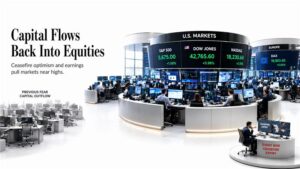
Dollar Hits One-Year High as Hawkish Warsh Fed Reprices Hikes · Dow Closes Above 52,000 with Alphabet · Gold Slides Below $4,000 · Bitcoin Sinks Toward $58.5K — Nasdaq 100 ~29,851.00, US 20Y ~4.65% | Technical Analysis U.S. Session | 30 June 2026
Tech Leads a Broad Risk Rally on Middle East Peace Hopes as Dollar Eases Off Its One-Year High —
Nasdaq Jumps Past 2% While Gold Slips and Bitcoin Rebounds near $60K
Wall Street opens the back half of the week with the dollar parked near a one-year high, equities pressing toward records on a stabilising chip trade, and gold, wheat and crypto all leaning on the defensive as markets digest a genuinely hawkish turn from new Fed Chair Kevin Warsh.
The dominant story of the U.S. session remains the repricing of the Fed’s rate path. Warsh’s June 17 debut meeting left the federal funds rate unchanged at 3.50–3.75%, but the Summary of Economic Projections flipped the median dot toward a hike by year-end for the first time since the cutting cycle began, with 17 of 18 officials now seeing inflation risks tilted to the upside. Fed-funds futures have moved to price roughly a 77% probability of a December hike, up sharply from about 24% a month earlier, and the resulting dollar strength is the single biggest driver across Tuesday’s session — pressuring gold, though it holds above $4,000, keeping a lid on wheat, and adding to crypto’s “Extreme Fear” slide.
Equities are holding up comparatively well: the Dow closed Monday above 52,000 for the first time, powered by new index member Alphabet, while Nasdaq 100 futures are firming toward 29,851.00 as the semiconductor names that drove last week’s tech-sector selloff show early signs of stabilising. Treasury yields continue to climb across the curve on the hawkish repricing, with the 20-year pressing toward 4.65%, while traders also monitor Tuesday’s fresh Doha talks between the U.S. and Iran following weekend clashes near the Strait of Hormuz, and position ahead of Wednesday’s concentrated Sintra panel where Warsh shares a stage with ECB President Christine Lagarde and BoE Governor Andrew Bailey.
U.S. Session Headlines
The stories driving price action across FX, metals, grains, equities, rates and crypto into Tuesday’s New York open
The Dollar’s One-Year High Is the Single Thread Tying Together Tuesday’s Cross-Asset Tape
The standout story beneath the surface of Tuesday’s U.S. session is not any single asset but the common driver running through nearly all of them: a dollar sitting near its strongest level in a year following Kevin Warsh’s hawkish FOMC debut. Gold’s hold above $4,000, wheat’s fresh 2026 low, and Bitcoin’s drift toward $59,334.50 are each, in part, a dollar story as much as an asset-specific one — the kind of broad, correlated cross-asset move that tends to happen when a new Fed chair surprises markets with a genuine change in policy bias rather than simple continuity.
That makes Wednesday’s Sintra panel disproportionately important for Tuesday’s positioning: Warsh shares the stage with Lagarde and Bailey for the first time since taking office, and any further hawkish confirmation from him there would likely extend the dollar’s run and add fresh pressure to gold, wheat and crypto alike. A more measured or data-dependent tone, by contrast, could trigger a meaningful unwind of Tuesday’s dollar-driven cross-asset moves heading into the back half of the week, particularly with Thursday’s ISM Manufacturing PMI and Friday’s June jobs report both carrying the potential to validate or undercut the market’s newly hawkish repricing.
U.S. Session Economic Calendar — 30 June 2026
Key releases and events shaping price action across today’s U.S. session and into the week ahead
| Time (ET) | Event | Actual / Expected | Impact | Market Read |
|---|---|---|---|---|
| 🇺🇸Tue (today) | US & Iran Hold Fresh Talks in Doha | Requested by Iran after weekend Hormuz clashes | 🔴 CRITICAL | Constructive outcome extends oil’s slide and supports risk sentiment; breakdown spikes crude and revives haven flows |
| 🇺🇸Tue (today) | USDA Quarterly Grain Stocks Report | Markets watching for confirmation of ample supply | 🟢 MED | A bearish surprise extends wheat’s slide toward fresh 2026 lows |
| 🇪🇺🇺🇸🇬🇧Wed (Sintra) | Fed Chair Warsh, Lagarde and Bailey Joint Panel | Most-watched event of the week for USD, EUR, GBP and global rates | 🔴 CRITICAL | A hawkish reaffirmation from Warsh extends the dollar’s one-year high; a dovish surprise triggers a sharp cross-asset unwind |
| 🇺🇸Wed | US ADP Employment Change | Markets watching for confirmation of labour-market resilience | 🟢 MED | A strong print reinforces the case for the Fed’s hawkish hold |
| 🇺🇸Thu | ISM Manufacturing PMI (June) | Markets watching for confirmation of moderating activity | 🔴 CRITICAL | A hot print would validate the Fed’s inflation concerns and extend the dollar rally; a soft print would pressure yields lower |
| 🇺🇸Fri | June Nonfarm Payrolls & Unemployment Rate | Markets watching for fresh signal on Fed’s December hike pricing | 🔴 CRITICAL | A strong report cements December hike odds near current ~77% level; a weak print forces a rapid dollar and yield unwind |
| 🇺🇸This week | Fed Chair Warsh’s Five Internal Task Forces | Reviewing Fed operations, including potential balance-sheet reduction | ⚪ LOW | Any concrete balance-sheet signal would add structural upward pressure to longer-dated Treasury yields |
| 🇺🇸This week | US Winter Wheat Harvest Progress Updates | 49% complete (HRW), 45% complete (SRW), both well ahead of average | ⚪ LOW | Continued fast progress keeps wheat pinned near 2026 lows into the Independence Day holiday week |
U.S. Session Trade Ideas — 30 June 2026
Eight structured setups — USD/CAD, USD/CHF, Gold, Wheat, Nasdaq 100, US 20Y, Bitcoin, BNB/USD — with live prices, levels, and full fundamental and technical analysis

Fundamental Backdrop
USD/CAD is trading near 1.4234, holding close to its highest level since late January as the broad dollar rally triggered by Fed Chair Warsh’s hawkish FOMC debut continues to dominate the pair. The loonie’s commodity-currency sensitivity to oil normally provides a partial offset, but WTI’s modest gain to roughly $70.54 has not been enough to outweigh the dollar’s own strength, with markets pricing a roughly 77% chance of a December Fed hike. The pair’s next major test is Tuesday’s Doha talks between the U.S. and Iran; a constructive outcome could lift oil further and provide CAD some support, while a breakdown would likely reinforce the existing bullish USD/CAD trend.
Technical Outlook
The pair remains in a well-established uptrend from January’s low near 1.3486, having recently touched a 2026 high close to 1.4234. Resistance: 1.4234 (June high) and 1.4350 (target, the next psychological extension). Support: 1.4170 (preferred buy-dip level, near the recent consolidation base) and 1.4090 (stop, below the prior week’s low). The setup favours buying dips while the dollar holds its hawkish-Fed bid, though a sharp, broad-based dollar reversal on a dovish Sintra surprise from Warsh would be the cleanest signal to step aside.
Session Catalysts
Watch for: (1) Tuesday’s Doha talks and their read-through to crude oil and the loonie; (2) Wednesday’s Warsh-Lagarde-Bailey Sintra panel, the dominant binary catalyst for the broad dollar; (3) Thursday’s ISM Manufacturing PMI and Friday’s nonfarm payrolls; (4) Bank of Canada commentary and any shift in the BoC’s own rate-path signalling; (5) broader WTI crude direction as the key offsetting variable to dollar strength.

Fundamental Backdrop
USD/CHF is trading near 0.8093, a touch softer on the day but still close to its strongest levels since late 2025, as the dollar’s broad hawkish-Fed bid offsets the franc’s traditional role as a safe haven. The Swiss National Bank has remained on the sidelines through the recent volatility, leaving the pair largely a pure dollar story for now. The fragile Strait of Hormuz truce and Tuesday’s Doha talks are the key swing factor for franc demand: a breakdown in negotiations would likely see the franc reassert its haven bid even against a strong dollar, while a constructive outcome should leave the pair’s dollar-driven uptrend largely intact.
Technical Outlook
The pair has staged a sharp recovery off its 2026 lows near 0.7850, putting in a series of higher lows through June. Resistance: 0.8120 (recent high) and 0.8190 (target, the next extension level). Support: 0.8040 (preferred buy-dip level, near the recent breakout base) and 0.7975 (stop, below the prior consolidation range). The setup favours buying pullbacks while the dollar holds its hawkish-Fed bid, with a hawkish Warsh confirmation at Wednesday’s Sintra panel the cleanest catalyst for a push toward 0.8190.
Session Catalysts
Watch for: (1) Tuesday’s Doha talks and their impact on franc haven demand; (2) Wednesday’s Sintra panel, given Warsh’s direct participation; (3) Thursday’s ISM Manufacturing PMI and Friday’s payrolls; (4) any SNB commentary on franc strength or intervention risk; (5) broader risk sentiment across European and U.S. equities as a guide to haven-flow direction.

Fundamental Backdrop
Gold is trading near $4,018.27 per ounce, having slipped back below the $4,000 psychological level as the dollar’s hawkish-Fed-driven strength continues to outweigh lingering geopolitical risk premium. The metal is on track for a quarterly decline exceeding 14%, its steepest on record, even as the World Gold Council flagged synchronized global inflation upside across the U.S., China and the euro area as an underreported bullish signal for the medium term. Structural demand remains a partial offset: the People’s Bank of China extended its buying streak to 18 consecutive months in April, and no major bank has withdrawn its longer-term price target, with Goldman Sachs at $5,400 and JPMorgan near $6,000.
Technical Outlook
Gold remains in a steep corrective downtrend from January’s all-time high near $5,597, now trading roughly 28% below that peak. Resistance: $4,090 (preferred sell-rally level, near the recent consolidation high) and $4,180 (stop, above the prior week’s high). Support: $3,950 (near-term floor) and $3,820 (target, extending the current corrective structure). The setup favours fading rallies while the dollar holds its hawkish bid, though a genuinely dovish Sintra surprise from Warsh, or a breakdown in the Doha talks reviving safe-haven demand, would both argue for a faster reversal of the current bearish bias.
Session Catalysts
Watch for: (1) Wednesday’s Warsh-Lagarde-Bailey Sintra panel and its read-through to the dollar; (2) Tuesday’s Doha talks and any shift in geopolitical risk premium; (3) Thursday’s ISM Manufacturing PMI and Friday’s nonfarm payrolls, both key inputs to December hike pricing; (4) ongoing PBoC and central-bank gold purchase data; (5) real-yield direction as Treasury yields climb across the curve.

Fundamental Backdrop
CBOT wheat has fallen to 588.45 cents per bushel, its weakest level since April, as the advancing U.S. winter wheat harvest reinforces expectations of ample near-term supply. Hard red winter wheat is 49% harvested, far ahead of both last year’s 11% and the five-year average of 19%, while soft red winter wheat is 45% complete, also outpacing historical norms. Weekly export sales data showed a year-over-year decline, with Japan and Mexico the largest buyers, while traders await Tuesday’s USDA Grain Stocks report for further confirmation of the supply picture heading into the Independence Day holiday week.
Technical Outlook
Wheat remains in a clear downtrend within its 52-week range of 492.25 to 688.25 cents, having broken below the prior three-week consolidation low of 580 on the latest harvest-driven selling. Resistance: 592.00 (preferred sell-rally level, near the recent breakdown point) and 610.00 (stop, above the prior week’s high). Support: 555.00 (near-term floor) and 540.00 (target, extending toward the lower end of the recent range). The setup favours fading rallies while harvest pressure dominates, though a sharp Black Sea or European weather disruption headline would be the clearest catalyst to invalidate the bearish bias quickly given wheat’s geopolitical sensitivity.
Session Catalysts
Watch for: (1) Tuesday’s USDA Quarterly Grain Stocks report, the dominant near-term catalyst; (2) ongoing U.S. winter wheat harvest progress updates; (3) European wheat-quality headlines following the recent heatwave; (4) Black Sea export and weather developments out of Russia and Ukraine; (5) the broader dollar trend, given wheat’s sensitivity to a stronger USD weighing on export competitiveness.

Fundamental Backdrop
Nasdaq 100 futures are trading near 29,851.00, up roughly 0.34% on the day, as chipmakers including Micron show early signs of stabilising following a difficult prior week in which the Nasdaq Composite posted a fifth straight losing session and Apple weighed broadly on sentiment. The index continues to navigate a genuine tension between a hawkish Fed repricing — which typically pressures growth-heavy, rate-sensitive technology names through a higher discount rate — and resilient underlying earnings momentum from mega-cap names, with the Dow’s close above 52,000 and Alphabet’s index inclusion underscoring broader market strength heading into Tuesday’s session.
Technical Outlook
The index is attempting to stabilise within a broader rising trend channel, having pulled back from levels near 30,975 to retest support near 29,200 amid this week’s renewed pressure. Resistance: 30,200 (recent range high) and 30,500 (target, near the prior consolidation shelf). Support: 29,650 (preferred buy-dip level, near the recent breakout base) and 29,300 (stop, below the prior week’s low). The setup favours buying dips while the chip-sector stabilisation holds, though a hot ISM print Thursday or a hawkish payrolls surprise Friday would likely reintroduce rate-driven pressure on richly-valued technology names quickly.
Session Catalysts
Watch for: (1) continued chip-sector stabilisation, particularly in Micron and other AI-infrastructure names; (2) Thursday’s ISM Manufacturing PMI and Friday’s nonfarm payrolls, both key inputs to Fed hike pricing; (3) Wednesday’s Sintra panel and its impact on the dollar and global rate expectations; (4) any further index-composition or mega-cap earnings headlines; (5) the 10-year and 20-year Treasury yield trend, given the index’s sensitivity to discount-rate moves.

Fundamental Backdrop
The U.S. 20-year Treasury yield is trading near an estimated 4.65%, having climbed steadily since Fed Chair Warsh’s hawkish FOMC debut on June 17 flipped the median dot plot toward a year-end rate hike. The move has been sharpest at the front end of the curve, with the 2-year yield jumping roughly 16 basis points on the decision day alone — the largest single-day move on a Fed meeting day since March 2008 — while the 10-year holds near 4.38% and the 30-year near 4.87%. Warsh has separately floated reducing the Fed’s balance-sheet holdings of Treasury notes and bonds through one of his five newly launched internal task forces, a structural theme that could add further upward pressure to the long end if it advances.
Technical Outlook
Yields remain in a clear uptrend from their early-June lows, tracking the broader steepening-then-flattening dynamic typical of a hawkish repricing cycle. Resistance: 4.85% (near the 30-year’s current level, a key psychological extension) and a longer-term target near 4.85–4.90% if the hike narrative fully consolidates. Support (i.e., the level that would need to break for a bullish-bond reversal): 4.55% (preferred level to fade yield dips) and 4.42% (stop, below the prior week’s low). The setup favours fading any near-term dip in yields while the hawkish Fed narrative holds, with Friday’s payrolls report the single most important near-term catalyst.
Session Catalysts
Watch for: (1) Friday’s June nonfarm payrolls, the dominant binary catalyst for December hike pricing; (2) Thursday’s ISM Manufacturing PMI; (3) Wednesday’s Sintra panel and any fresh Warsh commentary on the rate path or balance sheet; (4) ongoing Treasury issuance and auction demand at the long end; (5) any concrete update from Warsh’s balance-sheet task force.

Fundamental Backdrop
Bitcoin is trading near $59,334.50, within close range of its 52-week low around $58,131 and down sharply from levels a year ago, as the dollar’s hawkish-Fed-driven strength weighs broadly on digital assets. Bitcoin’s correlation with the dollar has turned sharply negative over the trailing 52 weeks, undercutting the “digital gold” hedge narrative that supported prices earlier in the cycle, while the Crypto Fear & Greed Index remains deep in “Extreme Fear” territory. Separately, MicroStrategy parent Strategy announced a new Digital Credit Capital Framework on June 29, including a $1.25 billion Bitcoin monetisation program and $2 billion in buyback authorisations, a shift from its prior pure-accumulation stance that some traders read as a subtle bearish signal for marginal demand.
Technical Outlook
Bitcoin remains in a steep downtrend from its all-time high near $126,080, now trading more than 50% below that peak. Both the 50-day and 200-day moving averages are falling on the daily and weekly timeframes, confirming the dominant medium-term trend remains down. Resistance: $61,500 (preferred sell-rally level, near the recent consolidation high) and $64,000 (stop, above the prior week’s high). Support: $58,131 (the 52-week low, a key psychological test) and $53,500 (target, extending the current corrective structure if that low breaks). The setup favours fading relief rallies while the dollar holds its bid, though a confirmed break of $58,131 on heavy volume would itself become a fresh bearish catalyst.
Session Catalysts
Watch for: (1) the broader dollar index and its persistently negative correlation with Bitcoin; (2) Wednesday’s Sintra panel and any dovish surprise from Warsh that could ease dollar pressure; (3) spot Bitcoin ETF flow data for signs of stabilising institutional demand; (4) further details on Strategy’s new monetisation and buyback framework; (5) Friday’s payrolls report as the next major macro catalyst for risk appetite broadly.

Fundamental Backdrop
BNB is trading near $543.97, tracking the broader crypto market’s dollar-driven slide alongside Bitcoin’s move toward its 52-week low. As the native token of the BNB Smart Chain ecosystem, BNB tends to trade with high beta to Bitcoin during broad risk-off episodes, and Tuesday’s session is no exception, with the token’s periodic auto-burn deflationary mechanism doing little to offset the macro-driven selling pressure. The token continues to benefit structurally from its role in transaction fees, Launchpad participation and broader BNB Chain ecosystem activity, but those fundamentals are taking a back seat to the dominant dollar-strength narrative for now.
Technical Outlook
BNB remains well below its December 2024 all-time high near $793, in a corrective structure that has deepened alongside the broader altcoin complex’s underperformance against Bitcoin. Resistance: $575.00 (preferred sell-rally level, near the recent consolidation high) and $600.00 (stop, above the prior week’s high). Support: $530.00 (near-term floor) and $505.00 (target, extending the current corrective structure). The setup favours fading relief rallies while Bitcoin’s own downtrend persists, given BNB’s typically higher beta to broad crypto-market direction during risk-off phases.
Session Catalysts
Watch for: (1) Bitcoin’s own price action and the $58,131 52-week-low test, the primary driver of BNB’s near-term direction; (2) the broader dollar index, given crypto’s persistently negative DXY correlation; (3) any BNB Chain ecosystem, Launchpad or auto-burn announcements; (4) Wednesday’s Sintra panel as a macro catalyst for broad risk appetite; (5) spot crypto ETF flow data across major tokens for signs of stabilising institutional demand.
Key Questions for the U.S. Session
Detailed answers to Tuesday’s most important analytical questions
U.S. Session Summary — Tuesday, 30 June 2026
Tuesday’s U.S. session opens with the dollar holding near a one-year high as markets continue to digest Fed Chair Kevin Warsh’s genuinely hawkish FOMC debut, a repricing that is the common thread running through nearly every asset on today’s calendar. Equities are proving the most resilient, with the Dow’s close above 52,000 and a firming Nasdaq 100 suggesting earnings momentum can coexist with a higher-for-longer rate path, at least for now. Highest-conviction macro: sell gold rallies toward $4,090, stop $4,180, target $3,820 — the dollar-strength setup remains the cleanest structural trade of the session, with Wednesday’s Sintra panel and Friday’s payrolls the key swing factors.
For the individual instruments: USD/CAD buy dips toward 1.4170, stop 1.4090, target 1.4350 — the hawkish Fed repricing dominates, offset only by a constructive Doha outcome lifting oil. USD/CHF buy dips toward 0.8040, stop 0.7975, target 0.8190 — dollar strength is dominant, but Mideast tail risk keeps the franc’s haven bid alive. Wheat sell rallies toward 592.00, stop 610.00, target 540.00 — ample-supply harvest pressure dominates ahead of Tuesday’s USDA Grain Stocks report. Nasdaq 100 buy dips toward 29,650, stop 29,300, target 30,500 — chip-sector stabilisation and resilient mega-cap earnings favour continuation, though Friday’s payrolls is a key risk. US 20Y fade yield dips toward 4.55%, stop 4.42%, target 4.85% — the hawkish Fed repricing favours continued yield pressure into Friday’s jobs report. Bitcoin sell rallies toward $61,500, stop $64,000, target $53,500 — dollar strength and Extreme Fear dominate, with a 52-week-low test the key near-term risk. BNB/USD sell rallies toward $575.00, stop $600.00, target $505.00 — correlated Bitcoin weakness dominates the broader altcoin tape. The decisive variable into Wednesday’s Warsh-Lagarde-Bailey Sintra panel and the back half of the week’s ISM PMI and payrolls data remains whether the market’s newly hawkish Fed repricing gets confirmed or unwound. Size positions accordingly.
Access Live U.S. Markets →