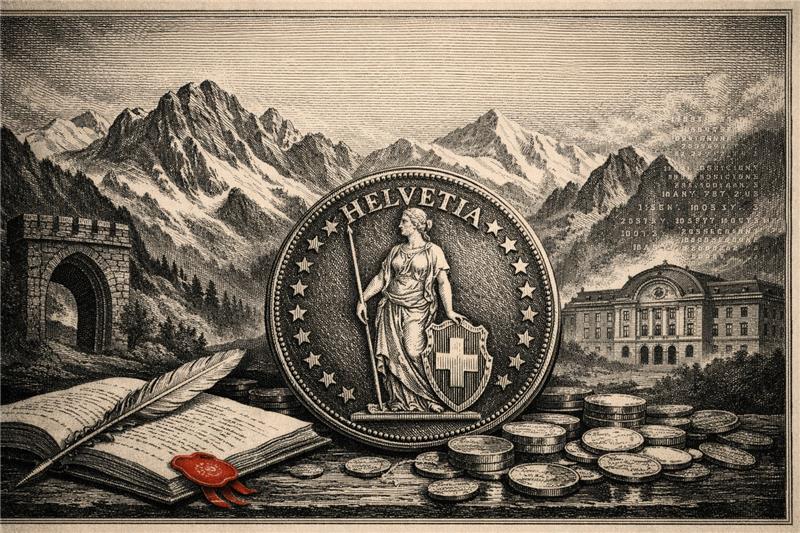
The Mountain Money: The Complete History and Future of the Swiss Franc (CHF) | Capital Street FX
The Mountain Money:
Switzerland’s Neutrality, Its Sanctuary Role, and the Enduring Power of the Swiss Franc
How three hundred years of political, legal, and financial neutrality built the world’s most trusted currency — the waves of capital that confirmed the trust, the secrecy that eroded it, and the question every investor is asking in 2026: what comes next?
Switzerland as Sanctuary: Why the Franc Is Not Just a Currency — It Is the Monetary Form of a Political Idea
There is no other currency in the world whose value rests so completely on a political and legal idea. The Swiss franc is not strong because Switzerland has the largest economy, the deepest capital markets, or the most sophisticated central bank. It is strong because Switzerland has, for over five hundred years, maintained something that no other major nation has managed to sustain for anything like as long: genuine, enforced, legally codified, and institutionally embedded neutrality — political neutrality in the affairs of nations at war, legal neutrality in the treatment of capital across its borders, and financial neutrality in the provision of banking services to clients whose governments may be enemies of each other.
This neutrality is not a passive stance. It is an active institutional architecture. It is written into Swiss law. It is enforced by Swiss courts. It is protected by Swiss mountains. It is maintained by a Swiss army whose primary purpose, since 1815, has been not to fight wars abroad but to make Switzerland too expensive to invade. And it is expressed, in every international monetary market that is open today, in the price of the Swiss franc against every other currency on earth.
When a French aristocrat fled Revolutionary France in 1790 with gold sewn into his coat and crossed the Jura mountains into Geneva, he was not simply moving money. He was moving his wealth into a different legal and political jurisdiction — one where the laws protecting his property would not change with the next government, where no tribunal could confiscate his assets by decree, and where the bankers he dealt with were professionally, legally, and morally obligated to maintain his confidentiality. That is exactly what a Brazilian family office, a Gulf sovereign wealth fund, or a European institutional investor is doing in April 2026 when they buy Swiss franc-denominated assets in a world where geopolitical polarisation, the weaponisation of the US dollar as a sanctions instrument, and the fundamental unpredictability of US policy have degraded the trust that the dollar and euro once commanded as safe haven benchmarks.
The Swiss franc is, in the deepest structural sense, the monetary expression of Switzerland’s constitutional position as a nation that refuses to be drawn into the conflicts of others — and the trust it has accumulated by maintaining that position, across wars, crises, scandals, and the entire arc of modern financial history, is the most durable competitive advantage in international finance. This article traces that advantage from its pre-monetary roots, through the crises that tested it, the secrecy that amplified it and the leaks that damaged it, the polarised world that has restored it, and the cryptographic future that may reinvent it.
“The franc is not trusted because of any single policy decision, monetary framework, or economic statistic. It is trusted because Switzerland, as a state, has been doing something extraordinarily unusual for a very long time: keeping out of everyone else’s wars while keeping its own house in order. That record — accumulated across five centuries and tested by every crisis of the modern era — is what the Swiss franc actually is.”
— CSFX Research Desk · April 2026
The Three Neutralities: Political, Legal, and Financial — and Why Together They Create Something No Other Nation Has
To understand the Swiss franc’s safe-haven premium, you must first understand that Switzerland’s neutrality operates on three distinct and mutually reinforcing levels, each with its own legal foundation and its own contribution to the trust that makes the franc uniquely valuable.
Political Neutrality: Five Hundred Years of Non-Involvement
Switzerland’s political neutrality is the oldest and most foundational of the three. Following the catastrophic defeat at the Battle of Marignano in 1515 — where the Swiss Confederation’s expansion into northern Italy was checked by a Franco-Venetian force, ending Swiss ambitions for territorial expansion — the Confederation adopted a policy of armed neutrality that it would maintain, with only minor interruptions, for the next five centuries. At the Congress of Vienna in 1815, this neutrality was formalised and guaranteed in international law by the European great powers — Austria, Britain, France, Prussia, and Russia — who recognised that a neutral Switzerland served their collective interest better than a Switzerland that could be drawn into any one of their rival alliances.
The consequences for the Swiss franc of this political architecture are direct and permanent. Switzerland is not a member of NATO. It is not a member of the European Union. It holds a seat at the United Nations, but not on the Security Council, where the great-power vetoes are exercised. It does not take sides in military conflicts between major powers. This means that the Swiss franc cannot be weaponised — it cannot be enlisted in any sanctions regime, any financial warfare campaign, or any alliance’s economic coercion toolkit without the unanimous consensus of all major powers, which structural reality makes effectively impossible. No other major currency operates with this degree of political insulation.
The monetary consequence of 211 years of peace is, in fiscal terms, extraordinary. A country that has not been at war since 1815 has not needed to finance military operations through monetary expansion in over two centuries. The Swiss franc has, as a direct consequence, never been subjected to the inflationary debasement that wartime financing produces in every combatant nation. Every major currency in the world has been inflated to finance at least one major war in the modern era. The Swiss franc has not. This record is irreplaceable: it cannot be manufactured through policy; it can only be accumulated over time. Switzerland has been accumulating it since before the concept of modern monetary policy existed.
Legal Neutrality: The Protective Architecture of Swiss Law
Switzerland’s legal neutrality is its second great pillar. Swiss law offers protections to private capital that few other jurisdictions can match: a constitutional guarantee of property rights that predates most European democracies, a court system that is independent of political influence, contract enforcement that is among the most reliable in the world, and — crucially — a long tradition of treating deposited assets as legally beyond the reach of foreign governmental authority except through the most formal and demanding legal processes.
The 1713 prohibition by the Council of Geneva on bankers disclosing client information — three centuries ago, in a city that would not formally join Switzerland for another 85 years — was the first expression of this legal neutrality in formal banking terms. The Federal Banking Act of 1934, which codified client confidentiality as a federal criminal offence, extended it to the entire Swiss state. The numbered bank account, introduced in the 1940s, pushed it to its logical extreme. This legal architecture told every threatened capital-holder in the world the same thing: bring your wealth here and no foreign government, no foreign court, no foreign political upheaval can reach it without going through Swiss law first — and Swiss law is difficult, slow, and extremely protective of what has been deposited under its jurisdiction.
Even after the mandatory transparency regimes of the 2010s dismantled absolute banking secrecy, Swiss law continues to provide a class of legal protection for private wealth that most jurisdictions do not. Article 47 of the Federal Banking Act still criminalises unauthorised disclosure of client information. Swiss courts still apply extremely demanding standards before agreeing to cooperate with foreign judicial requests. The principle of legal neutrality — that Swiss legal institutions will not simply execute the requests of foreign governments for their own fiscal or political purposes — remains structurally embedded in Swiss jurisprudence, even as the specific mechanism of banking secrecy has been substantially modified.
Financial Neutrality: The Provision of Services Across Political Divides
Switzerland’s financial neutrality is perhaps its most commercially consequential characteristic. Swiss banks, historically, have provided banking services to clients whose governments are enemies of each other: they held German and Allied accounts simultaneously during both World Wars, serviced Soviet bloc officials and Western European capitalists through the Cold War, managed the wealth of sanctioned regimes and their adversaries through the post-Cold War era. This financial neutrality is not a moral statement. It is a commercial practice grounded in the legal neutrality described above: Swiss banks argue, correctly under their own law, that their obligation is to their clients and to Swiss law, not to the political preferences of any foreign government.
The three neutralities together create something that has no equivalent elsewhere: a jurisdiction where capital from any political background, any geographic origin, and any ideological persuasion can be placed under the protection of a legal system that will not bend to the political winds of any other country. This is not an accident. It is a deliberate, constitutionally embedded, legally enforced characteristic of the Swiss state. And it is the primary reason — before monetary policy, before current account surpluses, before interest rate differentials — why the Swiss franc commands the safe-haven premium it has maintained, with only temporary interruptions, for more than three centuries.
Before the Franc: Two Thousand Years of Commercial Geography and the Building of a Financial State
The safe-haven instinct that makes the franc valuable today did not spring from the 1934 Banking Act or the numbered account. It is the monetary expression of a geographic and institutional reality that predates the Swiss franc by two millennia, and that predates the Swiss state by several more centuries still. To understand the franc, you must understand the mountain passes that first gave Switzerland its commercial reason to exist.
The Helvetii and the First Commercial Networks: 500 BC to 58 BC
The Celtic Helvetii who occupied the Swiss plateau in the centuries before Roman conquest were not isolated mountain farmers. La Tène culture — the late Iron Age civilisation centred on the shores of Lake Neuchâtel, named for the archaeological site at the lake’s eastern end — was one of the most commercially connected cultures in pre-Roman Europe. Amber from the Baltic coast, travelling through Germanic tribal networks across the Rhine, reached Switzerland and moved south through the alpine passes to Mediterranean markets. Salt from the Austrian Hallstatt mines moved west and north. Mediterranean wine from Massalia (Marseille) moved up the Rhône and into the alpine valleys. Bronze from Etruscan workshops traded against Baltic amber and central European tin.
The Helvetii were not merely participants in this trade network. Their geographic position — on the plateau between the Jura mountains to the west and north, the Alps to the south, and the Rhine to the north and east — made them natural intermediaries in every major trade route crossing the continent. The economic logic of Switzerland as a crossroads, as a point of transit and exchange where different commercial worlds meet and do business with each other, was already fully operational five centuries before Julius Caesar encountered the Helvetii and was already generating the kind of commercial wealth that would, eventually, underpin one of the world’s great banking traditions.
Roman Helvetia: 58 BC to 400 AD — The First Unified Money
Julius Caesar’s defeat of the Helvetii at the Battle of Bibracte in June 58 BC was, in economic terms, the annexation of the most strategically important real estate in Europe: the approaches to the Alpine passes. Rome did not merely conquer the Swiss plateau. It built the infrastructure — roads, bridges, customs stations, urban commercial centres — that transformed those passes into the most intensively exploited commercial corridor in the ancient world.
Under Emperor Augustus and his stepsons Drusus and Tiberius in 15 BC, Rome completed its Alpine infrastructure. Turicum (modern Zurich) was established as a customs station at the outlet of Lake Zurich specifically to tax goods moving along the Limmat River waterway. Augusta Raurica, near modern Basel, became a commercial city of perhaps 20,000 people. Aventicum (Avenches) grew into the provincial capital. The Roman road network connected Lyon in the west to Constance in the north, binding the entire plateau into a single economic zone served by a single currency: the Roman silver denarius and gold aureus, accepted from Hadrian’s Wall to the Nile, backed by the military and institutional authority of the most powerful state in the world.
This was the first time the Swiss plateau had a unified monetary system. It would be nearly nineteen hundred years before it had one again. The comparison is instructive: the Federal Coinage Act of 1850, which finally created the Swiss franc, was, in monetary institutional terms, solving a problem that Rome had solved before and the intervening nineteen centuries of monetary fragmentation had reintroduced. The commercial genius of the Swiss location — the insight that controlling the mountain passes gives you a structural position in the flow of goods, capital, and people between the world’s major economic zones — was already fully operational under Roman administration two thousand years ago.
Medieval Commerce and the Gotthard Revolution: 1000–1500
The fall of Rome in the 5th century destroyed the monetary unity that had sustained commerce for four hundred years. Germanic tribes — the Burgundians settling in the Rhône valley, the Alemanni crossing the Rhine — brought with them the fragmented monetary systems of tribal economies. By the early 19th century, over 8,000 distinct monetary denominations circulated in the Swiss cantons simultaneously, each issued by a different bishop, abbot, count, or city, each accepted only within the narrow political radius of its issuer. This monetary chaos was not merely inconvenient; it was an active impediment to the very commerce that Switzerland’s geographic position was designed to facilitate.
The pivotal event in medieval Swiss commercial history was the construction of the Teufelsbrücke — the Devil’s Bridge — across the Schöllenen Gorge in approximately 1230 AD. This bridge across the wild ravine through which the Reuss River carved its way through the St. Gotthard massif opened the Gotthard Pass to regular traffic for the first time in history. Before this bridge, the Gotthard was a seasonal mule track. After it, the Gotthard became the most important commercial corridor in Europe: the most direct overland route connecting northern Italy to the Rhine valley, cutting weeks from the journey between Venice and Augsburg. Within a generation, the commercial revenues from pass tolls transformed the forest cantons of Uri, Schwyz, and Unterwalden from marginal alpine communities into masters of Europe’s most valuable geographic asset.
The Swiss mercenary tradition, which would eventually bring gold back to the alpine cantons from seventeen different foreign armies over four centuries, was itself a commercial operation of extraordinary scale. Swiss cantons contracted to supply entire regiments to foreign governments — France, the Papacy, Spain, the Holy Roman Empire — in exchange for annual cash payments called Pensionen that flowed directly into cantonal treasuries. Pope Julius II established the Pontifical Swiss Guard in 1506; it still stands watch today, five hundred and twenty years later, as the oldest continuous expression of the principle that Switzerland’s reliability makes it the natural protector of things that others cannot protect for themselves. The Swiss franc embodies that principle in monetary form.
Geneva 1713 to Bern 1850: How Switzerland Invented Private Banking and Then Gave It a Currency
The modern Swiss financial system’s origin point is not 1850, when the Federal Coinage Act unified the canton’s monetary chaos into the Swiss franc. It is 1713, when the Council of Geneva enacted its prohibition on bankers disclosing client information. The decision was commercially motivated: French and Savoyard nobles needed somewhere to park money out of reach of domestic political turbulence, and the Geneva banking community understood that confidentiality was a service with real and lasting commercial value. That decision set in motion the institutional logic that would eventually produce a global offshore financial industry managing USD 2.2 trillion in cross-border private wealth.
The Huguenot refugees who fled Louis XIV’s revocation of the Edict of Nantes in 1685 brought commercial networks, capital, and banking expertise to Geneva, Basel, and Zurich. The French Revolutionary upheavals of the 1790s sent a second and larger wave: French aristocrats facing guillotine or confiscation, Italian merchants facing Napoleonic occupation, German princes hedging against the dissolution of the Holy Roman Empire. By the Congress of Vienna in 1815, Swiss banks held the savings of a significant fraction of European aristocracy. The pattern that would define Swiss banking for the next two centuries was established: when political upheaval threatened wealth in continental Europe, Switzerland was the destination.
The Federal Coinage Act of 1850 finally gave this banking tradition a unified currency. The Swiss franc replaced the 8,000-plus distinct monetary instruments circulating across the cantons with a single national money, minted at the Federal Mint in Bern, denominated in decimal units, and backed by silver at the standard of the Latin Monetary Union. The Swiss National Bank was established in 1907 to provide the central monetary authority that the fragmented cantonal system had lacked. The gold Vreneli — the Swiss 20-franc gold coin first minted in 1897, featuring the image of Helvetia — became a cultural symbol of monetary seriousness: every Swiss child received one as a traditional gift, a tangible expression of the conviction that money must be anchored to something real and permanent.
The 1934 Banking Act: Sanctuary Codified in Criminal Law
The Federal Banking Act of 1934 was the pivotal legal instrument in the history of Swiss safe-haven finance. By making client disclosure a federal criminal offence — not merely a civil breach of contract but a matter for criminal prosecution under federal law — Switzerland created the strongest banking confidentiality protection in the world. The official Swiss banking narrative for decades maintained that the law was enacted primarily to protect Jewish clients from Nazi confiscation. Research by Sébastien Guex at the University of Lausanne has challenged this as largely retrospective rationalisation: the immediate trigger was a 1932 French police raid on an undeclared Swiss bank office in Paris that exposed large-scale French tax evasion through Swiss accounts, threatening the industry’s foreign client business model. The anti-Nazi provisions protecting Jewish assets were real — but secondary. The banking secrecy law was the industry’s commercial response to the threat of international enforcement.
Whether its origins were primarily defensive or protective, the 1934 Act achieved both results. It attracted Jewish capital fleeing Nazi persecution. It also attracted Nazi gold looted from occupied countries — the Swiss National Bank received approximately USD 440 million in Nazi gold during World War II, of which an estimated USD 316 million is now considered to have been looted from occupied central banks and individual victims. Both flows were real. Both defined the moral complexity of financial neutrality carried to its extreme. The $1.25 billion settlement of 1998 — rising to $1.29 billion by disbursement — addressed the Holocaust victims’ dormant accounts. It could not erase the contradiction at the heart of the system: that a legal architecture designed to protect capital from political persecution protected the capital of the persecutors and the persecuted with identical efficiency.
And yet the world continued to bank in Switzerland. The Holocaust settlement was paid. The Bergier Commission documented the wartime failures. Swiss banks reformed and acknowledged their failures. And Switzerland remained the world’s largest offshore private wealth centre. The paradox is instructive: the institutional failures documented by the Bergier Commission made Swiss banking less morally comfortable to defend. They did not make Switzerland less attractive as a location for capital seeking protection from political risk. The logic of safe-haven banking is structural, not moral. Capital flows to where it is most reliably protected. Switzerland still provides that protection more reliably than almost anywhere else on earth.
Nine Waves of Capital That Built the World’s Most Trusted Currency — Crisis by Crisis, Century by Century
The Swiss franc’s safe-haven status was not decreed. It was earned, crisis by crisis, over three centuries, as wave after wave of threatened capital found its way to Swiss institutions and discovered that what was deposited there was still there when the storm passed. Each wave left behind a deeper sediment of institutional trust. Each crisis that Switzerland weathered while its neighbours collapsed added another data point to the record that makes the franc uniquely credible.
Wave One (1685–1815): The Aristocratic Flight. Huguenot refugees, French aristocrats facing Revolutionary tribunals, Italian merchants fleeing Napoleonic occupation, German princes hedging against imperial dissolution — all found their way to Swiss banks between the late 17th and early 19th centuries. By 1815, Swiss banks held the savings of a substantial fraction of European aristocracy. The pattern was established: when political upheaval threatened wealth in continental Europe, Switzerland was the destination.
Wave Two (1914–1918): The World War I Tax Flight. When France and Germany introduced progressive income and inheritance taxes to finance the war, Swiss bankers — operating with documented, deliberate marketing campaigns across wartime Europe — captured capital from wealthy Europeans seeking to avoid wartime fiscal extraction. Academic research by Baltensperger and Kugler (2016) confirmed that this was the moment when the Swiss franc’s safe-haven interest rate premium — the persistently lower yields than peer economies that economists call the “Swiss interest rate island” — crystallised as a permanent, measurable market phenomenon.
Wave Three (1920s–1934): The Hyperinflation Refugees. Germany’s Weimar hyperinflation, where a loaf of bread reached 750 million marks by November 1923, drove German savings into the only currency on the continent still maintaining gold parity. Switzerland was the last major currency area offering unconditional gold convertibility as its neighbours destroyed their currencies through wartime and postwar money printing.
Wave Four (1934–1945): The Most Morally Complex Wave. Jewish families fleeing Nazi persecution moved assets to Switzerland. The Nazi state itself moved gold — much of it looted from occupied countries and individual victims. Both flows were real; both defined the moral complexity of Switzerland’s financial neutrality in extremis. The safe-haven architecture served both the persecuted and the persecutors with equal legal efficiency.
Wave Five (1945–1990): The Cold War Capital. Latin American military governments protecting expropriated assets, Middle Eastern oil revenues seeking diversification, African kleptocrats with misdirected development aid, Eastern Bloc officials hedging against Soviet political volatility — all flowed into numbered Swiss accounts. Switzerland’s managed private wealth grew from a few billion dollars in 1945 to several trillion by 1990, making it the world’s largest offshore financial centre.
Wave Six (1990–2008): The Post-Soviet and Emerging Market Surge. The collapse of the Soviet Union generated enormous capital flight as newly privatised state assets were moved abroad by the oligarchs who had acquired them. Russian, Ukrainian, and Central Asian private wealth flooded into Swiss private banks. Emerging market crises from the 1994 Mexican peso collapse to the 2001 Argentine default sent further institutional capital seeking the most stable jurisdiction available.
Wave Seven (2008–2015): The GFC and Eurozone Crisis Surge. The Global Financial Crisis and the European sovereign debt crisis together produced the most intense safe-haven demand for the franc since World War II. EUR/CHF fell from 1.50 to 1.01 in three years. The SNB’s foreign exchange reserves tripled as it attempted to contain the appreciation. The franc appreciated approximately 70% in real effective terms in four years, forcing the SNB to impose negative rates and the EUR/CHF ceiling — both of which ultimately failed to reverse the structural trend.
Wave Eight (2022–2024): The Geopolitical Fragmentation Wave. Russia’s invasion of Ukraine triggered the largest European geopolitical shock since World War II, and the franc absorbed the safe-haven demand that followed. Simultaneously, the freezing of Russian sovereign assets by Western governments — a decision that alarmed every non-Western sovereign wealth fund about the safety of dollar and euro-denominated reserves — accelerated diversification into the few remaining neutral currencies. The franc was the primary beneficiary. This wave marked something structurally new: for the first time since the Cold War, the weaponisation of the US dollar’s reserve currency status was itself a driver of safe-haven flows into Switzerland.
Wave Nine (2025–2026): The Dollar Disenchantment and Polarisation Wave. In 2025, the franc appreciated almost 13% against the US dollar — reaching 11-year highs against both the dollar and the euro. This is not only a geopolitical safe-haven story. It is a dollar-trust story. US tariff policy under President Trump, political pressure on the Federal Reserve, and what Julius Baer described in December 2025 as an “unsustainable debt trajectory” embedded in US fiscal legislation have collectively degraded the dollar’s safe-haven credibility. Deutsche Bank’s head of FX research George Saravelos declared in February 2026 that the dollar’s safe-haven status was a “myth.” Whether or not that judgment proves correct, the capital consequences are real: in a world where the dollar is questioned, the franc strengthens automatically, because the structural alternative to dollar trust in the safe-haven hierarchy is Swiss franc trust, and Swiss franc trust has been accumulating since 1713.
The Only Devaluation in 175 Years: How Swiss Monetary Discipline Became the Institutional Backbone of the Franc
Through the 1920s, while Germany’s Weimar Republic experienced one of the most catastrophic monetary collapses in recorded history, the Swiss franc maintained its gold standard and attracted the savings of everyone watching the inflation with horror. Switzerland was the last major currency area still offering full, unconditional gold convertibility at a time when most of its neighbours were destroying their currencies through wartime and postwar money printing.
When the Great Depression arrived after 1929 and currencies fell in sequence — the British pound in September 1931, the US dollar in April 1933, the French franc in June 1936 — Switzerland tried, with extraordinary and eventually self-destructive stubbornness, to maintain its gold parity. The costs were enormous: wholesale prices fell by a third, consumer prices by a fifth, and unemployment exceeded 20% at the Depression’s trough. Academic modelling suggests that if Switzerland had devalued in 1931 alongside Britain, the Depression’s severity would have been substantially reduced. Instead, Switzerland waited until September 27, 1936, when the Federal Council issued an emergency decree devaluing the franc by 30%. It was the only formal devaluation in the Swiss franc’s modern history. In the 89 years since, the franc has not been devalued once. It has only appreciated.
In 1914, one US dollar bought CHF 5.13. In April 2026, one dollar buys CHF 0.79 — a 550% franc appreciation in 112 years. In 1914, one British pound bought CHF 25. Today it buys CHF 1.06 — a 96% appreciation. No other major developed-market currency comes close to this record of sustained purchasing power appreciation over more than a century. For any investor with a genuinely long time horizon, this track record is the most compelling monetary argument in the world.
Bretton Woods, the Nixon Shock, and the Discovery of What the Franc Is Really Worth
Switzerland joined the Bretton Woods monetary system in 1945, fixing the franc at CHF 4.375 per dollar. For twenty-six years, from 1945 to 1971, the franc was anchored to the dollar, which was in turn anchored to gold. The postwar decades were years of extraordinary Swiss prosperity: watchmaking, chemicals, machinery, and financial services boomed. Cold War capital flight — Latin American oligarchs, Middle Eastern oil revenues, Eastern Bloc officials — flowed steadily into Swiss numbered accounts throughout the 1950s, 1960s, and 1970s.
On August 15, 1971, President Nixon suspended dollar-gold convertibility, ending Bretton Woods. The franc was set free to float. The market’s immediate response was unambiguous: the franc was worth far more than 4.375 per dollar. Capital that had been pent up under the fixed-rate system surged into Swiss franc assets. By 1978, appreciation pressure against the Deutsche Mark had become severe enough that the SNB set an explicit exchange rate floor against the Mark — Switzerland’s first modern experiment with the currency management mechanism it would use again in 2011. The floor held exchange rates in check but at the cost of Swiss monetary credibility: inflation surged, the peg was abandoned, and the franc resumed its appreciation. The structural lesson was established for the first time: the safe-haven demand that drives franc appreciation is more powerful than any interest rate differential or explicit exchange rate commitment.
September 6, 2011: The SNB Fires Its Bazooka — and the Franc Wins Anyway
The Global Financial Crisis of 2008 drove USD/CHF from approximately 1.15 at the start of the year to below parity by 2010. But the European sovereign debt crisis of 2010–2012 proved even more consequential for the franc, because it raised a question that the GFC had not: whether the euro itself would survive. EUR/CHF fell from 1.50 to 1.10 in twelve months. By early September 2011, it was approaching parity. On September 6, 2011, the SNB announced the most dramatic peacetime monetary intervention in Swiss history: a hard floor on EUR/CHF at 1.20, backed by unlimited foreign currency purchases. EUR/CHF surged from 1.10 to 1.20 in a single session — the largest single-day franc depreciation ever recorded against the euro.
The SNB held the floor for three years and four months, accumulating over CHF 500 billion in foreign exchange reserves. Then, on January 15, 2015, it abandoned it without warning. EUR/CHF fell approximately 30% in a single session — the largest one-day move ever recorded in a major developed-market currency pair in peacetime. Dozens of retail brokers were rendered insolvent overnight. The SNB Shock of 2015 produced a pattern that has repeated in every subsequent SNB intervention: the central bank can delay the franc’s appreciation, but it cannot reverse the structural forces that drive it. Those forces — political neutrality, current account surplus, net creditor status, and the accumulated institutional trust of three centuries — are beyond the reach of any monetary policy tool.
When the Vault Opened: The Data Leaks, the Legal Dismantling, and the Capital That Left — Then Came Back
For three centuries, the Swiss financial fortress had one structural vulnerability that no external attack could exploit but that sustained international pressure could slowly erode: its banking secrecy. Beginning in 2009, that vault began to crack — not from outside assault but from the combined weight of American legal pressure, OECD multilateral frameworks, whistleblower leaks, and Switzerland’s own domestic reckoning with its financial history. The dismantling was gradual, then comprehensive, then — in the Credit Suisse collapse of 2023 — catastrophically symbolic.
The UBS Settlement of 2009: The First Breach
The first public breach of the banking secrecy wall came on February 18, 2009, when UBS AG agreed to pay $780 million to the US Department of Justice and the Securities and Exchange Commission as part of a deferred prosecution agreement acknowledging that it had helped American clients evade taxes through undeclared Swiss accounts. The DOJ had initially sought the names of 52,000 American clients. Switzerland initially resisted, citing banking secrecy law. In August 2009, under sustained US government pressure, Switzerland agreed to transfer the account details of approximately 4,450 specific clients — the first time in history that a Swiss bank had voluntarily released client names to a foreign government in a tax matter.
Switzerland’s oldest private bank, Wegelin & Co. (founded in 1741), eventually pleaded guilty to US charges of helping clients hide $1.2 billion from the IRS and was forced to close in 2013 — destroyed by the banking secrecy it had built its entire 272-year business upon. Dozens of other Swiss banks paid similar fines through the DOJ’s Swiss Bank Program. What had been a near-absolute legal guarantee became, in the space of four years, a negotiable position.
FATCA, the Common Reporting Standard, and the End of Absolute Secrecy
The structural dismantling of the 1934 framework was completed by two multilateral instruments. The US Foreign Account Tax Compliance Act (FATCA), signed by Switzerland in February 2013, requires Swiss banks to report information on US account holders to the IRS annually. The OECD Common Reporting Standard (CRS), adopted by Switzerland in 2017 and implemented from 2018, established automatic exchange of financial account information with over 100 countries. By 2015, the Swiss banking industry itself acknowledged that banking secrecy, in its traditional absolute form, was “dead.” The numbered bank account — once the definitive symbol of Swiss banking’s guarantee to clients — had been effectively eliminated: banks are now required to know and report the beneficial owner behind every account. As of February 2023, 99 jurisdictions had committed to the OECD’s multilateral information exchange framework.
The “Suisse Secrets” Leak of 2022 and the Credit Suisse Collapse
The “Suisse Secrets” leak arrived in February 2022 as a brutal reminder of the reputational gap between Switzerland’s reformed compliance framework and the historical accumulation of problematic accounts built up before those reforms. Fifty news outlets published data from approximately 18,000 Credit Suisse accounts leaked by an anonymous whistleblower. The accounts documented relationships with dictators, human rights abusers, war criminals, and individuals under active criminal investigation. Credit Suisse described the accounts as “historical.” The reputational damage was not.
The Credit Suisse collapse of March 2023 was the most severe single shock to Swiss banking credibility in the postwar period. Founded in 1856, Switzerland’s second-largest bank — once valued at CHF 100 billion — was sold to UBS for CHF 3 billion in a single emergency weekend, the largest forced banking merger in European history. The collapse was not a solvency failure: Credit Suisse met all regulatory capital requirements throughout. It died from a loss of confidence — a bank run by wealthy clients withdrawing up to CHF 10 billion per day — driven by the cumulative weight of a decade of scandals: Greensill Capital, Archegos, the Mozambique “tuna bonds” fraud, a spying scandal, and the global coverage of Suisse Secrets. The Swiss government forced through the UBS acquisition using emergency law, bypassing shareholder votes and writing off CHF 16 billion in AT1 bonds while preserving equity holders — a reversal of standard creditor hierarchy that sent shockwaves through global bond markets.
Did Capital Flee? The Evidence on Post-Secrecy Flows
The capital consequences of the secrecy dismantling were real but selective. Deloitte’s 2024 International Wealth Management Centre Ranking shows Switzerland still managing approximately USD 2.2 trillion in cross-border private assets — roughly 21% of global offshore wealth — the largest share of any jurisdiction in the world. The UK and US trail closely behind; Singapore and Hong Kong have ascended rapidly. The Boston Consulting Group projects that Hong Kong could surpass Switzerland as the largest offshore wealth hub by 2028 — a projection that would have been considered impossible a generation ago. Some categories of client — particularly those whose primary asset was banking secrecy as a tax evasion mechanism — clearly did leave. Those clients for whom secrecy meant protection from political confiscation, rather than protection from tax authorities, largely stayed.
The distinction matters enormously. The clients who stayed are the ones whose trust the franc’s safe-haven premium actually rests on: family offices seeking legal protection for multi-generational wealth, sovereign wealth funds diversifying away from dollar concentration, institutional investors hedging geopolitical risk. These clients were not primarily using Swiss banking for tax evasion — they were using it for the political and legal protection that Switzerland uniquely offers, and that protection remains intact even as the specific mechanism of banking secrecy has been dismantled. Switzerland’s Article 47 of the Federal Banking Act still criminalises unauthorised disclosure. Swiss legal standards for cooperating with foreign judicial requests remain demanding. The legal architecture is more transparent than in 1934 — but it is not neutral.
Is the Franc Strong Because of Tainted Capital — Or Because of Switzerland’s Fundamental Stability? The Evidence
The franc’s surge to 11-year highs against both the dollar and the euro in 2025–2026, coming precisely in a period when Western governments have aggressively pursued high-profile figures for sanctions violations, kleptocracy, and financial crimes, raises a question that analysts and policymakers are actively discussing: is Switzerland once again attracting the flight capital of the pursued — oligarchs, sanctioned entities, politically exposed persons — and is that the primary driver of the franc’s strength?
The Case That Tainted Capital Is a Factor
The circumstantial case is not without evidence. The 2022 Russian sanctions imposed by the EU, US, UK, and allies froze approximately $300 billion in Russian sovereign assets and targeted hundreds of Russian oligarchs. Switzerland — which maintains its neutrality and has historically moved more slowly than EU partners in implementing sanctions — was initially seen as a potential refuge for Russian capital seeking to escape Western enforcement. Switzerland did eventually implement EU sanctions against Russian entities, but its compliance timeline was slower than many Western partners, and its historical reputation as a jurisdiction with demanding standards for cooperating with foreign legal requests made it, in theory, an attractive destination for capital seeking political insulation. Similarly, in a world where US prosecutors have pursued high-profile financial figures from Saudi Arabia to China, the appeal of a jurisdiction that requires formal legal process — rather than executive order — before cooperating with foreign requests is structurally greater.
What the Data Actually Shows: Structural Factors Dominate
Despite the circumstantial case, the available evidence points overwhelmingly to structural, legitimate safe-haven flows as the primary driver of franc strength in 2025–2026. Several lines of evidence support this conclusion. First, the franc’s 12%+ appreciation against the dollar in 2025 tracked almost perfectly with broader dollar weakness driven by US trade policy, Federal Reserve independence concerns, and fiscal trajectory concerns — flows that are clearly driven by legitimate institutional portfolio rebalancing, not illicit capital flight. UBS’s survey of 300 Swiss companies, conducted in early 2026, found that business leaders cite political and geopolitical events — not changes in banking regulation or enforcement — as the primary reason for the franc’s strength.
Second, Commerzbank’s research in early 2026 identifies the franc as having displaced the dollar as the dominant safe-haven currency — a shift driven by the structural deterioration of dollar trust among legitimate institutional investors, not by an influx of illegitimate capital. Third, the SNB’s own balance sheet data shows that most franc appreciation pressure comes from repatriation of Swiss institutional portfolios — Swiss pension funds, insurance companies, and private wealth managers selling foreign assets and converting proceeds to francs as part of routine risk management — and from legitimate foreign institutional demand for CHF-denominated safe-haven hedges. These flows are transparent, well-documented, and entirely consistent with the safe-haven flywheel that has operated continuously since at least World War I.
Fourth, and perhaps most decisively, Switzerland has substantially tightened its anti-money-laundering framework in precisely the period when the franc has been strengthening. The Swiss Parliament adopted a new Anti-Money-Laundering Act in March 2021, strengthening suspicious activity reporting requirements. The Federal Council submitted further AML legislative measures to Parliament in May 2024. Switzerland’s federal government approved a bill in 2025 enabling the exchange of crypto asset information with 74 partner countries. These are not the actions of a jurisdiction accommodating illicit capital flight.
The honest conclusion is that tainted capital may be a component of Swiss franc inflows — Switzerland’s legal and political neutrality means it will always attract some capital that other jurisdictions would refuse — but it is not the primary driver of the franc’s 2025–2026 strength. The primary drivers are: the structural deterioration of dollar safe-haven credibility under US political and fiscal pressure, geopolitical fragmentation driving diversification away from both dollar and euro, legitimate institutional portfolio rebalancing into the only major currency whose political neutrality remains genuinely unchallenged, and the same structural forces — current account surplus, net creditor status, fiscal discipline, rule of law — that have driven every previous wave of franc appreciation.
“Banking secrecy is dead, but the franc is very much alive. The purchasing power of the currency has remained remarkably stable — and the franc’s safe-haven role rests not on secrecy but on Switzerland’s constitutional position as a neutral state whose institutions cannot be commandeered by any foreign power.”
— Reason Foundation, April 2024 — on the post-FATCA Swiss monetary system
The Seven Pillars of Swiss Franc Credibility — Why the World Has Trusted the CHF for Three Centuries
The trust commanded by the Swiss franc rests on seven distinct pillars, each independently significant and collectively near-impossible for any other currency to replicate. Understanding these pillars is understanding why the franc is not merely a currency — it is a constitutional achievement expressed in monetary form.
First: Political Neutrality Since 1515. Following the Battle of Marignano, Switzerland adopted a policy of military neutrality formalised at the Congress of Vienna in 1815 and maintained, with only minor exceptions, for over five hundred years. Switzerland is not a member of NATO. It is not a member of the EU. The Swiss franc cannot be weaponised, cannot be sanctioned without universal consensus, and cannot be subordinated to any external political agenda. For capital seeking genuine political risk insulation, this is an irreplaceable quality that no other major financial centre offers.
Second: The Oldest Formal Banking Confidentiality Tradition in the World. Geneva’s 1713 prohibition on banking disclosure, codified into criminal law by the Federal Banking Act of 1934, created a legal infrastructure of capital protection that attracted the savings of every threatened class of capital across three centuries of European crises. Even as absolute banking secrecy has been modified by international transparency regimes, the institutional culture of discretion, professional confidentiality, and legal protection for deposited assets remains deeply embedded in Swiss banking practice.
Third: The Only Devaluation in 175 Years. The Swiss franc has been formally devalued exactly once in its modern history: September 27, 1936, by 30%. Since that date, it has only appreciated. In 1914, one US dollar bought CHF 5.13. In April 2026, one dollar buys CHF 0.79 — a 550% franc appreciation in 112 years. No other major developed-market currency comes close to this record of preserved purchasing power over more than a century.
Fourth: A Persistent Current Account Surplus and Net Creditor Status. Switzerland runs a persistent current account surplus — it sells more to the world than it buys. It is the world’s largest net creditor nation on a per-capita basis. This structural configuration means that safe-haven capital flows into the franc during crises are not merely speculative but mechanical: Swiss investors repatriate assets in risk-off environments automatically, and both repatriation flows and foreign safe-haven demand push the franc in the same direction.
Fifth: Low Government Debt and Constitutional Fiscal Discipline. Swiss government debt-to-GDP stands at approximately 40% — compared to 140%+ for the United States, 155%+ for Italy, and 250%+ for Japan. Switzerland has never experienced a sovereign debt crisis. Its fiscal discipline is constitutionally enforced by the “debt brake” mechanism introduced in 2003, which requires the federal government to maintain a balanced budget over the economic cycle.
Sixth: Rule of Law, Property Rights, and Institutional Stability. Switzerland has had an essentially continuous democratic government since 1291 — the longest unbroken democratic tradition in European history. Its property rights protections are among the strongest in the world. Its institutions — the SNB, FINMA, the court system — operate with consistency across political administrations. For capital seeking a jurisdiction where the rules will not change with the government, Switzerland offers the most reliable record available.
Seventh: The Alpine Geography as Strategic Moat. The Alps are not merely a tourist attraction. They are Switzerland’s ultimate deterrent — a country surrounded on every side by mountains that convert offensive warfare into gruelling attrition, with underground command structures, wired bridges and tunnels, and fortified redoubts. Germany planned to invade Switzerland in 1940 and calculated the cost was not worth the gain. Capital deposited in Switzerland cannot be seized by a foreign army because foreign armies cannot readily reach it without paying a cost that makes seizure uneconomic.
The Self-Reinforcing Flywheel: Three Flows That No Policy Can Stop
To understand why the Swiss franc appreciates in every crisis regardless of SNB intervention, it is necessary to understand the self-reinforcing mechanics that drive it — mechanics that have operated continuously since at least World War I. Three distinct flows, each operating through different channels, all push in the same direction during periods of global stress:
Flow One: Swiss Investor Repatriation. Swiss institutional investors — pension funds, insurance companies, private banks managing client assets — collectively hold a stock of foreign assets that is enormous relative to Switzerland’s economic size. When global risk rises, risk-management disciplines at these institutions trigger repatriation: selling foreign equities and bonds and converting proceeds to Swiss francs. This is not speculative. It is the mechanical consequence of risk reduction in portfolios whose liabilities are denominated in Swiss francs. The repatriation flow is automatic and rule-driven. No rate change can eliminate it.
Flow Two: Foreign Safe-Haven Demand. Simultaneously, foreign investors — both institutional and private — seek the franc as a crisis portfolio hedge. The Swiss franc is one of a very small number of currencies that consistently maintains or increases its value during risk-off episodes. Foreign demand for CHF-denominated assets as insurance against their primary currency exposures adds to the same directional pressure as repatriation flows. This demand has, since 2022, been additionally driven by de-dollarisation concerns: sovereign wealth funds and central banks alarmed by the weaponisation of dollar reserves in the Russia sanctions are specifically seeking non-weaponisable alternatives, and the franc’s political neutrality makes it the most credible candidate.
Flow Three: Private Wealth Parking. Switzerland manages approximately USD 2.2 trillion in offshore private wealth — the world’s largest such centre. When global political risk rises, high-net-worth individuals and family offices increase their allocations to Swiss-managed wealth. This is the direct contemporary expression of the same impulse that drove French aristocrats to Geneva in 1790, German industrialists to Zurich in 1914, and Cold War capital to numbered accounts in 1960. The clients change. The instinct does not.
All three flows reinforce each other during crises. The SNB can make holding franc assets more expensive through negative rates or less attractive through verbal intervention. It cannot make Switzerland less neutral, less stable, less institutionally credible, or less geographically inaccessible. The structural drivers of safe-haven demand are beyond monetary policy’s reach. This is the fundamental reality that has defined SNB policy for fifty years and that the extraordinary events of 2015, 2022, and 2025–2026 have confirmed, rather than refuted.
The Franc in April 2026: Near Decade Lows for EUR/CHF, 11-Year Highs Against the Dollar — and a Polarised World That Has Nowhere Else to Go
In April 2026, the Swiss franc’s structural position is both familiar and historically notable. EUR/CHF trades at approximately 0.9213, near decade lows. USD/CHF trades at approximately 0.7904 — an 11-year high for the franc against the dollar, after appreciating approximately 12% in 2025 and extending those gains into 2026. The SNB’s policy rate remains at zero percent, unchanged for three consecutive meetings in 2026, with Chair Martin Schlegel and SNB member Petra Tschudin reiterating willingness to use foreign exchange interventions to curb franc strength while setting a high bar for returning to negative rates. The SNB’s balance sheet stands at approximately CHF 723 billion — larger than Switzerland’s entire annual GDP — a testament to the scale of safe-haven flows the bank has been managing for over a decade.
The drivers of current franc strength are multiple and mutually reinforcing. The Middle East conflict — involving disruption of Strait of Hormuz oil transit — has pushed European institutional safe-haven demand to levels not seen since the 2011 eurozone debt crisis. A US-Iran two-week ceasefire announced in early April 2026 has modestly reduced immediate safe-haven intensity, with the franc easing toward 0.789 per USD during the ceasefire period, but the fundamental dynamic — a world in fear seeking safety in Swiss institutions — has reasserted itself within days each time geopolitical tension rises. Simultaneously, the structural deterioration of dollar safe-haven credibility — driven by US tariff unpredictability, fiscal trajectory concerns, and political pressure on the Federal Reserve — means the franc is not competing with the dollar for safe-haven capital but is capturing flows from both directions.
UBS’s February 2026 analysis projects EUR/CHF appreciating toward 0.95 by summer 2026 if European growth recovery takes hold, while its base case survey of 300 Swiss companies shows an average EUR/CHF expectation of 0.91 and USD/CHF of 0.78 by year-end. J. Safra Sarasin’s consensus holds rates at zero through 2026 with a first rate hike in H2 2027. The SNB’s own inflation forecast for 2026 is just 0.3%, with negative monthly readings a real risk — the central bank faces the unusual problem of a currency too strong for its export sector at a time when it has no more room to cut rates.
The SNB’s Policy Dilemma in 2026
The SNB’s 2025 results revealed an CHF 8.8 billion loss on foreign exchange positions — a direct consequence of franc appreciation eroding the value of the bank’s massive foreign asset portfolio. Yet the conditions for systematic intervention are not in place: at 0.3% inflation, the SNB has no inflation mandate justification for aggressive easing, and the political and economic costs of returning to negative rates — which Martin Schlegel has repeatedly described as carrying “undesirable effects” on the banking system, savers, and the mortgage market — are sufficient to keep negative rates as a backstop rather than a base case. The market consensus, confirmed by a Reuters poll of 29 economists, is that the SNB holds rates unchanged through 2026 with selective FX interventions as the primary tool.
Middle East conflict escalates beyond current scope. Dollar weakness accelerates as US fiscal concerns compound. Global risk-off simultaneously weakens both the dollar (policy instability) and the euro (energy shock). EUR/CHF breaks and holds below 0.90. USD/CHF falls toward 0.70–0.73. SNB faces 2011-scale dilemma: formal ceiling or negative rates.
SNB delivers surprise FX intervention at scale or cuts to negative rates. Simultaneously, a ceasefire removes the acute safe-haven demand driver. ECB rate cycle driven by energy inflation widens EUR–CHF yield differential. EUR/CHF recovers toward 0.95–0.97. USD/CHF returns to 0.85–0.88.
The SNB, as in 1978, September 2011, and June 2022, delivers a large-scale unannounced FX purchase operation producing a sharp, discontinuous CHF depreciation in a single session. EUR/CHF surges 3–5% in hours. The SNB’s institutional track record is of acting decisively and without prior communication when its constraints are sufficiently violated.
Most probable path: EUR/CHF oscillates between 0.91 and 0.93 as war-driven safe-haven demand is periodically offset by SNB verbal intervention. USD/CHF holds between 0.78 and 0.82. Consensus from UBS (EUR/CHF ~0.94 base case), J. Safra Sarasin (no rate changes 2026, first hike H2 2027) converges around gradual CHF stability.
Where the Franc Goes From Here — and Whether Switzerland’s Crypto Economy Can Reinvent What Banking Secrecy Once Was
The structural picture for the Swiss franc over the next five years is one of continued, if occasionally interrupted, appreciation. The forces that have driven the franc to its current levels — political neutrality in a polarising world, institutional trust accumulated across three centuries, current account surplus, net creditor status, and the demonstrated failure of every system designed to reverse the appreciation — remain intact. They have survived the dismantling of banking secrecy, the Credit Suisse collapse, seven years of negative interest rates, a EUR/CHF ceiling, and a US Treasury designation as a “currency manipulator.” They will survive whatever comes next.
Multi-Horizon Price Projections: April 2026
The projections below synthesise current market conditions, institutional analyst consensus from UBS, J. Safra Sarasin, ING, LongForecast, and Rabobank, and the structural forces documented throughout this article. The SNB’s institutional pattern of surprise policy actions — documented in 1978, 2011, 2015, 2022, and 2024 — means all CHF forecasts carry a higher discontinuous risk profile than equivalent forecasts for the dollar, euro, or sterling.
| Horizon | USD/CHF Range | EUR/CHF Range | Directional Bias | Primary Driver | Key Risk |
|---|---|---|---|---|---|
| 1 Week Apr 10–17, 2026 |
0.776–0.808 | 0.912–0.932 | Range-Bound Neutral | US–Iran two-week ceasefire modestly reducing safe-haven intensity. Oil trajectory and daily geopolitical headlines dominate. No scheduled SNB event. Swiss CPI 0.3% (one-year high) slightly reduces SNB room to ease. | Any escalation in Middle East could push EUR/CHF back toward 0.90. Surprise ceasefire announcement could push EUR/CHF toward 0.94 in hours. |
| 1 Month May 2026 |
0.762–0.818 | 0.905–0.961 | CHF Firm Bias | No scheduled SNB meeting in May removes immediate policy catalyst. War trajectory is primary driver. LongForecast projects USD/CHF averaging approximately 0.775 by May month-end. Institutional safe-haven positioning continues building. | Hawkish ECB surprise would widen EUR–CHF rate differential, providing structural upward force on EUR/CHF. Peace negotiations — however unlikely — would remove dominant safe-haven driver. |
| 1 Year Apr 2027 |
0.693–0.780 | 0.920–0.970 | Modestly Stronger CHF | SNB–ECB rate differential compresses as ECB raises rates while SNB holds at 0%. War de-escalation (base case by H2 2026) removes acute safe-haven component. UBS base case: EUR/CHF ~0.94. J. Safra Sarasin base case: SNB first hike H2 2027. Structural CHF appreciation persists under base case. | Surprise SNB negative rate move (probability rises if EUR/CHF breaks 0.88). US economic rebound with Fed re-tightening would widen dollar-franc differential, supporting USD/CHF recovery toward 0.83+. |
| 5 Years 2031 |
0.65–0.78 | 0.88–0.96 | Structural CHF Strength | The structural forces — political neutrality in a polarising world, current account surplus, net creditor position, institutional trust — continue driving appreciation. No structural change in any of the seven pillars is foreseeable. The de-dollarisation trend and geopolitical fragmentation provide additional structural tailwinds beyond those present in previous decades. | A Swiss domestic political shock or a fundamental change in neutrality policy would be historically unprecedented. Digital currency competition could reduce demand for CHF-denominated assets. A sustained global risk-on environment would reduce safe-haven premiums across all CHF instruments. |
The Crypto Question: Can Switzerland Reinvent Banking Secrecy Through the Blockchain?
The most intriguing question about the Swiss franc’s future is not macroeconomic. It is institutional: as the old banking secrecy architecture has been dismantled by FATCA, the Common Reporting Standard, and the death of the numbered account, is Switzerland using its crypto and blockchain economy to construct a new form of financial privacy — one that operates through cryptographic means rather than legal ones, and that provides the next generation of wealthy depositors with a functionally equivalent level of financial autonomy to what numbered accounts once offered?
The evidence that Switzerland is attempting exactly this is substantial. The Zug canton, 30 kilometres from Zurich, began accepting Bitcoin for municipal services in 2016 and has since become the centre of what the industry calls “Crypto Valley” — a concentration of over 500 blockchain and fintech companies, including 17 blockchain unicorns valued over $1 billion, housed in the same alpine canton that began its commercial existence as a Gotthard pass toll-keeper in the 13th century. FINMA granted Switzerland’s first blockchain banking licences to AMINA Bank and Sygnum in 2019, making them the world’s first fully regulated banks dealing in digital assets. The DLT Act of 2021 amended existing Swiss financial laws to create a legal framework for blockchain-based securities with the same legal protections as traditional instruments. In March 2025, FINMA approved BX Digital AG as Switzerland’s first DLT trading venue — allowing institutional trading of tokenised securities settled in Swiss francs through the Swiss Interbank Clearing system on the Ethereum blockchain. The combined valuation of Switzerland’s top 50 blockchain companies reached USD 584 billion by late 2024 — a 56% increase in a single year.
The strategic logic behind Switzerland’s crypto embrace is transparent, and it is deeply connected to the banking secrecy legacy. As traditional banking secrecy has been stripped away by international transparency regimes, Switzerland has positioned itself as the most credible jurisdiction for the next-generation equivalent: cryptographic privacy. A client who can manage their wealth through a Swiss-regulated blockchain institution, holding digital assets under Swiss law with Swiss data protection guarantees, transacting on a public but pseudonymous blockchain, and benefiting from Switzerland’s political neutrality and demanding standards for cooperating with foreign legal requests, has access to a qualitatively similar proposition to what the numbered bank account once offered — but through mechanisms that are, by design, far more resistant to the kind of regulatory dismantling that destroyed traditional banking secrecy in the 2010s.
Switzerland was careful, however, not to replicate the unrestricted privacy of the 1934 era. Switzerland’s federal government approved in 2025 a bill enabling the exchange of crypto asset information with 74 partner countries, expected to take effect in January 2026 with the first data exchanges in 2027. FINMA has explicitly stated that stablecoin issuers face heightened money-laundering and sanctions-evasion risks. The DLT Act mandates anti-money-laundering compliance for all DLT trading venues. Switzerland is building cryptographic privacy within a compliance framework, not outside one — a distinction that may prove crucial for its long-term credibility but that also limits how completely the new system can replicate the old one’s appeal.
The honest assessment is that Switzerland’s crypto economy is constructing a next-generation institutional infrastructure for private wealth management that leverages the same geographic, legal, and political neutrality advantages that made traditional Swiss banking dominant — but in a form that is more transparent to tax authorities, more resistant to the kind of data-leak scandals that damaged Credit Suisse, and more accessible to a younger generation of wealth holders who are comfortable with digital assets but equally concerned about political risk. Whether this construction amounts to the reinvention of banking secrecy or merely its evolution into something more defensible is a question that the markets, the regulators, and the clients will answer over the next decade. What is clear is that Switzerland is not passively accepting the loss of its competitive banking advantage. It is actively constructing the next version of it.
The Mountain Money Has Outlasted Every System Built to Contain It — and Will Outlast the Next One Too
In 1713, the Council of Geneva forbade its bankers from disclosing client information. The decision was commercially motivated: French and Savoyard nobles needed somewhere to park money out of reach of domestic political turbulence, and the Geneva banking community understood that confidentiality was a service with real and lasting value. That decision — made three centuries ago, in a city that would not formally join Switzerland for another eighty-six years — set in motion the institutional logic that eventually produced the Swiss franc’s global safe-haven status.
But the franc’s safe-haven status is not ultimately the product of that 1713 decision, or the 1934 Banking Act, or the numbered account, or any specific legal instrument. It is the product of something far older and far more durable: Switzerland’s constitutional position as a nation that refuses to be drawn into the conflicts of others — a position maintained not by weakness or passivity but by deliberate, legally codified, militarily defended, politically consistent neutrality across five centuries of European and global turbulence. The franc is not strong because of any particular monetary policy. It is strong because Switzerland, as a state, has been doing something extraordinarily unusual for a very long time — keeping out of everyone else’s wars while keeping its own house in order — and the world has noticed, crisis after crisis, century after century.
That story has a moral chapter that no honest account can omit. The same secrecy that protected Jewish assets from Nazi confiscation also retained dormant Holocaust accounts for fifty years. The same banking framework that sheltered the persecuted also sheltered the proceeds of the persecutors. The same financial neutrality that makes Switzerland valuable to legitimate wealth also makes it attractive to illegitimate wealth. Switzerland reckoned with these contradictions, imperfectly and belatedly, through the Bergier Commission and the banking settlements of the 1990s. The institutional credibility of Swiss finance was tested by the reckoning and survived it — not because the contradictions were resolved, but because the world continued to require exactly the service Switzerland had always provided: a place where capital is protected more reliably than anywhere else, regardless of its source, regardless of its history, regardless of the political winds that blow across every other financial centre.
In April 2026, the structural picture has not fundamentally changed. The SNB’s balance sheet is larger than Switzerland’s entire annual GDP. EUR/CHF sits near decade lows. USD/CHF is at 11-year highs for the franc. A world more polarised than at any point since the Cold War — in which the weaponisation of financial systems has become a standard instrument of great-power competition — has found its way, once again, to the mountain money. Not because Switzerland offers banking secrecy, which it largely no longer does. But because Switzerland offers something that no legislative act and no regulatory reform can take away: a state that has kept its promises, protected what is deposited with it, and survived every crisis that has destroyed everything around it for over five hundred years.
The next chapter is being written in the canton of Zug, where seventeen blockchain unicorns are building the cryptographic infrastructure that may, in time, provide the next generation of depositors with the same functional autonomy that numbered accounts once offered — not through secrecy, but through mathematics. Whether that construction succeeds in attracting the private wealth flows that once made Switzerland dominant is the open question of the next decade. What is not in question is the underlying institutional foundation on which that construction is being built: the political neutrality, the rule of law, the geographic security, and the accumulated three-century record of trustworthiness that makes Switzerland the natural home for whatever the next generation of safe-haven financial architecture turns out to be.
The franc is not merely a currency. It is the monetary expression of an institutional reality that has been accumulating credibility since French nobles first crossed the Jura mountains with their gold in the 1790s. Every system designed to contain it — Bretton Woods, the Deutsche Mark floor, the EUR/CHF ceiling, seven years of negative rates — has eventually yielded to the structural forces it was designed to suppress. The mountain money endures. It was here before Switzerland in its modern form. It will outlast every crisis Switzerland faces. And the world, in its recurring moments of fear, will keep choosing it — because the alternatives, for capital seeking genuine safety in a world of weaponised finance and geopolitical polarisation, remain structurally inferior.
Explore More — Markets, Analysis & Research at Capital Street FX
Trade USD/CHF and Every Swiss Franc Cross at Capital Street FX
USD/CHF. EUR/CHF. GBP/CHF. AUD/CHF. CHF/JPY. The world’s oldest safe-haven currency is moving right now — and when the SNB acts, it moves without warning. Access the franc with spreads from 0.0 pips, leverage up to 1:10,000, and 24/7 execution on Capital Street FX.