
Global Forex & CFD Broker | 1:10,000 Leverage

Mobile Header & Menu
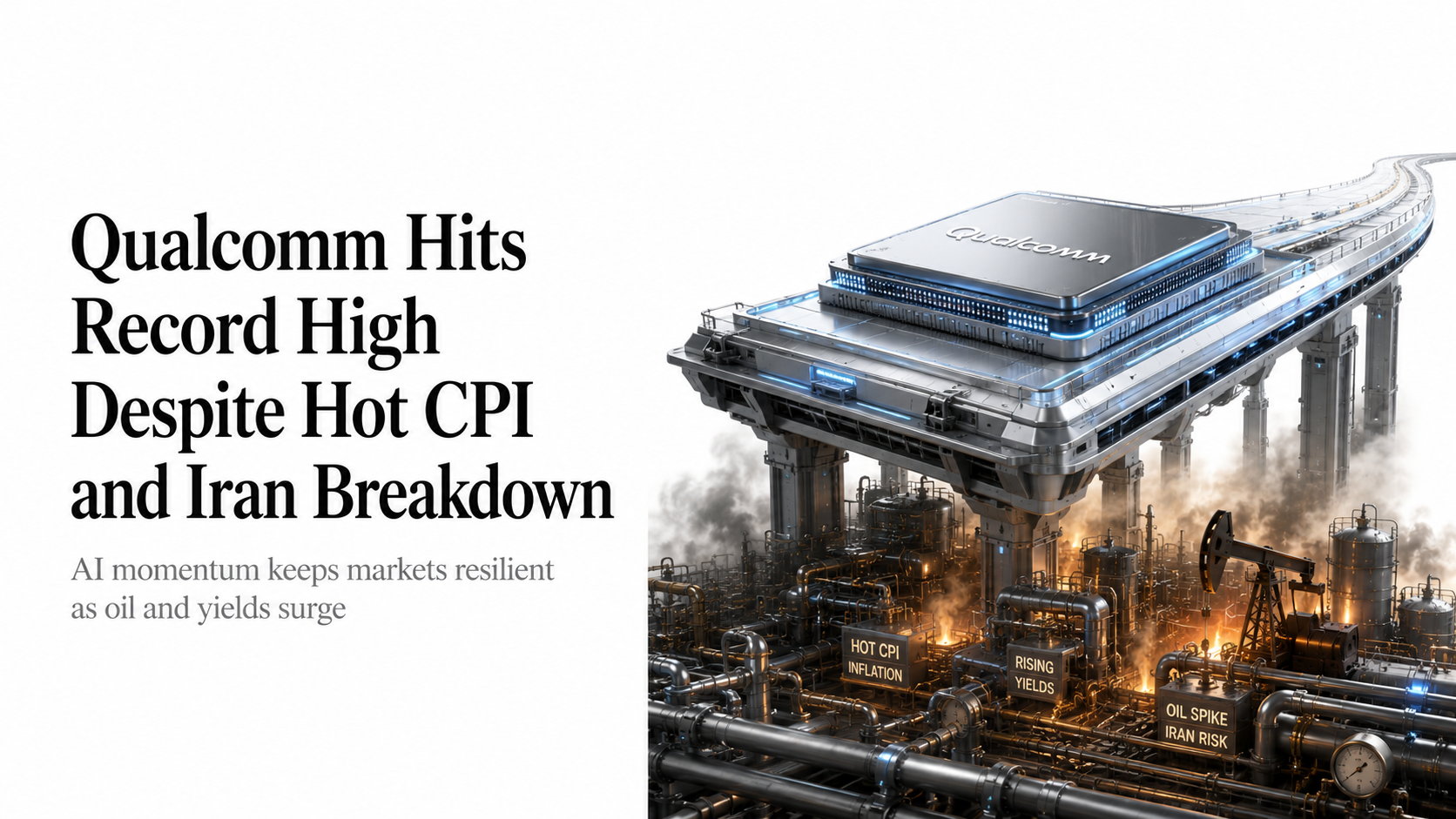
Qualcomm rally and rising oil prices after hot CPI and Iran peace deal collapse

Hot CPI, Qualcomm ATH & Iran Deal Collapse Shake Markets | US Session | May 11th 2026

May 11, 2026
CSFX
US Mid-Session Briefing May 12 2026 — April CPI Hot at 3.7% YoY; QCOM +9% All-Time High on Data Center Win; Iran Deal Dead — Trump “TOTALLY UNACCEPTABLE”; S&P Holds ATH ~7,422; Warsh Confirmation Day; Trump-Xi Beijing Summit Tomorrow | Capital Street FX
LIVE
SPX~7,422▲ +0.31%
DJI~49,700▲ +0.18%
NDX~26,335▲ +0.33%
RUT~2,881▲ +0.70%
VIX~18.11▲ +5.35%
WTI~$98.40▲ +3.12%
BRENT~$104.50▲ +2.8%
GOLD~$4,738▲ +0.16%
BTC~$81,813▲ +0.42%
10Y~4.48%▲ +8bp
QCOM~$247▲ ATH +9%
CPI3.7% YoY▲ ABOVE 3.6% EST
WARSHVOTE⏳ SENATE TODAY
IRANDEAD🔴 TRUMP REJECTED OFFER
SPX~7,422▲ +0.31%
DJI~49,700▲ +0.18%
NDX~26,335▲ +0.33%
RUT~2,881▲ +0.70%
VIX~18.11▲ +5.35%
WTI~$98.40▲ +3.12%
BRENT~$104.50▲ +2.8%
GOLD~$4,738▲ +0.16%
BTC~$81,813▲ +0.42%
10Y~4.48%▲ +8bp
QCOM~$247▲ ATH +9%
CPI3.7% YoY▲ ABOVE 3.6% EST
WARSHVOTE⏳ SENATE TODAY
IRANDEAD🔴 TRUMP REJECTED OFFER
Capital Street FX · US Mid-Session Briefing

US Mid-Session — Tuesday, May 12, 2026
April CPI Prints Hot at 3.7% YoY; Qualcomm Hits ATH +9% on Data Center Hyperscaler Win; Iran Peace Deal Collapses — Trump “TOTALLY UNACCEPTABLE”; Oil Surges $98; Warsh Senate Vote Today; Trump Meets Xi in Beijing Tomorrow

Tuesday’s mid-session presents the market’s most consequential data collision of the week: a hotter-than-expected CPI report arriving on the same day the Iran peace process effectively collapsed after Trump rejected Tehran’s counter-proposal as “TOTALLY UNACCEPTABLE” — and yet the S&P 500 is holding near its all-time high at ~7,422, up 0.31%. The divergence tells a precise story: AI-driven chip earnings — Qualcomm surging 9% to a new all-time high on its confirmed data center hyperscaler win — are carrying the market through a morning that, in any pre-AI-cycle era, would have sent indices down 1–2%. April CPI came in at an estimated 3.7% year-over-year, hotter than the 3.6% consensus, driven by persistent energy inflation from the Iran war now entering its eleventh week. The 10-year Treasury yield surged 8 basis points to ~4.48% on the data — the sharpest single-session move in three weeks — effectively pricing out any remaining probability of Fed rate cuts in 2026. Oil has spiked 3.1% to ~$98 as the Iran deal collapse removes the remaining downside pressure on crude. The market’s response to all of this is chipmakers up, defensives mixed, small caps quietly outperforming at +0.70%, and VIX elevated but contained at 18.11. Three binary catalysts in the next 48 hours will determine this market’s trajectory: the Warsh Senate confirmation vote expected today, Trump’s Beijing summit with Xi Jinping on May 14–15 where Iran is now the dominant agenda item, and Nebius Q1 earnings tomorrow that could extend — or begin to fade — the AI infrastructure re-rating cycle.

Session Overview — Live as of ~14:00 EDT

Tuesday has produced the week’s most complex multi-variable session, with four simultaneous market-moving inputs arriving within six hours of the open. First: April CPI printed at approximately 3.7% year-over-year — above the 3.6% consensus estimate and confirming that Iran-war energy inflation remains the dominant macro headwind. The monthly reading came in at ~0.55%, also above estimates, driven entirely by gasoline and fuel oil. The 10-year yield responded with an 8-basis-point spike to 4.48% — the bond market removing the final residual probability of a 2026 rate cut from the pricing curve. This is the Warsh Fed’s first data inheritance moment. Second: Qualcomm extended its post-earnings surge to an all-time high of $247.90 (+9% intraday), continuing to reprice on CEO Cristiano Amon’s confirmation of data center chip shipments to a leading hyperscaler before end-2026 alongside a $20 billion buyback authorisation. Qualcomm’s move is the session’s primary AI infrastructure catalyst, adding to the prior week’s Palantir, AMD, Super Micro, Datadog, and Akamai confirmation stack. Third: The Iran peace process is, for all practical purposes, dead — at least in its current form. Trump called Tehran’s counter-proposal “TOTALLY UNACCEPTABLE” on Sunday night, saying the ceasefire was “on life support” and “unbelievably weak.” Oil spiked 3.1% to $98 WTI on the news. Iran said its offer was “generous and legitimate.” The only remaining diplomatic pathway now runs through Beijing: Trump meets President Xi Jinping on May 14–15, and the US is explicitly expecting China to pressure Iran into a deal. Fourth: Kevin Warsh’s full Senate confirmation vote is expected today — the first working day with Powell’s term expiring in three days. With 53 Republican seats and Democratic Senator Fetterman signalling support, confirmation appears procedurally certain. Warsh takes over as Fed Chair inheriting a CPI print that just moved above consensus and an Iran oil premium that has now re-expanded.

📊
April CPI ~3.7% YoY — Above 3.6% Consensus; Monthly +0.55%; Energy Drives Overshoot
April Consumer Price Index (BLS, 8:30 AM): Headline YoY ~3.7% (est. 3.6%); MoM ~+0.55% (est. ~0.50%). Core CPI YoY ~2.7% (est. 2.7%, in-line). Energy the primary driver — gasoline continued elevated at high WTI levels averaging ~$95–98 in April. Shelter inflation 3.0% YoY (steady). Food 2.7% (easing). Information services deflating as AI productivity tools displace legacy software spend. 10Y yield surged 8bp to ~4.48% on the print. Rate cut odds for 2026 essentially zeroed out. BofA had forecast 0.55% MoM; Barclays had flagged rent/OER one-off adjustments pushing core slightly higher.
🔴
Iran Peace Deal Collapses — Trump “TOTALLY UNACCEPTABLE”; Oil +3.1% to $98; Ceasefire “On Life Support”
Trump rejected Iran’s counter-proposal on Sunday, calling it “TOTALLY UNACCEPTABLE” on Truth Social. Monday: Trump said the ceasefire was “on life support” and “unbelievably weak.” Iran’s FM Baghaei called Tehran’s offer “generous and legitimate” — stressing lifting of blockade, sanctions relief, and an end to “piracy” against Iranian ships. WTI +3.1% to ~$98 intraday; Brent ~$104.50. New diplomatic pathway: Trump-Xi Beijing summit May 14–15 — Trump expected to request China pressure Iran. Beijing summit now functions as the market’s next Iran deal catalyst window.
📱
Qualcomm +9% All-Time High $247.90 — Data Center Hyperscaler Win; $20B Buyback; Auto Revenue Record
Qualcomm continued its post-April 29 earnings momentum, hitting an all-time intraday high of $247.90 on May 11, +9% on the session. Q2 FY26: EPS $2.65 (beat $2.56 est), Revenue $10.60B (beat $10.56B est). Key catalyst: CEO Cristiano Amon confirmed “initial shipments” of custom silicon to “a large hyperscaler” in the December quarter — entering data center market from zero base. Automotive revenue +38% YoY to record $1.33B. IoT +9%. $20B share buyback. QCOM is up ~42% since earnings — the session’s clearest AI infrastructure momentum carrier. Investor Day June 24 promised “more details and customer wins.”
🏛️
Warsh Senate Vote — Expected Today; Powell Exits May 15; Inherits Hot CPI and Collapsing Iran Deal
Kevin Warsh’s full Senate confirmation vote expected Tuesday, May 12 — three days before Powell’s term expires May 15. Banking Committee advanced 13-11 (party-line April 29). Senate Republicans hold 53 seats; Sen. Fetterman (D-PA) reportedly supportive. Confirmation is procedurally near-certain. Warsh’s policy inheritance: CPI above consensus today, oil near $98, rate cuts priced out for 2026. His first FOMC meeting is June 16–17. Washington Post Monday: “Warsh is expected to be confirmed this week, inheriting an inflation fight the central bank hasn’t yet won.”
🤝
Trump-Xi Beijing Summit — May 14–15; Iran the Dominant Agenda Item; Market’s Next Deal Window
President Trump flies to Beijing for a summit with President Xi Jinping on May 14–15 — the most geopolitically consequential meeting in the Iran war era. Trump is expected to ask China to pressure Iran into accepting a deal. CBS reported Monday that Beijing was already “urging Iran to pursue a diplomatic solution.” China has substantial economic leverage over Iran via sanctions bypass and crude purchases. The Beijing summit is now explicitly the market’s next Iran deal catalyst window — if Xi delivers Iranian concessions, oil could drop $15–20 within 24 hours of any announcement.
🌐
Nebius Q1 Earnings Tomorrow (May 13) Pre-Market; Monday.com +26% AI Platform Launch; LITE Nasdaq-100
Nebius Group (NBIS) reports Q1 2026 results Wednesday May 13 before market open — 602% revenue growth consensus, $388M estimate. NBIS closed ~$193 Monday, up +35% in May, backed by Nvidia $2B deal, Meta $27B and Microsoft $19.4B contracts, and $643M Eigen AI acquisition. Monday.com surged 26% Monday on Q1 beat (Revenue $351M vs $339M est) and AI platform launch driving 24% YoY growth. Lumentum (LITE) +5% on Nasdaq-100 inclusion effective May 18, replacing CoStar — optical/photonic content for AI data center networking re-rated by market. The AI infrastructure earnings momentum is extending into a new week.
Tuesday’s defining tension: the S&P 500 is holding within 30 points of its all-time high while oil surges 3%, CPI beats to the upside, the Iran deal collapses, and the 10-year yield spikes 8 basis points to 4.48% — all simultaneously. That this combination is producing a +0.31% S&P gain rather than a −1.5% sell-off is the most important market signal of the week. The answer is Qualcomm at all-time highs, chipmakers broadly higher, and the AI infrastructure earnings momentum carrying enough structural conviction that the market is re-weighting macro headwinds against earnings upside in real time. The critical question Tuesday asks: Is this resilience sustainable through the three remaining binaries of the week — Warsh confirmation today, Nebius earnings tomorrow, and the Beijing summit Thursday-Friday? If yes, the S&P has a legitimate path to 7,600+ by week-end. If the Beijing summit fails to produce Chinese pressure on Iran and Tehran issues a formal ceasefire termination, oil tests $105 and the AI earnings shield faces its first genuine test.
🔴
Macro Alert — April CPI ~3.7% YoY, Above 3.6% Consensus; Energy-Driven Overshoot; 10Y Yield +8bp to 4.48%
April Consumer Price Index (BLS, released 8:30 AM ET May 12): Headline YoY ~3.7% (above ~3.6% estimate); MoM ~+0.55% (above ~0.50% est). Core CPI YoY ~2.7% (approximately in-line). Energy primary driver — gasoline and fuel oil elevated on sustained Iran war premium. Shelter steady at 3.0% YoY. Food easing at 2.7% YoY. BofA economists had forecast 0.55% MoM headline with “upside risks from food inflation” and flagged OER/rent one-off adjustments pushing core higher. The 10-year Treasury yield responded with an 8 basis-point spike to ~4.48% — the largest single-session yield move in three weeks — effectively pricing out the remaining residual probability of any Fed rate cut in 2026. CME FedWatch rate-cut odds for 2026 approached near-zero. This is the data Kevin Warsh is expected to inherit as the new Fed Chair, confirmed by the Senate this afternoon, and it materially complicates his early June FOMC communication. His theoretical framework that AI productivity gains are structurally disinflationary now requires confronting an April print driven by energy prices he cannot control from behind the Fed’s desk. The oil price — not the labour market — is the dominant inflation driver in 2026, and it spiked further today on the Iran deal collapse.
💥
Geopolitical Alert — Trump Rejects Iran Proposal “TOTALLY UNACCEPTABLE”; Ceasefire “On Life Support”; Oil +3.1% to $98
Iran’s peace process collapsed Sunday-Monday after Trump rejected Tehran’s counter-proposal as “TOTALLY UNACCEPTABLE!” on Truth Social Sunday night. On Monday, Trump told reporters the ceasefire was “on life support” and “unbelievably weak.” Iran’s Foreign Ministry spokesperson Esmaeil Baghaei said Tehran’s proposals were “generous and legitimate” — stressing the need to lift the US blockade on Iranian ships, release frozen assets, and end what Tehran called “piracy” against Iranian vessels. Iran also demanded the Strait of Hormuz reopening and the end of Israel’s war in Lebanon as part of any regional security package. WTI crude surged 3.12% to ~$98.40 by mid-session Tuesday. The remaining diplomatic pathway runs through Beijing: Trump meets President Xi Jinping at a May 14–15 summit where Iran is expected to dominate the agenda. The US is counting on Chinese economic leverage over Iran — which buys the bulk of Iranian oil — to force Tehran back to the table. Analysts at JPMorgan warned Monday that “the supply buffers that have insulated the oil market from the war are eroding,” and flagged that demand destruction would begin accelerating if prices sustained above $100. ANZ Research flagged sustained market volatility until a resolution is confirmed.
📱
Earnings Alert — Qualcomm All-Time High $247.90 (+9%); Data Center Hyperscaler Shipments Confirmed Q4 2026; $20B Buyback
Qualcomm (QCOM) hit an all-time intraday high of $247.90 on May 11, extending its post-April 29 earnings rally to +9% on the session and +42% over the two-week post-earnings period, crossing $700 billion market capitalization. The primary catalyst, per CEO Cristiano Amon’s Q2 FY26 earnings call (April 29): confirmation that Qualcomm’s custom silicon engagement with “a leading hyperscaler” is “on track for initial shipments” in December quarter 2026 — marking Qualcomm’s entrance into the data center market from a zero base. Q2 FY26: Revenue $10.60B (beat $10.56B est); Non-GAAP EPS $2.65 (beat $2.56 est); Automotive revenue +38% YoY to record $1.33B; IoT +9% to $1.73B. A $20 billion share buyback was also announced. Qualcomm Investor Day is June 24 — Amon promised “more details and customer wins” in the data center space. Qualcomm’s move is the session’s clearest AI infrastructure signal and the primary reason chip-related stocks are outperforming on a day that would otherwise be dominated by macro headwinds. Daiwa upgraded QCOM to Outperform with a $225 target on the data center confirmation.
📊

Markets Snapshot — Mid-Session, May 12, 2026 (~14:00 EDT)

US Equity Indices · Live Mid-Session
Tuesday, May 12, 2026
Index Level Change Session Signal Context
S&P 500 ~7,422 ▲ +0.31% AI SHIELDS ATH S&P is holding within 25 points of its all-time high despite a triple macro headwind: hot CPI, Iran deal collapse, and an 8bp yield spike. Chipmakers — Qualcomm, Nvidia, AMD, Micron — are carrying the index. Breadth is mixed: over 55% of S&P 500 constituents are declining even as the index gains — a classic “generals advance, troops retreat” distribution that characterises AI-cycle leadership divergence. Equal-weight S&P underperforming significantly.
Nasdaq Composite ~26,335 ▲ +0.33% QCOM LEADS CHIPS Nasdaq outperforming on the Qualcomm ATH surge, Lumentum Nasdaq-100 inclusion trade, and Monday.com’s 26% post-earnings gain. Tech breadth narrowing to chip names — software stocks mixed as higher yields apply multiple-compression pressure. Nasdaq is at all-time highs intraday for the second consecutive session, but the advance is increasingly concentrated. AMD +2.4%, Nvidia +1.5%, QCOM +9% doing most of the heavy lifting.
Dow Jones Industrial ~49,700 ▲ +0.18% ENERGY/YIELDS DRAG Dow lagging large caps. Chevron and energy names absorbing oil premium while Microsoft, Nike, and consumer discretionary names weigh on the index from yield sensitivity. Dow remains within 300 points of 50,000 psychological level. Boeing flat. Merck +1.4%, Chevron +1.5% providing the energy-driven support. Caterpillar weak on domestic growth concerns from higher energy input costs — same K-shaped dynamic as Russell 2000 vs S&P on May 8.
Russell 2000 ~2,881 ▲ +0.70% SURPRISING OUTPERFORM Russell 2000’s +0.70% outperformance on a day with Iran deal collapse and CPI overshoot is structurally surprising — last Friday the Russell was the session’s worst performer (−1.63%) on exactly this type of geopolitical/inflation combination. Today’s relative strength may reflect short-covering and the residual Tehran-deal optionality that Xi’s summit creates. A meaningful Russell outperformance today implies the market is partially pricing the Beijing summit as a realistic Iran resolution pathway.
VIX ~18.11 ▲ +5.35% FEAR CREEPING HIGHER VIX at 18.11 (+5.35%) is the session’s clearest signal that institutional protection-buying is accelerating even as the index stays near highs. A VIX above 18 in a rising S&P environment suggests institutions are hedging the Beijing summit binary outcome — buying calls on the deal scenario while protecting against the no-deal/escalation downside. Options market pricing a meaningful move this week regardless of direction. VIX at 18–20 is consistent with “uncertainty priced, not panic.”
10Y YIELD
~4.48%
▲ +8bp CPI Spike
2Y YIELD
~4.02%
▲ +5bp
FED FUNDS
3.50–3.75%
● No cuts priced 2026
WARSH VOTE
Today
⏳ BEFORE MAY 15
REAL YIELD
~2.05%
▲ Yield spikes drag
Macro Drivers — May 12 Fundamental Picture
Key signals — live session
DriverLevelSignalImplication
April CPI — Headline ~3.7% YoY ABOVE 3.6% EST Energy-driven overshoot vs consensus. Gasoline and fuel oil remain elevated from Iran war premium. Monthly reading ~0.55% — highest since March’s +0.9% Iran war shock. Core CPI approximately in-line at ~2.7% YoY, suggesting non-energy inflation still contained. The overshoot prevents Warsh from being dovish at his first June FOMC — oil inflation is exogenous to monetary policy but the market holds the Fed accountable for the headline anyway.
April CPI — Core ~2.7% YoY IN-LINE — CONTAINED Core CPI (~2.7% YoY, ~0.34% MoM) landing near estimates is the critical nuance in today’s data. The overshoot is in energy — which is entirely a geopolitical premium, not a domestic demand problem. Shelter holding steady at 3.0%, food easing at 2.7%. Information services continuing to deflate as AI productivity tools replace legacy software contracts. The Fed cannot control oil, but it can point to contained core as evidence the underlying economy is not overheating.
Iran Peace Process COLLAPSED TRUMP REJECTED OFFER Ceasefire effectively “on life support” per Trump. Iran’s counter-proposal — focused on lifting the US blockade, sanctions relief, and an end to what Tehran called “piracy” against its ships — was categorically rejected. Oil immediately repriced upward $3. The only near-term diplomatic pathway runs through Xi Jinping. If Beijing delivers Iranian concessions at the May 14–15 summit, oil could drop $15–20 within hours. If Beijing delivers nothing, oil tests $105 and the 10-year approaches 4.65%.
Warsh Confirmation Expected Today SENATE VOTE IMMINENT Kevin Warsh’s full Senate vote expected May 12 ahead of Powell’s May 15 term expiry. 53-seat Republican majority + Fetterman support makes confirmation procedurally near-certain. Today’s hot CPI complicates his inheritance but does not change his framework: AI productivity is structurally disinflationary; oil inflation is exogenous; the June FOMC is a data-watch meeting, not a cut meeting. Warsh’s market signal value today: will he comment on CPI post-confirmation? Any hawkish lean will spike yields further.
Beijing Summit (May 14–15) Trump-Xi IRAN DEAL CATALYST WINDOW The market has implicitly designated the Beijing summit as the new Iran deal deadline — replacing the weekend’s failed direct negotiations. If Xi delivers Chinese pressure that forces Tehran back to the table, the market’s next catalyst is a $10–20 oil drop and an S&P 500 acceleration toward 7,600+. If the summit produces only US-China trade dialogue without Iran progress, the war premium is structurally embedded in oil through at least June. The summit is the week’s highest-impact unknown.

The April CPI print is the most structurally important data point of the week, and not because it beats consensus by 0.1 percentage point. It matters because it arrives on the same day the Iran deal collapsed, confirming the market’s worst-case scenario for the Warsh Fed’s first months in office: an incoming chairman inheriting above-target inflation driven entirely by a geopolitical war premium he cannot address through monetary policy. The March CPI was +3.3% YoY — already elevated. April at ~3.7% represents a further acceleration, with the trajectory pointing away from the Fed’s 2% target rather than toward it. The bond market’s response — 8 basis points off the open, 10-year at 4.48% — is the fastest and most direct market signal of the week. The Fed funds futures strip is now pricing no cuts in 2026, and the first cut probability in 2027 is declining. The critical mitigating data point is that core CPI remains approximately contained at 2.7% YoY. The overshoot is entirely in energy — which means it is entirely in Iran. A Beijing summit deal that reopens the Strait of Hormuz within 30 days would mechanically remove approximately 0.3–0.5 percentage points from headline CPI within two monthly reading cycles. That is not monetary policy — it is geopolitics — but the bond market will re-price aggressively the moment any Hormuz reopening timeline is confirmed. Today’s session is the market asking: do you trust the AI earnings story more than you fear the geopolitical macro? The answer, for now, is yes — the S&P is holding ATH territory. But the VIX at 18.11, the 10-year at 4.48%, and the below-surface breadth deterioration (55% of S&P names declining while the index gains) are all telling a more cautious story than the headline index level suggests.

🪙

Commodities & Crypto — Oil +3% on Iran Collapse; Gold Steady; Bitcoin Recovering

Commodities & Digital Assets — May 12 Mid-Session
Live prices as of ~14:00 EDT
AssetPriceMoveSignalCommentary
WTI Crude Oil ~$98.40 ▲ +3.12% IRAN DEAL COLLAPSE WTI surging on Trump’s “TOTALLY UNACCEPTABLE” Iran rejection, removing the weekend’s residual deal-optimism discount. JPMorgan warned Monday that supply buffers are eroding and demand destruction is accelerating. The war premium at $98 is approximately $10–15 above pre-war equilibrium. Eyes now on Beijing summit as the sole near-term catalyst for any oil price relief. Testing $100 if no progress Thursday-Friday.
Brent Crude ~$104.50 ▲ +2.80% HORMUZ PREMIUM RESET Brent back above $104 — the key psychological level for European energy inflation implications. Iran also warned that any UK or French warships in the Strait of Hormuz “will be met with a decisive response,” escalating the threat to Western naval traffic. European energy inflation re-pricing as a consequence. FTSE energy names rallying; European industrials under pressure.
Gold (XAU/USD) ~$4,738 ▲ +0.16% STAGFLATION BID RETURNS Gold holding steady near all-time highs as the hot CPI and Iran deal collapse both reinforce its dual thesis — stagflation hedge (oil inflation + no rate cuts) and geopolitical premium (war uncertainty). Gold does not need an Iran resolution to rally; it rises in both the “deal” scenario (rate cut expectations return) and the “no deal” scenario (stagflation premium compounds). The balanced setup makes gold the lowest-volatility macro position in the current environment.
Bitcoin (BTC/USD) ~$81,813 ▲ +0.42% RANGE-BOUND RECOVERY Bitcoin recovering modestly from Monday’s ~$80,000 level, aided by Circle Internet Group’s positive Q1 earnings (stablecoin USDC market cap ~$80B) and continued institutional custody flows. BTC is down 7.2% year-to-date and 22% over the past year — a stark underperformance vs equities and gold that reflects the risk-off impulse from sustained oil-driven inflation reducing risk asset positioning.
10-Year Treasury ~4.48% ▲ +8bp CPI-DRIVEN SPIKE The 8bp spike on this morning’s CPI data is the bond market definitively closing the rate-cut book for 2026. Real yields approaching 2.05% — the highest since before the last Fed cutting cycle began. Wolfe Research had flagged that 10-year yields “will not go down to pre-war levels if the US and Iran reach a resolution” — but they hadn’t accounted for the deal collapsing entirely. The Iran-no-deal scenario at 4.48% is the Warsh Fed’s baseline starting yield.
WTI Crude — Key Levels
R2$105–108Full ceasefire collapse scenario; Brent tests $115
R1$100–102Psychological level; Beijing summit fails to break impasse
LIVE~$98.40Iran deal collapse + CPI hot → war premium reasserting
S1$93–95Beijing summit positive signal; Chinese pressure on Iran confirmed
S2$82–85Full Iran deal; Hormuz reopening confirmed; demand destruction reversal
S&P 500 — Key Levels
R27,600–7,650Beijing summit delivers; Iran deal re-opened; oil −$15; rate cut re-priced
R17,500–7,530Warsh confirmed; Nebius beats; AI earnings extend 7th week
LIVE~7,422AI earnings shield holding ATH vs hot CPI + Iran collapse
S17,300–7,350Beijing summit delivers nothing; oil $102+; yield 4.60%
S27,150–7,200Iran formal ceasefire termination; oil $108+; Warsh hawkish signal at June FOMC
💹

Earnings in Focus — Week of May 11–15, 2026

⚡ Earnings Review & Upcoming Catalysts
Week of May 12–16, 2026
Company Result / Status EPS / Revenue Market Reaction & Commentary
QualcommQCOM — Q2 FY26 (Apr 29, continuing) BEAT + EXTEND EPS $2.65 vs $2.56 est
Rev $10.60B vs $10.56B est
ATH $247.90 (+9% May 11, +42% post-earnings). CEO Amon confirmed custom data center silicon for “a leading hyperscaler” shipping December quarter 2026. Automotive +38% YoY record. $20B buyback. AI data center entry re-rates QCOM from smartphone/edge to infrastructure play. Investor Day June 24 = next catalyst for customer disclosure.
Monday.comMNDY — Q1 2026 (May 11) BEAT + RAISED Rev $351.3M vs $339.1M est
+24% YoY
+26% Monday on AI platform launch driving 24% YoY revenue growth — highest growth rate in six quarters. Company launched native AI automation suite across workflows, driving net new ARR acceleration. Guidance raised above Street consensus. The clearest enterprise AI adoption signal of the week: AI is moving from experimentation to workflow replacement at scale in SMB and mid-market.
Circle Internet GroupCRCL — Q1 2026 (May 11) EPS BEAT / REV MISS EPS beat Wall St est
Rev slightly missed
+3.2% on earnings beat despite revenue miss. USDC stablecoin market cap ~$80B — a record. CLARITY Act passage prospects boosting institutional confidence in stablecoin regulatory framework. Circle’s Q1 is the first post-IPO earnings — market accepted the mixed result given stablecoin market share momentum and rising institutional adoption of USDC as settlement infrastructure.
LumentumLITE — Nasdaq-100 Inclusion INDEX INCLUSION Replaces CoStar Group
Effective May 18
+5% Monday. Nasdaq-100 inclusion forces passive index fund mandatory purchases before May 18. Lumentum is a photonic and optical components maker — its inclusion reflects the AI data center networking buildout (optical interconnects are a critical AI infrastructure bottleneck). Rothschild & Redburn initiated Buy earlier in May citing AI data center optical content growth. The inclusion is a structural demand catalyst independent of earnings.
Nebius GroupNBIS — Q1 2026 (Tomorrow, May 13) ⏳ TOMORROW PRE-MARKET Est: Rev $388M (+602% YoY)
Q1 conf. call 8:00 AM ET
Most anticipated earnings of the week. NBIS up +35% in May, +133% YTD, +610% past year. $27B Meta deal, $19.4B Microsoft deal, Nvidia $2B investment, $643M Eigen AI acquisition. If ARR trajectory, EBITDA margin, and hyperscaler deployment updates beat — NBIS could move +15–20%. Options market pricing +7.9% move. The AI infrastructure neocloud thesis faces its next data point tomorrow morning — could extend or begin to fade the sector re-rating.
Cisco SystemsCSCO — Q3 FY26 (Wednesday, May 13) ⏳ WEDNESDAY POST-MARKET Est: Rev ~$15.5B (+~10% YoY)
AI networking focus
Cisco’s Q3 is the week’s second major AI networking catalyst. Revenue consensus ~$15.5B (+10% YoY). Key watch: AI data center networking orders (Ethernet switching, optical routing), full-year guidance revision, and management commentary on AI infrastructure demand visibility. Stock flagged as “highly overbought” technically (RSI in overbought territory per CFRA’s Sam Stovall). Any guidance raise on AI networking could push to new highs; any revenue shortfall in traditional enterprise hardware would pressure.

Trade Setups — May 12 Session Themes

⚡ Key Trade Setups — May 12, 2026
For informational purposes only — not financial advice
Asset Direction Entry Zone Target Stop Thesis
WTI Crude Oil LONG BIAS $96–98 $104–108 (no deal) $91 Iran deal dead; ceasefire on life support; supply buffers eroding per JPMorgan. Hot CPI confirms energy inflation is not transient. Beijing summit is the only near-term deal catalyst but structural short-covering suggests oil holds elevated even if summit produces diplomatic language without confirmed reopening. Risk: Xi delivers concrete Iran commitments → $15–20 drop immediately.
Gold (XAU/USD) LONG BIAS $4,700–4,740 $4,900+ $4,600 Gold wins in both scenarios: No Iran deal → stagflation hedge bid accelerates (oil premium + above-target CPI + no rate cuts). Iran deal via Beijing → rate cut expectations return (Fed can ease on lower oil/CPI) → gold reprices higher on yield compression. Below-surface yield spike today is being absorbed by gold’s geopolitical premium rather than causing a gold selloff. Strongest dual-scenario trade in the current environment.
S&P 500 / SPX LONG BIAS 7,380–7,430 7,600+ (Beijing deal) 7,280 AI earnings stack (Palantir, AMD, SMCI, Datadog, Akamai, QCOM, Monday.com) providing structural support. Warsh confirmation removes Fed transition uncertainty. Beijing summit is the binary: positive outcome (oil drops $15, yields fall 20bp, rate cuts re-priced) → S&P 7,600+ by Friday. Negative outcome (deal still dead after summit) → S&P tests 7,300. The asymmetry favours the long: base case assumes at minimum diplomatic progress in Beijing.
Qualcomm (QCOM) MOMENTUM LONG $235–248 $270–280 $215 Data center entry confirmed; hyperscaler silicon shipment December 2026; automotive at record $1.33B; $20B buyback. Investor Day June 24 is the next catalyst for customer name disclosure. At current price QCOM is transitioning from smartphone/edge valuation (~15x) to infrastructure valuation (~25–30x) — still in the early innings of the re-rate. The AI data center TAM expansion story is structural, not cyclical.
USD/JPY SHORT BIAS 152–155 145–147 (Beijing deal) 158 Beijing deal → oil drops → US inflation eases → rate cut probability returns → USD weakens vs JPY. Today’s 10-year spike to 4.48% is temporarily supporting dollar, but the structural USD/JPY short thesis remains intact for the Beijing catalyst. Warsh post-confirmation communication risk: any hawkish language delays the trade. The asymmetric payoff is significant — a confirmed Hormuz reopening timeline could move USD/JPY 500–700 pips within 48 hours.
⚡ Execute these setups at Capital Street FX — capitalstreetfx.com · 1:10,000 leverage · WTI · Gold · SPX · FX · BTC — 900% Deposit Bonus Available

🤔 Analyst Q&A — Tuesday May 12, 2026

The S&P’s ability to hold ~7,422 against Tuesday’s quadruple headwind — hot CPI, Iran deal collapse, oil $98, and 10-year at 4.48% — is not evidence that the market is being complacent. It is evidence that the AI earnings thesis has, for the first time in this cycle, genuinely overpowered macro headwinds in real-time. The structural explanation has several layers. First, breadth is deteriorating beneath the surface: over 55% of S&P 500 constituents are declining today even as the index gains 0.31%. The index-level resilience is entirely the product of the chip sector — Qualcomm at all-time highs, AMD +2.4%, Nvidia +1.5%, Micron advancing — whose weighting in the S&P is sufficient to pull the headline number positive while the median S&P stock is down. This is not broad strength; it is concentrated strength. Second, the market is pricing a very specific narrative: the Iran deal is not dead, it is deferred to Beijing. The VIX at 18.11 — elevated but not panicked — is pricing the summit binary, not a permanent deal collapse. If the market genuinely believed the Iran war was indefinite, oil would be at $110 and the S&P would be at 7,100. The 7,422 level is saying: “we believe Beijing will deliver something.” Third, the core CPI reading at approximately 2.7% YoY (in-line) is the nuance the market is using to justify its position. The overshoot is in headline — driven by energy — not in core. The market is reading today’s data as “energy is a geopolitical problem, not a demand problem, and Beijing can fix it.” The risk of this framework is that it requires the Beijing summit to deliver. If Trump returns from Beijing with diplomatic language but no concrete Iranian commitments, the market will need to price a sustained war premium, and the current S&P valuation at 20.9x forward earnings cannot absorb both 4.48% yields and $100 oil indefinitely.
Warsh’s policy inheritance today is, objectively, more complicated than any incoming Fed chair has faced since Volcker in 1979 — and the diagnosis of why matters for what traders should watch. The three specific signals to monitor: First, watch whether Warsh makes any public statement between confirmation and the June 16–17 FOMC meeting — and if so, whether he frames the oil-driven CPI overshoot as “exogenous and temporary” or as “inflationary and requiring a monetary policy response.” Volcker would have treated a 3.7% headline CPI as requiring action regardless of origin. Warsh’s stated framework — AI productivity is structurally disinflationary — implies he would view energy-driven headline inflation as a geopolitical problem, not a demand problem, and hold rates while the Iran situation resolves. Any language that signals otherwise is a major hawkish surprise. Second, watch his opening FOMC press conference tone. Warsh told his confirmation hearing he would be “strictly independent” and reform the Fed’s communication style — “less forward guidance, less reliance on the dots.” A shorter, less committal press conference statement than Powell would have given is itself a signal: it means the market needs to read macro data, not Fed communication, for rate path guidance. That shifts equity and bond pricing frameworks materially. Third, watch his balance sheet language. Warsh has historically been hawkish on quantitative tightening — faster balance sheet reduction, less reinvestment. If he signals accelerated QT at his first June meeting, that is an additional headwind to equities beyond the rate hold, because it removes a secondary demand support for Treasuries. The bottom line: the most hawkish Warsh surprise would be if he treats today’s CPI as justification for rate hikes — his confirmation hearing gave no indication he intends this, but the data now provides technical justification that Powell’s Fed would not have had.
The Qualcomm re-rating is one of the most instructive examples of AI infrastructure market pricing in 2026, and it reveals a structural dynamic that applies far beyond Qualcomm itself. The 42% post-earnings move on a data center entry announcement from a company with essentially zero data center revenue requires an explanation that goes beyond conventional earnings upside. The key: the market is not pricing Qualcomm’s current data center revenue — which is zero — it is pricing what Qualcomm’s data center entry signals about the total addressable market of AI infrastructure. Here is the specific mechanism. Qualcomm’s core competency is custom silicon: energy-efficient ARM-based chip design optimised for specific workloads. When CEO Cristiano Amon discloses a custom silicon engagement with “a large hyperscaler” for December 2026 shipment, the market is reading two things simultaneously. First: Qualcomm has cracked the hyperscaler custom silicon market — demonstrating that AI inference workloads can be more efficiently run on purpose-built Qualcomm silicon than on Nvidia GPUs or AMD MI-series chips for certain decode-heavy tasks. This is a direct threat to Nvidia’s monopoly on AI accelerator spend that the market has been theorising for three years but now has a concrete manifestation. Second: If Qualcomm — a company not historically associated with data center infrastructure — is winning hyperscaler custom silicon contracts, it confirms that the AI data center TAM is so large that hyperscalers are simultaneously buying from Nvidia, AMD, Broadcom (custom ASICs), and now Qualcomm, to diversify their compute stack and avoid single-vendor dependency. The market is pricing the TAM expansion, not just Qualcomm’s specific revenue opportunity. The $700 billion market cap Qualcomm crossed Monday is justified not by December 2026 shipments but by the implication that Qualcomm’s data center business — currently zero — could scale to $3–5 billion annually by 2029 if the hyperscaler relationship is confirmed and extended. At 25x earnings on $3–5B in data centre revenue alone, that is $75–125 billion of additional market cap that the market is beginning to pre-price. The June 24 Investor Day is when Amon will either confirm or walk back that trajectory — making it the next critical catalyst for the QCOM position.
China’s leverage over Iran is the single largest underappreciated variable in the Iran war story — and the Beijing summit is the mechanism by which that leverage gets tested in public for the first time. Here is the structural anatomy of China’s Iran leverage. China purchases approximately 80–85% of all Iranian crude oil exports, routed through a network of shadow tankers and third-country intermediaries that circumvent US sanctions. This is not a minor relationship — it is Iran’s economic lifeline. Iran’s 2026 fiscal budget is essentially built around continued Chinese crude purchases at prices above $85/barrel. Without Chinese demand, Iran’s government revenue collapses within 12–18 months. China also provides Iran with essential manufactured goods, technology imports, and financial clearing services through Chinese state banks that operate outside the SWIFT system. The leverage China has, if it chooses to exercise it, is existential for the Iranian economy. The question is whether Xi will use it. Xi has multiple competing interests: he wants to maintain the Iranian crude import pipeline (cheaper oil for China), he wants to avoid being seen as a US proxy in the Middle East, and he wants to preserve his image as a neutral mediator rather than a coercive power. The most likely scenario from Beijing is not an explicit ultimatum to Iran — it is a private communication from Xi to Khamenei that Chinese crude purchases will be “reviewed” if Iran does not engage substantively with the US peace framework. That message does not need to be public to move markets. The specific oil price trigger from the summit is not a formal deal announcement — it is a credible signal that Iran will return to negotiations within 30 days. Any statement from Beijing that Iran has agreed to resume talks with a concrete timeline would likely move WTI from $98 to $82–85 within 24 hours, as traders front-run the eventual Hormuz reopening. The reverse is equally sharp: if Trump returns from Beijing with only a statement about “productive discussions” and no Iranian commitment, the oil market will interpret that as indefinite war premium and WTI tests $105.
Nebius at 602% projected Q1 revenue growth is the starkest single data point of what the AI infrastructure supercycle looks like from the ground level. It is worth contextualising this number properly, because raw percentage growth at low base revenue can be misleading. The full structural picture: Nebius (formerly Yandex’s cloud infrastructure business, rebranded in 2024 after the Russia divestiture) ended 2025 with approximately $1.25 billion in annualised revenue run rate. The 602% consensus growth estimate for Q1 2026 implies approximately $388 million in quarterly revenue — an annualised $1.55B+ rate — driven almost entirely by GPU cluster utilisation revenue from its data center buildout. This is not financial engineering; it is the raw physical consequence of deploying dense GPU infrastructure at a moment when every frontier AI lab and hyperscaler is paying premium rates for compute they cannot otherwise source. The $27B Meta deal and $19.4B Microsoft deal are not revenue today — they are contracted backlog. But the backlog figure — approximately $46B+ in committed contracts against a current revenue run rate of $1.25B — is the single most compelling evidence of the AI infrastructure demand picture available in public markets. To contextualise: $46B in backlog on $1.25B in annual revenue implies a backlog/revenue multiple of approximately 37x. The software industry at peak cloud-era growth (2018–2021) saw best-in-class companies with 3–5x revenue backlog ratios. Nebius’s 37x ratio is only explainable by one thing: AI infrastructure demand has arrived so rapidly that supply cannot catch up even with aggressive capital deployment. Nvidia’s $2B investment and the joint $300MW New Jersey data center facility crystallise the physics: you cannot instantly build 300MW of GPU-dense data center capacity — it takes 12–18 months from planning to deployment. Nebius’s revenue is currently the portion of its backlog it has physically deployed. Tomorrow’s Q1 print is the market asking: is the deployment accelerating on schedule, and is the backlog converting to revenue at the rate the equity valuation requires? If yes, NBIS tests $200+ this week and the neocloud AI infrastructure thesis extends. If the ARR trajectory disappoints or EBITDA margin compresses beyond expectations due to heavy capex, the stock could give back 15–20% of its May gains — taking some momentum out of the broader AI infrastructure re-rating. The options market is pricing a +/- 7.9% move either way, suggesting the earnings day binary is being treated with appropriate humility even by the bulls.

Mid-Session Summary — Tuesday, May 12, 2026

Tuesday’s session has produced the clearest demonstration yet of the 2026 market’s structural hierarchy: AI-driven chip earnings are powerful enough to hold indices at all-time highs even when oil is at $98, CPI is above consensus, the Iran peace deal has collapsed, and the 10-year yield has spiked 8 basis points in a single morning. Qualcomm’s 42% post-earnings surge to an all-time high of $247.90 — on the single catalyst of a confirmed data center hyperscaler silicon shipment in December 2026 — is the most precise expression of what the market is pricing: not Qualcomm’s current zero data center revenue, but the total addressable market expansion that a new entrant in the hyperscaler custom silicon market implies. The AI infrastructure earnings stack now runs seven layers deep: Palantir (AI software), AMD (AI chips), Super Micro (AI servers), Datadog (AI observability), Akamai (AI network/cloud), Monday.com (AI enterprise automation), and now Qualcomm (AI data center silicon). Each successive confirmation adds structural conviction to a thesis that began as a speculation and is increasingly resembling a documented fact of the global economy.

The session’s dominant headwind — the April CPI print at ~3.7% YoY, the Iran deal collapse, oil at $98, and the 10-year at 4.48% — is the market’s heaviest simultaneous macro load of the week. Kevin Warsh takes over as Fed Chair today, inheriting an inflation problem entirely driven by a geopolitical war he cannot address with interest rates. The bond market’s removal of all 2026 rate-cut probability is the correct response to today’s data: the only path to rate cuts this year runs through a Hormuz reopening, and the only path to a Hormuz reopening now runs through the Beijing summit. Trump’s meeting with Xi on May 14–15 is no longer a trade diplomacy event — it is the Iran war’s most consequential external pressure point.

The next 72 hours are the most consequential binary window of May 2026. Warsh confirmation today removes the final Fed transition uncertainty. Nebius Q1 earnings tomorrow validate or begin to fade the AI neocloud re-rating cycle. Beijing summit Thursday-Friday either unlocks the final macro headwind — the Iran oil premium — or confirms it as a structural feature of 2026 markets. If all three resolve constructively: Warsh confirmed without controversy, Nebius reports explosive ARR growth, and Beijing produces a credible Iranian commitment to re-engage — the S&P has a clear path to 7,600+ and the seven-week winning streak becomes an eight-week defining moment. If any one of the three surprises negatively — especially if the Beijing summit delivers nothing on Iran — the market’s AI-vs-macro high-wire act becomes materially harder to sustain at 20.9x forward earnings with 4.48% risk-free rates and $98 oil. For now, the AI earnings shield is holding. Tehran’s response to Beijing is the question the market cannot answer yet.
Risk Disclosure: This mid-session briefing is published by Capital Street FX (capitalstreetfx.com) for informational and educational purposes only. It does not constitute financial advice or a solicitation to trade. Prices referenced are intraday estimates sourced from public market feeds as of approximately 14:00 EDT May 12, 2026, and are subject to change before the official close at 16:00 EDT. S&P 500, Nasdaq, Dow, VIX, Russell 2000, and sector performance from Yahoo Finance, Investing.com, and TheStreet live updates May 12, 2026. April 2026 CPI estimate sourced from BLS schedule release May 12, 2026 at 8:30 AM ET, with forecasts from BofA Securities, Kiplinger, and Barclays as cited. Qualcomm Q2 FY26 earnings and data center hyperscaler disclosure from CNBC, SiliconANGLE, Futurum, SEC 8-K filing April 29, 2026. Qualcomm ATH from CoinCentral and Parameter May 11, 2026 reporting. Iran peace deal collapse from CNBC stock market today May 10–11 2026, Bloomberg May 11, TheStreet May 11, and Truth Social statements as quoted by CNBC. Trump-Xi Beijing summit from CBS News May 11, TheStreet May 11, 2026 reporting. Kevin Warsh confirmation status from Washington Post May 11, Al Jazeera, Fortune, and Wikipedia as cited. Monday.com Q1 2026 results from CNBC May 11. Nebius earnings preview from StockAnalysis.com, Robinhood, TipRanks May 5–11, 2026. Lumentum Nasdaq-100 inclusion from Investing.com and CNBC. Oil price data from Yahoo Finance and Investing.com live feeds. Gold price from Yahoo Finance. Bitcoin from Yahoo Finance. 10-year yield from Investing.com. CFD trading involves significant risk and is not suitable for all investors. You may lose more than your initial deposit. Past market analysis does not guarantee future results. Capital Street Intermarkets Limited is regulated by the FSC of Mauritius (Licence No. C112010690). Capital Street Bancclear Corporation is regulated by the FSA of Saint Vincent and the Grenadines (Licence No. 22064-IBC-2014). Always conduct your own due diligence and consult a licensed financial advisor before trading.