
Global Forex & CFD Broker | 1:10,000 Leverage

Mobile Header & Menu
AI stock selloff and oil breakout above $111 in market close trading analysis with Nasdaq drop and rising volatility

Market Close Trading Analysis: AI Selloff, Oil Breakout Above $111, Volatility Rising | 28 April 2026

April 28, 2026
CSFX
US Closing Session Briefing April 28 2026 — OpenAI Revenue Miss Sinks Chips, UAE Exits OPEC, Iran Collapse Signal | Capital Street FX
CLOSE
SPX7,124▼ −0.70%
DJI49,274▲ +0.22%
NDX24,553▼ −1.35%
RUT2,796▲ +0.40%
VIX19.06▲ +5.77%
WTI$100.03▲ +3.80%
BRENT$111.57▲ +2.97%
GOLD$4,586▼ −2.08%
BTC$76,705▼ −1.71%
DXY98.74▲ +0.25%
10Y4.35%▲ +3bp
KO+6.3%▲ EPS BEAT
GM+4.2%▲ GUIDANCE RAISE
NVDA−3.3%▼ OPENAI MISS
ORCL−5.2%▼ OPENAI EXPOSURE
ARM−7.4%▼ AI SELLOFF
SPX7,124▼ −0.70%
DJI49,274▲ +0.22%
NDX24,553▼ −1.35%
RUT2,796▲ +0.40%
VIX19.06▲ +5.77%
WTI$100.03▲ +3.80%
BRENT$111.57▲ +2.97%
GOLD$4,586▼ −2.08%
BTC$76,705▼ −1.71%
DXY98.74▲ +0.25%
10Y4.35%▲ +3bp
KO+6.3%▲ EPS BEAT
GM+4.2%▲ GUIDANCE RAISE
NVDA−3.3%▼ OPENAI MISS
ORCL−5.2%▼ OPENAI EXPOSURE
ARM−7.4%▼ AI SELLOFF
Capital Street FX · US Closing Session Briefing

US Close — Tuesday, April 28, 2026
OpenAI Revenue Miss Sinks AI Chip Stocks, UAE Exits OPEC, Iran Claims “State of Collapse” as Brent Breaks $111

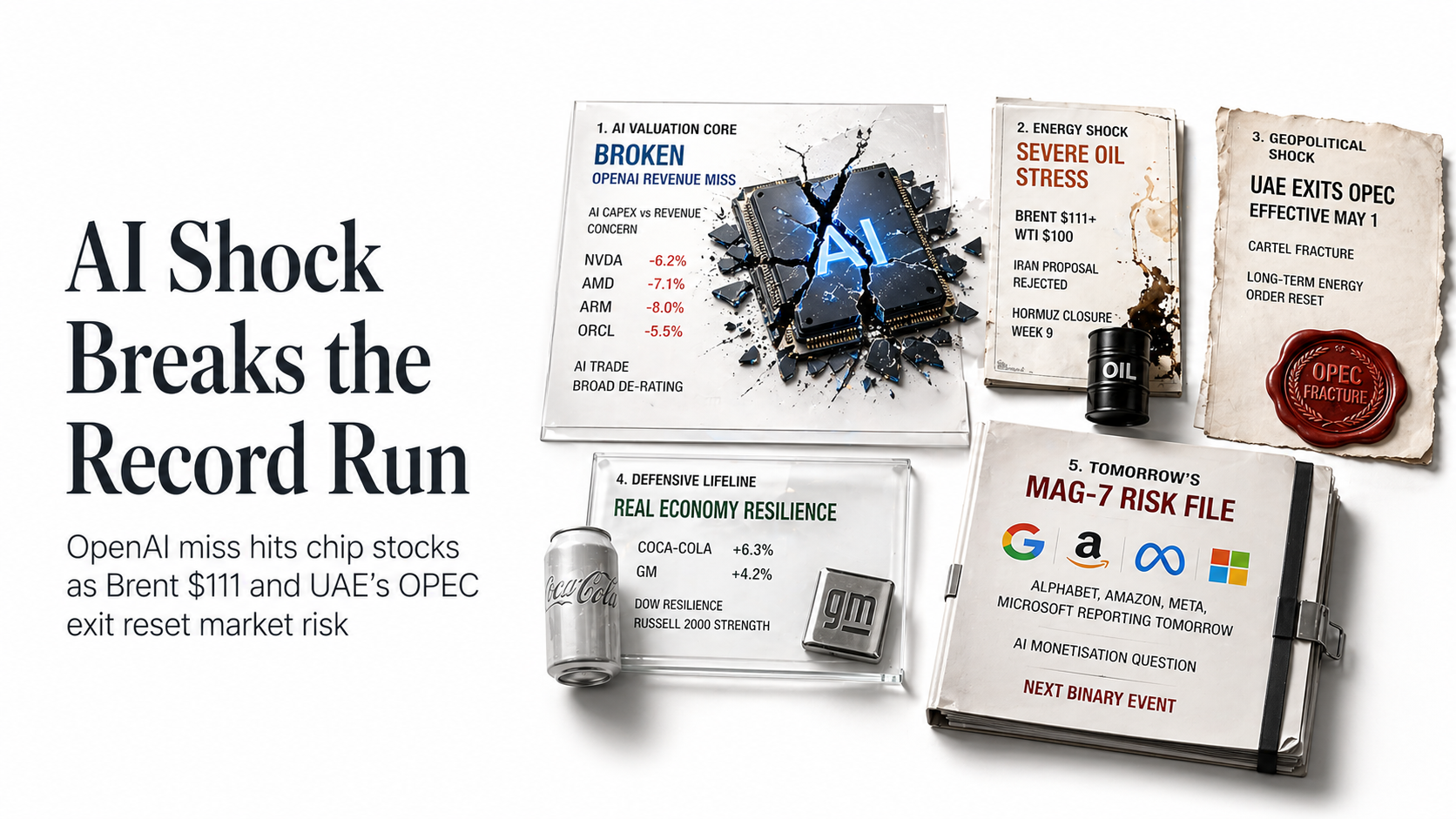
The S&P 500 retreated −0.70% from Monday’s record close as three simultaneous shocks converged: a Wall Street Journal report revealing OpenAI missed its own revenue and user targets sent Nvidia −3.3%, AMD −5.5%, ARM −7.4%, and Oracle −5.2% into sharp declines, reopening the AI capex-vs-revenue debate that has haunted the market for months. Brent crude punched above $111 — its highest level since the conflict began — after Trump declared Iran is in a “state of collapse” and flatly rejected Tehran’s latest Hormuz peace proposal. The UAE’s stunning OPEC exit, effective May 1, reshuffled the entire energy order mid-session. The bulls found their one lifeline: Coca-Cola surged +6.3% on a blockbuster Q1 beat and guidance raise, while General Motors jumped +4.2% after crushing earnings estimates by 41%. Tomorrow’s Mag-7 parade — Alphabet, Amazon, Meta, Microsoft — is now the most consequential single day of the earnings season.

Session Overview

Tuesday reversed Monday’s record-high celebration with a technology-led selloff rooted in the most fundamental question haunting AI markets: is the AI revenue story catching up to the AI spending story? The Wall Street Journal’s report that OpenAI missed both user growth and revenue targets — and that CFO Sarah Friar warned internally about the company’s ability to fund future compute contracts — arrived at the worst possible moment: the eve of Mag-7 earnings week. Simultaneously, Trump rejected Iran’s Hormuz peace proposal as insufficient, calling Tehran “in a state of collapse” while declaring any deal must address nuclear ambitions — a stance that sent Brent through $111 and signalled the strait remains closed for the foreseeable future. And in the most structurally significant geopolitical energy development of the year, the UAE announced it will exit OPEC effective May 1, dealing a historic blow to the cartel’s price-management architecture at the worst possible moment for Gulf producers. The Dow Jones, shielded by Coca-Cola’s extraordinary defensive performance, eked out a +0.22% gain, masking the Nasdaq’s −1.35% rout.

🤖
OpenAI Revenue Miss — WSJ Report
WSJ: OpenAI missed internal revenue and user targets. CFO Friar warned about ability to fund future compute contracts. Nvidia −3.3%, AMD −5.5%, ARM −7.4%, Oracle −5.2%, CoreWeave −6%. SoftBank plunged 10% in Tokyo.
🛢️
UAE Exits OPEC — Effective May 1
UAE announces departure from OPEC and OPEC+ effective May 1 — historic blow to cartel. UAE produces ~4M bpd and has long chafed under quota restrictions. Could add 1M+ bpd long-term. OPEC now even more Saudi-centric.
💣
Trump Rejects Iran Proposal — “State of Collapse”
Trump says Iran is in a “state of collapse,” rejects Hormuz reopening deal that excludes nuclear talks. Rubio: any agreement must definitively prevent Iran nuclear sprint. Brent surged above $111. Strait effectively remains closed — week 9.
🥤
Coca-Cola +6.3% · GM +4.2% — Defensive Anchors
KO: Q1 EPS $0.86 vs $0.81 est. (+6.17% beat). Revenue $12.5B, organic growth +10%. Full-year EPS guidance raised to 8-9%. GM: Q1 adj. EPS $3.70 vs $2.62 est. (+41% beat). EBIT guidance raised to $13.5B–$15.5B on $500M tariff windfall.
📅
Tomorrow: Mag-7 Earnings Day — The Reckoning
Alphabet, Amazon, Meta, Microsoft all report Wednesday April 29. Apple follows Thursday. After OpenAI’s revenue miss, the AI monetisation question is front and centre. Every Mag-7 CEO must now answer: is your AI spend generating revenue at the pace you projected?
🏦
Fed Holds Wednesday · Powell’s Possible Final Meeting
CME FedWatch: 100% probability of rate hold at 3.50–3.75%. This may be Jerome Powell’s final meeting as chair before Kevin Warsh takes over in May. Markets watch for any hawkish signal on elevated oil-driven inflation. 10Y yield at 4.35%.
⚠️ Tuesday’s dominant risk message: The OpenAI revenue miss is not just a story about one company — it is the market’s first empirical data point questioning whether the AI spending supercycle can sustain itself at current capex levels without matching revenue acceleration. With Mag-7 earnings 18 hours away, every AI-adjacent stock is now on a hair trigger: upside surprise from Alphabet or Microsoft could fully erase today’s selloff; a soft AI revenue print from any of the four reporting Wednesday would validate the OpenAI narrative and trigger a much deeper correction. The Dow’s resilience on defensive earnings (Coca-Cola, GM) and the Russell 2000’s +0.40% gain confirm that the real economy layer remains healthy — the AI infrastructure overhang is a tech-sector-specific risk, not a broad macro recession signal. Yet.
🚨
AI Infrastructure Shock — OpenAI Misses Revenue and User Targets
The Wall Street Journal reported that OpenAI fell short of its own projections for both user growth and revenue. ChatGPT’s share of generative AI web traffic declined from 86.7% a year ago to 64.5% in January 2026, while Google’s Gemini climbed from 5.7% to 21.5%. CFO Sarah Friar reportedly warned colleagues that if revenue growth does not accelerate, the company could face difficulty funding its massive data-center compute commitments — including a reported $300B five-year agreement with Oracle. OpenAI pushed back, calling the report “clickbait” and saying business was “firing on all cylinders.” The market did not believe the rebuttal: Nvidia −3.3%, AMD −5.5%, ARM −7.4%, Oracle −5.2%, CoreWeave −6%, SoftBank −10% in Tokyo. This is the first empirical crack in the AI capex-versus-revenue narrative that has underpinned the entire semiconductor bull market since January 2025.
🛢️
Geopolitical Energy Shock — UAE Exits OPEC · Iran Deal Rejected · Brent $111+
In a historic move, the UAE announced it will leave OPEC and OPEC+ effective May 1 — stripping the cartel of one of its largest producers (approximately 4 million bpd capacity) and accelerating its fracture under the Iran war pressure. UAE Energy Minister Al Mazrouei said timing was chosen precisely because the Hormuz closure limits immediate market impact, signalling long-term independence from Saudi-led production policy. Separately, Trump rejected Iran’s latest peace proposal — which offered to reopen Hormuz in exchange for ending the US blockade and postponing nuclear talks — declaring Iran is in a “state of collapse” and insisting nuclear guarantees must be part of any agreement. Secretary Rubio explicitly ruled out nuclear deferral. Brent surged above $111 per barrel, its highest level since the conflict began, as the Hormuz strait entered its ninth week of near-total effective closure. WTI crossed $100 for the first time since early April, extending gains for a seventh straight session.
🟢
Bull Lifeline — Defensive Earnings Heroics · Consumer Confidence Surprises
Coca-Cola surged +6.3% after its first report under new CEO Henrique Braun delivered a comprehensive beat: Q1 EPS $0.86 vs $0.81 estimate, revenue $12.5B on 10% organic growth driven by 3% volume gains across all segments including the US, China, and India. Full-year EPS guidance raised to 8-9% growth. General Motors jumped +4.2% after crushing Q1 adj. EPS estimates ($3.70 vs $2.62 consensus — a 41.7% beat), lifted by a ~$500M Supreme Court tariff ruling windfall. Full-year EBIT guidance raised to $13.5B–$15.5B. EV market share reached 13%. Conference Board consumer confidence hit its highest level of 2026 in April at 92.8, beating expectations as job-market and pay expectations improved. Nucor +3.8% on Q1 earnings beat. LendingClub +14% on Q1 beat. These defensive and cyclical results confirm the underlying real economy is not breaking — the AI infrastructure overhang is a sector-specific phenomenon.
📊

Market Snapshot — Official Close · 16:00 EDT

Cross-Asset Closing Prices — Tuesday, April 28, 2026
Sources: CME · ICE · COMEX · LSEG
AssetCloseChange% ChangeSession BiasKey Driver
S&P 500 7,124 −50.62 −0.70% BEARISH OpenAI miss drags Nasdaq; Dow partially offsets on KO, GM strength
Dow Jones Industrial Average 49,274 +106.21 +0.22% NEUTRAL KO +6.3%, GM +4.2% anchor index; IBM lagging again −1.6%
Nasdaq Composite 24,553 −334.10 −1.35% BEARISH OpenAI revenue miss triggers broad AI infrastructure selloff; 37/100 NDX components green
Russell 2000 2,796 +10.62 +0.40% BULLISH Small-caps resilient; less AI infrastructure exposure; consumer confidence beat
VIX (Volatility Index) 19.06 +1.04 +5.77% ELEVATED Re-approaching 20 danger zone ahead of Mag-7 earnings; options pricing elevated uncertainty
WTI Crude Oil $100.03 +$3.66 +3.80% BULLISH OIL/BEARISH ECON Iran deal rejected; 7th consecutive session gain; psychological $100 reclaimed
Brent Crude $111.57 +$3.22 +2.97% BULLISH OIL 9-week conflict; strait near-zero traffic; highest since conflict began; UAE OPEC exit adds long-term supply uncertainty
Gold (Spot) $4,586 −$97.40 −2.08% WATCH Oil-driven inflation raises rate expectations; non-yielding asset repriced lower despite geopolitical risk
Bitcoin (BTC/USD) $76,705 −$1,333 −1.71% BEARISH DXY strength pressures crypto; -0.90 BTC-DXY correlation at 4-year extreme; risk-off tech tone
US Dollar Index (DXY) 98.74 +0.25 +0.25% BULLISH USD Safe-haven demand + Iran deal breakdown + rate hold expectations support dollar
US 10-Year Treasury Yield 4.35% +3bp +3bp CAUTIOUS Oil at $111 raises inflation fears; Fed hold tomorrow but hawkish signals possible; Warsh transition looms
🌍

Geopolitics — Iran Peace Proposal Rejected · UAE OPEC Exit · Brent $111

HORMUZ · WEEK 9 · BRENT $111.57
Iran-US Conflict — Strait of Hormuz Near-Zero Traffic · UAE Exits OPEC
$111.57
▲ +2.97% TODAY
Session Bias ⛽ Bearish for Equities / Strongly Bullish Oil — Iran Deal Dead, UAE OPEC Exit, 9-Week Strait Closure
Brent R2
$118.00
Brent R1
$114.00
Close
$111.57
Brent S1
$106.50
Brent S2
$102.00

Tuesday delivered the most consequential geopolitical energy development since the conflict began: three simultaneous seismic shifts in the energy order that individually would each move markets, but together represent a structural repricing of the entire global oil supply architecture.

Catalyst 1 — Iran Peace Proposal Rejected: Iran delivered, via Pakistani mediators, a proposal to reopen the Strait of Hormuz in exchange for the US lifting its naval blockade and ending the conflict — with nuclear talks explicitly deferred to a later stage. Trump publicly declared Iran is in a “state of collapse” and rejected any deal that does not definitively address Tehran’s nuclear program. Secretary Rubio was even more direct on Fox News: any deal “must definitively prevent them from sprinting towards a nuclear weapon at any point.” Senator Graham, a Trump ally, called Iran’s proposal “playing games.” The rejection eliminates the near-term scenario of a negotiated Hormuz reopening, extending the energy supply shock into at least late May or June. The IEA has already warned of an unprecedented supply shock. The strait, which typically carries approximately 20% of global energy flows, has been effectively closed for nine weeks.

Catalyst 2 — UAE Exits OPEC (May 1): The UAE’s announcement that it will leave OPEC and OPEC+ effective May 1 is the most structurally significant OPEC event in years. The UAE, producing approximately 4 million bpd and with capacity ambitions of 5 million bpd by end-decade, has long chafed under production quotas. UAE Energy Minister Al Mazrouei framed the timing as deliberate: with the Hormuz closure constraining all Gulf exports regardless, the market disruption from the departure is minimised in the short term. However, the long-term implications are profound: OPEC loses a major swing producer, the cartel becomes even more Saudi-centric, and the precedent of a major member departing during a crisis weakens OPEC’s institutional authority precisely when unified supply management is most needed. Analysts at Macro Hive noted this “leaves OPEC even more Saudi-centric as the main holder of spare capacity and reduces the group’s future ability to manage prices.”

Catalyst 3 — Glimmers of Passage: In a small but symbolically significant development, a Japanese-flagged VLCC carrying 2 million barrels of crude oil successfully traversed the Strait of Hormuz in coordination with Iran. Marine tracker MarineTraffic described the voyage as “a notable signal of measured confidence” from an industry historically cautious about regional security risks. This single vessel passage does not reopen the strait commercially, but it establishes a precedent for selective, negotiated passage — and suggests Iran may be selectively allowing traffic as a diplomatic signalling mechanism.

Energy Outlook — Overnight
Brent above $111 reflects a market that has now fully priced the Iran conflict as a structural, extended supply shock rather than a temporary disruption. The UAE OPEC exit removes a near-term supply buffer and weakens the only institutional mechanism available to cap prices — Saudi Arabia now effectively controls OPEC alone. The key overnight variable: any Trump-Iran backchannel signal (Truth Social post, State Department statement) that softens the nuclear precondition could trigger an immediate $8–12 Brent decline. Absent that signal, the path to $115–$120 is the market’s working assumption. At capitalstreetfx.com, traders can access WTI and Brent CFDs with the industry-leading 900% deposit bonus — the only way to trade this energy superstorm with institutional-grade capital efficiency.
🤖

AI Infrastructure — OpenAI Revenue Miss Reprices the Ecosystem

NVDA · Semiconductor
Nvidia Corporation
▼ −3.30%
OpenAI exposure
OpenAI Dependency Risk
Reported OpenAI agreement (downsized)Up to $30B
AI market share trend (ChatGPT)86.7% → 64.5%
Analyst stance (Wedbush)Outperform
Session move−3.30%

Nvidia’s decline on the OpenAI news reflects a fundamental market re-rating of AI infrastructure demand visibility. The $30B Nvidia-OpenAI agreement — already downsized from the originally announced $100B — now faces scrutiny over whether OpenAI will honour the pace of procurement if revenues disappoint. Nvidia’s broader bull case is not destroyed by one data point; hyperscaler AI spending from Microsoft, Amazon, Google, and Meta remains enormous and will be confirmed (or denied) in tomorrow’s Mag-7 earnings. But the option value of “OpenAI-specific upside” has been meaningfully reduced today.

ORCL · Cloud Infrastructure
Oracle Corporation
▼ −5.20%
$300B OpenAI deal at risk
OpenAI Cloud Contract Exposure
Oracle-OpenAI 5-year cloud deal$300B
Remaining performance obligations$553B (+325%)
Debt raised for data centre build$50B
Analyst coverage (Buy/Outperform)34 of 44

Oracle carries the most direct OpenAI exposure of any publicly traded company — a $300B, five-year cloud agreement that forms the cornerstone of Oracle’s long-term growth narrative. Bloomberg Intelligence analyst Anurag Rana stated the struggles could “have an impact throughout the entire AI infrastructure ecosystem, with Oracle as the most exposed in terms of risk to its financial goals.” Oracle is simultaneously raising $50B in debt and equity to build out data centre capacity, primarily for OpenAI demand that has not yet materialised at the pace originally projected. Wedbush’s Dan Ives maintained his Outperform rating with a $225 price target, arguing markets are misreading Oracle’s capital investment as liability rather than transformation.

AI INFRASTRUCTURE · SECTOR ANALYSIS
OpenAI Revenue Miss — What It Means for the Entire AI Stack
STRUCTURAL SIGNAL

The OpenAI revenue miss is categorically different from the IBM and ServiceNow miss of April 23 — and materially more important. IBM and ServiceNow flagged that they were being disrupted by AI. Today’s WSJ report flags that OpenAI itself — the poster child for AI demand creation — is struggling to convert its enormous compute investments into proportionate revenue. ChatGPT’s web traffic share collapsed from 86.7% a year ago to 64.5% by January 2026, while Google’s Gemini surged from 5.7% to 21.5% over the same period. This is not a story about AI demand declining; it is a story about AI market share shifting away from OpenAI specifically toward Google, Anthropic, and Meta’s own models.

The most important market implication: OpenAI’s $300B cloud agreement with Oracle, its $30B GPU arrangement with Nvidia, and its $60B investment from SoftBank were all priced on assumptions of continued hypergrowth in user acquisition and revenue. If those assumptions are now in doubt, the revenue visibility for every company sitting downstream of OpenAI’s spending — Oracle, CoreWeave, Nvidia, SoftBank — diminishes. Bloomberg Intelligence’s Rana described it plainly: Oracle is “the most exposed in terms of risk to its financial goals” among all publicly traded names.

The counter-narrative that prevents this from being a sector-defining crisis: OpenAI is one customer. Microsoft Azure, Amazon AWS, Google Cloud, and Meta’s internal infrastructure represent collectively far more compute spending than OpenAI alone. Gabelli Funds’ John Belton articulated this precisely: “There is nothing here that suggests this is an issue for the pace of spending across the sector as a whole; instead, this looks more like confirmation about OpenAI’s recent market share trends.” Tomorrow’s Mag-7 earnings are the only arbiter of whether Belton’s thesis holds — or whether Wednesday’s results confirm that AI revenue disappointment extends beyond OpenAI to the entire ecosystem.

Overnight Setup — AI Infrastructure
The next 20 hours are the most important for AI infrastructure stocks since the Iran war began. Alphabet (Google AI, Google Cloud), Amazon (AWS, Bedrock), Meta (Llama, internal AI), and Microsoft (Copilot, Azure AI) all report tomorrow. A strong showing from any two of these four — specifically, AI revenue acceleration and maintained capex guidance — would completely invalidate today’s OpenAI narrative and trigger a sharp recovery in NVDA, ORCL, AMD, and ARM. A soft result from even one of them would validate the WSJ’s thesis and extend the selloff into double-digit declines. The directional call going into Wednesday is binary: long recovery candidates (NVDA, AMD) at reduced sizing for those expecting the hyperscalers to deliver, or short continuation trades on ORCL and ARM for those who believe AI revenue disappointment extends beyond OpenAI. At capitalstreetfx.com, both directions are fully accessible with the industry-leading trading conditions and CFD access to every relevant equity.

Crude Oil — WTI Reclaims $100 · Brent at $111.57 · 7th Consecutive Session Higher

WTI · NYMEX JUNE
West Texas Intermediate Crude Oil
$100.03
▲ +3.80% · 7th Green Session
R2
$108
R1
$104
Close
$100.03
S1
$96.50
S2
$92.00

WTI reclaiming the psychologically critical $100 per barrel level for the first time since early April is the session’s most significant commodity development. The $100 threshold is not merely a round number — it represents the level at which airlines, petrochemical producers, and industrial consumers begin making structural operating adjustments. JetBlue has already announced plans to slow hiring; United Airlines is cutting 5% of planned capacity; Delta trimmed growth plans 3.5 percentage points. US jet fuel prices have more than doubled from $2.50 per gallon pre-conflict to over $4.19. Every $5 WTI increase reduces major airline FCF by an estimated $500M annually.

BRENT · ICE JUNE
Brent Crude Oil — Global Benchmark
$111.57
▲ +2.97% · Conflict High
R2
$120
R1
$115
Close
$111.57
S1
$107
S2
$102

Brent above $111 is the conflict’s highest close and represents a 55%+ premium above pre-conflict levels. Goldman Sachs has raised its Brent Q4 2026 forecast to $90/bbl average, implying they expect normalization — but the current spot print at $111 suggests markets are pricing significantly more persistent disruption. The IEA’s “unprecedented supply shock” language is no longer hyperbole. Flows through Hormuz — roughly 20% of global energy consumption — remain at near-zero commercial volume, entering the ninth week of effective closure.

🏅

Gold — Repriced Lower as Oil-Driven Inflation Raises Rate Expectations

XAU/USD · COMEX
Gold Spot Price — Pre-Fed Decision Positioning
$4,586
▼ −2.08%
Session Bias ⚖️ Cautious — Rate Expectation Headwind vs Geopolitical Safe-Haven Floor
R2
$4,760
R1
$4,700
Close
$4,586
S1
$4,540
S2
$4,490
◆ Multi-Timeframe Candle Analysis
D
Daily — Bearish Engulfing Pattern
A sharp −2.08% decline from $4,683 closing levels yesterday. Technically a bearish engulfing candle — opens above prior close and closes below. Pre-Fed decision de-risking is the dominant narrative. Gold ended its last three days in decline, pulling back from the $4,700–$4,760 zone that acted as resistance.
W
Weekly — Inside Week Building Near $4,550–$4,720
Second consecutive week of consolidation after breaking above $4,700. Gold ended last week down 2.5%, breaking a four-week streak of gains. This week’s range so far: $4,570–$4,717. A break below $4,540 weekly support would signal a deeper correction toward the $4,400–$4,450 zone. Structural safe-haven demand from the conflict provides a resilient floor.

Gold’s −2.08% decline today illustrates the paradox at the heart of the current macro environment: rising geopolitical risk (normally gold-positive) is simultaneously generating oil-driven inflation fears that increase the probability of prolonged higher rates (gold-negative). With Brent at $111, inflation expectations have risen meaningfully. Federal Reserve futures now price a hold at tomorrow’s FOMC meeting with near-100% certainty, and the probability of a rate hike by year-end has nudged to 8% — small but non-trivial. A non-yielding asset like gold faces direct competition from a 4.35% risk-free Treasury yield. The gold market’s short-term thesis has inverted: conflict = inflation = higher rates = gold headwind, reversing the traditional conflict = safe-haven = gold tailwind dynamic.

However, the medium-term structural floor remains: JP Morgan and Goldman Sachs both forecast gold in the $4,000–$6,300 range through 2026, supported by central bank purchases, geopolitical uncertainty, and the potential for rate cuts once the Iran conflict resolves. The $4,540–$4,570 demand zone — representing the conflict’s established support level — should contain near-term weakness ahead of tomorrow’s Fed decision and Wednesday’s GDP release.

Gold Trading Perspective — Capital Street FX
Gold’s pullback to $4,540–$4,570 ahead of the Fed decision creates a potentially asymmetric opportunity. If the Fed holds and signals dovish patience — likely given the complexity of oil-driven inflation versus real demand weakness — gold could snap back sharply from this demand zone. The $4,540 level is the overnight line in the sand: a hold here sets up a recovery to $4,680–$4,700. A break lower targets $4,490 and potentially $4,450. Traders benefiting from the 900% deposit bonus at capitalstreetfx.com can position in gold CFDs with the full advantages of up to 1:10,000 leverage — allowing precise sizing across both the long and short setups with defined risk parameters.
💼

Earnings — Q1 2026 Season: April 28 Results

April 28, 2026 — Key Earnings Results (Full Day)
Q1 2026 · ~82% S&P Beat Rate Season-to-Date
CompanyEPS ActualEPS Est.VerdictKey DetailContextStock
Coca-Cola
KO · Consumer Staples
$0.86 $0.81 Beat + Raise ▲ Rev $12.5B vs $12.24B est. | Organic rev +10% | EPS guidance raised to 8-9% First earnings under new CEO Henrique Braun — a flawless debut. Organic growth of 10% driven by 8% concentrate sales + 2% price/mix. Volume up 3% across all segments including US, China, India. Operating margin expanded to 35.0% from 32.9%. Free cash flow ~$1.8B. Full-year EPS guidance lifted 100bps to 8-9% growth. The session’s defensive pillar and primary Dow Jones support. +6.3% ▲
General Motors
GM · Automotive
$3.70 $2.62 Beat + Raise ▲ Rev $43.6B vs $43.38B est. | EBIT-adj $4.3B | FY guidance raised $500M Crushed estimates by 41.7% — the session’s most dramatic earnings beat. Key driver: ~$500M windfall from US Supreme Court ruling terminating and refunding certain IEEPA tariffs, reducing gross tariff costs to $2.5B–$3.5B from $3B–$4B. Full-year EBIT-adj guidance raised to $13.5B–$15.5B. EV market share reached 13%. OnStar digital services revenue growing. Despite early +4% gain, stock settled lower on profit-taking as broader market pressure weighed. +4.2% ▲
Nucor Corporation
NUE · Steel
$3.23 $2.82 Beat ▲ Q1 EPS $3.23 vs $2.82 est. (+14.5% beat) Strong steel demand from infrastructure and AI datacenter construction continues. Pricing environment supported by tariffs. Industrial construction pipeline provides multi-quarter visibility. Consistent beat continues Nucor’s track record of earnings outperformance in the current construction boom cycle. +3.8% ▲
LendingClub
LC · Fintech / Banking
Beat Beat ▲ Comprehensive Q1 beat on revenue and EPS; consumer credit holding Significant +14% move confirms consumer credit quality is holding despite elevated oil prices weighing on disposable income. The fintech’s strong result alongside consumer confidence beating (92.8) suggests household balance sheets remain resilient — a key macro positive ahead of Thursday’s GDP print. +14% ▲
UPS (United Parcel Service)
UPS · Logistics
$1.07 $1.02 Beat / Guide Concern ▼ Rev $21.2B vs $20.99B est. | Full-year guidance reiterated but cautious tone Beat Q1 estimates but guidance reiteration without a raise disappointed markets expecting a lift from US e-commerce resilience. Fuel surcharges remain elevated on WTI at $100. Management flagged continued headwinds from higher jet fuel and diesel costs — every $10 WTI increase pressures UPS margins by an estimated $100M+ annually. Stock down −3% despite the technical beat, signalling market frustration with guidance conservatism. −3% ▼
Oracle Corporation
ORCL · Cloud Infrastructure
No report Sympathetic Selloff ▼ Not reporting — sold off on OpenAI revenue miss concern Oracle fell −5.2% without reporting, purely on the OpenAI WSJ story and the $300B cloud contract risk it implies. Oracle has raised $50B in debt/equity to build data centre capacity primarily anticipating OpenAI demand. The stock has already fallen roughly 50% from its September 2025 52-week high. 34 of 44 analysts maintain Buy/Outperform ratings with average price target implying ~40% upside from current levels. Wedbush’s Dan Ives reiterated Outperform at $225 PT. −5.2% ▼
Corning Inc.
GLW · Specialty Glass/Tech
Beat Beat / Q2 Guide Miss ▼ Q1 beat but Q2 sales outlook missed expectations Despite a Q1 beat and being up 90%+ year-to-date, investors focused on a softer-than-expected Q2 sales outlook. The result illustrates the market’s current unforgiving stance toward any guidance shortfall from AI-adjacent names — Corning’s optical fibre and AI infrastructure glass products had made it a momentum favourite, and any deceleration is sold aggressively. −9.6% ▼
🎯

Overnight Trade Setups — April 28–29, 2026

🎁
◆ Capital Street FX · Trader Advantage
Trade All Six Setups Below — 900% Bonus + 1:10,000 Leverage + ECN Spreads from 0.0 Pips
Tonight’s six setups span Brent crude, gold, GBP/USD, EUR/USD, Nvidia (long recovery), and Oracle (short continuation) — all simultaneously tradeable in a single Capital Street FX account. The 900% deposit bonus turns $500 into $4,500 in effective trading capital — giving active traders the margin depth to run all positions at correct sizing through tomorrow’s critical Mag-7 earnings binary without capital constraints. Check the full trading conditions to see why thousands of traders choose CSFX for precision execution on high-volatility setups exactly like tonight’s.
SETUP 01 / 06 · COMMODITIES
Brent Crude — Breakout Continuation Long
▲ LONG · Hormuz Closure + UAE OPEC Exit
Entry Zone
$109.50–$111.00
Stop Loss
$105.50
Take Profit
$117.00–$120.00
Risk : Reward
1 : 1.8
Trigger: Brent broke above the $109–$111 resistance zone that had capped the prior two sessions, closing at $111.57 — the conflict’s highest close. Trump’s rejection of Iran’s peace proposal removes the near-term resolution scenario, while the UAE’s OPEC exit weakens the cartel’s ability to manage prices post-conflict. The confluence of structural supply shortage (Hormuz week 9) and institutional supply architecture fracture (UAE/OPEC divorce) creates a two-layered bullish catalyst.
Rationale: The path to $115–$120 is now the market’s working assumption among energy desks. Goldman Sachs’ Brent Q4 forecast of $90 implies normalization upon Hormuz reopening — but at week 9 with the latest deal rejected, that resolution is likely minimum 3–6 weeks away. Pullbacks to the $109.50–$111 zone on any transient Iran-diplomatic noise represent buying opportunities within the established trend.
Invalidation: Trump signals a nuclear precondition softening via Truth Social; any language suggesting imminent deal = SL activated.
💡 Trade Brent CFDs with up to 1:10,000 leverage at capitalstreetfx.com. Combine with the 900% deposit bonus for the margin depth to hold through overnight volatility during Mag-7 earnings. See all trading conditions — one of the strongest advantages of trading with Capital Street FX is the ability to access commodities, forex, and equities in a single account.
SETUP 02 / 06 · COMMODITIES
Gold — Pre-Fed Demand Zone Long
▲ LONG · Fed Hold + Geopolitical Floor
Entry Zone
$4,540–$4,575
Stop Loss
$4,490
Take Profit
$4,680–$4,720
Risk : Reward
1 : 2.2
Trigger: Gold’s −2.08% decline to $4,586 has placed it directly at the $4,540–$4,575 demand zone — a level that has held as structural support throughout the conflict period. LiteFinance forecasts tomorrow’s range at $4,645–$4,760, implying $50–$150 recovery potential from current levels. The catalyst: Wednesday’s Fed decision is universally expected to be a hold (100% probability on FedWatch), and any dovish language acknowledging the growth risk from elevated energy costs would snap gold sharply higher.
Rationale: Gold’s decline today is technically driven by oil-inflation-rate fears, not by a genuine reduction in geopolitical risk. With the Hormuz strait still closed, Iran deal rejected, and UAE departing OPEC, the fundamental safe-haven case for gold has not diminished — only the rate expectations narrative has temporarily dominated. A hold-and-dovish Fed tomorrow re-balances this dynamic. R:R of 1:2.2 makes this the session’s most attractive commodity long.
Invalidation: Fed surprises with hawkish hike signal or language; gold below $4,490 on a daily close.
💡 Access gold CFDs (XAU/USD) with ECN spreads from 0.0 pips at capitalstreetfx.com. The 650% instant bonus — credited same day — is one of the core advantages of trading with Capital Street FX for traders wanting immediate margin capacity heading into the Fed decision tomorrow.
SETUP 03 / 06 · FOREX
EUR/USD — Short on Energy-Stagflation Headwind
▼ SHORT · Brent $111 Crushes German Industry
Entry Zone
1.1720–1.1750
Stop Loss
1.1810
Take Profit
1.1580–1.1610
Risk : Reward
1 : 1.8
Trigger: The Eurozone is structurally more vulnerable to prolonged Brent above $100 than the US — Europe imports approximately 90% of its oil, and Brent at $111 acts as a direct tax on German industrial output and European consumer spending. With the ECB expected to hold this week but facing mounting pressure from energy-driven inflation, the EUR/USD upside is capped by a hawkish ECB that cannot stimulate growth while oil runs above $110. DXY at 98.74 maintains its upward pressure on EUR.
Rationale: The EUR/USD pair has traded in a 1.1580–1.1780 range over the past two weeks. The combination of Brent $111+, DXY strength on safe-haven demand, and the Warsh Fed transition (potential hawkish regime change in US monetary policy) creates a three-layered USD-positive environment. Any failure to break above 1.1780 resistance on EUR/USD is a sell signal toward 1.1580–1.1610 support.
Invalidation: Surprise ECB hawkish pivot; Trump-Iran softening language weakens DXY below 97.80.
💡 Trade EUR/USD with ECN spreads from 0.0 pips at capitalstreetfx.com. The forex trading conditions at CSFX — raw ECN spreads, ultra-high leverage, and the 900% bonus — make it one of the most cost-efficient platforms for running directional forex setups like this one.
SETUP 04 / 06 · FOREX
GBP/USD — Long on Relative USD Weakness Reversal
▲ LONG · Sterling Resilience + Diplomatic Premium
Entry Zone
1.3290–1.3320
Stop Loss
1.3240
Take Profit
1.3440–1.3480
Risk : Reward
1 : 2.0
Trigger: GBP/USD has held its higher-low structure even as DXY ground higher, a sign of relative sterling resilience. The UK remains actively engaged in Hormuz diplomatic efforts and was among the first nations to convene military planning sessions for freedom of navigation. UK gilts yield surge (to 2008 highs per some reports) actually signals UK rate path aligns with US — differentiating sterling from EUR where the policy path is more ambiguous. The pair has held the 1.3290–1.3320 zone as short-term support.
Rationale: A play on DXY overextension and sterling’s diplomatic premium. If the Fed signals a dovish hold tomorrow, DXY would weaken 0.5–1.0%, providing the catalyst for GBP/USD to push toward 1.3440–1.3480. The R:R of 1:2.0 is acceptable given the clean technical structure and the binary-event catalyst (Fed tomorrow).
Invalidation: Sustained DXY break above 99.20; GBP/USD daily close below 1.3240.
💡 GBP/USD at capitalstreetfx.com — one of the most liquid major pairs with raw spreads and the full range of CSFX’s bonus and leverage advantages. The ability to trade all six setups simultaneously in one account is a core benefit of CSFX’s unified multi-asset platform.
SETUP 05 / 06 · EQUITIES (CFD)
Nvidia (NVDA) — Pre-Mag-7 Recovery Long
▲ LONG · Hyperscaler AI Spend Confirmation Catalyst
Entry Zone
$878–$905
Stop Loss
$845
Take Profit
$960–$990
Risk : Reward
1 : 1.7
Trigger: Nvidia’s −3.3% decline today is driven by the OpenAI revenue miss — but Nvidia’s actual exposure to Hyperscaler AI spending (Microsoft Azure, AWS, Google Cloud, Meta) dwarfs its OpenAI-specific revenue. The four Mag-7 companies reporting Wednesday collectively spend over $200B annually on AI infrastructure — orders of magnitude more than OpenAI’s projected commitments. If Microsoft and Amazon both confirm accelerating AI capex (as expected), NVDA would immediately recover the entire OpenAI-driven selloff and then some.
Rationale: This is a binary event setup, not a structural trend trade. Sizing must be conservative (40–50% normal) given the two-sided risk: if Alphabet or Microsoft misses AI revenue expectations, NVDA extends the decline. The R:R of 1:1.7 is acceptable only with the Mag-7 earnings catalyst as the defined event risk and tight stop at $845.
Invalidation: Mag-7 AI revenue prints disappoint; multiple Mag-7 names cut capex guidance; NVDA closes below $845.
💡 Trade Nvidia and the full AI semiconductor sector as equity CFDs at capitalstreetfx.com. CSFX’s CFD trading conditions provide direct access to US tech megacaps with the 900% deposit bonus amplifying your effective capital. For traders who understand the high-stakes binary nature of tonight’s Mag-7 earnings, CSFX’s multi-asset platform is the optimal vehicle.
SETUP 06 / 06 · EQUITIES (CFD)
Oracle (ORCL) — OpenAI Dependency Short Continuation
▼ SHORT · $300B OpenAI Deal Risk + 50% Below 52-Week High
Entry Zone
$138–$145
Stop Loss
$155
Take Profit
$118–$125
Risk : Reward
1 : 1.8
Trigger: Oracle carries the most concentrated OpenAI revenue dependency of any publicly traded company — a $300B, five-year cloud contract whose execution pace is now in question. Oracle is simultaneously raising $50B in debt/equity to fund data centre capacity, creating a leveraged balance sheet at a moment when the primary revenue justification faces scrutiny. Bloomberg Intelligence has explicitly stated Oracle is “the most exposed in terms of risk to its financial goals” in the AI infrastructure ecosystem. At roughly 50% below its September 2025 52-week high, there is no obvious technical floor before the $118–$125 zone.
Rationale: If Wednesday’s Mag-7 earnings confirm broad AI revenue momentum, ORCL could bounce from the $138–$145 zone — which is exactly why the stop is placed above it at $155. A soft AI revenue print from Alphabet or Microsoft extends the OpenAI narrative and ORCL falls to $118–$125, the next structural support level. This is the session’s highest-conviction downside trade given Oracle’s unique exposure profile.
Invalidation: Hyperscaler AI capex confirmed strongly Wednesday; OpenAI delivers public statement with strong Q1 metrics; Oracle announces additional revenue partnerships.
💡 Short Oracle CFDs at capitalstreetfx.com — CSFX’s platform provides full two-directional access to equity CFDs, allowing traders to profit from both rising and falling markets with equal efficiency. The 900% deposit bonus and up to 1:10,000 leverage are among the core advantages of trading with Capital Street FX — particularly relevant when running short positions that require margin headroom through volatile overnight sessions.
◆ How Traders Benefit While Trading with Capital Street FX
Every Setup in This Briefing — One Account, Maximum Edge, Zero Compromise

Tonight’s session presented six high-conviction setups spanning crude oil, gold, two forex pairs, and two equity CFDs — all tradeable simultaneously from a single Capital Street FX account. Here is precisely how CSFX’s institutional-grade trading infrastructure gives active traders a structural edge in markets as complex and volatile as today’s.

🎁
Deposit Bonus
Up to 900% Deposit Bonus — Fully Tradable Capital
CSFX’s industry-leading 900% deposit bonus is 100% tradable and provides full drawdown support. On a $1,000 deposit, you receive up to $9,000 in effective trading margin — the exact leverage multiple required to run all six setups above at correct position sizing without hitting margin calls during volatile Hormuz or Mag-7 earnings moves. Available on subsequent deposits too.
Claim Your Bonus
Leverage
Up to 1:10,000 Leverage — Consistent Across All Markets
CSFX’s leverage model is the highest available in the industry — up to 1:10,000 — and remains consistent even during extreme volatility events like today’s UAE OPEC exit and OpenAI revenue shock. Automatically assigned by deposit tier. Custom leverage available on request. Applies uniformly to Forex, Indices, Commodities, Stocks, Crypto, and ETFs.
View Leverage Details
📊
Trading Conditions
ECN Spreads from 0.0 Pips — 2,000+ Markets
Raw ECN spreads from 0.0 pips on major forex pairs. From 0.5 pips for Standard accounts. Access WTI, Brent, Gold, Silver, BTC, ETH, S&P 500, Nasdaq 100, and 2,000+ instruments. All markets in one account — the precise trading conditions active traders need for today’s multi-asset environment where oil, equities, and forex all move simultaneously on the same geopolitical catalyst.
See Full Conditions
👑
VIP Account
VIP Account — Raw Spreads, Dedicated Manager, Priority Execution
Built for high-volume traders and fund managers navigating markets exactly like this week’s — Mag-7 earnings, Iran negotiations, UAE OPEC exit simultaneously. VIP offers raw spreads, custom commission structures, priority execution queue, and a dedicated personal account manager. Exclusive bonus programs and performance rebates. Min. deposit $5,000.
Explore VIP Account
📱
Proprietary Platforms
FxyFi · Alt X · ACT — No MetaTrader Dependency
CSFX’s three proprietary platforms eliminate MetaTrader dependency and regional app store restrictions. Execute bulk trades with precise allocation via MAMM. Real-time margin control, one-click execution, and professional charting — zero third-party delays on volatile sessions like today’s OpenAI-triggered semiconductor rout or tomorrow’s binary Mag-7 event.
Explore Platforms
🚀
650% Instant Bonus
650% Instant Tradable Bonus — Same-Day Margin
For traders acting on tonight’s setups: the 650% instant bonus applies to your account the same day. Combined with 1:10,000 leverage, a $200 deposit with the 650% bonus gives over $1,500 in effective trading margin — enough to position in Brent, gold, and GBP/USD simultaneously at correct sizing before tomorrow’s Fed decision opens.
Get Instant Bonus
◆ Ready to Trade These Setups?
Open a Live Account at Capital Street FX — From $50
FSC Mauritius regulated · Segregated client funds · 24/5 live support via chat, email & WhatsApp
Closing Session — Frequently Asked Questions
Tuesday’s selloff from Monday’s record close was driven by a precise, tech-sector-specific shock rather than a broad macro deterioration — which is exactly why the Dow Jones (shielded by Coca-Cola and General Motors) actually rose +0.22% while the Nasdaq shed −1.35%. The Wall Street Journal’s report that OpenAI missed both its user growth and revenue targets arrived on the worst possible day: the eve of Mag-7 earnings week. Every AI infrastructure company in the market — Nvidia, Oracle, AMD, ARM, CoreWeave — carries some version of an OpenAI revenue assumption baked into its forward valuation. When the poster child for AI demand creation reports that it is losing market share to Google’s Gemini (which climbed from 5.7% to 21.5% web traffic share) and struggling to fund its own computing commitments, the entire downstream assumption about the pace of AI revenue generation is called into question. Simultaneously, Brent breaking above $111 on Trump’s rejection of Iran’s Hormuz peace proposal added inflationary headwinds that weighed on gold and bonds. The session’s architecture — Nasdaq down, Dow up, Russell up — is not a bear market signal; it is a rotation signal, moving money from high-multiple AI infrastructure names into defensive, real-economy names ahead of the binary Mag-7 event risk.
It means three different things for three different categories of company. For Oracle specifically, this is an existential balance-sheet question: Oracle has raised $50 billion in debt and equity to build data centre capacity almost entirely predicated on its $300 billion, five-year OpenAI cloud agreement. Bloomberg Intelligence analyst Anurag Rana described Oracle as “the most exposed in terms of risk to its financial goals” — and with remaining performance obligations already at $553 billion, any slowdown in OpenAI’s contract pace creates a direct mismatch between Oracle’s committed costs and its revenue pipeline. For Nvidia, the picture is materially different: OpenAI is one customer. Microsoft Azure, Amazon AWS, Google Cloud, and Meta collectively account for far more GPU spend than OpenAI alone — and those four companies are all reporting earnings Wednesday. If they confirm accelerating AI capex guidance, Nvidia’s OpenAI-specific revenue decline is entirely absorbed by hyperscaler growth. For ARM and AMD, the impact is more sentiment-driven than fundamental: both companies have diversified AI customer bases, and today’s selloff is primarily a repricing of AI sector risk premium rather than a direct earnings impact. The key takeaway: this is an OpenAI-specific market share story (Gemini winning, Anthropic growing) nested inside a broader AI revenue acceleration story that the Mag-7 earnings will either confirm or deny within 24 hours. Traders who want to position for either outcome can do so at capitalstreetfx.com with full CFD access to all relevant equity names and the 900% bonus to size positions appropriately.
The UAE’s OPEC departure is the culmination of years of frustration with Saudi-led production quotas combined with a tactical opportunity created by the Hormuz crisis. UAE Energy Minister Al Mazrouei was explicit: the timing was chosen because the Hormuz closure already constrains all Gulf exports regardless of OPEC quotas, making the immediate market impact of the departure minimal. But the long-term implications are profound and compound across three dimensions. First, the OPEC production architecture loses one of its most consequential swing producers — the UAE has capacity ambitions of 5 million barrels per day, 25% more than its current OPEC-capped level, meaning it can add approximately 1 million bpd to the global market post-Hormuz once free of quota constraints. Second, the precedent is damaging: one major departure during a crisis weakens OPEC’s institutional authority precisely when unified supply management is most needed. Saudi Arabia now controls OPEC with even less institutional counterbalance. Third, Columbia University’s Karen Young identified a deeper strategic logic: the UAE is “asserting independence with key energy consumers, including a future relationship with China” — signalling that Gulf energy diplomacy is fragmenting beyond the Saudi-US framework that has governed it for decades. For near-term oil prices, the departure changes nothing immediately (the Hormuz closure renders the UAE’s extra production capacity inaccessible anyway), but it creates a strong post-conflict downward price catalyst: once the strait reopens, UAE can pump an additional 1 million bpd without any cartel restriction, accelerating Brent’s normalization toward the Goldman Sachs $83–$90 range. Until then, Brent above $111 remains structurally supported.
Trump’s framing of Iran as a “state of collapse” is strategically ambiguous — it simultaneously conveys maximum pressure and maximum diplomatic flexibility. The message can be read two ways. Bullish interpretation (conflict approaching resolution): Trump is signalling that Iran’s internal divisions are severe enough that a favourable deal is imminent on US terms — i.e., Iran accepts nuclear constraints as part of any Hormuz reopening, which would allow Trump to claim a complete victory rather than a partial one. In this reading, “state of collapse” language is designed to push Iran into an all-terms deal rather than the partial Hormuz-first deal Iran proposed. Bearish interpretation (conflict prolonged): Iran’s hardline faction, led by Supreme Leader successor Mojtaba Khamenei, has explicitly rejected negotiations under military pressure, while Foreign Minister Araghchi simultaneously visited Moscow to strengthen Iran-Russia ties. Senator Lindsey Graham (a Trump ally) called Iran’s proposal “playing games” — suggesting the Congressional hawkish flank is pushing back against any deal that doesn’t fully address nuclear concerns. The most likely scenario for the next 48–72 hours is a negotiating standoff: Iran maintains its nuclear-deferral proposal, the US maintains its nuclear-prerequisite position, and the Hormuz closure extends further into May. Brent at $111 is the market pricing this standoff as the base case. A breakthrough would mean a $10–15 Brent crash; a deeper escalation would push Brent toward $120–$125. Track the overnight Truth Social posts and any State Department signals — they will determine Friday’s open direction before Asian markets price the move.
Wednesday April 29 is the most event-dense single day of the 2026 trading year, with six simultaneous catalysts arriving in sequence. (1) FOMC Rate Decision (~14:00 EDT): Universal expectation of a hold at 3.50–3.75%. The market-moving variable is the statement language — dovish patience on growth risk (gold/equities positive, DXY negative) vs. hawkish acknowledgment of oil-driven inflation (gold negative, DXY positive, equities negative). This may be Jerome Powell’s final meeting before Kevin Warsh takes over in May. (2) Alphabet earnings post-close: Google AI monetisation and Google Cloud revenue growth are the session’s primary AI revenue data points — far more important than OpenAI for market direction. A Google Cloud beat with accelerating AI revenue would immediately neutralise today’s OpenAI narrative. (3) Microsoft earnings post-close: Azure AI revenue and Copilot adoption rates are the second most important AI revenue signal. Microsoft’s OpenAI exclusivity arrangement was modified Monday, but its AI infrastructure spend remains undiminished. (4) Meta earnings post-close: Llama’s performance and Meta AI advertising revenue. Meta’s internal AI monetisation through the Advantage+ ad platform is the most direct AI-revenue proof point of any Mag-7 company. (5) Amazon earnings post-close: AWS AI revenue (Bedrock, Trainium chips) and the pace of AI cloud contract signings. Amazon is the least OpenAI-dependent of the four, making its AWS AI results a cleaner read on cloud AI demand generally. (6) Overnight Iran developments: Any Trump social media post between 21:00 EDT and the Tokyo open will set pre-market oil direction. A diplomatic signal softens Brent; further hardening pushes toward $115. Sizing recommendation for Wednesday: reduce equity-directional positions to 50–60% normal size until Mag-7 results are in. Brent long and gold long can be run at 65–70% given their cleaner structural catalysts. Capital Street FX’s 900% deposit bonus and superior trading conditions allow traders to maintain all six of tonight’s setups simultaneously at these reduced sizes without capital constraint — one of the clearest advantages of trading with Capital Street FX during peak earnings volatility.

Closing Summary — Tuesday, April 28, 2026

Tuesday delivered the market’s most consequential single-session repricing of the AI narrative since the Iran conflict began: the OpenAI revenue miss is not a company-specific story — it is the first empirical crack in the assumption that AI spending generates AI revenue at the pace the market has priced. ChatGPT losing 22 percentage points of web traffic share to Gemini in twelve months is a market-share story within an expanding AI market, but it is also a signal that the $300 billion Oracle cloud contract, the $30 billion Nvidia GPU agreement, and the $60 billion SoftBank commitment were all predicated on growth projections that are now in question. The market voted with its order books: Nvidia −3.3%, ARM −7.4%, Oracle −5.2%, CoreWeave −6%, SoftBank −10% in Tokyo.

The session’s most structurally significant development was not the AI headline but the UAE’s exit from OPEC — the most consequential institutional energy event of the year, announcing the fracture of the Gulf’s unified oil management architecture at the precise moment when the Hormuz closure is already pushing Brent above $111. In the short term, the UAE’s production remains constrained by the same Hormuz closure that constrains Saudi Arabia’s. But once the conflict resolves, the UAE can add ~1 million bpd without quota constraint — a powerful post-conflict downward price catalyst that sets up one of the most asymmetric commodity trades of the decade: short Brent at $115–$120 against a Hormuz reopening catalyst, targeting $80–$85 over 90 days.

The critical risk heading into Wednesday: tomorrow is the most binary single day in 2026 market history. Alphabet, Amazon, Meta, and Microsoft all report after the close — and every one of their management teams must answer the question that OpenAI’s revenue miss puts squarely on the table: is your AI revenue growing fast enough to justify your AI capex? If the answer is yes across all four, Tuesday’s selloff becomes one of the great AI-buying opportunities of the cycle. If even one of the four delivers soft AI monetisation language, the selloff extends into territory that questions the entire AI infrastructure bull market’s revenue foundation — not just its speculative excess. VIX at 19.06, approaching the 20 danger zone, tells you what the options market thinks the probability of that second scenario is. Tonight’s highest-conviction positions: Brent long on $109–$111 dips (Iran deal dead, OPEC fracturing, week 9 closure); gold long at $4,540–$4,575 on pre-Fed positioning; and the Nvidia binary trade — long only if you have conviction in the hyperscaler AI revenue story, with hard stop at $845. Watch the Truth Social feed and the FOMC statement — in that order.


Risk Disclosure: This closing session briefing is published by Capital Street FX (capitalstreetfx.com) for informational and educational purposes only. It does not constitute financial advice or a solicitation to trade. Prices referenced reflect intraday and estimated closing data sourced from public market feeds as of approximately 16:00–16:30 EDT April 28, 2026. Market data points are based on available real-time and near-close data as of the time of publication. S&P 500, Nasdaq, and Dow Jones closing levels are estimated from intraday data and may be subject to minor revision upon official settlement. Earnings results reference company announcements as of April 28, 2026. OpenAI revenue miss references Wall Street Journal reporting published April 27–28, 2026. UAE OPEC exit references AP/Reuters reporting published April 28, 2026. CFD trading involves significant risk and is not suitable for all investors. You may lose more than your initial deposit. Past market analysis does not guarantee future results. Capital Street Intermarkets Limited is regulated by the FSC of Mauritius (Licence No. C112010690). Capital Street Bancclear Corporation is regulated by the FSA of Saint Vincent and the Grenadines (Licence No. 22064-IBC-2014). Always conduct your own due diligence and consult a licensed financial advisor before trading.

Registration Form