
Trade FX, CFD, Stocks, BTC, Indices, Gold & Oil – 1:1000 Leverage & Bonus – CSFX

Mobile Header & Menu

EUR/USD Complete Guide 2026: History, Crisis, Forecast & Trade Setup | Capital Street FX

March 13, 2026
CSFXadmin
EUR/USD Complete Guide 2026: History, Crisis, Forecast & Trade Setup | Capital Street FX
EUR/USD 1.1524 ▼ –0.37% 2026 HIGH $1.2016 ▲ Jan 27, 2026 ALL-TIME HIGH $1.6038 · Jul 15, 2008 ALL-TIME LOW $0.8230 · Oct 2000 ECB RATE 2.00% · HOLD · Feb 2026 FED FUNDS 3.50–3.75% · FOMC Mar 18–19 BRENT CRUDE $113.40 · +55% SINCE FEB 27 DXY 103.80 ▲ IRAN WAR SAFE-HAVEN ECB HIKE DEC PROBABILITY 85% · PRICED BY MARKETS EUROZONE GDP 2026F +1.2% · IMF GERMANY €500B STIMULUS UNDERWAY · BULLISH EUR 2027+ CSFX BASE TARGET END-2026 $1.18 CSFX BULL TARGET 2030 $1.40 EUR/GBP 0.8342 ▼ –0.2% EUR/JPY 161.24 ▲ +0.3%
Capital Street FX · CapitalStreetFX.com · FX Research & Analysis
The Capital Dispatch
Friday, March 13, 2026  ·  Euro Special Edition  ·  Long-Form Investigation  ·  28-Minute Read
⚡ BREAKING — EUR/USD HITS 2026 LOW OF 1.1507 · IRAN WAR OIL SHOCK REVERSES HISTORIC BULL RUN · ECB HIKE NOW 85% PRICED BY DEC 2026 · FOMC DECISION DUE MARCH 18–19
FX Long-Form Investigation · Currency History Series · Euro Special Edition

The Euro: 27 Years,
Nine Crises, One Experiment
And the World is Still Watching.

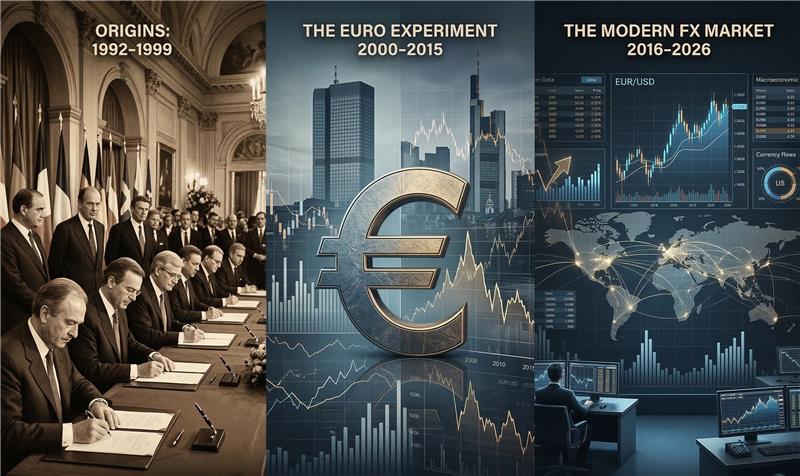
The Euro: Origins 1992-1999, The Euro Experiment 2000-2015, The Modern FX Market 2016-2026 — Capital Street FX exclusive editorial banner
CAPITAL STREET FX EDITORIAL BANNER  ·  ORIGINS 1992–1999  ·  THE EURO EXPERIMENT 2000–2015  ·  THE MODERN FX MARKET 2016–2026

The euro was not born in a market. It was born in a hotel conference room, by politicians who gambled that economic logic could be subordinated to political will, and that twenty nations running twenty different economies could thrive under one interest rate. In 27 years, it has survived four existential crises, a debt meltdown that nearly destroyed it, and a parity shock that most analysts said was impossible. Now, in March 2026, it faces its newest enemy: an oil war no one prepared for. This is the complete story — and the exclusive Capital Street FX forecast for where EUR/USD goes next.

■ EUR/USD Key Numbers — March 13, 2026
$1.1524
Current Rate
Mar 13, 2026
$1.6038
All-Time High
Jul 15, 2008
$0.8230
All-Time Low
Oct 2000
$1.2016
2026 High
Jan 27, 2026
$1.1507
2026 Low
Mar 11, 2026
+6.2%
12-Month Return
vs. USD
–4.1%
Jan 27→Mar 13
Iran War Drop
2.00%
ECB Rate
Feb 2026
20%
Global Reserve Share
Euro 2025

There are $7.5 trillion traded across the world’s foreign exchange markets every single day. Of that colossal sum, one currency pair — the euro against the US dollar — accounts for more than $1.7 trillion in daily volume. It is the most liquid, most watched financial instrument on earth. For 27 years, it has been both a barometer of geopolitical risk and the world’s most consequential monetary experiment.

No currency in history has been engineered the way the euro was. Not backed by the military dominance of a single empire, not born of colonial conquest, not evolved organically through centuries of commerce — the euro was designed. Designed in treaty rooms by economists and politicians who believed that erasing exchange rates between France and Germany, between Italy and Spain, would deliver the prosperity and peace that two world wars had failed to produce. Whether they were right is a question that 350 million Europeans answer at the petrol pump, the checkout, and the ballot box, every single day.

On March 13, 2026, EUR/USD sits at $1.1524. Down 4.1% from its 2026 peak. Caught between the Iran war’s oil shock and the structural dollar weakness thesis that drove it to $1.2016 in January. Watched by every FX desk on the planet. This is the complete story — and what comes next.

Chapter 01 — OriginsBefore the Euro Was a Currency, It Was a Dream

The idea of a shared European currency did not begin at Maastricht in 1992. It began at the end of the Second World War, in the rubble of a continent that had destroyed itself twice in thirty years — when European architects looked at the competitive devaluations and economic nationalism of the 1930s and made a diagnosis: money had been weaponised, and nations that wielded it against each other would eventually go to war because of it.

The Werner Report of 1970 — authored by Luxembourg Prime Minister Pierre Werner for the European Council — was the first serious blueprint. It proposed achieving monetary union by 1980 through coordinated policy, narrowing exchange rate bands, and ultimately a single currency under a common central bank. The OPEC oil shock of 1973, the collapse of Bretton Woods, and the currency volatility of the 1970s killed that timeline entirely. But the intellectual foundations survived.

What finally made monetary union politically possible was the fall of the Berlin Wall in November 1989. When German reunification became inevitable, French President François Mitterrand made a calculation: a unified Germany — 80 million people, Europe’s largest economy, positioned at the continent’s centre — would dominate Europe unless embedded so deeply in shared institutions that its power could only be exercised collectively. The price he negotiated for French support of reunification was Helmut Kohl’s agreement to surrender the Deutsche Mark. It was perhaps the most consequential monetary trade in post-war European history.

📜 Why Europe Needed One Currency — The Six Arguments That Won
  • Between 1945 and 1999, European nations devalued their currencies against each other an estimated 27 times — each devaluation a competitive attack on neighbours’ export industries
  • Currency speculation cost Britain £3.3 billion on Black Wednesday alone (September 16, 1992) as the pound was forced from the European Exchange Rate Mechanism
  • Cross-border business paid an estimated 0.4% of EU GDP annually simply in currency conversion costs — a silent tax on European commerce with no economic benefit
  • The German Deutsche Mark’s dominance meant smaller economies effectively imported Bundesbank monetary policy with no seat at the table and no vote on the rate
  • Exchange rate uncertainty was suppressing cross-border investment — businesses demanded higher returns to compensate for currency risk on long-term European projects
  • The Delors Report of 1989 provided the three-stage technical roadmap — its architecture became the foundation of the Maastricht Treaty and ultimately the euro itself

The Maastricht Treaty was signed on February 7, 1992. It required all member states to achieve five convergence criteria before joining: inflation within 1.5 percentage points of the three lowest EU rates, budget deficits below 3% of GDP, debt below 60% of GDP, exchange rate stability within ERM bands, and long-term interest rates within 2 percentage points of the three lowest. Germany designed these criteria to ensure its new currency would inherit the Deutsche Mark’s reputation for discipline. Several founding members — most notably Italy with debt at 121% of GDP and Belgium at 130% — were admitted anyway, with the understanding that they were on a convergence path. That decision would almost destroy the euro, eleven years later.

🖼 The Maastricht Photograph — What You Are Looking At

The image at the top of this article shows the formal signing ceremony of the Treaty on European Union, held in Maastricht, Netherlands, on February 7, 1992. Twelve foreign ministers signed the document that would abolish their currencies. The treaty required ratification by all member states — a process that nearly collapsed when Denmark rejected it in a June 1992 referendum (later ratified after opt-outs were negotiated) and when France approved it by only 51.05% in September 1992. The narrowness of those votes tells you everything about how contested this experiment was from its very first moment.

Chapter 02 — BirthJanuary 1, 1999: The Currency You Could Not Hold

At midnight on January 1, 1999, eleven currencies ceased to exist as independent monetary instruments. The German Deutsche Mark, French franc, Italian lira, Spanish peseta, Portuguese escudo, Dutch guilder, Belgian franc, Austrian schilling, Finnish markka, Irish pound, and Luxembourg franc all became fixed subunits of a new currency whose exchange rates were locked permanently on December 31, 1998. There was no going back. There was no mechanism for going back. That was the point.

For the first three years, the euro was invisible. It existed in ledgers, in computers, in interbank transfers. You could not hold it, carry it, or spend it. Physical coins and notes would not arrive until January 1, 2002. In that strange electronic interregnum, the euro’s opening price was set by market consensus at $1.1747 on its first day of trading — broadly in line with the weighted average of the legacy currencies it absorbed.

Markets were immediately skeptical. The euro’s launch coincided with the peak of the dot-com bubble — a period of extraordinary US equity performance, soaring dollar confidence, and capital flooding into American technology stocks. By October 2000, just 21 months after launch, EUR/USD had fallen to its all-time low of $0.8230 — a 30% loss against the currency it was supposed to eventually challenge for reserve currency dominance. Denmark held a referendum on joining in September 2000 and voted to keep its krone by 53% to 47%. The euro’s credibility was in genuine doubt.

Chapter 03 — Price HistoryEvery Peak, Every Crash, Every Turning Point (1999–2026)
■ EUR/USD COMPLETE PRICE HISTORY — 1999 TO MARCH 2026
Annotated with every major crisis, policy event, and structural turning point · Capital Street FX Research
1.60 1.40 1.20 1.00 0.90 0.82 ATL $0.82 Oct 2000 $1.00 ATH $1.60 Jul 2008 Debt Crisis “Whatever it takes” QE Low $1.04 Parity $0.95 $1.20 Jan ’26 NOW $1.1524 1999 2002 2005 2008 2011 2014 2017 2020 2023 ’26 Dot-com GFC Debt Crisis ECB QE Parity Iran
EUR/USD 1999–2026 · Annotated price history · Capital Street FX Research · For illustrative purposes
Jan 1, 1999 — Launch
The Euro Is Born — Invisible but Historic
Eleven nations abandon their currencies. EUR/USD opens at $1.1747. The dot-com boom is at peak. Alan Greenspan’s Fed holds at 5.00%. Most market participants pay the new currency little attention.
$1.1747 · Day 1
Oct 2000 — All-Time Low
$0.8230 — The Euro’s First Near-Death Experience
21 months after launch. US tech mania at its zenith. Denmark rejects euro membership. Capital floods into dollar assets. ECB rate cuts fail. EUR/USD loses 30% from launch price. The question is openly asked: will this currency survive?
$0.8230 · ALL-TIME LOW · –30%
2002–2004 — The Great Recovery
Dollar Collapses, Euro Surges Through Parity
Physical euro arrives Jan 1, 2002. Dot-com bust destroys US tech valuations. Iraq War raises geopolitical doubts about the US. America’s current account deficit balloons. EUR/USD crosses $1.00 parity and reaches $1.35 by year-end 2004.
$0.89 → $1.35 · +52% in 30 months
Jul 15, 2008 — All-Time High
$1.6038 — The Peak of Euro Supremacy
Bear Stearns has collapsed. US housing is imploding. The dollar is in freefall. ECB President Trichet raises rates to 4.25% — the same day EUR/USD hits its all-time record. Then global financial crisis overwhelms everything. EUR/USD crashes 23% in five months.
$1.6038 · ALL-TIME HIGH
2010–2012 — The Existential Crisis
Greece, Ireland, Portugal, Spain: The Euro Nearly Dissolves
Greek debt at 120% of GDP. Irish banks implode. Portuguese yields at 12%. The word “Grexit” enters the financial lexicon. EUR/USD falls from $1.51 to $1.20. Mario Draghi ends it with nine words on July 26, 2012: “Whatever it takes to preserve the euro.”
$1.51 → $1.20 · –20% · Existential crisis
2014–2015 — The QE Collapse
ECB Launches QE — EUR/USD Crashes to 12-Year Lows
ECB announces €1.1 trillion in asset purchases while the Fed tapers. Policy divergence is devastating. Greek crisis redux in 2015. EUR/USD falls from $1.39 to $1.04 in twelve months — one of the sharpest sustained falls in the pair’s history.
$1.39 → $1.04 · –25% · ECB-Fed divergence
Jul–Sep 2022 — Parity Shock
EUR/USD Below $1.00 — First Time Since 2002
The Fed hikes 75bp four times consecutively — the most aggressive cycle since Volcker. Russia cuts European gas. EUR/USD crashes through parity to $0.9535 — a level last seen when the euro was still a curiosity. Europe faces recession and energy rationing simultaneously.
$1.07 → $0.9535 · –11% · Parity breached
2023–Jan 2026 — The Bull Run
Dollar Weakens, Germany Unleashes €500B Stimulus, Euro Surges to $1.20
Fed begins cutting in September 2024. Trump’s tariff wars undermine dollar trust. Germany’s historic €500B infrastructure fund announced March 2025. EUR/USD climbs from $1.04 to $1.2016 by January 27, 2026 — highest since 2021. Every major bank is long euro.
$1.04 → $1.2016 · +15.5%
Feb 28 – Mar 13, 2026 — Iran War Reversal
Operation Epic Fury — Oil Shock Kills the Consensus Long Trade
US-Israeli campaign against Iran begins. Hormuz disrupted. Brent surges from $72 to $113. EUR/USD reverses from $1.2016 to $1.1507 in 13 trading days — one of the sharpest 13-day reversals since 2015. The consensus long euro trade turns into an urgent cover-and-reassess.
$1.2016 → $1.1507 · –4.2% in 13 days
Chapter 04 — Crisis AnatomyEvery Major EUR/USD Crash, Mapped

The euro has not moved in straight lines. It has moved in episodes — each one triggered by a specific failure of assumption, a policy miscalculation, or a geopolitical shock that the market had decided to ignore until it suddenly couldn’t. Understanding each crisis’s shape — how fast it fell, what catalysed the recovery, and how long the recovery took — is the single most valuable tool for navigating the current Iran war episode.

■ EUR/USD CRISIS COMPARISON — DRAWDOWN DEPTH & RECOVERY TIME
Six major EUR/USD bear phases since 1999 — drawdown %, duration in months, and days to prior high recovery
–5% –10% –15% –20% –25% –30% –30% 1999–2000 Dot-com 21 months –23% 2008 GFC 5 months –20% 2011–12 Debt Crisis 18 months –25% 2014–15 ECB QE 12 months –16% 2022 Parity Shock 8 months –4.2% 2026 Iran War ongoing
EUR/USD drawdown by crisis · Capital Street FX Research · For illustrative and educational purposes only
■ FED vs ECB RATE DIFFERENTIAL — THE PRIMARY EUR/USD DRIVER (2000–2026)
When the US-ECB rate gap widens, EUR/USD falls. When it narrows, the euro recovers. The most reliable mechanical relationship in FX.
6% 5% 4% 2% 0% FED ECB 2000 2003 2006 2008 2011 2014 2017 2020 2023 Fed 5.25% Peak 2006 Fed 5.25% Hike cycle ZIRP era both near 0% ECB went negative
Fed Funds vs ECB Deposit Rate 2000–2026 · Stylised representation · Capital Street FX Research
Chapter 05 — The MechanismFive Forces That Drive EUR/USD — What Every Trader Must Know

EUR/USD is not simply a vote on relative economic health. It is a real-time referendum on interest rate differentials, energy prices, geopolitical risk, capital flows, and the credibility of two of the world’s three most powerful central banks. Traders who reduce it to “strong US data equals strong dollar” will be right 60% of the time and catastrophically wrong the 40% that matters most.

Force 1 — Interest Rate Differential (The Mechanical Driver)

The most powerful short-to-medium term EUR/USD driver. When the Fed funds rate exceeds the ECB deposit rate, dollar assets offer higher nominal returns. Global capital sells euros to buy dollars. The 2022–2023 case was definitive: the Fed raised 525bp while the ECB raised 450bp at a slower pace, the differential peaked at ~150bp, and EUR/USD fell to $0.9535. As the gap narrows — as it has since the Fed began cutting in 2024 — EUR/USD recovers. Today’s differential is approximately 175bp in favour of the dollar. That suppresses the euro structurally until the ECB either hikes or the Fed cuts.

Force 2 — Europe’s Energy Vulnerability (The Structural Negative)

This is permanent and deeply underestimated by non-specialist traders. The eurozone imports 97% of its crude oil and the majority of its natural gas. When energy prices surge — as in 2022 and again in 2026 — Europe faces both an inflation shock and a current account deterioration that weakens the euro directly. The 2022 energy crisis cost the eurozone an estimated €800 billion in additional import costs. The Iran war’s oil shock is applying the same structural pressure. Every $10 sustained increase in Brent costs the eurozone approximately €35–40 billion in annual import bills — money that leaves the continent and lands in dollar-denominated energy markets.

Force 3 — ECB Political Complexity (The Unique Risk)

The euro carries a political risk premium no other major currency bears. Its survival requires twenty nations — running fundamentally different economies — to remain committed to a shared monetary policy when individual interests diverge. That premium is priced highest when growth is weakest and peripheral spreads widen. Italy’s debt at 140% of GDP, France’s deficit above 5%, and Greece’s structural fragility mean there is always a non-zero probability that the euro’s political architecture is tested again.

Force 4 — Dollar Safe-Haven Premium (The Crisis Override)

In moments of genuine geopolitical shock, the dollar does not behave like an ordinary currency. It is the world’s reserve, the denomination of oil, and the asset into which global capital retreats when fear is highest. The Iran war has reactivated this mechanism completely. While it persists — while Hormuz remains effectively closed — the safe-haven dollar premium caps EUR/USD rallies regardless of any fundamental analysis. The market’s fear trade always beats the economist’s rate differential model in the short run.

Force 5 — US Fiscal Trajectory (The Long-Term Clock)

The most powerful long-term driver is the one least discussed on trading desks. The US national debt stands at $36 trillion — 125% of GDP — with annual interest payments exceeding $1 trillion. Global central banks have been steadily diversifying away from the dollar: the US dollar’s share of global reserves has fallen from 71% in 1999 to 56.3% by end-2025. That structural de-dollarisation trend does not move EUR/USD on any given day. Over five-year periods, it has been the dominant driver of every major dollar bear market. It is the clock that the Iran war has temporarily paused — but not stopped.

📊 EUR/USD Indicator Dashboard · March 13, 2026
  • Rate Differential: Fed 3.50–3.75% vs ECB 2.00% — 150–175bp in USD’s favour · Bearish EUR near-term
  • Brent at $113.40: Each sustained $10 increase costs eurozone ~€35B annually · Bearish EUR structurally
  • DXY Safe-Haven Bid: Hormuz active, war escalation risk elevated · Bearish EUR near-term
  • ECB Hike Risk: 85% probability of 25bp by Dec 2026 — could paradoxically narrow differential · Mixed EUR signal
  • German €500B Stimulus: Infrastructure programme underway, boosts eurozone growth 2027–2028 · Bullish EUR medium-term
  • De-dollarisation: Reserve share falling 0.5–0.8pp per year, structural buying of EUR · Bullish EUR long-term
  • US Debt/Deficit: $36T debt, $1T+ interest, 6.1% fiscal deficit · Structurally Bullish EUR long-term
Chapter 06 — Present DayThe Iran War Has Changed Everything. Here’s the State of Play.

Six weeks ago, EUR/USD was the consensus long trade across every major FX desk. Goldman Sachs had a year-end 2026 target of $1.25. Deutsche Bank was at $1.25. MUFG had titled its 2026 outlook “A Post-Peak USD World.” The narrative was clean, data-supported, and broadly held: the Fed would cut twice, US fiscal deficits would erode dollar credibility, Germany’s historic €500 billion infrastructure programme would reboot eurozone growth, and the long dollar bull market that began in 2022 was definitively over.

Then February 28 happened. And in thirteen trading days, every one of those targets became a number to revise rather than a destination to target.

“The Iran war has not changed the long-term structural case for a weaker dollar and a stronger euro. It has changed the price at which you can build that position — and the timeline by which you will be proven right. That is a different problem. But it is not a small one.” — Capital Street FX Research Desk, March 2026

The ECB’s position is genuinely difficult. At its February 5, 2026 meeting — three weeks before the war began — the Governing Council held rates at 2.00% for the fifth consecutive time. Lagarde described inflation as “a good place.” Eurozone CPI had fallen to 1.7% in January — below the 2% target for the first time in three years. Markets were pricing a one-in-five chance of a cut before year-end. Now those same markets price an 85% probability of at least one 25bp hike by December.

That shift is not irrational. Every $10 sustained increase in oil adds approximately 0.5 percentage points to eurozone HICP inflation, according to the ECB’s own modelling. Oil is up $41 since February 27, implying roughly 2 full percentage points of additional inflation pressure if current prices hold — enough to push HICP from 1.7% back toward 3.5–4.0%. Oxford Economics maintains the ECB will look through the shock as temporary. Goldman Sachs says the ECB only hikes in the “worst-case scenario.” The market, characteristically, is pricing somewhere in between.

▸ Capital Street FX Community Poll · March 2026

Where will EUR/USD be at the end of 2026?

Below $1.100%
$1.10 – $1.180%
$1.18 – $1.250%
Above $1.250%
Chapter 07 — Short-Term ProjectionsCapital Street FX: 1-Week, 1-Month, 1-Year Exclusive Forecasts

The following short-term projections represent Capital Street FX Research Desk’s independent analysis, incorporating the Iran war’s oil shock, the FOMC meeting on March 18–19, ECB commentary, Hormuz developments, and the technical structure of EUR/USD’s current pullback. These are not consensus views. They are our proprietary assessment.

■ Capital Street FX — Short-Term EUR/USD Projections · March 13, 2026

1-Week Forecast · Mar 13–20
$1.1520
Range: $1.1420 – $1.1620
▶ SIDEWAYS / SLIGHT DOWNSIDE BIAS
Key event: FOMC March 18–19. Hawkish hold = dollar strength, tests $1.1420. Dovish signal = relief rally to $1.1620. Hormuz headlines dominate. Expect high volatility, no trend.
Confidence:
55%
1-Month Forecast · Apr 13
$1.1560
Range: $1.1340 – $1.1750
▶ RANGE-BOUND · FLOOR-FORMING
Oil trajectory is the primary driver. If Brent stabilises near $100 on IEA reserve release, floor forms at $1.1340. ECB April 30 meeting critical — any hike signal could push EUR to $1.1700+. Bear: war escalates, $1.1200.
Confidence:
52%
1-Year Forecast · Mar 2027
$1.2000
Range: $1.0800 – $1.2200
▲ RECOVERING · STRUCTURAL BULL
Base case: Iran war partially resolves by Q4 2026. Germany stimulus beginning to show in Q3 eurozone data. Fed cuts 1–2× in H2 2026, narrowing differential. EUR/USD recovers from Iran-war trough toward $1.18–1.22 by March 2027. Bear: $1.08 if war escalates. Bull: $1.24 if Fed cuts aggressively.
Confidence:
62%
5-Year Forecast · 2030
$1.28
Range: $1.14 – $1.42
▲ STRUCTURAL BULL · DOLLAR DECLINE
De-dollarisation accelerates. US debt compound problem intensifies. Germany’s infrastructure dividend lifts eurozone productivity. Fed ends at lower neutral rate than ECB. Global reserve diversification from USD to EUR continues at 0.5–0.8pp/year. Base case $1.28 by 2030.
Confidence:
58%
▸ Capital Street FX Trading Sentiment Poll · March 2026

What is your current EUR/USD position heading into the FOMC on March 18–19?

Long EUR/USD0%
Short EUR/USD0%
Flat / Hedged0%
Options Play0%
Chapter 08 — Exclusive 5-Year ProjectionEUR/USD 2026–2030: Three Scenarios, One Framework
■ EUR/USD 5-YEAR PROJECTION CHART — BULL / BASE / BEAR SCENARIOS (2026–2030)
Capital Street FX exclusive forward projections · Three scenario paths from March 2026 current level of $1.1524
1.42 1.34 1.25 1.18 1.10 1.02 Mar ’26 End ’26 End ’27 End ’28 End ’29 End ’30 $1.1524 Now $1.40 Bull $1.28 Base $1.14 Bear $1.22 $1.18 $1.08
EUR/USD 5-year scenario projections · Capital Street FX exclusive · Not financial advice

■ Capital Street FX — EUR/USD Scenario Forecasts 2026–2030 · Exclusive

🐂 BULL CASE — “The Dollar Loses the War” · Probability: 25%
End-2026
$1.22
End-2027
$1.28
End-2028
$1.34
End-2029
$1.38
End-2030
$1.40
The Iran war ends within 6 months via diplomatic ceasefire. Oil falls to $80–85 by Q4 2026. Fed cuts twice in H2 2026 (3.00–3.25%), narrowing the differential sharply while ECB holds at 2.25%. Germany’s infrastructure programme delivers 2.2%+ eurozone growth by 2027 — above consensus and above US growth for the first time since 2015. US fiscal deficit remains above 6% of GDP through 2028, accelerating de-dollarisation. The 2003 Iraq War script replays: a US military campaign coincides with a multi-year dollar bear market. EUR/USD reclaims pre-QE levels above $1.30 by 2028.
Three required conditions: (1) Iran ceasefire by Q4 2026, (2) Fed cuts 50bp+ before ECB, (3) No new eurozone political crisis. Historical precedent: 2003 Iraq War — EUR/USD rose from $1.08 to $1.37 during and after the US military campaign.
■ BASE CASE — “Delayed Bull, Same Destination” · Probability: 50% · CSFX Exclusive
End-2026
$1.18
End-2027
$1.22
End-2028
$1.25
End-2029
$1.26
End-2030
$1.28
The Iran war drags through H1 2026 before partial ceasefire. EUR/USD finds its floor at $1.13–$1.15 in Q2 2026 and begins a slow recovery. ECB delivers one precautionary 25bp hike in September 2026 to 2.25% — which narrows the differential and is mildly EUR-supportive. The Fed holds all year, paralysed by stagflation crosscurrents. By end-2026, EUR/USD reaches $1.18. Germany’s fiscal multiplier begins showing in 2027 data. USD structural decline reasserts gradually. This is the consensus pre-war Goldman/Deutsche Bank target — simply delayed by 12–18 months due to the Iran war episode.
Three required conditions: (1) Partial war de-escalation by Q3 2026, (2) No eurozone political crisis, (3) US deficit stays elevated — the last condition is the most certain of the three.
🐻 BEAR CASE — “The Euro’s Third Existential Test” · Probability: 25%
End-2026
$1.08
End-2027
$1.04
End-2028
$1.06
End-2029
$1.10
End-2030
$1.14
The Iran war escalates into a broader regional conflict. Oil holds above $110 through H2 2026. The ECB is forced to hike to 2.50%+ to defend its inflation credibility — identical to Trichet’s fatal 2008 and 2011 errors. Eurozone growth collapses to 0.3–0.5%. Italy’s BTP-Bund spread widens above 300bp, triggering ECB TPI activation and markets questioning the euro’s political architecture. EUR/USD breaks $1.13 support decisively and targets $1.08 by year-end. In 2027, energy recession deepens, the ECB reverses its hike — but EUR/USD falls through parity again, testing the 2022 template from a structurally weaker starting point.
Three triggers: (1) War escalation with Hormuz closure beyond 90 days, (2) ECB policy error — hiking into recession, (3) Italian political instability returning. This scenario is no one’s official call — which is exactly why it deserves 25% weight.
InstitutionPre-War TargetTimeframeKey RationalePost-Iran Revision
Goldman Sachs$1.25End-2026USD structural reversalDelayed to mid-2027
Deutsche Bank$1.25End-2026German stimulus, global growthDelayed to Q1 2027
J.P. Morgan$1.20Dec-2026Fed easing ahead of ECB$1.18 base, range $1.13–$1.22
Morgan Stanley$1.23 H1, $1.16 H22026Dollar softness, then reversal$1.13 trough Q2, $1.18 recovery
UBS$1.20End-2026French risk caps upside$1.17 — war drag, French risk
MUFG$1.24End-2026Post-peak USD world$1.19–1.21, war delays timeline
BNP Paribas$1.2412-monthFed cuts, USD premium fadesUnchanged — war resolves before year-end
★ Capital Street FX$1.18 Base · $1.22 Bull · $1.08 BearEnd-2026 · Exclusive · See full scenario analysis above
Chapter 09 — The Trade SetupHow Professional Traders Are Positioning in EUR/USD Right Now

The current setup is not a clean momentum trade in either direction. EUR/USD is pinned between two forces of roughly equal magnitude: the Iran war’s dollar safe-haven bid pulling it down, and the structural dollar weakness thesis that drove it to $1.2016 in January pulling it back up. In environments like this, the optimal trade is not a directional bet with reckless leverage — it is a position with a defined entry zone, a clearly articulated reason the floor holds, a generous stop below the structural support, and targets calibrated to the probability-weighted scenario.

■ Capital Street FX — EUR/USD Trade Framework · March 13, 2026

Direction
LONG EUR/USD
Structural bull · war-adjusted entry
Entry Zone
$1.1480 – $1.1560
Near 2026 support cluster
Stop Loss
$1.1340
Below Nov 2025 support · –1.5% risk
Target 1
$1.1700
+1.7% · 200-period SMA zone
Target 2
$1.1900
+3.5% · Pre-war consolidation
Target 3
$1.2100+
+5.7% · Bull case · war resolution
Risk / Reward
1:2.3 base · 1:3.8 bull
Risk 1.5% to make 3.5–5.7%
Position Size
3–6% portfolio
War uncertainty = reduced size
⚡ CATALYST CALENDAR: Fed FOMC March 18–19 (key — hold vs. dovish signal) · ECB Meeting March 19 (new projections) · ECB April 30 (potential hike signal) · US CPI April 10 · Germany Q1 GDP (May) · Hormuz status (daily) · IEA strategic reserve release (weeks lag) ·

■ TRADE INVALIDATION: Daily close below $1.1340 · War escalation to include Gulf State military involvement · ECB emergency 50bp hike signal · US data shows deep recession forcing emergency Fed cuts (paradoxically USD-supportive short-term) ·

⚠ NOT FINANCIAL ADVICE. This is analytical research for educational purposes. All positions involve risk. Use a qualified financial professional for personal investment decisions. Never trade with money you cannot afford to lose entirely.
Chapter 10 — RisksThe Five Ways the EUR/USD Bull Thesis Fails

■ EUR/USD Risk Register · Capital Street FX · March 2026

RISK 1 — HORMUZ STAYS CLOSED BEYOND 90 DAYS · HIGH PROBABILITY OF PRICE IMPACT
If Iran maintains effective Hormuz disruption beyond 90 days, European LNG import costs become structural. Eurozone CPI could reach 4–5%. The ECB would face 2011’s impossible choice — hike into a recession. EUR/USD bear case probability rises from 25% to 40%. Watch: IEA emergency stock drawdown timeline and US diplomatic back-channel progress.
RISK 2 — ECB POLICY ERROR — HIKING INTO OIL-SHOCK RECESSION · MEDIUM PROBABILITY
History is explicit: the ECB raised rates into oil shocks in July 2008 (the day of EUR/USD’s all-time high) and in April and July 2011. Both times produced brief EUR/USD rallies followed by catastrophic reversals as recession followed the hike. If the ECB hikes in July 2026 and Q3 eurozone GDP comes in at –0.2% or worse, the policy reversal would come within four months — but the damage to growth confidence would already be done. This is the Trichet error waiting to be repeated.
RISK 3 — ITALIAN POLITICAL CRISIS · MEDIUM PROBABILITY, HIGH MARKET IMPACT
Italy’s debt-to-GDP is 140%. Eurozone growth slowing to 0.5% under war conditions would push BTP-Bund spreads above 250bp — the level at which market pressure historically forces political crises. Meloni’s government is stable but fragile under economic stress. Any snap election that elevates euro-sceptic rhetoric would send EUR/USD to $1.10–$1.12 within days. The 2018 Italian political crisis: EUR/USD fell 4.5% in five trading sessions.
RISK 4 — US RECESSION PARADOX · MEDIUM PROBABILITY, COUNTERINTUITIVE IMPACT
The most overlooked risk: if the US enters deep recession in H2 2026 and the Fed cuts 100–150bp in emergency, the rate differential narrows rapidly — which should theoretically support EUR/USD. But in deep US recessions, global risk-off drives capital into the dollar as the safe-haven of last resort regardless of rate differentials. In 2008, the Fed cut from 5.25% to 0.25% and EUR/USD fell 23% in five months. The safe-haven premium overwhelms the rate differential argument every time global risk is truly elevated.
RISK 5 — FRENCH FISCAL DETERIORATION · LOW-MEDIUM PROBABILITY, UNDERPRICED
France’s fiscal deficit runs above 5% of GDP — well beyond the Maastricht 3% limit. With growth slowing under the war’s oil impact, revenues deteriorate while automatic stabilisers expand spending. A credit agency downgrade of France in H2 2026 would re-activate the euro’s political risk premium across the bloc. This is not a base case for 2026 — but it is the 2027 tail risk that most FX desks are not currently pricing.
Chapter 11 — Historical ParallelsThree Times This Movie Has Played Before

EUR/USD During Energy Shocks and US Military Campaigns

2008 — THE TRICHET RATE HIKE INTO $147 OIL
ECB Hikes Into an Oil Shock — Marks EUR/USD’s All-Time High and Immediate Crash
Oil hit $147/barrel in July 2008. Eurozone CPI was at 3.6%. The ECB raised rates to 4.25% on July 3, 2008 — the exact same day EUR/USD hit its all-time record of $1.6038. Within five months, EUR/USD was at $1.23 — a 23% collapse — as the financial crisis overwhelmed the inflation narrative. The ECB cut rates three times in the following four months. Trichet later called the July 2008 hike his greatest regret. 2026 verdict: An ECB hike into an oil shock has historically marked EUR/USD peaks, not floors. If the ECB hikes in July 2026, expect a brief EUR rally followed by a sharper reversal.
2003 — THE IRAQ WAR AND EURO’S FIVE-YEAR BULL MARKET
US Military Campaign Triggers Dollar Credibility Crisis — EUR/USD Rises 52% Over Three Years
The Iraq War began March 19, 2003. EUR/USD was at $1.08. By end-2004, it was at $1.35 — a 25% gain. By the dollar’s cycle low in 2008, it was at $1.60. The war coincided with ballooning US fiscal deficits, a deteriorating current account, and international loss of confidence in US foreign policy. The dollar’s structural bear market lasted five years. 2026 verdict: If the Iran war follows the Iraq War script — prolonged, expensive, diplomatically isolating — the structural dollar weakness thesis reasserts within 6–12 months from the war’s start, and EUR/USD’s bull market resumes from whatever trough the war initially creates.
2022 — RUSSIA’S ENERGY WAR AND EUR/USD PARITY SHOCK
Energy Crisis + Fed-ECB Divergence = Parity for First Time in 20 Years
Russia’s February 2022 invasion of Ukraine triggered Europe’s worst energy crisis since the 1970s. Gas prices rose 900%. EUR/USD fell from $1.14 to $0.9535 in eight months — through parity for the first time since 2002 — as the Fed hiked 75bp four times consecutively while the ECB was still at negative rates. The recovery came when the Fed paused and began cutting: EUR/USD recovered from $0.9535 to $1.2016 in thirty-two months. 2026 key difference: The ECB starts at 2.00% (not –0.50%), making the divergence less severe, and the Iran shock is oil-focused rather than gas-focused — slightly less structurally damaging for Europe.
2012 — DRAGHI’S “WHATEVER IT TAKES” — HOW WORDS ENDED A CRISIS
Nine Words, Zero Euros Spent — The Most Effective Intervention in Currency History
By July 2012, EUR/USD had fallen to $1.21 and Italian 10-year yields had hit 6.6%. The euro’s survival was being openly debated on the front pages of major newspapers. On July 26, 2012, ECB President Mario Draghi delivered nine words: “Within our mandate, the ECB is ready to do whatever it takes to preserve the euro. And believe me, it will be enough.” Italian yields fell 100bp within two days. EUR/USD began a recovery that eventually reached $1.40. Not a single euro was spent. 2026 lesson: The ECB’s primary weapon is not the rate lever — it is the credibility of its commitment to act. The Transmission Protection Instrument is today’s version of that commitment.
▸ Capital Street FX 5-Year View Poll · March 2026

Which scenario for EUR/USD by 2030 do you find most credible?

Bull $1.400%
Base $1.280%
Bear $1.140%
Parity Again0%
Euro banknotes Europa series ECB — the physical currency used by 350 million Europeans since January 2002
Euro banknotes, Europa series · The physical currency that 350 million Europeans have used since January 1, 2002 · ECB / Wikipedia
▸ Frequently Asked Questions

Everything Traders Need to Know About EUR/USD

What is EUR/USD trading at today, March 13, 2026?
EUR/USD is trading at $1.1524 on March 13, 2026 — down 0.37% on the session and 4.1% from its 2026 high of $1.2016 reached on January 27. The decline has been driven by the Iran war beginning February 28, which sent Brent crude from $72 to $113 and triggered a US dollar safe-haven rally. The 2026 intraday low is $1.1507, hit on March 11.
What is the EUR/USD forecast for next week (March 18–20, 2026)?
Capital Street FX’s 1-week forecast is a range of $1.1420–$1.1620, centred around $1.1520. The Federal Open Market Committee meeting on March 18–19 is the dominant event. A hawkish hold (Fed signals no 2026 cuts) tests the lower bound of $1.1420. A dovish signal (acknowledging growth risks) triggers a relief rally toward $1.1620. Hormuz developments and oil price moves will overlay on any FOMC reaction. Expect volatility above 80 pip daily range. Confidence: 55%.
What is the EUR/USD forecast for 1 month (mid-April 2026)?
Capital Street FX’s 1-month base case is $1.1480–$1.1700, centred at $1.1560. If oil stabilises near $100 following IEA emergency stock releases, EUR/USD finds its floor around $1.1340 and attempts a recovery. If Brent remains above $110, further downside to $1.1200 is possible. The ECB meeting on April 30 is critical — any hike signal would initially support EUR toward $1.1700. The April 10 US CPI print will also be decisive for the rate differential narrative. Confidence: 52%.
What is the EUR/USD forecast for 1 year (March 2027)?
Capital Street FX’s 1-year base case is $1.1900–$1.2200, centred at $1.2000. This assumes the Iran war partially de-escalates by Q4 2026, Germany’s infrastructure stimulus begins showing in eurozone growth data, the Fed delivers 1–2 cuts in H2 2026, and the ECB holds or hikes once. The structural dollar weakness thesis — de-dollarisation, US fiscal deterioration, narrowing rate differential — reasserts as the geopolitical war premium fades. Bear scenario for March 2027: $1.0800 if war escalates and eurozone enters recession. Bull scenario: $1.2400 if Fed cuts aggressively. Confidence: 62%.
What is EUR/USD’s all-time high and what caused it?
The all-time high was $1.6038 on July 15, 2008. It was not driven by European strength — it was driven by US dollar collapse. The US mortgage crisis was destroying confidence in American assets, Bear Stearns had failed in March, and the Fed was cutting rates. On the exact same day, ECB President Jean-Claude Trichet raised rates to 4.25% to fight oil-driven inflation — a decision he later called his greatest regret. EUR/USD hit its all-time high at 10:58 AM London time, then reversed. Within five months it was at $1.23 — a 23% crash. The irony is complete: the highest EUR/USD has ever been is the moment the ECB made its worst-ever policy decision.
Why did EUR/USD fall below parity ($1.00) in 2022?
Three converging forces drove EUR/USD below parity in July 2022 for the first time in 20 years. The Fed was raising rates by 75 basis points at a time — the most aggressive tightening since Volcker — while the ECB was still at negative rates, creating a 550bp+ rate differential. Russia simultaneously cut gas supplies to Europe, triggering an energy crisis that raised import costs, destroyed confidence in eurozone growth, and pushed European energy stocks into structural selloffs. Finally, global risk aversion from the Ukraine war drove capital into the dollar. EUR/USD fell to $0.9535 by September 2022 — a level that had not been seen since the euro’s first troubled years in 2000–2002.
Will the euro reach $1.30 or higher by 2030?
Capital Street FX’s base case is $1.28 by 2030, with a bull case of $1.40. For $1.30 to be achieved, three structural conditions must hold: the US fiscal deficit remains above 5% of GDP (near-certain), Germany’s €500B infrastructure programme delivers above-consensus eurozone growth of 2%+ by 2027–2028 (likely), and the Fed ends its rate cycle below the ECB’s endpoint (uncertain but increasingly probable). The 2003–2008 precedent — where EUR/USD rose from $1.08 to $1.60 during a period of US military engagement and fiscal deterioration — is the most instructive historical template for the 2026–2030 path.
Is the euro at risk of breaking up in the 2020s?
Near-term breakup risk is very low — significantly lower than during the 2010–2012 debt crisis, when Italian 10-year yields hit 7.5% and the word “Grexit” was being used in official ECB communications. The institutional architecture is much stronger: the ECB’s Transmission Protection Instrument can cap peripheral spreads directly, the European Stability Mechanism holds €500+ billion in emergency capacity, and the political consensus for the euro’s survival has deepened — not weakened — after every crisis. The realistic risk is not breakup but protracted political friction: French fiscal slippage, Italian stagnation, and the slow build of a political risk premium that suppresses EUR/USD below its fundamental value for years. Not a catastrophic break — a persistent drag. The euro’s greatest long-term enemy is not a crisis. It is mediocrity.
▸ EUR/USD Live
$1.1524
▼ –0.37% · –$0.0043 · Mar 13, 2026
2026 High$1.2016
2026 Low$1.1507
ATH$1.6038 · 2008
ATL$0.8230 · 2000
52-Wk High$1.2079
52-Wk Low$1.0732
12-Month+6.21%
ECB Rate2.00% Hold
Fed Rate3.50–3.75%
Daily Vol$1.7T+
▸ CSFX Projections ★
1-Week$1.1420–$1.1620
1-Month$1.1340–$1.1750
1-Year Base$1.2000
Bear 2026$1.08
Base 2026 ★$1.18
Bull 2026$1.22
Base 2028$1.25
Base 2030$1.28
Bull 2030$1.40
Exclusive Capital Street FX research. Not financial advice.
▸ Catalyst Calendar
Mar 18–19FOMC Decision
Mar 19ECB Commentary
Apr 10US CPI Print
Apr 30ECB Meeting
MayGermany Q1 GDP
DailyHormuz Updates
OngoingIEA Reserve Release
▸ Related Articles
GOLD
Gold: 6,000 Years, One Unstoppable Truth — $5,589 and Rising
MACRO
Stagflation 2026: Gold, Oil & The Fed’s Impossible Dilemma
WAR COST
The $11.3B Question: Iran War True Cost & Market Impact
USD
The Almighty Dollar: 100-Year History of America’s Reserve Currency
BITCOIN
Bitcoin: $0.0008 to $126,198 — Complete History & 2030 Forecast
▸ Disclaimer
Capital Street FX provides market analysis for educational purposes only. Nothing in this publication constitutes financial advice, investment advice, or a recommendation to buy or sell any instrument. FX trading involves significant risk. Past performance does not guarantee future results. Consult a qualified professional before making any investment decisions.
▸ Capital Street FX — Conclusion & Verdict · March 13, 2026

The Euro Has Survived
Every Crisis It Was Not Supposed To.

Twenty-seven years ago, twelve nations placed a political bet that economic logic could bend to political will — that a German industrial economy and a Greek tourism economy could share an interest rate and both prosper. The economists who said it couldn’t work were not wrong about the economics. They were wrong about the politics. Every time the euro has been genuinely threatened — the $0.8230 low of 2000, the debt crisis of 2010–2012, the parity shock of 2022 — the political will to preserve it has ultimately exceeded the market’s willingness to bet against it.

The Iran war is the latest test. It is serious. Oil at $113, an ECB caught between inflation and recession, a dollar on a safe-haven bid, and EUR/USD at $1.1524 — down 4.1% in thirteen trading days. The consensus long trade has been put on hold. The question now is whether it has been cancelled entirely, or merely interrupted.

Capital Street FX’s answer is: interrupted. The structural forces that drove EUR/USD from $1.04 in 2022 to $1.2016 in January 2026 — de-dollarisation, US fiscal deterioration, Germany’s transformative infrastructure programme, Fed easing ahead of ECB — have not been reversed by the Iran war. They have been delayed by it. The timeline has shifted. The destination has not.

The euro in 2030 will not be at $0.95. It will not, in our base case, be at $1.60 either. It will be somewhere around $1.25–$1.30 — a level that reflects a currency that is structurally gaining ground against a dollar whose fiscal foundations are steadily eroding, managed by a central bank that has navigated every crisis thrown at it and emerged with its mandate and its credibility intact.

That is not a prediction. It is a probability. And in markets, probability is everything.

“The euro has outlived every obituary written for it. The Iran war will produce its latest — and it will be wrong too. The base case is $1.18 by end-2026, $1.25 by 2028, and $1.28 by 2030. The bull case is $1.40. The bear case is $1.08. Position for the base, hedge for the bear, and keep your eye on the structural clock that the geopolitical noise is temporarily drowning out.” — Capital Street FX Research Desk, March 13, 2026


The Capital Dispatch
Capital Street FX · CapitalStreetFX.com · March 13, 2026 · Euro Special Edition
© 2026 Capital Street FX. All analysis for informational purposes only. Not financial advice.