
Trade FX, CFD, Stocks, BTC, Indices, Gold & Oil – 1:1000 Leverage & Bonus – CSFX

Mobile Header & Menu

When Central Banks Go to War: 100 Years of Monetary Policy Under Fire — Fed, ECB & BOJ Rate Decisions March 2026 | Capital Street FX

March 16, 2026
CSFXadmin
When Central Banks Go to War: 100 Years of Monetary Policy Under Fire — Fed, ECB & BOJ Rate Decisions March 2026 | Capital Street FX
⚡ Live Event Week Deep Research CAPITAL STREET FX RESEARCH DESK  ·  17 MARCH 2026

When Central Banks Go to War:
100 Years of Monetary Policy Under Fire

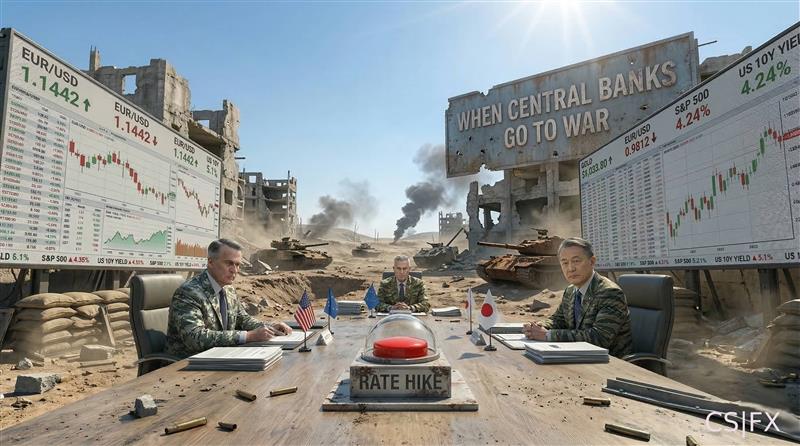
When Central Banks Go to War — Central bankers at war table with rate hike button, CSFX

From the gold standard’s collapse in 1914 to Volcker’s 20% rates, to Ukraine’s inflation shock, to this week’s most important rate decisions in a decade — a forensic history of what happens when central bankers face missiles, embargoes, and burning oil fields.

🇺🇸 Federal Reserve (FOMC)
3.50–3.75%
March 17–18 · Decision + Dot Plot
HOLD — near 100% priced
🇪🇺 European Central Bank
2.00%
March 19 · Decision + Lagarde presser
HOLD — hike risk rising sharply
🇯🇵 Bank of Japan
0.75%
March 19 · 30-year high rate
HOLD — 64/64 analysts agree

This week, three of the world’s most powerful financial institutions will announce rate decisions while an active war burns through the world’s most critical oil corridor. The Federal Reserve, European Central Bank, and Bank of Japan together control the cost of money for roughly half of global GDP. What they say on March 18 and 19 will move oil, gold, currencies, bonds, and equities simultaneously — in some cases, violently. But to understand what they will do, you must first understand what they are, how they work, and what 110 years of war has taught them about the limits of monetary power.

Brent Crude
$103
War peak $119.50/bbl
US PCE Inflation
2.9%
Above 2% target
US Unemployment
4.4%
Feb jobs: −92,000
Gold XAU/USD
$5,033
52-wk high $5,595
EUR/USD
1.1457
Pre-war: 1.1778
US Gasoline
$3.60+
Trending → $4.25/gal
Foundation

What Is a Central Bank — And Why Does It Control Your Life?

A central bank is the apex monetary authority of a nation or currency union. It does not serve the public directly — it serves the banking system and, through it, the entire economy. Its tools are blunt, powerful, and slow-acting, with effects that typically take 12 to 18 months to fully transmit through credit markets into consumer prices and employment. This lag is precisely why central bank decisions made today in the middle of a war will not be fully felt until 2027.

The Federal Reserve was created in 1913 after the catastrophic banking panic of 1907 revealed that the United States had no lender of last resort. The Bank of England is far older, established in 1694 originally to finance King William III’s wars. The European Central Bank, the youngest of the three, was born in 1998 to manage the newly created euro. These three institutions now collectively influence interest rates for economies producing roughly $50 trillion in annual output.

Understanding what central banks actually do requires understanding their tools. They are fewer than most people assume, but their combined effect is profound.

🎯
Policy Rate (The Main Lever)
The overnight interest rate at which commercial banks borrow from the central bank. When the Fed raises its rate, every mortgage, car loan, corporate bond, and credit card rate in the economy eventually rises to match. This is the instrument being decided this week.
📊
Open Market Operations
Central banks buy or sell government bonds in the open market. Buying bonds injects cash into the banking system (quantitative easing). Selling removes cash (QT). The Fed’s balance sheet peaked at $8.5 trillion post-COVID before shrinking to ~$6.2 trillion.
🏛
Reserve Requirements
The fraction of deposits banks must hold in reserve. Raising this reduces what banks can lend, tightening credit. The Fed set requirements to zero during COVID to maximise lending capacity. The ECB uses minimum reserve ratios actively to calibrate liquidity.
💬
Forward Guidance
In modern central banking, words are often the most powerful tool. When Powell says the Fed is “data dependent” or Lagarde says the ECB “stands ready to act,” bond markets move immediately. This week’s press conferences may move EUR/USD and gold more than the decisions themselves.
💵
Currency Intervention
Central banks can directly buy or sell their own currency. Japan spent over $100 billion defending the yen in 2024. With USD/JPY threatening 160 again, BOJ and Japan’s MoF are already warning of “one-sided moves” — coded language for imminent intervention.
🏰
Lender of Last Resort
When the banking system faces a liquidity crisis — 2008, COVID, SVB — the central bank steps in with emergency lending. This function, described by Walter Bagehot in 1873, is the original reason central banks exist: to stop panics from becoming depressions.

The Dual Mandate: The Federal Reserve is unique among major central banks in having a legally mandated dual objective: price stability (2% inflation) and maximum employment. The ECB has a single mandate: price stability. The BOJ targets 2% inflation but historically prioritised avoiding deflation. This difference in mandate explains why the Fed’s decisions are always more politically charged — it must simultaneously balance two goals that wars routinely force into direct conflict.

How Central Banks Monitor Markets in Real Time

Modern central banking is a data science exercise on an enormous scale. The Federal Reserve employs over 400 PhD economists across its 12 regional banks and the Washington Board of Governors. They monitor the monthly CPI and PCE deflator for inflation signals; Non-Farm Payrolls for employment; ISM surveys for real-time business activity; the 10-year Treasury yield for credit market signals; TIPS breakevens for inflation expectations; the Senior Loan Officer Survey for credit tightening; and — increasingly — real-time trackers for credit card spending, restaurant bookings, and jobless claims to detect turning points before official data confirms them.

The ECB additionally monitors eurozone energy prices with extreme attention because 20 European nations import the majority of their oil and gas — a structural vulnerability exposed brutally in 2022 and again this week. The BOJ watches Japan’s wage data obsessively because the country’s decades of deflation were caused by wages that refused to rise. For Governor Ueda, wage growth is the north star of every policy decision.

“Inflation is always and everywhere a monetary phenomenon — but the hardest part of central banking is knowing when to act before the data confirms what you already suspect.”
— Milton Friedman’s core thesis, applied by every major central banker since Volcker
100-Year History

War, Oil & Money: 110 Years of Central Banks Under Fire

The most important lesson of monetary history is simple: every major war creates an inflationary impulse, and every central bank that delayed fighting that impulse paid a severe price for it. The Fed’s catastrophic failure during the Vietnam era and the 1973 oil shock, and Volcker’s brutal correction of that failure, remain the defining reference points for every rate decision made today. Understanding 1973 is essential to understanding March 2026.

1914 – 1918  ·  World War I
The Fed’s Baptism of Fire
The Federal Reserve had been operating for barely one year when war broke out in Europe. The New York Stock Exchange closed for four months — the longest suspension in its history — and gold flooded into America from European nations paying for US exports. The Fed, bound by the gold standard, kept its discount rate deliberately low to facilitate Treasury “Liberty Loan” bond sales, raising approximately $10 billion across four issuances. The Fed was, in effect, subordinated to war financing needs. The result: the US price level roughly doubled between 1914 and 1920, with inflation peaking at 18% annually in 1918. The Bank of England suspended gold convertibility immediately on August 3, 1914. Governor Walter Cunliffe famously entered the Treasury in tears, warning “We shall be ruined if we are dragged in.” Britain’s price level tripled during the war. The Fed only recovered institutional independence by aggressively raising rates post-war — triggering the sharp but brief recession of 1920–21.
Price Level +100% Gold Standard Suspended Fed Subordinated to Treasury Discount Rate Kept Low
1939 – 1951  ·  World War II & the Treasury-Fed Accord
The Fed as “Engine of Inflation” — and Its Liberation
World War II produced the most direct suppression of central bank independence in American history. In 1942, the Fed formally agreed to peg US Treasury yields: 0.375% for short-term bills, 2.5% for long-term bonds. The Fed was an unconditional buyer of government bonds — a fully subordinated financing arm of the Treasury while war expenditures consumed 40% of GDP at peak. When wartime price controls were lifted in 1946, suppressed inflation burst through. Fed Governor Marriner Eccles publicly called the rate peg an “engine of inflation” in 1951. The historic Treasury-Fed Accord of March 1951 formally restored the Fed’s independence — a restoration that defines its institutional character to this day. The Bretton Woods system established in 1944 tied all major currencies to the US dollar at $35/oz of gold, creating the post-war monetary order that would survive until Nixon’s 1971 shock.
Yield Peg: 2.5% Treasury cap Fed independence lost 1942–51 Treasury-Fed Accord 1951 Bretton Woods 1944
1950 – 1953  ·  Korean War
The Battle to End Rate Pegging
The Korean War’s outbreak in June 1950 reignited the conflict between the Fed and the Truman administration. The entry of Chinese forces and fears of World War III escalation caused another surge in inflation. The Fed, still technically bound by the wartime yield peg, pushed back hard. Eccles argued publicly that buying unlimited government bonds was structurally inflationary — a position that proved decisive and led directly to the 1951 Accord. Inflation during Korea ran at 8–10% annually at its peak. Crucially, the Korean War was ultimately financed primarily through taxation rather than monetary expansion — a lesson that would be forgotten entirely during Vietnam.
Inflation 8–10% peak Treasury-Fed Accord secured Financed via taxation
1965 – 1975  ·  Vietnam War
“Guns and Butter” — The Seeds of Stagflation
The Vietnam War’s economic legacy is the most consequential in monetary history because it planted the seeds of the 1970s stagflation crisis. President Johnson’s “guns and butter” policy — simultaneously financing the war and the Great Society domestic spending programmes without raising taxes — created a massive fiscal expansion. Fed Chair William McChesney Martin raised rates modestly in 1965–66 but then capitulated to White House pressure. By 1965, Fed staff internally recognised that unreported military spending was causing their models to underpredict inflation — but political pressure suppressed aggressive tightening. Inflation drifted from 1.3% in 1964 to over 6% by 1970. When Nixon took office, he completed the monetary system’s destruction: the dollar was taken off the gold standard in August 1971 (“Nixon Shock”), ending the Bretton Woods era and creating the floating-rate currency system that still governs global FX markets today. The period established the most dangerous precedent: that political pressure can corrupt monetary policy, and the cost is always paid by ordinary people through inflation.
Inflation: 1.3% → 6%+ Nixon Shock 1971 — Gold standard ended Floating FX system born Political suppression of rate hikes
1973 – 1975  ·  Arab Oil Embargo
The Great Stagflation — The Worst Mistake in Fed History
On October 19, 1973, Arab OPEC members imposed an oil embargo on the United States in response to its support for Israel during the Yom Kippur War. Oil prices quadrupled — from $2.90 to $11.65 per barrel in months. The result was a dual shock: inflation surged as energy costs fed through the economy, while those same costs destroyed growth, creating the previously unknown phenomenon of stagflation. Fed Chair Arthur Burns committed what historians now regard as the greatest error in Federal Reserve history. He resisted raising interest rates, arguing that oil-price inflation was a “cost-push” supply shock outside monetary policy’s reach. Western central banks broadly agreed and cut rates to support growth. Inflation peaked at 12% in 1974. The economy contracted sharply. Burns’ intellectual failure — later confirmed by economists Romer and Romer — was the belief that monetary policy was powerless against supply-side inflation. It was not. The refusal to raise rates allowed the oil shock to embed itself in wage expectations, creating a worse wave of inflation in 1979. This is the story every central banker knows cold. And why no one wants to be Arthur Burns in 2026.
Oil: $2.90 → $11.65/bbl (×4) Inflation peak: 12% Burns refuses to hike — catastrophic error Stagflation born
1979 – 1982  ·  The Volcker Shock
The Most Brutal Monetary Medicine in Modern History
Paul Volcker was appointed Fed Chair in August 1979 with one mission: kill inflation regardless of economic cost. With inflation running above 13% and the dollar collapsing, Volcker abandoned interest rate targeting and instead targeted the money supply — a radical shift that caused rates to surge to 20% by mid-1981. The result was two back-to-back recessions (1980 and 1981–82), peak unemployment of nearly 11%, and mass bankruptcy among farmers, homebuilders, and small businesses. Volcker was burned in effigy. Farmers drove tractors to Washington to blockade the Fed building. But inflation fell from 13% to 4% by 1982, and by 1983 the US economy was growing at 4.5%. The Volcker Shock established the central lesson that every central bank carries today: credibility is the most valuable monetary asset. Once inflation expectations become unanchored, the cost of restoration is measured in years of recession. This is why every central banker in 2026 fears being the next Arthur Burns more than anything else.
Fed Funds Rate: 20% (1981) Inflation: 13% → 4% Two recessions, 11% unemployment Credibility as monetary asset established
1990 – 1991  ·  Gulf War I
The Template for “Looking Through” a War Shock
Iraq’s invasion of Kuwait in August 1990 sent oil prices from $18 to $42 per barrel — a similar percentage spike to the current Iran shock. The Fed, under Chairman Alan Greenspan, did not panic. When it became clear that the Gulf War would be short and decisive — Operation Desert Storm’s ground campaign lasted just 100 hours — the Fed held steady through the shock. Oil fell back below $20 within months. This episode became the template for “looking through” geopolitical oil shocks: if the shock is temporary and supply is restored, central banks need not react. This lesson will be directly invoked in every press conference this week — with the critical caveat that Iran’s infrastructure damage is far more severe than Kuwait’s in 1990, and the timeline to restoration is far less certain.
Oil: $18 → $42/bbl (+133%) Oil reversed to $20 post-war Fed holds — “look through” template 100-hour ground war — swift resolution
2001  ·  September 11
Emergency Cuts and the Seeds of the Housing Bubble
Following the September 11 attacks, the Fed cut its benchmark rate 11 times — from 6.5% to 1.75% by end-2001, and further to 1.0% by 2003. Emergency easing was appropriate for the demand shock. But Greenspan kept rates at 1% until 2004, and the resulting flood of cheap money flowed into the US housing market, inflating the bubble that burst in 2008. The monetary policy lesson of 9/11: cut fast during a demand shock, but raise again before cheap money finds a new speculative home. Duration is always the risk.
Fed cuts: 6.5% → 1.0% Rates held too low too long → housing bubble Emergency easing template
2008 – 2015  ·  Global Financial Crisis
Zero Rates, Quantitative Easing, and the Modern Playbook
The 2008 GFC produced the most radical expansion of central bank tools in history. The Fed cut rates to 0–0.25% and launched three rounds of QE, purchasing $3.5 trillion in Treasuries and mortgage-backed securities. The ECB eventually followed, and the BOJ — already at zero — introduced negative interest rates and yield curve control. The period from 2008 to 2022 was the longest era of ultra-loose monetary policy in modern history. This era created the financial conditions — deeply negative real rates, inflated asset prices, compressed risk premia — that made the 2022 inflation shock so severe when it finally arrived. The entire world had forgotten what inflation felt like.
Fed Funds: 0–0.25% QE: $3.5 trillion in bond purchases BOJ: negative rates + YCC 14 years of near-zero rates worldwide
2022 – 2023  ·  Russia–Ukraine War
The Fastest Hiking Cycle Since Volcker
Russia’s invasion of Ukraine on February 24, 2022 was not the cause of that year’s inflation surge — it was the accelerant. US inflation was already running at 7.5% when tanks crossed the border, driven by $5 trillion in COVID fiscal stimulus and supply chain disruptions. The war then added an energy shock that pushed European gas prices to ten times their pre-war levels and Brent crude above $120/bbl. The Fed’s response was the fastest hiking cycle since Volcker: 525 basis points in 16 months, taking the Fed Funds Rate from 0.25% to 5.5% by July 2023. The ECB hiked 450bp in 14 months, from −0.5% to 4.0%. Both cycles succeeded in bringing inflation back toward 2%. The Ukraine experience confirmed one new rule that governs every 2026 decision: you cannot afford to be late again.
Fed hikes: +525bp in 16 months ECB hikes: +450bp in 14 months EU gas: 10× pre-war levels Fastest tightening since Volcker Credibility maintained — barely
2026  ·  Iran War — This Week
The Stagflation Trap Returns
Operation Epic Fury, the US-Israeli strikes on Iran beginning February 28, 2026, has created the most complex monetary policy environment since 1973. Brent crude peaked at $119.50/bbl. US gasoline approached $3.60/gallon trending toward $4.25. US PCE inflation was already at 2.9% before the war. February payrolls showed a loss of 92,000 jobs. Q4 2025 GDP growth was revised down to 0.7%. This is the definition of stagflation: rising prices, slowing growth, rising unemployment. The Fed faces the same impossible choice Arthur Burns faced in 1973 — but with two critical differences. First, the Fed has far more credibility to lose, post-Volcker, post-Ukraine. Second, it has far more data, tools, and institutional experience. The unanimous expectation is a hold this week — but the dot plot and press conference language will reveal whether Powell is prepared to be the next Burns, or the next Volcker.
Brent peak: $119.50/bbl PCE: 2.9% (above 2% target) Feb jobs: −92,000 GDP Q4 2025: 0.7% (revised down) Classic stagflation setup
Decision Week

The Three Rate Decisions — What to Expect This Week

For the first time since the Ukraine war, three of the world’s four most systemically important central banks are announcing rates in the same 48-hour window while active military conflict continues to disrupt the world’s most critical energy corridor. The decisions themselves are almost certainly holds across the board. The market-moving information will be in the language, the dot plots, and the press conference responses to questions about the Iran war, stagflation risk, and the pace of future cuts — or hikes.

🇺🇸
Federal Reserve (FOMC)
MARCH 17–18, 2026 · DECISION + DOT PLOT
Current Rate3.50–3.75%
Expected DecisionHOLD (≈100% priced)
PCE Inflation2.9% YoY
Unemployment4.4% (rising)
Q4 GDP Growth0.7% (revised down)
Next Cut PricedDecember 2026 (1 cut total)
Key Market MoverUpdated Dot Plot + Powell presser
⏸ HOLD — FOCUS ON DOT PLOT SHIFT TO 2027
🇪🇺
European Central Bank
MARCH 19, 2026 · DECISION + LAGARDE PRESSER
Deposit Rate2.00%
Expected DecisionHOLD
Eurozone CPI (Feb est.)1.9% (above forecast)
TTF Gas Price~€50–51/MWh (was €32)
Hike Probability 202642% (was 12% pre-war)
Market Pricing1–2 hikes by Dec 2026
Key Market MoverLagarde language on energy/hike risk
⏸ HOLD — LAGARDE’S TONE IS THE TRADE
🇯🇵
Bank of Japan
MARCH 19, 2026 · DECISION + UEDA PRESSER
Current Rate0.75% (30-year high)
Expected DecisionHOLD (64/64 analysts)
Japan CPI2.9% (above target 44+ months)
Crude Import Dependence95% from Middle East
USD/JPY~157 (intervention risk >160)
Next Hike ExpectedOctober 2026 (base case)
Key Market MoverUeda language + USD/JPY signal
⏸ HOLD — WATCH USD/JPY ABOVE 158

⚠ The Stagflation Trap: The Fed faces inflation at 2.9% (above its 2% target for the fifth consecutive year) AND unemployment at 4.4% (rising). February payrolls lost 92,000 jobs. Cutting would risk entrenching oil-driven inflation. Hiking would accelerate job losses into a weakening economy. Holding — while the dot plot signals no cuts in 2026 — is the least bad option. Goldman Sachs has pushed its next cut forecast to September. The futures market has moved it to December. Some are now pricing zero cuts in 2026.

The Dot Plot: The Most Important Chart in Global Finance This Week

The Fed’s Summary of Economic Projections contains the famous “dot plot”: each of the 19 FOMC participants anonymously plots their expectation for the Fed Funds Rate at year-end for 2026, 2027, and the long run. In December 2025, the median dot showed one 25bp cut in 2026. The expectation is that this week’s median dot will shift to zero cuts in 2026 — effectively pushing the next easing action into 2027. This single number will move bond yields, the dollar, equity valuations, gold, and oil more than the rate decision itself. Watch the 10-year Treasury yield reaction: above 4.50% post-dot-plot signals a structurally higher-for-longer regime. Below 4.10% signals the market believes the war shock is transient and cuts return faster than the dot plot suggests.

ECB Context: Before the Iran war, the ECB consensus was firmly complete — deposit rate at 2.00% was widely considered “neutral.” That view has been shattered. ECB Governing Council member Joachim Nagel (Bundesbank president) stated the ECB “will act decisively in a timely manner” if energy prices translate into broad consumer inflation. ECB board member Isabel Schnabel acknowledged the trajectory has become “more uncertain.” Polymarket shows 42% probability of an ECB rate hike in 2026, up from 12% before the war. ING’s analysis states explicitly: “If the Strait of Hormuz were blocked for several months and oil prices rose to $110–$120, I could imagine the ECB raising rates once or twice this year.”

Bank of Japan: The Quietly Dangerous Decision

The BOJ’s decision receives far less attention than the Fed’s this week, but it may have the longest-lasting market implications. Japan imports 95% of its crude oil from the Middle East. Every $10 increase in Brent crude costs Japan roughly ¥2 trillion (~$13 billion) more per year in energy imports, simultaneously importing both inflation and current account deterioration. The yen has weakened sharply since the war began, with USD/JPY hovering near 157. Above 160, the BOJ and Japan’s Ministry of Finance have previously intervened — selling approximately $100 billion in reserves in summer 2024 to defend the yen. Governor Ueda described current conditions as requiring “nimble action.” If USD/JPY breaks decisively above 158–160 this week on a hawkish Fed signal, the BOJ may be forced to accelerate its next hike timeline from October to as early as May or June 2026 — a massive surprise that would destabilise the yen carry trade and trigger the kind of global risk-off unwind seen in August 2024.

Market Analysis

Which Markets Move Most — And Why

Rate week during an active war is the highest-volatility event combination in financial markets. The interaction effects — oil prices responding to hawkish Fed language, gold reacting to real rate moves, the euro jumping on ECB hike signals, the yen moving on BOJ intervention risk — create simultaneous, correlated volatility across asset classes.

Gold XAU/USD
$5,033
52-wk high: $5,595
Brent Crude
$103
War peak: $119.50
EUR/USD
1.1457
2026 low (was 1.2022)
USD/JPY
~157
Intervention zone: >160
US 10Y Yield
4.27%
+13bp past week
TTF Gas (EU)
€51
Was €32 pre-war

Gold (XAU/USD) — The Highest-Conviction Position

Gold is the natural beneficiary of every scenario this week. A hawkish Fed and rising real rates provide short-term pressure — but war uncertainty generates a structural bid that overrides rate headwinds in geopolitical stress periods. A dovish Fed or dovish dot plot sends gold surging immediately. An ECB hike signal increases European demand for gold as an inflation hedge. A weakening yen drives Japanese investors into dollar-denominated gold. Gold broke above $5,000 for the first time in history during the Iran war and has held that level even as oil retreated from its peak. Structural central bank demand — record purchases in 2023, 2024, and 2025 — provides a powerful floor.

Oil (Brent) — The Most Event-Sensitive Market

Brent is currently the most binary market in the world. A hawkish Fed combined with a credible peace signal would cause a violent downside reversal toward $80–85. A dovish Fed combined with Hormuz closure fears would push Brent back toward $110–115. The IEA’s release of 400 million barrels of strategic reserves has provided temporary relief with a defined duration. Watch whether Powell classifies the oil shock as “transient” (bearish for oil) or “persistent” (supportive for oil).

EUR/USD — The ECB Asymmetry Trade

EUR/USD has already fallen from 1.2022 (January 28 2026 high) to 1.1457 — a substantial repricing as US inflation risks rose relative to European ones. This week creates an asymmetric opportunity: if Lagarde explicitly signals willingness to hike if energy inflation persists, EUR/USD could recover sharply toward 1.16–1.18 as the ECB-Fed rate differential narrows. If Lagarde is dovish and the Fed dot plot signals higher-for-longer, EUR/USD could fall toward 1.12–1.13. The net direction depends entirely on which force dominates Lagarde’s language.

USD/JPY — The Intervention Wildcard

This is the highest-risk binary event of the week. If the Fed is perceived as hawkish, US yields rise, the dollar strengthens, and USD/JPY could push toward 158–160. At that point, BOJ intervention risk becomes acute — coordinated USD/JPY intervention could cause a 3–5% yen appreciation in a single session, unwinding carry trade positions globally and triggering risk-off across equities and EM currencies. If the Fed is perceived as dovish, the dollar weakens, USD/JPY retreats toward 150–152, and the BOJ holds without drama.

US Treasuries — The Dot Plot Trade

The 10-year Treasury yield has risen 13 basis points over the past week as markets price “higher for longer” on inflation. If the median dot shifts to zero cuts in 2026, expect the 10-year to test 4.40–4.50%. If the dot plot preserves one cut, the 10-year could fall to 4.10–4.20% on relief. The 2-year/10-year yield curve will also be closely watched: persistent inversion signals recession risk, which paradoxically supports bonds and gold while weighing on oil.

CSFX Exclusive

Capital Street FX Research Desk: Trade Setups & Projections

⚠ Risk Disclosure: The following trade setups are the exclusive proprietary views of the Capital Street FX Research Desk as of March 17, 2026. They are for informational and educational purposes only and do not constitute investment advice. All trading involves significant risk of loss. See full disclaimer below.

XAU/USD LONG BIAS
Entry Zone$4,850 – $4,950
Target 1$5,200
Target 2$5,450 (retest 52-wk high)
Stop Loss$4,750 (daily close)
Risk/Reward1:2.5 – 1:4.0
ConvictionHIGH ★★★★★
Structurally bullish across all scenarios. Hawkish Fed confirms economic stress (safe-haven bid). Dovish Fed accelerates cut pricing (real rates fall, gold surges). War premium alone justifies $4,800+ floor. Record central bank gold buying (2023–25) provides structural support. Only a rapid, credible ceasefire + mass risk-on rally undermines this — and would need to be sustained.
BRENT CRUDE EVENT-DRIVEN
Bear Scenario EntryShort from $105–108
Bear Target$85–88 (ceasefire priced)
Bull Scenario EntryLong on $95 retest
Bull Target$112–115
Stop (short position)$111 daily close
ConvictionCONDITIONAL ★★★☆☆
Wait for Powell’s classification of the oil shock (“transient” vs “persistent”) before committing. Hawkish Fed + peace signal = short oil toward $85. Dovish Fed + Hormuz closure fears = long oil toward $115. Do not trade crude pre-decision without hedges. IEA strategic reserve release caps near-term upside at current levels.
EUR/USD LONG BIAS
Entry Zone1.1380 – 1.1460
Target 11.1650
Target 21.1800 (ECB hike signal)
Stop Loss1.1280
Risk/Reward1:2.2 – 1:3.5
ConvictionMEDIUM ★★★☆☆
ECB hike risk is the catalyst. If Lagarde explicitly acknowledges energy-driven inflation risk and signals readiness to hike, EUR/USD could jump 150–200 pips in the press conference session. The pair has already repriced significantly lower since January — asymmetry favours recovery if ECB narrows the rate gap with the Fed. Undercut stops below 1.1280 invalidate setup.
USD/JPY SHORT BIAS
Entry Zone157.50 – 159.00
Target 1153.00
Target 2149.50 (intervention spike)
Stop Loss161.50 (above intervention zone)
Risk/Reward1:2.0 – 1:5.0 (intervention spike)
ConvictionMEDIUM ★★★★☆
Asymmetric short setup. Risk is capped by the intervention level. Reward is amplified by intervention probability: if BOJ/MoF intervene at 160+, a 5–8% yen spike (800–1,200 pip move) is historically possible in a single session. Monitor Ueda presser for any language around FX “one-sidedness” or “high urgency.”
US 10Y YIELD YIELD UP BIAS
Current Level4.27%
Hawkish Dot Plot Target4.45 – 4.55%
Dovish Dot Plot Target4.05 – 4.15%
Trade ExpressionShort TLT / Long TBF ETF
ConvictionMEDIUM ★★★☆☆
The dot plot shift to zero 2026 cuts is the base case. If confirmed, the 10-year should test 4.45–4.55%. Higher yields are net negative for equities at elevated multiples and modestly negative for gold in the short term, but the risk-off war bid for gold likely overrides the rate headwind. Express via bond ETFs for unleveraged exposure.
S&P 500 AVOID / WAIT
StanceNo directional position
Key Support5,200 (major)
Key Resistance5,700 – 5,800
Break Below 5,200→ Short toward 4,900
ConvictionAVOID ★☆☆☆☆
Equities face a stagflationary headwind: rising inflation erodes real earnings, higher unemployment reduces consumption, and higher-for-longer rates compress P/E multiples. But the market has partially adjusted. During event week with elevated VIX, false breakouts are common. CSFX recommends avoiding SPX during the decision window and re-evaluating post-dot-plot.
CSFX Projections

Scenario Matrix: Three Outcomes for the Rate Week

Convention Note: Scenarios are defined by the central bank communication outcome this week — not the rate decision itself (all three banks are expected to hold). The key variable is the tone and forward guidance of Powell, Lagarde, and Ueda, and whether their language tilts markets toward more or fewer future rate changes.

Scenario Definition Gold XAU Brent Oil EUR/USD USD/JPY US 10Y Yield Prob.
A — Hawkish Hold Fed dot plot: 0 cuts 2026, first cut pushed to 2027. Lagarde signals hike risk. BOJ signals earlier hike timeline. $4,950–5,100
War bid offsets rate headwind
$95–100
Demand destruction priced
1.1550–1.1700
ECB hike signal lifts EUR
153–155
BOJ acceleration + intervention
4.45–4.55%
Higher-for-longer repriced
35%
B — Neutral Hold (Base) Fed preserves 1 cut in 2026 (December). Lagarde signals patience. BOJ holds with no new hike signals. $5,050–5,200
Safe haven + mild relief
$100–108
Range-bound war premium
1.1400–1.1550
Limited movement both ways
155–158
No catalyst either direction
4.20–4.35%
Relief — cut still in play
40%
C — Dovish Hold Fed signals war shock “transient,” preserves 2 cuts in 2026. Lagarde dismisses hike risk. BOJ stays very cautious. $5,200–5,450
Real rates fall, gold surges
$108–115
Growth intact + war premium
1.1600–1.1800
Dollar weakens broadly
158–162
Dollar bid pushes JPY weak
4.05–4.20%
Cut expectations revive
25%

⚡ Black Swan: BOJ Surprise Hike (Probability: 3–5%) — If USD/JPY trades above 160 before the BOJ decision on March 19 and Governor Ueda delivers a surprise 25bp hike to defend the yen, all scenario tables are void. Expect: USD/JPY −500 to −800 pips in minutes, global carry trade unwind, risk-off across EM currencies and equities, gold volatile but likely higher on safe-haven demand. This would be the biggest BOJ shock since the July 2024 surprise hike that triggered the August 2024 global equity sell-off.

FAQ

Frequently Asked Questions

The Fed is overwhelmingly expected to hold rates at 3.50–3.75%. With PCE inflation at 2.9%, unemployment at 4.4%, and the Iran war pushing oil above $100/bbl, the Fed faces a stagflationary dilemma that makes both cutting and hiking inappropriate. Markets have fully priced a hold. The focus will be the updated dot plot — which may push the median first cut from late 2026 into 2027 — and Powell’s characterisation of the oil shock as “transient” or “persistent.”
The 1973 Arab oil embargo quadrupled oil prices and created the worst peacetime stagflation in American history. Fed Chair Arthur Burns refused to raise interest rates, believing supply-side oil shocks were outside monetary policy’s reach. This was catastrophically wrong. By failing to tighten, Burns allowed oil-price inflation to embed itself in wage expectations — workers demanded higher wages to compensate for fuel costs, companies raised prices to cover wages, creating a self-reinforcing cycle. The result was 12% inflation by 1974, requiring Volcker’s brutal 20% rates to correct. Every central banker in 2026 knows this story intimately. It is why Lagarde, Powell, and Ueda are all signalling readiness to act if oil-driven inflation feeds into core prices — even if they hold rates this week.
Yes — and the probability has risen sharply. Before the Iran war, the consensus was firmly for the ECB to hold at 2.00%. Now, Polymarket shows a 42% probability of an ECB hike in 2026, up from 12% before the war. ING’s analysis suggests if the Strait of Hormuz were blocked for several months and oil reached $110–120, the ECB could hike once or twice. Goldman Sachs puts the hike threshold at eurozone inflation rising 3.6 percentage points above projections. ECB Governing Council member Nagel has stated the ECB “will act decisively in a timely manner.” The question for EUR/USD this week is whether Lagarde’s language shifts markets from “hold” to “hike” mode.
Japan’s Ministry of Finance has historically intervened when USD/JPY moves above 155–160. In summer 2024, Japan spent approximately $100 billion defending the yen when it breached 160, triggering sharp and immediate yen appreciation. Governor Ueda has described current USD/JPY “volatility” as requiring “nimble action.” Finance Minister Katayama has expressed “deep concern” over yen weakness. The coded signal from Japanese authorities is that intervention is actively being prepared above 160. If the Fed’s hawkish dot plot this week pushes USD/JPY decisively above 158–160, the probability of coordinated BOJ/MoF intervention rises sharply — potentially triggering a 500–800 pip yen rally in a single session.
Gold’s traditional inverse relationship with real interest rates has been partially disrupted by two structural forces. First, central bank gold buying has been at record levels for three consecutive years (2023–2025), particularly from China, India, Turkey, and Gulf sovereign wealth funds — this institutional demand provides a price floor independent of rate dynamics. Second, war uncertainty creates a safe-haven bid that overrides rate headwinds during geopolitical stress periods. The Iran War has introduced genuine fears of Middle East escalation, nuclear risk, and dollar reserve system stress — all structurally bullish for gold regardless of where nominal rates sit.
The Treasury-Fed Accord of March 1951 formally restored the Federal Reserve’s independence from the US Treasury, ending a wartime arrangement where the Fed was obliged to hold Treasury bond yields at pegged low rates regardless of inflation. The Accord established the principle that a central bank must be free to set interest rates according to economic conditions — not government financing needs. This independence is under renewed political pressure in 2026: President Trump has repeatedly demanded the Fed cut rates to 1% or lower. The Accord’s legacy is why the Fed’s institutional independence is not just historical — it is the ongoing battleground between monetary credibility and political convenience that every rate decision this week takes place within.
Trade This Week’s Events
The Most Important Rate Week of the Decade

Three central banks. One burning oil corridor. Markets moving in real time.
Access them all — with up to 1:10,000 leverage and 0.0 pip spreads on Gold, Oil, Forex, and Indices.

⚡ Up to 1:10,000 Leverage 💹 0.0 Pip Spreads (Zero Account) 🌎 2,000+ Global Instruments 🏛 Regulated in Multiple Jurisdictions 💰 900% Deposit Bonus Available 🏰 Operational Since 2008
Open Your Account at capitalstreetfx.com →

Risk Disclosure & Disclaimer: Trading in financial instruments involves a high level of risk and may not be suitable for all investors. The value of investments and any income derived from them can go down as well as up. You may not get back all the money you invest. Leverage amplifies both gains and losses. Past performance is not indicative of future results. The trade setups, market projections, and scenarios presented in this article are the exclusive views of the Capital Street FX Research Desk as of March 17, 2026, for educational and informational purposes only. They do not constitute investment advice, a solicitation to trade, or a personal recommendation.

Capital Street FX is regulated by the Financial Services Commission (FSC) of Mauritius (License C112010690) and the Financial Services Authority (FSA) of St Vincent and the Grenadines (License 22064-IBC-2014). Headquarters: Pinpoint Business Park, Block 3, Unit 314, Calebasses, Mauritius. Contact: [email protected] | +370 650 04197.

Historical data on central bank policy rates and war-period inflation sourced from Federal Reserve Bank of Minneapolis, Federal Reserve Bank of Cleveland, Federal Reserve History, and publicly available academic research. All market data as of close March 14–16, 2026. Rate decision probabilities sourced from CME FedWatch Tool and publicly reported Reuters/Bloomberg market consensus data.