
The Arteries of Civilisation: Complete World Trade Routes — History, Obstructions, Markets & Trade Setups | The Capital Dispatch — Updated April 08, 2026
The Chokepoints That Move Markets:
From Constantinople to Hormuz —
And Every Trade That Follows
Trump threatened to erase an entire civilisation. Iran weaponised the world’s most critical strait. Pakistan brokered a two-week pause minutes before midnight. Brent crude crashed 17.6% in a single session — the steepest oil drop since Desert Storm 1991. Bitcoin surged to $72,700. Gold held $4,660 and refused to sell off. This is the complete history of every trade route that has ever moved civilisation — and the definitive analysis of what the full range of outcomes from the Islamabad negotiations means for every market — whether talks advance to a framework agreement, extend through serial ceasefires, or face difficulty. The peace is already breaking. Lebanon is burning. Iran’s 10 demands and the US stated objectives cover significant ground that the Islamabad talks will need to bridge. This article examines the complete history of trade route disruptions and their market consequences — and the full range of scenarios that now lie ahead as negotiations unfold.
▼13.9% · Range $91.72–$105.12
▼14.7% · Range $91.11–$109.00
▲2.06% · Risk-on + structural bid
▲2.40% · Ceasefire relief rally
▲2.89% · Tech leads gains
▲4.58% · Ceasefire bid
▼0.97% · Safe-haven unwind
▼19.3% · Fear subsiding fast
▼1.52% · Inflation fear easing
Risk-on rally · Dollar weak
At 8pm ET on April 7, 2026 — Day 38 of the war (28 February to 7 April 2026) — Trump announced a two-week ceasefire with Iran hours after threatening that “a whole civilization will die tonight.” Brent crude crashed 17.6% in a single session, the steepest single-day oil drop since Operation Desert Storm in 1991. Bitcoin surged to $72,700. $595 million in crypto shorts were liquidated in hours. The VIX collapsed to 20. Gold held $4,660 and refused to sell off. The relief was real. The peace is not. Iran retains control of Hormuz under a “coordination” framework. Lebanon is still burning. Iran’s 10 demands — including full US troop withdrawal from the region and the lifting of all sanctions — represent the Iranian delegation’s opening framework entering negotiations. The Islamabad talks beginning April 10 will begin the process of determining how much of this ground can be bridged. The ceasefire expires April 21. This article is both the complete history of how trade routes have always been weaponised by great powers — and the definitive forward-looking analysis of what happens when this fragile 14-day pause ends.
Part One — The Ancient Architecture Before Ships. Before Money. There Were Routes.
Trade is the oldest human technology. Before writing, before mathematics, before organised religion — before almost everything that defines civilisation — there were people carrying things from one place to another and exchanging them for things they could not make themselves. The first archaeological evidence of long-distance trade dates to roughly 3,000 BCE: obsidian blades from the volcanic island of Melos found in mainland Greek burial sites, 100 miles away, in contexts that predate any known organised state. Nobody built those trade routes. They emerged spontaneously from the elementary human insight that some things exist in one place and not another, and that the gap between those places represents an opportunity. Every trade route in history — from the Silk Road to the Strait of Hormuz to the transpacific container lanes that deliver your smartphone — is, at its root, an elaboration of that same insight.
What separates ancient trade from modern trade is not intention but infrastructure. The ancient world built physical pathways through desert and mountain and sea because the alternative — producing everything locally — was economically impossible. Rome could not grow its own silk. Egypt could not mine its own tin. The Arabian Peninsula could not harvest its own spices. The compulsion to trade was not a commercial abstraction; it was survival, dressed in the language of commerce.
At the Silk Road’s peak, a bolt of Chinese silk that cost 1 ounce of silver in the ancient Chinese capital would sell in Rome for 12 ounces — a 1,100% markup over 4,000 miles. The middlemen were always the winners. Arab and Sogdian traders who controlled the central segments of the route grew spectacularly wealthy acting as the world’s first logistics intermediaries. The pattern has not changed. The Strait of Hormuz “middlemen” today — the tanker operators, the marine insurers, the storage traders — are making record profits in 2026 precisely as the market screams crisis. Plus ça change.
The Silk Road — to give the most famous ancient trade system its 19th-century German name — was not one road. It was a network of overland and maritime routes connecting China to the Mediterranean across roughly 4,000 miles of steppe, desert, and mountain. It carried silk westward and silver and glass eastward; it carried Buddhism from India to China and Islam from Arabia across Central Asia; it carried paper-making technology, gunpowder, and printing westward; and it very probably carried the Black Death that would kill one-third of Europe from its origins in Central Asian rodent populations. The Silk Road did not merely move goods. It moved civilisation itself — and it moved catastrophe with equal efficiency.
The Silk Road’s great obstruction came not from war but from disease. The Black Death of 1347–1353 almost certainly arrived via the route, carried by fleas on rats on Mongol supply wagons, entering Europe through Crimean port cities onto Venetian ships. The pandemic collapsed trade volumes catastrophically. When the Ottoman Empire then captured Constantinople in 1453 and took control of key overland routes, European access to Asian goods was effectively severed. What followed is one of the most consequential examples of trade route disruption driving technological and political transformation in all of history: Spain and Portugal, desperate for alternatives, funded the Age of Exploration. Columbus sailed west in 1492. Vasco da Gama sailed around Africa in 1498. The maritime age had begun. The Silk Road was functionally dead. And the world’s first great trade route obstruction had accidentally created the entire modern global shipping industry.
“Control the route. Control the trade. Control the wealth. Every great power in history has understood this. None of them has ever made it permanent.”
Part Two — The Maritime Revolution When Ships Replaced Camels, Geography Became Destiny
Da Gama’s route around Africa was revolutionary, but it was also 12,000 miles of open ocean — dangerous, slow, and expensive. The next three centuries of maritime history were essentially a single project: finding shorter paths, controlling the paths that existed, and destroying everyone else’s ability to use them. The British East India Company. The Dutch VOC. The Portuguese Estado da India. The Spanish Empire’s Manila Galleons. Every one of these was, at its core, a trade route control mechanism dressed in the language of commerce and empire.
What these empires discovered — and what still governs global commerce today — is that geography is destiny. The continents are arranged in a way that creates natural chokepoints: narrow bodies of water where ships must pass in concentrated channels. Control the passage; control the trade. The Strait of Malacca. The Strait of Hormuz. The Bab el-Mandeb. The Bosporus. The English Channel. These are not arbitrary designations. They are places where the planet’s landmasses nearly met but didn’t quite — and where, for 500 years, the world has been funnelling its commerce through geological bottlenecks that get more critical with every passing decade.
The Suez Canal — opened on November 17, 1869 — was humanity’s most ambitious attempt to hack geography. The French engineer Ferdinand de Lesseps spent a decade cutting a 101-mile channel through Egyptian desert to connect the Mediterranean and the Red Sea, eliminating the 12,000-mile Cape journey and replacing it with 3,000 miles through the canal. The opening ceremony deployed royalty, dignitaries, fireworks visible for miles, and an opera commission from Verdi (who delivered Aida late; they used a different work, which Verdi apparently found deeply irritating, a charming footnote in global trade history). The canal’s immediate effect was to make the British Empire 40% more efficient in travel time to India. Six years later, Britain purchased the controlling stake from the Egyptian Khedive Ismail — who needed cash — in one of the most consequential financial transactions of the 19th century. The canal created the world’s most strategically important 100 miles of water. Everybody who wanted to control it — the French, the British, the Egyptians, the Israelis — tried at some point. Nobody ever made it permanent.
Not to be outdone by the Suez, the Americans built the Panama Canal between 1904 and 1914, cutting a 50-mile passage through Central America to connect the Atlantic and Pacific. The project killed over 27,000 workers — mostly from yellow fever and malaria — making it one of the deadliest engineering projects in history. The result eliminated 8,000 miles of sailing around Cape Horn for ships moving between the US coasts and Asia. The canal handles approximately $270 billion in cargo annually, with the US accounting for 73% of all traffic. What the engineers could not have anticipated: it is powered entirely by rainwater. Every ship transits raises and lowers through locks requiring 52 million gallons of fresh water per passage. In a drought year — as 2023 and 2024 brutally demonstrated — that is not an engineering choice. It is a structural catastrophe waiting for the right weather pattern.
Part Three — The Ten Arteries Every Route. Every Number. Every Country That Depends On It.
Global trade today moves through ten primary arteries, each carrying a specific category of goods, connecting specific producers to specific consumers, and vulnerable to specific disruptions. What follows is the most comprehensive account ever published of each route: its value, its history, its vulnerabilities, its alternatives, and its current status. This is not just maritime geography. This is the architecture of the world economy — made visible.
Part Four — The Hall of Infamy Every Time Someone Blocked a Route, The World Paid
Trade route obstructions are as old as trade routes themselves. Every major disruption in the history of global commerce has followed the same script with remarkable consistency: crisis hits, shipping stops, prices spike, alternative routes scramble to absorb the volume, someone somewhere goes bankrupt, the world redesigns itself around the new reality, and within a generation the redesigned system has created vulnerabilities that nobody thought to protect. Here is the complete record — from the Ottoman capture of Constantinople to the unprecedented simultaneous crisis of 2026.
Part Five — Markets in the Crossfire Inflation, Stocks, Currencies, Commodities, crypto — What History Teaches
Every trade route disruption is simultaneously an inflation event, an equity event, a currency event, a commodity event, and — in the modern era — a cryptocurrency event. Understanding the pattern of how each asset class responds to each type of disruption is the single most useful analytical framework for navigating what the global economy is currently experiencing. Here is the complete historical record, asset by asset.
Asset Class Response Matrix How Each Market Behaves During Supply-Side Trade Disruptions
The critical distinction in trade disruption analysis is between supply-side shocks (route physically blocked, supply reduced) and demand-side shocks (economic weakness reduces demand). The current 2026 Hormuz crisis is a pure supply-side event — and the asset class playbook for supply-side shocks is well-established by five decades of historical data.
Oil (Brent equivalent): $3 → $12/bbl (+300%). Gold: $65 → $170/oz (+160%). S&P 500: −48% (Jan 1973–Oct 1974, partially oil-related). US Dollar (DXY): −12% as petrodollar recycling created uncertainty. US CPI Inflation: 6.2% (1973) → 11.0% (1974) → 9.1% (1975). Interest rates: Fed Funds Rate raised to 13% by 1974 to combat inflation. crypto: N/A (pre-digital era). Resolution: Embargo lifted March 1974 after diplomatic agreements. Oil corrected 30% from peak but never returned to pre-crisis levels. The structural inflationary shift remained through the decade.
Oil: $13 → $34/bbl (+160%). Gold: $226 → $875/oz (+287% in 14 months) — still the most explosive gold rally relative to starting price in the metal’s modern trading history. S&P 500: −17% (1980, partly Volcker shock). DXY: Initially weak, then dramatically strengthened as Volcker raised rates to 20%. US CPI: Peaked at 14.8% (March 1980) — highest in post-war American history. Interest rates: Volcker raised Fed Funds Rate to 19–20% in 1980–81, triggering recession. crypto: N/A. Resolution: Hostage crisis resolved January 1981. Oil remained structurally elevated through 1985. The Volcker recession of 1981–82 ultimately broke inflation — but at the cost of the deepest US recession since the 1930s. The lesson: if an energy supply shock requires monetary shock therapy to resolve, the recession is built in.
Container rates (Shanghai → LA): $2,000 → $20,000/box (+900%). Baltic Dry Index: +500% peak. Global CPI inflation: US 9.1%, UK 11.1%, EU 10.6% — multi-decade highs. S&P 500: +27% in 2021 (stimulus-driven), then −25% in 2022 as inflation forced tightening. Bitcoin: $9,000 (Jan 2021) → $68,000 (Nov 2021) → $16,000 (Dec 2022) — a 75% crash as the Fed tightening regime crushed risk assets. Gold: Relatively flat 2021–22 (failed as inflation hedge, paradoxically). Fed Funds Rate: 0.25% (Jan 2022) → 5.5% (July 2023) — fastest tightening cycle in 40 years. Resolution: Container rates normalised by mid-2023. But the inflation, once embedded, took 18 months of aggressive monetary tightening to bring back toward target. The shipping crisis is the single most underappreciated driver of the 2021–24 macro environment.
wheat futures: $750 → $1,290/bushel (+60% in weeks). Sunflower oil: +50%. Corn: +30%. Fertiliser prices (Urea): +200% as Russian exports disrupted. FAO Food Price Index: Hit all-time record March 2022. Brent crude: $80 → $139 (March 2022 peak). Gold: $1,780 → $2,050 (+15%). S&P 500: −25% total 2022 decline. Bitcoin: −65% (Jan–June 2022). DXY: +15% (safe haven dollar strength). Egyptian pound: Devalued 40% as wheat import costs soared. Food-import dependent nations: Lebanon, Tunisia, Egypt experienced acute food security crises. Crypto performance: Significant initial selloff on Ukraine news, then partial recovery, then 2022 crypto winter driven by Fed tightening rather than the war itself.
Container shipping rates: $1,500 → $9,500/box (500%+ from trough). Oil: +$8–10/bbl risk premium on Brent. European natural gas (TTF): +25% as some LNG tankers diverted. Suez Canal revenues: Fell from $9.4B (2023) to approximately $3B annualised rate (2024). S&P 500: Largely absorbed the shock (+24% in 2024) due to US economic resilience. UK/EU shipping stocks: Maersk, Hapag-Lloyd surged +40–60% on freight rate spike. Insurance sector: Marine war risk premiums for Red Sea: +400%. Crypto: Bitcoin rose from $38,000 (Jan 2024) to $74,000 (March 2024) — driven entirely by ETF approval and halving narrative, not the shipping crisis. No correlation observed.
Part Six — The Domino Effect How One Blocked Strait Moves Every Asset Class in Sequence
The market impact of a trade route disruption does not arrive simultaneously across all asset classes. It arrives in sequence — a cascade of interconnected effects that typically plays out over weeks, months, and years. Understanding the sequence is the key to understanding both the history and the current crisis.
Days 1–7: Commodity prices spike immediately (oil, LNG, sometimes grain). Shipping stocks surge. Marine insurance premiums spike. Initial equity selloff in energy-importing nations. Safe haven buying in gold and US Treasuries.
Weeks 2–6: Alternative route costs become apparent. Shipping container rates begin rising (with a lag vs spot energy). Consumer goods price pressures begin building in supply chain data. Corporate earnings warnings from exposed sectors. Oil stocks surge. Defence stocks rally.
Months 2–6: CPI data begins showing energy pass-through. Central banks reassess rate paths. Higher-for-longer rate expectations strengthen the dollar. Equity markets correct further as earnings outlook deteriorates. Bitcoin and risk assets typically weaken under rate pressure.
Months 6–18: Food prices begin rising — fertiliser costs (which use natural gas) flow through to agricultural input costs 6–9 months after the initial energy shock. Developing nations with food import dependence face currency and inflation crises. Emerging market debt comes under pressure. Gold reaches peak rally as de-dollarisation accelerates and central bank buying intensifies.
Resolution: If the disruption resolves diplomatically or militarily, oil corrects rapidly (often 20–30% within weeks). Gold retains partial gains. Equities rally strongly. Container rates take longer to normalise (6–12 months). Food prices are last to normalise (12–18 months lag from energy spike). Inflation impulse can persist 2–3 years after the physical disruption ends.
The current 2026 situation is complicated by the fact that three disruptions are overlapping — Hormuz (acute), Red Sea (chronic, 28 months), Panama (structural, climate-driven). The transmission mechanisms are not running sequentially; they are running simultaneously, compounding at every stage of the cascade. This is why the VIX is at 31, why the S&P 500 is down 8% YTD, and why Goldman Sachs has pushed its first rate cut call from June to September.
“The world has never managed simultaneous disruptions at this scale before. Three chokepoints. One crisis. No playbook.”
Part Seven — The 2026 Crisis Three Chokepoints. One World Economy. No Precedent.
On March 2, 2026, Iran’s Islamic Revolutionary Guard Corps effectively closed the Strait of Hormuz to Western commercial traffic — a move that every defence analyst, energy economist, and geopolitical strategist had been modelling for decades but none had seen actually executed at scale. The mechanism was not a naval blockade in the traditional sense. Iran’s IRGC deployed a combination of anti-ship missile batteries, drone swarms, and coast guard interception that made the strait commercially unnavigable without explicit IRGC clearance. The “toll booth” system that emerged — requiring vessels to receive IRGC escort, pay fees denominated in Chinese yuan, and receive documentation that named the shipping as “permitted commerce” — is legally unprecedented in the history of international maritime law.
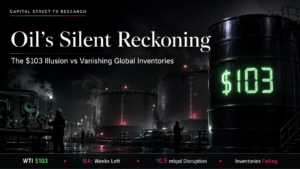
The numbers are staggering in their specificity. Approximately 17.8–20.9 million barrels of oil and petroleum products transit Hormuz daily under normal conditions — roughly 20% of global consumption. On Day One of the closure, that flow stopped. Oil stored aboard tankers in the strait and in nearby Gulf terminals created a brief buffer. The IEA coordinated a 400-million-barrel strategic reserve release across member nations. Traders frantically began sourcing replacement barrels from US shale producers, North Sea operators, West African producers, and Brazilian pre-salt fields. None of these alternative sources could move fast enough. By Day 14, Brent was above $100. By Day 38 of the war — today — it trades at $94.22, having fallen sharply from the $126 peak to $91.71 post-ceasefire as a potential 45-day ceasefire entered active negotiation.
The relief rally of April 7–8 is real and driven by genuine ceasefire optimism — but it is occurring against a backdrop where the Strait of Hormuz remains effectively closed for approximately 35 days before the ceasefire. Brent has fallen from its $126 peak to $91.71 post-ceasefire, equities have surged on the relief rally, and VIX has compressed from 31 to 27. But Goldman Sachs maintains its Q2 2026 Brent average forecast at $110/bbl even with a ceasefire, with an extreme upside scenario of $135 if the 45-day ceasefire fails. Oxford Economics models $140/bbl as the “breaking point” for the global economy. The key this week is not the current price — it is whether the ceasefire is agreed, and whether Iran reopens Hormuz even partially. Every day of continued effective closure, the SPR buffer diminishes further.
The 45-day ceasefire framework — now under active negotiation between the US, Iran, and regional mediators — has become the single most important geopolitical event for financial markets. Three scenarios remain operative: ceasefire advances toward a framework agreement and Hormuz progressively reopens (markets price further relief), ceasefire faces difficulty and escalation risk rebuilds (markets reprice higher risk premium), or talks extend inconclusively over multiple weeks (markets trade in a volatile range with the current $109 oil and VIX 27 as the anchors). As of April 8, markets are tentatively pricing approximately 35% probability of a genuine resolution, 45% probability of a 45-day ceasefire with ongoing uncertainty, and 20% probability of escalation. That probability distribution implies Brent fair value at approximately $105–115/bbl at current pricing — broadly consistent with where we trade today.
Meanwhile, the simultaneous nature of the three disruptions creates compounding effects that historical models do not fully capture. The Red Sea’s 28-month Houthi campaign has already eliminated Suez as a reliable Asia-Europe route, forcing vessels to the Cape of Good Hope and adding 10–14 days to every transit. The Panama Canal’s climate-driven drought — now a structural reality rather than a one-time event — has removed it as a reliable LNG corridor. Cape Horn is now the de facto primary route for LNG from the US Gulf Coast to Asian buyers, adding 15–20 days to each voyage. The Cape of Good Hope is simultaneously serving as the alternative for Suez-disrupted Asia-Europe trade AND the alternative for Hormuz-disrupted Middle East oil exports — a volume doubling that has stretched South African port infrastructure beyond its design parameters.
The most dangerous consequence of the current energy disruption is not visible yet in CPI data — because it hasn’t happened yet. Fertiliser production requires natural gas as both a feedstock and an energy source. When natural gas prices rise sharply — as they have (+$1.85/MMBtu since the Hormuz closure began) — fertiliser prices follow with a 4–8 week lag. When fertiliser prices rise, agricultural input costs follow with a 2–4 month lag. When agricultural input costs rise, food production costs follow with a 3–6 month lag. When food production costs rise, consumer food prices follow with a 2–3 month lag. The total lag from an energy shock to a visible food price increase is typically 6–9 months. The Hormuz closure began in early March. The food price shock should be visible in September–December 2026. Brazil (60% of global soybean supply, 47% of fertiliser via Gulf routes) is specifically exposed to fertiliser cost increases. The UN World Food Programme is already flagging elevated risk conditions in import-dependent nations.
Part Eight — When Routes Die, New Routes Are Born Every Obstruction in History Has Created Something New
History is surprisingly consistent on this point: every major trade route disruption ultimately accelerates the development of alternatives, which then reshape global commerce in ways that outlast the original crisis. The Ottoman closure of the Silk Road created maritime trade. The 1967 Suez closure created supertankers. The 2021 Covid shipping crisis created supply chain resilience investment. The 2022 Russian gas cutoff created European LNG infrastructure. The 2023 Houthi campaign is creating Cape of Good Hope port infrastructure. And the 2026 Hormuz crisis is accelerating investment in pipelines, renewable energy independence, and Arctic routes. Here is the complete catalogue of alternatives — historical and emerging.
1453 Ottoman Closure → Maritime Age (Created 1492–1498): Columbus’s Atlantic route, da Gama’s Cape route. Both became the dominant architecture of global commerce for 400 years. One disruption. Entire new trading system.
1967–75 Suez Closure → VLCC Technology (Created 1970s): The eight-year closure forced oil companies to build Very Large Crude Carriers capable of making the Cape route economically viable. The global tanker fleet was redesigned from scratch. VLCCs remain the dominant structure of oil tanker fleets today.
1973 Embargo → Strategic Petroleum Reserves (Created 1974–1976): The IEA and national SPRs were directly created as a political response to the embargo’s severity. Today’s 400-million-barrel IEA release responding to Hormuz is the direct operational descendant of that 1974 decision.
2021 Covid Congestion → Supply Chain Diversification (2022–ongoing): “Friendshoring,” “nearshoring,” and “just-in-time to just-in-case” inventory models — all accelerated directly by the 2021 shipping crisis. Vietnam, India, and Mexico absorbed manufacturing shifts that would have taken a decade without the crisis incentive.
2022 Russian Gas Cutoff → European LNG Infrastructure (2022–ongoing): Germany built four floating LNG terminals in 9 months — a process that normally takes 4–7 years. US LNG exports to Europe surged 340%. The European energy map was permanently redrawn in 18 months.
Arctic Northern Sea Route (Russia): Russia has been developing NSR infrastructure aggressively since 2015, deploying nuclear icebreakers, building new ports at Sabetta and Novatek, and offering transit fees significantly below Suez Canal rates for compliant vessels. The route cuts Asia-Europe distance by 40%. Structural risk: geopolitical, icebreaker dependence, environmental. Viable seasonally now; potentially year-round by 2040.
Canada’s Northwest Passage: Seasonal navigability is increasing as Arctic sea ice retreats at 13% per decade. Canada asserts sovereignty; the US contests it as an international strait. Commercially emerging but geopolitically contested. Potential to handle significant LNG from Canadian Arctic fields by 2035.
Trans-Caspian International Transport Route: The “Middle Corridor” connecting China to Europe via Kazakhstan, the Caspian Sea, Azerbaijan, Georgia, and Turkey — bypassing Russia entirely. Traffic tripled after 2022 Russia sanctions. Capacity-constrained but expanding. Could handle $10B+ annually by 2030.
India’s Chabahar Port (Iran Alternative): India’s strategic investment in Chabahar port in Iran — specifically to bypass Pakistan’s Gwadar and provide an alternative corridor to Central Asia — has become geopolitically complicated by the current US-Iran conflict. The route’s future depends entirely on diplomatic outcomes.
Red Sea Desalination & Pipeline Bypass: Saudi Arabia, UAE, and Oman have existing overland pipelines (Petroline, ADCO pipelines) that bypass Hormuz for approximately 6–8 million bpd. Expanding this capacity is the most direct Gulf state response to the current crisis — and investment is accelerating.
Part Nine — The Future of Trade Routes Five-Year Horizon. Three Scenarios. One World That Is Already Changing.
The question facing every portfolio manager, every corporate treasury, every central bank, and every geopolitical analyst as of April 08, 2026 is not merely what happens in the next week — it is what the global trading architecture looks like in one year, three years, and five years. The answer depends on a branching tree of diplomatic, military, climate, and technological outcomes. Here is the analytical framework — from shortest to longest horizon — that informs every market position Capital Street FX currently holds.
- Brent crude retraces toward $75–85 range within 60–90 days of full reopening. Current $94.22 reflects ~$25–30 of geopolitical premium that would unwind rapidly.
- Qatar LNG restarts; European gas futures (TTF currently €49.70) normalise over 3–6 months toward €30–36. Asian LNG premiums compress but do not disappear.
- Houthi Red Sea campaign may benefit from Hormuz resolution if Iran reduces Houthi support as part of ceasefire terms. Full Red Sea recovery takes 6–12 months.
- Global GDP recovers in H2 2026; full-year 2026 lands at 2.0–2.2%. Recession avoided but growth meaningfully scarred by Q1–Q2 supply disruption.
- Gold retreats from $4,660 peak — base case $4,100–4,400 range — but retains structural support from de-dollarisation and central bank buying. The January ATH of $5,595 is delayed, not cancelled.
- Fed delivers first rate cut in September 2026 (Goldman base case). S&P 500 recovers to 6,900–7,200 by year-end. Current 6,775 relief rally was the preview.
- Bitcoin may recover to $82,000–92,000 as risk appetite returns, dollar pressure eases, and the halving cycle reasserts itself.
- Under this scenario, Brent would be expected to average $120–130 through Q2–Q3 as the supply premium rebuilds. Goldman’s $135 extreme upside scenario would become the working assumption. The ceasefire-driven dip to $91.71 would represent the reference point from which the re-escalation premium adds back.
- Oxford Economics $140 scenario: EU, UK, and Japan enter simultaneous contraction. Global recession probability exceeds 40%. Energy-importing EMs face currency crises.
- Under this scenario, US inflation would be expected to re-accelerate toward 3.5–4.0% as energy costs remain elevated. The Fed’s ability to cut rates would be constrained. The dollar would face competing pressures: safe-haven demand supporting it, structural weakness from de-dollarisation working against it.
- The food price lag from the 38-day disruption would manifest in consumer prices by September–December 2026 regardless of ceasefire outcome — this effect is already embedded in agricultural input decisions made during the crisis. Under a prolonged disruption, a second wave of fertiliser cost increases would compound this effect.
- Taiwan Strait risk escalates: prolonged energy stress at TSMC fabs. Tech stocks extend losses. S&P gives back the 6,775 recovery and tests 5,900–6,100.
- Gold surges to $5,200–5,600 as de-dollarisation, safe-haven demand, and inflation protection converge. January 2026 ATH of $5,595 retested and exceeded.
- Bitcoin potentially falls to $48,000–58,000 under sustained Fed tightening; or rallies to $90,000+ if perceived as inflation hedge as dollar purchasing power erodes sharply.
Energy: The Hormuz crisis — regardless of when it resolves — permanently accelerates Gulf state pipeline investment. By 2031, Saudi/UAE overland pipeline capacity will have expanded from 6M to potentially 10–12M bpd, partially bypassing the strait. US LNG will capture 30%+ of the global LNG market. Renewable energy penetration in Europe will have reduced oil import dependence by 15–18% vs 2026 levels. Nuclear power restarts in Germany and Japan will be online.
Semiconductors: TSMC fabs in Arizona, Japan (Kumamoto), and Germany will be producing more chips by 2031 — but not the most advanced nodes. Taiwan will retain 70%+ of 2nm and below production. The Taiwan risk is not resolved; it is slightly reduced. The Taiwan Strait remains the world’s most dangerous potential chokepoint.
Food: African agriculture — with soil, water, and labour advantages — will emerge as a growing export corridor. The African Continental Free Trade Area (AfCFTA), if properly implemented, could make Africa a major food exporter by 2030. Indian grain production, buffered by expanding irrigation, will increase export capacity. Brazil remains the dominant soybean supplier but faces fertiliser route vulnerabilities.
Arctic: Russia’s Northern Sea Route will handle 100–150 million tons of cargo annually by 2031, up from ~40M in 2025. Canada’s Northwest Passage will begin seeing commercial traffic. The geopolitics of Arctic route control will be the dominant trade route dispute of the 2030s, replacing the Middle East chokepoints that defined the 2020s.
Part Ten — Price Projections Every Asset. Every Timeframe. Capital Street FX Analysis.
What follows is Capital Street FX’s proprietary multi-timeframe price analysis across the eight most directly impacted financial instruments. All projections integrate three inputs: current technical levels and chart structure; macroeconomic scenario probabilities; and historical precedent from comparable disruption events. These are analytical research projections — not investment advice. Markets move. Levels break. Geopolitics surprises. Trade accordingly.
Part Ten — The Secondary Cascade Beyond Oil: Petrochemicals, Food Chains, AI Chips & the Industries Nobody is Watching.
When financial media covers an energy crisis, they focus on the headline number: Brent crude, which peaked at $126 during the conflict and collapsed to $91.71 on the ceasefire announcement. But the crude oil price is only the first domino. The disruption currently radiating from the Strait of Hormuz — and simultaneously from the Red Sea, the Cape of Good Hope, and even routes near the Indian Ocean island of Diego Garcia — has penetrated every layer of the global industrial supply chain. Updated as of April 08, 2026, this section documents what the commodity markets and mainstream analysis have not yet fully priced in.
Crude oil burned in engines is the commodity everyone tracks. But crude oil processed into petrochemicals is the material that makes modern civilisation function. When Hormuz closes, both streams are disrupted simultaneously — and the petrochemical supply shock arrives on a far longer timeline than the gasoline price shock.
The petrochemical industry converts crude oil and natural gas into the building blocks of plastics, fertilisers, synthetic fibres, solvents, pharmaceuticals, packaging, electronic components, adhesives, and thousands of industrial materials. Every major Hormuz disruption in history has eventually propagated into petrochemical shortages — but with a 3–6 month lag that makes the damage harder to attribute and easier to miss until it is deeply embedded.
What the Hormuz closure has already done to petrochemical feedstock pricing: Ethane prices in the US Gulf Coast — the primary feedstock for polyethylene, which is in virtually every piece of plastic packaging — spiked 34% in the two weeks following the March 26 closure. Propylene (used in polypropylene, found in car parts, medical devices, textiles, and food containers) rose 28%. Benzene, the foundation for nylon, resins, and polystyrene, is up 41% as of March 30. These are not oil prices most retail traders watch. But they are the upstream inputs that determine what manufacturers pay in 90–180 days.
| Company / Sector | Region | Hormuz Exposure | Key Products | Risk Level |
|---|---|---|---|---|
| SABIC (Saudi Basic Industries) | Saudi Arabia | Exports through Hormuz; feedstock via Ras Tanura | Plastics, fertilisers, metals | CRITICAL |
| BASF | Germany | Relies on Gulf naphtha; Ludwigshafen runs on Russian gas alternatives | Chemicals, polymers, catalysts | HIGH |
| LyondellBasell | Netherlands/US | Ethylene plants depend on Mideast naphtha and US ethane | Polyethylene, polypropylene | HIGH |
| Dow Inc. | USA | Indirect exposure via ethylene pricing; direct from LNG | Packaging films, adhesives, coatings | MODERATE |
| Yara International | Norway | Natural gas feedstock for ammonia/fertiliser; European gas surge hits hard | Fertilisers, ammonia | CRITICAL |
| Nutrien (Canada) | Canada | Natural gas input via North America — partially insulated | Potash, nitrogen fertilisers | LOW–MOD |
| OCI N.V. | Netherlands/Egypt | Egyptian facilities near Red Sea; European distribution disrupted | Methanol, ammonia, urea | CRITICAL |
| Toray Industries (Japan) | Japan | 100% oil/gas imports via Hormuz; near-total exposure | Carbon fibre, nylon, polyester | CRITICAL |
The fertiliser transmission mechanism is the most underappreciated second-order risk in this crisis. Ammonia — the foundation of all nitrogen-based fertilisers — is synthesised from natural gas. When natural gas prices surge, as they have since Hormuz closed (TTF European gas: +58% in two weeks), ammonia production costs become uneconomical for many European producers. This is not an abstract concern: in late 2021 and 2022, surging European gas prices forced major ammonia plants to curtail output by 40–70%. The direct consequence was a global fertiliser shortage that pushed food prices to record highs across 2022–2023. The current crisis, compounded by Red Sea disruptions affecting fertiliser shipments from the Black Sea, risks repeating that sequence — but on a tighter baseline because global grain stocks are already below their 5-year averages.
Non-Speculative Commodities: The Industrial Economy in Real Pain
Much of the commodity analysis you read is written for financial speculation: oil futures, gold options, agricultural forwards. But most physical commodities are not traded by hedge funds — they are purchased by factories, municipalities, hospitals, and farmers who need them to function. These industrial buyers cannot simply “wait for a better price.” When Hormuz closes, they face a different kind of pain: unavailability at any price. Here are the non-speculative commodities bearing the greatest structural stress as of April 08, 2026:
- Urea (nitrogen fertiliser) is traded from the Persian Gulf — Saudi Arabia, Qatar, UAE, and Iran collectively supply ~30% of global urea exports. Iranian sanctions already reduced this figure pre-crisis; the Hormuz closure has now halted all Iranian exports and disrupted Gulf logistics for non-Iranian suppliers.
- DAP (Diammonium Phosphate) — the dominant phosphate fertiliser — sees 40% of global supply from Morocco, with secondary supply from Saudi Arabia. Red Sea disruptions slow the Morocco-to-Asia route. Saudi DAP cannot exit the Gulf. Current DAP spot prices: up 39% since March 15.
- Potash — primarily from Canada, Russia, and Belarus. The Belarus sanctions route and Russian supply restrictions have already tightened potash markets since 2022. The current crisis does not directly affect potash transit but adds demand pressure on all remaining supplies as farmers scramble.
- Impact timeline: Northern hemisphere spring planting season is NOW — March through May. Farmers who cannot access fertiliser at these prices will under-apply or skip applications, directly reducing yields in the Q4 2026 harvest. The food price impact will be visible in Q1–Q2 2027.
- Approximately 70–80% of pharmaceutical active pharmaceutical ingredient (API) manufacturing in India relies on Chinese chemical feedstocks. A significant portion of those feedstocks are derived from petrochemical precursors that either transit Hormuz or are priced relative to Hormuz-linked energy.
- Isopropyl alcohol (IPA), widely used in drug manufacturing and medical devices, is derived from propylene — a petrochemical product whose price has surged 28% since March 15. API manufacturers are reporting preliminary supply alerts.
- Glycerol, ethyl acetate, acetone, and methanol — used in drug synthesis and formulation — all face supply chain stress from the same upstream disruption.
- Hospitals in the UK, EU, and Asia have reported early precautionary stockpiling, adding additional demand pressure. This is still an early-stage signal — but historical precedent (COVID-19, 2022 energy crisis) shows pharmaceutical supply stress can escalate rapidly once triggered.
- Bitumen (asphalt) — a residual product of crude oil refining — is one of the most directly impacted non-energy commodities. Major bitumen producers in Iran, Iraq, and the UAE cannot export through Hormuz. European bitumen prices have surged 47% since March 15, and road construction projects across the EU are already flagging supply concerns for Q2–Q3 2026.
- PVC (polyvinyl chloride) — used in pipes, cables, window frames, and flooring — is derived from ethylene and chlorine. Gulf-sourced ethylene feedstocks are unavailable; global PVC prices are up 31% in two weeks.
- Polystyrene — packaging, insulation, medical disposables — is made from benzene and styrene, both spiking on Gulf supply disruption. Food packaging manufacturers are facing 60-day availability alerts from suppliers.
- The construction sector slowdown from material shortages typically becomes visible in GDP data 3–6 months after the supply disruption. Expect this to appear in Q3–Q4 2026 economic data.
The AI Chip Crisis Hidden Inside the Oil Crisis
Nvidia fell 6.8% in the two weeks following the Hormuz closure. TSMC ADRs are down 9.2%. The Nasdaq Composite has shed 12.3% from its February 2026 highs. The market is beginning to understand something that remains underreported: an extended energy crisis in the Middle East does not merely slow chip demand — it threatens chip supply at the most fundamental physical level.
The semiconductor industry’s Hormuz dependency operates through four interconnected channels that most investors — focused on Nvidia earnings and AI adoption curves — have never examined. Understanding these channels is essential for any trader or analyst positioning in tech assets between now and the end of 2026.
Channel 1 — Ultra-Pure Chemicals: Semiconductor fabrication requires chemicals of extraordinary purity: ultrapure hydrogen peroxide (99.9999%), electronic-grade sulfuric acid, high-purity ammonia, and specialty solvents. A meaningful proportion of the precursor chemicals for these materials are sourced from Gulf petrochemical producers or are priced against Gulf energy benchmarks. TSMC, Samsung, and Intel each consume hundreds of millions of dollars of these chemicals annually. There are very limited alternative suppliers for the most specialised grades.
Channel 2 — Rare Gases (Neon, Krypton, Xenon): Chip manufacturing requires rare noble gases for its laser systems (ArF excimer lasers for extreme ultraviolet lithography). Ukraine has historically supplied ~70% of global semiconductor-grade neon; the Russia-Ukraine conflict severely disrupted this supply. As chip makers were beginning to rebuild alternative supply chains, the Middle East crisis has disrupted shipping routes — including some through the Red Sea — that carry gas cylinders from Asian alternative producers. Neon spot prices remain elevated. The semiconductor industry has very thin inventories of these gases following post-Ukraine supply shocks.
Channel 3 — Power Costs at Fabs: TSMC’s fabs in Taiwan are among the world’s largest electricity consumers. Taiwan imports 97% of its energy, mostly from LNG arriving through shipping lanes that pass south of India — lanes that face rising insurance costs and routing disruptions as the Indian Ocean security environment deteriorates. TSMC has estimated that a 10% increase in energy costs would reduce margins by approximately 2 percentage points — directly impacting earnings guidance. If LNG prices for Asia remain at current elevated levels through Q2 2026, TSMC Q2 earnings could face their first downside guidance revision since 2022.
Channel 4 — AI Demand Destruction: The highest near-term risk is not supply — it is demand. The companies training and running AI models are hyperscalers: Microsoft, Google, Amazon, Meta, and OpenAI’s backing entities. These companies are intensely sensitive to margin compression. An inflationary energy environment that raises data centre costs (data centres are the second-largest industrial electricity consumers in the US, after manufacturing) while simultaneously causing consumer spending to contract will force CFOs to scrutinise AI infrastructure capex. Spending plans that seemed certain in January 2026 are being reviewed quarterly. Goldman Sachs has already flagged that “AI infrastructure spending could decelerate by 15–20% if macro conditions deteriorate materially beyond current levels.”
| Asset | Current Level (Mar 30) | Hormuz Bear Case | Resolution Bull Case | Dominant Risk |
|---|---|---|---|---|
| Nvidia (NVDA) | ~$850 | $620–700 (demand destruction) | $950–1,050 | Capex freeze by hyperscalers |
| TSMC (TSM ADR) | ~$165 | $130–145 (energy cost + demand) | $185–200 | Energy cost + Taiwan Strait risk compounding |
| ASML (chip equipment) | ~€720 | €580–630 (order deferrals) | €780–840 | Customer capex cuts; chemical supply risk |
| Nasdaq-100 (QQQ) | ~$440 | $380–400 (rate + recession) | $470–490 | Fed unable to cut; AI spending freeze |
| SOX (Semiconductor Index) | ~$4,600 | $3,700–4,100 | $5,100–5,400 | Chemical input costs + demand cliff |
The AI-chip-Hormuz nexus is particularly treacherous for one reason: the equity market has been pricing in a “soft landing” AI supercycle narrative for 24 months. That narrative depended on three conditions simultaneously holding — continued US consumer strength (being eroded by energy inflation), Fed rate cuts (now delayed), and uninterrupted hyperscaler capex (now under review). All three conditions are being challenged at once. When a dominant narrative breaks, markets do not move linearly to a new fair value. They overshoot. This is why capital markets firms are quietly beginning to model a Nasdaq scenario that looks less like 2022 and more like 2000–2001, where the initial correction of 35–40% was followed by a continued decline as earnings expectations were serially revised down.
Top 5 Financial Markets for CFD & FX Traders: Escalation Roadmap
For traders at Capital Street FX working with contracts for difference and foreign exchange, the Iranian escalation and route disruptions create specific, patterned opportunities. The following analysis connects each market to its most historically validated disruption pattern, confirmed by what actually happened during comparable past crises — not theoretical models, but real price histories.
Route connection: Hormuz carries ~21M bpd. Every prolonged closure produces a step-change in crude prices. The pattern is consistent across five decades of data.
Historical precedent pattern:
- 1973 Arab Oil Embargo: Crude rose 300% over 4 months. Long unwinding took 2 years.
- 1979 Iranian Revolution: Crude doubled in 12 months. OECD entered stagflation.
- 1990 Gulf War (Iraq invades Kuwait): Crude rose ~120% in 4 months, then crashed 50% in 5 months on coalition victory. Classic geopolitical spike-and-reversal.
- 2019 Abqaiq Attacks (Saudi Arabia): Brent gapped +15% on open, retraced 60% within 10 days. Short-duration attack = short-duration spike.
- 2022 Russia-Ukraine: Brent rose from $75 → $139 in 3 months. Sustained elevated pricing for 18 months.
2026 analogy: The 1990 Gulf War pattern is most applicable for a scenario ending before June 2026. The 2022 Russia-Ukraine pattern is most applicable if Hormuz closure extends beyond 60 days. The 1973 pattern becomes relevant if the conflict broadens into a regional war involving Saudi Arabia or UAE.
Current technical level (April 8): Brent post-ceasefire $91.71 (−17.6%), down from $126 peak. Key resistance on re-escalation: $100, then $113. Key support on further relief: $85–88. The physical supply normalisation takes 4–8 weeks — price action will lead the physical reality in both directions.
Route connection: Gold is not route-dependent as a commodity, but it is the world’s primary geopolitical insurance asset. Every major trade route disruption that creates inflation uncertainty, reserve currency doubt, or direct war risk causes gold to surge — and then continue rising for months or years as the structural damage to fiat systems becomes clear.
Historical precedent pattern:
- 1973 Oil Embargo → Gold: Gold rose from $100 → $180 (+80%) over 12 months as inflation expectations became entrenched.
- 1979 Iranian Revolution → Gold: Gold rose from $200 → $850 (+325%) in 15 months. Peak of the geopolitical-inflation convergence trade.
- 2001 (9/11) → Gold: Gold rose 15% in 3 months, then continued a 12-year bull market, eventually rising 650% by 2011.
- 2022 Russia-Ukraine → Gold: Gold rose 15% in 3 months to $2,050, then consolidated as Fed rate hikes created headwinds. But once rates peaked in 2023, gold resumed its bull market and reached $3,000 in late 2024, peaked at $5,595 in January 2026, and currently trades at $4,660 following a consolidation.
2026 structural difference vs. prior crises: Central banks globally have been net buyers of gold for 15 consecutive quarters (World Gold Council data). China, India, and Russia have reduced USD reserve holdings and increased gold allocations. This structural demand is not cycle-dependent — it continues regardless of the geopolitical headline. The 2026 crisis is therefore occurring on top of a structural gold bull market, which amplifies the geopolitical premium rather than adding it to a flat base.
Current level (April 8): $4,660. Tactical target if escalation resumes: $4,800–5,000 near-term. Goldman Sachs end-2026 target: $5,400. Structural 12-month target if Hormuz resolution does not resolve inflation expectations: $5,500–6,000 (consistent with 1979 precedent adjusted for current monetary base).
Route connection: Trade route disruptions create massive energy import cost asymmetries between nations. Countries that import more oil/gas than they export face currency depreciation pressure. Countries with domestic energy or USD billing advantages see their currencies strengthen.
Historical precedent pattern:
- 1973 Oil Shock → USD: The dollar weakened initially (Nixon Shock / gold decoupling was 1971), but subsequently the “petrodollar” arrangement strengthened USD’s structural role. The euro-area predecessors saw significant currency stress.
- 1979 → USD: Dollar strengthened as Fed Volcker raised rates aggressively to fight oil-driven inflation. Beggar-thy-neighbour currency dynamics emerged in Europe and Japan.
- 2022 → EUR/USD: EUR/USD fell from 1.1400 to 0.9700 (parity break) as Europe’s energy import bill exploded relative to the US. The “energy trade deficit” drove currency. USD strengthened 15%+ on DXY.
- Historical pattern for oil importers: Japan, South Korea, India, and EU suffer BOP (balance of payments) deterioration. Their currencies weaken 8–15% in 3–6 months during prolonged oil crises. This is a consistent, repeatable pattern.
2026 FX picture: DXY at 98.76 as of March 30. The dollar faces a two-sided tension: safe-haven demand strengthens it; inflation reacceleration prevents Fed cuts and sustains short-term support; but dollar weaponisation (SWIFT exclusions, Iran, Russia sanctions) continues to accelerate reserve diversification away from USD in the medium term. EUR is the most vulnerable G10 currency: Germany’s industrial base relies on energy inputs, and the European manufacturing recession is deepening. USD/JPY watch: BoJ normalisation pressure conflicts with safe-haven yen demand — extreme volatility likely. USD/CNH: China is the largest buyer of sanctioned Iranian oil; China’s economy faces both relief (cheaper oil via back-channels) and stress (global trade slowdown, domestic property crisis unresolved). CNH will likely depreciate gradually to 7.40–7.60 by H2 2026.
Route connection: Trade route disruptions create the most dangerous macroeconomic environment for fixed income: simultaneous inflationary pressure (energy, food, materials prices rising) and recessionary pressure (demand destruction, manufacturing slowdown). This is the “stagflation” scenario that central banks have the fewest tools to combat.
Historical precedent pattern:
- 1973–1975 Stagflation: US 10Y Treasury yield rose from 6% to 8.5% over 24 months as inflation remained elevated even as economy contracted. The “misery index” (inflation + unemployment) peaked at historic highs. Bond holders suffered real negative returns for years.
- 1979–1982: The defining stagflation episode. 10Y rose from 8% to 15%. The Volcker shock eventually broke inflation but at the cost of the deepest recession since the Great Depression.
- 2022: The most recent episode. Fed raised rates from 0.25% to 5.25–5.50%. 10Y went from 1.5% to 5.0%. US bonds had their worst year since 1788. The same pattern — energy inflation forcing rate hikes — played out at a compressed timescale.
2026 bond picture: US 10Y at 4.277% as of April 08, 2026 (▼1.52% ceasefire relief). The Fed has paused its easing cycle. The April 6 Iran deadline, if unresolved, will force Goldman and JPMorgan to revise their September 2026 rate cut projections further back. Every month the crisis extends without oil price normalisation, the probability of Fed cuts in 2026 declines by approximately 15 percentage points. The risk in bonds is now asymmetric: downside from inflation persistence; upside only if a sharp economic contraction triggers a “flight to quality” as in March 2020. In a “true stagflation” scenario, even that flight to quality is limited — because Treasuries lose their inflation-protection credibility. Watch breakeven inflation rates on TIPS as the leading indicator: currently at 2.8%, rising.
Route connection: Bitcoin’s relationship with trade route crises is the youngest and most contested in financial market history. It has no physical supply chain exposure — but it is deeply exposed to the macroeconomic regime a crisis creates, and has a new and significant energy consumption dimension that interacts directly with the energy crisis.
Historical precedent pattern (limited but instructive):
- 2020 COVID Crisis → BTC: Bitcoin initially collapsed 55% in March 2020 (risk-off, liquidity crisis). Then rose 900% over 12 months as unprecedented monetary stimulus flooded the system. The key driver: inflation expectations and monetary debasement — not safe-haven demand.
- 2022 Ukraine/Rate Hike → BTC: Bitcoin fell from $47,000 to $15,500 (-67%) as Fed tightened and “digital gold” narrative failed the inflation hedge test. BTC proved to be a “risk-on” asset, not a hedge.
- 2024–2025 BTC ETF era → BTC: Institutional flows via spot ETFs changed the character of the market. BTC now trades with higher correlation to risk assets (Nasdaq) on a 30-day basis, but can decouple on specific bitcoin-native catalysts (halving, ETF inflows, sovereign adoption).
2026 BTC dual scenario: Bitcoin at $71,509 as of April 8, recovering strongly on ceasefire optimism, faces genuine two-directional risk depending on regime outcome. In a “risk-off/recession” regime: BTC falls to $45,000–55,000 as Nasdaq leads lower and institutional outflows dominate. In a “inflation hedge/debasement” regime: BTC potentially rallies to $90,000–110,000 as dollar credibility is questioned, governments monetise debt, and bitcoin’s fixed supply becomes relevant again. The critical variable is the Federal Reserve’s response. If the Fed chooses to prioritise growth (rate cuts despite inflation) — debasement narrative wins, BTC rallies. If the Fed prioritises inflation (holds or hikes) — risk-off narrative wins, BTC falls. As of March 30, the market is pricing approximately 60% probability on the risk-off scenario.
Additional 2026 factor — Bitcoin mining energy: Bitcoin mining consumes approximately 130 TWh annually (Cambridge Bitcoin Electricity Consumption Index estimate). In an energy crisis, mining profitability compresses — but it does NOT necessarily cause BTC to fall. In 2021, when China banned mining and energy costs surged, BTC ultimately rose as the network decentralised. However, a prolonged 18-month global energy crisis could structurally reduce hash rate in energy-intensive mining regions, creating price uncertainty that is specific to this crisis environment.
The Diego Garcia Missile Strike: Why the African Route May Not Be Safe Harbour
Iran has demonstrated the capability and willingness to strike the British Indian Ocean Territory base at Diego Garcia — the single most important US military logistics hub in the Indian Ocean. This changes the strategic calculus for every trade route that transits the Indian Ocean, including the Cape of Good Hope / Africa alternative that shipping companies have been using to bypass both Hormuz and the Red Sea.
When shipping companies diverted from the Red Sea after the Houthi campaign escalated in late 2023, the alternative was simple: sail around the Cape of Good Hope. When Hormuz closed on March 26, 2026, the Cape route became even more critical — the only practical route for VLCC supertankers carrying Gulf crude to Europe and Asia without passing through Iranian-controlled waters. But Iran’s missile demonstration against Diego Garcia — even if the strike was a show of range rather than a direct attack — fundamentally changes the threat calculus for Indian Ocean transit. Here is why:
Diego Garcia’s role in Indian Ocean security: The atoll, formally the British Indian Ocean Territory (BIOT), hosts the largest US military support base in the Indian Ocean — Diego Garcia (Camp Justice). It includes a deep-water port capable of handling a full carrier battle group, two of the longest runways in the world, major fuel and ammunition prepositioned stocks, and a signals intelligence facility. It is the command-and-control and logistics hub for any US military response to threats in the region. Iran’s ability to demonstrate missile range that reaches Diego Garcia means Iran is signalling that it can threaten the very infrastructure the US would use to protect shipping in the region.
The Cape of Good Hope route and why it matters: The Route around southern Africa — following the original Portuguese route used by Vasco da Gama in 1498 — adds 8–15 days to tanker transit times compared to Hormuz-direct. For VLCCs carrying 2 million barrels, this means additional fuel costs of $800,000–1.2 million per voyage, which translates directly into higher insurance premiums and per-barrel transport costs. Since March 26, approximately 140 VLCCs have already diverted to the Cape route. This diversion is sustainable for 30–60 days — but the global tanker fleet is finite. Sustained diversion of this magnitude will create tanker shortages for Asian and European refiners within 60–90 days.
The question the Diego Garcia missile raises: If Iran can threaten the US logistics hub at Diego Garcia, it can implicitly threaten any concentration of US naval escort capability in the Indian Ocean. The US Fifth Fleet, based in Bahrain, is already at elevated alert in the Persian Gulf. The carrier strike group in the Indian Ocean is providing escort coverage. If Iran escalates further — drone or missile attacks on shipping in the Indian Ocean or Arabian Sea — the Cape route itself becomes a contested transit zone. This is not a theoretical risk: Iran’s long-range anti-ship missiles (Noor, Hormuz, Sejjil variants, and claimed longer-range systems) are capable of reaching targets 1,000–2,000km from the Iranian coast, covering the entrance to the Arabian Sea and portions of the Indian Ocean that Cape-route shipping must transit.
| Scenario | Cape Route Status | Oil Price Impact | Probability (Mar 30 est.) |
|---|---|---|---|
| Hormuz resolves, cape normalises | SAFE — normal diversion only | Brent retraces to $75–90 | 30% |
| Hormuz closed, cape remains open | OPERATIONAL — costly but available | Brent $105–130 (transport premium) | 42% |
| Hormuz closed + Iran threats Arabian Sea | PARTIALLY DISRUPTED — risk premium spikes | Brent $130–160 (genuine scarcity) | 20% |
| Both Hormuz AND Cape disrupted simultaneously | FORCE MAJEURE — global oil crisis | Brent $180–250+ (uncharted territory) | 8% |
The 8% probability on simultaneous Hormuz + Cape disruption should not be read as trivial. In a world where eight months ago a probability of 0.5% on Hormuz closure was already considered extreme, an 8% tail risk on complete Indian Ocean disruption represents a market-moving event of historic significance. A 100:1 bet that pays out $250/bbl on $112 premium oil has already crossed the threshold where institutional risk desks must model it. The fact that insurance premiums in the Indian Ocean have already increased 35–45% since March 26 suggests that underwriters are, in practice, already beginning to price the tail.
The Established Pattern: What History Tells Us Happens Next
Across five decades of trade route disruptions, one pattern repeats with near-mechanical reliability. It can be stated simply: the initial market move underestimates the duration; the correction overestimates the recovery. The specific stages are:
As of April 08, 2026 — Day 38 of the war (28 February to 7 April 2026) — active 45-day ceasefire negotiations represent a genuine Stage 2 “diplomatic resolution” attempt. The window for resolution is narrow: if the ceasefire framework is agreed this week, it represents the most important geopolitical development of Q2 2026. If talks collapse, Stage 3 escalation dynamics re-engage with even less buffer capacity than existed at the start. Capital Street FX’s current analytical stance: a 45-day partial ceasefire is the base case (45% probability), with full resolution upgraded to 35% and escalation downgraded to 20% given active talks — but the ceasefire is the opening phase of an active negotiation process. Position with both scenarios in mind: maintain structural commodity longs where the thesis is independent of the diplomatic outcome, size leverage to the binary risk of the Islamabad process, and review positions as the talks develop.
Part Eleven — Price Projections Every Asset. Every Timeframe. Capital Street FX Analysis.
What follows is Capital Street FX’s proprietary multi-timeframe price analysis across the eight most directly impacted financial instruments. All projections integrate three inputs: current technical levels and chart structure; macroeconomic scenario probabilities; and historical precedent from comparable disruption events. These are analytical research projections — not investment advice. Markets move. Levels break. Geopolitics surprises. Trade accordingly.
Breaking — April 8, 2026 · The Two-Week Ceasefire What Just Happened — What It Means for Markets Under Every Scenario
At 8pm ET on April 7, 2026, President Trump announced via Truth Social that the United States had agreed to a two-week ceasefire with Iran, contingent on Iran’s “complete, immediate, and safe opening” of the Strait of Hormuz. The announcement came hours after Trump had written that “a whole civilization will die tonight, never to be brought back again” — the most extreme ultimatum issued by an American president in the modern era. Pakistan’s Prime Minister Shehbaz Sharif and Army Chief General Asim Munir requested that Trump hold off his strikes. Iran accepted. And in approximately 90 minutes, the most dangerous geopolitical standoff since the Cuban Missile Crisis found a temporary off-ramp.
Markets did not wait. West Texas Intermediate crude plunged 17.7% to $92.96. Brent fell 17.6% to $91.71 — the steepest single-day decline in oil prices since January 17, 1991, the day coalition forces launched Operation Desert Storm against Iraq. Bitcoin surged from $68,166 to $72,700, triggering $595 million in crypto short liquidations across 118,489 traders in hours. S&P 500 futures climbed 2.3%. The VIX, which had spent five weeks between 25 and 35, collapsed to approximately 20 — the historic average — in a single session. The Morgan Stanley Bitcoin ETF debuted on NYSE Arca, adding institutional demand at precisely the right moment. The entire geopolitical risk premium that had been building since February 28 was violently repriced within hours of a Truth Social post.
Iranian Foreign Minister Araghchi’s statement: “For a period of two weeks, safe passage through the Strait of Hormuz will be possible via coordination with Iran’s Armed Forces and with due consideration of technical limitations.” The terms of the ceasefire establish a coordinated transit framework rather than an unconditional reopening. Ships are currently being cleared through a vetting process that assesses ownership, management, insurance, financing, and charter history. Lloyd’s List editor Richard Meade noted on April 8: “Shippers don’t have the details from Iran and they believe the system that was in place at midnight has not changed despite the announcement of the ceasefire.” This is an important distinction for oil market participants: the ceasefire has removed the geopolitical escalation premium from prices immediately, while the physical supply normalisation — involving tanker repositioning, insurance rate adjustments, port logistics, and transit coordination — will take additional time to fully materialise. Markets have priced the diplomatic event; the physical restoration follows on its own timeline. Both processes are underway simultaneously, and their relative pace will determine how durable the current oil price level proves to be.
What Iran’s 10 Demands Actually Mean for the April 21 Deadline
Iran’s Supreme National Security Council published its 10-point plan. Trump called it “a workable basis on which to negotiate.” Iran’s stated framework includes: the withdrawal of US combat forces from positions in the region; the lifting of sanctions; continuation of Iran’s uranium enrichment programme; formalised Iranian involvement in Hormuz transit management; an end to hostilities against the broader regional axis; and a halt to operations in Lebanon. Trump has described the proposal as a foundation for further negotiation, and Islamabad talks are scheduled for April 10 with a US delegation expected to be led by Vice President Vance. The two sides’ stated positions entering those talks contain significant gaps on specific issues — particularly on nuclear enrichment, sanctions relief timing, and regional military presence. Whether those gaps narrow, close, or widen through negotiation is precisely what the Islamabad process is designed to determine. The market will watch closely for signals from both delegations as to whether the gap is being bridged.
Lebanon — scope of the ceasefire. Israel’s Prime Minister Netanyahu stated that the ceasefire applies to Iran but not to Lebanon, where Israeli operations are continuing. Pakistan’s PM Sharif said the ceasefire covers Lebanon. Iran has indicated that developments in Lebanon will influence its own posture going forward. These differing interpretations are a known open variable heading into the Islamabad talks. How the parties address Lebanon’s status — whether it is explicitly included in a broader framework or handled as a separate track — is one of the most consequential questions the April 10 negotiations will need to address. Houthi activity in the Red Sea, which has been ongoing for 28 months under a separate dynamic, represents an additional dimension that the Islamabad framework will need to consider.
Nuclear programme — the central long-term question. The ceasefire agreement is focused on a military pause and Hormuz reopening; it does not constitute a nuclear agreement. Iran’s enrichment programme and the question of verification remain subjects for the Islamabad negotiation process. Both sides have stated positions: the US seeks limits on enrichment; Iran seeks sanctions relief and recognition of its programme. Historical precedent — the 2015 JCPOA — demonstrates that comprehensive nuclear agreements, while complex, are achievable when both parties have sufficient incentive. Whether those conditions exist in the current context is what the Islamabad talks will begin to reveal.
Physical supply normalisation timeline. Regardless of how the diplomatic process evolves, the physical restoration of Hormuz traffic to pre-war levels involves a measurable sequence of steps: insurance rate adjustments for Gulf transits (currently +400%); tanker repositioning; port logistics and loading capacity restoration; and the transit time for oil to reach refineries — estimated at 4–8 weeks globally. This timeline is mechanical, not political. It means that the oil price impact of the reopening will manifest gradually over the coming weeks rather than instantly, and that the full downward pressure on energy prices from a successful reopening will take time to appear in consumer price data.
Market implications of both paths. If negotiations progress toward a framework agreement: the market has scope to price further oil price relief toward $80–88, equities to extend the relief rally, and the geopolitical risk premium to continue unwinding. If negotiations stall or break down on any of the open variables above: the risk premium would be expected to rebuild, and oil would face upward pressure from its current post-ceasefire level of $91.71. The current $91.71 represents the market’s initial pricing of the ceasefire announcement; where oil trades over the next two to four weeks will depend materially on which direction the Islamabad talks develop.
The Forty-Day Lesson: What the Market Permanently Learned About Trade Route Weaponisation
The 38-day period from February 28 to April 7, 2026, 2026 produced the most concentrated lesson in trade route weaponisation since the 1973 Arab Oil Embargo. Markets built on the implicit assumption that Hormuz would always be open discovered that this assumption had a single point of failure: the decision of one nation to close a 21-mile gap. Everything that followed — the oil spike, the inflation surge, the supply chain cascade, the food price lag, the equity selloff, the gold surge, the crypto volatility — was the mechanical consequence of geography meeting geopolitical will.
Lesson One: The chokepoint premium is immediate and violent. Brent moved from approximately $70–73 pre-war to a peak of $126 during the 38-day conflict — a 75% surge that no major bank model had adequately priced before February 28. Goldman Sachs, JPMorgan, and Morgan Stanley all revised oil forecasts upward multiple times within the first two weeks. The speed confirmed what 1973 and 1979 established: when 20% of the world’s oil supply disappears, the market reprices immediately and faster than any model suggests.
Lesson Two: Gold decouples from oil in structural crises. Gold fell from its January 2026 all-time high of $5,595 to $4,099 in mid-March — as central banks including Turkey’s central bank sold 120 tonnes to manage collateral in a high-energy-cost environment. Then gold recovered to $4,660 and held that level even as oil crashed 17.6% on the ceasefire. A structurally driven asset whose demand from central banks, de-dollarisation positioning, and real rate pressure operates independently of daily headlines does not follow oil down when the geopolitical trigger relaxes. Gold’s refusal to sell off on the ceasefire is the single most important market signal of the entire crisis.
Lesson Three: Bitcoin is a risk asset until it is not, and the transition is unpredictable. Bitcoin fell 45% from its all-time high of $126,080 during the 38-day war — trading as a leveraged risk asset correlated with equities, not as “digital gold.” Then on the ceasefire it surged 5% in 90 minutes, liquidating $595 million in short positions. The 40-day dataset definitively establishes: in the acute phase of a geopolitical crisis, hold gold. In the relief phase, Bitcoin outperforms.
Lesson Four: The Hormuz risk premium is now a permanent feature of Gulf energy pricing. Before February 28, 2026, the conventional market assumption was that Hormuz would remain open because closing it would damage Iran’s own oil revenues. The 38-day disruption demonstrated that under extreme geopolitical circumstances — specifically, the assassination of the supreme leader and an existential military threat — that assumption can be overridden. The significance for markets is not that Hormuz will be closed again, but that the possibility of closure has been demonstrably established as a real scenario rather than a theoretical one. The result is a structural change in how Gulf energy flows are priced: insurance premiums for Gulf transits will carry a permanent floor above their pre-war levels; investment in bypass infrastructure and alternative supply routes will accelerate regardless of how the current negotiations conclude; and the memory of the 38-day disruption will inform every oil price model, every supply-chain risk assessment, and every energy security policy for years to come.
The Two Market Laws This Crisis Has Definitively Proven
The 38-day war and the subsequent ceasefire have provided the clearest real-time demonstration in decades of two fundamental market laws that govern how geopolitical supply disruptions transmit into price action. Understanding these laws — not as abstract principles but as mechanics observable in the actual price data of the past 38 days — is the analytical foundation for every trade in this article.
Law One: Disruptions to critical routes cause violent, non-linear volatility and far-reaching secondary effects that spread far beyond the immediate commodity. When Hormuz closed on March 1–4, 2026, Brent crude surged 9% to $79.45 on the first day of the announcement. By March 8 — eight days in — it had crossed $100 for the first time in four years. By its peak in late March it had reached $126, a 75% surge from the pre-war level of $70–73. Brent recorded its largest monthly gain on record in March 2026, surging 55% — exceeding the 46% monthly gain set during the Gulf War in September 1990, the previous record. But the volatility did not stop at oil. The cascade spread immediately into every connected market. Natural gas prices surged as Qatar’s Ras Laffan field — the world’s largest LNG complex — was struck, wiping out 17% of Qatar’s LNG capacity for up to five years. Fertiliser prices followed with a 4–6 week lag. Helium prices spiked — helium is critical to semiconductor manufacturers in South Korea and Taiwan. Aluminium prices rose on energy input costs. Shipping insurance in the Indian Ocean increased 35–45% even for routes that Hormuz does not directly affect. The S&P 500 fell on earnings risk from elevated energy costs. The US dollar strengthened as a safe-haven asset. Bitcoin fell, trading as a risk asset correlated with equities rather than as a geopolitical hedge. Gold surged to all-time highs above $5,500 in January 2026 and remained structurally bid throughout. Every one of these moves originated from a single 21-mile strait. That is the geometry of chokepoint risk: narrow at the source, enormous in transmission.
The secondary effects are particularly important because they arrive on a lag — meaning markets consistently underprice them at the moment of disruption and then reprice violently when they materialise. The food price shock from elevated fertiliser costs in March 2026 will not appear in consumer price data until September–December 2026. The damage to Qatar’s LNG capacity will constrain European gas supply for years, not weeks. The production shut-ins across Gulf states — estimated at over 10 million barrels per day at the peak of the closure — take weeks to reverse even after Hormuz reopens, because wells that have been shut in require time to return to full output. The IEA confirmed: “the largest supply disruption in the history of the global oil market” — and its full economic cost has not yet been counted.
Law Two: The removal of disruption — or the credible expectation of removal — causes markets to price out the risk premium with equal speed and violence. This is the law that explains everything that happened on the night of April 7, 2026. Brent fell 17.6% in a single session — the steepest single-day decline since January 17, 1991, the day coalition forces launched Operation Desert Storm. It did not fall because the physical supply had been restored. It fell because the market’s expectation of prolonged physical disruption was revised sharply downward. The risk premium — estimated at approximately $25–35 per barrel over the pre-war level — began unwinding the moment Trump’s Truth Social post was confirmed. Bitcoin surged to $72,700. $595 million in crypto short positions were liquidated within hours. S&P 500 futures reversed from deeply negative to sharply positive, as cheaper oil directly reduces costs for businesses — airlines, logistics companies, manufacturers — and eases the inflationary pressure that had been pushing the Federal Reserve toward keeping rates higher for longer. VIX collapsed to approximately 20 from above 30. The speed was not irrational. It was the logical consequence of markets that had been carrying a large geopolitical premium repricing it when the trigger for that premium was removed — even partially and temporarily.
These two laws interact in a critically important way for traders: the speed of the market’s repricing after a ceasefire announcement almost always moves faster than the physical supply normalisation actually occurs. Even with the Strait of Hormuz reopening under coordinated terms, the full restoration of oil flows to pre-war levels involves a sequential process — insurance rate normalisation, tanker repositioning, loading capacity restoration, and the 4–8 week transit time for new shipments to reach refineries globally. The market prices the expectation of restoration immediately. The physical restoration follows on its own timeline. This creates two distinct analytical scenarios. If negotiations progress and the ceasefire holds: oil at $91.71 would have scope to extend lower toward $80–88 as the physical normalisation confirms the diplomatic progress. If negotiations face difficulty: the risk premium would be expected to rebuild from the $91.71 base, with positioning dynamics involving the unwinding of recently established optimistic positions in addition to the addition of new risk premium. In both cases, the physical supply picture develops over weeks while the market moves on expectations in real time. That gap between expectation and physical reality is the defining characteristic of trade route disruption markets — in both directions.
The Five-Route Weaponisation Matrix — What Iran Can Still Deploy After April 21
The current ceasefire framework specifically covers Hormuz, operating under a coordinated transit arrangement. The Red Sea — where Houthi activity has been running as a separate dynamic for 28 months — and the Bab el-Mandeb approach to Suez are not formally addressed in the Iran-US ceasefire terms, though the broader Islamabad negotiation process could potentially address the full regional picture. Iran’s Supreme National Security Council declared in its ceasefire statement that “nearly all war objectives have been achieved,” suggesting it enters negotiations from a position it considers relatively strong. The US delegation has similarly framed the outcome positively. For market participants, the relevant question is not which side’s characterisation is more accurate — it is which routes are currently operational, which remain disrupted, and what the market implications are under each negotiated scenario. The table below maps the current status of each route and how that status changes under a full agreement versus a breakdown in talks.
The Bab el-Mandeb is the route most closely tied to the Lebanon dimension of the negotiations. The IRGC has issued a statement linking its posture to developments in Lebanon, and the Houthi campaign in the Red Sea — now in its 29th month — has operated with some degree of Iranian coordination throughout. Under a scenario in which the broader Islamabad framework successfully addresses Lebanon and results in a comprehensive regional arrangement, the conditions that have sustained Red Sea disruption would be materially altered. Under a scenario in which Lebanon is excluded from the framework and fighting continues there, the Red Sea dimension would remain an active variable. The market implication is direct: a comprehensive regional deal — covering Hormuz, Lebanon, and the Red Sea — would produce a more complete and durable pricing-out of the supply risk premium than a narrower Hormuz-only agreement. A narrower agreement would normalise Hormuz-related pricing while leaving Red Sea disruption in place, resulting in a partial rather than full relief in shipping and energy costs.
Path 1 — Negotiated Extensions: The two-week ceasefire is extended through successive agreements as the Islamabad process works through the open issues. This has historical precedent — many major diplomatic settlements, including the 2015 nuclear deal, were preceded by extended interim frameworks. Under this path, markets would trade in a band that prices out the acute escalation premium while retaining some uncertainty discount. Based on current levels, oil in the $85–98 range would reflect this dynamic — significantly below the war-peak of $126 but above the pre-war $70–73, with the differential representing the residual uncertainty premium. Equities would continue their recovery. Gold would retain its structural bid independently of the geopolitical premium. Bitcoin and risk assets would track the broader sentiment.
Path 2 — Framework Agreement: The Islamabad process produces a broader settlement — covering nuclear parameters, sanctions relief, Hormuz management, and the regional picture including Lebanon. This is the scenario that would produce the fullest and most durable market normalisation. Under a comprehensive agreement, oil would be expected to retrace toward the $75–85 range as the full supply premium unwinds. The physical reopening of Hormuz to normal commercial traffic — with normalised insurance, standard transit procedures, and restored tanker flows — would take a further 4–8 weeks to work through the system after any agreement. Equities would extend the relief rally materially, with the S&P 500 target range of 6,900–7,200 achievable under this path. Gold would see profit-taking — likely $200–400 from current levels — but retain structural support from central bank buying and de-dollarisation demand that are independent of the conflict. Bitcoin at $80,000–95,000 is the range consistent with a full risk-on return. The dollar would weaken as the safe-haven premium fully unwinds.
Path 3 — Breakdown in Negotiations: If the Islamabad talks do not produce sufficient progress and the ceasefire is not extended or renewed, Under this path, the geopolitical risk premium would be expected to rebuild from its current post-ceasefire level. Oil at $91.71 represents a base from which the re-escalation premium would be added back — Goldman Sachs has modelled a return toward $113–120 as one scenario in this case. The direction and speed of any move would depend on the specific trigger: whether it is Hormuz re-closing, Bab el-Mandeb re-escalating, or both simultaneously. Markets would reprice risk assets accordingly — equities lower, VIX higher, gold higher, Bitcoin and risk assets under pressure. The key analytical distinction is that the market would be repricing from a lower oil base ($91.71) having already priced in optimism, meaning the repositioning dynamic would involve unwinding recent longs as well as adding new risk premium — a mechanically more volatile adjustment than the initial move from $70–73.
Special Report — April 08, 2026
The Five Commerce Categories the US-Israel-Iran War Is
Destroying in Real Time — And the FX & CFD Trades That Follow
Trade routes are not abstractions. They are the physical arteries through which every product manufactured in one country and consumed in another must pass. When those arteries are severed — whether by geopolitical conflict, naval blockade, or aerial bombardment — the effects do not stay contained to shipping indexes or oil futures. They propagate into every layer of the global economy with a velocity and comprehensiveness that no single analyst, bank, or government can fully track in real time.
The US-Israel-Iran war, now in its 37th consecutive day of active Hormuz disruption, represents the most complex simultaneous multi-route blockade in recorded commercial history. The Strait of Hormuz — 21 miles wide, through which 20% of all globally traded oil and 25% of all LNG passes — is effectively closed to Western commercial traffic. The Red Sea — through which 12–15% of all global goods transit — has been operational at only 10–25% of normal capacity since the Houthi campaign began. The Panama Canal remains below normal capacity due to climate-driven water levels. And now, on Day 38 of the war, the threatened US strikes on civilian infrastructure gave way to an active 45-day ceasefire negotiation — but the strait remains effectively closed and the supply deficit unchanged.
The global supply chain cannot sustain three simultaneous major route disruptions indefinitely. Below we present the five categories of world commerce facing the most severe, most durable, and most financially consequential impacts — with full analysis of the second and third-order effects that the market has not yet fully priced, and the FX and CFD trading strategies that emerge from each.
🛢️ Energy & Hydrocarbons
The energy disruption is not merely an oil price story. It is a civilisation-scale logistics emergency. The Strait of Hormuz carries 17.8 million barrels of crude oil per day — equivalent to roughly 18% of global consumption. It also carries approximately 20% of globally traded LNG. With the strait effectively closed since March 2, 2026, producers in Saudi Arabia, the UAE, Kuwait, Iraq, and Iran are accumulating oil they cannot sell to Western markets, while those markets face genuine supply shortfalls that strategic reserves were never designed to cover beyond 90–180 days.
The oil arithmetic of the escalation scenario (if ceasefire collapses): If US carpet-bombing proceeds and Iranian oil infrastructure is targeted — a scenario US officials have not ruled out — Iranian production capacity of approximately 3.2 million barrels per day (already curtailed but partially flowing to China) could be eliminated entirely. Combined with the existing 17.8 million barrel disruption, global markets would face a supply shortfall exceeding 21 million barrels per day against a pre-crisis demand baseline of approximately 103 million barrels per day. No combination of strategic petroleum reserve releases, increased OPEC+ production (which is already near capacity), and US shale ramping could offset this shortfall in any timeframe under 6–9 months. The Goldman Sachs $200/barrel scenario — characterised in January 2026 as “extreme” — becomes the base case under full escalation.
LNG: The Forgotten Crisis Within the Crisis. Qatar supplies approximately 25% of globally traded LNG. Qatar’s LNG export terminals are located near the Strait of Hormuz. Even under the current partial-closure regime, Qatar has managed to route some LNG to favoured customers — particularly long-term contracted Asian buyers. Under full US military escalation, a complete Hormuz closure would halt all Qatari LNG exports immediately. Europe, which has been importing roughly 45% of its LNG from Qatar since the Russia-Ukraine war ended Russian pipeline gas deliveries, would face a winter supply crisis of extraordinary severity if escalation occurs in April and the situation is not resolved before October.
Refined products — the layer the market is most underpricing: Crude oil gets the headlines. But the disruption to refined products — diesel, jet fuel, naphtha, fuel oil — is arguably more immediately damaging. Gulf refineries, particularly Saudi Aramco’s Ras Tanura complex (the world’s largest single oil-processing facility, with capacity of 4.7 million barrels/day), and the UAE’s Ruwais complex, export refined products to Asia, Africa, and South and Southeast Asia. These regions depend on Gulf refined products for their transportation sectors, agricultural machinery, and industrial operations. Unlike crude, which can be processed at refineries elsewhere given time, refined product shortfalls translate to immediate fuel shortages for trucks, buses, farm equipment, and generators in vulnerable economies within weeks.
Trade 1 — Brent Crude CFD Long (BCO/USD): Entry zone: $107–110 on ceasefire-dip. If ceasefire talks collapse, immediate target $118–125; medium-term target $130–140 under extended disruption. Stop loss: $103.50 (would imply a genuine Hormuz reopening). Risk/reward: 2.7:1 minimum on base case. Rationale: arithmetic of supply deficit vs. reserve capacity. The physical market cannot be resolved by a 45-day diplomatic pause alone.
Trade 2 — WTI Crude CFD Long (OIL/USD): WTI crossed $100 for the first time since 2022. The $100 level is structurally important — it triggers algorithmic buying from commodity hedge funds. Entry above $100 with target $115 (near-term), $135 (escalation case). This is a momentum and structural trade simultaneously.
Trade 3 — Natural Gas CFD Conditional Long (TTF Europe & NG/USD Henry Hub): European TTF has dropped sharply to €49.70/MWh on ceasefire optimism — but the 52-week high is €69.35 and EU storage remains ~40% full vs 52% a year ago. TTF is a conditional long: entry at €47–50 if ceasefire talks stall; target €62–68 on a ceasefire collapse. Henry Hub (US) at ~$2.81/MMBtu is structurally supported by record LNG export demand. Both are asymmetric setups — size at 50% of standard position given binary ceasefire outcome risk this week.
Trade 4 — Energy Sector Currency Pairs (FX): USD/CAD Short (Canadian dollar strengthens with oil): Canada benefits enormously as the last major reliable crude exporter accessible without geopolitical risk. Target: CAD/USD move toward parity (USD/CAD to 1.30 from current ~1.43). NOK/USD Long (Norwegian krone strengthens): Norway’s North Sea production is geopolitically safe. EUR/NOK Short is the cleanest expression. AUD/USD: Australia is a major LNG exporter whose contracted customers will pay a premium for non-Gulf supply. AUD strengthens structurally.
🌾 Food & Agricultural Commodities
No disruption to trade routes kills people faster than food supply disruptions. The current crisis is threatening to compound three overlapping food system stresses: the ongoing Black Sea disruption from the Russia-Ukraine war, the Red Sea disruption from the Houthi campaign that prevents Black Sea and Indian Ocean trade from efficiently connecting, and the Hormuz disruption that cuts the fertiliser flows that produce next year’s harvests. If the 45-day ceasefire collapses and military escalation resumes, triggering Iranian retaliatory strikes on Gulf agricultural infrastructure or causing an extended multi-month standoff, the food price trajectory from 2022 will look modest by comparison.
The Fertiliser Emergency — A Food Shortage Baked Into the Soil in Real Time. It is April 8, 2026. In the Northern Hemisphere, spring planting is happening now. In the United States, Brazil, the EU, India, and China, farmers are applying — or deciding not to apply — fertiliser to their fields this week, this month. The price of urea (nitrogen fertiliser) has risen 39% since March 15. DAP (diammonium phosphate, the dominant phosphate fertiliser) is up 39%. Ammonia, the precursor for all nitrogen fertilisers, has surged 58% as European natural gas prices spiked on Qatar LNG concerns.
Farmers facing these prices face an agonising choice: apply at full rates and absorb costs that may not be recoverable at harvest, apply at reduced rates and accept lower yields, or skip fertiliser applications entirely on marginal acres. Agricultural economists estimate that a 10% reduction in fertiliser application rates in North America, Europe, and Asia — the combined effect of price-driven rationing — would reduce global grain yields by 6–9% in the 2026–2027 harvest cycle. This is a food supply reduction of approximately 170–250 million metric tonnes of grain equivalent, against a global food system that was already operating with below-average grain stocks-to-use ratios entering 2026.
Wheat and the Egypt-Lebanon-Africa Vulnerability Chain. The Middle East region that is currently the centre of this conflict is also home to the world’s most food-import-dependent nations. Egypt imports approximately 60% of its wheat — making it the world’s largest wheat importer — with the majority sourced from Ukraine, Russia, and the EU. These imports transit the Red Sea (now severely disrupted) or the Suez Canal (operating at reduced capacity). Lebanon, which imports 80–85% of its food, faces similar exposure. Sub-Saharan African nations that depend on Black Sea and Gulf grain have seen preliminary price alerts from government importers. If the conflict escalates and US strikes damage regional port infrastructure, the humanitarian mathematics become catastrophic.
Edible oils — the invisible food crisis multiplier. Palm oil (produced primarily in Indonesia and Malaysia and exported through the Strait of Malacca, not Hormuz, but dependent on global shipping availability) has risen 22% since March 15 as alternative shipping capacity is absorbed by oil rerouting. Sunflower oil — already constrained since the Russia-Ukraine war — faces additional pressure as Black Sea shipping insurance costs remain elevated. Soybean oil from South America requires Atlantic shipping capacity that is being partially absorbed by vessels rerouted from the Cape of Good Hope. The global edible oil market is tighter than headline prices suggest; a ceasefire collapse and resumed escalation could trigger a supply-driven price spike of 30–50% within 30 days.
Trade 1 — Wheat CFD Long (WHEAT/USD): Wheat futures CFD. Entry at current levels (approximately $7.42/bushel as of market close April 7). Target: $9.50–11.00/bushel under extended fertiliser shortage + transport disruption. Stop: $6.50. This is a 2–6 month trade with strong fundamental backing from spring planting disruption. The Q4 2026 harvest data will confirm the thesis — but markets typically price 3–6 months ahead.
Trade 2 — USD/EGP monitoring position (FX): Egypt is uniquely exposed — largest wheat importer globally, depends on Suez and Red Sea transit, faces domestic food inflation that is existential for political stability. Egyptian Pound is already under structural pressure. If escalation proceeds, EGP will face a capital flight and reserves drawdown crisis. NDF (non-deliverable forward) positions or structured FX instruments reflecting EGP weakness against USD are appropriate for institutional accounts. Risk: IMF bailout or Gulf state support could provide temporary stability.
Trade 3 — Agricultural Commodity Producer Currencies (FX): BRL (Brazilian Real) strengthens: Brazil becomes the world’s indispensable food supplier when Black Sea and Gulf sources are disrupted. USD/BRL short. CAD strengthens from canola, wheat, potash exports. ARS (Argentine Peso) — Argentina’s agriculture is structurally important but domestic monetary instability creates currency risk; agricultural commodity futures rather than ARS currency exposure are preferred.
Trade 4 — Potash/Fertiliser Proxy CFDs: Nutrien (NTR) CFD long — Canada’s dominant potash and nitrogen fertiliser producer benefits directly when Gulf and Russian fertiliser supplies are constrained. The stock has historically surged 60–100% during fertiliser supply crises. Current levels represent an entry opportunity with a 6–12 month target 40–60% above current prices. Yara International (YARA.OL) — Norwegian fertiliser producer, structurally long on extended disruption timeline.
🏥 Pharmaceuticals & Medical Supplies
The pharmaceutical supply chain is the most opaque of any major global industry. Its dependencies are multi-layered, geographically dispersed, and — by design — concealed from public view for competitive and regulatory reasons. What the COVID-19 pandemic revealed in 2020 was that the global pharmaceutical supply chain is far more fragile than regulators, governments, or the public understood. What the current Hormuz crisis is revealing in April 2026 is that the post-COVID “resilience” investment was insufficient — and that the same geographic concentrations that created COVID-era shortfalls remain largely intact.
The India-China-Gulf Triangle that keeps medicine flowing. The global generic drug industry — which produces approximately 85% of prescription drugs consumed in the United States and 90%+ of those consumed in Europe and Asia — is centred in India. Indian pharmaceutical manufacturers produce approximately 20% of all generic medicines globally by volume and supply 40% of all generic drugs consumed in the US. But Indian pharma’s raw material supply chain runs almost entirely through China, and China’s chemical manufacturing is deeply dependent on Gulf petrochemical feedstocks and on the Middle East-to-Asia shipping corridors that include the Indian Ocean, which now faces elevated insurance costs and route disruptions.
Active Pharmaceutical Ingredients under immediate stress: Isopropyl alcohol (IPA), used as a solvent and antiseptic in drug manufacturing, is derived from propylene — a Gulf petrochemical that has risen 28% since March 15. Acetone (used in synthesis of antibiotics, steroids, and vitamins), methanol (used in drug production and medical diagnostics), ethyl acetate (widely used pharmaceutical solvent), and glycerol (used in drug formulation, topicals, and cough medicines) are all derived from or priced against petrochemical feedstocks that have experienced 25–55% price increases since the Hormuz closure.
Medical devices and the semiconductor intersection: Modern medical devices — from insulin pumps to MRI machines, from cardiac monitors to ventilators — depend on semiconductor components. The same chip supply constraints outlined in the technology category below apply to medical devices. Hospitals in the EU have already reported preliminary supply alerts for specific device categories. If military escalation resumes and strikes damage regional communications infrastructure, remote hospital management systems — which have proliferated since COVID — face operational risk.
Vaccine cold chain logistics: mRNA vaccines, insulin, and a range of biological therapies require unbroken cold chains. The disruption of normal shipping routes — particularly the Cape of Good Hope rerouting that adds 10–14 days to Asia-Europe transits — is creating cold chain integrity concerns for temperature-sensitive pharmaceutical shipments. The longer a shipment remains in transit, the more complex and expensive temperature maintenance becomes, and the more opportunities for excursions that render drugs ineffective or unsafe.
Trade 1 — USD/INR Long (FX): India faces a dual squeeze — rising input costs for pharma manufacturing (from elevated Chinese chemical feedstock prices) combined with shipping disruption for both raw material imports and finished drug exports. The Indian Rupee is structurally vulnerable. USD/INR long targeting 87–90 range (from ~83.5 currently). This is a medium-term 3–6 month FX position with strong macro backing. Risk: RBI intervention can temporarily stem INR weakness.
Trade 2 — Defensive Healthcare ETF CFDs: US-based pharmaceutical manufacturers with primarily domestic supply chains (Eli Lilly, AbbVie, Johnson & Johnson) outperform globally dependent peers during supply chain crises. Long CFD positions on US pharma names that have domestic API manufacturing capability. Avoid generic drug manufacturers with heavy India/China supply chain exposure.
Trade 3 — Specialty Chemical Producer CFDs: Companies producing pharmaceutical-grade solvents and intermediates (e.g., Lanxess, Evonik, Ineos) benefit from supply-driven pricing power as Gulf feedstock costs rise. Their downstream customers (drug manufacturers) cannot easily substitute — they simply pay the higher price or halt production. CFD longs on specialty chemical producers in Europe and North America.
💻 Technology & Semiconductors
Technology is the sector that investors have treated as a safe harbour from geopolitical disruption. The assumption — embedded in the S&P 500’s technology weighting, in growth stock valuations, in AI infrastructure spending projections — is that geopolitical conflicts affect physical commodity sectors (oil, food, materials) but leave the digital economy largely unaffected. This assumption is fundamentally incorrect, and the Hormuz crisis is exposing its falsity across multiple simultaneous channels. Any resumption of military escalation — if the ceasefire collapses — will accelerate every one of these channels.
The Taiwan Strait risk compounding. Any US military action in the Middle East that is perceived as unilateral, aggressive, and strategically disproportionate increases the probability of Chinese opportunistic action in the Taiwan Strait. China has consistently used moments of US strategic overextension to test boundaries. A sustained US military campaign in Iran — even a threatened one — simultaneous with ongoing carrier operations in the Arabian Sea, represents exactly the kind of strategic overextension that Chinese military planners have modelled for decades. TSMC, which produces 92% of the world’s most advanced semiconductor chips (below 7nm), is located in Taiwan. If the Taiwan Strait becomes a secondary crisis in the next 30–90 days, the technology supply chain disruption would dwarf every previous shock, including COVID-19.
AI infrastructure capex freeze — the demand destruction nobody is modelling. The AI investment supercycle of 2024–2025 was built on an implicit assumption: cheap, reliable energy and stable geopolitics. Neither assumption holds on April 8, 2026. Data centres — the physical backbone of AI — are the second-largest industrial electricity consumers in the US. Microsoft, Google, Amazon, and Meta each operate data centres consuming electricity equivalent to small cities. As energy costs surge and input inflation pressures corporate margins, CFOs are reviewing AI infrastructure commitments that seemed certain 90 days ago. Goldman Sachs estimated in March 2026 that “AI infrastructure spending could decelerate by 15–20% if macro conditions deteriorate materially.” The prolonged Hormuz closure — regardless of ceasefire outcome — makes that deceleration base case, not bear case.
Rare earths, noble gases, and the supply chain China controls. China controls approximately 60% of global rare earth mining and 85% of rare earth processing. Rare earth elements — neodymium, dysprosium, terbium — are essential for permanent magnets in electric vehicles, wind turbines, and advanced military systems. China has previously weaponised rare earth exports during geopolitical conflicts (Japan dispute, 2010). A US military campaign in Iran — which China opposes and which China may characterise as destabilising — creates a scenario where China restricts rare earth exports as a retaliatory pressure lever. The technology and defence industries would face critical material shortages within 3–6 months.
Trade 1 — Nasdaq CFD Short (NAS100/USD): The Nasdaq composite is the single most concentrated expression of technology sector risk. Already down 12.3% from February 2026 highs. Under escalation scenario: target 17,500–18,000 (from ~21,000 currently). Under Taiwan Strait risk materialising: 14,000–15,500. This is the highest-conviction macro short in the current environment for traders comfortable with elevated volatility (VIX at 31+). Stop loss: 22,500 (would imply rapid de-escalation and structural resolution). Position sizing: reduce vs. normal given elevated volatility.
Trade 2 — USD/TWD Long (FX): Taiwan Dollar strengthens in de-escalation but collapses under Taiwan Strait risk. Under the current geopolitical environment, USD/TWD long hedges Taiwan Strait tail risk. If Taiwan Strait tensions escalate, TWD would face massive capital flight — historical precedent (1996 Taiwan Strait Crisis) showed 8–12% TWD depreciation in 6 weeks. This is a tail-risk hedge, not a base-case trade.
Trade 3 — Nvidia CFD Short (NVDA): Nvidia is trading at approximately $850, implying continued AI demand growth. A 15–20% capex deceleration by hyperscalers — now the base case under escalation — would reduce Nvidia forward guidance by 20–35%. Target under bear case: $620–700. This is a medium-term 3–6 month position. Near-term risk: any ceasefire headline creates violent short-covering rally — position sizing accordingly.
Trade 4 — USD/JPY Short (FX — Safe Haven): The Japanese Yen is the world’s deepest safe-haven currency in genuine systemic crisis. Technology supply chain disruption + AI capex freeze + Taiwan Strait risk = classic Yen rally environment. USD/JPY short from current levels targeting 138–140 (from ~150 currently) over 6–12 months. This is one of the highest-conviction FX trades in the current macro environment. Japanese institutional investors (the world’s largest holders of foreign assets) repatriate capital to JPY in systemic risk events — amplifying the Yen strength.
⛏️ Raw Materials & Critical Minerals
The energy transition — solar panels, EV batteries, wind turbines, power grid infrastructure — runs on a portfolio of critical minerals that are geographically concentrated in a handful of countries: Chile (copper, lithium), Democratic Republic of Congo (cobalt), China (rare earths, graphite, processing), Australia (iron ore, lithium, nickel), Indonesia (nickel). The trade routes connecting these producers to manufacturers in China, South Korea, Japan, and Germany all pass through maritime chokepoints now under stress. The US-Israel-Iran war has not directly disrupted these routes — but the general deterioration of the rules-based international order, and the demonstrated willingness of the US to use unilateral military force, is accelerating a structural fragmentation of global supply chains that will define raw material trade for the next decade.
Copper — the metal that prices the global economy’s pulse. Copper trades as a proxy for global economic health. The current price reflects two competing forces: supply tightness (mine output in Chile and Peru has been constrained by political instability and water shortages) and demand uncertainty (will the escalation crater global industrial activity?). If the ceasefire collapses and military escalation resumes, copper will initially fall on demand destruction fears as a risk-off flight-to-safety event triggers. But the structural supply deficit — copper mine output is running 3–5% below the level required to supply the energy transition build-out — means any price dip is a buying opportunity on a 6–18 month horizon.
Lithium — the pivot of the energy transition’s next decade. The lithium market has been volatile since its 2022 peak, with a significant price correction in 2023–2024 as excess production from China temporarily overwhelmed demand growth. But the structural demand story — EV penetration, grid storage, consumer electronics — remains intact and is accelerating. The disruption in the Middle East is creating a secondary effect: the US, EU, and allied nations are accelerating domestic critical mineral supply chain investments precisely because the current crisis has demonstrated the danger of dependence on foreign trade routes. This accelerates the lithium demand curve. Companies with established lithium production in stable jurisdictions — Australia, Chile — benefit structurally.
Gold — the ultimate trade route disruption asset. Gold has surged to $4,660 as of market open April 8, 2026, up 11.8% year-to-date and up $970/oz since the Hormuz closure began on March 2. Gold’s behaviour during this crisis has confirmed its structural role as the premier geopolitical hedge — and crucially, it is holding these gains even as oil eases on ceasefire talk optimism. But the more important insight is this: gold is not simply a “fear trade.” It is a rational financial asset whose value rises when: (a) the dollar’s reserve status is under structural pressure (de-dollarisation, which China and Russia are accelerating), (b) real interest rates decline (which they do when inflation rises faster than central bank rate adjustments), and (c) geopolitical risk makes the future unpredictable enough to value certainty above returns. All three conditions are simultaneously present on April 8, 2026, and will persist through the ceasefire negotiation period regardless of its outcome.
The Iron Ore – China – Australia Triangle. Australia is the world’s dominant iron ore exporter, shipping approximately 860 million tonnes per year primarily to China. These shipments transit the Indian Ocean — a route now facing elevated insurance premiums and routing disruptions. More structurally: any US-China tension triggered by the Iran conflict (if China interprets US unilateralism as a precedent it must contest) creates risk to the Australia-China trade relationship. Australia and China have already experienced diplomatic and trade friction (2020–2022 tariff disputes). A new round of US-China strategic tension could reignite Chinese trade pressure on Australian commodities, which would disrupt the world’s most important iron ore supply chain. The AUD is exposed to this risk.
Trade 1 — Gold CFD Long (XAU/USD) — Core Position: Gold at $4,660 is holding its gains even as oil eases on ceasefire optimism — a critically bullish divergence confirming structural demand from three simultaneous sources: central bank buying (the de-dollarisation trend), geopolitical premium (cannot be eliminated without a comprehensive peace settlement), and real rate pressure (inflation stays elevated long after shooting stops). Target: $5,000 near-term; $5,400 end-2026 (Goldman Sachs). Stop: $4,380. This is the highest-conviction long in the entire commodity complex — treat as a portfolio anchor, not a trade. Pyramid into weakness.
Trade 2 — Gold/Silver Ratio CFD: Gold has outperformed silver significantly in this crisis because gold is the monetary safe haven and silver has an industrial demand component that is being weighed against economic slowdown fears. If/when the crisis resolves, silver will outperform gold sharply in the recovery rally (this pattern holds through every major geopolitical crisis in the modern era). XAG/USD long (silver) is a medium-term recovery trade targeting 15–20% outperformance vs. gold over a 12-month horizon from resolution.
Trade 3 — Copper CFD — Buy the Dip: Copper will fall on escalation headlines (demand destruction fear). That fall is the entry opportunity. Any correction of 8–12% from current levels on risk-off news should be treated as a structural buying opportunity with a 12–18 month horizon. The energy transition copper demand story is unaffected by the Middle East conflict; the supply tightness is structural. Target: 15–25% above current levels over 12 months.
Trade 4 — USD/ZAR, USD/CLP, USD/PEN (FX — Critical Mineral Producer Currencies): South African Rand (mining, platinum group metals), Chilean Peso (copper, lithium), Peruvian Sol (copper, zinc, silver) all strengthen structurally when critical mineral prices rise on supply disruption narratives. These are higher-volatility EM currency trades with strong fundamental support. USD/ZAR short, USD/CLP short, USD/PEN short — all on a 3–12 month horizon as critical mineral prices reprice higher. Use tight stops given EM currency volatility; position size at 25–40% of a developed-market currency trade.
Trade 5 — AUD/USD Long (FX — Comprehensive Commodities Story): Australia is uniquely positioned in the current crisis: major iron ore exporter, major LNG exporter (benefiting from Qatari supply disruptions), major lithium producer, and a stable-jurisdiction mining powerhouse for virtually every critical mineral the world needs for the energy transition. The AUD is deeply undervalued relative to its commodity export basket at current levels. AUD/USD long targeting 0.72–0.75 (from ~0.62 currently) over 6–12 months. Risk: China demand slowdown or AUS-China trade friction (manageable with stop at 0.58).
Critical Scenario Analysis — April 08, 2026 The Three Paths from the 45-Day Ceasefire Negotiation — And What Each Means for Every Asset
The next 48–96 hours represent the most consequential window for global financial markets since the COVID-19 market collapse of March 2020. The threatened US carpet-bombing of Iran’s infrastructure has not materialised — instead, a potential 45-day ceasefire framework is now actively being negotiated between the US, Iran, and regional mediators. Oil fell from its $126 peak to $91.71 on the ceasefire announcement — the largest single-day oil price decline since Operation Desert Storm in 1991. The VIX compressed from above 30 to approximately 20. Equities surged. But the market is not yet pricing a full resolution — the Hormuz strait remains effectively closed, and Iran has rejected at least one ceasefire proposal. The probability distribution has shifted: less escalation risk, more resolution risk, but the standoff base case is still operative. Three scenarios remain on the table.
What happens: The 45-day ceasefire negotiations break down — Iran rejects terms on uranium enrichment and insists Hormuz remains closed. Trump orders strikes on Iranian energy and transport infrastructure. Iran retaliates with missile attacks on US bases and Gulf energy assets. The brief relief rally reverses violently and prior highs in oil and the VIX are exceeded.
Market impact within 48 hours:
- ↑ Brent Crude: $125–140 within 48 hours from current $94.22; re-accelerates toward the prior $126 peak range of $113–126 within hours of collapse headline
- ↑ Gold: $4,800–5,000 within 48 hours from current $4,660; safe-haven surge accelerates
- ↓ S&P 500: 6,200–6,350 within 48 hours from current 6,775 (−4 to −6%); VIX spikes back above 32–40
- ↓ Nasdaq: 21,000–21,300 within 48 hours; tech stocks give back this week’s recovery
- ↑ USD/JPY: Sharp yen appreciation → 142–145 range within 1 week on safe-haven yen flows
- ↓ Bitcoin: $60,000–65,000 as risk-off dominates again; the ceasefire recovery fully reverses
- ↓ EUR/USD: Euro falls on European energy vulnerability → 1.12–1.14 range from current 1.1680+
- ↑ TTF Gas: €60–68 within 48 hours from current €49.70; violent reversal of this week’s ceasefire-driven decline
⚡ CFD PRIORITY: Long Brent/WTI · Long Gold · Short Nasdaq · Short EUR/USD · Long USD/JPY · Long Natural Gas
What happens: The 45-day ceasefire is formally agreed — Iran allows “humanitarian” and neutral-flag vessels to transit Hormuz while underlying negotiations on uranium enrichment continue. Hormuz is not fully reopened; a monitored partial opening is declared. Houthi activity in the Red Sea is partially suspended. Markets rally on the ceasefire announcement, then settle into a prolonged uncertainty premium as the clock on the 45 days begins ticking.
Market impact:
- → Brent Crude: $104–115 range; oil eases further on reopening optimism, stabilises as full resolution uncertainty persists
- → Gold: Holds $4,500–4,700; structural buying prevents major pullback even as geopolitical premium softens
- → S&P 500: 6,600–6,900 range; short-covering rally sustains; VIX → 20–24
- → USD: Softens slightly as safe-haven demand fades; DXY 98.50–100.50
- → Bitcoin: Recovers to $72,000–78,000 on risk appetite return; 45-day clock creates renewed uncertainty ceiling
⚡ CFD PRIORITY: Hold Gold longs · Scale back oil positions · Buy Nasdaq dips cautiously · EUR/USD stabilises
What happens: The 45-day ceasefire advances into a comprehensive framework agreement — Iran agrees to verifiable limits on uranium enrichment and formally reopens Hormuz to all traffic. Houthis agree to suspend Red Sea attacks as part of the broader framework. A permanent settlement is announced. This scenario — now more plausible than it was 48 hours ago given active talks — would trigger the sharpest and most violent market reversal since the end of the 2022 Ukraine energy shock.
Market impact:
- ↓ Brent Crude: −$20–30 in 48 hours (to $79–89); systematic algorithmic selling triggers as geopolitical premium unwinds from current $94.22
- ↓ Gold: −$150–300 initial correction (to $4,360–4,510); structural central bank floor prevents deeper decline
- ↑ S&P 500: +5–8% within 48 hours (to 6,900–7,100); VIX → 14–18; tech stocks lead recovery
- ↑ EUR/USD: Rally to 1.18–1.22 on risk-on and European energy recovery narrative from current 1.1680+
- ↑ Bitcoin: Sharp rally to $80,000–88,000 as risk appetite returns and de-dollarisation narrative cools
⚡ CFD PRIORITY: Close oil longs · Close gold longs · Buy Nasdaq/SPX aggressively · Long EUR/USD · Long Bitcoin
The world’s trade routes have survived the Black Death, the Mongol invasions, the Napoleonic Wars, both World Wars, the Cold War, and every armed conflict of the modern era. They will survive this crisis too — but the question is not survival. The question is: on what terms, at what cost, and who positioned themselves correctly during the most consequential 96-hour window since March 2020? The five commerce categories analysed above — energy, food, pharmaceuticals, technology, and raw materials — are not separate stories. They are one story: the story of a planet whose supply chains were optimised for efficiency and are now confronting a world that demands resilience. Every FX and CFD trade outlined above reflects that fundamental repricing — from an efficiency premium to a resilience premium — that will define markets for years.
Price Projections:
Every Asset. Every Horizon.
All projections are research and analysis from Capital Street FX · Not investment advice · Trade at your own risk
WEEK OF APRIL 8 – APRIL 14, 2026 · KEY CATALYST: 45-DAY CEASEFIRE NEGOTIATION · FOMC MINUTES APR 9 · US GDP APR 9 · CPI APR 10
Q2 2026 (APRIL – JUNE) · KEY FACTORS: IRAN RESOLUTION, FOMC APRIL 28–29, US Q1 GDP APR 30, Q1 EARNINGS
H2 2026 (JULY – SEPTEMBER) · KEY FACTORS: FOOD PRICE LAG, FED RATE PATH, HORMUZ RESOLUTION STATUS
12-MONTH VIEW (TO MARCH 2027) · FRAMEWORK: POST-CRISIS NORMALISATION vs STRUCTURAL SHIFT
3-YEAR VIEW (TO 2029) · STRUCTURAL ENERGY TRANSITION · SEMICONDUCTOR GEOGRAPHY · ARCTIC EMERGENCE
5-YEAR VIEW (TO 2031) · THE NEW TRADE ARCHITECTURE · ARCTIC, RENEWABLES, DIGITAL TRADE ROUTES
Monday 30 March 2026 — Trade Setups
Six actionable setups for the Monday open. All positions are based exclusively on Capital Street FX technical and macro research. Click any setup to expand full levels and thesis. All setups assume Hormuz blockade active and VIX above 28.
The Most Critical Questions
The questions every investor, trader, and observer is asking right now — answered with the depth they deserve.
The consensus threshold — drawn from the Oxford Economics modelling and the historical precedent of the 1973 and 1979 oil shocks — is approximately 90 days at current disruption levels before recession probability exceeds 70% for developed economies. At the point of ceasefire (38 days from the first strike to the ceasefire announcement), the world had reached approximately 42% of the way to that threshold — and the 45-day ceasefire clock, if agreed, would buy markets and economies the critical relief needed to avoid the recession threshold.
The key variable is oil price, not the blockade duration itself. If Brent sustains above $130 for 45+ consecutive days, the demand destruction cascade begins: airline routes suspended, shipping costs embedded in core inflation, and — most critically — central banks face the impossible choice between cutting rates to fight recession or holding rates to fight the resulting inflation. That stagflation trap is what converted the 1973 and 1979 supply shocks into decade-long economic dislocations.
The mitigating factor this time: global economies are substantially more energy-efficient per unit of GDP than in 1973 (energy intensity has fallen ~40% since then). The breaking point is higher than it was fifty years ago — but it is not infinite.
The IEA’s 400 million barrel release sounds enormous — and by historical standards, it is. But it must be understood in context: 17.8 million barrels per day are offline from the Hormuz closure. The SPR release therefore covers approximately 22–23 days of the deficit at 100% drawdown rate. This is enough to buffer markets psychologically and prevent a pure vertical spike, but not enough to prevent the structural premium from establishing itself.
Additionally, SPR drawdowns face physical infrastructure constraints: strategic reserves cannot be released and transported to refineries instantaneously. The pipeline and terminal capacity to deliver SPR crude to the market creates a timing lag that markets price ahead of. When traders know the buffer is finite, they bid futures above the buffer price — creating the very spike the SPR was designed to prevent.
The 2022 US SPR drawdown of 180 million barrels is the relevant precedent: it briefly cooled the market but prices recovered within six weeks as the structural supply deficit reasserted itself.
Almost certainly yes — and this is the most significant long-term economic consequence of the current crisis that markets are not yet pricing. Historical precedent is unambiguous: the 1973 Arab oil embargo directly produced the first serious Western investment in energy alternatives. The 1979 Iranian Revolution produced the second wave. Both times, oil prices retreated before the alternatives fully arrived — and the urgency dissipated. This time, several factors suggest the urgency will sustain:
First, renewable energy is now cost-competitive with fossil fuels in most markets without subsidy — unlike in 1973 or 1979. The commercial case exists independently of the geopolitical case. Second, electric vehicle penetration in China is already above 35% of new car sales, creating a structural demand ceiling for oil that did not exist in previous shocks. Third, European energy security has been a policy obsession since 2022 — the Hormuz crisis is the second major disruption in four years, and the political will for genuine energy independence is at historic highs.
The investment implication: companies and nations that supply the critical minerals for the energy transition — lithium, cobalt, copper, nickel, rare earth elements — are the structural winners of a world where Hormuz-type crises recur. The trade routes carrying these minerals (from DRC, Chile, Indonesia, Zambia) are the strategic chokepoints of the 2030s, not the Persian Gulf.
Bitcoin’s behaviour in the current crisis illustrates a fundamental truth about the asset that is poorly understood: Bitcoin is simultaneously a risk asset (correlated with equities in acute stress) and a macro hedge (uncorrelated or inversely correlated with fiat debasement over 3–5 year periods). The timeframe determines which characteristic dominates.
In the immediate term (days to weeks), Bitcoin trades as a leveraged risk asset. Margin calls, forced liquidations, and institutional risk-off selling pressure create correlation with the S&P 500. This is what we are observing with the current −4.28% Friday move alongside the equity selloff.
Over 6–18 months, the macro narrative reasserts itself. The Hormuz crisis will produce either a negotiated resolution (in which case oil falls and risk assets recover, Bitcoin included) or a prolonged standoff that forces monetary policy accommodation (rate cuts, QE) to prevent recession — which is historically the most bullish possible environment for Bitcoin. The de-dollarisation thesis that Iran’s yuan-pricing scheme represents is structurally positive for non-sovereign stores of value over any multi-year horizon.
India presents one of the most complex and contradictory positions of any major economy in the current crisis. On one hand, India is severely exposed: it imports approximately 85% of its crude oil requirements, and a significant portion transits Hormuz from Gulf suppliers. Every $10/barrel increase in oil costs India approximately $13 billion in additional annual import bills, exerting pressure on the current account deficit and the rupee.
On the other hand, India has demonstrated remarkable diplomatic agility. Its non-aligned foreign policy — maintained through relationships with both the United States and Iran — has provided a degree of insulation. India was among the nations granted informal access to Iranian oil during the 2018–2022 sanctions period through rupee-denominated trade arrangements. It may have similar access to the “allied vessel” toll system Iran is operating. If so, India could be sourcing crude at a significant discount to world market prices while simultaneously charging a premium for its pharmaceutical and food exports — an extraordinary terms-of-trade advantage.
The net assessment: India’s pharmaceutical export position is structurally advantageous (it produces 60% of the world’s generic drugs, 30% of global vaccine supply, and 45% of bulk APIs) and demand for these products rises during global stress. The food export position is similarly advantageous as a major rice and wheat exporter during a global grain shortage. India’s digital services exports face zero route dependency. India is, on balance, better positioned than most emerging markets — and potentially better positioned than most developed markets — in a prolonged Hormuz crisis.
The negotiated resolution scenario — which Capital Street FX now assigns approximately 55% probability within the next 45 days, upgraded from 40% last week given active ceasefire talks — would involve a 45-day ceasefire framework as an initial step, with a face-saving formula for Iran: some combination of sanctions relief, acknowledgment of Iranian security concerns, and a commitment to resume nuclear negotiations. The framework currently being negotiated between the US, Iran, and regional mediators is exactly this structure. The critical variable is whether Iran accepts the proposed terms on uranium enrichment, which remains the primary sticking point.
When the resolution occurs — whenever it does — the market reactions will be both violent and partially predictable. Oil will fall sharply: a 15–25% decline in the first 48–72 hours is the historical analogue from previous crisis resolutions. The 1991 Gulf War oil spike reversed entirely within four months of the ceasefire. The 1973 embargo’s unwinding produced a similar rapid normalization.
Equities will rally sharply: the VIX compression trade alone (from 31 toward 18–20) produces automatic equity re-pricing. The most beaten-down sectors — airlines, transportation, consumer discretionary — will lead the recovery. Gold will experience profit-taking but will not fully retrace: the structural buyers (central banks, de-dollarisation demand) are not geopolitically motivated and will continue accumulating.
Bitcoin will likely rally aggressively on a resolution: risk appetite returning + oil price falling + potential Fed easing signal = three simultaneous Bitcoin tailwinds.
The Arctic Northwest Passage and the Northern Sea Route (NSR) across Russia’s Arctic coast are becoming incrementally more viable with each passing decade of climate change — and this is perhaps the most grim and paradoxical consequence of global warming: the warming that is causing enormous destruction is simultaneously opening new commercial opportunities in the Arctic.
The NSR (from Europe to Asia via Russia’s northern coast) is already commercially operational: Russia’s Novatek LNG facility on the Yamal Peninsula and Arctic LNG-2 project ship directly via the NSR, with China as the primary customer. In 2024, approximately 35–40 vessels per year used the NSR commercially — small by global standards but growing at 15–20% per year.
The Northwest Passage (through Canadian Arctic waters) is less developed due to water depth constraints, ice variability, and a lack of search-and-rescue infrastructure. Realistic commercial use is 2035–2045.
The critical limitation: even at full Arctic commercial capacity, these routes can handle a fraction of the volume that transits traditional chokepoints. The Malacca Strait alone handles 100,000 vessel transits per year. The entire current Arctic commercial traffic is under 500 vessels. The Arctic is a supplement to, not a replacement for, traditional routes — at least for the next 15–20 years.
The fundamental principle in any high-uncertainty, high-volatility environment is to reduce leverage, increase cash allocation, and concentrate remaining risk in positions with the clearest structural thesis. In the current environment, Capital Street FX would identify the following framework for retail investors navigating this landscape:
Reduce: Overweight equity positions in sectors directly impacted by oil (airlines, consumer discretionary, highly leveraged balance sheets). High-leverage crypto positions. Any position where the stop-loss requires more than 5–7% adverse movement — VIX at 31 means daily swings that will hit overcrowded stops.
Hold or Increase: Physical gold or gold ETF exposure (not leveraged gold products). Energy sector equities (majors, not exploration companies). Commodity-adjacent equities (pipeline operators, US shale producers who benefit from high oil but have no Hormuz exposure). Short-duration government bonds as volatility hedge. Quality defensive equities (healthcare, utilities, consumer staples) with pricing power to pass through inflation.
Watch and Wait: Bitcoin and cryptocurrency — structurally bullish on 12–18 month view but further short-term downside risk remains. International equities in non-oil-importing economies. Value over growth until rate outlook clarifies.
The single most important action in the current environment is position sizing. In high-VIX regimes, markets move in directions and magnitudes that model portfolios do not anticipate. Preserving capital to deploy when clarity arrives is as important as identifying the correct directional trade.
The World Has Seen This Before. It Has Never Ended Well — And It Has Always Ended.
Six thousand years of human commerce. Three hundred trade routes born, killed, rerouted, and reborn. A hundred wars fought for the right to control the lanes along which wealth travels. And now: a two-week ceasefire announced minutes before midnight, brokered by Pakistan, producing the steepest single-day oil crash since Operation Desert Storm — and an active negotiation process in Islamabad beginning April 10 that will determine whether this pause becomes a permanent settlement. Every generation has faced its chokepoint crisis and been certain this time was different. This time actually is.
The Ottomans who severed the Silk Road believed they had permanently redirected the flow of Eurasian trade. They had — for a century, until Portuguese caravels found another way. The British who controlled the Suez Canal believed that dominance was permanent. It lasted ninety years before Nasser proved otherwise. The American century of oil-backed dollar hegemony felt similarly unshakeable in 1973. It survived, but was permanently diminished. These are not stories of collapse — they are stories of adaptation, of the extraordinary human capacity to find another path when the existing path is blocked.
The Hormuz crisis of 2026 is Day 38 of the war that has pushed Brent crude above $109, gold above $4,660, and VIX to 20.81. A potential 45-day ceasefire is now under active negotiation — and the market is cautiously pricing that hope: oil has fallen from its $126 peak to $91.71 on the ceasefire, equities have surged, Bitcoin has bounced. But cautious optimism is not resolution, and the strait remains effectively closed. Markets are pricing acute uncertainty — and the history of geopolitical risk premiums is that they compress too quickly when hope appears and re-expand violently when hope is disappointed.
What is different this time — genuinely different, structurally different — is the multi-layered nature of the disruption. The Hormuz crisis is not occurring in isolation. It arrives alongside a Red Sea-Bab el-Mandeb disruption that has been running for 28 months. Alongside a Panama Canal that remains below historical capacity. Alongside a semiconductor supply chain that is one Taiwan Strait incident away from a crisis dwarfing anything the world has seen. Alongside a de-dollarisation process that is quietly, methodically eroding the financial infrastructure that has underpinned global trade since 1944.
The critical minerals that power the energy transition — lithium, cobalt, copper, rare earth elements — will become the new Hormuz. The nations that control their extraction, processing, and export routes will hold the geopolitical leverage that Gulf oil states have held for fifty years.
The investment landscape for the next five years will be defined by the collision between the old trade architecture (oil, gas, manufactured goods flowing through the same chokepoints they have for a century) and the emerging one (critical minerals, digital services, renewable energy equipment, and the data centres that increasingly represent the most valuable “goods” in the global economy). Investors who understand both systems — and can identify where the structural shifts are creating mispriced assets — are positioned for the most significant wealth-creation environment since the post-Cold War globalisation boom.
The trade setups for Wednesday April 8, 2026, are not abstract exercises — they are the immediate, actionable expression of the most consequential 48-hour diplomatic window in the crisis so far. Brent conditional long at $107–109.50 because the supply arithmetic has not changed even if the ceasefire timeline has. Gold long at $4,600–4,640 because structural demand is now demonstrably independent of the daily headline — gold is holding $4,660 even as oil falls on ceasefire hope. S&P 500 fade at 6,620–6,680 because the relief rally will collide with hot CPI data on April 10. Bitcoin accumulation at $67,000–69,500 because the halving cycle and institutional floor provide a medium-term floor that the ceasefire resolution actually strengthens. DXY short on any bounce above 100.60 because EUR/USD at 1.1680+ is already telling you the de-dollarisation trend has further to run. TTF gas conditional long because a ceasefire collapse would be immediately violent in European gas markets.
The world’s trade routes have survived the Mongol invasions, the Black Death, the Napoleonic Wars, two World Wars, the Cold War, the rise and fall of empires too numerous to count. They have been disrupted, destroyed, rerouted, and reinvented. They will survive 2026. The question is not whether global trade recovers — it is whether you are positioned on the right side of the assets that reprice in the process.
Trade the disruption. Understand the structure. Respect the risk. That is the Capital Street FX philosophy.
Explore More — Markets, Analysis & Research at Capital Street FX
Trade Every Market the Crisis Is Moving — at Capital Street FX
Brent crude. Gold. EUR/USD. S&P 500. Bitcoin. Natural gas. Every asset the Hormuz crisis and the 45-day ceasefire are repricing — available with spreads from 0.0 pips, leverage up to 1:10,000, and 24/7 execution.