Stagflation 2026: Gold, Crude Oil & Interest Rates — The Unholy Trinity | CapitalStreetFx
Stagflation Is Back.
Gold Knew First. Oil Started It.
The Fed Can’t Fix Either.
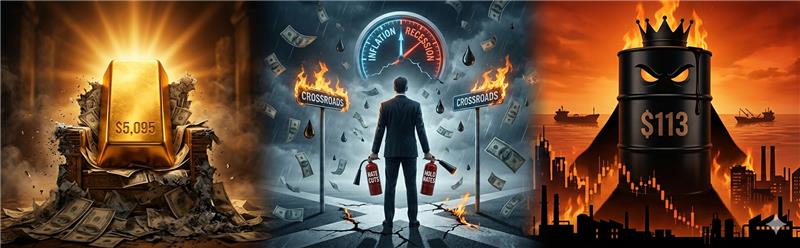
$113 oil, -92,000 jobs, gold at $5,095, and a Federal Reserve stuck between a flaming inflation fire and a collapsing jobs market. This is stagflation’s unholy trinity. Here’s what the data says — and what real investors across every platform are actually doing about it.

There is a word that economists dread more than “recession.” More than “correction.” More than any of the other dramatic vocabulary Wall Street has invented for when things go wrong. That word is stagflation. And on March 9, 2026, it is no longer a theoretical risk. It has taken a seat at the table, ordered dinner, and is making itself comfortable.
The diagnosis: oil at $113/barrel driving costs upward across the entire economy, February payrolls down 92,000 jobs for the third time in five months, and a Federal Reserve that cannot cut rates without reigniting inflation it has spent five years fighting. Three simultaneous crises. One policy tool. No clean answer.
And gold? At $5,095 an ounce — up 7.7% since the Iran war began on February 28 — it is doing exactly what it has always done when the financial system starts to crack: going up without asking anyone’s permission.
Ed Yardeni has raised his odds of 1970s-style stagflation to 35%, calling the Iran war “the latest stress test of the US economy’s resilience since the start of the decade.” Meanwhile, Morgan Stanley’s Ellen Zentner says the weak jobs numbers have put the Fed between a rock and a hard place — where significant labour market weakness would support rate cuts, but higher-for-longer oil could trigger another inflation surge.
Stagflation is the simultaneous occurrence of stagnant or declining economic growth, high unemployment, and persistent inflation. The conventional tools of monetary policy are built for fighting one at a time. Stagflation presents all three simultaneously — each cure making the others worse.
Cut rates to support employment? You accelerate inflation. Raise rates to crush prices? You deepen the recession. Hold steady? Both deteriorate while you wait for better data. High inflation and slow growth present a double threat, as stimulative measures such as interest rate cuts and government spending only aggravate inflation.
Both happening at once. Neither fixable without making the other worse.
The US economy did not walk into this crisis in a single day. It arrived here through a series of accumulating pressures that were already straining the foundations before the Iran war lit the final match. Understanding each layer explains why the current downturn feels so stubborn — and why the usual fixes are not working.
Oil is the engine of modern stagflation. It has been since 1973. The mechanism is brutally straightforward: oil is an input cost for virtually everything — transport, manufacturing, agriculture, heating, plastics, fertiliser. When oil spikes sharply, prices for all of these rise simultaneously. That is the inflation side. But oil also acts as a giant tax on consumers and businesses, diverting spending from everything else. Less spending, less profit, less growth. That is the stagnation side.
Research from the Federal Reserve Bank of Dallas suggests that a $10 increase in oil prices adds roughly 0.2 percentage points to inflation while shaving about 0.1 percentage point off real GDP growth. Oil has risen roughly $40/barrel since the war began — implying approximately +0.8pp additional inflation and -0.4pp from GDP growth, stacked on an economy already losing jobs.
Gold doesn’t hold press conferences. It doesn’t have earnings calls or forward guidance. It prices itself in real time based on what markets collectively believe about the purchasing power of paper money, the competence of central banks, and the safety of the financial system. At $5,095 today — near its all-time high of $5,595 set in January 2026 — gold is saying something very specific: I don’t trust the plan.
Apollo Global Management’s Torsten Slok has noted that gold’s popularity will depend on how long investors view increased inflation as a threat — and raised the possibility of a permanently higher inflation regime driving permanent demand for real assets like gold.
According to a Kitco News Gold Survey, 71% of retail investors expect gold to trade above $5,000/oz in 2026 — a number collected before the Iran war began. Since February 28, that forecast has already been validated. Deutsche Bank reiterated its $6,000/oz gold target in February 2026, while Societe Generale called $6,000 potentially conservative, and Goldman Sachs raised its end-of-year target to $5,400.
Pre-war (Feb 27): ~65 barrels (gold $4,720 / oil $72) — balanced markets
Today (Mar 9): ~45 barrels (gold $5,095 / oil $113) — compressing
Signal: When both assets rally together, professional desks read it as sustained broad inflation pricing — a stagflation flag, not a temporary supply event.
1970s parallel: A simultaneous gold-oil rally preceded and accompanied the worst periods of 1970s stagflation. The current pattern matches exactly.
The Federal Reserve has been “data dependent” for so long it has become data paralysed. In March 2026, the data is sending two violently opposing signals simultaneously.
Signal One (Cut rates): February payrolls down 92,000 — third monthly job loss in five months. Unemployment at 4.4%. Atlanta Fed GDPNow Q1 growth collapsed from 3.0% to 2.1% in one week. Every number says: act now.
Signal Two (Don’t cut): Core PCE at 3.0% — a full point above target for the fifth straight year. Oil at $113 hasn’t even hit CPI data yet (4–8 week lag). Analysts project headline inflation could reach 4.0–4.5% if oil stays elevated. Prior to the US-Israeli attack on Iran, futures traders were pricing in June for the next Fed rate cut, with at least one more before year-end. That first cut has now been pushed out to September — July at the earliest — and no second reduction in 2026 is priced.
Dollar-gold convertibility ends. Gold begins free-floating from $35/oz. The clock starts.
Oil quadruples. Inflation surges. The stagflation era begins. Gold responds slowly, then violently.
Fed Chair Arthur Burns, under political pressure, cuts rates despite rising inflation. “Stop-go” policy creates a wage-price spiral. Gold climbs from $100 to $200/oz.
Second supply shock hits a stagflationary economy. Gold surges from $200 to $850/oz in one year. CPI peaks at 14.8%. Gold: +2,300% for the decade.
New Fed Chair Paul Volcker raises rates to 20%. Severe recession. Unemployment 10.8%. Inflation breaks. Gold enters a 20-year bear market. The cure was brutal — but it worked.
Oil $113, triggered by Iran war — again. Gold $5,095 — near ATH before the war even started. Jobs bleeding. Fed frozen. But global debt is $340 trillion. A Volcker Shock today would detonate every sovereign debt market on Earth.
| Factor | 1973–1980 | 2026 | Verdict |
|---|---|---|---|
| Oil Trigger | OPEC embargo, Iran Revolution | Iran war, Hormuz closure | Very Similar |
| Oil Price Surge | ~400% over decade | +55% in 9 days | Faster Today |
| Global Debt | Below 100% of GDP | $340T — 3-4x global GDP | Far Worse Today |
| Fed Rate Room | Could raise to 20% | Limited — already elevated, $36T debt | Less Room Today |
| Gold Starting Point | $35/oz (suppressed) | $5,095/oz (near ATH) | Already Pricing Risk |
| Jobs Market | Deteriorating from healthy base | Already negative 3 of last 5 months | Starting Weaker |
| Volcker Option? | Yes — painful but viable | Extremely dangerous given debt levels | Much Harder Today |
Click any asset for a full breakdown of how stagflation affects it and what we are watching in 2026.
What Investors Are Saying Across the Web
Paraphrased sentiment gathered from across investing forums, finance communities, trading platforms, and discussion boards — reflecting the range of views circulating in March 2026. All views paraphrased and categorised by sentiment; no direct quotations reproduced.
A widely upvoted perspective making rounds in finance communities argues that this situation mirrors 1973 — but with a far more constrained Fed, since global debt levels mean that Volcker’s 20% rate solution simply cannot be replicated without triggering a sovereign debt catastrophe.
The dominant sentiment among gold traders on platforms like Stocktwits centres on a single thesis: gold was already at record highs before the war started. The geopolitical shock hasn’t created the bull case — it has simply accelerated one that was already structurally in place. Many users report holding long positions opened well below current levels.
A recurring theme in macro analysis pieces is the “Fed trap” concept — the idea that any rate cut signals the Fed has given up on inflation, while any rate hold deepens the labour market damage. Several contributors argue the March 17–18 FOMC meeting is the most consequential in years, with the dot plot potentially moving market expectations dramatically in either direction.
The most-viewed answers to “should I buy gold now?” on finance Q&A platforms are drawing on historical stagflation data from the 1970s. Respondents consistently cite the gold-oil correlation, negative real yields, and de-dollarisation by central banks as reasons to maintain exposure — while cautioning that buying at $5,095 after a +2,300% historical precedent requires a long time horizon and discipline not to panic-sell on corrections.
Technical traders on charting platforms are watching the $113–$119 oil range with a mix of conviction and caution. Several prominent chart setups identify strong resistance at current levels, with a scenario analysis suggesting a correction if diplomatic signals emerge from Iran — but also flagging that a break above $120 with volume would signal an accelerating move toward $140–$150 without fundamental resistance until 2008 highs.
The prevailing sentiment on financial Twitter around the Fed’s position can be summarised as: “they are out of good options.” Posts drawing thousands of engagements point out that the Fed cannot credibly pivot to cuts while headline CPI is about to spike from oil, but also cannot maintain rates at current levels without the labour market deteriorating further. The most-shared framing describes it as a policy “straightjacket.”
Outside the professional investing world, the most emotionally resonant discussions are coming from ordinary households — people writing about their actual grocery bills, gas receipts, and utility statements. The consistent theme is that the market’s “technical” analysis of stagflation as an abstract risk doesn’t reflect the lived reality of inflation already embedded in daily life for millions of people well before the CPI data captures it.
Mainstream financial media commentary has shifted notably in tone since February 28. Articles that a month ago were headlined around “soft landing confirmed” and “rate cuts coming” are now consistently using the word “stagflation” and debating whether the 1970s comparison is apt. The consensus analytical view: if the war ends in weeks, the shock is manageable. If it extends to months, the inflation embedding is hard to reverse without a significant policy response.
Stagflation, Gold & Oil — Every Question Answered
The questions flooding search engines, finance communities, and every trading chat right now — answered without jargon, with data, and appropriate levels of concern.
Stagflation is the combination of stagnant or declining economic growth + high unemployment + persistent inflation all at once. Every policy tool a central bank uses to fix one problem makes the others worse.
Cut rates to save the jobs market? You’ve just added fuel to inflation. Raise rates to crush inflation? Enjoy your recession. Hold steady? Watch both deteriorate. Stagflation doesn’t give you clean answers — it gives you a menu of bad options.
The panic in 2026 is real because for the first time since the 1970s, all three ingredients are simultaneously live: oil at $113 driving costs higher (inflation ✓), February jobs -92,000 for the third time in five months (stagnation ✓), and a Fed that’s been fighting inflation for five years and cannot credibly pivot to cuts without risking a new price spiral (policy trap ✓).
Gold’s stagflation track record is genuinely remarkable. Starting the 1970s at $35/oz, it reached $850/oz by January 1980 — a 2,300% gain. Its real returns (after adjusting for inflation) were still strongly positive, outperforming stocks, bonds, and cash by a wide margin.
The mechanism: stagflation pushes real interest rates (nominal rate minus inflation) toward zero or negative. When your bond earns 6% but inflation runs at 12%, your real return is -6%. Gold, which earns zero yield, becomes the rational choice since it also loses zero yield to inflation. In 2026, with Core PCE at 3.0% and oil about to push CPI higher, real rates may be heading in exactly that direction.
Gold eventually peaked and crashed — but only after Volcker raised rates to 20% in 1979, making real yields strongly positive again. That option is far more constrained in 2026 given $36 trillion in national debt.
Oil isn’t just one commodity. It is the foundational input cost of the modern economy. Everything that moves, everything made, everything grown, and everything heated uses oil somewhere in its supply chain. A sharp oil spike raises all of those costs simultaneously — that is the inflation side.
But oil also acts as an economic tax. Higher fuel costs force consumers and businesses to divert spending away from everything else — that is the stagnation side. Research from the Dallas Fed suggests every $10 oil rise adds ~0.2pp to inflation while removing ~0.1pp from real GDP growth. With oil up $40+/barrel since the war began, the arithmetic points to roughly +0.8pp inflation and -0.4pp GDP, on top of an economy already losing jobs. This is not a futures market problem anymore. It is already in the real economy.
Because cutting rates during an oil-driven inflation spike is one of the most dangerous policy mistakes a central bank can make. We know this because the Fed made exactly this mistake in the 1970s under Arthur Burns, producing a wage-price spiral that took Volcker’s 20% rates and a severe recession to resolve.
In 2026, with core PCE at 3.0%, oil at $113, and headline CPI about to rise further as energy prices embed in the data, cutting rates now risks validating inflation expectations and triggering the same dynamic Burns set in motion. Joe Brusuelas, chief economist at RSM, has described the Fed’s situation as a real stress test for rate setters: all eyes remain on the direction of energy prices as the risk of stagflation permeates the outlook.
The Fed’s “wait and see” position is genuinely the least-bad option available, even if it feels like doing nothing.
Gold and oil share a historically positive correlation through three channels.
The Inflation Channel: Both are dollar-denominated. When oil rises, inflation rises, the dollar loses purchasing power, and gold — as an alternative store of value — tends to rise.
The Macro Signal Channel: The gold-to-oil ratio (barrels per ounce of gold) is a long-watched macro indicator. When both assets rally together — as now — professional desks read it as sustained broad inflation pricing, not a temporary supply event. The ratio has compressed from ~65 to ~45 barrels since the war began.
The Geopolitical Channel: Middle East instability simultaneously disrupts oil supply (pushing crude higher) and drives safe-haven demand (pushing gold higher). Professional trading desks regularly watch the spread between gold and crude prices for early macro signals — a synchronised rally across both markets often suggests inflation pressure spreading through the economy.
It is not worse in all dimensions — but it is more complex and arguably harder to resolve. The similarities are genuine: oil supply shock, geopolitical crisis involving Iran, Fed facing an inflation-vs-employment dilemma, gold rallying. The playbook rhymes unmistakably.
But two factors make 2026 materially harder. First: global debt at $340 trillion (3-4x global GDP). A Volcker-style rate shock would make government debt servicing costs catastrophic. Ray Dalio has noted that the US is approaching the late stage of a big debt cycle, where borrowing and interest costs compound faster than economic growth — with federal debt at ~$36 trillion (~125% of GDP) and annual deficits near $2 trillion. Second: velocity. The 1970s stagflation developed over years. This version is compressing into weeks — oil up 55% in 9 days. The policy system has less adaptation time.
Important: This is educational analysis, not financial advice. Consult a qualified financial advisor before making any investment decisions.
With that said, here is what historical evidence and current analyst consensus suggests:
✅ Gold (5–15% allocation): The most historically proven stagflation hedge. Physical bullion, ETFs (GLD, IAU), or gold mining stocks for leverage. Most advisors recommend meaningful but not excessive allocation.
✅ TIPS: Principal adjusts with official CPI. Replace some or all long-duration bond exposure.
✅ Energy stocks — domestic producers: Direct beneficiary of elevated oil. US domestic production insulated from Hormuz disruption.
✅ Defensive equities with pricing power: Healthcare, utilities, consumer staples — companies that can pass cost increases to customers without losing volume.
❌ Reduce: Long-duration bonds — most exposed to rising yields and inflation erosion.
❌ Reduce: High-multiple growth stocks — valuation compression from higher-for-longer rates plus margin pressure from input cost surge.
Stagflation Doesn’t Ask
For Permission. It Just Arrives.
The word “stagflation” has been recycled as a warning, a risk, a headline, and a theoretical exercise for three years. On March 9, 2026, it graduated. It is the current economic condition — early-stage, potentially temporary if the Iran war resolves quickly, but undeniably present in every data point that matters.
For most economists and strategists, the primary variable is duration. If the Iran situation can be resolved in a few weeks, any stagflationary shock will likely be muted. But if oil prices stay elevated for long enough, it becomes a growth scare — and if bond yields start falling as people worry about growth, that is the stagflation mode.
The 1970s comparison is instructive but imperfect. The mechanism is identical — oil supply shock, cost-push inflation spiral, weakening economy, frozen Fed. But the debt environment is far more constraining, the policy options fewer, and the velocity of the shock far faster. Paul Volcker’s solution — aggressively raising short-term interest rates — is far more difficult to replicate in a world where US debt is $36 trillion at 125% of GDP and interest payments already exceed $1 trillion per year.
What that means in practice: the Fed will hold. Markets will need to reprice. A 2026 that was supposed to feature multiple rate cuts, AI earnings growth, and a soft landing now faces a fundamentally different macro backdrop. Gold — already at $5,095 before the war, with institutional targets ranging from $5,400 to $6,300 — is not in a bubble. It is in a rational response to an environment where the standard playbook has stopped working.
The most important data points this week: Tuesday CPI (last clean read before oil shock embeds), Wednesday G7 statement on reserve releases, Thursday signals from new Supreme Leader Mojtaba Khamenei, and daily Strait of Hormuz tanker traffic — the single variable that resolves everything else if it moves in either direction.
“Gold doesn’t lie. Oil doesn’t care. The Fed doesn’t have a good answer. And the public — from finance forums to kitchen tables — already knows it. The unholy trinity of stagflation is here. The 1970s said: own gold, own energy, reduce duration, survive until Volcker arrives. The problem is there is no Volcker available this time. The debt won’t allow it. Plan accordingly — and watch the strait.”