Nikkei 225 History: Bubble, Crash & Record 2026 High
The Longest Wait in Modern Markets: The Complete Story of the Nikkei 225 — From Occupied Japan to All-Time Highs, and the $500 Billion Trade Now in Reverse
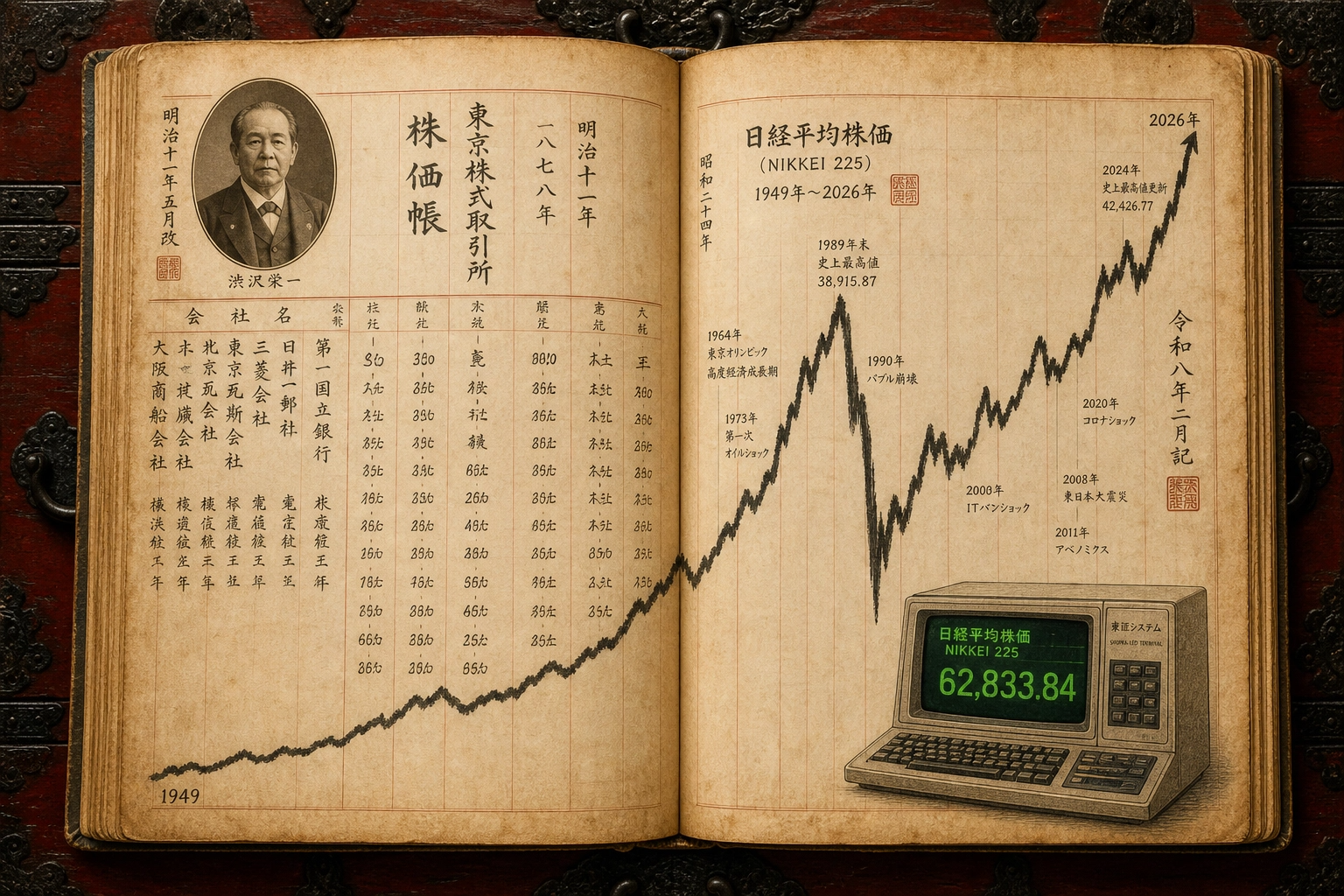
Today — May 7, 2026 — the Nikkei 225 closed at 62,833.84, posting its largest single-day point gain in history: 3,320 points in one session, driven by US-Iran peace deal optimism and five trading days of pent-up buying pressure. The index that began life in 1949 as a three-digit number scratched together from the rubble of occupied Japan has now more than doubled since it finally erased its 1989 bubble peak in February 2024. It took thirty-four years and three months. No major developed-market index has ever waited longer to recover from a peak. This is the complete story — from the 1878 founding of the Tokyo Stock Exchange on land built for Edo-era samurai, through the occupation peg, through the greatest stock market bubble in modern history, through three lost decades, through the carry trade era that rebuilt the whole thing on borrowed yen, and through the five scenarios now staring down every trader who holds or watches Japan — with the exchange’s full 148-year institutional history, precise weekly-chart trade setups across the Nikkei and USD/JPY, and the carry trade mechanics that will determine the direction of global risk assets for years.
- The Tokyo Stock Exchange: A 148-Year Institutional History — From Samurai Bonds to Electronic Milliseconds (1878–2026)
- Origins: Born from Rubble — The Occupation Peg and the Decision to Measure Japan (1949–1955)
- The Economic Miracle and the Index’s First Ascent (1955–1973)
- Oil Shocks and the First Test of Japan’s Model (1973–1984)
- The Plaza Accord, the Bubble, and the Most Spectacular Mania in Modern Financial History (1985–1989)
- The Collapse: 38,915 to 7,603 — The Longest Bear Market in Developed-Market History (1990–2003)
- The Lost Decades: What Zero Rates, Deflation, and a Demographic Cliff Did to Japan (1991–2012)
- Abenomics and the Yen-Powered Recovery (2013–2020)
- The Carry Trade Era: How Cheap Yen Rebuilt Everything the Bubble Had Destroyed (2020–2024)
- August 5, 2024: The Day the Nikkei Had Its Worst Session Since 1987 — and Recovered in a Week
- The Record Run to 62,833: What Has Driven the New All-Time High (2024–2026)
- The BOJ Dilemma: Caught Between Inflation and a Fragile Recovery
- ⚡ Trade Setups: Precise Entries, Targets & Stops Based on Live Weekly Chart Technicals
- The Five-Year Outlook: Scenario Analysis, Key Levels, and What Every Trader Needs to Know (2026–2031)
The Tokyo Stock Exchange: A 148-Year Institutional History — From Samurai Bonds to Electronic Milliseconds
To understand the Nikkei 225, you must first understand the exchange it lives on. The Tokyo Stock Exchange is not merely a marketplace. It is a direct chronicle of Japanese civilisation across three imperial eras, two world wars, an occupation, an economic miracle, the greatest asset bubble in modern history, and now a structural revolution in corporate governance that has drawn foreign capital back to Japan for the first time in three decades. It is the oldest stock exchange in Asia, the largest in Japan, and the third largest in the world by market capitalisation — approximately $6.34 trillion as of late 2025, listing 3,943 companies. Its history is the history of modern Japan rendered in prices.
1878 — The Meiji Foundation: Samurai Bonds and the Burning Rope
The district of Kabuto-cho in Tokyo’s Nihonbashi ward takes its name from “Kabuto-zuka” — Armour Mound — a burial mound from the Edo era that once sat on what was then a coastal reclamation, created on the orders of Tokugawa Ieyasu to build a harbour at the turn of the 17th century. By September 1871, following the Meiji Restoration, the land had been awarded to the Mitsui family and other zaibatsu as rewards for their support of the new imperial government. The name Kabuto-cho — Armour Town — stuck. The connection between military power and financial power proved permanent.
Japan in 1878 was a country in the middle of the most rapid voluntary modernisation in human history. The Meiji government, having watched Western imperial powers carve up Asia while Japan remained feudally isolated, had decided to industrialise at maximum speed. That required capital markets. It also required a mechanism to trade the government bonds issued to Japan’s former samurai class — the kinroku kosai, salary bonds that compensated the warrior caste for the abolition of their hereditary stipends. Finance Minister Shigenobu Okuma enacted the Stock Exchange Ordinance on May 4, 1878. Eleven days later, the licence was granted to a founding group that included Eiichi Shibusawa — Japan’s most celebrated industrialist, later chosen as the face of the ¥10,000 banknote — alongside Younosuke Mitsui and a consortium of Tokyo businessmen. Trading commenced on June 1, 1878, with four listed stocks and five types of government bonds, auctions conducted using a hinawa — a burning rope — as the time limit per session. The exchange was Japan’s first formal capital market. It opened 87 years after the New York Stock Exchange was founded under a buttonwood tree.
1878–1937 — The Meiji and Taisho Expansions
Through the Meiji and Taisho eras the TSE expanded steadily alongside Japan’s industrialisation, growing from a primarily bond-trading venue into a genuine equity market with listings in the hundreds. The open-outcry floor — floor clerks in kimono, chalk-written prices, runners carrying orders between brokerage offices — persisted well into the Showa period. By the 1920s the exchange was a hub for the shares of textiles, shipping, and nascent heavy industry. The global depression of the 1930s hit hard: repeated stock price crashes made Kabuto-cho more stagnant by the season. With Japan’s Manchurian Incident of 1937 and the economy placed on a war footing, the securities market came progressively under government control.
1943–1949 — Wartime Merger, Occupation, and the Street Trading of Ruins
In June 1943, the government completed a forced merger of all eleven regional Japanese stock exchanges into a single semi-governmental entity: the Japan Securities Exchange. The consolidation was explicit in its purpose — to channel capital toward war production under centralised direction. Floor trading was suspended on August 1, 1945, four days before the bombing of Hiroshima. Japan surrendered on September 2. General MacArthur signed a directive on September 25 prohibiting stock market activity entirely. The TSE building was occupied by the General Headquarters of the Allied Forces from October 1945 until January 1948. For two and a half years, the largest financial institution in Japan’s history functioned as an office for its occupiers. Securities companies, forbidden from formal trading, conducted semi-organised over-the-counter transactions on the streets around Kabuto-cho — informal markets that kept Japan’s capital allocation alive at minimal scale through the deepest years of reconstruction.
The securities industry lobbied persistently for restoration. In March 1946, 1,000 Japanese brokerage employees petitioned the Allied Headquarters directly. A thirteen-person committee prepared the reestablishment. Finally, under the new Securities and Exchange Act — modelled on the US Securities Exchange Act of 1934 — the Tokyo Stock Exchange reopened on May 16, 1949. Its first day was not triumphant: trading was thin, the economy was in ruins, and the index that would be measured against this reopening began life at 176.21. But the institution existed again. The scoreboard was back on.
1950s–1990 — Miracle, Floor Closure, and Full Computerisation
Through the 1950s and 1960s the TSE expanded dramatically as Japan’s economy grew at 10% annually. Listed companies crossed 1,000 by the mid-1960s. A new TSE building opened in 1961; a second Section for mid-sized companies was added the same year. The exchange operated through traditional open-outcry floor trading well into the 1980s, with computerisation of back-office processes beginning gradually in the early part of the decade. By November 1990 — in the early months of the bubble’s collapse — the TSE had fully computerised its trading floor, automating order placement and matching. The era of burning ropes and kimono-clad clerks had given way to screens. Incidentally, November 1990 is also when the Nikkei was falling toward 20,000 from its 38,915 peak — the exchange’s technological modernisation completed precisely as the market it hosted entered its darkest chapter.
The bubble’s apogee was also the TSE’s historical peak of global dominance. By December 1989, the TSE accounted for over 60% of global stock market capitalisation — the highest concentration ever achieved by any single national exchange. Tokyo had surpassed New York by market cap. Thirty-two of the world’s fifty largest companies were Japanese. The six largest banks by assets were all Japanese. It was, by every measurable standard, the most dominant single exchange in the history of modern financial markets — and it lasted precisely until January 4, 1990, when the Bank of Japan opened its books for the new year and the Nikkei fell.
1999–2010 — Electronic Trading, the Fat Finger, and Arrowhead
On April 30, 1999, the TSE’s trading floor — 121 years of open-outcry — closed permanently. TSE Arrows, a new electronic facility, opened on May 9, 2000. The exchange was now fully digital. It would immediately begin discovering what that meant in practice.
On November 1, 2005, a newly installed Fujitsu-developed trading system failed catastrophically, limiting the exchange to 90 minutes of trading — the worst disruption in its history at that point. One month later, on December 8, 2005, a Mizuho Securities employee typed an order to sell 600,000 shares at ¥1 each, instead of 1 share at ¥600,000. Mizuho failed to catch it. The TSE system initially blocked the cancellation. Net loss: $347 million shared between the exchange and Mizuho. The TSE’s CEO and two senior executives resigned. The Mizuho “fat finger” became one of the most cited human-error trading disasters in history — and it directly triggered the creation of the Arrowhead platform. On January 4, 2010, Arrowhead launched: order execution in 5 milliseconds, capacity to handle 80,000 orders per second. The TSE had entered the millisecond era.
2013–2026 — JPX Merger, the 2020 Full-Day Halt, and the Governance Revolution
On January 1, 2013, the TSE merged with the Osaka Securities Exchange to create the Japan Exchange Group (JPX), making it the world’s third-largest bourse by listed companies. In July 2013, 1,100 Osaka-listed stocks migrated to the TSE — including Nintendo, Murata Manufacturing, and Nidec. On October 1, 2020, for the first time in its all-electronic era, the TSE halted trading for an entire day due to a hardware failover failure in the Arrowhead system — all regional exchanges using the same platform also suspended. The TSE president resigned.
On April 4, 2022, the exchange implemented its biggest restructuring in more than 60 years: five market sections replaced by three — Prime Market (now home to 1,609 companies), Standard Market (1,565), and Growth Market (611). Critically, companies trading below 1x book value were required to present credible capital efficiency improvement plans or face delisting from the Prime Market. This was extraordinary by Japanese corporate standards: a stock exchange directly pressuring listed companies to improve returns to shareholders. The wave of share buybacks, dividend increases, and restructurings it triggered is the structural engine behind the Nikkei’s bull run from 39,098 in February 2024 to 62,833 today. The exchange that was founded to trade samurai bonds in 1878, occupied by MacArthur’s forces in 1945, briefly unable to cancel a mistyped order in 2005, and halted entirely for a day in 2020 has — through its 2022 governance reform — become a primary structural driver of Japan’s equity market reaching all-time highs in 2026.
| Year | TSE Milestone | Market Impact |
|---|---|---|
| Jun 1878 | TSE founded — Tokyo Kabushiki Torihikijo. 4 stocks, 5 bond types. Burning-rope auctions. | Japan’s first formal capital market. Kabuto-cho becomes Japan’s Wall Street. |
| Jun 1943 | Forced wartime merger — all 11 regional exchanges become Japan Securities Exchange | Capital markets become a tool of war economy under government control |
| Aug 1945 | TSE floor closed. Building occupied by MacArthur’s GHQ until Jan 1948. | Informal kerb trading in Kabuto-cho streets keeps Japan’s market alive at minimum scale |
| May 1949 | TSE reopens under the Securities Exchange Act. Nikkei first calculated Sep 7 1950. | Opening Nikkei reading: 176.21. The scoreboard restarts. |
| 1961 | New TSE building opens. Second Section established. | Listed companies approaching 1,000. Market cap expanding with the Economic Miracle. |
| 1975–1985 | Rebranded “Nikkei Dow Jones Stock Average” — formal Dow Jones partnership | World recognises Japan’s exchange as a peer of New York’s |
| Dec 1989 | TSE becomes world’s largest exchange — over 60% of global market cap | Nikkei peaks at 38,915. 32 of world’s 50 largest companies are Japanese. |
| Nov 1990 | TSE fully computerises trading floor operations | Open-outcry ends as the bubble begins collapsing. Technology arrives at the worst moment. |
| Apr 1999 | Trading floor closes permanently after 121 years | TSE Arrows electronic facility opens May 2000. Japan becomes fully digital. |
| Nov 2005 | Fujitsu system bug — 90-minute trading halt, worst in TSE history | Directly leads to Arrowhead development |
| Dec 2005 | Mizuho “fat finger” — $347M loss from one mistyped order | TSE CEO resigns. Exchange admits system fault. Arrowhead development accelerated. |
| Jan 2010 | Arrowhead launches — 5ms execution, 80,000 orders/second | TSE enters millisecond era. Aligns with global HFT standards. |
| Jan 2013 | JPX formed — TSE merges with Osaka Securities Exchange | World’s 3rd-largest bourse by listed companies. 1,100 Osaka stocks migrate to TSE. |
| Oct 2020 | Full-day trading halt — Arrowhead hardware failover failure | First all-day suspension in electronic era. TSE president resigns. |
| Apr 2022 | Biggest restructuring in 60 years — Prime, Standard, Growth markets. Below-book companies must improve or face delisting. | Triggers corporate governance revolution. Foreign capital returns to Japan for first time in decades. |
| Feb 2024 | Nikkei closes at 39,098.68 — above the 1989 peak for the first time | 34-year wait ends. TSE governance reform vindicated by market. |
| May 7 2026 | Nikkei closes at 62,833.84 — all-time record. Record single-day point gain: +3,320.72. | TSE market cap ~$6.34 trillion. 3rd globally. The exchange founded for samurai bonds now processes 80,000 orders per second. |
Born From Rubble — The Occupation Peg and the Decision to Measure Japan
On September 7, 1950, in the offices of the Nihon Keizai Shimbun — Japan’s equivalent of the Financial Times, whose name translates literally as “Japan Economic Newspaper” — a team of statisticians completed a calculation that had been assigned to them by the American occupation government. Their task was to construct a single number that could summarise the state of Japanese corporate Japan. The number they published that morning was 176.21. It was retroactively dated to May 16, 1949, the day the Tokyo Stock Exchange had reopened under American supervision after five years of forced closure. The Nikkei 225 was born.
The context demands stating plainly: Japan in 1949 was economically destroyed. Its cities had been firebombed. Its manufacturing base had been converted entirely to war production and then dismantled by occupation orders. Its currency had collapsed from approximately 3.6 yen per dollar before the war to a rate that markets pushed toward 600 yen per dollar by 1947, before the occupation government intervened. The index that would one day touch 62,833 began life as a measurement of wreckage.
The decision to model the new index on the Dow Jones Industrial Average was deliberate and political. General Douglas MacArthur’s occupation administration was remaking Japan in the image of American capitalism — a constitutional democracy with a free-market economy and a stock exchange functioning as the visible scorecard of corporate health. The Nikkei, like the Dow, would be price-weighted: each of its 225 components would influence the index in proportion to its share price, not its market capitalisation. A company with a ¥10,000 stock would move the index ten times as much as a company with a ¥1,000 stock, regardless of how large either business was. The mechanics were borrowed wholesale from the American model, and from 1975 to 1985 the index was formally rebranded “the Nikkei Dow Jones Stock Average” in acknowledgment of that lineage.
“The Nikkei’s first official reading of 176.21 in 1949 was almost exactly identical to the Dow Jones’s closing value of 175.76 on the same retroactive date. Two economies, one destroyed and one ascendant, starting at the same scoreboard. By 1989, Japan’s number would be 38,915 and America’s would be 2,753. The scoreboard had run very differently.” — CSFX Research Desk, Index History Series · May 2026
The 225 stocks selected for the original index covered the full breadth of Japan’s reconstruction economy: steel, shipping, chemicals, textiles, banking. The emphasis was not on glamour but on industrial capacity — the companies that would have to be rebuilt for Japan to feed, clothe, and eventually export its way back to self-sufficiency. Toyota Motor had already been listed in 1949. Hitachi, Nippon Steel, Sumitomo, and Mitsubishi were all early constituents. The index was, from its first day, a portrait of the corporate Japan that MacArthur was trying to build.
One detail about the index’s construction has outlasted everything else: its price-weighting methodology means it is structurally analogous to the Dow, not the S&P 500 or the TOPIX. The consequence is that a single high-priced stock can distort the entire index. In 2026, Advantest and SoftBank Group together account for a disproportionate share of Nikkei movements relative to their economic significance. This is not a bug. It is the same design decision made by Dow Jones in 1896, inherited without modification by the newspaper that began computing Japan’s economic temperature in 1950.
The Economic Miracle and the Index’s First Ascent
Between 1955 and 1973, Japan achieved the most sustained period of economic growth in the recorded history of any developed nation. GDP expanded at an average annual rate of approximately 10% for nearly two uninterrupted decades. No country before or since has replicated that pace at anything approaching Japan’s scale. The Nikkei 225 was the scoreboard for a transformation so rapid and so total that it has no real historical precedent — and understanding what drove it is essential to understanding both the bubble that followed and the carry-trade era now drawing to its close.
The three pillars of the miracle were as interrelated as they were powerful. The first was the American security umbrella: Japan’s constitution, written under occupation, constrained defence spending to roughly 1% of GDP. This freed an extraordinary proportion of national savings and government expenditure for productive investment that every other major industrialised nation was diverting to military capacity. The second pillar was the undervalued yen — fixed at 360 per dollar from 1949 until Nixon closed the gold window in 1971 — which made Japanese exports cheaply competitive on world markets for the entire duration of the miracle decade. The third was MITI: the Ministry of International Trade and Industry, which functioned as an industrial strategy ministry unlike anything that existed in any Western democracy, directing credit, technology licensing, and export promotion toward industries that Japan decided, by national consensus, it wanted to dominate. Steel in the 1950s. Shipbuilding in the 1960s. Electronics in the 1970s. Automobiles through all three decades.
The Nikkei reflected this transformation in its numbers. From its retroactive starting point of 176.21 in 1949, it crossed 1,000 in 1963. It crossed 2,000 in 1968. By January 1973, it had reached 5,350 — a thirty-fold increase in 24 years, sustained by earnings growth that was genuine and not leverage-inflated, because the companies underlying it were genuinely producing more goods, selling them at higher margins, and expanding into global markets that had never encountered Japanese competition at this quality and price point.
The companies that powered the Nikkei’s first great ascent became the household names of global manufacturing. Toyota’s production system — the elimination of waste through “just-in-time” delivery and continuous improvement — was a manufacturing methodology so revolutionary that American companies spent decades reverse-engineering it. Sony’s transistor radio of 1955, the Walkman of 1979, the Trinitron television of 1968: products that did not merely compete with Western equivalents but redefined the standard of what the category could be. The Nikkei in 1973 was not a financial abstraction. It was a measurement of an industrial civilisation that had rebuilt itself from ash in less than 30 years and was now competing on equal terms with the countries that had defeated it.
Oil Shocks and the First Test of Japan’s Model
October 1973 revealed Japan’s most fundamental structural vulnerability with brutal efficiency. The OPEC oil embargo — triggered by the Yom Kippur War and Arab states’ fury at Western support for Israel — quadrupled crude oil prices in a matter of months. Japan, which imported essentially all of its petroleum, was hit harder than any other major economy. Inflation surged above 20% in 1974, the worst since the immediate postwar period. The Nikkei fell from 5,350 in early 1973 to below 3,800 by late 1974 — a decline of nearly 30%, its worst bear market to that point.
The response to the oil shocks was, characteristically for Japan, total and systematic. The government redirected industrial policy away from energy-intensive heavy industry and toward precision electronics and fuel-efficient automobiles. Companies slashed energy consumption per unit of output. By the early 1980s, Japan’s GDP growth per barrel of oil consumed was dramatically higher than any other industrialised nation. The oil shocks that had appeared to threaten the miracle actually accelerated it into its most durable form: the shift toward high-value, low-weight, low-energy-intensity manufactured goods that would define Japan’s export supremacy through the 1980s.
A second oil shock in 1979 — triggered by the Iranian Revolution and subsequent supply disruption — was absorbed with less damage. The yen weakened against the dollar as Paul Volcker’s shock therapy pushed US rates above 20%, attracting global capital to dollar assets. USD/JPY reached 240 per dollar by 1982 — a weak yen that actually benefited Japanese exporters even as it raised import costs. The Nikkei recovered steadily through the early 1980s, pushed higher by the earnings power of an export machine now running at full capacity into a world that wanted Japanese cars, cameras, televisions, and semiconductors.
By 1985, the Nikkei had climbed to approximately 13,000. The index had delivered a 70-fold return from its 1949 origin. And it was about to do something that would take 34 years to undo.
The Plaza Accord, the Bubble, and the Most Spectacular Mania in Modern Financial History
On September 22, 1985, the finance ministers and central bank governors of the five largest economies in the world — the United States, Japan, West Germany, France, and the United Kingdom — met in secret at the Plaza Hotel in New York City. The meeting lasted an afternoon. The agreement they announced the following morning became one of the most studied acts of coordinated currency intervention in modern financial history, and it set in motion the conditions for the asset bubble that followed.
The problem the Plaza Accord was designed to solve was straightforward. Paul Volcker’s interest rate shock of 1979–1982 had made the dollar extraordinarily attractive to global capital, pushing it approximately 50% higher against major currencies between 1980 and 1985. The effect on American manufacturing was catastrophic: Japanese cars were arriving in the United States at prices that American producers couldn’t match, and the US trade deficit with Japan alone had reached $49.7 billion in 1985, generating intense congressional pressure for protectionist tariffs. The Plaza Accord was designed to correct this through coordinated intervention to weaken the dollar and strengthen the yen and Deutsche Mark.
Japan’s Finance Minister Noboru Takeshita entered the Plaza Hotel expecting the yen to appreciate by approximately 10–12%. At USD/JPY 240, that would mean a move to around 216. What actually happened was categorically different. Within weeks, the yen had blown through 200. By summer 1986, it was at 160. By 1988, it had reached 128. By 1995, at the absolute peak of its appreciation, the yen hit ¥79.75 per dollar — the strongest level in its modern history, and one it has never since repeated. Japan entered the Plaza Accord targeting a move to 216. The market delivered 80. The overshoot was more than four times the intended adjustment.
| Year | USD/JPY | BOJ Rate | Nikkei Level | Japan Land Prices | Key Event |
|---|---|---|---|---|---|
| 1985 | 240 | 5.00% | 13,000 | Normal | Plaza Accord signed Sep 22 |
| 1986 | 160 | 3.00% | 18,820 | Rising sharply | BOJ cuts rates 5 times to cushion yen shock |
| 1987 | 145 | 2.50% | 21,564 | Accelerating | Black Monday Oct 19; Nikkei falls 15%, recovers |
| 1988 | 128 | 2.50% | 30,159 | Exponential | Japan’s equity market passes US in total cap |
| 1989 | 143 | 3.75–6.00% | 38,915 — PEAK | Imperial Palace > California | BOJ begins hiking Dec 1989; bubble seals its fate |
The mechanism of the bubble is central to understanding the Nikkei’s entire modern history. Faced with a surging yen that was devastating the export sector, the Bank of Japan cut its discount rate five consecutive times between 1986 and 1987, driving it to an all-time low of 2.5%, where it stayed for two years and three months. The explicit objective was to stimulate domestic demand so that Japan’s growth wouldn’t depend entirely on exports that were being priced out of world markets by the rising yen. The actual result was a catastrophic flood of cheap credit into asset markets.
Japanese banks, awash in deposits and restricted from excessive lending to the now-unfashionable heavy industries, directed credit toward real estate and equity. Real estate prices in Tokyo’s central business districts doubled, tripled, then doubled again. Golf club memberships — in a country where golf was a status symbol — began trading on secondary markets like securities, with memberships at premium clubs selling for more than ¥500 million. By 1990, the total assessed value of all land in Japan was theoretically four times the total assessed value of all land in the United States — a nation twenty-six times Japan’s geographic size. The land under the Imperial Palace in Tokyo, a few dozen hectares in the centre of the city, was theoretically worth more than the entire state of California.
The Nikkei reflected and amplified this madness. From 13,000 in 1985, it reached 18,820 by end-1986. It crossed 20,000 in 1987 — briefly collapsing 15% in the global crash of Black Monday in October of that year before recovering with remarkable speed, a resilience the market interpreted as confirmation of Japan’s structural strength. By end-1988, it was at 30,159. The pace of the rise had detached entirely from the earnings growth of the underlying companies: price-to-earnings multiples across the index averaged 60x by 1989, compared to roughly 15x in the United States. Japanese companies justified this by arguing that land assets held on their balance sheets at historical cost were worth multiples of their book value, and that once those hidden reserves were accounted for, valuations were reasonable. The argument was circular, the asset values were imaginary, and the edifice had no foundation outside the assumption that prices would continue rising because they had been rising.
On December 29, 1989, the Nikkei 225 closed at 38,915.87. It was the last trading day of the decade. At that level, Japan’s equity markets accounted for 40% of global stock market capitalisation, though Japan represented barely 10% of global GDP. Thirty-two of the world’s fifty largest companies by market cap were Japanese. The six largest banks in the world by assets were all Japanese. The Tokyo Stock Exchange had surpassed the New York Stock Exchange in total market capitalisation. It was, by every measurable standard, the most overvalued major stock market that the modern era had ever produced.
And it had three more trading days in the decade. On January 4, 1990, the Bank of Japan opened its books for the new year’s trading. The Nikkei fell.
The Collapse: 38,915 to 7,603 — The Longest Bear Market in Developed-Market History
The Bank of Japan had begun raising rates in May 1989, seven months before the bubble peaked — a belated recognition that the asset inflation it had helped create was becoming dangerous. By August 1990, the discount rate had risen from 2.5% to 6.0% in fifteen months — the most aggressive tightening cycle in Japanese postwar history. The Nikkei had already begun responding. It fell 38% in 1990 alone, its worst calendar-year performance. By 1992, it was below 15,000. And then it kept falling. Not in a straight line, and not without rallies — but the general direction, interrupted by brief recoveries that each failed to hold, was relentlessly lower for more than a decade.
The mechanism of the collapse was not simply that overvalued assets corrected to fair value. The deeper problem was balance-sheet debt. During the bubble years, Japanese banks had lent against asset values that were now collapsing. Corporate borrowers had pledged land and stock as collateral for loans that now exceeded the collateral’s market value. Banks that acknowledged these non-performing loans would have been technically insolvent. For most of the 1990s, they didn’t acknowledge them — a practice that regulators permitted and policymakers encouraged, on the theory that explicit recognition of the losses would trigger a banking crisis that would deepen the recession. The effect was the opposite of what was intended: by refusing to clear bad debts, Japan kept zombie borrowers alive, preventing the creative destruction that normally allows economies to recover from credit busts, and extending the malaise for a decade rather than compressing it into three or four brutal years.
The human toll of the Lost Decades, expressed through the Nikkei’s trajectory, was immense. Wages, which had peaked in real terms in 1997, declined for the following sixteen years. Household consumption stagnated. The suicide rate rose sharply through the 1990s as salarymen — the lifetime employment contract workers who had built their entire identity around corporate loyalty — found themselves made redundant by companies that could no longer afford the obligations they had promised. Japan’s nominal GDP in 2023 was virtually identical to Japan’s nominal GDP in 1993. An entire generation of Japanese investors and workers saw three decades of economic experience produce net zero progress.
The Nikkei bottom of 7,603.76 on April 28, 2003, represents the nadir of the most complete destruction of equity value in the history of modern developed markets. An investor who bought the Nikkei at its December 1989 peak and held through April 2003 had lost 80% of their investment in nominal terms — more in real terms — over thirteen years. No major developed market index before or since has produced a loss of that magnitude, sustained over that duration, from a peacetime peak.
The Lost Decades: What Zero Rates, Deflation, and a Demographic Cliff Did to Japan
Japan’s three lost decades are typically taught as a cautionary tale about asset bubbles and the consequences of delayed balance-sheet adjustment. That framing is accurate but incomplete. The structural forces that made the recovery so agonisingly slow were not merely financial — they were demographic, cultural, and geopolitical in ways that no policy toolkit could fully address.
The demographic dimension is among the least discussed. Japan’s total fertility rate fell below replacement level in 1975 and has not recovered since. By the 1990s, the leading edge of this demographic shift was becoming visible in labour markets: the working-age population began to shrink just as the economy needed workforce growth to sustain corporate earnings and government tax revenues simultaneously. The Bank of Japan could create money but couldn’t create workers. MITI could direct credit toward promising industries but couldn’t create the young consumers needed to buy the products of those industries at scale. The combination of a shrinking workforce, a debt-laden banking system, and a culture of corporate caution that had been trained by a decade of losses produced an economy incapable of generating the self-sustaining growth that ZIRP and QE were designed to stimulate.
The yen served as the perverse mirror of Japan’s economic distress throughout this period. The currency that should have weakened as the economy deteriorated instead strengthened — driven by Japan’s current account surplus (exporters repatriating foreign earnings), the country’s creditor status (Japanese investors buying overseas assets then repatriating in crises), and the yen’s structural safe-haven role. When the 2008 Global Financial Crisis hit, USD/JPY fell from 110 to 76 as global panic drove capital into the perceived safety of Japanese assets. When the March 2011 Tōhoku earthquake and tsunami struck — killing nearly 16,000 people, triggering the Fukushima nuclear disaster, and causing an estimated $235 billion in damage — the yen strengthened. Japanese insurance companies and institutional investors repatriated overseas assets to fund reconstruction. The G7 had to coordinate a rare joint currency intervention to weaken the yen and prevent the strengthening currency from compounding the disaster’s economic damage.
“Japan spent two decades proving that monetary policy alone cannot cure a balance-sheet recession. The Bank of Japan could hold rates at zero. It could buy every government bond issued. It could expand its balance sheet to 130% of GDP. None of it could make companies borrow money they didn’t want to borrow, or consumers spend money they were determined to save. The medicine was correct. The disease was structural.” — CSFX Research Desk, Index History Series · May 2026
By 2012, the Nikkei was trading around 8,500 — barely 22% of its 1989 peak, and lower in real yen terms than it had been at the bottom of the 2003 bear market. Japan’s nominal GDP had shrunk from $5.55 trillion in 1995 to roughly $4.9 trillion in 2012. Germany, with half Japan’s population, had surpassed it as the world’s third-largest economy. The index that had once measured an industrial civilisation building itself from ash had spent two decades measuring its stagnation.
Abenomics and the Yen-Powered Recovery
Shinzo Abe won Japan’s December 2012 election on the most explicit economic platform in Japanese political history: he would end deflation, weaken the yen, and reflate the Japanese economy through a combination of aggressive monetary stimulus, fiscal expansion, and structural reform. The three “arrows” of what markets immediately branded “Abenomics” were announced in quick succession. The Bank of Japan, now under Haruhiko Kuroda, launched the most aggressive quantitative easing programme any central bank had ever attempted — committing to buy ¥60–70 trillion of government bonds annually and doubling the monetary base within two years. The yen, which had been at 76 per dollar at its 2011 intervention level, began to weaken immediately. By early 2015, it was above 120. By 2015–2016, it had reached 125.
The Nikkei’s response was almost immediate and dramatically powerful. From approximately 8,500 in November 2012, it crossed 10,000 by January 2013. It was above 15,000 by May 2013. It crossed 20,000 for the first time since 2000 in April 2015. The mechanism was direct and mechanical: a weaker yen made Japanese exporters’ overseas revenues worth more when translated back into yen, expanding profit margins without any change in the underlying business. Toyota, Sony, Panasonic, Toshiba — the same companies that had powered the miracle decades — were suddenly reporting record earnings simply because the currency had moved. The Nikkei was rising not on economic transformation but on currency debasement, and the difference mattered enormously for what would come next.
Abenomics produced a genuine recovery in some dimensions: corporate earnings reached record levels, the unemployment rate fell to its lowest since the 1970s, and the Nikkei returned to levels not seen since the 1990s. But the structural reforms — the “third arrow” — were largely not delivered. Labour market rigidity, barriers to foreign investment, and the demographic problem were not addressed with the same aggression as monetary policy. Real wages remained stagnant. Domestic consumption, which Abe needed to generate self-sustaining growth independent of yen manipulation, never fully recovered. The recovery was real but narrow: it enriched equity holders and exporters while doing relatively little for workers and domestic businesses.
Then the pandemic arrived.
The Carry Trade Era: How Cheap Yen Rebuilt Everything the Bubble Had Destroyed
The COVID-19 pandemic and its aftermath produced the conditions for the largest rally in Nikkei history measured in index points — a rally that was not primarily driven by improvement in the Japanese economy, but by a global financial arbitrage that used Japan’s cheap money as the funding source for a broad risk-asset expansion that touched equities, bonds, and cryptocurrency.
The yen carry trade is conceptually simple: borrow in yen at near-zero Japanese interest rates, convert the proceeds into a currency with higher yields — the US dollar, the Australian dollar, the Mexican peso — invest in higher-yielding assets there, and pocket the spread. While US rates were near zero in 2020–2021, the carry trade was somewhat dormant. But as the Federal Reserve raised rates aggressively from early 2022 to manage post-pandemic inflation — ultimately reaching 5.25–5.50% — while the Bank of Japan held its own policy rate at or below zero, the rate differential between Japan and the rest of the world became the widest it had been in decades. Borrowing yen at 0% and investing in US Treasuries yielding 5% was essentially free money, as long as the yen didn’t strengthen enough to erode the gain.
The yen did not strengthen. Under the BOJ’s yield curve control policy — which capped 10-year Japanese government bond yields at effectively 0% until its modification in 2023 and ultimate abandonment in 2024 — and with the interest rate differential making yen holdings unattractive, USD/JPY rose from approximately 102 in early 2021 to a 32-year low of 161.95 in June 2024. The carry trade was printing money at scale. Morgan Stanley estimated outstanding yen carry positions at over $500 billion by mid-2024. The cheap yen didn’t just fund bond purchases; it funded positions in US tech stocks, cryptocurrency, emerging market debt, and — circling back to Japan — it made Japanese exporters’ overseas earnings explosively valuable when translated back into yen, driving Japanese corporate profits to record levels and pushing the Nikkei relentlessly higher.
A hedge fund borrows ¥10 billion at 0.1% annual interest. It converts to USD at 150, receiving $66.7 million. It invests in US Treasuries yielding 5.25%. Annual income: $3.5 million. Annual yen borrowing cost: ¥10 million (≈ $66,000). Net profit: approximately $3.43 million on a zero-capital position, as long as USD/JPY stays flat or the yen weakens further. Multiply this across $500 billion in estimated positions. Then consider what happens when the yen strengthens 10% in six weeks. The $3.43 million annual profit turns into a $6.7 million capital loss overnight. Every fund faces the same margin call simultaneously. That is what August 2024 was.
The Nikkei surged through this era at a pace that erased all memory of the Lost Decades. From approximately 16,400 at the March 2020 COVID bottom, it crossed 30,000 for the first time in 30 years in February 2021. It reached 33,000 by mid-2023. And then, with a momentum that stunned even the most bullish observers, it began accelerating toward the 1989 peak — the level that had stood for thirty-four years as the high-water mark of the greatest bubble in modern equity history. On February 22, 2024, the Nikkei 225 closed at 39,098.68. For the first time since December 29, 1989, the index had exceeded its bubble peak. Thirty-four years and fifty-five days. The longest wait in developed-market history was over.
August 5, 2024: The Day the Nikkei Had Its Worst Session Since 1987 — and Recovered in a Week
The recovery from the bubble peak, the erasure of thirty-four years of losses in a single market session — the euphoria lasted exactly five months. On August 5, 2024, the Nikkei 225 suffered its worst single-session percentage decline since Black Monday in October 1987. The index fell 12.4% in a single day — a drop of approximately 4,451 points in terms of index points, the largest one-day point decline in the entire seventy-five-year history of the index. The VIX, Wall Street’s “fear gauge,” spiked to levels above 65 intraday — heights last seen during the COVID pandemic collapse of March 2020.
The trigger was a combination of three events arriving in rapid succession. The Bank of Japan, at its July 31 meeting, raised its policy rate from 0.1% to 0.25% — its second hike of 2024 — while simultaneously announcing that it would reduce its monthly bond purchases by approximately half. The rate hike was not itself surprising; it had been telegraphed. What surprised markets was the combination of the hike with the pace of bond purchase tapering, which tightened financial conditions more than expected. Simultaneously, a softer-than-expected US non-farm payrolls report for July — showing 114,000 jobs added versus expectations of 185,000 — ignited recession fears and triggered a global risk-off move. And the yen, which had been weakening since 2021 and had reached 161.95 in June, began a rapid reversal that accelerated through the BOJ’s new rate signal.
Within three weeks of the July 31 meeting, the yen had strengthened from approximately 155 to 141 per dollar — a move of nearly 10% in currency terms. For the carry trade, this was catastrophic. Funds that had borrowed yen at 0.1% and invested in dollar assets were suddenly facing not just the narrowing of the interest rate differential but a capital loss on the currency leg of the trade. Margin calls propagated across the financial system. Funds sold whatever they could. Japanese exporters’ overseas earnings, translated back into a strengthening yen, collapsed in value. The banking and insurance stocks that had been strong performers — because rising yields improved their net interest margins — were hit hardest as deleveraging spread indiscriminately.
| Date | Nikkei Level | Move | USD/JPY | VIX | Context |
|---|---|---|---|---|---|
| Jul 11 2024 | 42,426.77 | All-time high (at the time) | ~161.95 | ~12 | Peak before correction |
| Jul 31 2024 | ~39,100 | −8% from Jul peak | ~152 | ~17 | BOJ hikes to 0.25%; bond taper announced |
| Aug 2 2024 | ~35,909 | Weak US jobs data | ~146 | ~23 | US payrolls miss triggers global risk-off |
| Aug 5 2024 | 31,458 | −12.4% in ONE SESSION | ~143 | 65+ intraday | Largest 1-day point fall in Nikkei history |
| Aug 6 2024 | 34,675 | +10.2% recovery | ~145 | ~38 | BOJ Dep. Gov. says no hike while volatile |
| Aug 12 2024 | ~36,000 | Full week recovery | ~147 | ~20 | Markets stabilise; carry trade partially rebuilt |
The recovery was as swift as the collapse. The day after the crash, the Nikkei rebounded 10.2% — its best single-day performance since 2008. By the end of the week, it had recovered the majority of its losses. The VIX receded from crisis levels. The Bank of Japan’s Deputy Governor Ryozo Himino stated publicly that the central bank would not raise rates in an environment of market instability — a signal markets interpreted as a retreat from the July hawkishness, which helped restore confidence. The episode ended as a “mini-crash” rather than a structural bear market, and the Nikkei subsequently resumed its ascent.
But August 5, 2024, left an indelible mark on every risk manager, every carry trader, and every investor in global equities. What had happened in one day — a 12.4% decline in Japan, a VIX spike to 65, Bitcoin falling 24%, emerging market currencies collapsing, US equities losing 3% — was a preview, not a resolution. The BOJ had hiked and the carry trade had cracked. The BOJ was going to keep hiking. The carry trade had not finished unwinding. The August episode was, as it turned out, a 10% unwind of an estimated $500 billion in outstanding positions. The other 90% was still there. This is the structural reality that shapes every forecast and every trade in the Nikkei 225 in 2026 and beyond.
The Record Run to 62,833: What Has Driven the New All-Time High
The Nikkei has, since erasing its 1989 bubble peak in February 2024, added a further 61% to reach the all-time high of 62,833.84 recorded today — May 7, 2026. That additional 61% was not built on a single theme. Understanding the stacking of forces that drove the index from 39,098 to 62,833 is essential to assessing how durable the level is and which of those forces remain intact.
The first force was the continuation of yen weakness. Even after the August 2024 correction, USD/JPY remained structurally weak — the BOJ’s rate of tightening remained far slower than the pace at which the yen would need to appreciate to make carry trades uneconomical. Japanese exporters continued to report record yen-translated earnings. The carry trade, though partially unwound in August, rebuilt itself through the subsequent months as the rate differential between Japan and the world remained large. The Nikkei’s composition — 54% weighted toward technology and exporters as of 2026 — made it highly sensitive to this mechanism.
The second force was Japan’s corporate governance revolution. The Tokyo Stock Exchange, frustrated by decades of Japanese companies sitting on enormous cash balances and trading below book value, launched a major reform push beginning in 2023: companies trading below 1x book value were required to present credible plans to improve capital efficiency or face delisting from the Prime Market. This was extraordinary by Japanese standards — a stock exchange directly pressuring listed companies to improve returns to shareholders rather than hoarding cash. The response was a wave of share buybacks, dividend increases, and restructurings that made Japanese equities genuinely more attractive to global institutional capital for the first time in decades. Foreign investors, who had systematically avoided Japan through the Lost Decades, began returning in volume. Foreign ownership of Tokyo-listed equities rose significantly through 2024 and 2025.
The third force was semiconductor and AI infrastructure investment. Japan’s position as a critical supplier of precision manufacturing equipment, specialty chemicals, and semiconductor fabrication tools placed it at the centre of the global technology supercycle. Companies like Tokyo Electron, Advantest, Shin-Etsu Chemical, and Lasertec became global benchmark names for the AI infrastructure build-out. Their earnings growth was real and rapid — not yen-translation mathematics but genuine volume and pricing power in markets with constrained global supply. These companies, heavily weighted in the Nikkei due to their high share prices, were the index’s fastest-growing contributors through 2024 and 2025.
The fourth force — and the most recent — is the US-Iran peace deal optimism driving today’s all-time high. Following five days of holiday market closure, the Nikkei reopened on May 7, 2026 with five trading days of accumulated buying pressure, tracking overnight gains in US equities on reports that the United States and Iran were nearing a deal to end the conflict that had closed the Strait of Hormuz. Lower oil prices are directly significant for Japan: as a nation that imports essentially all of its petroleum, every dollar decline in Brent crude is a direct reduction in Japan’s energy import bill. Nomura Securities senior strategist Takashi Ito’s assessment on the day — “even a modest easing of inflation can provide meaningful relief” — understates the arithmetic: oil at $93 versus oil at $112 represents tens of billions of dollars in annual savings on Japan’s current account. The prospect of a geopolitical resolution that reduces energy costs and restores global trade normalcy sent the Nikkei up 5.58% in a single session, breaking through 63,000 intraday for the first time in its history before closing at 62,833.84.
The BOJ Dilemma: Caught Between Inflation and a Fragile Recovery
The Bank of Japan is navigating the most difficult monetary policy environment it has faced since the early 1990s. Its April 2026 policy meeting produced a 6-3 vote to hold rates at 0.75% — the most hawkish split in Governor Ueda’s tenure, with three board members pushing to raise immediately. The market has shifted its expectation for the next hike to June 2026, making the June 16–17 FOMC a critical date for the Nikkei, the yen, and by extension for every risk asset globally that has been funded by cheap yen borrowing.
The inflation picture is complex. Japanese headline CPI has moderated from its peak of 3.7% to approximately 2.8% as of the latest reading — still above the BOJ’s 2% target, and driven by a combination of genuinely improving domestic demand (real wages finally turned positive in early 2025 after years of decline) and cost-push pressures from energy imports and the weak yen. The BOJ’s own core-core inflation forecast for FY2027 and FY2028 suggests persistent above-target price growth, arguing for continued policy normalisation. Five-year household inflation expectations, surveyed by the BOJ, reached 10.3% in early 2026 — the highest reading since the central bank began collecting the data, indicating that inflation psychology is becoming entrenched in a way that will be difficult to reverse without clear tightening action.
Against this, the Hormuz oil shock cuts the other way. Japan imports approximately 85–90% of its petroleum through or near the Strait, and the closure — even partial — has driven energy costs sharply higher. Higher energy costs are stagflationary: they raise headline inflation while simultaneously reducing real household incomes and corporate profit margins outside the exporter sector. This creates an impossible policy bind: the inflation data argues for rate hikes, but the growth damage from energy costs argues for caution, or even accommodation. The IMF has explicitly encouraged the BOJ to continue tightening even in the current environment, arguing that the credibility of Japan’s inflation target — hard-won after decades of deflation — is too valuable to sacrifice for short-term growth concerns. The BOJ appears to agree in principle but is moving carefully.
| BOJ Rate | Date | Vote | Nikkei reaction | USD/JPY reaction |
|---|---|---|---|---|
| −0.10% | Pre-2024 | Consensus | Bullish (cheap yen = exports) | Weak yen structural |
| 0.10% | Mar 2024 | 8-1 | +2.5% (hawkish but measured) | 150 → 153 (brief) |
| 0.25% | Jul 2024 | 7-2 | −12.4% crash Aug 5 | 161 → 141 (violent) |
| 0.50% | Jan 2025 | 8-1 | Moderate correction, recovered | 158 → 151 |
| 0.75% | Dec 2025 | Unanimous | +0.8% initial, net positive | 155 → 148 |
| HOLD | Apr 2026 | 6-3 split | Muted (holiday-adjusted) | Yen bid on hawkish signal |
| 1.00% (expected) | Jun 2026 | TBC | Critical binary event | Critical binary event |
The carry trade dynamic remains the dominant structural risk for the Nikkei at current levels. Morgan Stanley’s estimate of $500 billion in outstanding yen carry positions suggests that August 2024 was approximately a 10% partial unwind. Even if the remaining $450 billion or so in estimated positions unwinds gradually rather than violently — even if there is no repeat of the one-day 12.4% crash — the steady accumulation of yen buying pressure from carry unwind will be a persistent headwind for yen-weakness-dependent Nikkei earnings. Toyota, Sony, and the other export giants that have reported record yen-translated profits through the weak-yen era will see those profits compress as USD/JPY moves toward the 140–145 range that analysts project for end-2026 under a gradual normalisation scenario. The corporate governance reforms and semiconductor earnings growth need to be substantial enough to offset that currency translation headwind — and the margin of comfort is not large at current index levels.
Trade Setups: Nikkei 225, USD/JPY & the Carry Trade — Entries, Targets and Stops
The following setups are built from weekly chart technical readings as of May 7, 2026, incorporating RSI(14), MACD, and key moving averages sourced from Investing.com and TradingView’s weekly summary signals. All levels are directional and approximate — not financial advice. Confirm against live charts before execution. Position size to your risk tolerance.
| Level | Type | Significance | Trading Action |
|---|---|---|---|
| 63,091 | Resistance → Next Target | Intraday ATH May 7 2026 | Weekly close above = momentum continuation to 65,000+. Bull case confirmed. |
| 62,833 | ATH Closing Support | All-time record close May 7 2026 | New structural base. Hold above = bull intact. First level to defend on any pullback. |
| 61,500 | Prior Resistance → Support | Breakout point, now first floor | Bounce here on first pullback = add long. Clean failure on weekly close = caution signal. |
| 58,000 | Key Support — Watch Closely | Feb 2026 record zone; ascending channel top | Break below activates systematic selling. Primary carry-unwind signal. Watch weekly close, not intraday. |
| 55,500 | Institutional Buy Zone | BofA year-end 2026 target | Strong institutional buying expected here. Core long entry on correction to this zone. |
| 52,700 | 50-Week MA | Major dynamic support | Deep correction entry — highest R/R long for 2–3 year horizon. Pre-plan now, execute with discipline. |
| 46,000–47,000 | Structural Channel Floor | Ascending broadening wedge base | Bear scenario only. Extreme long entry if fundamentals intact. FXEmpire high-conviction zone. |
| 38,915 | 1989 Bubble Peak — Ultimate Floor | 34-year resistance — now the last line of defence | Generational bear signal if breached on a weekly close. The level that defines the entire modern Nikkei story. |
The Five-Year Outlook: Scenario Analysis, Key Levels, and What Every Trader Needs to Know
The Nikkei at 62,833 sits at the intersection of several structural forces pulling in different directions: the completion of a 34-year recovery from a severe equity bubble; a corporate governance transformation that is changing how listed Japanese companies allocate capital; a semiconductor supercycle that has made Japan a significant supplier in global technology infrastructure; and a carry trade of historic scale that is in the early stages of an unwinding process that will take years to complete and will at times produce sharp market dislocations. The five-year outlook depends on which of these forces dominates, and in what sequence.
The Scenario Framework — 2026 Through 2031
BOJ hikes gradually to 1.25% by end-2027. USD/JPY stabilises at 140–145. Hormuz reopens fully; oil falls to $75–85. Corporate ROE reforms deliver sustained EPS growth of 10–12% annually. AI semiconductor supercycle accelerates Japan’s tech earnings. US-Japan trade deal reduces tariff uncertainty. Forward P/E re-rates to 23x on improving governance. Carry trade unwinds orderly over 3 years without triggering systemic events.
BOJ reaches 1.0% by end-2026, 1.25–1.50% by 2028. USD/JPY 138–148 range. Oil stabilises $85–100 on partial Hormuz resolution. Corporate earnings grow 6–8% annually; yen translation provides modest headwind. Forward P/E moderates to 20–21x from 2026 peak. Occasional carry trade volatility episodes (mini-crashes of 8–15%) create entry points within an overall sideways-to-rising band. IG and Bank of America year-end 2026 targets of 52,000–55,500 prove roughly correct.
Hormuz conflict escalates; oil surges above $120. BOJ forced to hike aggressively to 1.5–2.0% to defend yen and fight imported inflation. USD/JPY falls sharply toward 130–135, triggering full carry trade unwind. Nikkei falls 25–35% from current peak. Exporter earnings collapse in yen terms; domestic consumption squeezed by energy costs. Oxford Economics bear case scenario of “macro-skunk event” materialises. Key support levels: 58,000, then 53,000–55,000, then 46,000–47,000 structural floor.
Key Technical Levels for Active Traders
| Level | Significance | Action Trigger |
|---|---|---|
| 63,091 | Intraday ATH reached May 7, 2026 | Breakout target for further upside; close above confirms momentum |
| 62,833 | Current closing ATH (May 7 2026) | New floor for the bull case |
| 61,500 | Prior technical resistance, now support | Hold above = bullish structure intact; break below = distribution signal |
| 58,000 | Key technical support (Feb 2026 record highs) | Break below activates systematic sell programs; watch for carry unwind |
| 53,000–55,500 | IG/BofA year-end 2026 base-case range | Institutional buying zone in bear corrections |
| 46,000–47,000 | Strong structural support (ascending channel floor) | High-conviction long entry in bear case; FXEmpire deep-value zone |
| 42,426 | Jul 2024 ATH before carry crash | Critical long-term support; breach would signal secular reversal |
| 38,915 | 1989 bubble peak — 34-year resistance now support | Ultimate floor; break below would be a generational bear signal |
The Five Key Catalysts to Watch — 2026 Through 2031
1. The June BOJ Meeting (June 16–17, 2026) — The most immediate binary event. A hike to 1.0% with hawkish forward guidance would likely trigger a sharp yen rally and Nikkei correction of 8–12%. A hold with dovish language would support the index and likely push it toward the 65,000 level. The 6-3 vote split at the April meeting has already moved market expectations decisively toward a June hike. The Nikkei’s behaviour in the 2 weeks before the meeting will be the best real-time signal of how the market is positioning.
2. The Hormuz Resolution or Escalation — Today’s 5.58% rally was driven entirely by peace deal optimism. A confirmed Hormuz reopening — with verifiable maritime traffic data showing genuine normalisation — would reduce Japan’s energy import bill dramatically, reduce BOJ inflation pressure, and allow the central bank to hike gradually rather than aggressively. A re-escalation or collapse of peace negotiations would have the reverse effect: oil above $110–120, stagflation risk, and a BOJ forced into an impossible choice between growth and currency defence.
3. The Carry Trade Unwind Pace — Morgan Stanley’s $500 billion estimate of outstanding carry positions is a key variable for the Nikkei’s medium-term trajectory. If this unwinds gradually over 3–4 years as the BOJ tightens by 25bp increments, the Nikkei can absorb the headwind through earnings growth. If it unwinds abruptly — triggered by a BOJ surprise, a USD/JPY move through key levels, or a broader risk-off event — the pattern of August 5, 2024 (−12.4% in one session) could repeat, potentially at greater scale given that carry positions have partially rebuilt since then. Whether the next episode is orderly or disorderly is an open question that markets will answer in real time.
4. Corporate Governance Reform Delivery — The Tokyo Stock Exchange’s push for companies trading below 1x book value to improve capital allocation has been the structural catalyst that attracted foreign capital back to Japan. The sustainability of this reform agenda — and whether it survives political pressure from incumbent management resistant to the shift — will determine whether the Nikkei’s P/E multiple can sustain current levels or must compress. The Takaichi administration has identified 17 priority industries including defence, AI, and next-generation energy; government alignment with the TSE reform agenda is a supportive signal.
5. Yen-Sensitive Earnings Through FY2027 — The key earnings test for the Nikkei’s current valuation is whether Japanese exporters can sustain profit growth as USD/JPY moves from its current level toward the 140–145 range that analysts project by end-2026. Toyota, Sony, Fanuc, Keyence, and similar companies need to demonstrate genuine pricing power and cost efficiency in local currency terms — not just yen-translation mathematics — to justify current multiples as the currency tailwind reduces. Q2 and Q3 2026 earnings seasons will be the first real test of this.
Five-Year Quantitative Targets — Analyst Consensus
| Institution / Source | Time Horizon | Target / Range | Key Assumption |
|---|---|---|---|
| Bank of America | End-2026 | 55,500 | Real wage growth ignites domestic demand; rates reach 1.0% |
| IG / Barclays | End-2026 | 52,000 | P/E moderates to 20.5x; earnings +8–9% |
| Citi / Morningstar | End-2026 | 58,000–61,500 | Speed correction from ATH; reforms provide floor |
| BingX / Quantitative | End-2026 Bull | 65,000+ | Hormuz opens; BOJ gradual; semiconductor supercycle intact |
| Oxford Economics | End-2026 Bear | 50,400–53,000 | Oil above $120; BOJ forced aggressive; carry unwind violent |
| Traders Union / Statistical | End-2027 | 87,000–94,000 | Extrapolation of 2025 bull trend; assumes no structural break |
| LongForecast Model | End-2028 | ~90,000 | Trend continuation; BOJ normalisation orderly |
| Statistical Projection | End-2031 Base | ~88,000–105,000 | 7–8% CAGR; structural reform delivery; moderate carry unwind |
The Structural Case for 100,000 Before 2035
The argument for the Nikkei eventually reaching 100,000 — a level that would represent a 59% further gain from today’s all-time high — rests on three structural pillars that, if they hold, compound powerfully over a decade. The first is Japan’s semiconductor and AI equipment export position: in a world spending trillions to build AI infrastructure, Tokyo Electron, Advantest, Shin-Etsu, and their peers are critical suppliers with limited substitutes. Secular earnings growth of 8–10% annually for these companies, sustained over five to seven years, has a mechanical effect on the Nikkei’s price-weighted calculation. The second is corporate governance normalisation: if Japanese companies reach Western levels of return on equity — currently still averaging 8–9% versus 15–18% for US comparables — the re-rating of Japanese equity multiples would be substantial. The third is demographic tailwind from immigration policy: Japan has quietly begun liberalising immigration rules under sustained political pressure from an economy running out of workers. If this produces a meaningful increase in labour force participation through the late 2020s, it addresses the structural headwind that undermined every previous recovery attempt.
Against this, the structural case for the Nikkei being lower in five years than it is today also has a legitimate argument. The carry trade has not finished unwinding. The yen at 79.75 per dollar — its 1995 all-time high — is not the base case for this cycle, but the direction of yen travel as the BOJ normalises is broadly toward appreciation, and the arithmetic of yen translation on exporter earnings is a mechanical headwind that does not disappear. Japan’s debt-to-GDP ratio, at approximately 260% and the highest of any developed economy, limits fiscal room for manoeuvre in the event of a growth shock. And the Nikkei at a forward P/E of 22–24x at current levels is not cheap — it is pricing in substantial earnings delivery that has not yet been proven in an environment of stronger yen and higher domestic rates.
“The Nikkei at 62,833 is simultaneously the most expensive it has been in nominal terms in its entire history, the most structurally supported it has been since the early 1980s, and the most exposed it has been to a single mechanical risk — the carry trade — since the Plaza Accord era. These three things are all true at once. The five-year path will be shaped by which of them dominates, and when.” — CSFX Research Desk, Index History Series · May 2026
What the 1989 Analogy Does and Doesn’t Tell Us
The most common question about the Nikkei at 62,833 is whether this is another bubble — whether today’s all-time high is the 1989 all-time high, with three decades of pain ahead. On the available evidence, the comparison does not hold straightforwardly, though it merits serious engagement rather than dismissal.
The 1989 bubble had a forward P/E of 60x across the index and land values that were mathematically impossible to justify under any plausible growth scenario. Today’s Nikkei trades at approximately 22–24x forward earnings — elevated by global standards but not in a different dimension from US valuations. Japan’s corporate sector is genuinely more profitable than it was in 1989: the reform push has forced capital allocation discipline that was absent during the bubble era. And the global context is different: in 1989, Japan’s market was inflated by domestic credit in a closed capital account. Today’s Nikkei is owned significantly by global institutional investors who apply more rigorous valuation discipline.
The risk profile is different but not absent. In 1989, the mechanism of collapse was credit contraction in domestic real estate and banking. Today’s mechanism of potential dislocation is carry trade unwind — an external, leverage-driven dynamic that can be equally violent and equally fast. The speed of August 5, 2024 — a 12.4% decline in hours, recovered in a week — is actually characteristic of carry-trade crashes rather than fundamental bear markets. The structural bear case for today’s Nikkei is not that Japan is in a bubble. It is that a large portion of the index’s gains since 2020 were funded by borrowed yen, and the unwinding of those positions will be disorderly even if Japan’s underlying corporate story remains intact.
On the longer-term evidence, the Nikkei’s direction over five years appears more likely higher than lower. The path will not be straight, and the carry-related volatility events along the way are likely to be fast and sharp when they arrive.
Glossary of Key Terms for Nikkei 225 Traders
| Term | Definition | Nikkei Relevance |
|---|---|---|
| Yen Carry Trade | Borrow in JPY at low rates; invest in higher-yielding assets elsewhere | Estimated $500B outstanding; partial unwind drove Aug 2024 crash |
| Price-Weighted Index | Higher-priced stocks have greater influence regardless of market cap | Nikkei shares this with the Dow; makes SoftBank, Advantest disproportionate movers |
| TOPIX | Tokyo Price Index; broader, market-cap weighted alternative to Nikkei | Better gauge of whole market; hit record 3,840.49 alongside Nikkei today |
| Yield Curve Control (YCC) | BOJ policy that capped 10Y JGB yields; abandoned 2024 | Elimination of YCC removed key yen-suppression mechanism; accelerates normalisation |
| Abenomics | Abe’s three-arrow policy: aggressive QE, fiscal stimulus, structural reform | Reflated Nikkei from 8,500 to 20,000+ between 2013–2015 |
| Lost Decades | Japan’s 1991–2012 period of stagnation after the bubble collapse | Nikkei fell from 38,915 (1989) to 7,603 (2003); flat for 20+ years |
| Corporate Governance Reform | TSE push for companies below 1x book to improve capital efficiency | Key structural driver of foreign inflows and Nikkei re-rating since 2023 |
| BoJ Put | BOJ’s historic policy of buying ETFs when Nikkei fell >2% | Formally ended with policy normalisation; its removal is a near-term headwind |